Q1 Un raggio di luce verde di frequenza Hz passa attraverso uno strato di materiale trasparente che ha indice di rifrazione . • Determinare la lunghezza d’onda della luce nel materiale trasparente.
Topic: Geometric Optics, Oscillations & Waves Metodi: Wave Equation, Snell’s Law Competenze: Physical Reasoning, Mathematical Modeling Objects: — Fonte: Testo (PDF) — p.2 Soluzione: Soluzioni (PDF)
Q1 A green light beam of Hz passes through a transparent material layer which has a refractive index . • Determine the wavelength of light in the transparent material.
Topic: Geometric Optics, Oscillations & Waves Metodi: Wave Equation, Snell’s Law Competenze: Physical Reasoning, Mathematical Modeling Objects: — Fonte: Testo (PDF) — p.2 Soluzione: Soluzioni (PDF)
Q2 Un condensatore a facce piane e parallele, di capacità pF, ha le armature distanti 0.5 mm. Viene inserito in una scatola costituita da un conduttore le cui pareti orizzontali distano 0.25 mm dall’armatura più vicina. Si forma cosı` un nuovo sistema. • Trascurando gli effetti di bordo, determinare la nuova capacità del sistema. Nota: Assumere che il sistema sia nel vuoto.
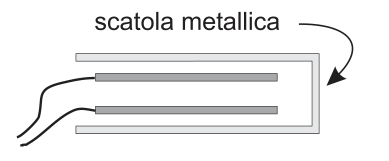 condensatore in scatola metallica
Topic: Electrostatics Metodi: Electric Potential Method, Gauss’s Law Competenze: Diagrammatic Reasoning, Mathematical Modeling Objects: Capacitor Fonte: Testo (PDF) — p.2 Soluzione: Soluzioni (PDF)
Q2 A capacitor with flat and parallel faces pF, has the armour 0.5 mm apart. It is placed in a box consisting of a conductor whose walls horizontal axes are 0.25 mm from the nearest armor. It forms so A new system. • Disregarding the effects on board, determining new capacity The system. Note: Assume that the system is empty.
*capacitor in metal box *
Topic: Electrostatics Metodi: Electric Potential Method, Gauss’s Law Competenze: Diagrammatic Reasoning, Mathematical Modeling Objects: Capacitor Fonte: Testo (PDF) — p.2 Soluzione: Soluzioni (PDF)
Q3 Una molla ha un’energia potenziale elastica di 12 J quando la sua lunghezza è 24.0 cm, e un’energia potenziale di 18 J quando è compressa di 5.0 cm rispetto alla sua lunghezza a riposo. • Tra le lunghezze a riposo della molla compatibili con i dati, determinare la minore.
Topic: Conservation of Energy Metodi: Hooke’s Law, Energy Conservation Method Competenze: Physical Reasoning, Mathematical Modeling Objects: Spring Fonte: Testo (PDF) — p.2 Soluzione: Soluzioni (PDF)
Q3 A spring has an elastic potential energy of 12 J when its length is 24.0 cm, and an energy of The maximum potential of 18 J when compressed by 5,0 cm compared to its length at rest. • Determine the minimum of the data-compatible resting lengths of the spring.
Topic: Conservation of Energy Metodi: Hooke’s Law, Energy Conservation Method Competenze: Physical Reasoning, Mathematical Modeling Objects: Spring Fonte: Testo (PDF) — p.2 Soluzione: Soluzioni (PDF)
Q4 Un laser a He-Ne emette una radiazione con una potenza di 1 mW alla lunghezza d’onda di 632.8 nm. • Quanti fotoni emette in 2.5 s?
Topic: Modern-Quantum Physics, Oscillations & Waves Metodi: Photon Energy Relation Competenze: Mathematical Modeling, Physical Reasoning Objects: Photon Fonte: Testo (PDF) — p.2 Soluzione: Soluzioni (PDF)
Q4 A He-Ne laser emits a radiation with a power of 1 mW at a wavelength of 632.8 nm. • How many photons does it emit in 2.5 seconds?
Topic: Modern-Quantum Physics, Oscillations & Waves Metodi: Photon Energy Relation Competenze: Mathematical Modeling, Physical Reasoning Objects: Photon Fonte: Testo (PDF) — p.2 Soluzione: Soluzioni (PDF)
Q5 Una mole di gas perfetto compie il ciclo termodinamico rappresentato in figura nel piano . • Calcolare il lavoro del ciclo sapendo che atm e K.
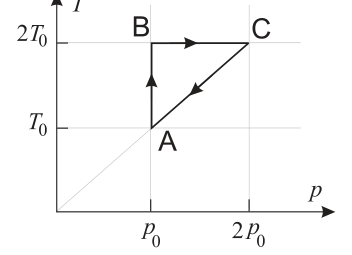 ciclo termodinamico piano T-p
Topic: Thermodynamics Metodi: Thermodynamic Cycle Analysis, Ideal Gas Law, First Law of Thermodynamics Competenze: Mathematical Modeling, Physical Reasoning Objects: Gas Fonte: Testo (PDF) — p.2 Soluzione: Soluzioni (PDF)
Q5 A perfect mole of gas completes the thermodynamic cycle as shown in the plane. • Calculate the cycle work by knowing that atm and K.
The following table shows the results of the calculations:
Topic: Thermodynamics Metodi: Thermodynamic Cycle Analysis, Ideal Gas Law, First Law of Thermodynamics Competenze: Mathematical Modeling, Physical Reasoning Objects: Gas Fonte: Testo (PDF) — p.2 Soluzione: Soluzioni (PDF)
Q6 Andrea abita vicino a un fiume che scorre con una velocità uniforme e costante di . Nel letto del fiume sono stati piantati quattro pali che formano i vertici di un quadrato, come in figura. Andrea può nuotare 100 m in un tempo minimo di 125 s e sa che il percorso in figura è lungo 40 m. Propone quindi ai suoi amici la seguente scommessa: “Scommetto che posso percorrere a nuoto il perimetro del quadrato in meno di un minuto.” • Prima di accettare la scommessa, gli amici determinano il tempo minimo che Andrea può impiegare per aggirare i pali. Che risultato trovano?
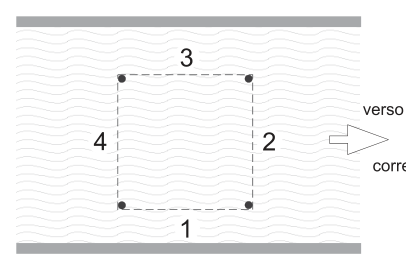 percorsi di nuoto nel fiume
Topic: Newtonian Mechanics Metodi: Vector Decomposition, Kinematic Equations Competenze: Physical Reasoning, Mathematical Modeling Objects: — Fonte: Testo (PDF) — p.3 Soluzione: Soluzioni (PDF)
Q6 Andrea lives by a river that flows with a uniform and constant speed of . Four were planted in the riverbed. poles forming the vertices of a square, as shown in Figure 1. Andrea can swim 100 m in a minimum of 125 seconds And you know that the path in the figure is 40 meters long. He then offers his friends the following bet: I can swim across the perimeter of the square less. One minute. • Before accepting the bet, friends determine the minimum time Andrea can spend on
- I’m going to get around the poles. What result do they find?
The following is a list of the waterways used for swimming in the river:
Topic: Newtonian Mechanics Metodi: Vector Decomposition, Kinematic Equations Competenze: Physical Reasoning, Mathematical Modeling Objects: — Fonte: Testo (PDF) — p.3 Soluzione: Soluzioni (PDF)
Q7 Un sistema è composto da un’asta rigida CE, di massa trascurabile, che può ruotare liberamente intorno a un fulcro D. All’estremo E è posto un corpo di massa m, mentre l’estremo C è collegato, tramite una catenella inestensibile di massa trascurabile, all’estremo B dell’asta AB. Anche l’asta AB è di massa trascurabile e a sua volta può ruotare liberamente intorno al suo estremo A. Tutto il sistema può muoversi su un piano verticale. Un secondo corpo di massa 3 m è posto sull’asta AB a distanza x da A in modo che il sistema risulti in equilibrio con entrambe le aste disposte orizzontalmente. • Sapendo che e , determinare x in funzione di m e .
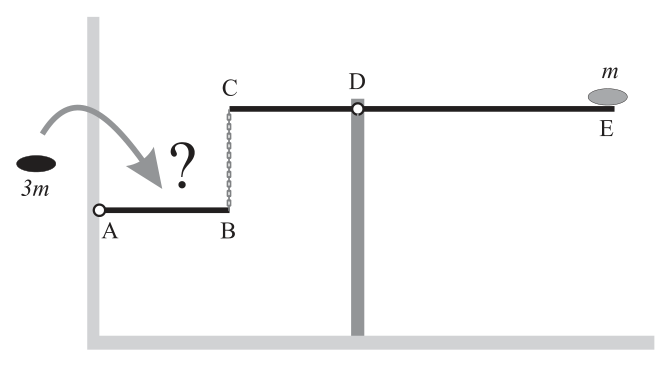 sistema di aste e corpi in equilibrio
Topic: Rigid Body Statics, Newtonian Mechanics Metodi: Torque & Angular Momentum Analysis, Free-Body Diagram Competenze: Diagrammatic Reasoning, Mathematical Modeling Objects: Rod, Lever, String Fonte: Testo (PDF) — p.3 Soluzione: Soluzioni (PDF)
Q7 A system consists of a rigid EC bar of negligible mass which can rotate freely around a D-spot. At the end of E is a mass m body, while at the end of C is connected, through an extensive chain of negligible mass at the B extreme of the AB axis. The AB is also massed The Commission has already taken the necessary steps to ensure that the To spin freely around his Extreme A. The whole system can move. It’s on a vertical plane. A second mass body 3 m is placed on the AB axis at a distance x from A so that the system The results are in balance with both. the auctions arranged horizontally. • Knowing that and , determine x in The function of m and .
balanced auction system and bodies
Topic: Rigid Body Statics, Newtonian Mechanics Metodi: Torque & Angular Momentum Analysis, Free-Body Diagram Competenze: Diagrammatic Reasoning, Mathematical Modeling Objects: Rod, Lever, String Fonte: Testo (PDF) — p.3 Soluzione: Soluzioni (PDF)
Q8 Un corpo di massa g è collegato a un altro corpo di massa M tramite una fune avvolta attorno a una carrucola. Si assuma che sia la fune che la carrucola siano di massa trascurabile. Si vuole che il sistema si muova senza che la fune si spezzi, qualunque sia il valore di . • Quale deve essere il minimo valore del carico di rottura della fune?
 corpo su pista curva con fune
Topic: Newtonian Mechanics Metodi: Free-Body Diagram, Kinematic Equations, Conservation Laws Competenze: Physical Reasoning, Mathematical Modeling Objects: Block, String, Pulley Fonte: Testo (PDF) — p.3 Soluzione: Soluzioni (PDF)
Q8 A mass body g is connected to another mass body M by means of a ropes wrapped around a carriage. Assuming both the rope and the wagon They are of negligible mass. The system is to be moved without the rope breaking, whatever the value of . • What is the minimum value of the rope breaking load?
body on curved track with ropes
Topic: Newtonian Mechanics Metodi: Free-Body Diagram, Kinematic Equations, Conservation Laws Competenze: Physical Reasoning, Mathematical Modeling Objects: Block, String, Pulley Fonte: Testo (PDF) — p.3 Soluzione: Soluzioni (PDF)
Q9 Si consideri un sistema formato da un recipiente di capacità termica trascurabile e isolato termicamente che contiene 10 litri di acqua continuamente agitata da un’elica collegata a un motorino elettrico esterno che eroga una potenza W. • Determinare la variazione di energia interna dell’acqua in un intervallo min .
Topic: Thermodynamics, Conservation of Energy Metodi: First Law of Thermodynamics, Energy Conservation Method Competenze: Physical Reasoning, Mathematical Modeling Objects: Container Fonte: Testo (PDF) — p.3 Soluzione: Soluzioni (PDF)
Q9 It is considered a system consisting of a negligible heat capacity vessel and thermal insulation Containing 10 litres of water continuously agitated by a propeller connected to an electric motor an external power output of W. • Determine the change in water internal energy in a range min.
Topic: Thermodynamics, Conservation of Energy Metodi: First Law of Thermodynamics, Energy Conservation Method Competenze: Physical Reasoning, Mathematical Modeling Objects: Container Fonte: Testo (PDF) — p.3 Soluzione: Soluzioni (PDF)
Q10 Tre resistori A, B e C hanno rispettivamente resistenza , , . La serie formata dai resistori B e C è collegata in parallelo sia con A che con un generatore elettrico di f.e.m. V e resistenza interna trascurabile. • Determinare il rapporto tra le potenze dissipate nei resistori A e C.
Topic: Circuits Metodi: Kirchhoff’s Laws, Equivalent Circuit Reduction Competenze: Mathematical Modeling, Diagrammatic Reasoning Objects: Resistor, Battery Fonte: Testo (PDF) — p.3 Soluzione: Soluzioni (PDF)
Q10 Three resistors A, B and C have resistance , and respectively. The series It is connected in parallel with both A and an electrical generator of f.e.m. V and negligible internal resistance. • Determine the ratio of the dissipation forces in resistors A and C.
Topic: Circuits Metodi: Kirchhoff’s Laws, Equivalent Circuit Reduction Competenze: Mathematical Modeling, Diagrammatic Reasoning Objects: Resistor, Battery Fonte: Testo (PDF) — p.3 Soluzione: Soluzioni (PDF)
P1 Tiro al bersaglio Punti 20 Una sferetta di massa m è appesa, ferma, a un filo di massa trascurabile la cui altra estremità è tenuta fissa nel punto O. In tutto il problema si trascuri il raggio della sferetta e ogni forma di attrito. Alla sferetta viene impressa istantaneamente una velocità iniziale orizzontale di modulo , cosicche ́ essa inizia a muoversi nel piano verticale. Per piccoli valori di il filo resta sempre teso e la pallina compie delle oscillazioni lungo un arco di circonferenza di raggio R pari alla lunghezza del filo (pendolo semplice); l’ampiezza delle oscillazioni è funzione crescente di , ma all’aumentare del valore di può succedere che la tensione si annulli, cosicche ́ la pallina si stacca dalla traiettoria circolare e inizia un moto parabolico.
- Si trovi per quali valori di la tensione del filo può annullarsi. Un bersaglio puntiforme è posto in un punto A, sulla verticale di O, a distanza R da questo. Quando il filo è ancora in tensione e forma un angolo prefissato con la verticale, un dispositivo brucia istantaneamente il filo. Sia il valore dell’energia cinetica iniziale della sferetta nel punto più basso della circonferenza e si chiami l’angolo tra il filo e l’orizzontale, per cui .
- Sia il limite inferiore dell’energia cinetica iniziale per cui il filo è ancora teso quando la sferetta raggiunge la posizione in cui il filo viene bruciato: si determini in funzione di . Il bersaglio in A può essere raggiunto bruciando il filo a un qualunque angolo , oppure muovendosi sempre lungo la circonferenza.
- Detta la velocità della sferetta nel momento in cui il filo viene bruciato, si determini il valore di per cui il bersaglio viene colpito. Si esprima il risultato in termini di , R e g. Si fissi adesso il punto in cui il filo viene bruciato, ponendo .
- Si calcoli l’energia cinetica iniziale necessaria per colpire il bersaglio, e si verifichi che il filo resta teso fino alla sua bruciatura. Si verifichi inoltre che l’energia cinetica richiesta per raggiungere A bruciando il filo è minore di quella richiesta muovendosi lungo la circonferenza, indicata con .
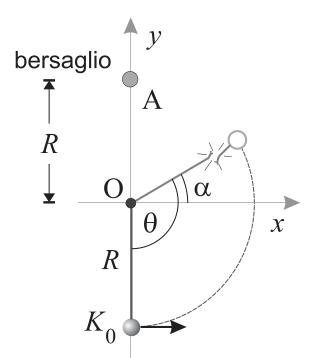 pendolo sferico e bersaglio circolare
Topic: Newtonian Mechanics, Conservation of Energy Metodi: Free-Body Diagram, Energy Conservation Method, Kinematic Equations Competenze: Mathematical Modeling, Physical Reasoning, Diagrammatic Reasoning Objects: Pendulum, String, Ball, Projectile Fonte: Testo (PDF) — p.8 Soluzione: Soluzioni (PDF)
P1 Shoot the target The Commission shall adopt implementing acts in accordance with Article 21 of this Regulation. A sphere of mass m is suspended, fixed, from a thread of negligible mass whose other end is held fixed at O. The whole problem is to neglect the radius of the sphere and any form of friction. The sphere is instantly printed a horizontal initial speed of the form , so that it starts at move in the vertical plane. For small values of the wire is always stretched and the ball oscillates The length of the wire length (simple pendulum) is equal to an arc of radius R of circumference; the width of the wire lengths oscillations is a function of increasing, but as the value of increases, the voltage may be cancelled, So the ball breaks off the circular trajectory and starts a parabolic motion.
- Find out what values of the wire voltage can be cancelled for. A pointed target is placed at a point A, on the vertical of O, at distance R from this. When the wire is still tense and forms a fixed angle with the vertical, a device burns instantly The wire. Whether the value of the initial kinetic energy of the sphere at the most The angle between the wire and the horizontal is where is used.
- Whether the lower limit of the initial kinetic energy for which the wire is still stretched when the sphere reaches the position where the wire comes burned: is determined by . The target in A can be reached by burning the wire to any angle , or always moving along the circumference.
- The speed of the sphere at the time the wire is burned is given by , the value of is determined for The target is hit. The result is expressed in terms of , R and g. Now you fix the point where the wire is burned, and you put .
- The initial kinetic energy needed to hit the target is calculated and the wire remains stretched until the target is reached. to his burning. It is also necessary to check that the kinetic energy required to reach A by burning the wire is less than that required by moving along the circumference, indicated by .
spherical pendulum and circular target
Topic: Newtonian Mechanics, Conservation of Energy Metodi: Free-Body Diagram, Energy Conservation Method, Kinematic Equations Competenze: Mathematical Modeling, Physical Reasoning, Diagrammatic Reasoning Objects: Pendulum, String, Ball, Projectile Fonte: Testo (PDF) — p.8 Soluzione: Soluzioni (PDF)
P2 Cinque lampadine Punti 15 Il circuito in figura è composto da cinque lampadine a incandescenza identiche e una pila da 12 V di resistenza interna trascurabile. Ognuna di queste lampadine funziona in modo regolare se ad essa è applicata una d.d.p. di 6 V ed è attraversata da una corrente elettrica di 0.3 A. In questo regime la luminosità è considerata normale. Per una d.d.p. inferiore al valore normale di funzionamento la lampadina si illumina debolmente. Viceversa per d.d.p. comprese tra 6 e 8.5 V la luminosità aumenta progressivamente, ma la lampadina non si brucia; infine per d.d.p. superiori a 8.5 V si ha un surriscaldamento quasi immediato, con un flash molto intenso e il filamento si brucia. Si vuol diminuire il numero di lampadine accese minimizzando la variazione della luminosità complessiva del sistema. Si supponga di eliminare una lampadina scelta a caso.
- Studiando il funzionamento del circuito elettrico, determinare in modo qualitativo come è variata la luminosità delle altre lampadine. Quale lampadina bisognerebbe rimuovere per introdurre il minore cambiamento nella luminosità delle altre lampadine?
- Si supponga ora di sostituire a una qualsiasi lampadina un pezzettino di filo di resistenza trascurabile. Si stabilisca l’effetto di questa operazione sulla luminosità delle altre lampadine.
- Cosa succederebbe alla luminosità delle altre lampadine, se ne venissero eliminate due a caso? Si consideri uno soltanto – a scelta – tra tutti i casi possibili, indicando quali lampadine si sono tolte.
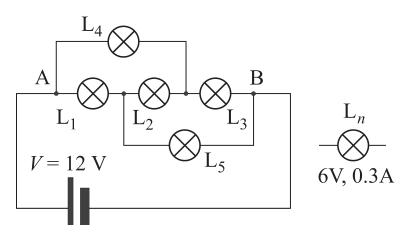 circuito con cinque lampadine
Topic: Circuits Metodi: Kirchhoff’s Laws, Equivalent Circuit Reduction Competenze: Physical Reasoning, Diagrammatic Reasoning, Mathematical Modeling Objects: Battery, Wire Fonte: Testo (PDF) — p.9 Soluzione: Soluzioni (PDF)
P2 Five lamps The Commission shall adopt implementing acts in accordance with Article 15 of this Regulation. The circuit in the figure consists of five identical incandescent lamps and a 12 V battery of The internal resistance is negligible. Each of these bulbs works normally if a D.D.P. is applied to it. 6 V and is crossed by a Electric current of 0.3 A. In this regime the brightness is It’s considered normal. For a D.D.P. less than normal operating value The light bulb is dimly lit. The conversion of D.D.P. The lighting is increased gradually, but the lamp is not The Commission has already adopted a number of proposals for a new directive on the protection of workers’ rights. If the temperature is above 8.5 V, you have an almost immediate overheating, with a very intense flash. And the filament burns. The aim is to reduce the number of lamps lit by minimising the overall variation in brightness of the light source. The system. Suppose you’re deleting a randomly chosen light bulb.
- By studying the operation of the electrical circuit, determine qualitatively how the brightness of the other lamps has varied. What light bulb should be removed to introduce the slightest change In the brightness of the other bulbs?
- Now suppose you replace any light bulb with a tiny piece of resistant wire. Si The lighting system shall be used to determine the effect of this operation on the brightness of the other lamps.
- What would happen to the brightness of the other bulbs if two were to be knocked out at random? Consider yourself Only one optional in all possible cases, indicating which lamps have been removed.
five-lamp circuit
Topic: Circuits Metodi: Kirchhoff’s Laws, Equivalent Circuit Reduction Competenze: Physical Reasoning, Diagrammatic Reasoning, Mathematical Modeling Objects: Battery, Wire Fonte: Testo (PDF) — p.9 Soluzione: Soluzioni (PDF)
P3 Due fratelli allo specchio Punti 13 In un museo della Scienza, Alberto e la sua sorellina piccola Bianca stanno guardando uno strano doppio specchio – grande, curvo e semitrasparente (∗) da entrambi i lati – ottenuto lucidando le due facce di una porzione di superficie sferica di 10 m di raggio. Quando i due fratelli si trovano il primo da una parte dello specchio e la seconda dalla parte opposta, sull’asse di questo, a 6 m di distanza uno dall’altro, Alberto osserva una curiosa coincidenza: la sua immagine, data dallo specchio curvo, è dritta e coincide in posizione e dimensione con la figura della sorellina Bianca che intravede attraverso lo specchio.
- Chi dei due sta dalla parte concava dello specchio?
- A quali distanze dallo specchio si trovano i due fratelli?
- Se Alberto è alto 180 cm, quanto è alta Bianca?
- Che cosa può osservare Bianca guardando verso il fratello?
- Ci sono altre posizioni in cui si realizza la stessa coincidenza? —————— (∗) Si possono quindi vedere contemporaneamente le immagini riflesse dallo specchio e quello che sta dietro lo specchio.
 specchio concavo e convesso
Topic: Geometric Optics Metodi: Thin Lens & Mirror Equation, Ray Tracing Competenze: Diagrammatic Reasoning, Mathematical Modeling, Physical Reasoning Objects: Mirror Fonte: Testo (PDF) — p.9 Soluzione: Soluzioni (PDF)
P3 Two Brothers in the Mirror The Commission shall adopt implementing acts in accordance with Article 13 (1) of this Regulation. In a science museum, Alberto and his little sister Bianca are standing Looking at a strange double mirror. Big, curved and half-transparent. () on both sides obtained by polishing the two faces of a portion of the surface a sphere with a radius of 10 m. When the two brothers are on one side of the mirror and the other side of the mirror on the opposite side, on the axis of this, 6 m apart, Albert He observes a curious coincidence: his image, given by the curved mirror, is straight. And it matches the position and size of the little white sister who is looking through. through the mirror.
- Which one of you is on the concave side of the mirror?
- How far from the mirror are the two brothers?
- If Alberto is 6’8”, how tall is Bianca?
- What can Bianca observe as she looks at her brother?
- Are there other positions where the same coincidence is realized? —————— (∗) Thus, the mirror reflected images can be seen at the same time as the image behind the mirror.
- concave and convex mirror*
Topic: Geometric Optics Metodi: Thin Lens & Mirror Equation, Ray Tracing Competenze: Diagrammatic Reasoning, Mathematical Modeling, Physical Reasoning Objects: Mirror Fonte: Testo (PDF) — p.9 Soluzione: Soluzioni (PDF)
P4 Disco di Vinile Punti 12 Prima dell’avvento delle registrazioni digitali (diffusione in streaming o su DVD) la musica si ascoltava alla radio o con un giradischi su cui si montano dischi di vinile, tornati adesso di moda. Un disco microsolco Long Playing (LP) di vinile ha un diametro di 12” pari a 304.8 mm, deve ruotare alla velocità di 100 giri in 3 minuti e riproduce musica per 30 minuti. Questa è registrata su un solco, cioè un’incisione microscopica che si sviluppa a spirale dall’esterno verso il centro del disco; questa struttura può essere semplificata approssimandola a una successione di circonferenze equispaziate. Nella versione più semplice di un solo canale audio, ogni solco circolare è modulato con oscillazioni radiali, la cui ampiezza massima è dell’ordine di 1/3 della distanza tra due solchi contigui; le oscillazioni radiali riproducono fedelmente quelle del segnale acustico. La parte relativa all’incisione musicale è facilmente riconoscibile nella foto e inizia dopo i primi 5 solchi, più distanziati, che servono a guidare inizialmente la puntina, le cui vibrazioni radiali vengono trasdotte in un segnale elettrico e successivamente riprodotte in suono dalle casse acustiche.
- Stimare, utilizzando la foto, la larghezza della corona circolare incisa, la distanza media tra un solco e il successivo e la lunghezza totale dell’incisione. Si faccia ora riferimento a un solco nella parte centrale della registrazione, avente un raggio mm; per qualche secondo viene riprodotta la nota La che ha una frequenza di Hz.
- Si determini, in millimetri, la lunghezza d’onda della sinusoide incisa sul disco lungo il solco considerato.
- Stimare, in unità di g, l’accelerazione massima della puntina mentre viene riprodotta questa nota.
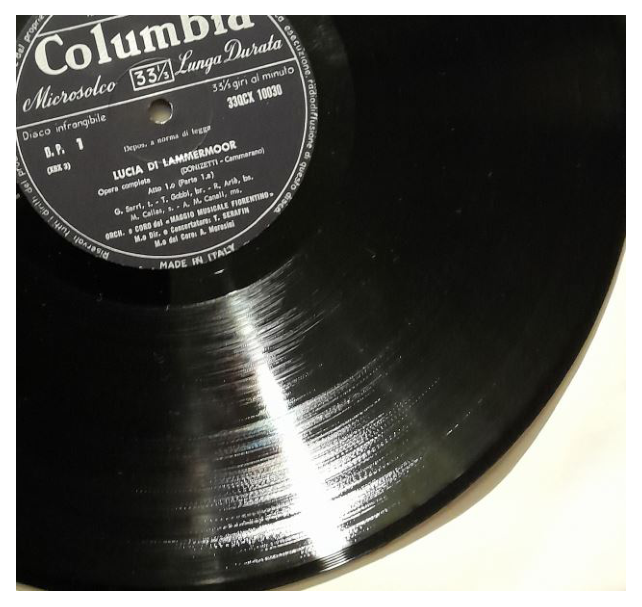 foto disco vinile e solchi microscopio
Topic: Oscillations & Waves, Newtonian Mechanics Metodi: Simple Harmonic Motion Analysis, Kinematic Equations Competenze: Estimation & Approximation, Mathematical Modeling, Physical Reasoning Objects: Disk Fonte: Testo (PDF) — p.10 Soluzione: Soluzioni (PDF)
P4 Vinyl record The Commission shall adopt implementing acts in accordance with Article 12 of this Regulation. Before the advent of digital recordings (streaming or DVD) music was heard on the radio or with a Other, of a width of not more than 600 mm vinyl, come back in style now. A micro-solar long-playing vinyl LP has a diameter of 12 equal to 304.8 mm, shall rotate It’s 100 rounds in three minutes and it plays music for 30 minutes. This is recorded on a track, This is a microscopic incision that is It develops in a spiral from the outside towards the the center of the disk; this structure It can be simplified by approximating it to a succession of equally spaced circumferences. In the simplest version of a only audio channels, each circular track is modulated by radial oscillations, a width of not more than 1/3 of the distance between two straps Contiguous; radial oscillations faithfully reproduce those of the signal I’m not going to do it. The part relating to the musical incision is easily recognizable in the photo and begins after the first 5 steps, The radial vibrations are transferred to a electrical signal and then reproduced in sound by the sound recording equipment.
- Estimate, using the photo, the width of the circular crown engraved, the average distance between a trunk and the The following is the total length of the engraving. Refer now to a groove in the central part of the record, with a radius mm; for A few seconds later the note La is played, which has a frequency of Hz.
- The wavelength of the sinusoid, engraved on the disc along the groove in question, shall be determined in millimetres.
- Estimate, in units of g, the maximum acceleration of the dot while this note is played.
Vinyl disc photo and microscope solches
Topic: Oscillations & Waves, Newtonian Mechanics Metodi: Simple Harmonic Motion Analysis, Kinematic Equations Competenze: Estimation & Approximation, Mathematical Modeling, Physical Reasoning Objects: Disk Fonte: Testo (PDF) — p.10 Soluzione: Soluzioni (PDF)