Un’automobile che comincia ad accelerare uniformemente copre, nei primi 4 s, una distanza pari a 32 m e nei successivi 4 s un’ulteriore distanza di 56 m.
- Qual era la velocità iniziale dell’automobile?
Topic: Newtonian Mechanics Metodi: Kinematic Equations Competenze: Physical Reasoning Objects: — Fonte: Testo (PDF) — p.3 Soluzione: Soluzioni (PDF)
A car that starts accelerating evenly covers a distance of 32 m in the first 4 seconds and an additional 56 m in the next 4 seconds.
What was the car’s initial speed?
Topic: Newtonian Mechanics Metodi: Kinematic Equations Competenze: Physical Reasoning Objects: — Fonte: Testo (PDF) — p.3 Soluzione: Soluzioni (PDF)
Due moli di He, in un recipiente, hanno una temperatura di 100°C e subiscono una trasformazione nella quale assorbono J di calore. Al termine la temperatura del gas è di 1000°C.
- Determinare l’eventuale scambio di energia avvenuto sotto forma di lavoro meccanico.
Topic: Thermodynamics Metodi: First Law of Thermodynamics, Ideal Gas Law Competenze: Physical Reasoning Objects: Gas, Container Fonte: Testo (PDF) — p.3 Soluzione: Soluzioni (PDF)
Two He mills in a container have a temperature of 100°C and undergo a transformation in which they absorb J of heat. The gas temperature at the end is 1000°C.
- Determine the possible exchange of energy in the form of mechanical work.
Topic: Thermodynamics Metodi: First Law of Thermodynamics, Ideal Gas Law Competenze: Physical Reasoning Objects: Gas, Container Fonte: Testo (PDF) — p.3 Soluzione: Soluzioni (PDF)
Un carrellino pieno di sabbia avente massa complessiva di 20 kg si muove verso sinistra lungo un piano orizzontale senza attrito alla velocità di . Una palla di massa 1 kg, mentre si muove orizzontalmente verso destra a , colpisce il carrellino e resta conficcata nella sabbia.
- Determinare il modulo e il verso della velocità del sistema dopo l’urto.
 Ball hitting sandbox cart collision diagram
Topic: Conservation of Momentum, Newtonian Mechanics Metodi: Conservation of Momentum Competenze: Physical Reasoning Objects: Cart, Ball Fonte: Testo (PDF) — p.4 Soluzione: Soluzioni (PDF)
A sand-filled trailer with an overall mass of 20 kg moves to the left along a horizontal plane without friction at . A ball weighing 1 kg, while moving horizontally to the right at , hits the cart and remains stuck in the sand.
Determine the mode and direction of the system’s velocity after impact.
The following table shows the results of the tests:
Topic: Conservation of Momentum, Newtonian Mechanics Metodi: Conservation of Momentum Competenze: Physical Reasoning Objects: Cart, Ball Fonte: Testo (PDF) — p.4 Soluzione: Soluzioni (PDF)
Fra due elettrodi è mantenuta una differenza di potenziale . I due elettrodi sono posti nel vuoto e da quello a potenziale minore sono emessi, a velocità trascurabile, elettroni al secondo.
Tutti gli elettroni sono catturati dal secondo elettrodo — costituito da una piastrina di alluminio avente una massa di — provocandone un aumento di temperatura.
- Trascurando ogni perdita di calore, dopo quanto tempo la temperatura dell’elettrodo di alluminio sarà aumentata di 100°C?
Calore specifico dell’alluminio: .
Topic: Electrostatics, Thermodynamics Metodi: Energy Conservation Method, Electric Potential Method Competenze: Physical Reasoning, Mathematical Modeling Objects: Electron Fonte: Testo (PDF) — p.4 Soluzione: Soluzioni (PDF)
A potential difference of between two electrodes is maintained. The two electrodes are placed in the vacuum and the lower-potential one emits, at negligible speed, electrons per second.
All electrons are captured by the second electrode consisting of an aluminium plate with a mass of causing an increase in temperature.
- If heat loss is neglected, how long after will the temperature of the aluminium electrode rise by 100°C?
Calore specifico dell’alluminio: .
Topic: Electrostatics, Thermodynamics Metodi: Energy Conservation Method, Electric Potential Method Competenze: Physical Reasoning, Mathematical Modeling Objects: Electron Fonte: Testo (PDF) — p.4 Soluzione: Soluzioni (PDF)
Una mole di gas perfetto subisce la trasformazione in figura passando dallo stato 1 allo stato 2.
- Determinare la temperatura massima raggiunta dal gas durante il processo.
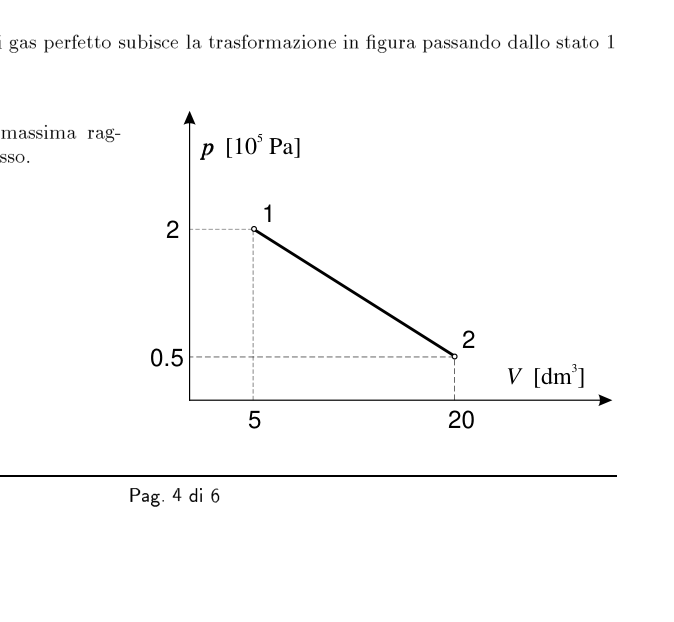 p-V diagram linear process state 1 to 2
Topic: Thermodynamics Metodi: Ideal Gas Law, Thermodynamic Cycle Analysis Competenze: Physical Reasoning, Mathematical Modeling Objects: Gas Fonte: Testo (PDF) — p.4 Soluzione: Soluzioni (PDF)
A perfect mole of gas is transformed into a figure by moving from state 1 to state 2.
- Determine the maximum temperature reached by the gas during the process.
The following table shows the results of the calculation of the total number of samples.
Topic: Thermodynamics Metodi: Ideal Gas Law, Thermodynamic Cycle Analysis Competenze: Physical Reasoning, Mathematical Modeling Objects: Gas Fonte: Testo (PDF) — p.4 Soluzione: Soluzioni (PDF)
Un filo rettilineo molto lungo è carico elettricamente e la sua densità di carica è uniforme. Una sferetta di massa e carica è sospesa ad un filo di lunghezza come indicato in figura.
- Sapendo che l’angolo del filo di sospensione con la verticale è , determinare la densità di carica sul filo rettilineo.
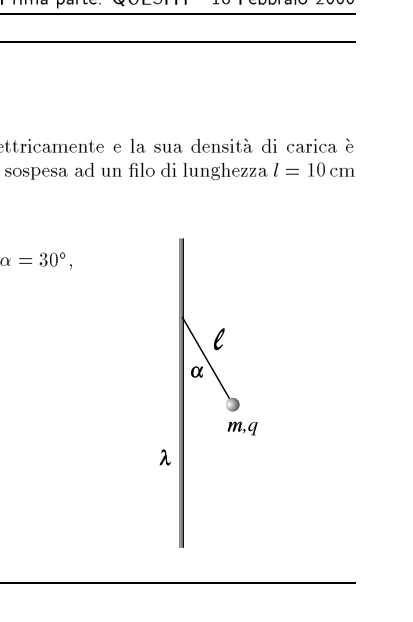 Charged sphere suspended near long wire
Topic: Electrostatics Metodi: Gauss’s Law, Free-Body Diagram Competenze: Physical Reasoning, Mathematical Modeling Objects: Wire, Sphere, String Fonte: Testo (PDF) — p.5 Soluzione: Soluzioni (PDF)
A very long straight wire is electrically charged and its charge density is uniform. A sphere of mass and load shall be suspended from a length of wire as shown in Figure 1.
- Knowing that the angle of the suspension wire with the vertical is , determine the load density on the straight wire.
Charged sphere suspended near long wire
Topic: Electrostatics Metodi: Gauss’s Law, Free-Body Diagram Competenze: Physical Reasoning, Mathematical Modeling Objects: Wire, Sphere, String Fonte: Testo (PDF) — p.5 Soluzione: Soluzioni (PDF)
Un osservatore vede riflessi in uno specchio piano gli oggetti A e B; la situazione vista dall’alto è rappresentata in figura.
- Dopo aver riprodotto la figura, segnare su quella almeno un punto P dal quale l’osservatore vede allineate le immagini degli oggetti e indicare in quali regioni deve mettersi l’osservatore per vedere A a destra di B oppure B a destra di A, mediante una costruzione geometrica brevemente commentata.
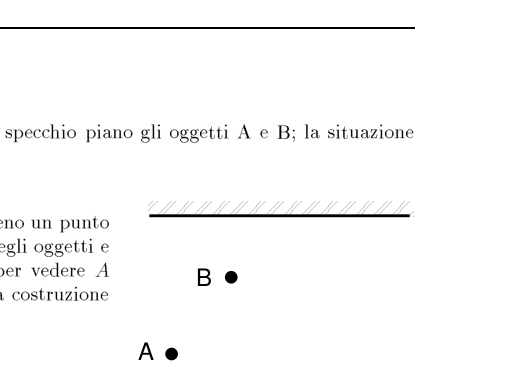 Top-view mirror with objects A and B
Topic: Geometric Optics Metodi: Ray Tracing Competenze: Diagrammatic Reasoning, Physical Reasoning Objects: Mirror Fonte: Testo (PDF) — p.5 Soluzione: Soluzioni (PDF)
An observer sees objects A and B reflected in a flat mirror; the situation seen from above is represented in the figure.
- After reproducing the figure, mark on it at least one point P from which the observer sees the images of the objects aligned and indicate which regions the observer must place himself to see A to the right of B or B to the right of A, using a briefly commented geometric construction.
Top-view mirror with objects A and B
Topic: Geometric Optics Metodi: Ray Tracing Competenze: Diagrammatic Reasoning, Physical Reasoning Objects: Mirror Fonte: Testo (PDF) — p.5 Soluzione: Soluzioni (PDF)
Un corpo viene lasciato da fermo nel punto A di uno scivolo piano che termina con un tratto orizzontale; il corpo si ferma nel punto B. Il percorso non è liscio e il coefficiente di attrito, , è lo stesso in ogni punto.
- Determinare, in funzione dei dati indicati in figura, il coefficiente di attrito.
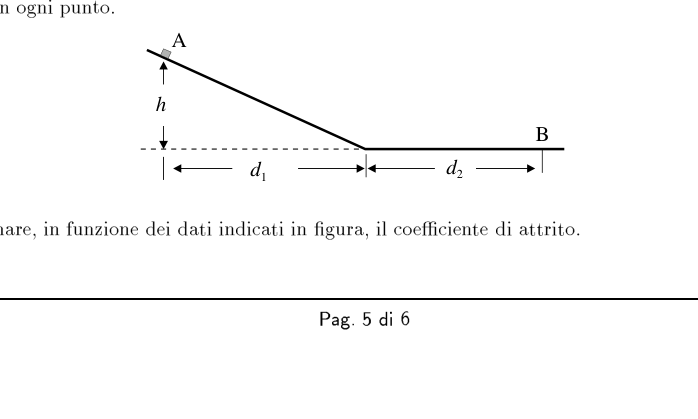 Inclined plane with horizontal stop, h, d1, d2
Topic: Newtonian Mechanics, Conservation of Energy Metodi: Energy Conservation Method, Free-Body Diagram Competenze: Physical Reasoning, Mathematical Modeling Objects: Inclined Plane, Block Fonte: Testo (PDF) — p.5 Soluzione: Soluzioni (PDF)
A body is left standing at point A of a flat slide ending in a horizontal stroke; the body stops at point B. The path is not smooth and the friction coefficient, , is the same at each point.
- Determine the friction coefficient, based on the data shown in the figure.
The following table shows the following characteristics:
Topic: Newtonian Mechanics, Conservation of Energy Metodi: Energy Conservation Method, Free-Body Diagram Competenze: Physical Reasoning, Mathematical Modeling Objects: Inclined Plane, Block Fonte: Testo (PDF) — p.5 Soluzione: Soluzioni (PDF)
Un voltmetro con resistenza interna è usato per misurare . Se , si legge sul voltmetro una d.d.p. di 6 V.
- Quanto vale in assenza del voltmetro?
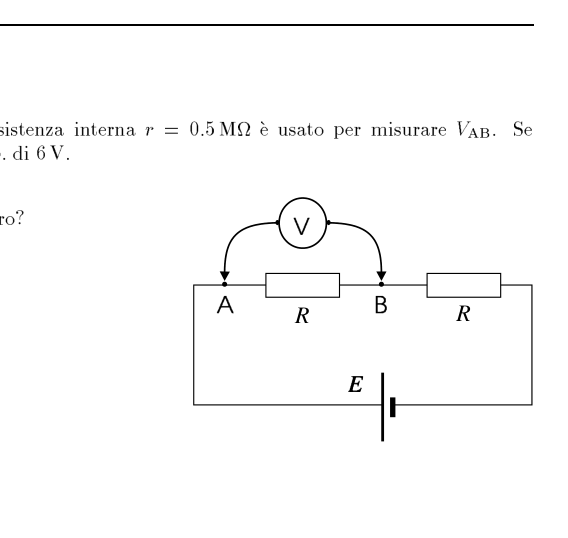 Circuit with voltmeter across AB, two R and battery E
Topic: Circuits Metodi: Kirchhoff’s Laws, Equivalent Circuit Reduction Competenze: Physical Reasoning, Mathematical Modeling Objects: Galvanometer, Resistor, Battery Fonte: Testo (PDF) — p.6 Soluzione: Soluzioni (PDF)
A voltmeter with internal resistance is used to measure . If , the voltmeter is read as a d.d.p. di 6 V.
- Quanto vale in assenza del voltmetro?
Circuit with voltmeter across AB, two R and battery E
Topic: Circuits Metodi: Kirchhoff’s Laws, Equivalent Circuit Reduction Competenze: Physical Reasoning, Mathematical Modeling Objects: Galvanometer, Resistor, Battery Fonte: Testo (PDF) — p.6 Soluzione: Soluzioni (PDF)
La figura mostra un’automobile che affronta una curva; la distanza tra le ruote posteriori è e la traiettoria circolare descritta dalla ruota A ha raggio .
Si indichi con la velocità angolare della ruota A e con quella della ruota B.
- Determinare, nell’ipotesi di rotolamento puro, la variazione relativa tra le due velocità angolari definita come .
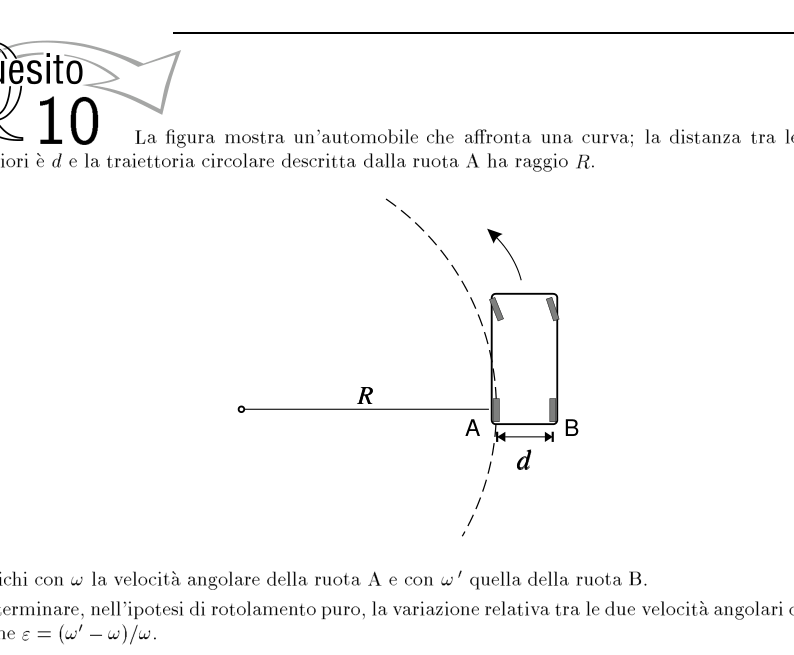 Car turning curve, wheels A and B, radii R and R+d
Topic: Rotational Dynamics, Newtonian Mechanics Metodi: Kinematic Equations, Torque & Angular Momentum Analysis Competenze: Physical Reasoning, Mathematical Modeling Objects: Wheel Fonte: Testo (PDF) — p.6 Soluzione: Soluzioni (PDF)
The figure shows a car facing a curve; the distance between the rear wheels is and the circular trajectory described by wheel A has a radius .
The angular speed of wheel A shall be and the angular speed of wheel B shall be .
- Determine, in the pure rolling hypothesis, the relative variation between the two angular speeds defined as .
Car turning curves, wheels A and B, radii R and R+d
Topic: Rotational Dynamics, Newtonian Mechanics Metodi: Kinematic Equations, Torque & Angular Momentum Analysis Competenze: Physical Reasoning, Mathematical Modeling Objects: Wheel Fonte: Testo (PDF) — p.6 Soluzione: Soluzioni (PDF)
Macchina di Atwood
Due sferette di massa rispettivamente ed sono appese alle estremità opposte di un lungo filo che può scorrere attorno a due carrucole fisse; filo e carrucole hanno massa trascurabile. Sulla sferetta è appoggiato un anello di massa , infilato nel filo. Il dispositivo è costruito in modo che, quando il filo scorre:
- se si alza sopra la linea di riferimento porta su anche l’anello come in fig. 2;
- se va più in basso della stessa linea l’anello resta appoggiato ad un apposito sostegno (la superficie inferiore dell’anello permette urti totalmente anelastici) come in fig. 3.
Rispetto alla posizione di equilibrio mostrata in fig. 1, che coincide con la linea di riferimento, il filo inizialmente viene tirato in modo che si abbassi per una lunghezza ; poi il tutto viene rilasciato. Si chiede di studiare il moto del sistema rispetto alla linea di riferimento (). In particolare si chiede di:
- Calcolare il modulo dell’accelerazione di quando è più in alto di e viceversa (tali moduli verranno chiamati rispettivamente e ).
- Calcolare l’istante nel quale cade per la prima volta sul sostegno e la velocità posseduta in quell’istante.
- Calcolare la variazione di energia meccanica del sistema in seguito all’arresto di .
- Calcolare l’istante in cui si trova nel punto più basso e quello in cui e sono di nuovo in contatto.
- Disegnare i diagrammi della posizione e della velocità di fino all’istante .
Dati numerici: ; ; ; ; .
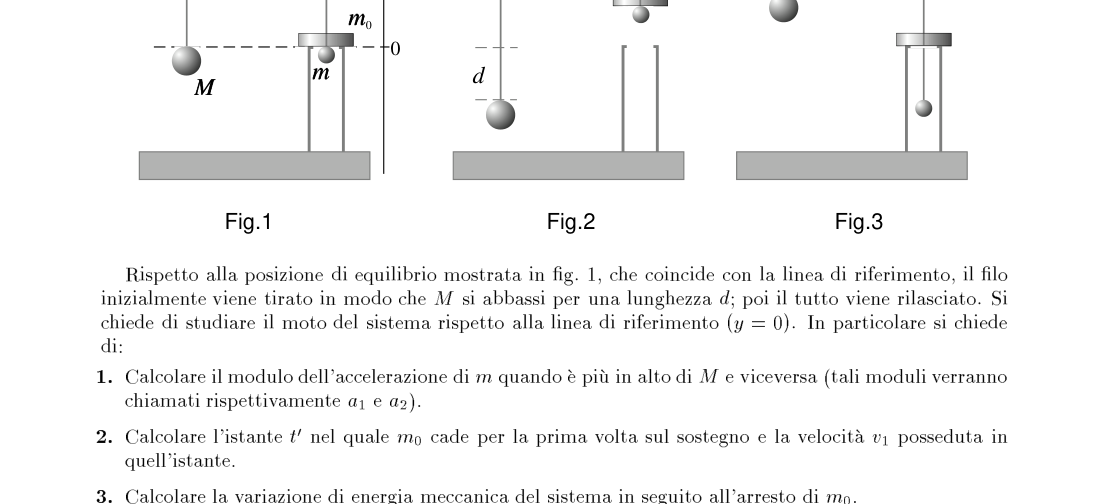 Atwood machine three configurations Fig.1 Fig.2 Fig.3
Topic: Newtonian Mechanics, Conservation of Energy, Conservation of Momentum Metodi: Free-Body Diagram, Kinematic Equations, Conservation of Energy, Impulse-Momentum Theorem Competenze: Physical Reasoning, Mathematical Modeling Objects: Pulley, String Fonte: Testo (PDF) — p.8 Soluzione: Soluzioni (PDF)
Macchina di Atwood
Two spheres of mass and respectively are suspended at the opposite ends of a long wire that can run around two fixed cartridges; wire and cartridges have negligible mass. A ring of mass is supported on the sphere, inserted into the wire. The device is constructed so that when the wire is running:
- if is raised above the reference line, the ring is also lifted as shown in Fig. 2;
- if goes further down the same line the ring remains supported to a specific support (the lower surface of the ring allows totally anelastic impact) as shown in Fig. 3.
Compared to the equilibrium position shown in Fig. 1, which coincides with the reference line, the wire is initially pulled so that drops down a length ; then the whole is released. The motion of the system with respect to the reference line () is requested. In particular, it is asked to:
- Calculate the acceleration module of when higher than and vice versa (these modules will be called and respectively).
- Calculate the instant in which falls on the support for the first time and the speed possessed at that instant.
- Calculate the change in mechanical energy of the system following the stop of .
- Calculate the moment where is at the lowest point and where and are again in contact.
- Draw diagrams of the position and speed of up to the instant .
Dati numerici: ; ; ; ; .
Atwood machine three configurations Fig.1 Fig.2 Fig.3
Topic: Newtonian Mechanics, Conservation of Energy, Conservation of Momentum Metodi: Free-Body Diagram, Kinematic Equations, Conservation of Energy, Impulse-Momentum Theorem Competenze: Physical Reasoning, Mathematical Modeling Objects: Pulley, String Fonte: Testo (PDF) — p.8 Soluzione: Soluzioni (PDF)
Un filo a piombo… laser
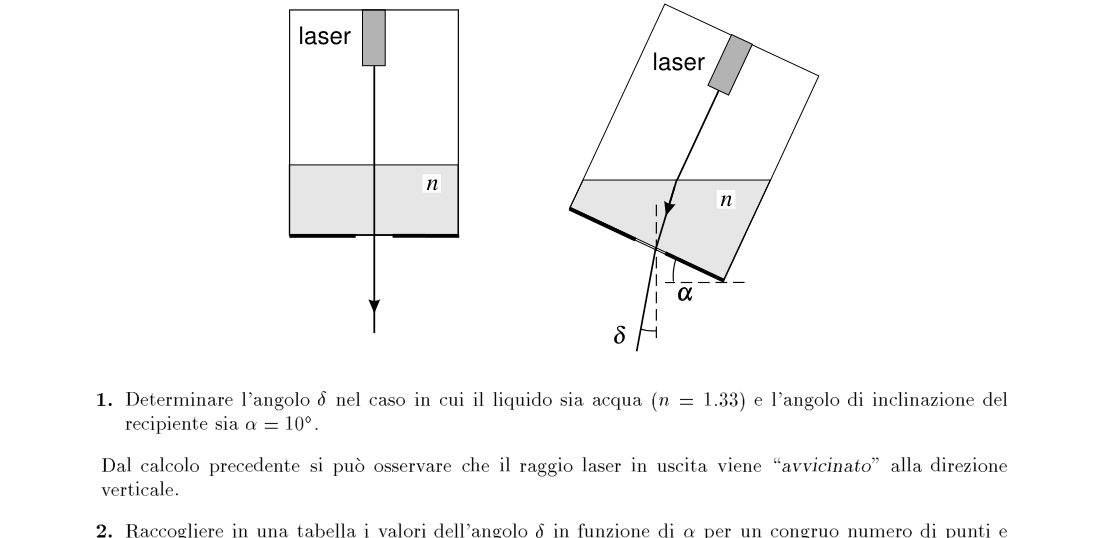
Un recipiente, con il fondo trasparente e di spessore trascurabile, contiene un liquido con indice di rifrazione . Nella sua parte superiore è fissato un piccolo laser, come mostrato in figura a sinistra.
Si osserva che quando si varia l’angolo di inclinazione del recipiente, il raggio che emerge dal fondo forma un angolo con la verticale, come nella figura a destra.
- Determinare l’angolo nel caso in cui il liquido sia acqua () e l’angolo di inclinazione del recipiente sia .
Dal calcolo precedente si può osservare che il raggio laser in uscita viene “avvicinato” alla direzione verticale.
- Raccogliere in una tabella i valori dell’angolo in funzione di per un congruo numero di punti e rappresentarli in un grafico. Mostrare poi che per piccoli valori dell’angolo di inclinazione vale la relazione approssimata con ; determinare il valore numerico di , sempre nel caso che il liquido sia acqua.
- Sempre nell’ipotesi di piccoli angoli di inclinazione, si può verificare che esiste un particolare valore dell’indice di rifrazione per il quale è approssimativamente nullo, indipendentemente da . In questa condizione il raggio laser in uscita indicherebbe (con buona approssimazione) la direzione verticale anche per piccole inclinazioni del dispositivo che, come tale, potrebbe essere utilizzato come un “filo a piombo”. Determinare il particolare valore di .
Nota. Può essere utile ricordare che se (essendo espresso in radianti) valgono le due seguenti approssimazioni: e .
 Laser in liquid container vertical and tilted configurations
Topic: Geometric Optics Metodi: Snell’s Law, Small-Angle Approximation, Graph Linearization Competenze: Physical Reasoning, Mathematical Modeling Objects: Container Fonte: Testo (PDF) — p.9 Soluzione: Soluzioni (PDF)
A lead wire… The following information is provided:
A transparent bottom container of negligible thickness contains a liquid with a refractive index . A small laser is fixed to the top of the device, as shown in the figure to the left.
It is noted that when the inclination angle of the container is changed, the radius emerging from the bottom forms an angle with the vertical, as shown in the figure to the right.
- Determine the angle in the case of water () and the angle of inclination of the container is .
From the previous calculation it can be observed that the output laser beam is ‘approached’ in the vertical direction.
- Collect in a table the values of the angle as a function of for an appropriate number of points and represent them in a graph. Then show that for small slope values the approximate ratio to is used; determine the numerical value of , if the liquid is water.
- Also in the case of small inclination angles, a particular value of the refractive index for which is approximately zero, regardless of can be found. In this condition the output laser beam would indicate (with good approximation) the vertical direction even for small inclinations of the device which, as such, could be used as a ‘lead wire’. Determine the particular value of .
The following information shall be provided: It may be useful to remember that if (expressed in radiants as ) the following two approximations are true: and .*
Laser in liquid container vertical and tilted configurations
Topic: Geometric Optics Metodi: Snell’s Law, Small-Angle Approximation, Graph Linearization Competenze: Physical Reasoning, Mathematical Modeling Objects: Container Fonte: Testo (PDF) — p.9 Soluzione: Soluzioni (PDF)
Carica di un condensatore
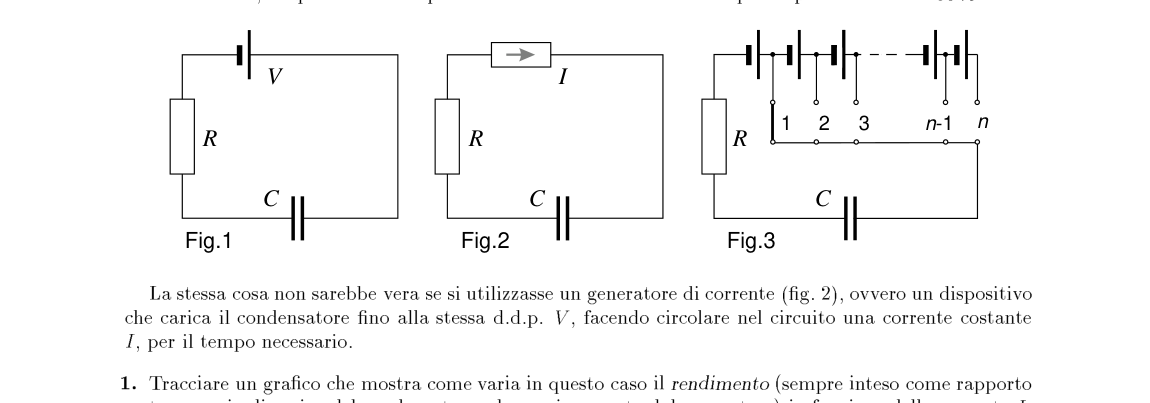
È noto che caricando un condensatore per mezzo di un generatore di f.e.m. costante (fig. 1) metà dell’energia erogata dal generatore si dissipa in calore per effetto Joule, indipendentemente dal valore della resistenza; in questo senso si potrebbe dire che il rendimento di questa procedura è del 50%.
La stessa cosa non sarebbe vera se si utilizzasse un generatore di corrente (fig. 2), ovvero un dispositivo che carica il condensatore fino alla stessa d.d.p. , facendo circolare nel circuito una corrente costante , per il tempo necessario.
- Tracciare un grafico che mostra come varia in questo caso il rendimento (sempre inteso come rapporto tra energia di carica del condensatore ed energia erogata dal generatore) in funzione della corrente , calcolando per quale valore di esso è pari al 50%.
Si consideri ora una batteria di generatori di f.e.m., uguali tra loro e tali che disposti in serie forniscano ancora una f.e.m. totale , e si carichi il medesimo condensatore secondo la procedura che segue. Prima fase: si collega il condensatore al primo generatore (connessione al punto 1 in fig. 3) e si attende che il condensatore sia carico, avendo raggiunto l’equilibrio elettrostatico. Seconda fase: si sposta il commutatore nella posizione 2 (stessa figura) e si attende che il condensatore venga ulteriormente caricato per mezzo dei primi due generatori in serie. Ulteriori fasi: si sposta il commutatore nella posizione 3 e si ripete l’operazione allo stesso modo con i primi tre generatori in serie, poi con quattro, e così via, fino ad arrivare alla posizione .
- Calcolare separatamente l’energia erogata dai generatori attivi nelle prime tre fasi del processo di carica.
- Determinare il rendimento del sistema durante il processo completo di carica, valutandone l’estremo superiore al variare del numero di generatori impiegati.
Nota. Può essere utile ricordare che la somma dei primi numeri interi è data da:
 Capacitor charging circuits Fig.1 voltage source Fig.2 current source Fig.3 n-generator switching
Topic: Circuits, Electrostatics Metodi: Kirchhoff’s Laws, Energy Conservation Method, Calculus-Integration Competenze: Physical Reasoning, Mathematical Modeling Objects: Capacitor, Resistor, Battery, Switch Fonte: Testo (PDF) — p.10 Soluzione: Soluzioni (PDF)
Carica di un condensatore
It is known that charging a capacitor using an F.E.M. generator costante (fig. 1) half of the energy delivered by the generator is dissipated in heat by Joule effect, regardless of the resistance value; in this sense, the * yield * of this procedure is 50%.
The same would not be true if a power generator were used (fig. 2), i.e. a device charging the capacitor to the same D.D.P. , by circulating a constant current in the circuit for the time required.
- Draw a graph showing how the * yield * (always understood as the ratio of capacitor load energy to generator power) varies in this case according to the current , calculating for which value it is equal to 50%.
Consider a battery of f.e.m. generators, equal to each other and those arranged in series still provide an f.e.m. The total and the same capacitor is loaded according to the following procedure. First stage: connects the capacitor to the first generator (connection to point 1 in Fig. 3) and the capacitor is expected to be loaded, having reached electrostatic equilibrium. Second phase: the switch is moved to position 2 (the same figure) and the capacitor is expected to be further charged by the first two serial generators. *Additional steps: * move the switch to position 3 and repeat the same operation with the first three serial generators, then four, and so on, until you reach the position.
- Calculate separately the energy delivered by the active generators during the first three phases of the charging process.
- Determine the performance of the system during the complete charging process, evaluating the higher end of the system than the variable number of generators used.
Nota. It may be useful to remember that the sum of the first integers is given by:
Capacitor charging circuits Fig.1 voltage source Fig.2 current source Fig.3 n-generator switching
Topic: Circuits, Electrostatics Metodi: Kirchhoff’s Laws, Energy Conservation Method, Calculus-Integration Competenze: Physical Reasoning, Mathematical Modeling Objects: Capacitor, Resistor, Battery, Switch Fonte: Testo (PDF) — p.10 Soluzione: Soluzioni (PDF)