Un piccolo aereo effettua una virata alla velocità di , mantenendo costante la quota. Se il raggio della virata è di , quanto vale l’accelerazione dell’aereo?
Topic: Newtonian Mechanics Metodi: Kinematic Equations Competenze: Physical Reasoning Objects: — Fonte: Testo (PDF) — p.3 Soluzione: Soluzioni (PDF)
A small aircraft makes a turn at , keeping the altitude constant. If the radius of the turn is , how much is the aircraft’s acceleration?
Topic: Newtonian Mechanics Metodi: Kinematic Equations Competenze: Physical Reasoning Objects: — Fonte: Testo (PDF) — p.3 Soluzione: Soluzioni (PDF)
In una miniera profonda si infiltrano litri di acqua al minuto, che vengono estratti facendo funzionare una pompa elettrica. La pompa ha un rendimento del .
- Calcolare la potenza elettrica necessaria per tenere asciutta la miniera.
Topic: Newtonian Mechanics, Conservation of Energy Metodi: Energy Conservation Method Competenze: Physical Reasoning Objects: — Fonte: Testo (PDF) — p.3 Soluzione: Soluzioni (PDF)
In a deep mine litres of water per minute are infiltrated, which are extracted by operating an electrical pump. The pump has a yield of .
Calculate the electrical power required to keep the mine dry.
Topic: Newtonian Mechanics, Conservation of Energy Metodi: Energy Conservation Method Competenze: Physical Reasoning Objects: — Fonte: Testo (PDF) — p.3 Soluzione: Soluzioni (PDF)
Marina esplora il fondo di un lago con attrezzatura subacquea. Quando espira salgono alla superficie delle bolle di gas. La pressione nelle bolle varia con la profondità e di conseguenza cambiano le loro dimensioni.
Nel grafico presentato a destra è riportato l’andamento della pressione del gas nelle bolle in funzione della profondità.
- Qual è il volume, al pelo della superficie del lago, di una bolla che a di profondità ha un volume di , se la temperatura nell’acqua del lago è la stessa in ogni punto?
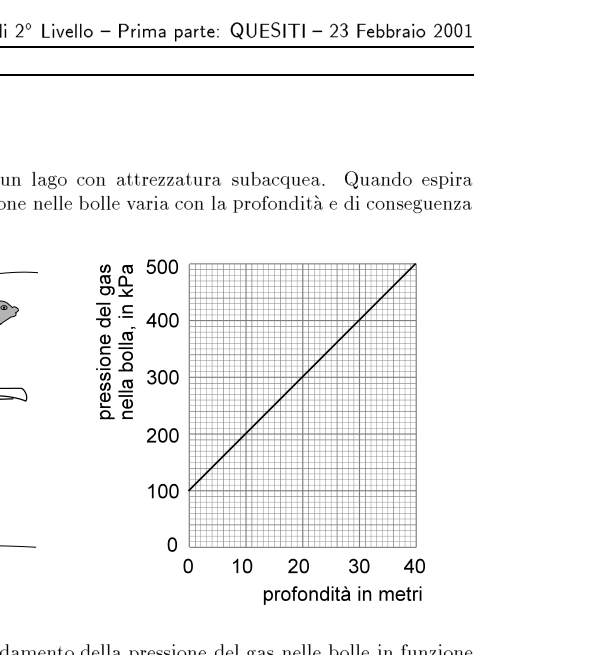 Pressione gas in bolle vs profondità
Topic: Fluid Mechanics, Thermodynamics Metodi: Ideal Gas Law, Hydrostatic Equilibrium Competenze: Physical Reasoning, Graph Linearization Objects: Bubble, Gas Fonte: Testo (PDF) — p.4 Soluzione: Soluzioni (PDF)
Marina is exploring the bottom of a lake with underwater equipment. When he exhale, the gas bubbles rise to the surface. The pressure in the bubbles varies with depth and consequently their size changes.
The graph on the right shows the direction of the gas pressure in the bubbles according to the depth.
- What is the volume of a bubble at depth of at the surface of the lake, if the temperature in the lake water is the same at each point?
The pressure of the gas in the bubbles vs. the depth of the gas in the bubbles
Topic: Fluid Mechanics, Thermodynamics Metodi: Ideal Gas Law, Hydrostatic Equilibrium Competenze: Physical Reasoning, Graph Linearization Objects: Bubble, Gas Fonte: Testo (PDF) — p.4 Soluzione: Soluzioni (PDF)
Tre grandi piastre metalliche uguali, A, B, C, sono disposte parallelamente nel vuoto a distanze molto minori delle loro dimensioni. Le due piastre esterne A e B sono collegate fra loro e distano rispettivamente e dalla piastra centrale, isolata, sulla quale è posta una carica .
- Come si divide la carica sulle due facce della piastra centrale?
Topic: Electrostatics Metodi: Gauss’s Law, Electric Potential Method Competenze: Physical Reasoning Objects: Capacitor Fonte: Testo (PDF) — p.4 Soluzione: Soluzioni (PDF)
Three equal large metal plates, A, B, C, are arranged parallel to each other in the vacuum at distances much smaller than their size. The two outer plates A and B are connected to each other and separate and respectively from the insulated central plate, on which a charge is placed.
- Come si divide la carica sulle due facce della piastra centrale?
Topic: Electrostatics Metodi: Gauss’s Law, Electric Potential Method Competenze: Physical Reasoning Objects: Capacitor Fonte: Testo (PDF) — p.4 Soluzione: Soluzioni (PDF)
Una massa da è appesa a due funi come si vede in figura (una fune forma con la verticale e l’altra con la verticale).
- Calcolare la tensione delle funi.
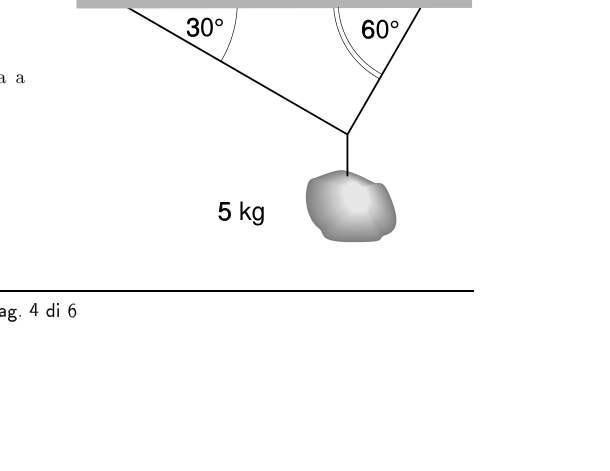 Massa 5 kg appesa a due funi 30° 60°
Topic: Newtonian Mechanics, Rigid Body Statics Metodi: Free-Body Diagram, Vector Decomposition Competenze: Physical Reasoning Objects: String Fonte: Testo (PDF) — p.4 Soluzione: Soluzioni (PDF)
A mass of is suspended from two strings as shown in the figure (one strings is with the vertical and the other with the vertical).
- Calculate the tension of the strings.
Weight of 5 kg suspended from two ropes 30° 60°
Topic: Newtonian Mechanics, Rigid Body Statics Metodi: Free-Body Diagram, Vector Decomposition Competenze: Physical Reasoning Objects: String Fonte: Testo (PDF) — p.4 Soluzione: Soluzioni (PDF)
Una molla di lunghezza a riposo è posta verticalmente su un piano; una pallina di massa viene appoggiata sulla molla e lasciata libera da ferma. La pallina inizia ad oscillare ma dopo un certo tempo la pallina si ferma e la lunghezza della molla è .
- Quanta energia meccanica si dissipa prima che si raggiunga l’equilibrio?
Topic: Oscillations & Waves, Conservation of Energy Metodi: Energy Conservation Method, Hooke’s Law Competenze: Physical Reasoning Objects: Spring, Ball Fonte: Testo (PDF) — p.5 Soluzione: Soluzioni (PDF)
A spring of rest length is placed vertically on a plane; a ball of mass is rested on the spring and left free to stand. The ball starts to oscillate but after a while the ball stops and the length of the spring is .
How much mechanical energy is dissipated before balance is achieved?
Topic: Oscillations & Waves, Conservation of Energy Metodi: Energy Conservation Method, Hooke’s Law Competenze: Physical Reasoning Objects: Spring, Ball Fonte: Testo (PDF) — p.5 Soluzione: Soluzioni (PDF)
Una mole di olio è contenuta in un recipiente di volume alla pressione . Si dà al volume che la pressione vengono raddoppiati con una trasformazione, rappresentata nel piano - da un segmento, come mostrato in figura (la trasformazione lineare va da a ).
- Quanto calore deve essere fornito al gas?
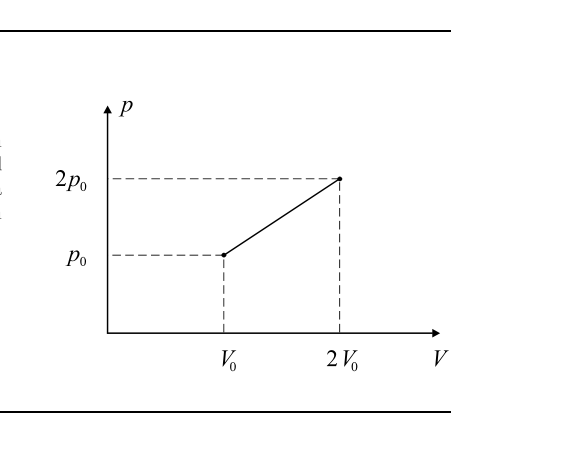 Piano p-V trasformazione lineare olio
Topic: Thermodynamics Metodi: First Law of Thermodynamics, Thermodynamic Cycle Analysis Competenze: Physical Reasoning, Mathematical Modeling Objects: Gas, Container Fonte: Testo (PDF) — p.5 Soluzione: Soluzioni (PDF)
One mole of oil is contained in a volume container at pressure . The volume is given that the pressure is doubled with a transformation, represented in the plane - by a segment, as shown in Figure (the linear transformation ranges from to ).
How much heat should be supplied to the gas?
The following table shows the results of the calculations:
Topic: Thermodynamics Metodi: First Law of Thermodynamics, Thermodynamic Cycle Analysis Competenze: Physical Reasoning, Mathematical Modeling Objects: Gas, Container Fonte: Testo (PDF) — p.5 Soluzione: Soluzioni (PDF)
In un bagno d’olio ( di olio) è inserito un riscaldatore elettrico ai cui capi è applicata una differenza di potenziale di , facendo aumentare la temperatura dell’olio di in minuti.
- Qual è la resistenza elettrica del riscaldatore?
Il calore specifico dell’olio è .
Topic: Circuits, Thermodynamics Metodi: Kirchhoff’s Laws, First Law of Thermodynamics Competenze: Physical Reasoning Objects: Resistor Fonte: Testo (PDF) — p.5 Soluzione: Soluzioni (PDF)
An electric heater is inserted into an oil bath ( of oil) to which a potential difference of is applied, increasing the temperature of the oil by in minutes.
What’s the electrical resistance of the heater?
The specific heat of the oil is .*
Topic: Circuits, Thermodynamics Metodi: Kirchhoff’s Laws, First Law of Thermodynamics Competenze: Physical Reasoning Objects: Resistor Fonte: Testo (PDF) — p.5 Soluzione: Soluzioni (PDF)
Sul fondo di un recipiente a sezione circolare, con le pareti opache e riempito con glicerina (), è disposta una sorgente luminosa puntiforme. Sulla superficie della glicerina galleggia un disco, anch’esso opaco, di diametro e spessore trascurabile.
Il centro del disco si trova sulla perpendicolare passante per la sorgente luminosa, come mostrato in figura.
- Quanto vale la massima altezza della glicerina nel recipiente per la quale nessun raggio luminoso esce dal recipiente?
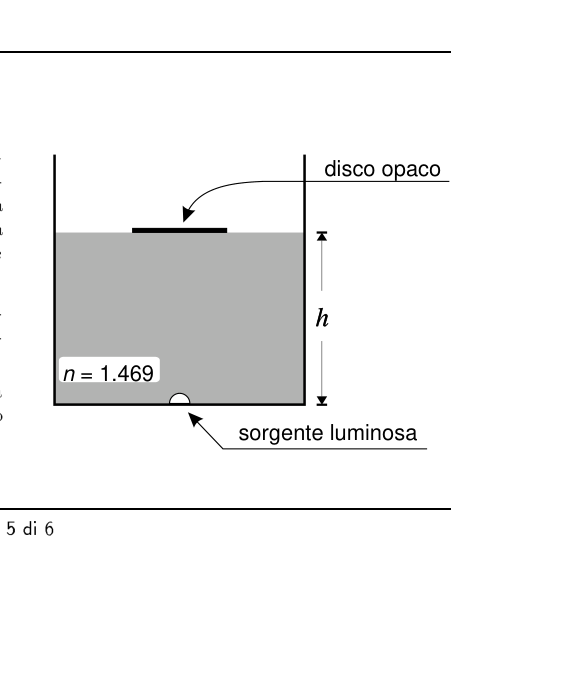 Glicerina con disco opaco e sorgente
Topic: Geometric Optics Metodi: Snell’s Law, Ray Tracing Competenze: Physical Reasoning Objects: Container, Disk Fonte: Testo (PDF) — p.5 Soluzione: Soluzioni (PDF)
A pointed light source is placed on the bottom of a circular section container with opaque walls and filled with glycerin (). On the surface of the glycerin floats a disc, also opaque, of diameter and negligible thickness.
The center of the disc is on the perpendicular passing through the light source, as shown in the figure.
- What is the maximum height of glycerin in the container for which no light rays are emitted from the container?
Glycerin with opaque disc and source
Topic: Geometric Optics Metodi: Snell’s Law, Ray Tracing Competenze: Physical Reasoning Objects: Container, Disk Fonte: Testo (PDF) — p.5 Soluzione: Soluzioni (PDF)
Una nave si muove parallelamente alla linea di costa lungo cui sono situate due antenne che trasmettono, in fase, onde elettromagnetiche di uguale ampiezza (costante) e alla stessa frequenza .
Quando la nave transita di fronte alle antenne un passeggero sulla nave osserva che la distanza angolare tra le antenne è circa e che l’intensità dell’onda e.m. ricevuta varia periodicamente nel tempo, con un periodo tra due massimi successivi (si noti che la situazione è rappresentata solo indicativamente in figura).
- Il passeggero si accorge che con questi dati può stimare la velocità della nave: che valore ottiene?
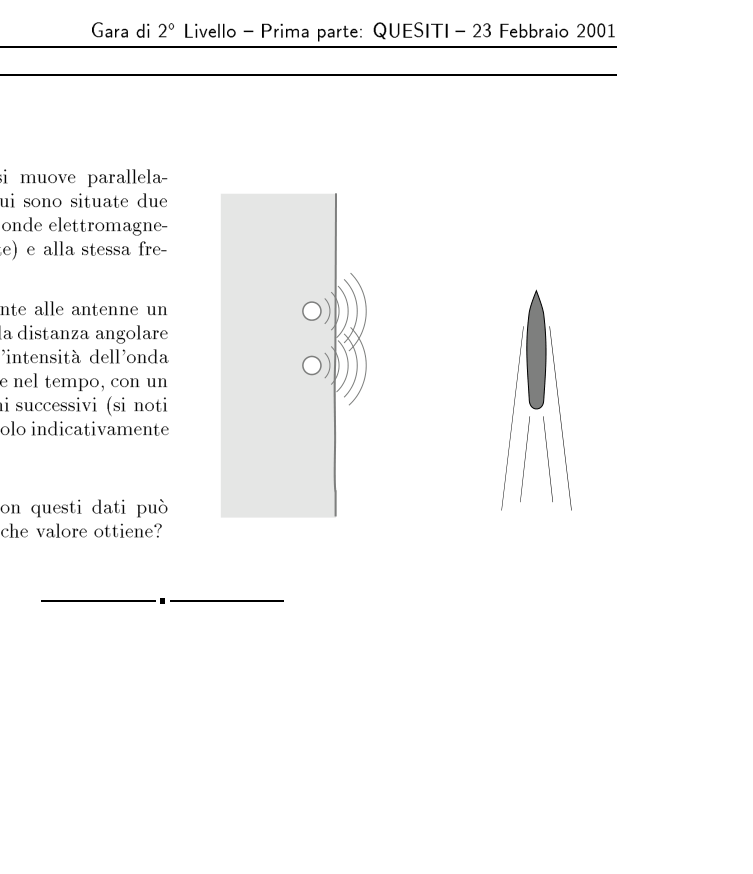 Due antenne e nave in movimento
Topic: Oscillations & Waves, Wave Optics Metodi: Interference & Diffraction Analysis, Superposition Principle Competenze: Physical Reasoning, Mathematical Modeling Objects: — Fonte: Testo (PDF) — p.6 Soluzione: Soluzioni (PDF)
A ship moves parallel to the coastline along which two antennas are located, transmitting, in phase, electromagnetic waves of equal width (constant) and at the same frequency .
When the ship is passing in front of the antennas a passenger on board observes that the angular distance between the antennas is approximately and that the wave intensity is e.m. The amount of the information received varies periodically over time, with a period between two successive maximum levels (note that the situation is only indicated in the figure).
- The passenger realizes that with this data he can estimate the speed of the ship.
Two antennas and moving ship
Topic: Oscillations & Waves, Wave Optics Metodi: Interference & Diffraction Analysis, Superposition Principle Competenze: Physical Reasoning, Mathematical Modeling Objects: — Fonte: Testo (PDF) — p.6 Soluzione: Soluzioni (PDF)
Problema 1 – Urti ripetuti
Su una guida orientabile circolare (come i binari dei treni) è ben fabbricata possono correre senza attrito due carrelli di dimensioni trascurabili rispetto al diametro della guida.
In un certo istante uno dei carrelli, di massa , è fermo in un punto che assumiamo come origine delle coordinate angolari per descrivere il moto. L’altro carrello, di massa , si sta muovendo con velocità in verso antiorario; assume i carrelli si muovono lungo la guida, a un certo punto avviene un urto centrale elastico con il primo carrello.
- Si dica quali sono le velocità (con i relativi versi) dei due carrelli dopo l’urto.
- Si dica dove avviene un secondo urto, la posizione dell’urto espressa come angolo in verso antiorario rispetto alla posizione iniziale del primo carrello.
- Si trovino le velocità dei due carrelli dopo il secondo urto.
- Si indichi la posizione del terzo urto, e poi si generalizzi al caso dell’-esimo urto.
Topic: Newtonian Mechanics, Conservation of Momentum Metodi: Conservation of Momentum, Conservation of Energy, Kinematic Equations Competenze: Physical Reasoning, Mathematical Modeling Objects: Cart Fonte: Testo (PDF) — p.8 Soluzione: Soluzioni (PDF)
The following is the list of the most commonly used methods for the treatment of patients with diabetes:
On a well-fabricated circular steering wheel (such as train tracks) two carriages of negligible size with respect to the wheel diameter can run without friction.
At a certain moment one of the carts, mass , is stationary at a point which we assume as the origin of the angular coordinates to describe the motion. The other cart, of mass , is moving at speed against the clock; assuming the cart moves along the wheel, at some point an elastic centre impact occurs with the first cart.
- Tell us what the speeds (with the relative vertices) of the two cars are after the impact.
- Say where a second impact occurs, the impact position expressed as an angle against the clock relative to the initial position of the first cart.
- Find the velocities of the two cars after the second impact.
- The location of the third impact is indicated, and then generalized to the case of the -eighth impact.
Topic: Newtonian Mechanics, Conservation of Momentum Metodi: Conservation of Momentum, Conservation of Energy, Kinematic Equations Competenze: Physical Reasoning, Mathematical Modeling Objects: Cart Fonte: Testo (PDF) — p.8 Soluzione: Soluzioni (PDF)
Problema 2 – “Rifrazione” con elettroni
Le armature di un condensatore sono costituite da sottili reticelle metalliche parallele e poste nel vuoto. La loro distanza è ; fra di loro è stabilita una d.d.p. .
Un fascio di elettroni, di energia , è diretto con un angolo come in figura, verso l’armatura e penetra, attraverso la reticella, nel condensatore.
Per la descrizione del campo e delle due reticelle queste possono essere trattate come superfici continue che consentono il passaggio degli elettroni.
- Determinare il campo nel condensatore e la densità di carica sulle armature.
- Tenendo conto che opportune considerazioni energetiche possono semplificare la soluzione, trovare il massimo valore per cui gli elettroni del fascio possono uscire attraverso l’armatura superiore.
- Detto l’angolo con cui escono gli elettroni che attraversano il condensatore, mostrare che — come per la luce che si propaga da un mezzo ad un altro — il rapporto è costante al variare di .
- Spiegare perché, anche se la condizione stabilita al punto 2 non fosse soddisfatta, il comportamento degli elettroni sarebbe comunque analogo a quello della luce.
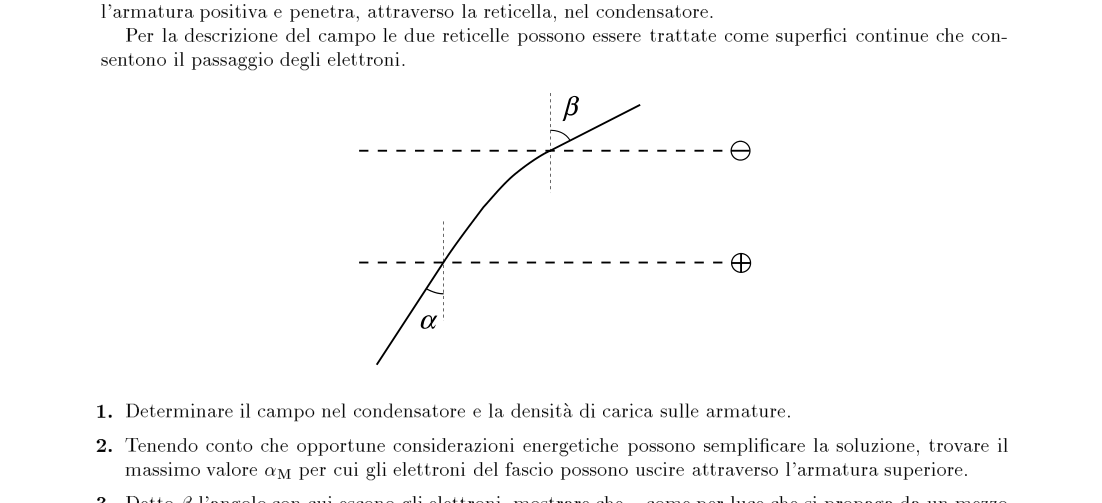 Condensatore a reticelle con fascio elettroni
Topic: Electrostatics, Modern-Quantum Physics Metodi: Electric Potential Method, Energy Conservation Method, Gauss’s Law Competenze: Physical Reasoning, Mathematical Modeling Objects: Capacitor, Particle Beam, Electron Fonte: Testo (PDF) — p.8 Soluzione: Soluzioni (PDF)
The following is the list of the types of electron refraction:
The armor of a capacitor consists of thin parallel metal lattices placed in a vacuum. Their distance is ; a D.D.P. is established between them. .
A beam of electrons, of energy , is directed at an angle as shown in the figure, towards the armor and penetrates, through the lattice, into the capacitor.
For the description of the field and the two networks these can be treated as continuous surfaces that allow the passage of electrons.
- Determine the field in the capacitor and the load density on the armor.
- Taking into account that appropriate energy considerations can simplify the solution, find the maximum value for which the beam electrons can exit through the upper armor.
- If is the angle at which the electrons passing through the capacitor exit, show that as for light propagating from one medium to another the ratio is constant at the variation of .
- Explain why, even if the condition set out in point 2 is not met, the behaviour of the electrons would still be similar to that of light.
*Wire mesh capacitor with electron beam *
Topic: Electrostatics, Modern-Quantum Physics Metodi: Electric Potential Method, Energy Conservation Method, Gauss’s Law Competenze: Physical Reasoning, Mathematical Modeling Objects: Capacitor, Particle Beam, Electron Fonte: Testo (PDF) — p.8 Soluzione: Soluzioni (PDF)
Problema 3 – Bollicine
Sul fondo di un bicchiere di birra, si forma una bollicina di gas che presto si stacca dal fondo e sale alla superficie.
Descrivere il comportamento della bolla di gas dal punto di vista fisico è molto complesso ma, facendo delle ipotesi semplificative, si può trattare di costruire un modello abbastanza valido per capire quello che accade e per impostare qualche osservazione sperimentale; per fare questo si possono utilizzare le informazioni e le relazioni matematiche date di seguito.
L’altezza della barra nel bicchiere è di ; la temperatura della birra, costante, è di ; la pressione esterna, pure costante, vale . Il diametro della bolla, che non rimane costante, è di circa quando si stacca dal fondo del bicchiere.
Si assumano le seguenti ipotesi:
- la densità della birra sia la stessa di quella dell’acqua;
- il gas nella bolla sia (con massa molare ) che, dal punto di vista termodinamico, si può considerare alla stregua di un gas perfetto; ;
- la massa di gas nella bolla si mantiene costante durante la salita verso la superficie;
- il moto della bolla si attua in regime di Stokes, secondo cui l’attrito viscoso è su una sferetta in un fluido è direttamente proporzionale alla sua velocità, il coefficiente di proporzionalità, per una sferetta di raggio , è dato da , dove rappresenta il coefficiente di viscosità del fluido; in questo caso sia .
- Trascurando gli effetti della tensione superficiale, determinare quanto gas è contenuto nella bolla.
- Calcolare il rapporto tra il volume della bolla in superficie e quello della bolla quando è ancora sul fondo del bicchiere e ancora una volta verificare che la vita della bolla sia troppo breve perché il gas contenuto in essa possa rimanere in equilibrio termico con l’ambiente.
- Calcolare la velocità limite della bolla in regime viscoso, supponendo che il suo volume sia quello iniziale e valutare di quanto varia, in percentuale, tale valore considerando che il volume sia quello alla superficie.
- Calcolare quanto tempo impiega la bolla a salire in superficie supponendo che, in una prima fase del moto, la sua accelerazione sia uguale a quella iniziale e poi, raggiunta la velocità limite, prosegua con quella velocità per il tratto rimanente.
Topic: Fluid Mechanics, Thermodynamics, Kinetic Theory Metodi: Ideal Gas Law, Hydrostatic Equilibrium, Differential Equations, Physical Modeling Competenze: Physical Reasoning, Mathematical Modeling Objects: Bubble, Gas, Container Fonte: Testo (PDF) — p.9 Soluzione: Soluzioni (PDF)
The following table shows the results of the study:
On the bottom of a glass of beer, a bubble of gas forms that soon breaks off the bottom and rises to the surface.
Describe the behavior of the gas bubble from a physical point of view is very complex but, by making simplifying assumptions, you can build a model that is valid enough to understand what is happening and to set up some experimental observations; to do this you can use the information and mathematical relationships given below.
The height of the bar in the glass is ; the temperature of the beer, constant, is ; the external pressure, even constant, is . The diameter of the bubble, which does not remain constant, is about when detached from the bottom of the glass.
The following assumptions shall be made:
- the density of beer is the same as that of water;
- the gas in the bubble is (molar mass ) which, from a thermodynamic point of view, can be considered to be the equivalent of a perfect gas; ;
- the mass of the gas in the bubble remains constant during the ascent to the surface;
- the motion of the bubble is in Stokes mode, where the viscous friction on a sphere in a fluid is directly proportional to its velocity, the coefficient of proportionality, for a sphere of radius , is given by , where is the coefficient of viscosity of the fluid; in this case it is .
- Ignoring the effects of surface tension, determine how much gas is contained in the bubble.
- Calculate the ratio of the volume of the bubble on the surface to that of the bubble when it is still at the bottom of the glass and once again verify that the life of the bubble is too short for the gas contained in it to remain in thermal equilibrium with the environment.
- Calculate the speed limit of the bubble in viscous mode, assuming its initial volume and estimate how much this value varies, as a percentage, considering the volume at the surface.
- Calculate how long it takes the bubble to rise to the surface assuming that, in a first stage of the motion, its acceleration is equal to the initial one and then, when the speed limit is reached, it continues with that speed for the remaining stretch.
Topic: Fluid Mechanics, Thermodynamics, Kinetic Theory Metodi: Ideal Gas Law, Hydrostatic Equilibrium, Differential Equations, Physical Modeling Competenze: Physical Reasoning, Mathematical Modeling Objects: Bubble, Gas, Container Fonte: Testo (PDF) — p.9 Soluzione: Soluzioni (PDF)