In un’autofficina, per sollevare un autocarro da 3500 kg viene adoperato un torchio idraulico formato da due cilindri a stantuffo di diversa sezione comunicanti con un tubo e riempiti con olio. Sullo stantuffo a sezione minore un dispositivo esercita una forza di 300 N.
- Calcolare il rapporto dei diametri dei due cilindri.
Topic: Fluid Mechanics Metodi: Hydrostatic Equilibrium, Physical Modeling Competenze: Physical Reasoning, Mathematical Modeling Objects: Piston, Cylinder, Tube Fonte: Testo (PDF) — p.3 Soluzione: Soluzioni (PDF)
In an auto-workshop, a hydraulic torque is used to lift a 3500 kg truck made up of two cylinders with a different section, which are connected by a tube and filled with oil. On a small-section stump, a device shall exert a force of 300 N.
- Calculate the ratio of the diameters of the two cylinders.
Topic: Fluid Mechanics Metodi: Hydrostatic Equilibrium, Physical Modeling Competenze: Physical Reasoning, Mathematical Modeling Objects: Piston, Cylinder, Tube Fonte: Testo (PDF) — p.3 Soluzione: Soluzioni (PDF)
Una motocicletta percorre una curva di 120 m di raggio alla velocità di 90 km/h.
- Che informazione se ne può ricavare circa il coefficiente di attrito statico tra la gomma della ruota e l’asfalto della strada?
Topic: Newtonian Mechanics Metodi: Free-Body Diagram, Kinematic Equations Competenze: Physical Reasoning Objects: Wheel Fonte: Testo (PDF) — p.3 Soluzione: Soluzioni (PDF)
A motorcycle travels a 120 m radius curve at a speed of 90 km/h.
- What information can be obtained about the static friction coefficient between the tyre and the road asphalt?
Topic: Newtonian Mechanics Metodi: Free-Body Diagram, Kinematic Equations Competenze: Physical Reasoning Objects: Wheel Fonte: Testo (PDF) — p.3 Soluzione: Soluzioni (PDF)
Un liquido viene portato all’ebollizione assorbendo da un fornello una potenza costante. Il recipiente che lo contiene ha capacità termica trascurabile. Appena prima dell’ebollizione la temperatura del liquido cresce di 4 K al minuto e nei successivi 40 minuti tutto il liquido vaporizza.
- Determinare il rapporto fra il calore specifico del liquido e il calore latente di ebollizione.
Topic: Thermodynamics Metodi: First Law of Thermodynamics, Physical Modeling Competenze: Physical Reasoning, Mathematical Modeling Objects: — Fonte: Testo (PDF) — p.4 Soluzione: Soluzioni (PDF)
A liquid is brought to boil by absorbing a constant power from a furnace. The container containing it has negligible thermal capacity. Just before boiling, the temperature of the liquid rises by 4 K per minute and in the next 40 minutes all the liquid vaporizes.
- Determine the ratio of the specific heat of the liquid to the latent heat of the boiling.
Topic: Thermodynamics Metodi: First Law of Thermodynamics, Physical Modeling Competenze: Physical Reasoning, Mathematical Modeling Objects: — Fonte: Testo (PDF) — p.4 Soluzione: Soluzioni (PDF)
Carlo è miope e riesce a vedere distintamente solo gli oggetti che non siano a distanza superiore a 40 cm; usando però un paio di occhiali con due lenti divergenti uguali, può vedere nitidamente anche le stelle.
- Che potere diottrico devono avere le lenti, se vengono poste a distanza trascurabile dagli occhi?
NOTA: Il “potere diottrico” o “potere convergente” di una lente (in diottrie) è definito come il reciproco della distanza focale espressa in metri.
Topic: Geometric Optics Metodi: Thin Lens & Mirror Equation, Physical Modeling Competenze: Physical Reasoning, Mathematical Modeling Objects: Lens Fonte: Testo (PDF) — p.4 Soluzione: Soluzioni (PDF)
Charles is nearsighted and can see only objects that are not more than 40 cm away; but using a pair of glasses with two identical divergent lenses, he can clearly see the stars as well.
What diopteric power must the lenses have if they are placed at negligible distance from the eyes?
NOTE: The “diotric power” or “convergent power” of a lens (in diotries) is defined as the reciprocal of the focal length in metres.
Topic: Geometric Optics Metodi: Thin Lens & Mirror Equation, Physical Modeling Competenze: Physical Reasoning, Mathematical Modeling Objects: Lens Fonte: Testo (PDF) — p.4 Soluzione: Soluzioni (PDF)
Un condensatore di capacità , inizialmente scarico, viene caricato con un dispositivo che fornisce una corrente il cui andamento nel tempo è rappresentato in figura (impulso rettangolare: per , altrimenti).
- Disegnare il grafico dell’andamento della d.d.p. ai capi del condensatore, specificando sui rispettivi assi i valori numerici caratteristici.
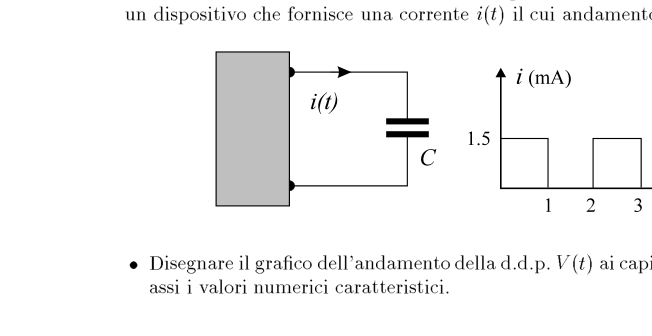 Grafico corrente i(t) impulso rettangolare
Topic: Circuits Metodi: Kirchhoff’s Laws, Physical Modeling Competenze: Diagrammatic Reasoning, Mathematical Modeling Objects: Capacitor Fonte: Testo (PDF) — p.4 Soluzione: Soluzioni (PDF)
A capacitor initially discharged is charged with a device providing a current whose current over time is shown in Figure (rectangular pulse: for , otherwise).
- Draw a chart of the D.D.P. to the capacitor heads, specifying the characteristic numerical values on the respective axes.
The following table shows the current and the current of the system:
Topic: Circuits Metodi: Kirchhoff’s Laws, Physical Modeling Competenze: Diagrammatic Reasoning, Mathematical Modeling Objects: Capacitor Fonte: Testo (PDF) — p.4 Soluzione: Soluzioni (PDF)
Un cilindro di vetro graduato, il cui diametro interno è , è tarato in cm³; la scala, le cui suddivisioni equivalgono a 2 cm³ ciascuna, inizia in corrispondenza del fondo del recipiente. Sul fondo del cilindro vuoto viene sistemato un oggetto, anch’esso di forma cilindrica, di altezza e densità media . Successivamente viene lentamente versata dell’acqua nel cilindro fino al momento in cui l’oggetto appoggiato sul fondo comincia a galleggiare, rimanendo in posizione verticale.
- Che valore si legge sulla scala graduata?
Topic: Fluid Mechanics Metodi: Hydrostatic Equilibrium, Physical Modeling Competenze: Physical Reasoning, Mathematical Modeling Objects: Cylinder, Container Fonte: Testo (PDF) — p.4 Soluzione: Soluzioni (PDF)
A graded glass cylinder, with an internal diameter of , is graded in cm3; the scale, with subdivisions equal to 2 cm3 each, begins at the bottom of the container. On the bottom of the empty cylinder is placed an object, also cylindrical in shape, of height and average density . Water is then slowly poured into the cylinder until the bottom-mounted object begins to float, remaining in a vertical position.
- What’s the value on the graduated scale?
Topic: Fluid Mechanics Metodi: Hydrostatic Equilibrium, Physical Modeling Competenze: Physical Reasoning, Mathematical Modeling Objects: Cylinder, Container Fonte: Testo (PDF) — p.4 Soluzione: Soluzioni (PDF)
In uno scaldabagno a gas l’acqua entra alla temperatura di ed esce alla temperatura di . In un certo tempo sono prelevati 10.2 litri di acqua, per riscaldarla i quali sono stati bruciati 27 litri di gas. Il potere calorifico del gas, cioè la quantità di energia termica prodotta per unità di volume, è .
- Calcolare il rendimento dello scaldabagno.
Topic: Thermodynamics Metodi: First Law of Thermodynamics, Physical Modeling Competenze: Physical Reasoning, Mathematical Modeling Objects: — Fonte: Testo (PDF) — p.5 Soluzione: Soluzioni (PDF)
In a gas water heater, water enters at and exits at . In a certain period of time, 10.2 litres of water were taken to heat it, which was burned with 27 litres of gas. The heat output of the gas, i.e. the amount of heat energy produced per unit volume, is .
- Calculate the water heater’s performance.
Topic: Thermodynamics Metodi: First Law of Thermodynamics, Physical Modeling Competenze: Physical Reasoning, Mathematical Modeling Objects: — Fonte: Testo (PDF) — p.5 Soluzione: Soluzioni (PDF)
Una lampadina posta 1 metro sopra a un tavolo riesce a illuminare sufficientemente il punto del tavolo posto proprio sotto di essa; questa viene sostituita da un lampadario posto 1.4 m più in alto della lampadina.
- Quante lampadine almeno deve avere il lampadario perché nello stesso punto il tavolo sia illuminato almeno quanto prima?
NOTA: Si faccia l’ipotesi che le lampadine montate sul lampadario siano molto vicine tra loro e tutte alla stessa distanza dal tavolo.
Topic: Electromagnetic Induction Metodi: Physical Modeling, Approximation & Series Expansion Competenze: Physical Reasoning, Mathematical Modeling Objects: — Fonte: Testo (PDF) — p.5 Soluzione: Soluzioni (PDF)
A lamp placed 1 meter above a table can illuminate the table point just below it enough; it is replaced by a lamp stand placed 1.4 m higher than the lamp.
How many light bulbs does the lighthouse have to have so that the table is illuminated at the same point at least as soon as possible?
NOTE: Assume that the lamps mounted on the lamp stand are very close to each other and all at the same distance from the table.
Topic: Electromagnetic Induction Metodi: Physical Modeling, Approximation & Series Expansion Competenze: Physical Reasoning, Mathematical Modeling Objects: — Fonte: Testo (PDF) — p.5 Soluzione: Soluzioni (PDF)
Si vuole determinare la resistenza interna di un generatore reale di f.e.m. Avendo a disposizione 2 fili conduttori uguali, la cui resistenza è nota, si osserva che la potenza dissipata nei fili quando essi sono disposti in parallelo è 3 volte maggiore di quando sono disposti in serie.
- Determinare il valore del rapporto .
Topic: Circuits Metodi: Kirchhoff’s Laws, Equivalent Circuit Reduction Competenze: Physical Reasoning, Mathematical Modeling Objects: Resistor, Wire, Battery Fonte: Testo (PDF) — p.5 Soluzione: Soluzioni (PDF)
The internal resistance of a real f.e.m. generator is to be determined. With two identical conducting wires available, the strength of which is known, it is observed that the power dissipated in the wires when they are arranged in parallel is 3 times greater than when they are arranged in series.
- Determine the value of the ratio .
Topic: Circuits Metodi: Kirchhoff’s Laws, Equivalent Circuit Reduction Competenze: Physical Reasoning, Mathematical Modeling Objects: Resistor, Wire, Battery Fonte: Testo (PDF) — p.5 Soluzione: Soluzioni (PDF)
Un satellite in orbita polare circolare compie un giro in un giorno. Ad un certo istante, mentre sorvola il Polo Nord, si muove sul piano del meridiano di Roma (longitudine: circa), provenendo dall’emisfero opposto al nostro.
- Motivando adeguatamente la risposta, dire se, ed eventualmente dopo quanto tempo, il satellite si troverà sulla verticale di Roma (latitudine: , circa).
Topic: Gravitation, Astrophysics Metodi: Kepler’s Laws, Physical Modeling Competenze: Physical Reasoning, Mathematical Modeling Objects: Satellite, Planet Fonte: Testo (PDF) — p.5 Soluzione: Soluzioni (PDF)
A satellite orbiting the polar circle makes one orbit in one day. At a certain moment, as it surpasses the North Pole, it moves along the plane of the meridian of Rome (length: approximately), coming from the opposite hemisphere to ours.
- Providing adequate reasons for the answer, whether and possibly how long after the satellite will be on the Rome vertical (latitude: , approx.).
Topic: Gravitation, Astrophysics Metodi: Kepler’s Laws, Physical Modeling Competenze: Physical Reasoning, Mathematical Modeling Objects: Satellite, Planet Fonte: Testo (PDF) — p.5 Soluzione: Soluzioni (PDF)
Placchetta riscaldata
Due elettrodi conduttori (anodo e catodo) sono disposti in un tubo di vetro nel quale è stato fatto il vuoto e sono collegati a una batteria con differenza di potenziale attraverso una resistenza . Dal catodo vengono emessi elettroni, a velocità praticamente nulla, che, dopo essere stati accelerati dal campo, colpiscono l’anodo costituito da una placchetta di alluminio della massa di 1 g. In queste condizioni nel circuito scorre una corrente costante .
- Calcolare la differenza di potenziale che si stabilisce fra anodo e catodo e la velocità con cui gli elettroni colpiscono l’anodo.
- Supponi che l’anodo si riscaldi. Nell’ipotesi che tutte le perdite di energia siano trascurabili, dopo quanto tempo la sua temperatura sarà cresciuta di ?
- Calcolare la temperatura di equilibrio raggiunta dall’anodo. Si consideri ora che l’anodo disperde calore nell’ambiente, che ha una temperatura , secondo la relazione , dove è la potenza dispersa, la temperatura dell’anodo, una costante che vale .
NOTA: Il calore specifico dell’alluminio è .
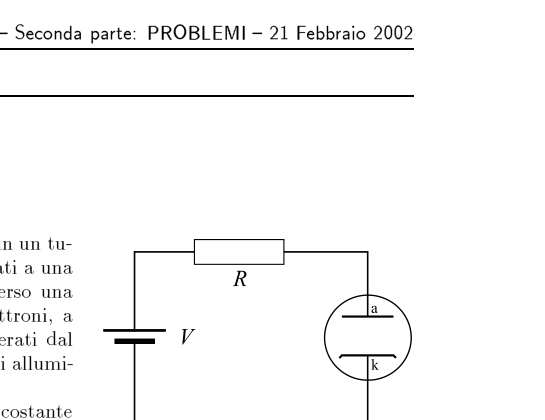 Circuito con resistenza R e batteria V
Topic: Circuits, Modern-Quantum Physics Metodi: Kirchhoff’s Laws, Energy Conservation Method Competenze: Physical Reasoning, Mathematical Modeling Objects: Battery, Resistor, Electron Fonte: Testo (PDF) — p.7 Soluzione: Soluzioni (PDF)
Heated plate
Two conducting electrodes (anode and cathode) are arranged in a glass tube in which the vacuum has been made and are connected to a battery with a potential difference through a resistance . Electrons are emitted from the cathode, at a speed of almost zero, which, after being accelerated by the field, strike the anode consisting of an aluminium plate of mass of 1 g. In these conditions, a constant current flows in the circuit.
- Calculate the difference of potential between anode and cathode and the speed at which electrons hit the anode.
- Suppose the anode warms up. If all the energy losses are negligible, how long will its temperature rise by ?
- Calculate the equilibrium temperature reached by the anode. Consider now that the anode disperses heat into the environment, which has a temperature , according to the ratio, where is the dispersed power, the temperature of the anode, a constant of .
NOTE: The specific heat of aluminium is .
R-resistant circuit and battery V
Topic: Circuits, Modern-Quantum Physics Metodi: Kirchhoff’s Laws, Energy Conservation Method Competenze: Physical Reasoning, Mathematical Modeling Objects: Battery, Resistor, Electron Fonte: Testo (PDF) — p.7 Soluzione: Soluzioni (PDF)
Macchina di Stirling
Una macchina termica esegue cicli di Stirling reversibili, ovvero cicli formati da due trasformazioni isoterme e due isocorie; la sostanza termodinamica è costituita da 2 moli di gas perfetto. Le trasformazioni isoterme avvengono alle temperature di due sorgenti esterne di calore: e . Durante un ciclo, dalla sorgente a temperatura maggiore viene assorbita una quantità di calore pari a .
- Mostrare che il calore assorbito durante la fase di riscaldamento è uguale a quello ceduto durante il raffreddamento.
Poiché, come si è detto, il calore assorbito durante la fase di riscaldamento è uguale a quello ceduto durante il raffreddamento, tra le stesse temperature, l’effettivo scambio di calore tra la macchina e l’esterno avviene soltanto durante le trasformazioni isoterme con le rispettive sorgenti di calore; ne segue che, dal punto di vista del rendimento, una macchina termica di Stirling è del tutto assimilabile a una di Carnot, che scambia calore con le stesse due sorgenti.
- Dopo aver calcolato il rendimento della macchina di Stirling, trovare il lavoro eseguito in un ciclo.
- Calcolare il rapporto tra valore iniziale e finale del volume durante ogni trasformazione isotermica.
- Calcolare il rapporto tra valore iniziale e finale della pressione durante ciascuna trasformazione isocora.
- Disegnare con accuratezza il ciclo termodinamico nel piano tenendo conto delle relazioni trovate tra i volumi e le pressioni.
Topic: Thermodynamics Metodi: Thermodynamic Cycle Analysis, Ideal Gas Law Competenze: Diagrammatic Reasoning, Mathematical Modeling Objects: Heat Engine, Gas Fonte: Testo (PDF) — p.7 Soluzione: Soluzioni (PDF)
The following table shows the number of units of the engine:
A thermal machine performs reversible Stirling cycles, i.e. cycles formed by two isothermal transformations and two isocories; the thermodynamic substance consists of 2 moles of perfect gas. Isothermal transformations occur at the temperatures of two external heat sources: and . During a cycle, a heat amount of is absorbed from the source at higher temperature.
- Show that the heat absorbed during the heating phase is equal to that delivered during cooling.
Since, as has been said, the heat absorbed during the heating phase is equal to that given during cooling, between the same temperatures, the actual heat exchange between the machine and the outside takes place only during isothermal transformations with the respective heat sources; it follows that, from the performance point of view, a Stirling thermal machine is quite similar to a Carnot thermal machine, which exchanges heat with the same two sources.
- After you calculate the performance of Stirling’s machine, find the work done in a cycle.
- Calculate the ratio of the initial and final volume value during each isothermal transformation.
- Calculate the ratio of the initial and final pressure values during each isocoric transformation.
- Accurately draw the thermodynamic cycle in the plane taking into account the relationships between volumes and pressures.
Topic: Thermodynamics Metodi: Thermodynamic Cycle Analysis, Ideal Gas Law Competenze: Diagrammatic Reasoning, Mathematical Modeling Objects: Heat Engine, Gas Fonte: Testo (PDF) — p.7 Soluzione: Soluzioni (PDF)
Equilibrio per attrito
Un blocco di massa , appoggiato su un piano orizzontale scabro, è unito mediante un filo (inestensibile e di massa trascurabile) a un secondo corpo di massa . Il filo viene fatto passare su una carrucola posta a una certa altezza sopra il piano in modo che il secondo corpo resti sospeso mentre il tratto di filo che va dal blocco alla carrucola forma un angolo di con la verticale. Dalla sola osservazione che il sistema è in equilibrio, si possono ricavare informazioni circa il coefficiente di attrito statico tra il blocco e il piano e sul rapporto delle due masse.
- Mostrare che l’equilibrio del sistema è possibile se il coefficiente d’attrito statico tra blocco e piano è maggiore di un certo valore e determinare tale valore.
L’equilibrio è possibile anche con un rapporto di masse maggiore di quello dato, ma fino ad un certo limite, oltre il quale i due corpi non possono rimanere fermi in quella posizione, qualunque sia il valore del coefficiente d’attrito statico.
- Quanto può valere al massimo il rapporto tra le due masse perché il sistema resti in equilibrio nella posizione data?
Successivamente si mette in oscillazione il corpo sospeso, con un’ampiezza (angolo massimo rispetto alla verticale) mentre il blocco rimane fermo sul piano. Ripetendo la prova con ampiezze di oscillazione progressivamente crescenti, si osserva che per nell’istante in cui il corpo che oscilla passa nel punto più basso, il blocco inizia a muoversi sul piano.
- Mostrare che è possibile adesso determinare il valore del coefficiente d’attrito statico (sempre nel caso ).
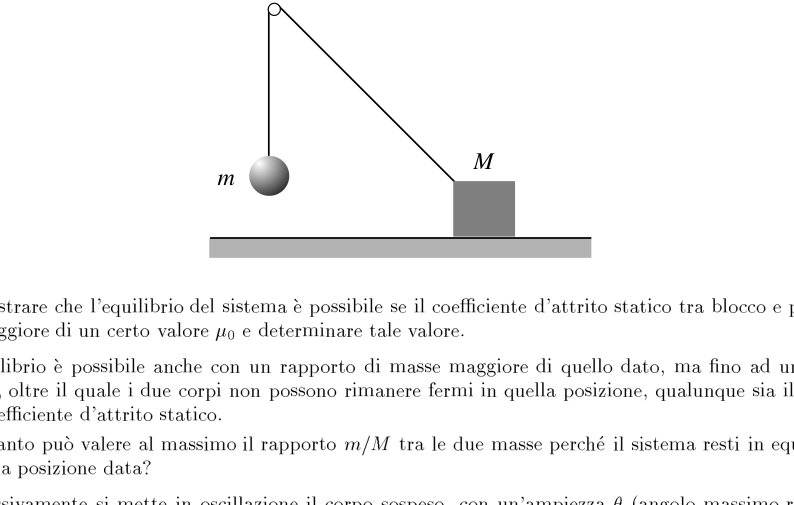 Blocco M su piano scabro con massa m sospesa
Topic: Newtonian Mechanics, Oscillations & Waves Metodi: Free-Body Diagram, Conservation of Energy Competenze: Physical Reasoning, Diagrammatic Reasoning Objects: Block, String, Pulley Fonte: Testo (PDF) — p.8 Soluzione: Soluzioni (PDF)
The following table shows the results of the calculation of the weighted average weight of the product:
A mass block , resting on a rough horizontal plane, is connected by a wire (inextensible and of negligible mass) to a second mass body . The wire is passed over a carriage placed at a certain height above the floor so that the second body remains suspended while the stretch of wire from the block to the carriage forms an angle of with the vertical. From the mere observation that the system is in balance, information can be obtained about the static friction coefficient between the block and the plane and the ratio of the two masses.
- Show that system balance is possible if the block-plane static friction coefficient is greater than a certain value and determine that value.
The equilibrium is also possible with a mass ratio greater than that given, but up to a certain limit, beyond which the two bodies cannot remain stationary in that position, whatever the value of the static friction coefficient.
- What is the maximum value of the ratio between the two masses for the system to remain in equilibrium at the given position?
The suspended body is then oscillated, with a width (maximum angle to the vertical) while the block remains stationary on the plane. Repeating the test with progressively increasing oscillation amplitudes, it is observed that for the moment the oscillating body passes to the lowest point, the block begins to move on the plane.
- Show that it is now possible to determine the value of the static friction coefficient (always in the case of ).
M block on the shallow plane with suspended mass m
Topic: Newtonian Mechanics, Oscillations & Waves Metodi: Free-Body Diagram, Conservation of Energy Competenze: Physical Reasoning, Diagrammatic Reasoning Objects: Block, String, Pulley Fonte: Testo (PDF) — p.8 Soluzione: Soluzioni (PDF)