- Quanto dista SOHO dalla Terra? Nota: assumere l’orbita della Terra come circolare. Possono essere utili i seguenti dati: • Distanza Sole - Terra m. • Rapporto fra la massa della Terra e quella del Sole . Suggerimento: ricorda che , se .
Prisma 14 punti Sia ABC la sezione normale di un prisma di vetro tale che l’angolo di vertice C valga , quelli di vertici B e A valgano ciascuno e la lunghezza del lato AC sia mm. Un raggio di luce monocromatica, per la quale l’indice di rifrazione del vetro vale , viaggia parallelamente al lato AB e colpisce la faccia AC del prisma in un punto H tale che . Il raggio uscirà da una delle altre due facce.
- Calcolare l’angolo di rifrazione del raggio dopo che esso è entrato nel prisma.
Topic: Gravitation, Geometric Optics Metodi: Newton’s Law of Gravitation, Approximation & Series Expansion, Snell’s Law Competenze: Mathematical Modeling, Physical Reasoning Objects: Planet, Prism Fonte: Testo (PDF) — p.8 Soluzione: Soluzioni (PDF)
- How far is SOHO from Earth? Note: take Earth’s orbit as a circle. The following data may be useful: • Sun-Earth distance m. • The mass ratio of the Earth to the Sun . Note: Please note that , if .
Other 14 points Whether ABC is the normal section of a glass prism such that the angle of vertices C is , those of vertices B and A are Each and the length of the AC side is mm. A radius of Monochrome light, for which the refractive index of the glass is , travels parallel to the AB side and hits the the prism AC at a point H such that . The beam It’ll come out of one of the other two faces.
- Calculate the angle of refraction of the beam after it has entered the prism.
Topic: Gravitation, Geometric Optics Metodi: Newton’s Law of Gravitation, Approximation & Series Expansion, Snell’s Law Competenze: Mathematical Modeling, Physical Reasoning Objects: Planet, Prism Fonte: Testo (PDF) — p.8 Soluzione: Soluzioni (PDF)
- Stabilire per quali valori di x il raggio esce dalla faccia AB, disegnando il suo percorso all’interno del prisma e calcolando la deviazione angolare rispetto alla direzione iniziale.
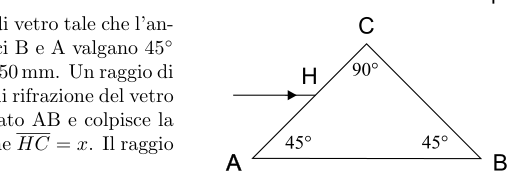 sezione prisma ABC con raggio
Topic: Geometric Optics Metodi: Ray Tracing, Snell’s Law, Vector Decomposition Competenze: Diagrammatic Reasoning, Mathematical Modeling Objects: Prism Fonte: Testo (PDF) — p.8 Soluzione: Soluzioni (PDF)
- Establish the values of x for which the radius exits the face AB, drawing its path within the prism and calculating the angular deviation from the starting direction.
*ABC prism section with radius *
Topic: Geometric Optics Metodi: Ray Tracing, Snell’s Law, Vector Decomposition Competenze: Diagrammatic Reasoning, Mathematical Modeling Objects: Prism Fonte: Testo (PDF) — p.8 Soluzione: Soluzioni (PDF)
- Stabilire per quali valori di x il raggio esce dalla faccia BC, disegnando il suo percorso all’interno del prisma e calcolando la deviazione angolare rispetto alla direzione iniziale.
Miscuglio di gas 14 punti Un recipiente con pareti termicamente isolanti è diviso in due parti uguali, ciascuna di volume , da un diaframma anch’esso isolante. Una delle due parti del recipiente contiene dell’elio (massa molare ) a 300 K e a pressione atmosferica. L’altra parte contiene del neon (massa molare ), sempre a pressione atmosferica ma a 500 K.
Topic: Geometric Optics, Thermodynamics, Kinetic Theory Metodi: Ray Tracing, Snell’s Law, Ideal Gas Law, Kinetic Theory of Gases Competenze: Diagrammatic Reasoning, Mathematical Modeling Objects: Prism, Gas, Container Fonte: Testo (PDF) — p.8 Soluzione: Soluzioni (PDF)
- Establish the values of x for which the radius exits the face BC, drawing its path within the radius prism and calculating the angular deviation from the starting direction.
Gas mixture 14 points A container with thermal insulating walls shall be divided into two equal parts, each of volume, It is also insulated by a diaphragm. One of the two parts of the container contains helium (molar mass ) at 300 K and at atmospheric pressure. The other part contains neon (molar mass) ), always at atmospheric pressure but at 500 K.
Topic: Geometric Optics, Thermodynamics, Kinetic Theory Metodi: Ray Tracing, Snell’s Law, Ideal Gas Law, Kinetic Theory of Gases Competenze: Diagrammatic Reasoning, Mathematical Modeling Objects: Prism, Gas, Container Fonte: Testo (PDF) — p.8 Soluzione: Soluzioni (PDF)
- Determinare il numero di atomi di elio e di neon e le corrispondenti velocità quadratiche medie. A un certo istante il diaframma viene rimosso e i due gas si mischiano.
Topic: Kinetic Theory, Thermodynamics Metodi: Ideal Gas Law, Kinetic Theory of Gases, Statistical Averaging Competenze: Mathematical Modeling, Physical Reasoning Objects: Gas, Atom Fonte: Testo (PDF) — p.8 Soluzione: Soluzioni (PDF)
- Determine the number of helium and neon atoms and the corresponding average square velocities. At a certain moment the diaphragm is removed and the two gases mix.
Topic: Kinetic Theory, Thermodynamics Metodi: Ideal Gas Law, Kinetic Theory of Gases, Statistical Averaging Competenze: Mathematical Modeling, Physical Reasoning Objects: Gas, Atom Fonte: Testo (PDF) — p.8 Soluzione: Soluzioni (PDF)
- Determinare la temperatura finale del miscuglio di gas.
Topic: Thermodynamics, Kinetic Theory Metodi: First Law of Thermodynamics, Ideal Gas Law, Conservation Laws Competenze: Mathematical Modeling, Physical Reasoning Objects: Gas Fonte: Testo (PDF) — p.8 Soluzione: Soluzioni (PDF)
- Determine the final temperature of the gas mixture.
Topic: Thermodynamics, Kinetic Theory Metodi: First Law of Thermodynamics, Ideal Gas Law, Conservation Laws Competenze: Mathematical Modeling, Physical Reasoning Objects: Gas Fonte: Testo (PDF) — p.8 Soluzione: Soluzioni (PDF)
- Calcolare la variazione totale di energia interna del miscuglio.
Moto di cariche in un campo magnetico 12 punti Tre particelle cariche vengono accelerate da una d.d.p. di 1000 V ed entrano, in tempi diversi e dallo stesso punto, in una zona sede di un campo magnetico uniforme mT perpendicolare alla velocità delle particelle. Le traiettorie, contrassegnate dai numeri 1, 2, 3 e relative alle tre particelle, sono riportate in figura. Il campo è uscente dal piano del foglio. Il rapporto per la particella 1 vale .
Topic: Thermodynamics, Magnetism, Conservation of Energy Metodi: First Law of Thermodynamics, Energy Conservation Method, Lorentz Force Analysis Competenze: Mathematical Modeling, Physical Reasoning Objects: Point Charge Fonte: Testo (PDF) — p.8 Soluzione: Soluzioni (PDF)
- Calculate the total change in internal energy of the mixture.
Charge motor in a magnetic field 12 points Three charged particles are accelerated by a D.D.P. The number of volts in the sample is 1000 V and they enter at different times and from the same point, in a zone where a uniform magnetic field mT is perpendicular to the speed of the The particles. Trajectories marked with the numbers 1, 2, 3 and relating to the three particles are shown in It’s a figure. The field is coming out of the sheet plane. The ratio for particle 1 is .
Topic: Thermodynamics, Magnetism, Conservation of Energy Metodi: First Law of Thermodynamics, Energy Conservation Method, Lorentz Force Analysis Competenze: Mathematical Modeling, Physical Reasoning Objects: Point Charge Fonte: Testo (PDF) — p.8 Soluzione: Soluzioni (PDF)
- Determinare il rapporto ed il segno della carica elettrica di ciascuna delle altre due particelle.
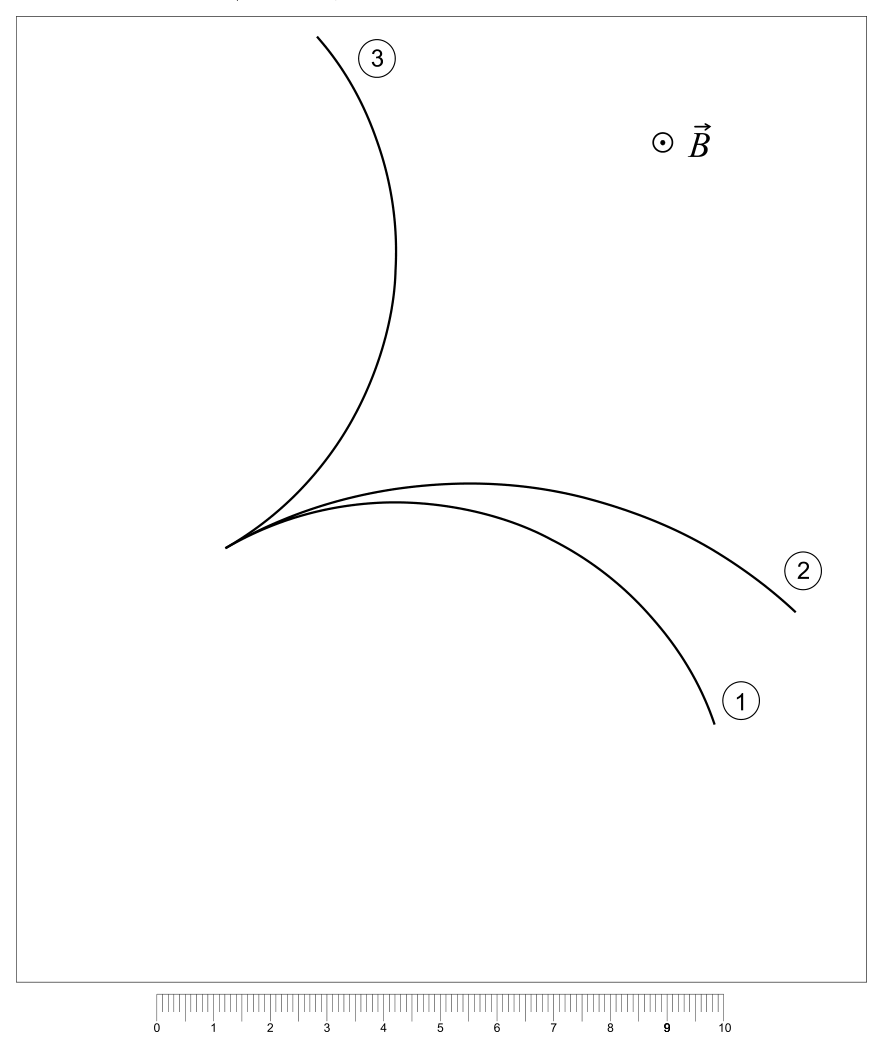 traiettorie tre cariche in campo B
Topic: Magnetism, Conservation of Energy Metodi: Lorentz Force Analysis, Energy Conservation Method, Dimensional Analysis Competenze: Diagrammatic Reasoning, Physical Reasoning, Mathematical Modeling Objects: Point Charge Fonte: Testo (PDF) — p.9 Soluzione: Soluzioni (PDF)
- Determine the ratio and the electric charge sign of each of the other two particles.
*trajectories three loads in the field B *
Topic: Magnetism, Conservation of Energy Metodi: Lorentz Force Analysis, Energy Conservation Method, Dimensional Analysis Competenze: Diagrammatic Reasoning, Physical Reasoning, Mathematical Modeling Objects: Point Charge Fonte: Testo (PDF) — p.9 Soluzione: Soluzioni (PDF)