- Indicata con la velocità di ogni automobile, determinare, in funzione di questa, di e di , la distanza di sicurezza che deve essere mantenuta da ogni automobile. Si supponga che il tratto di strada considerato, di lunghezza , contenga esattamente automobili che stanno viaggiando in sicurezza.
Topic: Newtonian Mechanics Metodi: Kinematic Equations, Free-Body Diagram, Physical Modeling Competenze: Physical Reasoning, Mathematical Modeling Objects: — Fonte: Testo (PDF) — p.8 Soluzione: Soluzioni (PDF)
- Indicated by the speed of each vehicle, determine, according to this, the distance of and The safety must be maintained by each vehicle. Assume that the road section in question, in length, contains exactly cars travelling safely.
Topic: Newtonian Mechanics Metodi: Kinematic Equations, Free-Body Diagram, Physical Modeling Competenze: Physical Reasoning, Mathematical Modeling Objects: — Fonte: Testo (PDF) — p.8 Soluzione: Soluzioni (PDF)
- Esprimere in funzione di e degli altri parametri del modello la velocità consentita in questa condizione. Calcolare e nel caso particolare . Sia il flusso automobilistico definito come dove è il numero di automobili che passano in un certo punto della strada nell’intervallo di tempo .
Topic: Newtonian Mechanics Metodi: Kinematic Equations, Physical Modeling, Dimensional Analysis Competenze: Physical Reasoning, Mathematical Modeling Objects: — Fonte: Testo (PDF) — p.8 Soluzione: Soluzioni (PDF)
- Express the speed allowed in this model according to and other model parameters condition. Calculate and in the particular case . Whether the motor vehicle flow defined as where is the number of cars passing through a certain point on the road in the time interval .
Topic: Newtonian Mechanics Metodi: Kinematic Equations, Physical Modeling, Dimensional Analysis Competenze: Physical Reasoning, Mathematical Modeling Objects: — Fonte: Testo (PDF) — p.8 Soluzione: Soluzioni (PDF)
- Qual è la velocità ottimale delle automobili, affinché sia massimo?
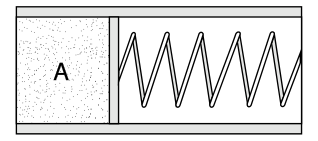 Cilindro orizzontale con pistone e molla
Topic: Newtonian Mechanics Metodi: Physical Modeling, Approximation & Series Expansion Competenze: Physical Reasoning, Mathematical Modeling Objects: — Fonte: Testo (PDF) — p.8 Soluzione: Soluzioni (PDF)
- Qual è la velocità ottimale delle automobili, affinché sia massimo?
Horizontal cylinder with piston and spring
Topic: Newtonian Mechanics Metodi: Physical Modeling, Approximation & Series Expansion Competenze: Physical Reasoning, Mathematical Modeling Objects: — Fonte: Testo (PDF) — p.8 Soluzione: Soluzioni (PDF)
- Quanto vale ? (1) In questo problema consideriamo come distanza di sicurezza la minima distanza tra la parte posteriore dell’automobile che precede e la parte anteriore dell’automobile che segue, per fare in modo che la vettura possa fermarsi senza urtare quella precedente anche nel caso teoricamente più sfavorevole di un arresto istantaneo di questa. (2) Per tempo di reazione si intende l’intervallo di tempo che trascorre dall’istante in cui si presenta un pericolo all’istante in cui l’automobilista mette in atto la corretta reazione.
Due lenti sottili su un banco ottico 8 punti Su un banco ottico ci sono due lenti sottili con gli assi coincidenti; la prima è convergente con distanza focale e diametro utile , e la seconda è divergente, dello stesso diametro. Prima della prima lente, sull’asse a distanza , viene posta una sorgente puntiforme di luce. Dopo essere passata anche attraverso la seconda lente, la luce emessa si presenta in un fascio cilindrico, parallelo all’asse, di diametro .
Topic: Newtonian Mechanics, Geometric Optics Metodi: Physical Modeling, Ray Tracing, Thin Lens & Mirror Equation Competenze: Diagrammatic Reasoning, Mathematical Modeling Objects: Lens Fonte: Testo (PDF) — p.8 Soluzione: Soluzioni (PDF)
- Quanto vale ? (1) In this problem we consider as safety distance the minimum distance between the rear The front of the preceding car and the front of the following car, so that the The vehicle can stop without impacting the previous one even in the theoretically most unfavorable case of An instant arrest of this one. (2) Reaction time is the time interval from the moment a reaction occurs. The risk of an accident is that the driver is in a position to react correctly.
Two thin lenses on an optical bench 8 points On an optical bench there are two thin lenses with parallel axes; the first is convergent with distance The focal length and the useful diameter , and the second is divergent, of the same diameter. Before the The first lens, on the distance axis, is a pointed light source. After being The light emitted is also passed through the second lens, and it appears in a cylindrical beam, parallel to the a diameter of .
Topic: Newtonian Mechanics, Geometric Optics Metodi: Physical Modeling, Ray Tracing, Thin Lens & Mirror Equation Competenze: Diagrammatic Reasoning, Mathematical Modeling Objects: Lens Fonte: Testo (PDF) — p.8 Soluzione: Soluzioni (PDF)
- Determinare la distanza focale della lente divergente.
Topic: Geometric Optics Metodi: Thin Lens & Mirror Equation, Ray Tracing Competenze: Diagrammatic Reasoning, Mathematical Modeling Objects: Lens Fonte: Testo (PDF) — p.8 Soluzione: Soluzioni (PDF)
- Determine the focal length of the divergent lens.
Topic: Geometric Optics Metodi: Thin Lens & Mirror Equation, Ray Tracing Competenze: Diagrammatic Reasoning, Mathematical Modeling Objects: Lens Fonte: Testo (PDF) — p.8 Soluzione: Soluzioni (PDF)
- Determinare la distanza fra la prima lente e la seconda.
Un gas che si espande 20 punti Un cilindro orizzontale ha l’area di base ed è diviso in due parti da un pistone perfettamente scorrevole e a tenuta. Il pistone è sottoposto, come in figura, all’azione di una molla che ha costante ; quando la molla è a riposo il pistone è in contatto con la parete sinistra del cilindro (quindi la parte A ha volume nullo). Nella parte A vengono introdotte 0.01 moli di elio e il tutto è portato alla temperatura . Nella parte del cilindro dove si trova la molla è fatto il vuoto.
Topic: Geometric Optics, Thermodynamics Metodi: Thin Lens & Mirror Equation, Ideal Gas Law, Hooke’s Law Competenze: Diagrammatic Reasoning, Mathematical Modeling Objects: Cylinder, Piston, Spring, Gas Fonte: Testo (PDF) — p.8 Soluzione: Soluzioni (PDF)
- Determine the distance between the first and second lens.
A gas that expands 20 points A horizontal cylinder has the base area and is divided in two parts by a piston perfectly It’s a slippery and tight. The piston is subjected, as shown in the figure, to the action of a spring having a constant ; when the spring is at rest the piston is in contact with the left wall of the cylinder (so part A has zero volume). In Part A, 0.01 moles of helium are introduced and the whole is brought to temperature. In the part of the cylinder where the spring is is emptied.
Topic: Geometric Optics, Thermodynamics Metodi: Thin Lens & Mirror Equation, Ideal Gas Law, Hooke’s Law Competenze: Diagrammatic Reasoning, Mathematical Modeling Objects: Cylinder, Piston, Spring, Gas Fonte: Testo (PDF) — p.8 Soluzione: Soluzioni (PDF)
- Determinare il volume e la pressione del gas. Successivamente il gas viene lentamente riscaldato fino a raddoppiare il volume iniziale.
Topic: Thermodynamics Metodi: Ideal Gas Law, Hooke’s Law, First Law of Thermodynamics Competenze: Mathematical Modeling, Physical Reasoning Objects: Gas, Cylinder, Piston, Spring Fonte: Testo (PDF) — p.9 Soluzione: Soluzioni (PDF)
- Determine the volume and pressure of the gas. The gas is then slowly heated until the initial volume doubles.
Topic: Thermodynamics Metodi: Ideal Gas Law, Hooke’s Law, First Law of Thermodynamics Competenze: Mathematical Modeling, Physical Reasoning Objects: Gas, Cylinder, Piston, Spring Fonte: Testo (PDF) — p.9 Soluzione: Soluzioni (PDF)
- Determinare la quantità di calore necessaria per il riscaldamento, trascurando la capacità termica del cilindro e del pistone, come tutte le eventuali perdite di calore verso l’esterno.
Un guasto alla linea telefonica 22 punti In un punto di una linea telefonica lunga si è prodotto un danneggiamento al rivestimento isolante dei cavi elettrici ed in conseguenza di ciò in viene a crearsi una resistenza elettrica “di fuga” tra i due fili della linea telefonica. Per individuare il punto esatto in cui è avvenuto il danneggiamento, la squadra addetta alla manutenzione collega ad un’estremità della linea una batteria con una f.e.m. e resistenza interna trascurabile. Quando la linea è aperta, cioè all’altra estremità della linea i terminali sono liberi, la corrente erogata dalla batteria è , mentre quando la linea è chiusa, cioè all’altra estremità della linea i terminali vengono cortocircuitati, la corrente erogata dalla batteria è . Esaminando i dati progettuali della linea si sa inoltre che la resistenza elettrica di un filo del cavo telefonico vale .
Topic: Thermodynamics, Circuits Metodi: First Law of Thermodynamics, Ideal Gas Law, Kirchhoff’s Laws Competenze: Mathematical Modeling, Physical Reasoning Objects: Battery, Resistor, Gas Fonte: Testo (PDF) — p.9 Soluzione: Soluzioni (PDF)
- The amount of heat required for heating, while neglecting the thermal capacity of the The cylinder and piston, as well as any heat leaks to the outside.
A phone line failure . 22 points In a point of a long telephone line damage to the coating occurred The electrical insulation of the electrical cables and as a consequence in an electrical resistance is created between the two wires of the telephone line. To determine the exact location of the damage, the maintenance team shall At one end of the line, a battery with an f.e.m. e resistenza interna trascurabile. When the line is open, i.e. at the other end of the line the terminals are free, the current delivered is The battery is , while when the line is closed, i.e. at the other end of the line the terminals are The battery is short-circuited and the current is . Examining the design data The electrical resistance of a telephone wire is also known to be .
Topic: Thermodynamics, Circuits Metodi: First Law of Thermodynamics, Ideal Gas Law, Kirchhoff’s Laws Competenze: Mathematical Modeling, Physical Reasoning Objects: Battery, Resistor, Gas Fonte: Testo (PDF) — p.9 Soluzione: Soluzioni (PDF)
- Determinare la resistenza elettrica “di fuga” in tra i fili del cavo telefonico.
Topic: Circuits Metodi: Kirchhoff’s Laws, Equivalent Circuit Reduction Competenze: Diagrammatic Reasoning, Mathematical Modeling Objects: Resistor, Wire Fonte: Testo (PDF) — p.9 Soluzione: Soluzioni (PDF)
- Determine the electrical resistance of leakage in between the wires of the telephone cable.
Topic: Circuits Metodi: Kirchhoff’s Laws, Equivalent Circuit Reduction Competenze: Diagrammatic Reasoning, Mathematical Modeling Objects: Resistor, Wire Fonte: Testo (PDF) — p.9 Soluzione: Soluzioni (PDF)
- Determinare la posizione esatta del punto lungo la linea telefonica. Individuato il punto il danno viene riparato dalla squadra addetta alla manutenzione della linea, ma per un maldestro errore l’isolamento non viene ripristinato correttamente e tra i due cavi elettrici permane una resistenza di fuga residua pari a . Una linea telefonica funziona in modo tale che una comunicazione telefonica o risulta disturbata o al limite impossibile da farsi, se ai due terminali d’ingresso di un telefono la differenza di potenziale “portata” dalla linea telefonica risulta inferiore al valore di progetto. Tuttavia una comunicazione telefonica può ancora avvenire senza eccessivi disturbi se la differenza di potenziale ai capi del telefono non è inferiore al 95% della differenza di potenziale di progetto.
Topic: Circuits Metodi: Kirchhoff’s Laws, Equivalent Circuit Reduction Competenze: Diagrammatic Reasoning, Mathematical Modeling, Physical Reasoning Objects: Resistor, Wire Fonte: Testo (PDF) — p.9 Soluzione: Soluzioni (PDF)
- Determine the exact position of the point along the telephone line. If is detected, the damage is repaired by the line maintenance team, but for A blurry error. The insulation is not restored properly and the electrical wires remain between the two. a residual leakage resistance of . A telephone line operates in such a way that telephone communication is either disrupted or at the limit This is impossible if the difference in the potential of a telephone’s two terminal entrances is the telephone line is less than the project value. However, telephone communication can be still occur without excessive disturbance if the potential difference to the phone heads is not less 95% of the project potential difference.
Topic: Circuits Metodi: Kirchhoff’s Laws, Equivalent Circuit Reduction Competenze: Diagrammatic Reasoning, Mathematical Modeling, Physical Reasoning Objects: Resistor, Wire Fonte: Testo (PDF) — p.9 Soluzione: Soluzioni (PDF)
- Schematizzando il telefono come un oggetto dotato di una resistenza elettrica , determinare se dopo la maldestra riparazione del danno all’isolamento dei cavi elettrici è di nuovo possibile effettuare una comunicazione telefonica senza eccessivi disturbi.
Topic: Circuits Metodi: Kirchhoff’s Laws, Equivalent Circuit Reduction Competenze: Diagrammatic Reasoning, Mathematical Modeling Objects: Resistor Fonte: Testo (PDF) — p.9 Soluzione: Soluzioni (PDF)
- By schematizing the phone as an object with an electrical resistance , determine If after the damage has been repaired, the electrical cable insulation can be re-used. a telephone communication without excessive interference.
Topic: Circuits Metodi: Kirchhoff’s Laws, Equivalent Circuit Reduction Competenze: Diagrammatic Reasoning, Mathematical Modeling Objects: Resistor Fonte: Testo (PDF) — p.9 Soluzione: Soluzioni (PDF)