In alcuni esperimenti la luce di un laser è stata inviata su un riflettore collocato sulla Luna in modo che essa torni sulla Terra. Dal tempo che impiega ad andare e tornare indietro si può valutare con notevole accuratezza la distanza Terra-Luna, o più esattamente la distanza fra osservatorio terrestre e riflettore lunare.
- Dare una stima dell’errore che si commette sulla distanza così determinata se la velocità di propagazione della luce si considera costante per tutto il percorso e pari a , senza tener conto della presenza dell’atmosfera.
Per semplicità si consideri la Luna allo Zenit dell’osservatorio e l’atmosfera come uno strato uniforme di spessore e di indice di rifrazione .
Topic: Geometric Optics, Order-of-Magnitude Estimation Metodi: Snell’s Law, Order-of-Magnitude Estimation, Approximation & Series Expansion Competenze: Error Propagation, Estimation & Approximation, Physical Reasoning Objects: Planet, Satellite Fonte: Testo (PDF) — p.3 Soluzione: Soluzioni (PDF)
In some experiments, the light from a laser was sent to a reflector placed on the Moon so that it would return to Earth. From the time it takes to go back and forth, the distance from Earth to the Moon, or more accurately, the distance between the Earth’s observatory and the lunar reflector, can be estimated with remarkable accuracy.
- To give an estimate of the error that is committed at such a distance if the speed of light propagation is considered constant throughout the path and equal to , regardless of the presence of the atmosphere.
For simplicity, consider the Moon at the Zenit of the observatory and the atmosphere as a uniform layer of thickness and refractive index.
Topic: Geometric Optics, Order-of-Magnitude Estimation Metodi: Snell’s Law, Order-of-Magnitude Estimation, Approximation & Series Expansion Competenze: Error Propagation, Estimation & Approximation, Physical Reasoning Objects: Planet, Satellite Fonte: Testo (PDF) — p.3 Soluzione: Soluzioni (PDF)
Ad un estremo di una molla di costante elastica e lunghezza a riposo viene collegata una massa rispetto alla quale la massa della molla è trascurabile.
- Se il sistema massa-molla viene fatto ruotare uniformemente a velocità angolare , su un piano orizzontale intorno all’altro estremo della molla, mantenuto fisso, quanto vale la lunghezza della molla?
Topic: Newtonian Mechanics, Oscillations & Waves Metodi: Free-Body Diagram, Hooke’s Law, Kinematic Equations Competenze: Mathematical Modeling, Physical Reasoning Objects: Spring, Block Fonte: Testo (PDF) — p.3 Soluzione: Soluzioni (PDF)
At one end of a spring of constant elasticity and rest length a mass is attached with respect to which the mass of the spring is negligible.
- If the mass-spring system is rotated uniformly at angular speed , on a horizontal plane around the other end of the spring, while maintaining a fixed position, what is the length of the spring?
Topic: Newtonian Mechanics, Oscillations & Waves Metodi: Free-Body Diagram, Hooke’s Law, Kinematic Equations Competenze: Mathematical Modeling, Physical Reasoning Objects: Spring, Block Fonte: Testo (PDF) — p.3 Soluzione: Soluzioni (PDF)
Un condensatore di capacità elettrica è caricato ad una differenza di potenziale e successivamente isolato. Un secondo condensatore, inizialmente scarico e di capacità elettrica , viene collegato in parallelo al primo.
- Indicata con la differenza di potenziale elettrico presente ai capi dei due condensatori così collegati, quanto vale ?
Topic: Electrostatics, Circuits Metodi: Conservation Laws, Electric Potential Method Competenze: Mathematical Modeling, Physical Reasoning Objects: Capacitor Fonte: Testo (PDF) — p.4 Soluzione: Soluzioni (PDF)
A capacitor of electrical capacity is charged at a potential difference and subsequently isolated. A second capacitor, initially discharged and with an electrical capacity , is connected in parallel to the first.
- Indicated by the difference in electrical potential present in the heads of the two capacitors so connected, what is ?
Topic: Electrostatics, Circuits Metodi: Conservation Laws, Electric Potential Method Competenze: Mathematical Modeling, Physical Reasoning Objects: Capacitor Fonte: Testo (PDF) — p.4 Soluzione: Soluzioni (PDF)
Un’automobile con il motorino di avviamento guasto è parcheggiata in un tratto piano di strada rettilinea. Due persone si offrono di spingerla sviluppando complessivamente una forza di . La massa dell’automobile, compreso l’automobilista, è di . L’attrito produce complessivamente una resistenza che si può stimare in .
- Se per riavviare il motore è necessario che l’automobile abbia raggiunto una velocità minima di , dopo quanto tempo dall’inizio della spinta l’automobilista può rilasciare il piede dalla frizione?
Topic: Newtonian Mechanics Metodi: Free-Body Diagram, Kinematic Equations Competenze: Unit Conversion, Physical Reasoning Objects: Cart Fonte: Testo (PDF) — p.4 Soluzione: Soluzioni (PDF)
A car with a faulty starter motor is parked on a straight road. Two people offer to push it by developing a force of overall. The mass of the vehicle, including the driver, is . The total strength of friction is estimated at .
- If the vehicle has to reach a minimum speed of to restart the engine, after how long after the start of the drive the driver can release the foot from the clutch?
Topic: Newtonian Mechanics Metodi: Free-Body Diagram, Kinematic Equations Competenze: Unit Conversion, Physical Reasoning Objects: Cart Fonte: Testo (PDF) — p.4 Soluzione: Soluzioni (PDF)
Un cilindro chiuso da un pistone mobile contiene di vapore acqueo alla temperatura di . Il vapore viene compresso isotermicamente.
- Sapendo che a quella temperatura la densità di vapor saturo vale , determinare quanto vale il volume quando il vapore inizia a condensare.
Topic: Thermodynamics Metodi: Ideal Gas Law, Physical Modeling Competenze: Mathematical Modeling, Physical Reasoning Objects: Gas, Cylinder, Piston Fonte: Testo (PDF) — p.4 Soluzione: Soluzioni (PDF)
A cylinder closed by a moving piston contains of water vapour at a temperature of . The steam is isothermally compressed.
- Knowing that at that temperature the saturated vapor density is , determine the volume value when the vapor begins to condense.
Topic: Thermodynamics Metodi: Ideal Gas Law, Physical Modeling Competenze: Mathematical Modeling, Physical Reasoning Objects: Gas, Cylinder, Piston Fonte: Testo (PDF) — p.4 Soluzione: Soluzioni (PDF)
Nel tratto di circuito rappresentato in figura, l’amperometro A misura una corrente ed il voltmetro V una differenza di potenziale .
- Trovare il valore della resistenza , se la resistenza interna del voltmetro è .
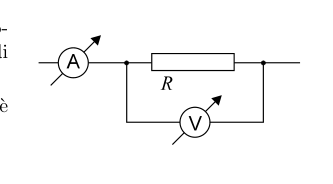 Amperometro A in serie, seguito dal parallelo tra la resistenza incognita e il voltmetro V.
Topic: Circuits Metodi: Kirchhoff’s Laws, Equivalent Circuit Reduction Competenze: Measurement & Instrumentation, Mathematical Modeling Objects: Resistor, Galvanometer Fonte: Testo (PDF) — p.4 Soluzione: Soluzioni (PDF)
In the circuit shown in Figure A, the amperometer A measures a current and the voltmeter V a potential difference .
- Find the resistance if the internal resistance of the voltmeter is .
Serial A-Amperometer followed by the parallel between the unknown resistance and the voltmeter V.
Topic: Circuits Metodi: Kirchhoff’s Laws, Equivalent Circuit Reduction Competenze: Measurement & Instrumentation, Mathematical Modeling Objects: Resistor, Galvanometer Fonte: Testo (PDF) — p.4 Soluzione: Soluzioni (PDF)
Gravimetro a molla in ascensore in partenza
Un misuratore di gravità (gravimetro) può essere costituito, nella forma più semplice, da una molla tenuta verticalmente alla quale è appeso un oggetto che, a riposo, ne determina l’allungamento. Carlo possiede un gravimetro e lo porta in ascensore. L’allungamento della molla quando l’ascensore parte è pari ai di quello osservabile con l’ascensore fermo.
- Se la massa di Carlo è , calcolare la forza esercitata dall’ascensore sui piedi di Carlo nel momento in cui parte.
Topic: Newtonian Mechanics Metodi: Free-Body Diagram, Hooke’s Law Competenze: Diagrammatic Reasoning, Mathematical Modeling Objects: Spring, Block Fonte: Testo (PDF) — p.4 Soluzione: Soluzioni (PDF)
**Spring gravity meter in the lift starting **
A gravity meter (gravimeter) may be made up, in its simplest form, of a spring held vertically to which an object is suspended, which, at rest, determines its elongation. Carlo owns a gravimetric and carries it in an elevator. The elongation of the spring when the lift is started is equal to of that observed with the stationary lift.
- If the mass of Carlo is , calculate the force exerted by the elevator on Carlo’s feet as it starts.
Topic: Newtonian Mechanics Metodi: Free-Body Diagram, Hooke’s Law Competenze: Diagrammatic Reasoning, Mathematical Modeling Objects: Spring, Block Fonte: Testo (PDF) — p.4 Soluzione: Soluzioni (PDF)
La velocità di propagazione di onde lunghe in acque poco profonde (più dell’ampiezza dell’onda ma meno della sua lunghezza d’onda) è data con discreta approssimazione da dove è la profondità del fondale.
In una certa zona, in mare aperto, il fondale può essere schematizzato da due piani orizzontali, uno profondo e l’altro profondo , collegati fra loro da una scarpata di andamento pressoché rettilineo, che va da NE a SW. Delle onde si propagano nella zona dove il fondale è più profondo, in direzione N.
- In quale direzione si propagheranno queste onde dopo aver oltrepassato la scarpata, sul fondale meno profondo?
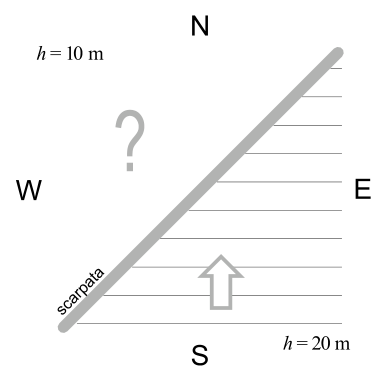 Schema con assi N–S ed E–W; scarpata diagonale NE–SW che separa il fondale (in basso, S) dal fondale (in alto, N); onde incidenti che procedono verso N.
Topic: Oscillations & Waves, Geometric Optics Metodi: Snell’s Law, Physical Modeling, Vector Decomposition Competenze: Mathematical Modeling, Physical Reasoning, Diagrammatic Reasoning Objects: — Fonte: Testo (PDF) — p.5 Soluzione: Soluzioni (PDF)
La velocità di propagazione di onde lunghe in acque poco profonde (più dell’ampiezza dell’onda ma meno della sua lunghezza d’onda) è data con discreta approssimazione da where is the depth of the bottom.
In a certain area, in the open sea, the bottom can be outlined by two horizontal planes, one deep and the other deep , connected by a nearly straight line running from NE to SW. The waves propagate to the area where the bottom is deeper, in the direction N.
- Which way will these waves propagate after they have passed the shoe, to the shallower bottom?
Schema with NS and EW axes; NESW diagonal shear separating the bottom (below, S) from the bottom (above, N); incident waves moving towards N.
Topic: Oscillations & Waves, Geometric Optics Metodi: Snell’s Law, Physical Modeling, Vector Decomposition Competenze: Mathematical Modeling, Physical Reasoning, Diagrammatic Reasoning Objects: — Fonte: Testo (PDF) — p.5 Soluzione: Soluzioni (PDF)
Da un rubinetto, un getto d’acqua scende verticalmente con una sezione circolare di di diametro. Più sotto, ad una distanza di , il diametro del getto è diventato .
- Sapendo che il flusso è stazionario, qual è la velocità con cui l’acqua esce dal rubinetto?
Topic: Fluid Mechanics Metodi: Continuity Equation, Bernoulli’s Equation, Kinematic Equations Competenze: Mathematical Modeling, Physical Reasoning Objects: — Fonte: Testo (PDF) — p.5 Soluzione: Soluzioni (PDF)
From a tap, a water jet descends vertically with a circular section of in diameter. Further down, at a distance of , the diameter of the jet became .
- Knowing the flow is stationary, how fast does the water come out of the tap?
Topic: Fluid Mechanics Metodi: Continuity Equation, Bernoulli’s Equation, Kinematic Equations Competenze: Mathematical Modeling, Physical Reasoning Objects: — Fonte: Testo (PDF) — p.5 Soluzione: Soluzioni (PDF)
L’ammoniaca è un composto di idrogeno ed azoto; alla pressione atmosferica e alla temperatura ambiente di ha una densità di e può essere ragionevolmente trattata come un gas perfetto. La massa molare dell’idrogeno atomico (H) è ; quella dell’azoto atomico (N) è .
- Mostrare che con questi dati è possibile ricavare la nota composizione chimica dell’ammoniaca.
Topic: Thermodynamics, Kinetic Theory Metodi: Ideal Gas Law, Dimensional Analysis Competenze: Mathematical Modeling, Physical Reasoning Objects: Gas Fonte: Testo (PDF) — p.5 Soluzione: Soluzioni (PDF)
Ammonia is a compound of hydrogen and nitrogen; at atmospheric pressure and room temperature of it has a density of and can reasonably be treated as a perfect gas. The molar mass of the atomic hydrogen (H) is ; that of the atomic nitrogen (N) is .
- To show that this data can be used to obtain the known chemical composition of ammonia.
Topic: Thermodynamics, Kinetic Theory Metodi: Ideal Gas Law, Dimensional Analysis Competenze: Mathematical Modeling, Physical Reasoning Objects: Gas Fonte: Testo (PDF) — p.5 Soluzione: Soluzioni (PDF)
Un’automobile ha una massa (comprensiva di passeggeri e bagaglio) di . La distanza tra gli assi delle ruote è di e il baricentro si trova a dall’asse delle ruote anteriori, ad un’altezza di dal suolo. L’automobile sta viaggiando su un tratto rettilineo di una strada orizzontale, a velocità costante; la velocità non è elevata, cosicché in tutte le domande si può trascurare l’attrito dell’aria.
- Calcolare il modulo della forza normale al piano stradale che questo esercita complessivamente sulle due ruote anteriori e su quelle posteriori.
- Ad un certo istante l’automobile frena con un’accelerazione (in modulo) di . Calcolare il modulo della forza frenante complessiva che la strada esercita sull’automobile.
- Calcolare il modulo della forza normale complessiva che la strada esercita, durante la frenata, sulle due ruote anteriori e su quelle posteriori.
- Supponendo che gli ammortizzatori anteriori si comportino come molle, calcolarne la costante elastica, sapendo che durante la frenata si comprimono di in più rispetto all’andatura a velocità costante, considerando che la forza normale si ripartisce in modo uguale tra le due ruote anteriori.
Topic: Newtonian Mechanics, Rigid Body Statics Metodi: Free-Body Diagram, Torque & Angular Momentum Analysis, Hooke’s Law Competenze: Diagrammatic Reasoning, Mathematical Modeling, Physical Reasoning Objects: Cart, Spring, Wheel Fonte: Testo (PDF) — p.6 Soluzione: Soluzioni (PDF)
A vehicle has a mass (including passengers and luggage) of . The distance between the wheels axles is and the centre of the axle is from the front wheel axle, at a height of from the ground. The car is travelling on a straight line of a horizontal road at a constant speed; the speed is not high, so that in all questions the friction of the air can be overlooked.
- Calculate the shape of the normal force on the road surface that it exerted on the two front and rear wheels as a whole.
- At a certain moment the vehicle brakes with an acceleration (in the form) of . Calculate the form of the overall braking force exerted by the road on the vehicle.
- Calculate the form of the overall normal force exerted by the road during braking on the front and rear wheels.
- Assuming that the front shock absorbers behave as springs, calculate their elastic constant, knowing that they compress more during braking than they do at constant speed, considering that the normal force is evenly distributed between the two front wheels.
Topic: Newtonian Mechanics, Rigid Body Statics Metodi: Free-Body Diagram, Torque & Angular Momentum Analysis, Hooke’s Law Competenze: Diagrammatic Reasoning, Mathematical Modeling, Physical Reasoning Objects: Cart, Spring, Wheel Fonte: Testo (PDF) — p.6 Soluzione: Soluzioni (PDF)
Il calorimetro di Favre-Silbermann
Il calorimetro di Favre e Silbermann funziona come un grosso termometro a mercurio con un bulbo cilindrico B ben isolato e un cannello C graduato in joule o calorie anziché in gradi. Nella cavità cilindrica A, di raggio e altezza , viene alloggiato un provettone con il materiale da studiare; il recipiente cilindrico B, di raggio e altezza , è riempito di mercurio; C è un cannello graduato di raggio e V è una vite di azzeramento.
- Se il mercurio è a e nel provettone vengono messi d’acqua a , qual è la temperatura di equilibrio del sistema?
- La colonnina di mercurio nel cannello C si allunga di ; determinare il coefficiente di dilatazione termica cubica del mercurio.
- In una misura del calore specifico di un liquido (stesse condizioni iniziali) si ottiene . Calcolare il calore specifico del liquido.
- Mostrare che è possibile tarare in joule la scala ottenendo una relazione lineare. Trovare il passo della scala (joule per centimetro).
Dati: ; .
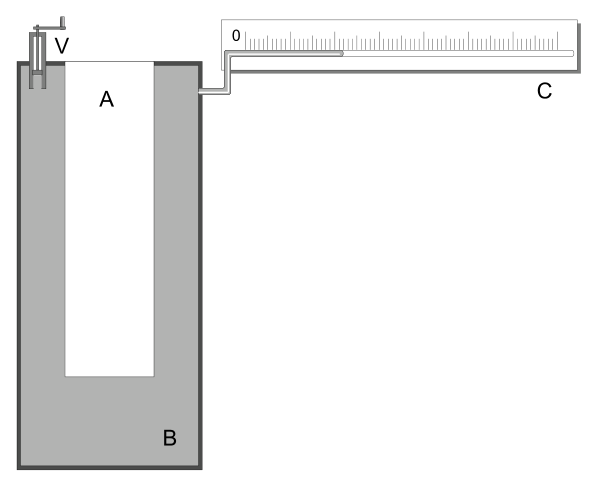 Schema del calorimetro — cavità A centrale, bulbo B di mercurio attorno, cannello graduato orizzontale C in alto a destra, vite V di azzeramento.
Topic: Thermodynamics Metodi: Energy Conservation Method, Physical Modeling, Graph Linearization Competenze: Measurement & Instrumentation, Graph Linearization, Mathematical Modeling Objects: Calorimeter Fonte: Testo (PDF) — p.7 Soluzione: Soluzioni (PDF)
Il calorimetro di Favre-Silbermann
The Favre and Silbermann calorimeter works like a large mercury thermometer with a well-insulated cylindrical B bulb and a C-camel graded in joules or calories instead of degrees. In the cylindrical cavity A, radius and height , a proton with the material to be studied is housed; the cylindrical container B, radius and height , is filled with mercury; C is a graded cannel radius and V is a screw of zeros.
- If the mercury is and of water is put into the sample at , what is the system equilibrium temperature?
- The mercury column in cannula C lengthens by ; determine the cubic thermal dilation coefficient of mercury.
- In a specific heat measurement of a liquid (the same initial conditions) is obtained. Calculate the specific heat of the liquid.
- Show that you can scale in joules by getting a linear relationship. Find the scale step (joule per centimeter).
Dati: ; .
Calorimetric scheme central cavity A, bulb B surrounding mercury, horizontal graded channel C at the top right, screw V of zeroing.
Topic: Thermodynamics Metodi: Energy Conservation Method, Physical Modeling, Graph Linearization Competenze: Measurement & Instrumentation, Graph Linearization, Mathematical Modeling Objects: Calorimeter Fonte: Testo (PDF) — p.7 Soluzione: Soluzioni (PDF)
Due piccole sfere conduttrici identiche di raggio , poste alle estremità di una sottile asticella isolante di lunghezza , vengono caricate con cariche e (). L’asticella ha resistività elettrica ; di conseguenza si ha uno spostamento di carica fino all’equilibrio, in cui le cariche valgono e .
- Sapendo che la sezione dell’asticella è e la lunghezza è , determinare la corrente che scorre inizialmente tra le due sferette.
- Detto e supposto noto il tempo finito di scarica, esprimere il valore medio della corrente in questo intervallo.
- Scrivere l’espressione della variazione di energia elettrostatica del sistema.
- Usando la conservazione dell’energia e approssimando la corrente istantanea con quella media, stimare l’ordine di grandezza di con: ; ; ; .
Topic: Electrostatics, Circuits Metodi: Coulomb’s Law, Energy Conservation Method, Order-of-Magnitude Estimation Competenze: Mathematical Modeling, Estimation & Approximation, Physical Reasoning Objects: Conducting Sphere, Rod Fonte: Testo (PDF) — p.8 Soluzione: Soluzioni (PDF)
Two small identical conductive spheres of radius, placed at the ends of a thin insulating blade of length, are loaded with and loads (). The steering wheel has an electrical resistivity ; thus a charge shift to equilibrium is achieved, where the charges are and .
- Knowing that the section of the glass is and the length is , determine the current that initially flows between the two spheres.
- If is given and the time of discharge is assumed to be known, the mean current value in this range is expressed.
- Write the expression of the system’s electrostatic energy change .
- Using energy conservation and approximating the instantaneous current to that average, estimate the order of magnitude of with: ; ; ; .
Topic: Electrostatics, Circuits Metodi: Coulomb’s Law, Energy Conservation Method, Order-of-Magnitude Estimation Competenze: Mathematical Modeling, Estimation & Approximation, Physical Reasoning Objects: Conducting Sphere, Rod Fonte: Testo (PDF) — p.8 Soluzione: Soluzioni (PDF)