La lancetta dei minuti di un orologio a muro è lunga e la sua punta si muove 18 volte più velocemente della punta della lancetta delle ore.
- Quanto è lunga la lancetta delle ore?
Topic: Oscillations & Waves Metodi: Superposition Principle, Wave Equation Competenze: Physical Reasoning, Mathematical Modeling Objects: — Fonte: Testo (PDF) — p.2 Soluzione: Soluzioni (PDF)
The minute tip of a wall clock is long and its tip moves 18 times faster than the tip of the clock tip.
- How long is the hourly rate?
Topic: Oscillations & Waves Metodi: Superposition Principle, Wave Equation Competenze: Physical Reasoning, Mathematical Modeling Objects: — Fonte: Testo (PDF) — p.2 Soluzione: Soluzioni (PDF)
In un recipiente vengono mescolati di acqua con di alcool (etanolo). In un secondo recipiente vengono mescolati di acqua con di alcool.
- Quale miscela ha la maggiore densità?
I valori delle densità possono essere trovati nelle tabelle a pagina 5.
Nota: Sperimentalmente si osserva che il volume di una miscela di acqua e etanolo risulta minore della somma dei volumi impiegati di circa il ; tuttavia qui si chiede di trascurare questo effetto.
Topic: Oscillations & Waves Metodi: Superposition Principle, Wave Equation Competenze: Physical Reasoning, Mathematical Modeling Objects: Container Fonte: Testo (PDF) — p.2 Soluzione: Soluzioni (PDF)
In a container of water is mixed with of alcohol (ethanol). In a second container of water is mixed with of alcohol.
Which mixture has the highest density?
The density values can be found in the tables on page 5.
Note: Experimentally, the volume of a mixture of water and ethanol is less than the sum of the volumes used by about ; however, this effect is to be overlooked.
Topic: Oscillations & Waves Metodi: Superposition Principle, Wave Equation Competenze: Physical Reasoning, Mathematical Modeling Objects: Container Fonte: Testo (PDF) — p.2 Soluzione: Soluzioni (PDF)
All’inizio di un esperimento una bombola di elio è alla temperatura di . Alla fine dell’esperimento la pressione nel recipiente è diminuita del e la temperatura vale .
- Quale frazione dell’elio inizialmente contenuto nella bombola è stata impiegata nell’esperimento?
Topic: Oscillations & Waves Metodi: Superposition Principle, Wave Equation, Simple Harmonic Motion Analysis Competenze: Mathematical Modeling, Physical Reasoning Objects: Gas, Cylinder Fonte: Testo (PDF) — p.3 Soluzione: Soluzioni (PDF)
At the beginning of an experiment, a helium pump is at . At the end of the experiment the pressure in the container decreased by and the temperature was .
- What fraction of the helium originally contained in the flask was used in the experiment?
Topic: Oscillations & Waves Metodi: Superposition Principle, Wave Equation, Simple Harmonic Motion Analysis Competenze: Mathematical Modeling, Physical Reasoning Objects: Gas, Cylinder Fonte: Testo (PDF) — p.3 Soluzione: Soluzioni (PDF)
Un gas perfetto monoatomico si espande a pressione costante e la sua energia interna aumenta di .
- Quanto calore assorbe il gas?
Topic: Oscillations & Waves Metodi: Superposition Principle, Wave Equation Competenze: Physical Reasoning, Mathematical Modeling Objects: Gas Fonte: Testo (PDF) — p.3 Soluzione: Soluzioni (PDF)
A perfect monoatomic gas expands at constant pressure and its internal energy increases by .
- How much heat does the gas absorb?
Topic: Oscillations & Waves Metodi: Superposition Principle, Wave Equation Competenze: Physical Reasoning, Mathematical Modeling Objects: Gas Fonte: Testo (PDF) — p.3 Soluzione: Soluzioni (PDF)
Una particella elettrica di carica e massa viene lasciata libera da un punto posto a metà tra le due facce di un condensatore piano mantenuto a una differenza di potenziale costante , come mostrato in figura. La particella è soggetta sia alla forza elettrica che alla forza gravitazionale.
- A quale distanza verticale dal punto deve essere praticato un foro su una faccia del condensatore in modo che la particella carichi ci passi attraverso?
Valori numerici: , , , .
p.3 — Condensatore piano con carica e punto P
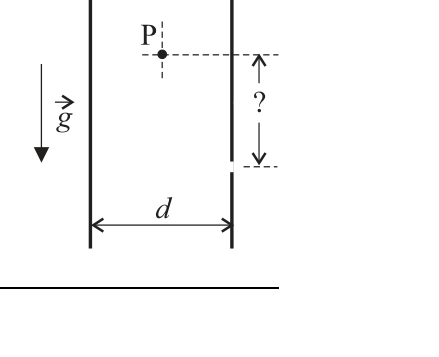
Topic: Newtonian Mechanics, Rigid Body Statics Metodi: Free-Body Diagram, Vector Decomposition, Small-Angle Approximation Competenze: Physical Reasoning, Mathematical Modeling Objects: Point Charge, Capacitor Fonte: Testo (PDF) — p.3 Soluzione: Soluzioni (PDF)
An electric charge particle and mass is released from a point placed halfway between the two faces of a flat capacitor maintained at a constant potential difference , as shown in Figure 1. The particle is subject to both electrical force and gravitational force.
- A quale distanza verticale dal punto deve essere praticato un foro su una faccia del condensatore in modo che la particella carichi ci passi attraverso?
Valori numerici: , , , .
**p.3 ** Flat-loaded and P-point capacitor
Topic: Newtonian Mechanics, Rigid Body Statics Metodi: Free-Body Diagram, Vector Decomposition, Small-Angle Approximation Competenze: Physical Reasoning, Mathematical Modeling Objects: Point Charge, Capacitor Fonte: Testo (PDF) — p.3 Soluzione: Soluzioni (PDF)
Sia la focale di una lente sottile. A distanza da questa lente, sullo stesso asse ottico, si dispone una seconda lente di focale pari a . Una sorgente puntiforme all’infinito è posta sull’asse ottico, a sinistra del sistema delle due lenti, come mostrato in figura.
- Attraverso una costruzione geometrica, o in alternativa con una soluzione analitica, si determini a che distanza dalla seconda lente si forma l’immagine della sorgente.
p.3 — Sistema di due lenti sottili sull’asse ottico
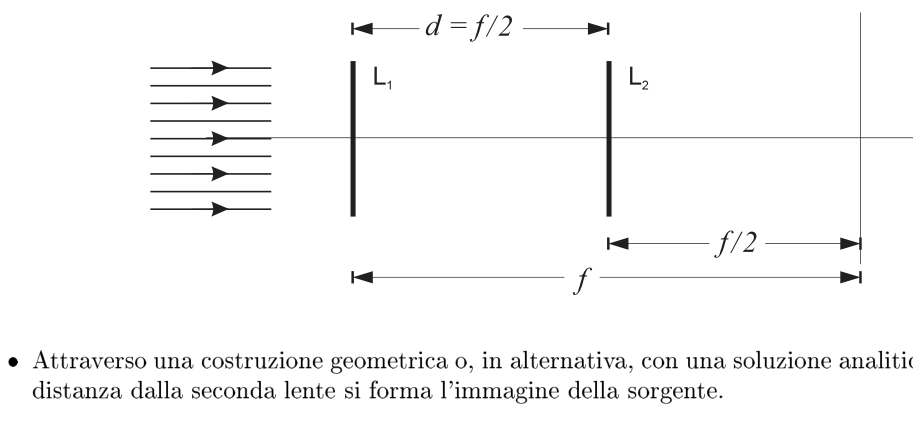
Topic: Newtonian Mechanics, Rigid Body Statics Metodi: Free-Body Diagram, Small-Angle Approximation, Approximation & Series Expansion Competenze: Mathematical Modeling, Physical Reasoning, Estimation & Approximation Objects: Lens Fonte: Testo (PDF) — p.3 Soluzione: Soluzioni (PDF)
Sia la focale di una lente sottile. At distance from this lens, on the same optical axis, a second focal length of is available. An infinitely pointed source is placed on the optical axis, to the left of the two lens system, as shown in the figure.
- By means of a geometric construction, or alternatively by means of an analytical solution, the distance from the second lens is determined for the image of the source.
**p.3 ** Two thin lens system on the optical axis
Topic: Newtonian Mechanics, Rigid Body Statics Metodi: Free-Body Diagram, Small-Angle Approximation, Approximation & Series Expansion Competenze: Mathematical Modeling, Physical Reasoning, Estimation & Approximation Objects: Lens Fonte: Testo (PDF) — p.3 Soluzione: Soluzioni (PDF)
Per un esame diagnostico della tiroide viene somministrata a un paziente una sostanza contenente dell’isotopo radioattivo . La metà dello iodio somministrato viene assorbita dalla tiroide, mentre l’altra metà viene espulsa dall’organismo entro 24 ore. Il tempo di dimezzamento dell’isotopo radioattivo è di 8 giorni.
- Quanto iodio rimane nella tiroide dopo 4 giorni?
Topic: Electrostatics, Circuits Metodi: Gauss’s Law, Electric Potential Method, Equivalent Circuit Reduction Competenze: Physical Reasoning, Mathematical Modeling Objects: Nucleus Fonte: Testo (PDF) — p.4 Soluzione: Soluzioni (PDF)
For a diagnostic test of the thyroid, a substance containing of the radioactive isotope is given to a patient. Half of the iodine is absorbed by the thyroid, while the other half is excreted within 24 hours. The half-life of the radioactive isotope is 8 days.
How much iodine is left in the thyroid after four days?
Topic: Electrostatics, Circuits Metodi: Gauss’s Law, Electric Potential Method, Equivalent Circuit Reduction Competenze: Physical Reasoning, Mathematical Modeling Objects: Nucleus Fonte: Testo (PDF) — p.4 Soluzione: Soluzioni (PDF)
Una lampada (puntiforme e isotropa) da è posta lungo l’asse di una superficie quadrata di lato , a distanza dal suo centro; la superficie assorbe interamente la luce che incide su di essa.
- Calcolare l’energia assorbita dalla superficie quadrata in un’ora.
p.4 — Lampada sopra superficie quadrata di lato 2a
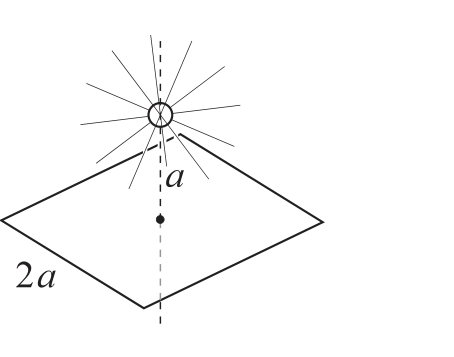
Topic: Electrostatics, Circuits Metodi: Gauss’s Law, Electric Potential Method, Equivalent Circuit Reduction Competenze: Physical Reasoning, Mathematical Modeling, Diagrammatic Reasoning Objects: Screen Fonte: Testo (PDF) — p.4 Soluzione: Soluzioni (PDF)
A point-and-isotropic lamp shall be placed along the axis of a square side surface , at a distance from its centre; the surface shall absorb the light which hits it entirely.
Calculate the energy absorbed by the square in an hour.
**p.4 ** Lamp above square surface of side 2a
Topic: Electrostatics, Circuits Metodi: Gauss’s Law, Electric Potential Method, Equivalent Circuit Reduction Competenze: Physical Reasoning, Mathematical Modeling, Diagrammatic Reasoning Objects: Screen Fonte: Testo (PDF) — p.4 Soluzione: Soluzioni (PDF)
Un alto cilindro è riempito di un certo liquido. Una sferetta di densità è immersa nel liquido a fondo, mentre una seconda sferetta, di dimensioni uguali alla prima, e densità galleggia. Nell’ipotesi che i tempi in cui le sferette sono accelerate siano trascurabili, si osserva che il tempo necessario alla prima per raggiungere il fondo partendo dalla superficie del liquido è uguale al tempo che la seconda impiega per raggiungere la superficie staccandosi dal fondo.
- Determinare la densità del liquido.
Topic: Electrostatics, Circuits Metodi: Gauss’s Law, Electric Potential Method, Experimental Data Analysis Competenze: Physical Reasoning, Mathematical Modeling, Experimental Data Analysis Objects: Container, Sphere Fonte: Testo (PDF) — p.4 Soluzione: Soluzioni (PDF)
A high cylinder is filled with a certain liquid. A sphere of density is immersed in the liquid at the bottom, while a second sphere, of equal size to the first, and density floats. If the spheres are accelerated at negligible times, the time taken by the first to reach the bottom from the surface of the liquid is equal to the time taken by the second to reach the surface from the bottom.
Determine the density of the liquid.
Topic: Electrostatics, Circuits Metodi: Gauss’s Law, Electric Potential Method, Experimental Data Analysis Competenze: Physical Reasoning, Mathematical Modeling, Experimental Data Analysis Objects: Container, Sphere Fonte: Testo (PDF) — p.4 Soluzione: Soluzioni (PDF)
Verso sera, camminando con le spalle al sole su un terreno piano (orizzontale), osservo che l’ombra della mia testa si forma a circa 12 passi davanti a me.
- A che altezza sull’orizzonte posso stimare che sia il Sole in questo momento?
Topic: Geometric Optics, Order-of-Magnitude Estimation Metodi: Order-of-Magnitude Estimation, Small-Angle Approximation Competenze: Estimation & Approximation, Physical Reasoning Objects: Star Fonte: Testo (PDF) — p.4 Soluzione: Soluzioni (PDF)
In the evening, walking with my back to the sun on a flat (horizontal) terrain, I observe that the shadow of my head forms about 12 paces ahead of me.
- How high on the horizon can I estimate the sun is right now?
Topic: Geometric Optics, Order-of-Magnitude Estimation Metodi: Order-of-Magnitude Estimation, Small-Angle Approximation Competenze: Estimation & Approximation, Physical Reasoning Objects: Star Fonte: Testo (PDF) — p.4 Soluzione: Soluzioni (PDF)