Due automobili partono allo stesso istante dallo stesso posto e seguono lo stesso itinerario. La prima ha velocità ; la seconda, che ha velocità , giunge a destinazione con un ritardo rispetto alla prima.
Che distanza hanno percorso le due automobili?
Nota: Trascurare i tempi di accelerazione e frenata.
Topic: Newtonian Mechanics Metodi: Impulse-Momentum Theorem, Vector Decomposition, Free-Body Diagram Competenze: Diagrammatic Reasoning, Mathematical Modeling, Physical Reasoning Objects: — Fonte: Testo (PDF) — p.2 Soluzione: Soluzioni (PDF)
Two cars leave the same place at the same time and follow the same route. The first has a speed ; the second, which has a speed , arrives at its destination with a delay from the first.
How far did the two cars go?
Note: Ignore the acceleration and braking times.
Topic: Newtonian Mechanics Metodi: Impulse-Momentum Theorem, Vector Decomposition, Free-Body Diagram Competenze: Diagrammatic Reasoning, Mathematical Modeling, Physical Reasoning Objects: — Fonte: Testo (PDF) — p.2 Soluzione: Soluzioni (PDF)
Tre resistenze uguali che, alimentate a , dissipano ciascuna vengono disposte in serie tra loro e collegate alla stessa batteria da .
Trovare la potenza elettrica dissipata da ciascuna resistenza nella nuova disposizione.
Topic: Newtonian Mechanics Metodi: Impulse-Momentum Theorem, Vector Decomposition, Physical Modeling Competenze: Mathematical Modeling, Physical Reasoning Objects: Resistor, Battery Fonte: Testo (PDF) — p.2 Soluzione: Soluzioni (PDF)
Three equal resistors which, fed to , dissipate each are arranged in series with each other and connected to the same battery by .
Find the electrical power dissipated by each resistor in the new arrangement.
Topic: Newtonian Mechanics Metodi: Impulse-Momentum Theorem, Vector Decomposition, Physical Modeling Competenze: Mathematical Modeling, Physical Reasoning Objects: Resistor, Battery Fonte: Testo (PDF) — p.2 Soluzione: Soluzioni (PDF)
Un oggetto di massa viene lanciato verso l’alto su un piano inclinato privo di attrito, con velocità iniziale . Nel suo moto l’oggetto è fissato ad un estremo di una molla di massa trascurabile che inizialmente è alla lunghezza di riposo.
Osservato che il corpo si ferma esattamente al bordo superiore del piano inclinato, all’altezza del punto di sospensione della molla (come mostrato in figura), quanto vale la costante elastica della molla?
p.3 — Piano inclinato con molla e corpo lanciato
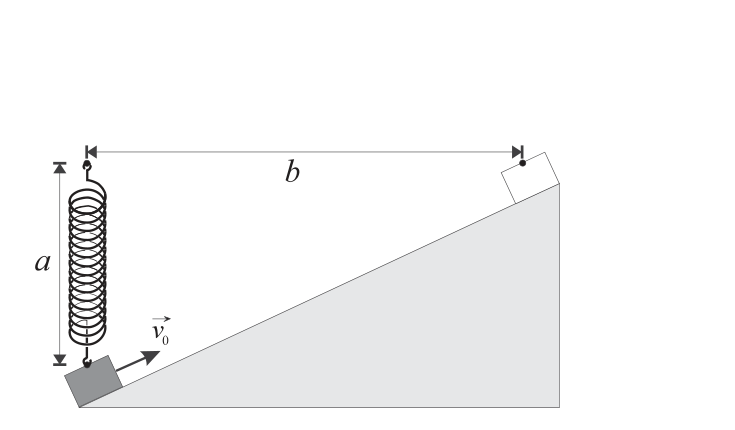
Topic: Newtonian Mechanics Metodi: Approximation & Series Expansion, Conservation of Momentum, Physical Modeling Competenze: Mathematical Modeling, Physical Reasoning Objects: Inclined Plane, Spring, Block Fonte: Testo (PDF) — p.3 Soluzione: Soluzioni (PDF)
An object of mass is thrown upwards on an inclined plane without friction, with initial speed . In its motion the object is fixed to an extreme of a spring of negligible mass which is initially at rest length.
If the body is seen to stop exactly at the upper edge of the inclined plane, at the height of the spring’s suspension point (as shown in the figure), what is the elastic constant of the spring worth?
**p.3 ** Tilted plane with spring and body thrown
Topic: Newtonian Mechanics Metodi: Approximation & Series Expansion, Conservation of Momentum, Physical Modeling Competenze: Mathematical Modeling, Physical Reasoning Objects: Inclined Plane, Spring, Block Fonte: Testo (PDF) — p.3 Soluzione: Soluzioni (PDF)
Una macchina termica ideale, funzionante secondo un ciclo di Carnot, assorbe di calore alla temperatura di .
Quanto calore viene ceduto dalla macchina all’ambiente a ?
Topic: Newtonian Mechanics Metodi: Kinematic Equations, Physical Modeling Competenze: Mathematical Modeling, Physical Reasoning, Estimation & Approximation Objects: Heat Engine Fonte: Testo (PDF) — p.3 Soluzione: Soluzioni (PDF)
An ideal heat engine, operating on a Carnot cycle, absorbs heat at temperature.
How much heat is released from the machine to the environment at ?
Topic: Newtonian Mechanics Metodi: Kinematic Equations, Physical Modeling Competenze: Mathematical Modeling, Physical Reasoning, Estimation & Approximation Objects: Heat Engine Fonte: Testo (PDF) — p.3 Soluzione: Soluzioni (PDF)
Un corpo di massa è sospeso, con un filo di lunghezza , ad un chiodo (indicato in figura con ); un secondo chiodo () è posto più in basso, sulla verticale del primo, a della lunghezza del filo. Il corpo viene spostato in modo che il filo teso formi con la verticale un angolo piccolo (), e poi lasciato da fermo.
In quanto tempo il corpo torna nella posizione iniziale?
Note: il corpo può essere trattato come puntiforme, il filo inestensibile e di massa trascurabile rispetto al corpo; ogni forma di attrito sia trascurabile.
p.3 — Pendolo con due chiodi A e B
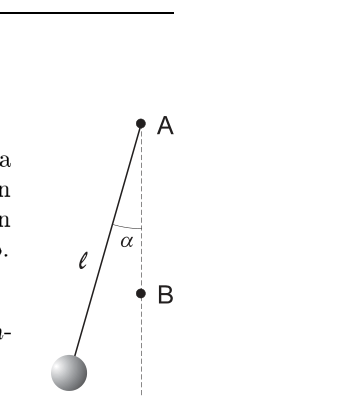
Topic: Newtonian Mechanics Metodi: Kinematic Equations, Physical Modeling Competenze: Mathematical Modeling, Physical Reasoning Objects: Pendulum, String Fonte: Testo (PDF) — p.3 Soluzione: Soluzioni (PDF)
A mass body is suspended, with a length thread, to a nail (indicated in figure ); a second nail () is placed lower, on the vertical of the first, at of the length of the thread. The body is moved so that the wire is stretched with the vertical forming a small angle (), and then left standing.
How long before the body returns to its original position?
Note: the body can be treated as pointed, the wire is not extensible and of negligible mass compared to the body; any form of friction is negligible.
**p.3 ** Pendulum with two nails A and B
Topic: Newtonian Mechanics Metodi: Kinematic Equations, Physical Modeling Competenze: Mathematical Modeling, Physical Reasoning Objects: Pendulum, String Fonte: Testo (PDF) — p.3 Soluzione: Soluzioni (PDF)
Una sorgente luminosa puntiforme si trova a di profondità al centro di una grande vasca circolare piena d’acqua. Al di sopra della sorgente un tappeto compatto di ninfee e altre piante che galleggiano sulla superficie dell’acqua impedisce di vedere la sorgente luminosa dall’esterno, da qualunque punto si guardi.
Qual è la minima superficie dell’area occupata dalle piante?
Topic: Newtonian Mechanics, Oscillations & Waves Metodi: Kinematic Equations, Physical Modeling, Superposition Principle Competenze: Mathematical Modeling, Physical Reasoning Objects: Container Fonte: Testo (PDF) — p.3 Soluzione: Soluzioni (PDF)
A pointed light source is located at depth in the center of a large circular tank full of water. Above the fountain is a compact carpet of nymphs and other floating plants that prevents the light source from being seen from the outside, from wherever you look.
What is the minimum area of the area occupied by plants?
Topic: Newtonian Mechanics, Oscillations & Waves Metodi: Kinematic Equations, Physical Modeling, Superposition Principle Competenze: Mathematical Modeling, Physical Reasoning Objects: Container Fonte: Testo (PDF) — p.3 Soluzione: Soluzioni (PDF)
Due recipienti metallici contengono due gas diversi, entrambi perfetti, alla stessa temperatura, pari a quella dell’ambiente. Il primo ha un volume di , e in esso il gas ha una pressione di . Il secondo ha un volume di , e in esso il gas ha una pressione di . I due recipienti vengono messi in comunicazione attraverso un sottile forellino e lentamente si mescolano, mentre la temperatura rimane costante.
Calcolare la pressione finale quando il sistema ha raggiunto l’equilibrio.
Topic: Circuits Metodi: Kirchhoff’s Laws, Equivalent Circuit Reduction Competenze: Diagrammatic Reasoning, Mathematical Modeling Objects: Container, Gas Fonte: Testo (PDF) — p.4 Soluzione: Soluzioni (PDF)
Two metal containers contain two different gases, both perfect, at the same temperature, equal to that of the environment. The first has a volume of , and in it the gas has a pressure of . The second volume is , and the gas in it is . The two vessels are put in contact through a thin furnace and are slowly mixed, while the temperature remains constant.
Calculate the final pressure when the system has reached equilibrium.
Topic: Circuits Metodi: Kirchhoff’s Laws, Equivalent Circuit Reduction Competenze: Diagrammatic Reasoning, Mathematical Modeling Objects: Container, Gas Fonte: Testo (PDF) — p.4 Soluzione: Soluzioni (PDF)
Tre cariche elettriche sono disposte ai vertici di un quadrato di lato come si vede in figura. Si supponga .
Calcolare il vettore campo elettrico nel quarto vertice.
p.4 — Quattro cariche ai vertici di un quadrato
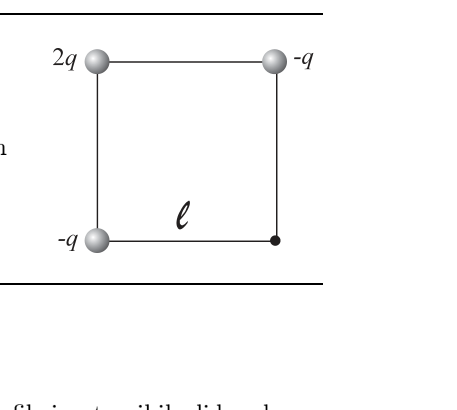
Topic: Circuits Metodi: Kirchhoff’s Laws, Equivalent Circuit Reduction, Physical Modeling Competenze: Diagrammatic Reasoning, Mathematical Modeling, Physical Reasoning Objects: Point Charge Fonte: Testo (PDF) — p.4 Soluzione: Soluzioni (PDF)
Three electrical charges are arranged at the vertices of a side square as shown in the figure. Assume that .
Calculate the electric field vector at the fourth vertex.
Four loads at the vertices of a square
Topic: Circuits Metodi: Kirchhoff’s Laws, Equivalent Circuit Reduction, Physical Modeling Competenze: Diagrammatic Reasoning, Mathematical Modeling, Physical Reasoning Objects: Point Charge Fonte: Testo (PDF) — p.4 Soluzione: Soluzioni (PDF)
Un corpo di massa viene fissato ai due estremi di un filo inestensibile di lunghezza che passa attorno a tre carrucole come mostrato in figura a sinistra (filo e carrucole hanno massa trascurabile rispetto al corpo; anche le dimensioni delle carrucole sono trascurabili rispetto all’intero sistema).
Determinare la tensione del filo quando il sistema ha assunto la configurazione di equilibrio, mostrata nella figura a destra.
p.4 — Corpo sospeso a filo su tre carrucole
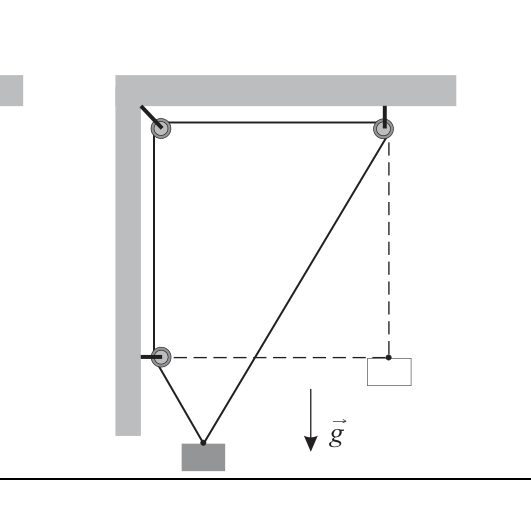
Topic: Circuits Metodi: Kirchhoff’s Laws, Equivalent Circuit Reduction Competenze: Diagrammatic Reasoning, Mathematical Modeling Objects: String, Pulley Fonte: Testo (PDF) — p.4 Soluzione: Soluzioni (PDF)
A mass body is fixed at the two ends of an inextensible wire of length that passes around three carrots as shown in the figure to the left (wire and carrots have negligible mass relative to the body; the size of the carrots is also negligible relative to the whole system).
Determine the voltage of the wire when the system has taken on the equilibrium configuration, shown in the figure to the right.
**p.4 ** Wire suspended body on three carriages
Topic: Circuits Metodi: Kirchhoff’s Laws, Equivalent Circuit Reduction Competenze: Diagrammatic Reasoning, Mathematical Modeling Objects: String, Pulley Fonte: Testo (PDF) — p.4 Soluzione: Soluzioni (PDF)
Una lastra di un particolare vetro, di spessore , le cui superfici sono trattate in modo da poter trascurare la frazione di luce riflessa, trasmette metà della luce che la attraversa.
Che percentuale di luce incidente trasmette un’altra lastra dello stesso vetro, trattata allo stesso modo, ma di spessore ?
Seconda parte: Problemi
Topic: Circuits Metodi: Kirchhoff’s Laws, Equivalent Circuit Reduction, Dimensional Analysis Competenze: Mathematical Modeling, Physical Reasoning Objects: — Fonte: Testo (PDF) — p.4 Soluzione: Soluzioni (PDF)
A sheet of a particular glass, thick, whose surfaces are treated so as to overlook the reflected light fraction, transmits half the light that passes through it.
What percentage of incident light is transmitted by another sheet of the same glass, treated in the same way but thickness?
# Part two: Trouble
Topic: Circuits Metodi: Kirchhoff’s Laws, Equivalent Circuit Reduction, Dimensional Analysis Competenze: Mathematical Modeling, Physical Reasoning Objects: — Fonte: Testo (PDF) — p.4 Soluzione: Soluzioni (PDF)
Girotondo [10 punti]
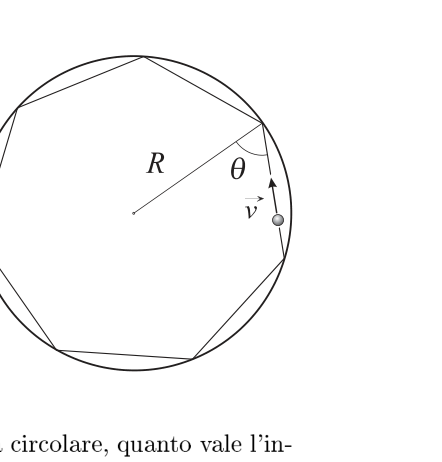
Un oggetto di massa e dimensioni trascurabili, in moto a velocità , incide sul bordo di una guida circolare priva di attrito con angolo rispetto alla normale, rimbalzando elasticamente. La guida, di raggio , è fissata su un piano orizzontale, anch’esso senza attrito, e la traiettoria risultante è un poligono di lati inscritto nella guida circolare. La figura mostra un esempio di questa situazione per una traiettoria poligonale di 7 lati ().
-
Determinare innanzitutto la variazione di quantità di moto di un corpo di massa che urta una parete piana e priva di attrito, con velocità che forma un angolo con la normale alla parete e il valor medio dell’intensità della forza che la parete esercita sul corpo se questa agisce in un intervallo di tempo .
-
Nel caso esposto sopra di una traiettoria poligonale di lati entro la guida circolare, quanto vale l’intensità media della forza che la parete circolare esercita sul corpo, assumendo ora che sia l’intervallo di tempo tra due urti successivi?
-
Passando al limite per infinitamente grande che significato ha l’espressione trovata al punto precedente?
p.6 — Guida circolare con traiettoria poligonale
Topic: Newtonian Mechanics, Conservation of Momentum Metodi: Impulse-Momentum Theorem, Conservation of Momentum, Physical Modeling Competenze: Physical Reasoning, Mathematical Modeling Objects: — Fonte: Testo (PDF) — p.6 Soluzione: Soluzioni (PDF)
The following table shows the following information:
An object of mass and negligible size, moving at speed, impacts the edge of a friction-free circular wheel with an angle from the normal, bouncing elastically. The direction of the radius shall be fixed on a horizontal plane, also without friction, and the resulting trajectory shall be a side polygon inscribed in the circular direction. The figure shows an example of this for a 7-sided polygonal trajectory ().
-
Determine first the change in the amount of motion of a mass body hitting a flat, friction-free wall at a speed forming an angle with the normal to the wall and the mean value of the strength intensity that the wall exert on the body if it acts over a time interval .
-
In the case of a linear path above a side within the circular wheel, what is the mean intensity of the force exerted by the circular wall on the body, assuming that is the time interval between two successive impacts?
-
Moving to the limit for infinitely large what is the meaning of the expression found in the previous point?
The following is the list of the types of vehicles that are used in the manufacture of the product:
Topic: Newtonian Mechanics, Conservation of Momentum Metodi: Impulse-Momentum Theorem, Conservation of Momentum, Physical Modeling Competenze: Physical Reasoning, Mathematical Modeling Objects: — Fonte: Testo (PDF) — p.6 Soluzione: Soluzioni (PDF)
Atletica leggera: 100 metri e Staffetta 4×100 [20 punti]
Si schematizza la corsa di un atleta, su una lunghezza totale , in questo modo: in un primo tratto lungo l’atleta si muove di moto uniformemente accelerato con accelerazione e per il resto del percorso (pari a ) di moto uniforme alla velocità raggiunta nel primo tratto. Nella corsa di un centometrista si può assumere che l’accelerazione duri per metà del percorso, ovvero per .
-
Sapendo che l’attuale record mondiale sui è di (Asafa Powell, Giamaica, realizzato il 9 settembre 2007 a Rieti), calcolare l’accelerazione e la velocità finale del recordman.
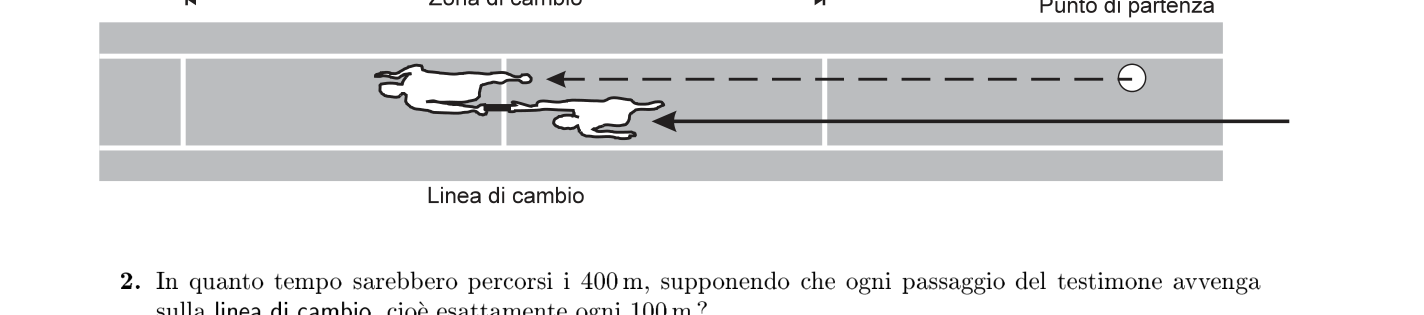
Nella gara della “Staffetta 4×100” gli atleti (escluso il primo) effettuano una partenza “lanciata” muovendosi prima del traguardo delle frazioni lunghe che chiameremo linea di cambio; questa linea è al centro della zona di cambio (, come mostrato in figura), che è il tratto di pista entro cui il testimone deve essere passato di mano in mano tra i corridori. Supporremo adesso che la prima frazione di sia percorsa dal campione mondiale nello stesso modo detto sopra e che gli altri tre corridori siano tutti in grado di sviluppare la stessa accelerazione del campione, fino alla linea di cambio, proseguendo poi a velocità costante.
-
In quanto tempo sarebbero percorsi i , supponendo che ogni passaggio del testimone avvenga sulla linea di cambio, cioè esattamente ogni ?
-
Nel momento in cui il secondo corridore scatta dal punto indicato, a che distanza da lui si trova il primo atleta in arrivo? E nei successivi cambi?
p.7 — Pista con staffetta e linea di cambio
Topic: Newtonian Mechanics Metodi: Kinematic Equations, Physical Modeling Competenze: Mathematical Modeling, Physical Reasoning Objects: — Fonte: Testo (PDF) — p.7 Soluzione: Soluzioni (PDF)
Light athletics: 100 metres and Staff 4×100 [20 points]
The course of an athlete, over a total length , is outlined as follows: in a long first stroke the athlete moves uniformly accelerated motorcycle with acceleration and for the rest of the route (equal to ) uniform motorcycle at the speed reached in the first stroke. In a centometric run, acceleration can be assumed to last half the way, i.e. .
- Knowing that the current world record on is (Asafa Powell, Jamaica, set on 9 September 2007 in Rieti), calculate the recorder’s acceleration and final speed.
In the “Staffette 4×100” race, the athletes (excluding the first) make a “throw” start by moving before the finish of the long fractions which we will call the gear line; this line is at the center of the gear zone (, as shown in the figure), which is the track section within which the participant must have passed hand in hand between the runners. We will now assume that the first fraction of is travelled by the world champion in the same way as above and that the other three runners are all able to develop the same acceleration as the sample, up to the gear line, then continue at a constant speed.
-
How long would the take, assuming that each pass of the witness takes place on the line of change, that is, exactly every ?
-
When the second runner jumps from the point, how far away is the first athlete? What about the next change?
p.7 Track with racket and gear
Topic: Newtonian Mechanics Metodi: Kinematic Equations, Physical Modeling Competenze: Mathematical Modeling, Physical Reasoning Objects: — Fonte: Testo (PDF) — p.7 Soluzione: Soluzioni (PDF)
Onde in arrivo [10 punti]
Un osservatore misura l’intensità delle onde provenienti da una certa sorgente puntiforme e isotropa, trovando il valore di . L’osservatore si dirige verso la sorgente, percorrendo un tratto di , e trova che in questa posizione l’intensità delle onde è .
- A quale distanza si trovava all’inizio l’osservatore?
- Qual è la potenza della sorgente?
Topic: Oscillations & Waves Metodi: Physical Modeling, Dimensional Analysis Competenze: Mathematical Modeling Objects: — Fonte: Testo (PDF) — p.7 Soluzione: Soluzioni (PDF)
The following points shall be added:
An observer measures the intensity of waves coming from a certain point source and isotropic, finding the value of . The observer heads towards the source, traveling a stretch of , and finds that the wave intensity at this position is .
- How far away was the observer at the beginning?
- What’s the power of the source?
Topic: Oscillations & Waves Metodi: Physical Modeling, Dimensional Analysis Competenze: Mathematical Modeling Objects: — Fonte: Testo (PDF) — p.7 Soluzione: Soluzioni (PDF)
Misure di resistenza con un circuito a ponte [20 punti]
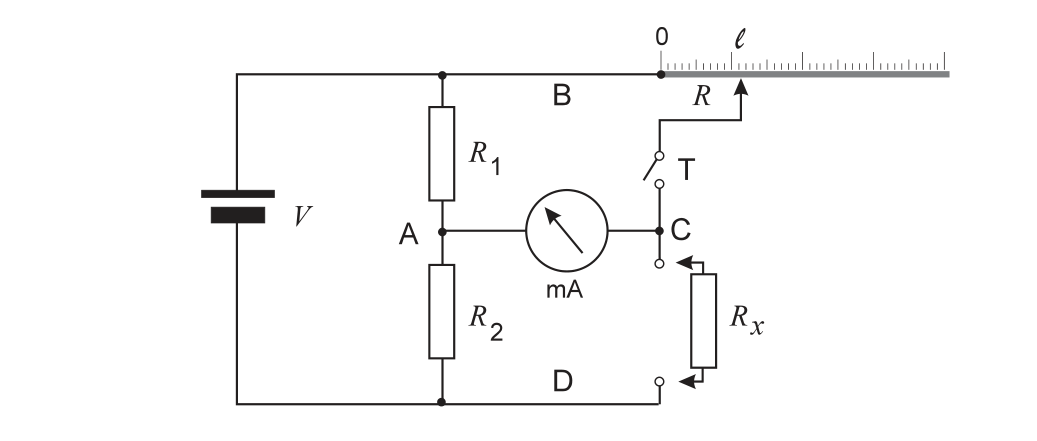
Nel circuito in figura, alimentato da una batteria di f.e.m. , le resistenze e sono fisse, la resistenza è costituita da un lungo filo teso di nichel-cromo (di sezione e resistività ) sul quale scorre un contatto mobile in modo che la resistenza tra i punti e possa essere variata facilmente e con accuratezza; lo strumento posto tra i punti e è un milliamperometro, la cui resistenza interna si suppone sempre trascurabile, e infine tra i punti e può essere inserita un’ulteriore resistenza il cui valore incognito è da determinare con precisione. Inizialmente la resistenza incognita non è inserita e il tasto è aperto.
-
Quanto vale la d.d.p. tra i punti e ?
-
Dopo aver chiuso il tasto , quanto vale la corrente misurata dal milliamperometro, se il cursore della resistenza variabile è posto in modo che sia ?
-
Adesso si inserisce tra e la resistenza incognita e si posiziona il cursore della resistenza variabile in modo che la corrente misurata dal milliamperometro sia nulla; il righello indica che il cursore sta alla distanza dall’estremo del filo. Quanto vale la resistenza ?
-
Come deve essere scelta la resistenza in modo che la lettura del righello in centimetri dia direttamente il valore di in ohm?
p.8 — Circuito a ponte con milliamperometro
Topic: Circuits, Electromagnetism Metodi: Kirchhoff’s Laws, Equivalent Circuit Reduction, Physical Modeling Competenze: Mathematical Modeling, Measurement & Instrumentation Objects: Battery, Resistor, Wire, Galvanometer, Switch Fonte: Testo (PDF) — p.8 Soluzione: Soluzioni (PDF)
The following shall be added to the list of the following:
In the circuit shown, powered by an f.e.m. battery , le resistenze e sono fisse, la resistenza è costituita da un lungo filo teso di nichel-cromo (di sezione e resistività ) sul quale scorre un contatto mobile in modo che la resistenza tra i punti e possa essere variata facilmente e con accuratezza; lo strumento posto tra i punti e è un milliamperometro, la cui resistenza interna si suppone sempre trascurabile, e infine tra i punti e può essere inserita un’ulteriore resistenza il cui valore incognito è da determinare con precisione. Initially the unknown resistance is not inserted and the key is opened.
-
How much is the D.D.P. worth? between and ?
-
After the key is closed, what is the current measured by the milliampereometer if the variable resistance cursor is set to ?
-
Now insert the unknown resistance between and and place the variable resistance cursor so that the current measured by the millimeter is zero; the reel indicates that the cursor is from the end of the wire. What is the resistance ?
-
How should the resistance be chosen so that the reading of the reel in centimetres gives the value of in ohms directly?
The following conditions shall apply:
Topic: Circuits, Electromagnetism Metodi: Kirchhoff’s Laws, Equivalent Circuit Reduction, Physical Modeling Competenze: Mathematical Modeling, Measurement & Instrumentation Objects: Battery, Resistor, Wire, Galvanometer, Switch Fonte: Testo (PDF) — p.8 Soluzione: Soluzioni (PDF)