- Esprimere in funzione dei dati del problema.
p.4 — due cariche puntiformi su asse x
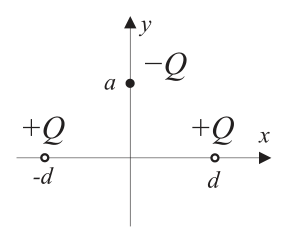
Topic: Electrostatics, Conservation of Energy, Newtonian Mechanics Metodi: Energy Conservation Method, Coulomb’s Law, Physical Modeling Competenze: Physical Reasoning, Mathematical Modeling Objects: Point Charge Fonte: Testo (PDF) — p.5 Soluzione: Soluzioni (PDF)
- Express according to the problem data.
**p.4 ** two pointed charges on the x-axis
Topic: Electrostatics, Conservation of Energy, Newtonian Mechanics Metodi: Energy Conservation Method, Coulomb’s Law, Physical Modeling Competenze: Physical Reasoning, Mathematical Modeling Objects: Point Charge Fonte: Testo (PDF) — p.5 Soluzione: Soluzioni (PDF)
- Se la particella viene lanciata con un’energia cinetica pari al doppio di quella corrispondente alla velocità definita sopra, in quanto tempo attraversa la distribuzione sferica? (ovvero percorre un diametro pari a )
Topic: Electrostatics, Conservation of Energy, Newtonian Mechanics Metodi: Energy Conservation Method, Kinematic Equations, Conservation Laws Competenze: Physical Reasoning, Mathematical Modeling Objects: Point Charge Fonte: Testo (PDF) — p.5 Soluzione: Soluzioni (PDF)
- If the particle is launched with a kinetic energy equal to twice that of the speed The time it takes to cross the spherical distribution is defined above. (i.e. it has a diameter of )
Topic: Electrostatics, Conservation of Energy, Newtonian Mechanics Metodi: Energy Conservation Method, Kinematic Equations, Conservation Laws Competenze: Physical Reasoning, Mathematical Modeling Objects: Point Charge Fonte: Testo (PDF) — p.5 Soluzione: Soluzioni (PDF)
- Quanto vale la carica totale della distribuzione?
Topic: Electrostatics Metodi: Gauss’s Law, Coulomb’s Law, Electric Potential Method Competenze: Mathematical Modeling, Physical Reasoning Objects: Point Charge Fonte: Testo (PDF) — p.5 Soluzione: Soluzioni (PDF)
- What is the total distribution charge?
Topic: Electrostatics Metodi: Gauss’s Law, Coulomb’s Law, Electric Potential Method Competenze: Mathematical Modeling, Physical Reasoning Objects: Point Charge Fonte: Testo (PDF) — p.5 Soluzione: Soluzioni (PDF)
- In quali punti la carica della distribuzione è positiva e in quali è negativa? ————— (*) Non si dovranno quindi considerare urti meccanici tra le particelle.
Misura di spessori sottilissimi. [20 punti] Due vetrini da microscopio, M1 e M2, sono mantenuti a contatto tra loro a una estremità e separati all’altra con un sottile foglio metallico, in modo tale che fra di essi ci sia uno strato d’aria in forma di cuneo. Il bordo del foglio metallico si trova inizialmente ad una distanza dal punto di contatto dei vetrini. Il sistema è illuminato con luce quasi monocromatica di lunghezza d’onda in direzione ortogonale ai due vetrini (l’angolo fra di essi è trascurabile). Si forma pertanto una figura di interferenza (osservata sempre in direzione ortogonale) fra la luce riflessa dalle superfici del primo e del secondo vetrino affacciate sul cuneo d’aria, con frange parallele alla linea di contatto fra i due vetrini. Fra le molte frange di interferenza che si osservano, si consideri un intervallo di 20 frange nella regione centrale. La larghezza di questo intervallo, misurata dal minimo di luminosità che precede la prima frangia considerata fino al minimo che segue la ventesima, risulta . La figura illustra la situazione, ma lo spessore t del foglio metallico in realtà è molto più piccolo di quanto sembra ed è anche di alcuni ordini più piccolo dello spessore dei vetrini da microscopio.
Topic: Electrostatics, Wave Optics Metodi: Symmetry Argument, Interference & Diffraction Analysis, Superposition Principle Competenze: Physical Reasoning, Diagrammatic Reasoning Objects: — Fonte: Testo (PDF) — p.5 Soluzione: Soluzioni (PDF)
- Where is the distribution charge positive and where is it negative? ————— (*) Mechanical collisions between particles should therefore not be considered.
Very fine thickness. The Commission shall adopt implementing acts in accordance with Article 21 of this Regulation. Two microscopic windows, M1 and M2, are held in contact with each other at one end and separated from the other by a thin sheet metal, so that there is a cone-shaped layer of air between them. The edge of the sheet The metallic material is initially located from the contact point of the windows. The system is illuminated with a nearly monochrome light of wavelength in the direction orthogonal to the two The glass (the angle between them is negligible). The result is an interference figure (always observed in the direction of the orthogonal) between the light reflected from the surfaces of the first and second windows overlooking the air angle, with fringes parallel to the contact line between the two windows. Among the many interference bands observed, a 20-band interval in the central region is considered. The width of this range, measured from the minimum luminosity preceding the first fringe considered up to the The minimum following the 20th is . The figure illustrates the situation, but the The thickness of the sheet metal is actually Much smaller than it looks and is The Commission has also taken into account the thickness of the microscope glass.
Topic: Electrostatics, Wave Optics Metodi: Symmetry Argument, Interference & Diffraction Analysis, Superposition Principle Competenze: Physical Reasoning, Diagrammatic Reasoning Objects: — Fonte: Testo (PDF) — p.5 Soluzione: Soluzioni (PDF)
- Si determini l’espressione che fornisce la posizione x dell’n-simo massimo a partire dal punto di contatto delle piastrine in funzione dello spessore t del foglio metallico, della sua distanza L dal punto di contatto dei vetrini e della lunghezza d’onda della luce.
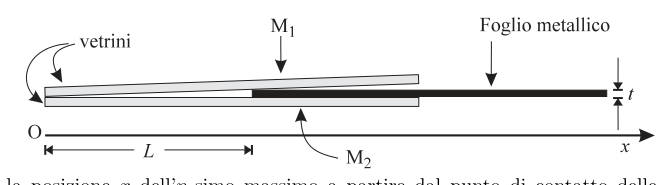 vetrini microscopio con foglio metallico
Topic: Wave Optics Metodi: Interference & Diffraction Analysis, Superposition Principle, Small-Angle Approximation Competenze: Mathematical Modeling, Physical Reasoning Objects: — Fonte: Testo (PDF) — p.6 Soluzione: Soluzioni (PDF)
- The expression giving the position x of the maximum n-second is determined from the point of contact of the plates according to the thickness t of the sheet, its distance L from the contact point of the windows; and The light wavelength shall be measured.
- microscopic glass with sheet metal *
Topic: Wave Optics Metodi: Interference & Diffraction Analysis, Superposition Principle, Small-Angle Approximation Competenze: Mathematical Modeling, Physical Reasoning Objects: — Fonte: Testo (PDF) — p.6 Soluzione: Soluzioni (PDF)
- Si determini lo spessore t del foglio metallico.
Topic: Wave Optics Metodi: Interference & Diffraction Analysis, Experimental Data Analysis Competenze: Mathematical Modeling, Estimation & Approximation Objects: — Fonte: Testo (PDF) — p.6 Soluzione: Soluzioni (PDF)
- Determine the thickness of the sheet t.
Topic: Wave Optics Metodi: Interference & Diffraction Analysis, Experimental Data Analysis Competenze: Mathematical Modeling, Estimation & Approximation Objects: — Fonte: Testo (PDF) — p.6 Soluzione: Soluzioni (PDF)
- Si dica cosa succede alla figura di interferenza se: a. il foglio metallico viene lentamente allontanato; b. il foglio metallico viene lentamente scaldato, mantenendo costante la distanza L; c. lo spazio fra i due vetrini viene riempito d’acqua.
Due blocchi sovrapposti in moto. [20 punti] Due blocchi A e B, di massa rispettivamente e , sono collocati uno sopra l’altro. Una fune inestensibile e di massa trascurabile li collega scorrendo senza attrito su di una carrucola fissata ad una parete. I due tratti di fune al di fuori della carrucola sono orizzontali. Una forza viene applicata al blocco superiore, come mostrato in figura. Si vuole studiare il comportamento del sistema nei quattro casi che si presentano in funzione delle forze di attrito statico agenti tra il blocco A ed il pavimento e tra i due blocchi A e B.
Topic: Wave Optics Metodi: Interference & Diffraction Analysis, Superposition Principle, Physical Modeling Competenze: Physical Reasoning, Diagrammatic Reasoning Objects: Block, String, Pulley Fonte: Testo (PDF) — p.6 Soluzione: Soluzioni (PDF)
- Tell yourself what happens to the interference figure if: a. The metal sheet is slowly removed; b. The sheet is heated slowly, keeping the L distance constant. c. The space between the two windows is filled with water.
Two blocks overlapping on a motorcycle. The Commission shall adopt implementing acts in accordance with Article 21 of this Regulation. Two blocks A and B, of and respectively, are They’re placed on top of each other. A rope of mass and expanse It’s a little bit of a draw. It’s a little bit of a draw. The two strands of rope outside The wheelchair is horizontal. A force is applied the upper block, as shown in Figure 1. The aim is to study the system’s behavior in the four cases that occur as a function of the frictional forces. static agents between block A and floor and between two blocks A and B.
Topic: Wave Optics Metodi: Interference & Diffraction Analysis, Superposition Principle, Physical Modeling Competenze: Physical Reasoning, Diagrammatic Reasoning Objects: Block, String, Pulley Fonte: Testo (PDF) — p.6 Soluzione: Soluzioni (PDF)
- Trascurando inizialmente ogni forma di attrito, disegnare, separatamente per i due blocchi, il diagramma di tutte le forze agenti e successivamente determinare l’accelerazione dei due blocchi e la forza risultante agente su ciascuno dei due.
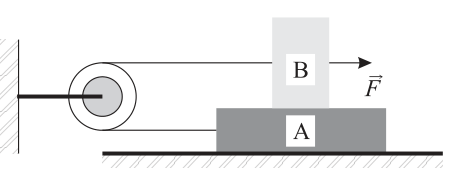 due blocchi A e B sovrapposti
Topic: Newtonian Mechanics Metodi: Free-Body Diagram, Kinematic Equations, Vector Decomposition Competenze: Diagrammatic Reasoning, Mathematical Modeling Objects: Block Fonte: Testo (PDF) — p.6 Soluzione: Soluzioni (PDF)
- Initially neglecting any form of friction, draw, separately for the two blocks, the diagram of all the The two blocks are then accelerated and the resulting force on each block is determined. Of the two.
*two blocks A and B overlapping *
Topic: Newtonian Mechanics Metodi: Free-Body Diagram, Kinematic Equations, Vector Decomposition Competenze: Diagrammatic Reasoning, Mathematical Modeling Objects: Block Fonte: Testo (PDF) — p.6 Soluzione: Soluzioni (PDF)
- Per ognuno dei casi sottoelencati disegnare, separatamente per i due blocchi, il diagramma di tutte le forze agenti e determinare il modulo F della forza minima necessaria per mettere in moto il sistema: a. attrito statico solamente tra il pavimento ed il blocco A, il cui coefficiente vale ; b. attrito statico solamente tra il blocco A ed il blocco B, il cui coefficiente vale ; c. attrito statico tra il pavimento ed il blocco A e tra il blocco A ed il blocco B, i cui coefficienti valgono rispettivamente e .
Topic: Newtonian Mechanics Metodi: Free-Body Diagram, Vector Decomposition, Conservation Laws Competenze: Diagrammatic Reasoning, Mathematical Modeling, Physical Reasoning Objects: Block Fonte: Testo (PDF) — p.6 Soluzione: Soluzioni (PDF)
- For each of the cases listed below, draw, separately for the two blocks, the diagram of all the forces acting on the and determine the F-module of the minimum force required to start the system: a. only static friction between the floor and block A, the coefficient of which is ; b. only static friction between block A and block B, the coefficient of which is ; c. static friction between floor and block A and between block A and block B, the coefficients of which are and respectively.
Topic: Newtonian Mechanics Metodi: Free-Body Diagram, Vector Decomposition, Conservation Laws Competenze: Diagrammatic Reasoning, Mathematical Modeling, Physical Reasoning Objects: Block Fonte: Testo (PDF) — p.6 Soluzione: Soluzioni (PDF)