Question 1.1 (MC)
As you know, the Physics Olympiad reimburses participants for the cost of train tickets. You are looking for a support partner to cover these costs for the second round. What costs are most likely to be incurred by the support partner?
- A. CHF 9.-
- B. CHF 30.-
- C. CHF 900.-
- D. CHF 3000.-
- E. CHF 9000.- (F) CHF 30000.-
Topic: Order-of-Magnitude Estimation Metodi: Order-of-Magnitude Estimation Competenze: Estimation & Approximation Objects: — Fonte: Testo (PDF) — p.3
**Domanda 1.1 (MC) **
Come sapete, l’Olimpiade di Fisica rimborsa i partecipanti per il costo dei biglietti di treno. Cercate un partner di supporto per coprire i costi del secondo round. Quali sono i costi che il partner di sostegno rischia di sostenere?
- A. CHF 9.-
- B. CHF 30.-
- C. CHF 900.-
- D. CHF 3000.-
- E. CHF 9000.- F) CHF 30000 -
Topic: Order-of-Magnitude Estimation Metodi: Order-of-Magnitude Estimation Competenze: Estimation & Approximation Objects: — Fonte: Testo (PDF) — p.3
Question 1.2 (MC)
Mr Fogg and Passepartout took up the challenge to circumnavigate the globe. They chose to follow the equator. Mr Fix, who is chasing them, is always at the point on Earth diametrically opposite the two companions. How many times will Fix and Fogg be at the same altitude at the same time?
- A. Never.
- B. Possibly only once.
- C. At least twice.
- D. It depends on the Earth’s position in relation to the Sun.
Topic: Newtonian Mechanics, Gravitation Metodi: Physical Modeling, Symmetry Argument Competenze: Physical Reasoning Objects: Planet Fonte: Testo (PDF) — p.3
**Domanda 1.2 (MC) **
Fogg e Passepartout hanno accettato la sfida di girare il globo. Hanno scelto di seguire l’equatore. Il signor Fix, che li sta inseguendo, è sempre al punto sulla Terra diametralmente opposto ai due compagni. Quante volte Fix e Fogg saranno alla stessa quota allo stesso tempo?
- A. Mai.
- B. Possibile solo una volta.
- C. Almeno due volte.
- D. Dipende dalla posizione della Terra rispetto al Sole.
Topic: Newtonian Mechanics, Gravitation Metodi: Physical Modeling, Symmetry Argument Competenze: Physical Reasoning Objects: Planet Fonte: Testo (PDF) — p.3
Question 1.3 (MC)
Which of the following setups has the lowest equivalent stiffness ? All individual springs have the same stiffness and the same length.
- A. [setup A]
- B. [setup B]
- C. [setup C]
- D. [setup D]
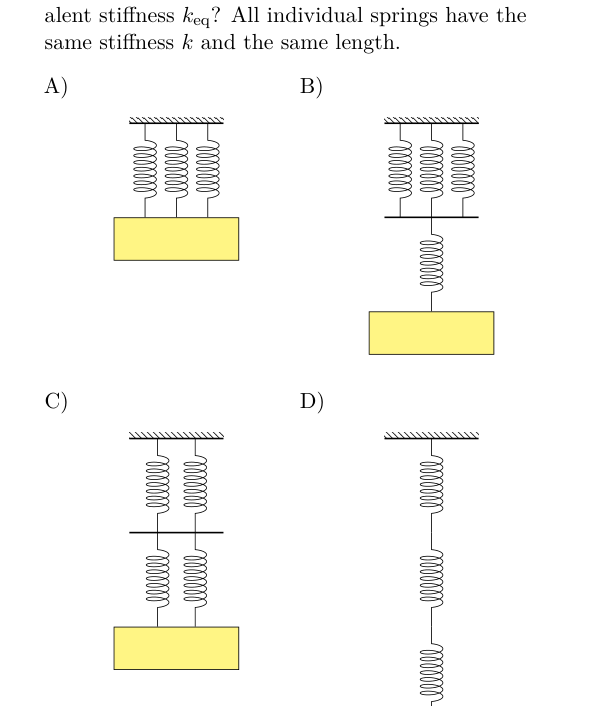 Four spring configurations A B C D
Topic: Oscillations & Waves, Newtonian Mechanics Metodi: Hooke’s Law, Superposition Principle Competenze: Physical Reasoning, Diagrammatic Reasoning Objects: Spring Fonte: Testo (PDF) — p.3
**Domanda 1.3 (MC) **
Qual è la configurazione di cui sopra con la rigidità equivalente più bassa? Tutte le sorgenti individuali hanno la stessa rigidità e la stessa lunghezza.
- A. [impostazione A]
- B. [impostazione B]
- C. [impostazione C]
- D. [impostazione D]
Quattro configurazioni di primavera A B C D
Topic: Oscillations & Waves, Newtonian Mechanics Metodi: Hooke’s Law, Superposition Principle Competenze: Physical Reasoning, Diagrammatic Reasoning Objects: Spring Fonte: Testo (PDF) — p.3
Question 1.4 (MC)
Globi has decided to fly to the moon. He would like to visit the extraterrestrials who are supposed to live on the moon. As he naturally does not want to turn up without anything, he has decided to take a wheel of Swiss cheese with him. As he wants to divide it up fairly, he also takes a spring scale with him. The scale is calibrated on Earth and the gravitational constant on the moon is about six times smaller than on Earth. What does he discover when he weighs the wheel of cheese on the moon?
- A. Nothing. The scales show the same weight as on earth.
- B. The scales show approximately six times the weight on earth.
- C. The scales show approximately one sixth of the weight on earth.
- D. Can’t be predicted.
Topic: Newtonian Mechanics, Gravitation Metodi: Newton’s Law of Gravitation, Free-Body Diagram Competenze: Physical Reasoning Objects: Spring Fonte: Testo (PDF) — p.4
**Domanda 1.4 (MC) **
Globi ha deciso di volare sulla luna. Vorrebbe visitare gli extraterrestri che dovrebbero vivere sulla luna. Poiché naturalmente non vuole venire senza nulla, ha deciso di portare con sé una ruota di formaggio svizzero. Poiché vuole dividerla in modo equo, porta anche una scala di primavera con sé. La scala è calibrata sulla Terra e la costante gravitazionale sulla Luna è circa sei volte più piccola di quella terrestre. Cosa scopre quando pesa la ruota del formaggio sulla luna?
- **A ** Niente. Le scale mostrano lo stesso peso della terra. Le scale mostrano circa sei volte il peso terrestre. Le scale mostrano circa un sesto del peso terrestre.
- ** D.** Non è prevedibile.
Topic: Newtonian Mechanics, Gravitation Metodi: Newton’s Law of Gravitation, Free-Body Diagram Competenze: Physical Reasoning Objects: Spring Fonte: Testo (PDF) — p.4
Question 1.5 (MC)
You are on an expedition in a submarine on Saturn’s moon Titan which has lakes of liquid ethane and methane. They have a density of around and Titan has a gravitational acceleration of . You know that Titan has a surface pressure of (). The barometer in your submarine shows a pressure of . How deep in the lake are you?
- A.
- B.
- C.
- D.
- E. (F)
Topic: Fluid Mechanics Metodi: Hydrostatic Equilibrium Competenze: Physical Reasoning, Unit Conversion Objects: — Fonte: Testo (PDF) — p.4
La domanda 1.5 (MC)
Sei in una spedizione su un sottomarino sulla luna di Saturno Titano che ha laghi di etano liquido e metano. Hanno una densità di circa e Titan ha un’accelerazione gravitazionale di . Sapete che Titan ha una pressione superficiale di (). Il barometro del sottomarino mostra una pressione di . Quanto sei in profondità?
- A.
- B.
- C.
- D.
- E. (F)
Topic: Fluid Mechanics Metodi: Hydrostatic Equilibrium Competenze: Physical Reasoning, Unit Conversion Objects: — Fonte: Testo (PDF) — p.4
Question 1.6 (MC)
A coconut with constant velocity explodes and splits into 3 pieces which fly away in different directions. Which of the following is correct for their respective momentum vectors in the coconut’s frame of reference?
- A. They are perpendicular to each other.
- B. The sum of their lengths is equal to the initial momentum of the coconut.
- C. The vectors have equal length.
- D. The vectors all lie in a plane.
Topic: Conservation of Momentum, Newtonian Mechanics Metodi: Conservation of Momentum, Vector Decomposition Competenze: Physical Reasoning Objects: — Fonte: Testo (PDF) — p.4
**Domanda 1.6 (MC) **
Una noce di cocco con velocità costante esplode e si divide in 3 pezzi che volano via in direzioni diverse. Quale delle seguenti è corretta per i rispettivi vettori di impulso nel quadro di riferimento della noce di cocco?
- A. Sono perpendicolari l’una all’altra.
- B. La somma delle loro lunghezze è pari al momento iniziale della noce di cocco.
- C. I vettori hanno la stessa lunghezza.
- D. I vettori si trovano tutti in un piano.
Topic: Conservation of Momentum, Newtonian Mechanics Metodi: Conservation of Momentum, Vector Decomposition Competenze: Physical Reasoning Objects: — Fonte: Testo (PDF) — p.4
Question 1.7 (MC)
A motorbike is in a jump midair and its front wheel is turning in the clockwise direction for Alice who is observing from the side. The bike is initially not rotating and the front wheel axis is aligned with the back wheel’s. Which of the following statements accurately describes what happens and why it happens when the driver hits the brake on the front wheel (and the wheel completely stops rotating with respect to the motorbike)?
- A. The angular velocity of the motorbike remains 0 as no external torque is applied.
- B. The motorbike starts turning in the clockwise direction because of the conservation of angular momentum.
- C. The motorbike starts turning in the anticlockwise direction because of the conservation of angular momentum.
- D. The motorbike starts turning in the clockwise direction because of the conservation of energy.
- E. The motorbike starts turning in the anticlockwise direction because of the conservation of energy. (F) The motorbike changes its horizontal translational velocity because of the conservation of energy.
Topic: Rotational Dynamics, Conservation of Momentum Metodi: Torque & Angular Momentum Analysis, Conservation Laws Competenze: Physical Reasoning, Diagrammatic Reasoning Objects: Wheel Fonte: Testo (PDF) — p.4
**Domanda 1.7 (MC) **
Una moto è in un salto in mezzo all’aria e la sua ruota anteriore gira in senso orario per Alice che sta osservando da un lato. La moto non ruota inizialmente e l’asse della ruota anteriore è allineato con quello della ruota posteriore. Quale delle seguenti affermazioni descrive con precisione cosa accade e perché accade quando il conducente frena la ruota anteriore (e la ruota smette completamente di ruotare rispetto alla moto)?
- A. La velocità angolare della moto rimane 0 in quanto non viene applicato una coppia esterna.
- B. La moto inizia a girare in senso orario a causa della conservazione del momento angolare.
- C. La moto inizia a girare in direzione anticlockwise a causa della conservazione del momento angolare.
- D. La moto inizia a girare in senso orario a causa della risparmia di energia.
- E. La moto inizia a girare in direzione anticlockwise a causa della conservazione dell’energia. F) La moto cambia la velocità di traslazione orizzontale a causa della conservazione dell’energia.
Topic: Rotational Dynamics, Conservation of Momentum Metodi: Torque & Angular Momentum Analysis, Conservation Laws Competenze: Physical Reasoning, Diagrammatic Reasoning Objects: Wheel Fonte: Testo (PDF) — p.4
Question 1.8 (MC)
As we have learned in the first round, a person of height only needs a mirror of height to see themself fully. How should the mirror be hanged so that they actually can see themself?
- A. Such that the upper edge of the mirror is exactly at the height of the tip of the head.
- B. Such that the upper edge of the mirror is approximately at the height of the person’s forehead.
- C. Such that the middle of the mirror is exactly at height .
- D. This depends on the distance of the person from the mirror.
Topic: Geometric Optics Metodi: Ray Tracing Competenze: Physical Reasoning, Diagrammatic Reasoning Objects: Mirror Fonte: Testo (PDF) — p.4
**Domanda 1.8 (MC) **
Come abbiamo imparato nel primo round, una persona di altezza ha bisogno solo di uno specchio di altezza per vedersi pienamente. Come si dovrebbe appendere lo specchio in modo che possano vedere se stessi?
- A. Tale che il bordo superiore dello specchio sia esattamente all’altezza della punta della testa.
- B. Tale che il bordo superiore dello specchio sia approssimativamente all’altezza della fronte della persona.
- C. Tale che il centro dello specchio sia esattamente all’altezza .
- D. Questo dipende dalla distanza della persona dallo specchio.
Topic: Geometric Optics Metodi: Ray Tracing Competenze: Physical Reasoning, Diagrammatic Reasoning Objects: Mirror Fonte: Testo (PDF) — p.4
Question 1.9 (MC)
A thin convex lens is shown in Fig. 1. The distance of the object to the lens and its image to the lens is labelled and respectively. The focal length is labelled . At what distance from the lens must an object be placed so that the image is exactly the same size on the other side of the lens?
- A.
- B.
- C. It is not possible.
- D.
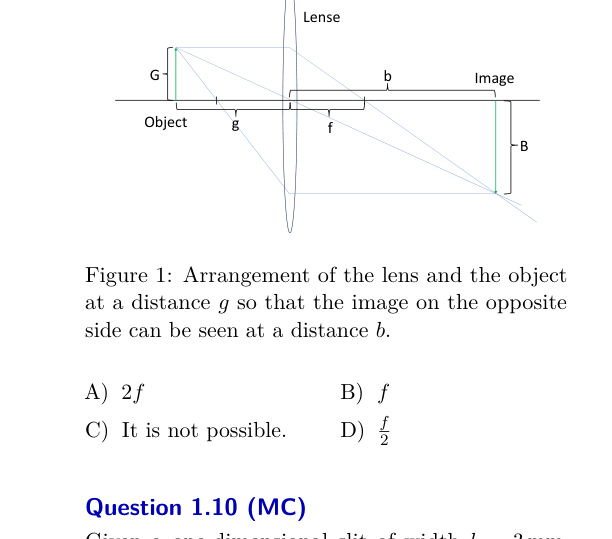 Convex lens with object at distance g
Topic: Geometric Optics Metodi: Thin Lens & Mirror Equation, Ray Tracing Competenze: Physical Reasoning, Mathematical Modeling Objects: Lens Fonte: Testo (PDF) — p.5
La domanda 1.9 (MC)
La figura mostra una lente convexa sottile. 1. La distanza dell’oggetto dalla lente e la sua immagine dalla lente sono segnalate rispettivamente e . La distanza focale è etichettata . A che distanza da quella obiettivo deve essere posto un oggetto in modo che l’immagine sia esattamente della stessa dimensione dall’altra parte della lente?
- A.
- B.
- C. Non è possibile.
- D.
L’obiettivo convex con oggetto a distanza g
Topic: Geometric Optics Metodi: Thin Lens & Mirror Equation, Ray Tracing Competenze: Physical Reasoning, Mathematical Modeling Objects: Lens Fonte: Testo (PDF) — p.5
Question 1.10 (MC)
Given a one-dimensional slit of width , what is the minimal angular separation in arcseconds between two lights of wavelength , so that they can be resolved through the slit?
- A.
- B.
- C.
- D.
Topic: Wave Optics Metodi: Interference & Diffraction Analysis, Small-Angle Approximation Competenze: Mathematical Modeling, Unit Conversion Objects: Slit Fonte: Testo (PDF) — p.5
**Domanda 1.10 (MC) **
Data una fessura unidimensionale di larghezza , qual è la separazione angolare minima in arcsecond tra due luci di lunghezza d’onda , in modo che possano essere risolte attraverso la fessura?
- A.
- B.
- C.
- D.
Topic: Wave Optics Metodi: Interference & Diffraction Analysis, Small-Angle Approximation Competenze: Mathematical Modeling, Unit Conversion Objects: Slit Fonte: Testo (PDF) — p.5
Question 1.11 (MC)
Is a heat engine operating between two thermal reservoirs at temperatures and with an efficiency of 30% physically possible?
- A. Yes, independently of the process.
- B. Yes, if the process of the engine is reversible.
- C. Yes, depending on the exact process of the engine.
- D. No.
Topic: Thermodynamics Metodi: Thermodynamic Cycle Analysis, First Law of Thermodynamics Competenze: Physical Reasoning, Mathematical Modeling Objects: Heat Engine Fonte: Testo (PDF) — p.5
La domanda 1.11 (MC)
È fisicamente possibile un motore termico che opera tra due serbatoi termici a temperature e con un’efficienza del 30%?
- A. Sì, indipendentemente dal processo.
- B. Sì, se il processo del motore è reversibile.
- C. Sì, a seconda del processo esatto del motore.
- D. No.
Topic: Thermodynamics Metodi: Thermodynamic Cycle Analysis, First Law of Thermodynamics Competenze: Physical Reasoning, Mathematical Modeling Objects: Heat Engine Fonte: Testo (PDF) — p.5
Question 1.12 (MC)
Alice uses an ice cube to cool her glass of water. Just after adding the ice cube, the water height in the glass is . After a while, the ice cube has completely melted. What can be said about the water height at this point?
- A.
- B.
- C.
- D. Not enough information is given.
Topic: Fluid Mechanics, Thermodynamics Metodi: Hydrostatic Equilibrium, Physical Modeling Competenze: Physical Reasoning Objects: — Fonte: Testo (PDF) — p.5
**Domanda 1.12 (MC) **
Alice usa un cubo di ghiaccio per raffreddare il suo bicchiere d’acqua. Appena dopo aver aggiunto il cubo di ghiaccio, l’altezza dell’acqua nel vetro è . Dopo un po’, il cubo di ghiaccio si è completamente sciolto. Cosa si può dire dell’altezza dell’acqua a questo punto?
- A.
- B.
- C.
- D. Non sono fornite informazioni sufficienti.
Topic: Fluid Mechanics, Thermodynamics Metodi: Hydrostatic Equilibrium, Physical Modeling Competenze: Physical Reasoning Objects: — Fonte: Testo (PDF) — p.5
Question 1.13 (MC)
Tyres play an essential role in Formula 1. The tyre pressure must therefore be optimal. We want to inflate a tyre so that we can drive at a tyre pressure of , where corresponds approximately to . By driving, a tyre temperature of is reached and the tyre pressure of is expected for this temperature. To what pressure must we inflate the tyre in the pit lane at a temperature of ? Assume that the volume is constant.
- A.
- B.
- C.
- D.
- E. (F)
Topic: Thermodynamics, Kinetic Theory Metodi: Ideal Gas Law Competenze: Mathematical Modeling, Unit Conversion Objects: Gas Fonte: Testo (PDF) — p.5
La domanda 1.13 (MC)
Le gomme svolgono un ruolo essenziale nella Formula 1. La pressione dei pneumatici deve pertanto essere ottimale. Vogliamo gonfiare un pneumatico in modo da poter guidare a una pressione di , dove corrisponde approssimativamente a . Quando si guida, si raggiunge una temperatura del pneumatico di e si prevede una pressione del pneumatico di per questa temperatura. A che pressione deve gonfiare il pneumatico in pista a temperatura ? Supponiamo che il volume sia costante.
- A.
- B.
- C.
- D.
- E. (F)
Topic: Thermodynamics, Kinetic Theory Metodi: Ideal Gas Law Competenze: Mathematical Modeling, Unit Conversion Objects: Gas Fonte: Testo (PDF) — p.5
Question 1.14 (MC)
A lit candle stands in a basin filled with water up to half the height of the candle. Albertina puts a glass over the candle so that the glass is immersed in the water. The candle goes out. What happens to the water level inside the glass?
- A. The water level sinks.
- B. The water level does not change.
- C. The water level rises or falls depending on the altitude above sea level.
- D. The water level rises.
Topic: Thermodynamics, Fluid Mechanics Metodi: Ideal Gas Law, Hydrostatic Equilibrium Competenze: Physical Reasoning Objects: Container, Gas Fonte: Testo (PDF) — p.5
**Domanda 1.14 (MC) **
Una candela accesa si trova in un pozzo pieno di acqua fino alla metà dell’altezza della candela. Albertina mette un bicchiere sopra la candela in modo che il bicchiere sia immerso nell’acqua. La candela si spegne. Che succede al livello dell’acqua all’interno del bicchiere?
- A. Il livello dell’acqua si scende.
- B. Il livello dell’acqua non cambia.
- C. Il livello dell’acqua aumenta o diminuisce a seconda dell’altitudine sul livello del mare.
- D. Il livello dell’acqua aumenta.
Topic: Thermodynamics, Fluid Mechanics Metodi: Ideal Gas Law, Hydrostatic Equilibrium Competenze: Physical Reasoning Objects: Container, Gas Fonte: Testo (PDF) — p.5
Question 1.15 (MC)
Look at the circuit in Fig. 1. Through which resistors does the smallest current (lowest ampere value) flow if all have the same resistance ?
- A. A and E.
- B. B and D.
- C. Only C.
- D. The same current flows through all of them.
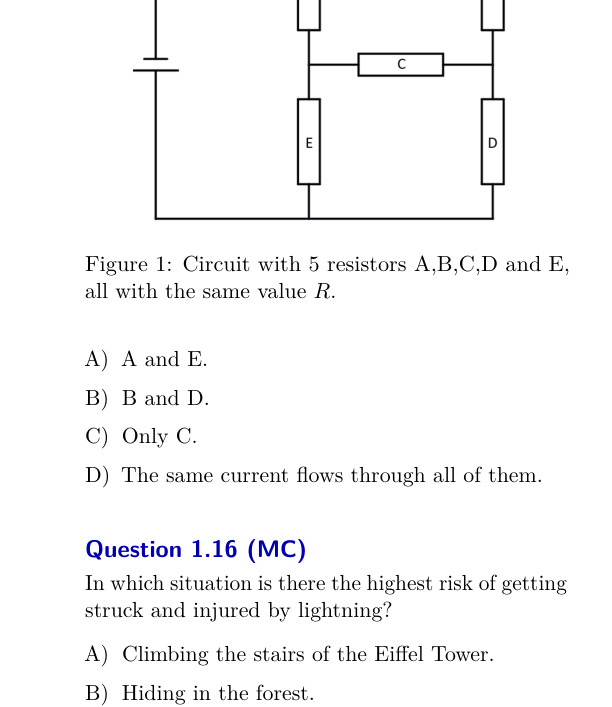 Circuit with 5 resistors A B C D E
Topic: Circuits Metodi: Kirchhoff’s Laws, Equivalent Circuit Reduction Competenze: Physical Reasoning, Diagrammatic Reasoning Objects: Resistor Fonte: Testo (PDF) — p.6
**Domanda 1.15 (MC) **
Guarda il circuito in Fig. 1. Tra quali resistenti scorre la corrente più piccola (valore di ampere più basso) se tutte hanno la stessa resistenza ?
- A. A e E.
- B. B e D.
- C. Solo C.
- D. La stessa corrente scorre attraverso tutti.
Circuito con 5 resistori A B C D E
Topic: Circuits Metodi: Kirchhoff’s Laws, Equivalent Circuit Reduction Competenze: Physical Reasoning, Diagrammatic Reasoning Objects: Resistor Fonte: Testo (PDF) — p.6
Question 1.16 (MC)
In which situation is there the highest risk of getting struck and injured by lightning?
- A. Climbing the stairs of the Eiffel Tower.
- B. Hiding in the forest.
- C. Driving a car.
- D. Flying below the clouds in an airplane.
Topic: Electrostatics, Electromagnetism Metodi: Physical Modeling Competenze: Physical Reasoning, Estimation & Approximation Objects: — Fonte: Testo (PDF) — p.6
La domanda 1.16 (MC)
In quale situazione è il rischio più elevato di essere colpito e ferito da fulmine?
- Scalando le scale della Torre Eiffel.
- B. Nascondendosi nella foresta.
- C. Guidare un’auto.
- D. Volando sotto le nuvole in aereo.
Topic: Electrostatics, Electromagnetism Metodi: Physical Modeling Competenze: Physical Reasoning, Estimation & Approximation Objects: — Fonte: Testo (PDF) — p.6
Question 1.17 (MC)
The escape velocity of Earth for a particle of mass and charge is approximately . What would it be if the Earth had a total charge of ? The mass of the Earth is , its radius is , the Coulomb constant is and the gravitational constant is .
- A.
- B.
- C.
- D.
Topic: Gravitation, Electrostatics Metodi: Newton’s Law of Gravitation, Coulomb’s Law, Energy Conservation Method Competenze: Mathematical Modeling Objects: Planet Fonte: Testo (PDF) — p.6
**Domanda 1.17 (MC) **
La velocità di fuga della Terra per una particella di massa e carica è approssimativamente . Che cosa sarebbe se la Terra avesse una carica totale di ? La massa della Terra è , il suo raggio è , la costante di Coulomb è e la costante gravitazionale è .
- A.
- B.
- C.
- D.
Topic: Gravitation, Electrostatics Metodi: Newton’s Law of Gravitation, Coulomb’s Law, Energy Conservation Method Competenze: Mathematical Modeling Objects: Planet Fonte: Testo (PDF) — p.6
Question 1.18 (MC)
Consider two spheres, each carrying the same total charge . One sphere is uniformly charged throughout its volume, while the other is a conducting sphere with its charge distributed only on its surface. The spheres may have different radii. Determine which sphere produces a stronger electric field at a distance from the center of the sphere, where (the radius of the sphere).
- A. The conducting sphere will produce a stronger electric field.
- B. The uniformly charged sphere will produce a stronger electric field.
- C. The sphere with the larger radius will produce a stronger electric field.
- D. The sphere with the smaller radius will produce a stronger electric field.
- E. The electric field will be the same for both spheres.
Topic: Electrostatics Metodi: Gauss’s Law, Coulomb’s Law Competenze: Physical Reasoning, Mathematical Modeling Objects: Sphere, Conducting Sphere Fonte: Testo (PDF) — p.6
La domanda 1.18 (MC)
Considerate due sfere, ciascuna con la stessa carica totale . Una sfera è uniformemente carica per tutto il suo volume, mentre l’altra è una sfera conduttrice con la sua carica distribuita solo sulla sua superficie. Le sfere possono avere diversi raggi. Determinare quale sfera produce un campo elettrico più forte a una distanza dal centro della sfera, dove (radiale della sfera).
- A. La sfera conduttrice produrrà un campo elettrico più forte.
- B. La sfera con carica uniforme produrrà un campo elettrico più forte.
- C. La sfera con raggio più ampio produrrà un campo elettrico più forte.
- D. La sfera con raggio più piccolo produrrà un campo elettrico più forte.
- E. Il campo elettrico sarà lo stesso per entrambe le sfere.
Topic: Electrostatics Metodi: Gauss’s Law, Coulomb’s Law Competenze: Physical Reasoning, Mathematical Modeling Objects: Sphere, Conducting Sphere Fonte: Testo (PDF) — p.6
Question 1.19 (MC)
Chef Clara wants to heat her food as quickly as possible. She decides to use her induction cooktop, which generates a changing magnetic field to induce currents in metal pots. What would you suggest her?
- A. Placing the pot slightly off-center on the induction cooktop.
- B. Using a pot made of a non-conductive material like glass.
- C. Using a pot made of a highly conductive material, like copper.
- D. Using a smaller pot base covering less of the cooktop’s magnetic field.
Topic: Electromagnetic Induction, Circuits Metodi: Faraday’s Law of Induction, Physical Modeling Competenze: Physical Reasoning Objects: Container Fonte: Testo (PDF) — p.7
**Domanda 1.19 (MC) **
La chef Clara vuole riscaldare il suo cibo il prima possibile. Decide di usare la sua cucina ad induzione, che genera un campo magnetico in variazione per indurre correnti in vasi metallici. Cosa le suggeriresti?
- A. Mettire il vaso leggermente fuori centro sulla cucina a induzione.
- B. Utilizzando una pentola fatta di un materiale non conduttivo come il vetro.
- C. Utilizzando una pentola di materiale altamente conduttivo, come il rame.
- D. Utilizzando una base di pentola più piccola che copra meno del campo magnetico della cottura.
Topic: Electromagnetic Induction, Circuits Metodi: Faraday’s Law of Induction, Physical Modeling Competenze: Physical Reasoning Objects: Container Fonte: Testo (PDF) — p.7
Question 1.20 (MC)
It is known that it is possible to break a wine glass with the right sound. What happens to the sound needed to break the glass if we partially fill it with water?
- A. Frequency goes up.
- B. Frequency goes down.
- C. Only the needed intensity changes.
- D. Nothing changes.
Topic: Oscillations & Waves Metodi: Simple Harmonic Motion Analysis, Physical Modeling Competenze: Physical Reasoning Objects: Container Fonte: Testo (PDF) — p.7
**Domanda 1.20 (MC) **
È noto che è possibile rompere un bicchiere di vino con il giusto suono. Che cosa succede al suono necessario per spezzare il vetro se lo riempiamo parzialmente di acqua?
- A. La frequenza aumenta.
- ** B.** La frequenza scende.
- C. Solo l’intensità necessaria cambia.
- D. Niente cambia.
Topic: Oscillations & Waves Metodi: Simple Harmonic Motion Analysis, Physical Modeling Competenze: Physical Reasoning Objects: Container Fonte: Testo (PDF) — p.7
Question 1.21 (MC)
The picture shows a stationary wave on a string between two walls at time . The string vibrates at a frequency of . Which of the following pictures shows the state of the string at ?
- A. [figure A]
- B. [figure B]
- C. [figure C]
- D. [figure D]
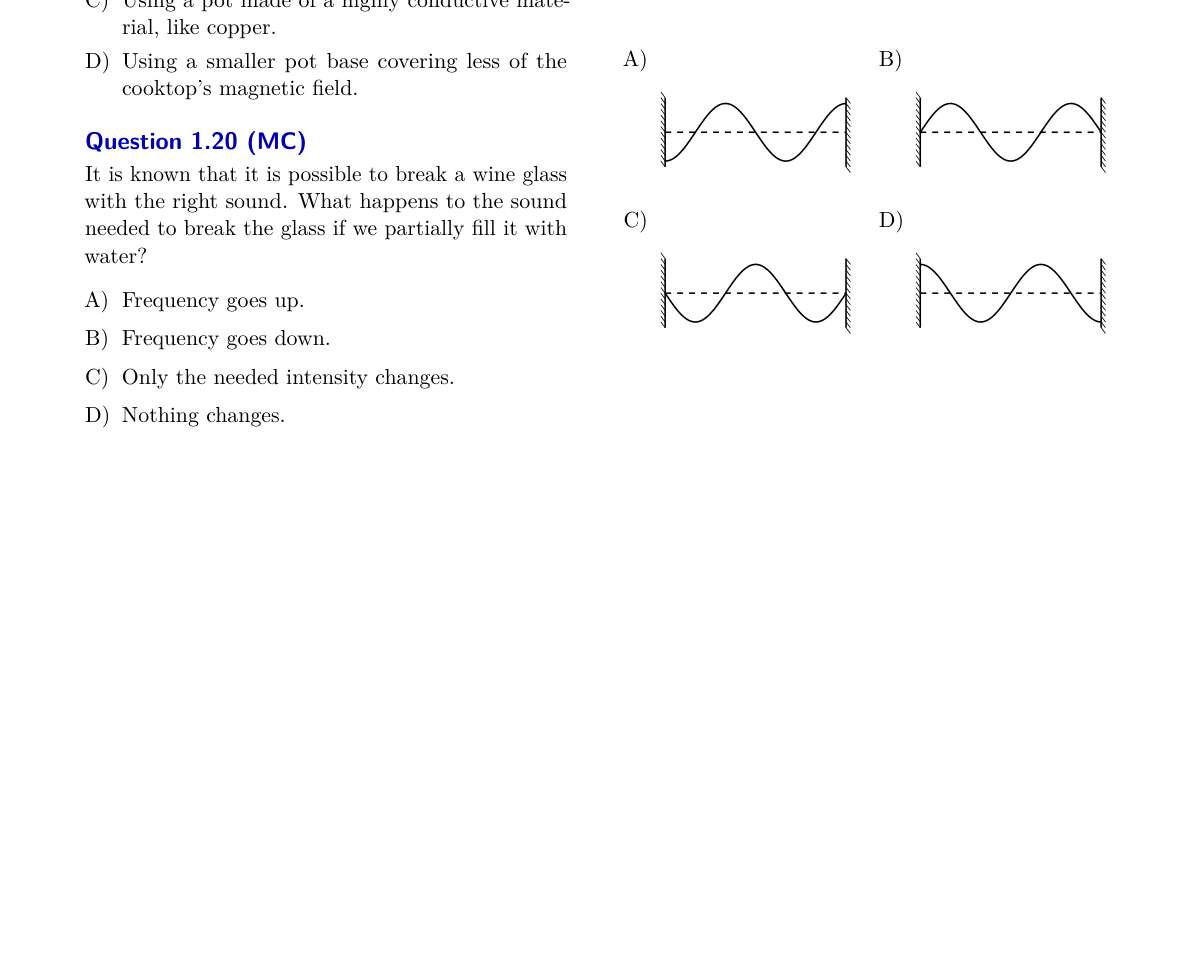 Standing wave on string at t=0 and options A-D
Topic: Oscillations & Waves Metodi: Wave Equation, Simple Harmonic Motion Analysis Competenze: Physical Reasoning, Diagrammatic Reasoning Objects: String Fonte: Testo (PDF) — p.7
**Domanda 1.21 (MC) **
L’immagine mostra un’onda stazionaria su una corda tra due muri al tempo . La corda vibra a una frequenza di . Quale delle seguenti immagini mostra lo stato della stringa a ?
- A. [figura A]
- B. [figura B]
- C. [figura C]
- D. [figura D]
onda in piedi su una corda a t=0 e opzioni A-D
Topic: Oscillations & Waves Metodi: Wave Equation, Simple Harmonic Motion Analysis Competenze: Physical Reasoning, Diagrammatic Reasoning Objects: String Fonte: Testo (PDF) — p.7
Long problem 2.1: Strépy-Thieu Boat Lift (16 points)
The Strépy-Thieu boat lift is a naval infrastructure to connect two canals in Belgium. It consists of two independent counterweighted caissons, which can each hold a large 1350 tonnes barge. Note: The numerical values in this problem have been adapted and do not entirely reflect the reality.
Part A. Statics
A caisson has inner dimensions of and a water depth of . It is suspended by 112 suspension cables and 32 control cables.
i. (1 pt) What is the total mass of the water inside the caisson when no boat is present?
ii. (1 pt) Knowing that an empty caisson weighs 3000 t and that the counterweights exactly match the total mass of the full caisson, calculate the tension in each of the cables (= force carried by each of the cables). You may assume that all cables hold the same tension.
iii. (1.5 pts) The lift is designed to carry boats of up to 1350 t. Calculate the volume of water that leaves the caisson when such a boat enters it. Explain your result. Assume that the water level remains constant.
iv. (2 pts) The caisson has a door on each (narrow) end, which spans the whole cross-section of the water. Calculate the force with which the water pushes on each door.
Part B. Dynamics
i. (1 pt) The control cables can withstand a maximal tension of 600 kN. Calculate the maximal acceleration that is possible before the cables break.
ii. (1 pt) Describe the change in normal force (of the cable on the cylinder) caused by a small change of the angle swept by the cable. Assume there is a tension on the cable and use appropriate simplifications.
iii. (3 pts) Using the previous result, how does the change of the tension per small angle depend on the tension and the friction? State what has to be when . This is now a differential equation. You do not need to solve it.
iv. (2 pts) Calculate the minimal number of turns needed for each control cable in order to be able to reach the maximal acceleration without the cable slipping. The friction coefficient of steel on steel is 0.78.
Part C. Energetics
The lift has a maximal speed of and a height of . It is powered by electric motors, which can also be used as generators to slow it down. The efficiency of these motors is smaller when used as generators: You can neglect the energy dissipation due to friction for this part.
i. (1 pt) Calculate the total energy that is effectively needed for one ascent of the caisson.
ii. (1 pt) What mass of water could we bring to a boil with this energy? The water starts at and has a specific heat capacity of .
iii. (1.5 pts) Calculate the average power needed during the acceleration phase. You can assume that the acceleration change is instantaneous and that we only use half of the maximal acceleration to keep a security margin.
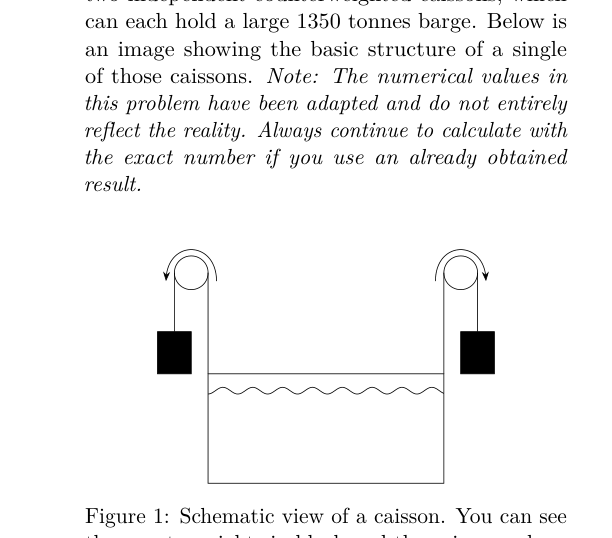 Schematic view of caisson with counterweights
Topic: Fluid Mechanics, Newtonian Mechanics, Thermodynamics Metodi: Hydrostatic Equilibrium, Free-Body Diagram, Conservation of Energy, Calculus-Integration, Differential Equations Competenze: Mathematical Modeling, Physical Reasoning Objects: Container, String, Pulley Fonte: Testo (PDF) — p.12
Problema lungo 2.1: Strépy-Thieu Boat Lift (16 punti)
L’elevatore navale Strépy-Thieu è un’infrastruttura navale per collegare due canali in Belgio. È costituito da due cassonne indipendenti, contropesi, che possono contenere ciascuna una grande barca di 1350 tonnellate. Nota: i valori numerici di questo problema sono stati adattati e non riflettono interamente la realtà.
Parte A. Statici
Un caisson ha dimensioni interne di e una profondità d’acqua di . È sospeso da 112 cavi di sospensione e da 32 cavi di controllo.
i. (1 pt) Qual è la massa totale dell’acqua all’interno del caisson quando non c’è barca?
ii. (1 pt) Sapendo che un caisson vuoto pesa 3000 t e che i contrappesi corrispondono esattamente alla massa totale del caisson completo, calcolare la tensione in ciascuno dei cavi (= forza trasportata da ciascuno dei cavi). Si può presumere che tutti i cavi abbiano la stessa tensione.
iii. (1,5 pts) L’ascensore è progettato per trasportare imbarcazioni fino a 1350 tonnellate. Calcola il volume di acqua che lascia il caisson quando una barca entra in esso. Spiegate il risultato. Supponiamo che il livello dell’acqua rimanga costante.
iv. (2 punti) Il caisson ha una porta su ciascuna estremità (stretta) che si estende su tutta la sezione trasversale dell’acqua. Calcola la forza con cui l’acqua spinge su ogni porta.
Parte B. Dinamica
i. (1 pt) I cavi di controllo possono sopportare una tensione massima di 600 kN. Calcolare l’accelerazione massima possibile prima che i cavi si rompano.
ii. (1 pt) Descrivere la variazione nella forza normale (del cavo sul cilindro) causata da un piccolo cambiamento dell’angolo spazzato dal cavo. Supponiamo che il cavo abbia una tensione e utilizziamo le semplificazioni appropriate.
iii. (3 punti) Sulla base del risultato precedente, come dipende la variazione della tensione per angolo dalla tensione e dalla frizione? Indicare quale deve essere quando . Questa è ora un’equazione differenziale. Non devi risolverlo.
iv. (2 punti) Calcolare il numero minimo di giri necessari per ogni cavo di controllo per raggiungere l’accelerazione massima senza che il cavo scivoli. Il coefficiente di attrito dell’acciaio sullo acciaio è di 0,78.
C. Parte C. Energia
L’ascensore ha una velocità massima di e un’altezza di . È alimentato da motori elettrici, che possono anche essere utilizzati come generatori per rallentare. L’efficienza di questi motori è minore quando utilizzati come generatori: Puoi trascurare la dissipazione di energia a causa dell’attrito per questa parte.
i. (1 pt) Calcolare l’energia totale necessaria per una salita del caisson.
ii. (1 pt) Che massa d’acqua potremmo portare a bollire con questa energia? L’acqua inizia a e ha una capacità termico specifica di .
iii. (1,5 punti) Calcolare la potenza media necessaria durante la fase di accelerazione. Si può supporre che il cambiamento di accelerazione sia istantaneo e che usiamo solo la metà dell’accelerazione massima per mantenere un margine di sicurezza.
Vista schematica del caisson con contrapesi
Topic: Fluid Mechanics, Newtonian Mechanics, Thermodynamics Metodi: Hydrostatic Equilibrium, Free-Body Diagram, Conservation of Energy, Calculus-Integration, Differential Equations Competenze: Mathematical Modeling, Physical Reasoning Objects: Container, String, Pulley Fonte: Testo (PDF) — p.12
Long problem 2.2: Liquid crystals (16 points)
Some airplane windows can adjust their transparency using liquid crystal technology, which controls how much light passes through. This is performed by adjusting the polarization of the throughgoing light. Polarization denotes the oscillation direction of the electric field of the light (which is an electromagnetic wave). The polarization is always perpendicular to the propagation direction. If light with intensity goes through a linear polarizer, the transmitted light intensity is generally given by where is the angle between the polarization direction of the incoming light and the transmission axis of the second polarizer.
Part A. System Sketch
First, light passes through a static linear polarizer. Then, the light passes through a liquid crystal layer that changes the polarization of the light by an angle . In its ground state (no field), the liquid crystal rotates the polarization by an angle . When an electric field is applied, the rotation angle decreases. Finally, light passes through a second linear polarizer placed at a distance and aligned at an angle with respect to the first.
i. (2 pts) Sketch the system, label the distance between the filters and insert a label for the intensity at each stage.
ii. (1 pt) Describe in your own words the polarization state of the incoming light.
iii. (1 pt) Describe in your own words the polarization state of the outgoing light.
Part B. Capacitor Behavior
The liquid crystal layer has a thickness of , and a maximum applied voltage of . The relative permittivity of the liquid crystal is .
i. (2 pts) Calculate the electric field strength between the two polarizers across the liquid crystal layer when the maximum voltage is applied.
ii. (1 pt) Determine the capacity of a area of the liquid crystal layer.
Part C. Adjusting the Intensity
The angle is determined by: where the polarization change depends on the applied voltage: where completely eliminates the polarization rotation.
i. (2 pts) What is the light intensity after the first linear polarizer with respect to the intensity of the incoming light ?
ii. (1 pt) You want to have a window with maximum transparency. If you are free to choose the value of , what value will you set it to?
iii. (3 pts) Calculate the voltage that must be applied to reduce the transmitted light intensity by 70% with respect to the incoming light.
Part D. Calculator Screens
The same technology is used in displays of many calculators. The only conceptual difference is that a mirror is placed at one side of the setup. Light thus traverses the system twice.
i. (2 pts) In this case, what voltage has to be applied to reduce the intensity by 70% with respect to the incoming light?
ii. (1 pt) What is the value of the fraction ?
Topic: Wave Optics, Electrostatics, Electromagnetic Induction Metodi: Superposition Principle, Electric Potential Method, Interference & Diffraction Analysis Competenze: Mathematical Modeling, Physical Reasoning Objects: Capacitor, Mirror Fonte: Testo (PDF) — p.14
Problema lungo 2.2: cristalli liquidi (16 punti)
Alcune finestre degli aerei possono regolare la loro trasparenza utilizzando la tecnologia dei cristalli liquidi, che controlla la quantità di luce che passa attraverso. Questo viene effettuato regolaendo la polarizzazione della luce che attraversa. La polarizzazione indica la direzione di oscillazione del campo elettrico della luce (che è un’onda elettromagnetica). La polarizzazione è sempre perpendicolare alla direzione di propagazione. Se la luce con intensità passa attraverso un polarizzatore lineare, l’intensità luminosa trasmessa è generalmente data da dove è l’angolo tra la direzione di polarizzazione della luce in entrata e l’asse di trasmissione del secondo polarizzatore.
Parte A. Sketch del sistema
In primo luogo, la luce passa attraverso un polarizzatore lineare statico. Poi, la luce passa attraverso uno strato di cristallo liquido che cambia la polarizzazione della luce da un angolo . Nel suo stato di base (senza campo), il cristallo liquido ruota la polarizzazione con un angolo . Quando viene applicato un campo elettrico, l’angolo di rotazione diminuisce. Infine, la luce passa attraverso un secondo polarizzatore lineare posizionato a una distanza e allineato ad un angolo rispetto al primo.
i. (2 punti) Sniciare il sistema, etichettare la distanza tra i filtri e inserire un’etichetta per l’intensità in ogni fase.
ii. (1 p) Descrivi con le tue parole lo stato di polarizzazione della luce in arrivo.
iii. (1 p) Descrivi con le tue parole lo stato di polarizzazione della luce uscente.
Parte B. Comportamento del condensatore
Lo strato di cristallo liquido ha uno spessore di e una tensione massima applicata di . La relativa permissività del cristallo liquido è .
i. (2 punti) Calcolare la resistenza del campo elettrico tra i due polarizzatori attraverso lo strato di cristallo liquido quando viene applicata la tensione massima.
ii. (1 pt) Determinare la capacità di una superficie dello strato di cristallo liquido.
C. Parte C. Regolazione dell’intensità
L’angolo è determinato da: se la variazione di polarizzazione dipende dalla tensione applicata: in cui elimina completamente la rotazione di polarizzazione.
i. (2 punti) Qual è l’intensità luminosa dopo il primo polarizzatore lineare rispetto all’intensità della luce in entrata ?
ii. (1 pt) Si desidera avere una finestra con massima trasparenza. Se siete liberi di scegliere il valore di , a quale valore lo imposterete?
iii. (3 punti) Calcolare la tensione da applicare per ridurre l’intensità della luce trasmessa del 70% rispetto alla luce in entrata.
Parte D. Screens di calcolatore
La stessa tecnologia viene utilizzata nei display di molte calcolatrici. L’unica differenza concettuale è che un specchio è posto su un lato dell’impianto. La luce attraversa il sistema due volte.
i. (2 punti) In questo caso, quale tensione deve essere applicata per ridurre l’intensità del 70% rispetto alla luce in entrata?
ii. (1 pt) Qual è il valore della frazione ?
Topic: Wave Optics, Electrostatics, Electromagnetic Induction Metodi: Superposition Principle, Electric Potential Method, Interference & Diffraction Analysis Competenze: Mathematical Modeling, Physical Reasoning Objects: Capacitor, Mirror Fonte: Testo (PDF) — p.14
Long problem 2.3: Voltmeter (16 points)
A voltmeter is a device that is used to measure voltages in an electrical circuit.
Part A. Calculate voltages
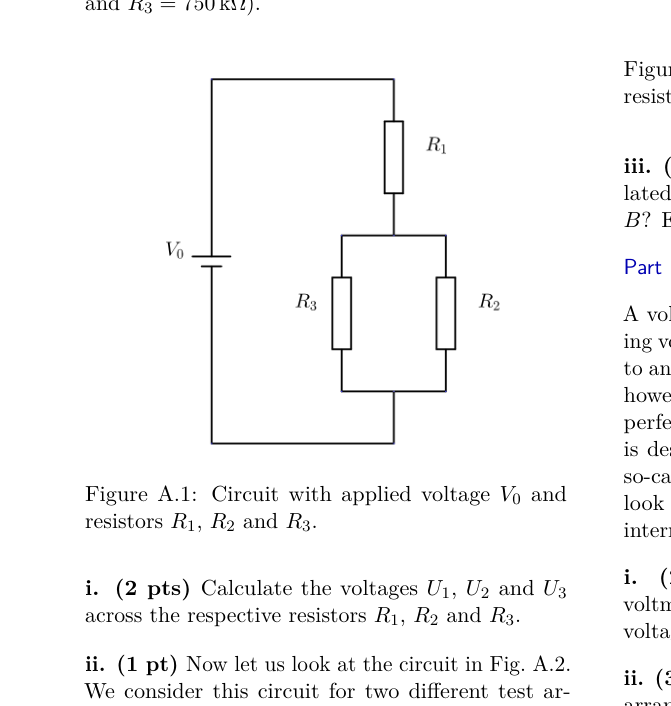
Consider the circuit in Fig. A.1 with applied voltage and resistors , , (where and are in parallel with each other, and is in series with that combination).
i. (2 pts) Calculate the voltages , and across the respective resistors , and .
ii. (1 pt) Now consider the circuit with only and in series (Fig. A.2) for two different test arrangements A and B:
- and
- and
Calculate the voltage across the resistor for both arrangements A and B.
iii. (1.5 pts) What is noticeable about the calculated voltage in both test arrangements A and B? Explain mathematically why this is the case.
Part B. Internal resistance of a voltmeter
i. (2 pts) Draw a sketch of how to connect a voltmeter to the circuit in Fig. A.2 to measure the voltage across . Give reasons for your choice.
ii. (3 pts) In an experiment, both test arrangements were recreated and the voltage across was measured with the same voltmeter, obtaining:
- A)
- B)
Calculate the internal resistance of the voltmeter.
iii. (1 pt) What should apply to the internal resistance compared to the resistance you want to measure for precise measurements?
Part C. Electroscope
An analogue voltmeter can be represented using an electroscope as shown in Fig. C.1. The electroscope consists of two plates with charges and of area , and a conductive pointer attached to one plate that can rotate freely. The pointer has small positive charge and mass , both concentrated at its tip. The electric field between the plates is homogeneous.
i. (0.5 pts) Explain why the pointer moves.
ii. (1 pt) Which condition must be met if the pointer no longer moves in a tangential direction? Describe with the help of a sketch.
iii. (2 pts) From the equilibrium condition for the tangential direction, calculate the deflection angle as a function of the forces present.
iv. (1.5 pts) Calculate the electrical force on the tip as a function of the charges on the plate, the charge on the tip and the plate area .
v. (0.5 pts) Now calculate the deflection angle for the following values:
 Electroscope with charged plates and pointer
Topic: Circuits, Electrostatics Metodi: Kirchhoff’s Laws, Equivalent Circuit Reduction, Coulomb’s Law, Gauss’s Law Competenze: Mathematical Modeling, Physical Reasoning Objects: Resistor, Galvanometer, Capacitor Fonte: Testo (PDF) — p.15
Problema lungo 2.3: Voltmeter (16 punti)
Un voltmeter è un dispositivo che viene utilizzato per misurare le tensioni in un circuito elettrico.
Parte A. Tensioni calcolatrici
Considerate il circuito di Fig. A.1 con tensione applicata e resistori , , (in cui e sono parallele tra loro e è in serie con tale combinazione).
i. (2 punti) Calcolare le tensioni , e sulle rispettive resistenze , e .
ii. (1 pt) Ora consideriamo il circuito con solo e in serie (Fig. A.2) per due diversi sistemi di prova A e B:
- e
- e
Calcolare la tensione attraverso la resistenza per entrambe le disposizioni A e B.
iii. (1,5 pts) Cosa è notevole della tensione calcolata in entrambe le modalità di prova A e B? Spiega matematicamente perché è così.
Parte B. Resistenza interna di un voltmeter
i. (2 punti) Disegnare un disegno di come collegare un voltmeter al circuito in Figura. A.2 per misurare la tensione su . Datemi le ragioni per la vostra scelta.
ii. (3 punti) In un esperimento, sono state ricreate entrambe le disposizioni di prova e la tensione attraverso è stata misurata con lo stesso voltmeter, ottenendo:
- A)
- B)
Calcolare la resistenza interna del voltometro.
iii. (1 pt) Che cosa dovrebbe applicarsi alla resistenza interna rispetto alla resistenza che si desidera misurare per misure precise?
C. Parte C. L’elettroscopio
Un voltometro analogo può essere rappresentato con un elettroscopo come mostrato nella figura. C.1. L’elettroscopo è costituito da due piastre con cariche e di superficie e da un puntatore conduttore collegato a una piastra che può ruotare liberamente. Il puntatore ha una piccola carica positiva e massa , entrambe concentrate alla sua punta. Il campo elettrico tra le piastre è omogeneo.
i. (0.5 punti) Spiega perché il puntatore si muove.
ii. (1 p) Quale condizione deve essere soddisfatta se il puntatore non si muove più in direzione tangenziale? Descrivi con l’aiuto di uno schizzo.
iii. (2 punti) Dal punto di equilibrio della direzione tangenziale, calcolare l’angolo di deviazione come funzione delle forze presenti.
iv. (1,5 punti) Calcolare la forza elettrica della punta come funzione delle cariche sulla targa, della carica sulla punta e della superficie della targa .
v. (0,5 punti) Calcola ora l’angolo di deflessione per i seguenti valori:
*Elettroscopio con piastre e puntatori carichi *
Topic: Circuits, Electrostatics Metodi: Kirchhoff’s Laws, Equivalent Circuit Reduction, Coulomb’s Law, Gauss’s Law Competenze: Mathematical Modeling, Physical Reasoning Objects: Resistor, Galvanometer, Capacitor Fonte: Testo (PDF) — p.15