Question 1.1 (MC)
Estimate how many litres of water fall down the Rhine Falls each year.
- A.
- B.
- C.
- D.
Topic: Order-of-Magnitude Estimation Metodi: Order-of-Magnitude Estimation Competenze: Estimation & Approximation Objects: — Fonte: Testo (PDF) — p.3
**Domanda 1.1 (MC) **
Calcola quanti litri di acqua cadono ogni anno nelle cascate del Reno.
- A.
- B.
- C.
- D.
Topic: Order-of-Magnitude Estimation Metodi: Order-of-Magnitude Estimation Competenze: Estimation & Approximation Objects: — Fonte: Testo (PDF) — p.3
Question 1.2 (MC)
Three celestial objects approximated as point masses with the masses , and are in a line at time . The mass is in the centre. Between and and between and is a distance , respectively. The initial velocities of and are opposite, perpendicular to the axis through the three centres of gravity, and have the same magnitude . What is the maximum mass of so that a stable motion can be achieved?
(A)
(B)
(C)
(D) None of the above answers are correct.
Topic: Gravitation, Newtonian Mechanics Metodi: Newton’s Law of Gravitation, Physical Modeling, Conservation of Energy Competenze: Physical Reasoning, Mathematical Modeling Objects: Planet Fonte: Testo (PDF) — p.3
**Domanda 1.2 (MC) **
Tre oggetti celesti approssimati come masse puntine con le masse , e sono in una linea temporale . La massa è al centro. Tra e e tra e è una distanza , rispettivamente. Le velocità iniziali di e sono opposte, perpendicolari all’asse attraverso i tre centri di gravità, e hanno la stessa magnitudine . Qual è la massa massima di per ottenere un movimento stabile?
(A)
(B)
(C)
(D) Nessuna delle risposte sopra esposte è corretta.
Topic: Gravitation, Newtonian Mechanics Metodi: Newton’s Law of Gravitation, Physical Modeling, Conservation of Energy Competenze: Physical Reasoning, Mathematical Modeling Objects: Planet Fonte: Testo (PDF) — p.3
Question 1.3 (MC)
Two semi-transparent mirrors, each reflecting 75% of the incident light, are positioned parallel to each other at a distance of 1 m. A beam of light is now directed onto the first mirror, which is reflected back and forth between the mirrors in a zigzag pattern. What proportion of the light was lost in total after 9 reflections?
- A. approx. 97.5%
- B. approx. 95.0%
- C. approx. 92.5%
- D. approx. 90.0%
Topic: Geometric Optics, Wave Optics Metodi: Physical Modeling, Approximation & Series Expansion Competenze: Mathematical Modeling, Physical Reasoning Objects: Mirror Fonte: Testo (PDF) — p.3
**Domanda 1.3 (MC) **
Due specchi semitransparenti, che riflettono ciascuno il 75% della luce incidente, sono posizionati paralleli l’uno all’altro a una distanza di 1 m. Ora un raggio di luce è diretto verso il primo specchio, che si riflette avanti e indietro tra i specchi in un modello in zigzag. Quale percentuale della luce è stata persa dopo 9 riflessioni?
- A. approssimativamente. 97.5%
- B. approssimativamente. 95.0%
- C. approssimativamente. 92.5%
- D. approssimativamente. 90.0%
Topic: Geometric Optics, Wave Optics Metodi: Physical Modeling, Approximation & Series Expansion Competenze: Mathematical Modeling, Physical Reasoning Objects: Mirror Fonte: Testo (PDF) — p.3
Question 1.4 (MC)
A particle moves randomly between the three positions A, B and C. From one time step (, arbitrary units) to another, the probability that it stays in the same position is and the probability that it moves to any of the other positions is . Let’s say that our particle starts at in position A. What is the probability that it is at position B at ?
- A. 0.08
- B. 0.16
- C. 0.2
- D. 0.24
- E. 0.32 (F) 0.36 (G) 0.4 (H) 0.48
Topic: Modern-Quantum Physics Metodi: Statistical Averaging, Physical Modeling Competenze: Mathematical Modeling, Physical Reasoning Objects: — Fonte: Testo (PDF) — p.3
**Domanda 1.4 (MC) **
Una particella si muove in modo casuale tra le tre posizioni A, B e C. Da un passo temporale (, unità arbitrarie) all’altro, la probabilità che rimanga nella stessa posizione è e la probabilità che si muova in qualsiasi delle altre posizioni è . Diciamo che la nostra particella inizia a nella posizione A. Qual è la probabilità che sia in posizione B a ?
- A. 0.08
- B. 0.16
- C. 0.2
- D. 0.24
- E. 0.32 (F) 0.36 (G) 0.4 (H) 0.48
Topic: Modern-Quantum Physics Metodi: Statistical Averaging, Physical Modeling Competenze: Mathematical Modeling, Physical Reasoning Objects: — Fonte: Testo (PDF) — p.3
Question 1.5 (MC)
A washing machine rotates at 1500 revolutions per minute. As soon as it is switched off, it brakes with a constant angular acceleration of . How many revolutions does the drum make before it comes to a standstill?
- A. 300
- B. 2000
- C. 7000
- D. 12 000
Topic: Rotational Dynamics Metodi: Kinematic Equations, Torque & Angular Momentum Analysis Competenze: Mathematical Modeling Objects: Wheel Fonte: Testo (PDF) — p.3
La domanda 1.5 (MC)
Una lavatrice ruota a 1500 rotazioni al minuto. Non appena viene spento, frenare con un’accelerazione angolare costante di . Quante rivoluzioni fa il tamburo prima di fermarsi?
- A. 300
- B. 2000
- C. 7000
- D. 12 000
Topic: Rotational Dynamics Metodi: Kinematic Equations, Torque & Angular Momentum Analysis Competenze: Mathematical Modeling Objects: Wheel Fonte: Testo (PDF) — p.3
Question 1.6 (MC)
A pendulum is suspended to the ceiling of an elevator. When the elevator starts accelerating upwards, the frequency of the pendulum
- A. remains unchanged.
- B. increases.
- C. decreases.
Topic: Oscillations & Waves, Newtonian Mechanics Metodi: Simple Harmonic Motion Analysis, Free-Body Diagram Competenze: Physical Reasoning Objects: Pendulum Fonte: Testo (PDF) — p.3
**Domanda 1.6 (MC) **
Un pendolo è sospeso al soffitto di un ascensore. Quando l’ascensore inizia ad accelerare verso l’alto, la frequenza del pendolo
- A. rimane invariato.
- B. aumenta.
- C. diminuisce.
Topic: Oscillations & Waves, Newtonian Mechanics Metodi: Simple Harmonic Motion Analysis, Free-Body Diagram Competenze: Physical Reasoning Objects: Pendulum Fonte: Testo (PDF) — p.3
Question 1.7 (MC)
While Remco is cycling, the powermeter on his bike has access to the following data:
I. Remco’s speed,
II. the force with which Remco pushes on his pedals,
III. Remco’s weight,
IV. the slope of the road on which Remco is cycling,
V. the angular velocity with which Remco pedals.
Which informations does the powermeter use to calculate Remco’s power?
- A. I, III, IV
- B. I, IV
- C. II, IV, V
- D. II, V
Topic: Newtonian Mechanics, Rotational Dynamics Metodi: Kinematic Equations, Physical Modeling, Torque & Angular Momentum Analysis Competenze: Physical Reasoning Objects: — Fonte: Testo (PDF) — p.4
**Domanda 1.7 (MC) **
Mentre Remco guida in bicicletta, il powermeter della sua moto ha accesso ai seguenti dati:
I. La velocità di Remco,
II. la forza con cui Remco spinge i suoi pedali,
III. Il Il peso di Remco,
IV. la pendenza della strada su cui Remco si sposta in bicicletta,
V. la velocità angolare con cui Remco pedale.
Quali informazioni utilizza il powermeter per calcolare la potenza di Remco?
- A. I, III, IV
- B. I, IV
- C. II, IV, V
- D. II, V
Topic: Newtonian Mechanics, Rotational Dynamics Metodi: Kinematic Equations, Physical Modeling, Torque & Angular Momentum Analysis Competenze: Physical Reasoning Objects: — Fonte: Testo (PDF) — p.4
Question 1.8 (MC)
Look at the beam scale below. What does the scale show when the weight on the left-hand side is moved to the outermost position of the bar? The individual scale elements are rigid, with hinges attached at the points marked in red.
- A. The left side is heavier.
- B. Both sides are in balance.
- C. The right-hand side is heavier.
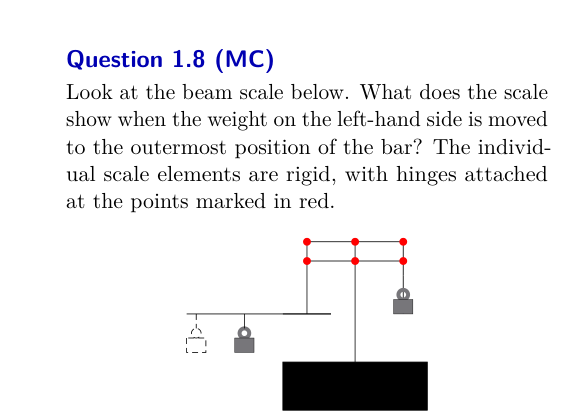 Beam scale with hinges and movable weight
Topic: Rigid Body Statics, Newtonian Mechanics Metodi: Torque & Angular Momentum Analysis, Free-Body Diagram Competenze: Diagrammatic Reasoning, Physical Reasoning Objects: Beam, Lever Fonte: Testo (PDF) — p.4
**Domanda 1.8 (MC) **
Guarda la scala di raggi qui sotto. Cosa mostra la scala quando il peso sul lato sinistro viene spostato nella posizione più esterna della barra? Gli elementi di scala individuali sono rigidi, con cerniere attaccate ai punti contrassegnati in rosso.
- A. Il lato sinistro è più pesante.
- B. Entrambi i lati sono in equilibrio.
- C. Il lato destro è più pesante.
Scala di fascio con cerniere e peso mobile
Topic: Rigid Body Statics, Newtonian Mechanics Metodi: Torque & Angular Momentum Analysis, Free-Body Diagram Competenze: Diagrammatic Reasoning, Physical Reasoning Objects: Beam, Lever Fonte: Testo (PDF) — p.4
Question 1.9 (MC)
Alice goes up and down the Mont Blanc, rising above sea level. On the ways up and down she averages a (horizontal) speed of and respectively. What can be said about the average speed of the whole trip?
(A)
(B)
(C)
(D)
(E)
Topic: Newtonian Mechanics Metodi: Kinematic Equations, Approximation & Series Expansion Competenze: Physical Reasoning, Mathematical Modeling Objects: — Fonte: Testo (PDF) — p.4
Question 1.9 (MC)
Alice goes up and down the Mont Blanc, rising above sea level. Per le rotte in su e in giù, ha una velocità media (orizzontale) rispettivamente di e . Che cosa si può dire della velocità media di tutto il viaggio?
(A)
(B)
(C)
(D)
(E)
Topic: Newtonian Mechanics Metodi: Kinematic Equations, Approximation & Series Expansion Competenze: Physical Reasoning, Mathematical Modeling Objects: — Fonte: Testo (PDF) — p.4
Question 1.10 (MC)
When an electron in an excited atom makes a transition from a higher to a lower energy level, the atom emits light whose frequency is proportional to the energy difference between the two levels. Consider an atom with three energy states. Let the frequency of the light emitted during a transition from state to state be denoted by . What relationship holds among , and ?
(A)
(B)
(C)
(D)
Topic: Modern-Quantum Physics, Astrophysics Metodi: Bohr Model & Quantization, Photon Energy Relation Competenze: Physical Reasoning, Mathematical Modeling Objects: Atom, Electron, Photon Fonte: Testo (PDF) — p.4
**Domanda 1.10 (MC) **
Quando un elettrone in un atomo eccitato fa una transizione da un livello di energia più alto a un livello di energia più basso, l’atomo emette luce la cui frequenza è proporzionale alla differenza di energia tra i due livelli. Consideriamo un atomo con tre stati energetici. La frequenza della luce emessa durante la transizione dallo stato allo stato deve essere indicata da . Qual è la relazione tra , e ?
(A)
(B)
(C)
(D)
Topic: Modern-Quantum Physics, Astrophysics Metodi: Bohr Model & Quantization, Photon Energy Relation Competenze: Physical Reasoning, Mathematical Modeling Objects: Atom, Electron, Photon Fonte: Testo (PDF) — p.4
Question 1.11 (MC)
Why does the sky appear blue during the day?
(A) Because nitrogen absorbs the other colours.
(B) Because the sun emits blue light stronger than red light.
(C) Because the water on earth makes the sky blue.
(D) Because the ozone layer favours the transmission of blue light.
(E) Because short-wavelength, visible light is scattered more strongly by the air molecules than long-wavelength light.
(F) Because violet is so strongly scattered that it is distributed in the sky and blue dominates.
(G) Because a heavenly painter has painted the sky blue.
Topic: Wave Optics, Astrophysics Metodi: Physical Modeling, Superposition Principle Competenze: Physical Reasoning Objects: — Fonte: Testo (PDF) — p.4
La domanda 1.11 (MC)
Perché il cielo appare blu durante il giorno?
A) Perché l’azoto assorbe gli altri colori.
(B) Perché il sole emette luce blu più forte della luce rossa.
(C) Perché l’acqua sulla terra rende il cielo azzurro.
D) Perché lo strato di ozono favorisce la trasmissione della luce blu.
(E) Poiché la luce visibile a lunghezza d’onda corta è dispersa più fortemente dalle molecole dell’aria che la luce a lunghezza d’onda.
(F) Perché il viola è così fortemente disperso che è distribuito nel cielo e il blu domina.
(G) Perché un pittore celeste ha dipinto il cielo in blu.
Topic: Wave Optics, Astrophysics Metodi: Physical Modeling, Superposition Principle Competenze: Physical Reasoning Objects: — Fonte: Testo (PDF) — p.4
Question 1.12 (MC)
A glacier moves at a constant speed over a subsurface. Consider a cuboid ice plate with a square base side length of 100 m and a height of 10 m. The coefficient of sliding friction is , the subsurface does not remove heat and the top of the ice sheet has a constant temperature of . The density of ice is and the thermal conductivity of ice is . At what speed does the ice begin to melt?
- A.
- B.
- C.
Topic: Thermodynamics, Fluid Mechanics Metodi: Energy Conservation Method, Physical Modeling, Free-Body Diagram Competenze: Mathematical Modeling, Physical Reasoning Objects: — Fonte: Testo (PDF) — p.5
**Domanda 1.12 (MC) **
Un ghiacciaio si muove a una velocità costante sopra un sottosuolo. Considerate una piastra di ghiaccio cuboide con una lunghezza laterale quadrata di base di 100 m e un’altezza di 10 m. Il coefficiente di attrito di scorrere è , il sottosuolo non rimuove il calore e la parte superiore della calotta glaciale ha una temperatura costante di . La densità del ghiaccio è e la conducibilità termica del ghiaccio è . A che velocità inizia a sciogliere il ghiaccio?
- A.
- B.
- C.
Topic: Thermodynamics, Fluid Mechanics Metodi: Energy Conservation Method, Physical Modeling, Free-Body Diagram Competenze: Mathematical Modeling, Physical Reasoning Objects: — Fonte: Testo (PDF) — p.5
Question 1.13 (MC)
Do you remember my leftovers from the first round? Doesn’t matter if you don’t. I reheated them later that week and it turned out that it was still too much food! So I ended up with left overs from the left overs. Naturally, I put them in the fridge once again (at ). Which diagram qualitatively describes their temperature over time?
- A. Temperature rises monotonically from a sub-zero value toward room temperature.
- B. Temperature decreases monotonically from a positive value, flattening toward the fridge temperature.
- C. Temperature first rises (from being heated) then drops exponentially toward fridge temperature.
- D. Temperature drops steeply at first then levels off at fridge temperature with an inflection point.
(See diagrams A–D on the question sheet.)
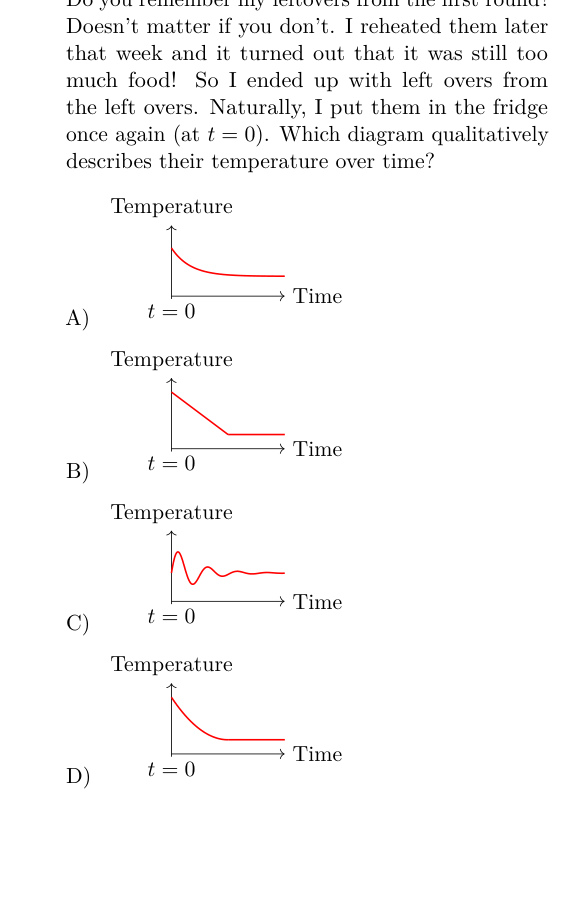 Four temperature–time graphs A B C D
Topic: Thermodynamics Metodi: Physical Modeling, First Law of Thermodynamics Competenze: Physical Reasoning, Diagrammatic Reasoning Objects: — Fonte: Testo (PDF) — p.5
La domanda 1.13 (MC)
Ti ricordi i miei resti del primo round? Non importa se non lo fai. Li ho riscaldati più tardi quella settimana e si è scoperto che era ancora troppo cibo! Quindi ho finito con le manche sinistra delle manche sinistra. Naturalmente, li metto ancora una volta nel frigorifero (a ). Quale diagramma descrive qualitativamente la loro temperatura nel tempo?
- A. La temperatura aumenta monotonicamente da un valore sotto zero verso la temperatura ambiente.
- B. La temperatura diminuisce monotonicamente da un valore positivo, appiattendo verso la temperatura frigorifera.
- C. La temperatura sale prima (da quando viene riscaldata) e poi scende esponenziale verso la temperatura del frigorifero.
- D. La temperatura scende notevolmente all’inizio e poi si riduce a temperatura frigorifera con un punto di inflezione.
*(Vedi i diagrammi AD della scheda di domande.) *
Quattro grafici temporali di temperatura A B C D
Topic: Thermodynamics Metodi: Physical Modeling, First Law of Thermodynamics Competenze: Physical Reasoning, Diagrammatic Reasoning Objects: — Fonte: Testo (PDF) — p.5
Question 1.14 (MC)
The heat capacity for solids is predicted by the Dulong-Petit law to be independent of the temperature. However, experiments showed that at low temperatures, the heat capacity of a solid is after all temperature dependent. The Einstein model accounts for these observations using quantum mechanics. Which of the following results is the heat capacity in the Einstein model using the internal energy given as in (1)?
(A)
(B)
(C)
(D)
Topic: Modern-Quantum Physics, Thermodynamics Metodi: Bohr Model & Quantization, Kinetic Theory of Gases, Calculus-Integration Competenze: Mathematical Modeling, Physical Reasoning Objects: — Fonte: Testo (PDF) — p.5
**Domanda 1.14 (MC) **
La capacità termica dei solidi è prevista dalla legge di Dulong-Petit come indipendente dalla temperatura. Tuttavia, gli esperimenti hanno dimostrato che a basse temperature, la capacità termico di un solido dipende dalla temperatura. Il modello di Einstein spiega queste osservazioni utilizzando la meccanica quantistica. Quale dei seguenti risultati è la capacità di calore nel modello di Einstein utilizzando l’energia interna data come in (1)?
(A)
(B)
(C)
(D)
Topic: Modern-Quantum Physics, Thermodynamics Metodi: Bohr Model & Quantization, Kinetic Theory of Gases, Calculus-Integration Competenze: Mathematical Modeling, Physical Reasoning Objects: — Fonte: Testo (PDF) — p.5
Question 1.15 (MC)
What current will flow through an electrical overhead power line if a tension of 100 kV is applied? The cylindrical cable is long, has a radius of 20 mm and a specific resistivity of .
- A.
- B.
- C.
- D.
Topic: Circuits, Electrostatics Metodi: Kirchhoff’s Laws, Physical Modeling Competenze: Mathematical Modeling, Unit Conversion Objects: Wire Fonte: Testo (PDF) — p.5
**Domanda 1.15 (MC) **
Qual è la corrente che fluirà attraverso una linea elettrica aerea se viene applicata una tensione di 100 kV? Il cavo cilindrico è lungo , ha un raggio di 20 mm e una resistenza specifica di .
- A.
- B.
- C.
- D.
Topic: Circuits, Electrostatics Metodi: Kirchhoff’s Laws, Physical Modeling Competenze: Mathematical Modeling, Unit Conversion Objects: Wire Fonte: Testo (PDF) — p.5
Question 1.16 (MC)
What force acts on the charge when one of the charges is removed from the following configuration, where is the distance from to each of the charges ?
(The configuration has at the centre and five charges arranged symmetrically around it.)
(A) 0
(B)
(C)
(D)
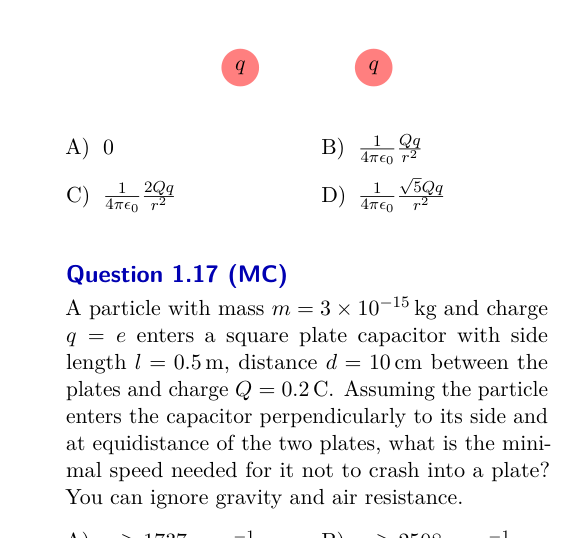 Five charges q symmetrically around central charge Q
Topic: Electrostatics Metodi: Coulomb’s Law, Superposition Principle, Symmetry Argument Competenze: Physical Reasoning, Diagrammatic Reasoning Objects: Point Charge Fonte: Testo (PDF) — p.6
**Domanda 1.16 (MC) **
Qual è la forza che agisce sulla carica quando una delle cariche viene rimossa dalla configurazione seguente, dove è la distanza da a ciascuna delle cariche ?
La configurazione ha al centro e cinque cariche disposte simmetricamente intorno a essa.) *
(A) 0
(B)
(C)
(D)
Quattro cariche q simmetricamente attorno alla carica centrale Q
Topic: Electrostatics Metodi: Coulomb’s Law, Superposition Principle, Symmetry Argument Competenze: Physical Reasoning, Diagrammatic Reasoning Objects: Point Charge Fonte: Testo (PDF) — p.6
Question 1.17 (MC)
A particle with mass and charge enters a square plate capacitor with side length , distance between the plates and charge . Assuming the particle enters the capacitor perpendicularly to its side and at equidistance of the two plates, what is the minimal speed needed for it not to crash into a plate? You can ignore gravity and air resistance.
- A.
- B.
- C.
- D.
- E.
Topic: Electrostatics, Newtonian Mechanics Metodi: Electric Potential Method, Kinematic Equations, Lorentz Force Analysis Competenze: Mathematical Modeling Objects: Capacitor, Point Charge Fonte: Testo (PDF) — p.6
**Domanda 1.17 (MC) **
Una particella con massa e carica entra in un condensatore quadrato di piastra con lunghezza laterale , distanza tra le piastre e carica . Supponendo che la particella entri nel condensatore perpendicolare al suo lato e a equidistanza delle due lastre, qual è la velocità minima necessaria per non colpire una lastra? Puoi ignorare la gravità e la resistenza dell’aria.
- A.
- B.
- C.
- D.
- E.
Topic: Electrostatics, Newtonian Mechanics Metodi: Electric Potential Method, Kinematic Equations, Lorentz Force Analysis Competenze: Mathematical Modeling Objects: Capacitor, Point Charge Fonte: Testo (PDF) — p.6
Question 1.18 (MC)
Which of the following statements about the electric potential is (are) correct?
I: The electric potential is unique.
II: The work required to move a charge from to is independent of the path.
III: A larger electric potential means a stronger electric field.
- A. I.
- B. II.
- C. III.
- D. I & II.
- E. I & III. (F) II & III. (G) I, II & III.
Topic: Electrostatics Metodi: Electric Potential Method, Coulomb’s Law Competenze: Physical Reasoning Objects: — Fonte: Testo (PDF) — p.6
La domanda 1.18 (MC)
Quali delle seguenti affermazioni sul potenziale elettrico sono corrette?
Il potenziale elettrico è unico.
II: Il lavoro necessario per spostare una carica da a è indipendente dal percorso.
III: Un potenziale elettrico maggiore significa un campo elettrico più forte.
- A. I.
- B. II.
- C. III.
- D. I & II.
- E. I & III. F) II e III. (G) I, II e III.
Topic: Electrostatics Metodi: Electric Potential Method, Coulomb’s Law Competenze: Physical Reasoning Objects: — Fonte: Testo (PDF) — p.6
Question 1.19 (MC)
A charged particle with mass and charge is located on a circular path with radius in a homogeneous magnetic field of strength . How does the radius of the particle’s circular path change if its kinetic energy is doubled in the direction of movement?
(A)
(B)
(C)
(D)
(E)
Topic: Magnetism, Newtonian Mechanics Metodi: Lorentz Force Analysis, Kinematic Equations, Energy Conservation Method Competenze: Mathematical Modeling, Physical Reasoning Objects: Point Charge Fonte: Testo (PDF) — p.6
**Domanda 1.19 (MC) **
Una particella carica con massa e carica si trova su un percorso circolare con raggio in un campo magnetico omogeneo di forza . Come cambia il raggio del percorso circolare della particella se la sua energia cinetica è raddoppiata nella direzione del movimento?
(A)
(B)
(C)
(D)
(E)
Topic: Magnetism, Newtonian Mechanics Metodi: Lorentz Force Analysis, Kinematic Equations, Energy Conservation Method Competenze: Mathematical Modeling, Physical Reasoning Objects: Point Charge Fonte: Testo (PDF) — p.6
Question 1.20 (MC)
In the rope park, Emmy races from one tree to another on a zipline. The contact between the rope and the pulley creates a loud whirring sound with a frequency . An observer at the starting point of the zipline hears a frequency and an observer at the end point of the zipline hears a frequency . How do the frequencies , and relate to each other?
(A)
(B)
(C)
(D)
(E)
(F)
Topic: Oscillations & Waves, Newtonian Mechanics Metodi: Wave Equation, Physical Modeling Competenze: Physical Reasoning Objects: String, Pulley Fonte: Testo (PDF) — p.6
**Domanda 1.20 (MC) **
Nel parco delle corde, Emmy corre da un albero all’altro su una zipline. Il contatto tra la corda e la polla crea un forte rumore di tormento con una frequenza . Un osservatore al punto di partenza della linea di ritiro sente una frequenza e un osservatore al punto finale della linea di ritiro sente una frequenza . Come si relazionano le frequenze , e ?
(A)
(B)
(C)
(D)
(E)
(F)
Topic: Oscillations & Waves, Newtonian Mechanics Metodi: Wave Equation, Physical Modeling Competenze: Physical Reasoning Objects: String, Pulley Fonte: Testo (PDF) — p.6
Question 1.21 (MC)
Three consecutive resonant frequencies of an organ pipe have the values 1310 Hz, 1834 Hz and 2358 Hz. Is this organ pipe closed at one end or open at both ends?
(A) Both ends open, because the frequency difference is a multiple of the fundamental frequency.
(B) Both ends open, as the pipe has short distances between the resonances, typical for open pipes.
(C) One end closed, because the frequency difference is not a multiple of the fundamental frequency.
(D) One end closed, as the frequencies increase linearly, which does not occur with a pipe where both ends are open.
Topic: Oscillations & Waves Metodi: Simple Harmonic Motion Analysis, Physical Modeling, Wave Equation Competenze: Physical Reasoning, Mathematical Modeling Objects: Tube Fonte: Testo (PDF) — p.7
**Domanda 1.21 (MC) **
Le tre frequenze di risonanza consecutive di un tubo di organo hanno i valori 1310 Hz, 1834 Hz e 2358 Hz. Questa tubazione di organo è chiusa da una parte o aperta da entrambe le estremità?
(A) Entrambe le estremità sono aperte, perché la differenza di frequenza è un multiple della frequenza fondamentale.
(B) Entrambe le estremità sono aperte, poiché il tubo ha brevi distanze tra le risonanze, tipiche per i tubi aperti.
(C) Una estremità chiusa, perché la differenza di frequenza non è un multiple della frequenza fondamentale.
D) Una estremità chiusa, poiché le frequenze aumentano linealmente, cosa che non si verifica con un tubo con entrambe le estremità aperte.
Topic: Oscillations & Waves Metodi: Simple Harmonic Motion Analysis, Physical Modeling, Wave Equation Competenze: Physical Reasoning, Mathematical Modeling Objects: Tube Fonte: Testo (PDF) — p.7
Question 1.22 (MC)
Given are an ideal string pendulum and a homogeneous rod rotatably attached at one end. Both have the same mass and the same length and are initially fixed in a horizontal position. Then both pendulum bobs are released simultaneously. Which of the two pendulum bobs reaches the lowest point first?
(A) String pendulum — it has a smaller moment of inertia .
(B) String pendulum — it has a greater moment of inertia .
(C) Rod — it has a smaller moment of inertia .
(D) Rod — it has a greater moment of inertia .
(E) Both at the same time — the mass and length are irrelevant.
(F) Too little information provided — the solution depends on the effective length .
Topic: Rotational Dynamics, Oscillations & Waves Metodi: Torque & Angular Momentum Analysis, Simple Harmonic Motion Analysis Competenze: Physical Reasoning, Mathematical Modeling Objects: Pendulum, Rod Fonte: Testo (PDF) — p.7
La domanda 1.22 (MC)
Si tratta di un pendolo a corda ideale e di una canna omogenea collegata in modo rotabile ad una estremità. Entrambe hanno la stessa massa e la stessa lunghezza e sono inizialmente fissate in posizione orizzontale. Poi entrambi i bobini del pendolo vengono rilasciati contemporaneamente. Quale delle due bobine di pendolo raggiunge il punto più basso per primo?
(A) Pendole a stringhe ha un momento di inerzia più piccolo .
(B) Pendole di corda ha un momento di inerzia maggiore .
(C) Rod ha un momento di inerzia più piccolo .
(D) Rod ha un maggiore momento di inerzia .
(E) Sia allo stesso tempo la massa che la lunghezza sono irrilevanti.
F) Troppe informazioni fornite la soluzione dipende dalla lunghezza effettiva .
Topic: Rotational Dynamics, Oscillations & Waves Metodi: Torque & Angular Momentum Analysis, Simple Harmonic Motion Analysis Competenze: Physical Reasoning, Mathematical Modeling Objects: Pendulum, Rod Fonte: Testo (PDF) — p.7
Long problem 2.1: Reflections on an umbrella (16 points)
We make some calculations about umbrellas and the water on the umbrellas. We model the umbrella as a flat, round disc with mass and radius . Throughout the task, we neglect the surface tension of the water in particular.
Part A. The stationary umbrella / It’s raining (3.75 points)
Firstly, we consider a raindrop falling from the sky. Raindrops consist of water (density: ) and we assume that the raindrops are spherical. The air resistance acting on a falling raindrop as a function of velocity is where is a constant and is the cross-sectional area of the raindrop perpendicular to the direction of fall.
i. (1.5 pts) Determine the falling speed of the raindrop as a function of its radius when it hits the umbrella.
The rain is very heavy. The amount of rain in mass per unit area and time is .
ii. (1.25 pts) The force that must be applied to hold the umbrella is . Determine the radius of the raindrops as a function of the relevant variables. We assume that the weight of the water resting on the umbrella is negligible.
iii. (1 pt) Calculate the number of drops on the umbrella per unit of time as a function of , , , and any other variables used.
Part B. The spinning umbrella (10.75 points)
As the water collects on David’s flat umbrella and drips down the edge, David begins to turn the umbrella at a constant angular velocity , flinging the water away. As David has been walking in the rain for a long time, an equilibrium-like state has been reached. For simplified calculations, we model the friction as follows: The friction in the radial direction between the water and the umbrella is negligible, the tangential friction between the water and the umbrella is infinite. This means that all water can only move relative to the umbrella in the radial direction. Equivalently, you can imagine the water in radial grooves on the umbrella, which force the water onto a purely radial, straight path (from a co-rotating perspective).
i. (0.75 pts) Explain why David must always exert a torque on the umbrella despite the flow equilibrium and why this is compatible with the conservation of energy.
ii. (0.5 pts) Using the results, formulae, values and constants from Task A, determine the rate of water thrown away in mass per time.
iii. (2.5 pts) We consider a single drop of water that hits the umbrella at a distance from the centre of it. Find a simple expression for the velocity of the droplet at the edge of the umbrella in the radial direction if the droplet is not influenced by the rest of the water on the umbrella.
iv. (2 pts) We now return to the situation in the pouring rain. It has been shown that the speed of a small volume of water depends exclusively on where it is located on the umbrella. In particular, the flow velocity is independent of where the water has fallen on the umbrella. Find an expression for the velocity of the water at distance from the centre of the umbrella that depends only on constants in addition to .
Hint: The water consists of many drops that have come together in inelastic collisions. You may use the following identity without justification:
v. (2 pts) Calculate how high the water is on the umbrella and show that the height is independent of the radius.
vi. (1 pt) Based on the result of the last subtask, calculate the mass moment of inertia of the umbrella including the water on it. Assume that the mass of the umbrella itself is evenly distributed.
Note: The mass moment of inertia of a cylinder with an axis of rotation coaxial to the axis of rotation through the centre of gravity is .
vii. (1.5 pts) In a short period of time , a certain amount of water is thrown away and a certain amount of water is added to the umbrella. Explain why this consideration can be used to determine the torque that David must exert on the umbrella in order to maintain its rotational speed and calculate it.
viii. (0.5 pts) Calculate the rotational energy of the entire umbrella including the water on it.
Part C. Water battle (1.5 points)
i. (1.5 pts) Calculate how far the water splashes from the centre of the umbrella when it is rotated at a height above the ground.
Topic: Fluid Mechanics, Rotational Dynamics, Newtonian Mechanics Metodi: Free-Body Diagram, Conservation of Energy, Torque & Angular Momentum Analysis, Calculus-Integration, Physical Modeling, Kinematic Equations Competenze: Mathematical Modeling, Physical Reasoning Objects: Disk, Droplet Fonte: Testo (PDF) — p.12
Problema lungo 2.1: Riflessioni su un ombrello (16 punti)
Facciamo dei calcoli sulle ombrellone e sull’acqua sulle ombrellone. Il modello dell’ombrello è un disco piatto e rotondo con massa e raggio . Durante tutto il compito, trascuriamo la tensione superficiale dell’acqua in particolare.
**Parte A. Il parapluvia stazionario / Sta piovendo ** (3,75 punti)
Innanzitutto, consideriamo una goccia di pioggia che cade dal cielo. Le gocce di pioggia sono costituite da acqua (densità: ) e presumiamo che le gocce di pioggia siano sferiche. La resistenza dell’aria che agisce su una goccia di pioggia cadente in funzione della velocità è , dove è una costante e è l’area trasversale della goccia di pioggia perpendicolare alla direzione di caduta.
i. (1,5 pts) Determinare la velocità di caduta della goccia di pioggia in funzione del suo raggio quando colpisce l’ombrello.
La pioggia è molto pesante. La quantità di pioggia in massa per unità di area e di tempo è .
ii. (1,25 pts) La forza che deve essere applicata per tenere il parapetto è . Determinare il raggio delle gocce di pioggia in funzione delle variabili pertinenti. Supponiamo che il peso dell’acqua che riposa sul parabrezza sia trascurabile.
iii. (1 pt) Calcolare il numero di gocce sul parabrezza per unità di tempo come funzione di , , , e di qualsiasi altra variabile utilizzata.
**Parte B. Il parapenone a rotazione ** (10,75 punti)
Mentre l’acqua si accumula sullo ombrello piatto di Davide e goccia giù dal bordo, Davide inizia a girare l’ombrello a una velocità angolare costante , gettando via l’acqua. Mentre Davide camminava nella pioggia per molto tempo, si è raggiunto uno stato di equilibrio. Per calcoli semplificati, modelliamo il frattamento come segue: il frattamento nella direzione radiale tra l’acqua e l’ombrello è trascurabile, il frattamento tangenziale tra l’acqua e l’ombrello è infinito. Ciò significa che tutta l’acqua può muoversi solo in direzione radial rispetto all’ombrello. Allo stesso modo, si può immaginare l’acqua in solchi radiali sul parapello, che forzano l’acqua su un percorso puro radiale e retto (da una prospettiva di rotazione co-rotante).
i. (0.75 pts) Spiegate perché David deve esercitare sempre una coppia sul pulsante nonostante l’equilibrio di flusso e perché questo è compatibile con la conservazione dell’energia.
ii. (0,5 pts) Con i risultati, le formule, i valori e le costanti del lavoro A, determinare la velocità di acqua gettata in massa per volta.
iii. (2.5 pts) Si considera una singola goccia d’acqua che colpisce l’ombrello a una distanza dal suo centro. Trova una semplice espressione per la velocità della goccia al bordo dell’ombrello nella direzione radiale se la goccia non è influenzata dal resto dell’acqua sull’ombrello.
iv. (2 pts) Ora torniamo alla situazione della pioggia torrente. È stato dimostrato che la velocità di un piccolo volume di acqua dipende esclusivamente da dove si trova sullo ombrello. In particolare, la velocità di flusso è indipendente da dove l’acqua è caduta sul paracadute. Trova una espressione per la velocità dell’acqua a distanza dal centro dell’ombrello che dipende solo da costanti oltre a .
Signore: l’acqua è costituita da molte gocce che si sono riunite in collisioni inelastiche. È consentito utilizzare la seguente identità senza giustificazione:
v. (2 pts) Calcolare l’altezza dell’acqua sullo ombrello e mostrare che l’altezza è indipendente dal raggio.
vi. (1 pt) Sulla base del risultato dell’ultimo sottoattività, calcolare il momento di massa di inerzia dell’ombrello, compreso l’acqua che ne è presente. Supponiamo che la massa del parabrezza stesso sia distribuita uniformemente.
Nota: Il momento di inerzia di massa di un cilindro con un asse di rotazione coassiale all’asse di rotazione attraverso il centro di gravità è .
-
il numero di persone (1.5 pts) In un breve periodo di tempo viene gettata una certa quantità di acqua e viene aggiunta una certa quantità di acqua all’ombrello. Spiegate perché questa considerazione può essere usata per determinare la coppia che Davide deve esercitare sul parabrezza per mantenere la sua velocità di rotazione e calcolarla.
-
Il terzo. (0,5 pts) Calcolare l’energia di rotazione dell’intero ombrello, compresa l’acqua che ne è contenuta.
C. Parte C. Battaglia acquatica (1,5 punti)
i. (1.5 punti) Calcolare la distanza tra la spilla dell’acqua e il centro del parabrezza quando viene girata ad un’altezza sopra il suolo.
Topic: Fluid Mechanics, Rotational Dynamics, Newtonian Mechanics Metodi: Free-Body Diagram, Conservation of Energy, Torque & Angular Momentum Analysis, Calculus-Integration, Physical Modeling, Kinematic Equations Competenze: Mathematical Modeling, Physical Reasoning Objects: Disk, Droplet Fonte: Testo (PDF) — p.12
Long problem 2.2: Inferior Mirage (16 points)
Part A. Light and media (3 points)
i. (1 pt) A ray propagating in medium 1 with refractive index hits an interface to a medium 2 with refractive index with an angle with respect to the surface normal (see Fig. A.1). What is the dependence of the outgoing angle with respect to , and ?
ii. (1.5 pts) Let there be many materials with parallel horizontal interfaces in between them. Each material has a refractive index . A ray of light propagates through this stack of materials (assume no total internal reflections). For every layer we define the angle as the angle between the vertical and the ray. The system can be seen in Fig. A.2. What is the relation in layer between and the initial angle ?
iii. (0.5 pts) Find a function such that .
Part B. The refractive index (5.5 points)
During a so-called inferior mirage the light bends because of an inhomogeneous refractive index of air. This is caused by a temperature gradient between the hot ground and cooler air above it. At warm and sunny days, this results in strips on streets, which appear wet or like a mirror (see Fig. B.1).
i. (1 pt) Find a relation between , and (from A.iii). Assume that can be approximated by infinitesimally thin horizontal slices of constant refractive index.
ii. (1 pt) Relate and the slope of the path of the ray at any given point.
iii. (3.5 pts) Relate from part B.i and from part B.ii by eliminating . You do not have to solve the resulting differential equation. For full marks, a result without trigonometric functions is required.
Part C. The inferior mirage (7.5 points)
The refractive index of air is dependent on pressure and temperature , and is of the form (with , ). A sketch of the resulting ray is shown in Fig. B.2. We assume in the following calculations that .
Miranda is outside on a sunny day. The pressure is at 1.013 bar and the temperature at head height of 170 cm is . Miranda sees a wet-like patch from an inferior mirage 400 m in front of her. A sketch can be seen in Fig. B.2.
i. (1 pt) Calculate the refractive index at her head height.
ii. (3.5 pts) What is the minimal refractive index at the floor?
iii. (1.5 pts) What is the maximum temperature at the floor in ?
iv. (1.5 pts) Sketch the temperature as a function of the height .
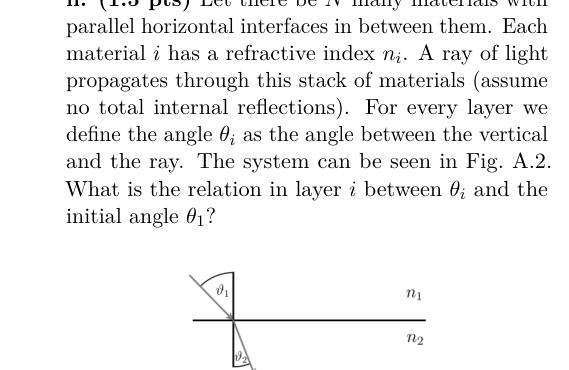 Fig A.1 light ray at interface of two media
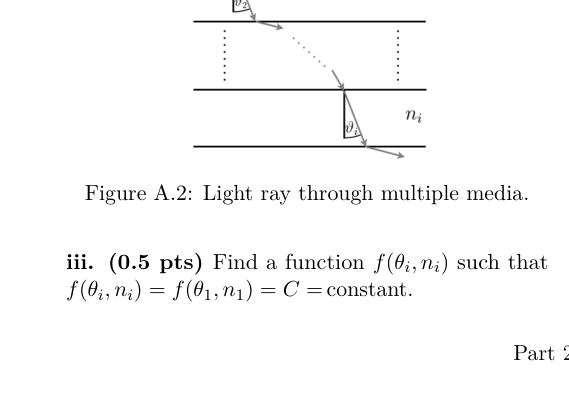 Fig A.2 light ray through N parallel media
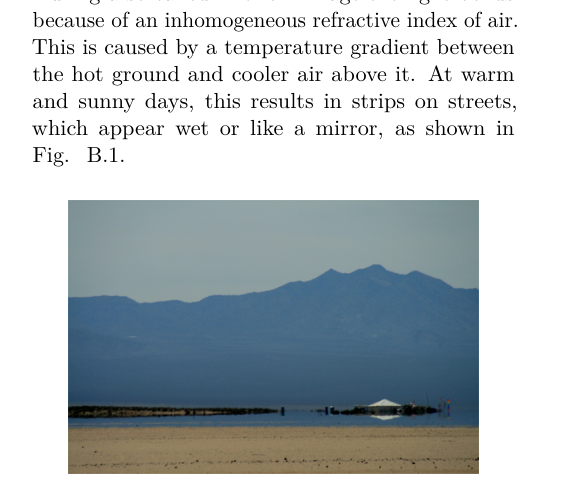 Fig B.1 photograph of inferior mirage on road
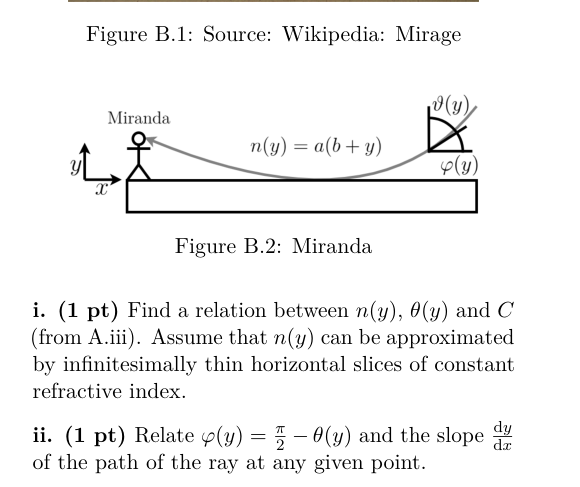 Fig B.2 Miranda seeing inferior mirage sketch
Topic: Geometric Optics, Wave Optics, Thermodynamics Metodi: Snell’s Law, Ray Tracing, Physical Modeling, Differential Equations, Approximation & Series Expansion Competenze: Mathematical Modeling, Physical Reasoning Objects: — Fonte: Testo (PDF) — p.14
Problema lungo 2.2: Mirage inferiore (16 punti)
**Parte A. Luce e supporto ** (3 punti)
i. (1 pt) Un raggio che si propaga nel mezzo 1 con indice di rifrazione colpisce un’interfaccia con un mezzo 2 con indice di rifrazione con un angolo rispetto alla superficie normale (vedi figura 2. A.1). Qual è la dipendenza dell’angolo di uscita rispetto a , e ?
ii. (1.5 pts) Let there be many materials with parallel horizontal interfaces in between them. Ogni materiale ha un indice di rifrazione . Un raggio di luce si propaga attraverso questo ammasso di materiali (non si presuppone riflessioni interne totali). Per ogni strato definiamo l’angolo come l’angolo tra la verticale e il raggio. Il sistema è visibile in Figura 1. A.2. Qual è la relazione in strato tra e l’angolo iniziale ?
iii. (0,5 punti) Trova una funzione tale da .
**Parte B. Indice di rifrazione ** (5,5 punti)
Durante un cosiddetto miraggio inferiore la luce si piega a causa di un indice di rifrazione inomogeneo dell’aria. Questo è causato da un gradiente di temperatura tra il terreno caldo e l’aria più fredda sopra di esso. In giornate calde e soleggiate, ciò comporta strisce in strada, che sembrano bagnate o come uno specchio (vedi Figura 1). B.1).
i. (1 pt) Trovare una relazione tra , e (da A.iii). Supponiamo che possa essere approssimato da parti orizzontali infinitesimalmente sottili di indice di rifrazione costante.
ii. (1 pt) Relazionare e la pendenza del percorso del raggio in un dato punto.
iii. (3.5 punti) Relazionare dalla parte B.i e dalla parte B.ii eliminando . Non è necessario risolvere l’equazione differenziale risultante. Per i punteggi completi, è richiesto un risultato senza funzioni trigonometriche.
C. Parte C. Il miraggio inferiore (7,5 punti)
L’indice di rifrazione dell’aria dipende dalla pressione e dalla temperatura e è di forma (con , ). Un disegno del raggi risultante è mostrato nella figura. B.2. Nel seguente calcolo, supponiamo che .
Miranda è fuori in una giornata di sole. La pressione è di 1,013 bar e la temperatura a 170 cm di altezza è . Miranda vede un’immagine bagnata da un miraggio inferiore 400 metri di fronte a lei. Un bozzetto può essere visto in Figura. B.2.
i. Calcolare l’indice di rifrazione all’altezza della testa.
ii. (3.5 punti) Qual è l’indice di rifrazione minimo al pavimento?
iii. 1, 5 pts) Qual è la temperatura massima al pavimento in ?
iv. 1, 5 punti) Segnare la temperatura in funzione dell’altezza .
Figura A.1 raggio luminoso all’interfaccia di due supporti
Figura A.2 raggio luminoso attraverso N supporti paralleli
Figura B.1 fotografia di miraggio inferiore su strada
Fig B.2 Miranda seeing inferior mirage sketch
Topic: Geometric Optics, Wave Optics, Thermodynamics Metodi: Snell’s Law, Ray Tracing, Physical Modeling, Differential Equations, Approximation & Series Expansion Competenze: Mathematical Modeling, Physical Reasoning Objects: — Fonte: Testo (PDF) — p.14
Long problem 2.3: Paramagnetic crystal (16 points)
A crystal is made up of identical (but distinguishable), non-interacting magnetic particles, each possessing a magnetic moment of intensity . These particles are placed in a uniform external magnetic field . Each magnetic moment can point either parallel or anti-parallel to the direction of the magnetic field. An example of a possible configuration of this crystal is illustrated in Figure 1. The energy associated with each particle depends on its orientation: a magnetic moment aligned with the magnetic field has energy , while one aligned against the field has energy .
In this problem, we investigate how the macroscopic thermodynamic properties of the system emerge from the microscopic configurations of the particles.
Hint: For some tasks you may find useful identities at the end of the problem.
Part A. Energy of the system (4 points)
We first study the energy of the system. We call and the number of particles with magnetic moment aligned parallel and anti-parallel respectively to the direction of the magnetic field.
i. (1 pt) Express the total energy of the system as a function of the given variables.
ii. (2 pts) For what values of and is the absolute value of the energy of the system maximal and for what values is it minimal?
iii. (1 pt) Express and as a function of and the parameter .
Part B. Entropy and temperature (8 points)
For a fixed value of the energy of the system there are multiple different configurations of the crystal that have this energy. We call this number of configurations for a given value of the energy .
i. (1 pt) What are the units of ?
ii. (2 pts) Express as a function of the given variables. Use your results from part A and recall that the particles are distinguishable.
iii. (2 pts) In statistical physics the entropy of an isolated system is where is the natural logarithm and is Boltzmann’s constant. Show that the entropy of the crystal is where Work with the assumption , under which Stirling’s approximation applies: .
iv. (2 pts) The statistical temperature of an isolated system with entropy is defined by Express the temperature of the crystal in terms of .
v. (1 pt) Can this statistical temperature be negative? If yes, explain under what conditions and what does it physically represent.
Part C. Specific heat (3 points)
i. (1 pt) Invert your expression from task B.iv to obtain an expression for as a function of and other variables.
ii. (1 pt) Express the specific heat of the system.
iii. (1 pt) How does behave as ? Explain briefly why this result makes sense physically.
Part D. Dynamics (1 point)
We now consider the dynamics of the system and model them as follows. Every time interval there is a 50% probability that one of the particles (any of them) changes its magnetic moment.
i. (1 pt) If we let the dynamics run enough (i.e. in the limit ), what will be the energy of the system? To what configuration does this correspond? Use a thermodynamic argument and the graph of the function given in Figure D.1 to justify your answer.
Useful identities:
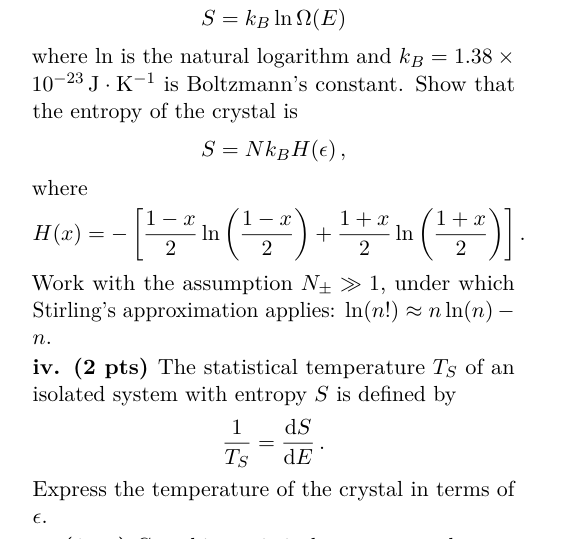 Figure 1 paramagnetic crystal in field B
Topic: Thermodynamics, Modern-Quantum Physics, Magnetism Metodi: Statistical Averaging, Kinetic Theory of Gases, First Law of Thermodynamics, Physical Modeling, Calculus-Integration Competenze: Mathematical Modeling, Physical Reasoning Objects: Magnetic Dipole Fonte: Testo (PDF) — p.16
**Problema lungo 2.3: cristallo paramagnetico ** (16 punti)
Un cristallo è costituito da particelle magnetiche identiche (ma distinguibili), non interagiscono, ognuna con un momento magnetico di intensità . Queste particelle sono collocate in un campo magnetico esterno uniforme . Ogni momento magnetico può indicare sia parallelo che antiparallelo alla direzione del campo magnetico. Un esempio di una possibile configurazione di questo cristallo è illustrato nella figura 1. L’energia associata a ciascuna particella dipende dalla sua orientamento: un momento magnetico allineato al campo magnetico ha energia , mentre uno allineato al campo ha energia .
In questo problema, si studia come le proprietà termodinamiche macroscopiche del sistema emergono dalle configurazioni microscopiche delle particelle.
Signore: Per alcune attività si possono trovare utili identità alla fine del problema.
** Parte A. Energia del sistema** (4 punti)
Prima di tutto studiamo l’energia del sistema. Chiamiamo e il numero di particelle con il momento magnetico allineato parallelo e antiparallelo rispettivamente alla direzione del campo magnetico.
i. (1 pt) Esprimere l’energia totale del sistema come funzione delle variabili indicate.
ii. (2 punti) Per quali valori di e il valore assoluto dell’energia del sistema è massimo e per quali valori è minimo?
iii. (1 pt) Esprimere e come funzioni di e il parametro .
**Parte B. Entropia e temperatura ** (8 punti)
Per un valore fisso dell’energia del sistema ci sono molteplici configurazioni diverse del cristallo che hanno questa energia. Chiamiamo questo numero di configurazioni per un dato valore di energia .
i. (1 pt) Quali sono le unità di ?
ii. (2 punti) Esprimere come funzione delle variabili indicate. Utilizzare i risultati della parte A e ricordare che le particelle sono distinguibili.
iii. (2 punti) In fisica statistica l’entropia di un sistema isolato è dove è il logaritmo naturale e è la costante di Boltzmann. Mostrare che l’entropia del cristallo è dove Lavorare con l’ipotesi , in base alla quale si applica l’approssimazione di Stirling: .
iv. (2 pts) La temperatura statistica di un sistema isolato con entropia è definita da: Esprimere la temperatura del cristallo in termini di .
v. (1 pt) Questa temperatura statistica può essere negativa? Se sì, spiegate in quali condizioni e cosa rappresenta fisicamente.
C. Parte C. Calore specifico (3 punti)
i. (1 pt) Invertire l’espressione da attività B.iv per ottenere un’espressione per come funzione di e altre variabili.
ii. (1 pt) Esprimere il calore specifico del sistema.
iii. (1 p) Come si comporta come ? Spiegate brevemente perché questo risultato ha senso fisicamente.
Parte D. Dinamica (1 punto)
Ora consideriamo le dinamiche del sistema e le modelliamo come segue. Ogni intervallo temporale ha una probabilità del 50% che una delle particelle (una qualsiasi di esse) cambie il suo momento magnetico.
i. (1 pt) Se lasciamo che la dinamica funzioni abbastanza (cioè nel limite ), quale sarà l’energia del sistema? A quale configurazione corrisponde questo? Per giustificare la risposta, utilizzare un argomento termodinamico e il grafico della funzione indicato nella figura D.1.
*Identifiche utili: *
Figura 1 cristallo paramagnetico nel campo B
Topic: Thermodynamics, Modern-Quantum Physics, Magnetism Metodi: Statistical Averaging, Kinetic Theory of Gases, First Law of Thermodynamics, Physical Modeling, Calculus-Integration Competenze: Mathematical Modeling, Physical Reasoning Objects: Magnetic Dipole Fonte: Testo (PDF) — p.16