Problem 1 Balloon (15 points) For this problem consider a small, air-filled balloon that has a very thin, elastic skin. The balloon may always be assumed to be spherical, and the pressure exerted by the balloon skin on the interior of the balloon is inversely proportional to the radius of the balloon. To solve the problems, also use the following values: External air pressure Ambient temperature Gravitational acceleration Density of water Should you need further values or constants, please take them from a physics textbook. a) For a balloon radius the pressure inside the balloon is . Determine the pressure prevailing inside the balloon after the balloon has been inflated to a radius of . The air temperature inside the balloon should, even after inflating, equal the ambient temperature. (2 points) b) The balloon inflated in this way is now slowly submerged in water. Determine to what depth below the water surface the balloon must be brought so that its radius is again . Assume for this that the balloon skin is a very good thermal conductor and that the water temperature is a constant . (3 points) c) Determine, analogously to the previous part, the depth to which the balloon must be brought for the case in which the balloon skin is ideally thermally insulating, and also compute the temperature of the air inside the balloon at this depth. (4.5 points) d) Compute in each case the work that must be done to slowly submerge the balloon in water, as in parts b) and c), to the corresponding depths, if the balloon radius before inflation is . (5.5 points)
Topic: Thermodynamics, Fluid Mechanics, Elasticity & Materials Metodi: Ideal Gas Law, Hydrostatic Equilibrium, First Law of Thermodynamics Competenze: Mathematical Modeling, Physical Reasoning Objects: Bubble, Gas Fonte: Testo (PDF) — p.2
Problema 1 Balloon (15 punti) Per questo problema considerate un piccolo pallone pieno di aria che ha un molto sottile, elastico
- La pelle. Il palloncino può sempre essere presunto di essere sferico, e la pressione esercitata da la pelle del palloncino sull’interno del palloncino è inversamente proporzionale al raggio del palloncino ballo. Per risolvere i problemi, utilizzare i seguenti valori: Pressione esterna dell’aria Temperatura ambientale Accelerazione gravitazionale Densità di acqua Se avete bisogno di ulteriori valori o costanti, per favore, prendeteli da un libro di fisica. a) Per un raggio di ballo la pressione all’interno del ballo è . Determinazione la pressione che prevale all’interno del palloncino dopo che il palloncino è stato gonfiato a un raggio of . La temperatura dell’aria all’interno del pallone dovrebbe essere inflating, pari alla temperatura ambientale. (2 punti) b) Il pallone inflato in questo modo è ora lentamente immerso in acqua. Determine il pallone deve essere portato in modo che il suo radius is again . Supponiamo per questo che la pelle del palloncino è un buon conduttore termico e che la temperatura dell’acqua è una costante . (3 punti) c) Determinare, analogamente alla parte precedente, la profondità alla quale il pallone deve essere portati per il caso in cui la pelle del palloncino è idealmente termicamente isolante, e anche calcolare la temperatura dell’aria all’interno del palloncino a questa profondità. (4,5 punti) d) Calcolare in ogni caso il lavoro che deve essere fatto per submergere lentamente il pallone in acqua, come in le parti b) e c), alle profondità corrispondenti, se il radius del pallone prima dell’inflazione è . (5,5 punti)
Topic: Thermodynamics, Fluid Mechanics, Elasticity & Materials Metodi: Ideal Gas Law, Hydrostatic Equilibrium, First Law of Thermodynamics Competenze: Mathematical Modeling, Physical Reasoning Objects: Bubble, Gas Fonte: Testo (PDF) — p.2
Problem 1 is Balloon (15 points) For this problem consider a small, air-filled balloon that has a very thin, elastic The skin. The balloon may always be assumed to be spherical, and the pressure exerted by The balloon skin on the interior of the balloon is inversely proportional to the radius of the balloon.
- The balloon. To solve the problems, also use the following values: External air pressure Ambient temperature Gravitational acceleration Density of water If you need further values or constants, please take them from a physics textbook. (a) For a balloon radius the pressure inside the balloon is . Determine The pressure prevailing inside the balloon after the balloon has been inflated to a radius of . The air temperature inside the balloon should, even after inflating, equal to the ambient temperature. (two points) b) The balloon inflated in this way is now slowly submerged in water. Determine to The balloon must be brought so that its radius is again . Assume for this that the balloon skin is a very good thermal conductor and that the water temperature is a constant . (three points) (c) Determine, analogous to the previous part, the depth to which the balloon must be brought for the case in which the balloon skin is ideally thermally insulating, and also compute The temperature of the air inside the balloon at this depth. (4.5 points) (d) Calculate in each case the work that must be done to slowly submerge the balloon in water, as in Parts (b) and (c), to the corresponding depths, if the balloon radius before inflation is . (5.5 points)
Topic: Thermodynamics, Fluid Mechanics, Elasticity & Materials Metodi: Ideal Gas Law, Hydrostatic Equilibrium, First Law of Thermodynamics Competenze: Mathematical Modeling, Physical Reasoning Objects: Bubble, Gas Fonte: Testo (PDF) — p.2
Problem 2 Sphere and coin in a funnel (21+9 points) A collection device occasionally to be admired at fundraising events consists of a large funnel, into which coins can be rolled from the upper rim. The coins then roll downward and are collected in a container placed beneath the funnel. z R(z) Figure 1: Sketch of a coin-collecting funnel In this problem you are to investigate properties of such funnels using simplified models, and then briefly consider a rolling coin in a funnel. The radius of the rotationally symmetric funnel is described by a function , which, as seen in the sketch, gives the radius as a function of the vertical distance to the lower rim. The funnel is open both at the top and at the bottom. Assume that the bodies always move along the wall of the funnel. The Earth’s gravitational acceleration is and acts in the direction of the negative z-axis. Leibniz-Institut für die Pädagogik der Naturwissenschaften und Mathematik, Olshausenstr. 62, D - 24098 Kiel 42nd IPhO 2011 - Problems of the 2nd Round 2.1 Point mass in the funnel In the following problems consider a point mass of mass that moves without friction in different funnels. a) The point mass is placed into a funnel at a height with a velocity directed horizontally and tangentially to the funnel surface. Surprisingly, the mass, independently of the chosen z-coordinate, always remains at the same height during the motion, i.e. its z-coordinate is constant. Determine what shape the funnel must have for this, i.e. give the function as a function of the parameters that appear. Also determine how tall the funnel must therefore be if the mass moves with a velocity of and the upper and lower radius of the funnel are and respectively. (4 points) b) The mass is now placed at the upper rim of another funnel with a velocity directed horizontally and tangentially to the funnel surface. The radius of the funnel is described by the function , where denotes the funnel radius at the upper rim and gives the height of the funnel. Show that for every value of the mass always remains at the upper rim of the funnel, i.e. does not change its z-coordinate. In addition to the velocity , the mass now initially has a velocity component perpendicular to the horizontal velocity and along the funnel surface. State qualitatively how the motion of the mass proceeds and, for the values as well as and , estimate the time until the mass leaves the funnel. (7 points) c) Now a third funnel is given, whose radius is described by the function with a positive constant . The point mass is again brought into the funnel with only a horizontal velocity . Show that for every sufficiently large value of there exists a height at which the mass always remains, i.e. does not change its z-coordinate. Give this height. Also state how large the velocity must at least be for such a height to exist. (3 points) d) Consider a funnel as in part c) for a funnel height of as well as an upper and lower radius of the funnel of and respectively. The mass is placed at the upper rim with the horizontal velocity that is necessary for it to remain at this height. Now the mass is again given an additional velocity perpendicular to the horizontal velocity and along the funnel surface. Describe qualitatively the motion that the point mass now performs, and determine the range of the additional velocity in which the point mass does not leave the vessel at the lower rim. (7 points) 2.2 Coin in the funnel Now consider the case of a coin in a funnel. The coin has a homogeneously distributed mass and a radius that can always be assumed to be very small compared with the funnel radius. The thickness of the coin is very small and the coin is supposed to roll in the funnel without slipping. Rolling friction is negligible. Leibniz-Institut für die Pädagogik der Naturwissenschaften und Mathematik, Olshausenstr. 62, D - 24098 Kiel 42nd IPhO 2011 - Problems of the 2nd Round e) As in part a), for a purely horizontal velocity the coin moves along the same height for a particular funnel shape. Determine for this case too what shape the funnel must have, i.e. give the function as a function of the parameters that appear. Note that should hold. (6 points) f) Describe qualitatively what happens if, in the funnel considered in e), the coin is replaced by a sphere of the same radius and the same, homogeneously distributed mass. (3 points)
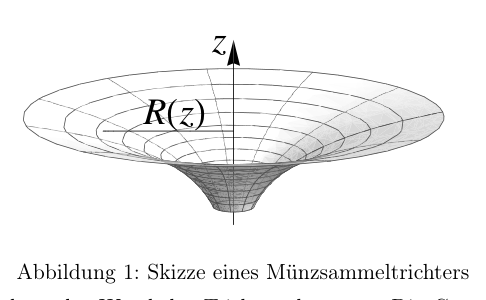 Funnel with z-axis and radius R(z)
Topic: Newtonian Mechanics, Rotational Dynamics Metodi: Free-Body Diagram, Conservation of Energy, Torque & Angular Momentum Analysis Competenze: Mathematical Modeling, Physical Reasoning, Diagrammatic Reasoning Objects: Disk, Sphere Fonte: Testo (PDF) — p.2
Problema 2 Sphere and coin in a funnel (21+9 punti) Un dispositivo di raccolta di fondi occasionally to be admired at fundraising events è costituito da un grande funnel, in cui le monete possono essere rotolate dal bordo superiore. Le monete poi rotolare verso il basso e vengono raccolti in un contenitore posto sotto il funile. z R(z) Figura 1: Sketch of a coin-collecting funnel In questo problema si sono di indagare le proprietà di tali funnels utilizzando modelli semplificati, e poi brevemente considerare un rolling coin in a funnel. Il radius del funile simmetrico rotativo è descritto da una funzione , che, come visto nello schema, dà il radius come un funzione della distanza verticale verso il basso
- Rim. Il funnel è aperto entrambi al vertice e in fondo. Supponiamo che i corpi si muovano sempre lungo il muro del funile. L’accelerazione gravitazionale della Terra è e agisce nella direzione della
- l’asse z. Leibniz Institute for the Pedagogy of Natural Sciences and Mathematics, Olshausenstr. 62, D - 24098 Kiel 42° IPhO 2011 - Problemi del secondo round 2.1 Punto di massa nel funnel In questi problemi considerate un punto di massa che si muove senza attrito in
- Le funzioni di controllo a) Il punto di massa è inserito in un funnel ad un’altezza con una velocità diretta orizzontalmente e tangentialmente alla superficie del funnel. Sorprendentemente, il la massa, indipendentemente dalla coordinata z scelta, rimane sempre la stessa alti durante il movimento, cioè La sua coordinata z è costante. Determine quale forma il funnel deve avere per questo, cioè give the function come una funzione dei parametri che appaiono. Quindi, determinate come Tall il funnel deve quindi essere se la massa si muove con una velocità di and the upper and lower radius of the funnel are and rispettivamente. (4 punti) b) La massa è ora collocata all’alto bordo di un altro funnel con una velocità diretta orizzontalmente e tangentialmente alla superficie del funnel. Il raggio del funnel è descritto dalla funzione , dove denota il funnel. funnel radius at the upper rim and gives the height of the funnel. Mostra che per ogni valore di la massa rimane sempre al bordo superiore del funile, i.e. non cambia le sue coordinate z. In aggiunta alla velocità , la massa ora inizia a avere una componente di velocità perpendicolare alla velocità orizzontale e lungo la superficie del funile. Stat qualitativamente how the motion of the mass proceeds and, for the values , nonché e , estimate the time until the mass leaves the
- Funnel. 7 punti) c) Ora è dato un terzo funnel, il cui raggio è descritto dalla funzione con una costante positiva . Il punto di massa è di nuovo portato nel funile con solo un velocità orizzontale . Mostra che per ogni sufficientemente grande valore di esiste un’altezza a cui il la massa rimane sempre, cioè non cambia le sue coordinate z. - Dammi questa altezza. Quindi, state quanto grande la velocità deve essere almeno per tali un’altezza di esistenza. (3 punti) d) Considerare un funnel as in part c) for a funnel height of as well as a radius superiore e inferiore del funnel di e rispettivamente. The mass is placed at the upper rim with la velocità orizzontale necessaria per E’ un’idea che non si può fare a questo livello. Ora la massa è di nuovo data a velocità aggiuntiva perpendicolare alla velocità orizzontale e lungo la superficie del funile. Descrivere qualitativamente il movimento che il punto di massa ora esegue, e determinare la gamma della velocità aggiuntiva in cui il punto di massa non lascia il recipiente
- Al bordo inferiore. 7 punti) 2.2 Coin in the funnel Ora considerate il caso di una moneta in un funnel. La moneta ha un distribuito omogeneo Mass and a radius that can always be assumed to be very small compared with the funnel radius. Lo spessore della moneta è molto piccolo e la moneta è supposto di rotolare nel funnel senza
- Slipperare. La frizione a rotoli è trascurabile. Leibniz Institute for the Pedagogy of Natural Sciences and Mathematics, Olshausenstr. 62, D - 24098 Kiel 42° IPhO 2011 - Problemi del secondo round e) Come in parte a), per una velocità puramente orizzontale the coin moves lungo la stessa altezza per una particolare forma di funile. Determine per questo caso anche che forma il funnel deve avere, cioè dare la funzione come funzione dei parametri che appaiono. Nota che dovrebbe tenere. (6 punti) f) Descrivere qualitativamente cosa succede se, in the funnel considered in e), il coin è sostituito da una sfera dello stesso raggio e della stessa massa distribuita in modo omogeneo. (3 punti)
*Funnel with z-axis and radius R(z) *
Topic: Newtonian Mechanics, Rotational Dynamics Metodi: Free-Body Diagram, Conservation of Energy, Torque & Angular Momentum Analysis Competenze: Mathematical Modeling, Physical Reasoning, Diagrammatic Reasoning Objects: Disk, Sphere Fonte: Testo (PDF) — p.2
Problem 2 Sphere and coin in a funnel (21+9 points) A collection device occasionally to be admired at fundraising events consists of a large funnel, into which coins can be rolled from the upper rim. The coins then roll downward and are collected in a container placed under the funnel. z R(z) Figure 1: Sketch of a coin-collecting funnel In this problem you are to investigate properties of such funnels using simplified models, and then briefly consider a rolling coin in a funnel. The radius of the rotationally symmetrical funnel is described by a function , which, as seen in the sketch, gives the radius as a function of the vertical distance to the lower I’m going to go. The funnel is open both at the top And at the bottom. Assume that the bodies always move along the wall of the funnel. The Earth’s gravitational acceleration is and acts in the direction of the negative the z-axis. The Leibniz Institute for the Education of Natural Sciences and Mathematics, Olshausenstr. The Commission has not yet adopted a proposal for a regulation. 42nd IPhO 2011 - Problems of the 2nd Round 2.1 Point mass in the funnel In the following problems consider a point mass of that moves without friction in different funnels. (a) The point mass is placed into a funnel at a height with a velocity directed horizontally and tangentially to the funnel surface. Surprisingly, the mass, independently of the chosen z-coordinate, always remains at the same height during the motion, i.e. Its z-coordinate is constant. Determine what shape the funnel must have for this, i.e. Give the function as a function of the parameters that appear. So determine how Therefore, the funnel must be tall if the mass moves with a velocity of and the upper and lower radius of the funnel are and The Commission shall adopt the following measures: (four points) (b) The mass is now placed at the upper rim of another funnel with a velocity directed horizontally and tangentially to the funnel surface. The radius of the funnel is described by the function , where denotes the funnel radius at the upper rim and gives the height of the funnel. Show that for every value of the mass always remains at the upper rim of the funnel, i.e. does not change its z-coordinate. In addition to the velocity , the mass now initially has a velocity component perpendicular to the horizontal velocity and along the funnel surface. State qualitatively how the motion of the mass proceeds and, for the values as well as and , estimate the time until the mass leaves the I’m going to the funnel. (seventh and final points) c) Now a third funnel is given, whose radius is described by the function with a positive constant . The point mass is again brought into the funnel with only a horizontal velocity . Show that for every sufficiently large value of there exists a height at which the mass always remains, i.e. does not change its z-coordinate. Give this height. So state how big the velocity must at least be for such A height to exist. (three points) (d) Consider a funnel as in part c) for a funnel height of as well as a upper and lower radius of the funnel of and respectively. The mass is placed at the upper rim with the horizontal velocity that is necessary for It’s to remain at this height. Now the mass is again given an additional velocity perpendicular to the horizontal velocity and along the funnel surface. Describe qualitatively the motion that the point mass now performs, and determine the range of the additional velocity in which the point mass does not leave the vessel At the lower rim. (seventh and final points) 2.2 Coin in the funnel Now consider the case of a coin in a funnel. The coin has a homogeneously distributed mass and a radius that can always be assumed to be very small compared with the funnel radius. The thickness of the coin is very small and the coin is supposed to roll into the funnel without slipping. Rolling friction is negligible. The Leibniz Institute for the Education of Natural Sciences and Mathematics, Olshausenstr. The Commission has not yet adopted a proposal for a regulation. 42nd IPhO 2011 - Problems of the 2nd Round (e) As in Part (a), for a purely horizontal velocity the coin moves along the same height for a particular funnel shape. Determine for this case too what shape the funnel must have, i.e. Give the function as a function of the parameters that appear. Note that should hold. (seventh and sixth points) (f) Describe qualitatively what happens if, in the funnel considered in e), the coin is replaced by a sphere of the same radius and the same, homogeneously distributed mass. (three points)
*Funnel with z-axis and radius R(z) *
Topic: Newtonian Mechanics, Rotational Dynamics Metodi: Free-Body Diagram, Conservation of Energy, Torque & Angular Momentum Analysis Competenze: Mathematical Modeling, Physical Reasoning, Diagrammatic Reasoning Objects: Disk, Sphere Fonte: Testo (PDF) — p.2
Problem 3 Particle physics at the Large Hadron Collider (LHC) (11+7+7 points) This problem is an introduction to experimental particle physics and is intended to explain, in broad terms, why the LHC was built the way it is. You will have to look up some properties of the particles considered. Please state your source(s) for this. For the speed of light in vacuum you may use . 3.1 Accelerator physics Consider a charged particle with rest mass and charge that moves with very large velocity in a homogeneous magnetic field of flux density . The flux density is perpendicular to the velocity. a) The particle is forced onto a circular orbit by the magnetic field. Determine the radius of the circular orbit as a function of the given quantities. Consider an electron and a proton that are each accelerated to an energy of and stored in the storage ring of the LHC with a circumference of . Compute which magnetic field is necessary in each of the two cases to force the particles onto the circular orbit. (3.5 points) b) Accelerated, electrically charged particles radiate energy through so-called bremsstrahlung. Using a dimensional analysis, determine an expression for the radiated power of a particle as a function of its charge , the speed of light , its instantaneous acceleration and the electric field constant . A complete relativistic treatment would, in the case of circular motion, lead to an additional factor in the result, where . Include this factor in the following considerations. (3.5 points) c) At CERN, between 1989 and 2000, the Large Electron Positron Collider (LEP) operated, a ring accelerator in which an electron beam and an opposing positron beam were brought to collision with an energy of each. In the same ring (with modified apparatus) the LHC is located today. Compute how much smaller the energy loss through bremsstrahlung is for protons compared with electrons of the same energy, i.e. give the ratio of the radiated powers. The next large planned accelerator is to be again an electron-positron accelerator, but with a center-of-mass energy of . Justify why it is sensible to construct this as a linear accelerator and not as a ring accelerator. Carry out a suitable example calculation as part of your justification. (4 points) Leibniz-Institut für die Pädagogik der Naturwissenschaften und Mathematik, Olshausenstr. 62, D - 24098 Kiel 42nd IPhO 2011 - Problems of the 2nd Round 3.2 Stationary target vs. head-on collider An alternative design to the accelerators above, in which particle beams of equal energies collide head-on (so-called head-on colliders), is the following: one accelerates only a single particle beam and lets it strike a stationary target. For example, one can shoot a proton beam at a hydrogen container. Over the course of the 20th century this original fixed-target design has been almost completely abandoned, and head-on colliders are preferred today, even though these involve higher technical challenges. To understand this, in the following compare the two accelerator designs by considering the energy available for the production of new particles in the center-of-mass frame during the collision. d) Compute the energy available in the center-of-mass frame when two proton beams with an energy per proton of each collide. The energy should be much larger than the rest energy of a proton. (2 points) e) Repeat this calculation for the case in which a proton beam with an energy of strikes a stationary hydrogen target. The hydrogen target can be regarded as a collection of practically free protons with negligible kinetic energy. (5 points) 3.3 Beam-energy variations at LEP At the LEP collider a surprising effect was observed: during the day, small but measurable variations in the beam energy could be detected, which were attributed to passing trains. The trains in the vicinity of the LEP collider are operated with direct current and a voltage of , being supplied by a power line, and the circuit is closed mainly through the rails but also through the ground and thereby also through the LEP tunnel lying 80 meters underground. More precisely, the circuit is closed through the grounded vacuum chamber, which consists essentially of aluminum and, as shown in Figure 2, has an asymmetric shape. The elliptical cavity contains the electron and positron beams, the right space contains the vacuum pump, and the left space is a channel for the cooling fluid. The leakage current changes the magnetic field in the storage ring, and the beam energy must be changed accordingly in order to keep the particle beam in the storage ring at the same magnet configuration. Figure 2: Cross-section of the LEP vacuum chamber (CERN-PHOTO-83051701). The chamber is about 25 cm wide and 10 cm high. For an approximate explanation of this effect the following assumptions can be made: The train passes close to the accelerator tunnel at two locations of the accelerator ring lying opposite each other, at a distance of about 1 km from it. Otherwise the route runs far from the accelerator tunnel. The voltage drop along the rails between these two locations is about 10 V. The leakage currents through the vacuum chamber can be modeled by a current-carrying wire that runs along the middle of the chamber for the vacuum pump. In addition, for the specific resistances of ground and aluminum, values of and respectively can be assumed. Leibniz-Institut für die Pädagogik der Naturwissenschaften und Mathematik, Olshausenstr. 62, D - 24098 Kiel 42nd IPhO 2011 - Problems of the 2nd Round f) Using the data above, estimate the effect of the train leakage currents on the beam energy at the LEP collider, assuming suitable values. This part is about estimating the correct order of magnitude and not about an exact result. (7 points)
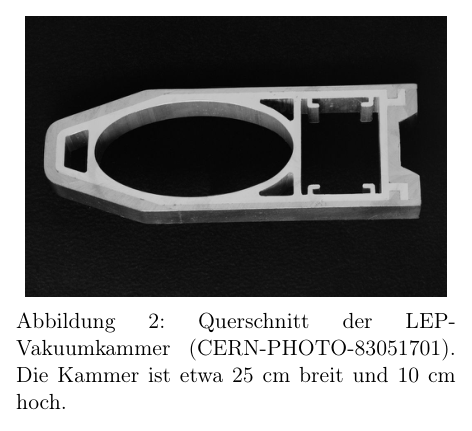 Cross-section of the LEP vacuum chamber
Topic: Special Relativity, Magnetism, Nuclear & Particle Physics Metodi: Lorentz Force Analysis, Relativistic Energy-Momentum, Dimensional Analysis Competenze: Mathematical Modeling, Estimation & Approximation, Physical Reasoning Objects: Particle Beam, Point Charge, Electron Fonte: Testo (PDF) — p.4
Problema 3 Particella fisica al Large Hadron Collider (LHC) (11+7+7 punti) Questo problema è un’introduzione alla fisica delle particelle sperimentali ed è destinato a spiegare, In termini generali, perché l’LHC è stato costruito come è. Dovrai guardare alcune proprietà delle particelle considerate. Per favore, afferma
- La mia fonte. Per la velocità della luce in vacuum si può usare . 3.1 Acceleratore fisica Considerare una particella carica con massa di riposo e carica che si muove con velocità molto grande in un campo magnetico omogeneo di densità di flusso . La densità di flusso è perpendicolare alla velocità. a) La particella è forzata in orbita circolare dal campo magnetico. Determinazione radius dell’orbita circolare a funzione delle quantità indicate. Considerate un elettrone e un protone che sono entrambi accelerati ad un’energia di e conservati nel ring di stoccaggio del LHC con una circonferenza di . Calcolare quale campo magnetico è necessario in each of the two cases to force the particles onto l’orbita circolare. (3,5 punti) b) Le particelle accelerate e elettricamente cariche irradiano energia attraverso il cosiddetto “radiamento di frenata”. Usando un’analisi dimensionale, determinare un’espressione per il potenza di una particella a funzione della sua carica , la velocità di luce , la sua accelerazione istantanea e la costante del campo elettrico . Un trattamento relativistico completo, nel caso di movimento circolare, porterebbe ad un fattore aggiuntivo nel risultato, dove . Includere questo fattore in Le seguenti considerazioni. (3,5 punti) c) A CERN, tra il 1989 e il 2000, è stato operato il Large Electron Positron Collider (LEP), acceleratore in cui un fascio di elettroni e un fascio di positroni opposti sono stati portati a collisione con un’energia di ciascuno. In the same ring (con LHC è situato oggi. Calcolare quanto più piccola la perdita di energia attraverso la radiazione di frenata è per i protoni rispetto agli elettroni della stessa energia, cioè Give the ratio of the radiated Poteri. Il prossimo grande acceleratore pianificato sarà di nuovo un acceleratore di positroni elettronici, ma con un centro di massa di . Justify why it is sensitive per costruire questo come un acceleratore lineare e non come un acceleratore anello. Portate fuori a suitable example calculation as part of your justification. (4 punti) Leibniz Institute for the Pedagogy of Natural Sciences and Mathematics, Olshausenstr. 62, D - 24098 Kiel 42° IPhO 2011 - Problemi del secondo round 3.2
- Stazionario target vs. Collider a testa Un design alternativo agli acceleratori sopra, in cui i fasci di particelle di pari le energie collidono head-on (cosiddette collidori head-on), è il seguente: one accelerates only un singolo fascio di particelle e lascia che colpisca un bersaglio stazionario. Per esempio, Si può sparare un raggio di protoni su un contenitore di idrogeno. Nel corso del XX secolo questo originale Il design a destinazione fissa è stato quasi completamente abbandonato, e i collider head-on sono preferiti oggi, anche se questi comportano maggiori sfide tecniche. Per capire questo, nel seguente compare i due accelerator disegni considerando La produzione di particelle nuove nel centro di massa durante la collisione. d) Calcolare l’energia disponibile nel centro di massa quando due protoni collidono con un’energia per protone di ogni volta. La energia dovrebbe essere molto più grande del resto dell’energia di un protone. (2 punti) e) Repeat this calculation for the case in which a proton beam with an energy of strikes a stationary hydrogen target. Il target idrogeno può essere considerato come una raccolta di protoni praticamente liberi con energia cinetica negligible. 5 punti) 3.3 Variations in beam energy at LEP Al collider LEP un effetto sorprendente che è stato osservato: durante il giorno, Le variazioni di energia del fascio sono state note.
- Treni. I treni nelle vicinanze del collider LEP sono operati con corrente diretta e a voltage of , being supplied by a power line, and the Il circuito è chiuso principalmente attraverso i binari ma anche attraverso il terreno e quindi anche attraverso il tunnel LEP che si trova a 80 metri sotto terra. Più precisamente, il circuito è chiuso attraverso la camera a vuoto fondata, che consiste essenzialmente in alluminio e, come mostrato nella figura 2, ha una forma asimmetrica. La cavità ellittica contiene i fasci elettronici e i fasci positroni, il giusto spazio contiene il pompa a vuoto, e lo spazio sinistro è un canale per il fluido di raffreddamento. La perdita di corrente cambia il Il campo magnetico nel ring di stoccaggio, e l’energia del fascio deve essere cambiata di conseguenza per mantenere il particellare nel cerchio di stoccaggio alla stessa configurazione magnetica. Figura 2: Sezione incrociata di Lezioni di formazione camera di vuoto (CERN-PHOTO-83051701) La camera è di circa 25 cm di larghezza e 10 cm
- E’ alta. Per una spiegazione approssimativa di questo effetto le seguenti ipotesi possono essere fatte: Il treno passa vicino al tunnel dell’acceleratore in due luoghi dell’anello dell’acceleratore, all’opposto, a una distanza di circa 1 km da it. Altrimenti la strada è lontana dal tunnel dell’acceleratore. La voltage scende lungo i binari tra questi due location è di circa 10 V. Le correnti di perdita through the vacuum chamber può essere modellato da un current-carrying wire that runs lungo il centro della camera per la pompa a vuoto. Inoltre, per le specificità di resistenza di terra e alluminio, si possono assumere valori di e rispettivamente. Leibniz Institute for the Pedagogy of Natural Sciences and Mathematics, Olshausenstr. 62, D - 24098 Kiel 42° IPhO 2011 - Problemi del secondo round f) Usando i dati sopra, stimare l’effetto dei correnti di fuga del treno sull’energia del fascio Al COLIDORE LEP, assumendo valori adeguati. Questa parte è circa Estimando il corretto ordine di magnitudo e non circa un risultato esatto. 7 punti)
Cross-section of the LEP vacuum chamber
Topic: Special Relativity, Magnetism, Nuclear & Particle Physics Metodi: Lorentz Force Analysis, Relativistic Energy-Momentum, Dimensional Analysis Competenze: Mathematical Modeling, Estimation & Approximation, Physical Reasoning Objects: Particle Beam, Point Charge, Electron Fonte: Testo (PDF) — p.4
Problem 3 Particle physics at the Large Hadron Collider (LHC) (11+7+7 points) This problem is an introduction to experimental particle physics and is intended to explain, in Broadly speaking, why the LHC was built the way it is. You’ll have to look up some properties of the particles considered. Please state your source(s) for this. For the speed of light in vacuum you may use . 3.1 Accelerator physics Consider a charged particle with rest mass and charge that moves with very large velocity in a homogeneous magnetic field of flux density . The flux density is perpendicular to the velocity. (a) The particle is forced into a circular orbit by the magnetic field. Determine the radius of the circular orbit as a function of the given quantities. Consider an electron and a proton that are each accelerated to an energy of and stored in the storage ring of the LHC with a circumference of . Compute which magnetic field is necessary in each of the two cases to force the particles onto the The circular orbit. (iii) the number of employees (b) Accelerated, electrically charged particles radiate energy through so-called braking radiation. Using a dimensional analysis, determine an expression for the radiated power of a particle as a function of its charge , the speed of light , Its instantaneous acceleration and the electric field constant . A complete relativistic treatment would, in the case of circular motion, lead to an additional factor in the result, where . Include this factor in the following considerations. (iii) the number of employees (c) At CERN, between 1989 and 2000, the Large Electron Positron Collider (LEP) operated, a ring accelerator in which an electron beam and an opposing positron beam were brought to collision with an energy of each. In the same ring (with The LHC is located today. Calculate how much smaller the energy loss through brake radiation is for protons compared to electrons of the same energy, i.e. Give the ratio of the radiated
- The powers. The next big planned accelerator is to be again an electron-positron accelerator, but with a center-of-mass energy of . Justify why it is sensitive to construct this as a linear accelerator and not as a ring accelerator. Carry out a suitable example calculation as part of your justification. (four points) The Leibniz Institute for the Education of Natural Sciences and Mathematics, Olshausenstr. The Commission has not yet adopted a proposal for a regulation. 42nd IPhO 2011 - Problems of the 2nd Round 3.2 The stationary target vs. Head-on collider An alternative design to the accelerators above, in which particle beams of equal The energy collide head-on (so-called head-on colliders), is the following: one accelerates only A single particle beam and lets it strike a stationary target. For example, One can shoot a proton beam at a hydrogen container. Over the course of the 20th century this original Fixed-target design has been almost completely abandoned, and head-on colliders are preferred today, even though these involve higher technical challenges. To understand this, in the following compare the two accelerator designs by considering The energy available for the production of new particles in the center-of-mass frame During the collision. (d) Calculate the energy available in the center-of-mass frame when two proton beams with an energy per proton of each collide. The energy should be much larger than the rest of the energy of a proton. (two points) e) Repeat this calculation for the case in which a proton beam with an energy of strikes a stationary hydrogen target. The hydrogen target can be considered As a collection of practically free protons with negligible kinetic energy. (five points) 3.3 Beam energy variations at LEP At the LEP collider a surprising effect was observed: during the day, Small but measurable variations in the beam energy could be detected, which were attributed to passing
- I’m going to train. The trains in the vicinity of the LEP collider are operated with direct current and a voltage of , being supplied by a power line, and the The circuit is closed mainly through the rails but also through the ground and therefore also through the The LEP tunnel lies 80 meters underground. More precisely, the circuit is closed through the grounded vacuum chamber, which consists essentially of aluminum and, as shown in Figure 2, has an asymmetrical shape. The elliptical cavity contains the electron and positron beams, the right space contains the vacuum pump, and the left space is a channel for the cooling fluid. The leakage current changes the The magnetic field in the storage ring, and the beam energy must be changed accordingly in order to keep the Particle beam in the storage ring at the same magnet configuration. Figure 2: Cross-section of the The following is the list of the countries of the European Union: vacuum chamber The Commission has already taken a number of measures to ensure that the Community’s financial resources are used effectively. The chamber is about 25 cm wide and 10 cm High. For an approximate explanation of this effect the following assumptions can be made: The train passes close to the accelerator tunnel at two locations of the accelerator ring lying opposite each other, at a distance of about 1 km from it. Otherwise the route runs far from the accelerator tunnel. The voltage drop along the rails between these Two locations is about 10 V. The leakage currents through the vacuum chamber can be modeled by a current-carrying wire that runs Along the middle of the chamber for the vacuum pump. In addition, for the specific resistance of ground and aluminum, values of and respectively can be assumed. The Leibniz Institute for the Education of Natural Sciences and Mathematics, Olshausenstr. The Commission has not yet adopted a proposal for a regulation. 42nd IPhO 2011 - Problems of the 2nd Round (f) Using the data above, estimate the effect of the train leakage currents on the beam energy The following is the list of the types of CO2 emissions from the LEP collider. This part is about estimating the correct order of magnitude and not about an exact result. (seventh and final points)
Cross-section of the LEP vacuum chamber
Topic: Special Relativity, Magnetism, Nuclear & Particle Physics Metodi: Lorentz Force Analysis, Relativistic Energy-Momentum, Dimensional Analysis Competenze: Mathematical Modeling, Estimation & Approximation, Physical Reasoning Objects: Particle Beam, Point Charge, Electron Fonte: Testo (PDF) — p.4
Problem 4 Experimental problem - Refractive index of a salt solution (30 points) In this problem you are to investigate how the refractive index of water changes through the addition of salt. For the experiments use only the following materials: • table salt • tap water • a spoon • a bowl • a laser pointer • a small mirror • a surface to catch the laser light • fastening materials to fix the laser pointer and the mirror • a kitchen scale • a measuring cup • a folding ruler (or, more precisely, a jointed measuring rule) a) Using a suitable experimental setup, investigate experimentally as accurately as possible the dependence of the refractive index of a tap-water–salt solution on the salt concentration and represent this dependence graphically. (20 points) b) Express this dependence, using the results, through the simplest possible mathematical expression and from it determine the refractive index of tap water. State the errors in each of your results. (10 points) Describe your theoretical considerations, the experimental setups, the experimental procedure and the analysis in such a way that they are easily comprehensible. Do not look directly into the laser beam and do not point it at other living beings either! Leibniz-Institut für die Pädagogik der Naturwissenschaften und Mathematik, Olshausenstr. 62, D - 24098 Kiel
Topic: Geometric Optics Metodi: Snell’s Law, Experimental Data Analysis, Graph Linearization Competenze: Experimental Data Analysis, Graph Linearization, Error Propagation Objects: Mirror Fonte: Testo (PDF) — p.6
Problema 4 Problema sperimentale - Indice rifrattivo di una soluzione salata (30 punti) In questo problema si deve indagare come l’indice di refraczione dell’acqua cambia attraverso l’aggiunta di sale. Per gli esperimenti utilizzare solo i seguenti materiali: • sale da tavola • acqua di tappo • un cucchiaino • un bowl • un puntatore laser • un piccolo specchio • una superficie per catturare la luce laser • materiali di fissaggio per fissare il laser pointer e lo specchio • a kitchen scale • una coppa di misura • un rotolo pieghevole (o, più precisamente, una regola di misurazione congiunta) a) Usando una configurazione sperimentale appropriata, indagare sperimentalmente con la massima accuratezza possibile la dipendenza dell’indice di refrazione di una soluzione di acqua di tappi sul livello di sale e rappresentano questa dipendenza in modo grafico. 20 punti b) Esprimere questa dipendenza, usando i risultati, attraverso il più semplice possibile L’espressione matematica e da essa determinano l’indice di refraczione dell’acqua del rubinetto. Indicare gli errori in ciascuno dei risultati. 10 punti Descrivere le vostre considerazioni teoriche, le configurazioni sperimentali, la procedura sperimentale e l’analisi in modo che siano facilmente comprensibili. Non guardare direttamente nel fascio laser E non puntarlo ad altri esseri viventi! Leibniz Institute for the Pedagogy of Natural Sciences and Mathematics, Olshausenstr. 62, D - 24098 Kiel
Topic: Geometric Optics Metodi: Snell’s Law, Experimental Data Analysis, Graph Linearization Competenze: Experimental Data Analysis, Graph Linearization, Error Propagation Objects: Mirror Fonte: Testo (PDF) — p.6
The problem is 4 Experimental problem - refractive index of a salt solution (30 points) In this problem you are to investigate how the refractive index of water changes through the addition of salt. For the experiments use only the following materials: • table salt • tap water • a spoon • a bowl • a laser pointer • a small mirror • a surface to catch the laser light • fastening materials to fix the laser pointer and the mirror • a kitchen scale • a measuring cup • a folding ruler (or, more precisely, a jointed measuring rule) (a) Using a suitable experimental setup, investigate experimentally as accurately as possible the dependence of the refractive index of a tap watersalt solution on the salt concentration And represent this dependence graphically. (A) the number of points (b) Express this dependence, using the results, through the simplest possible mathematical expression and from it determine the refractive index of tap water. State the errors in each of your results. (Figure 1) Describe your theoretical considerations, the experimental setups, the experimental procedure and the analysis in such a way that they are easily comprehensible. Do not look directly into the laser beam And don’t point it at other living beings either! The Leibniz Institute for the Education of Natural Sciences and Mathematics, Olshausenstr. The Commission has not yet adopted a proposal for a regulation.
Topic: Geometric Optics Metodi: Snell’s Law, Experimental Data Analysis, Graph Linearization Competenze: Experimental Data Analysis, Graph Linearization, Error Propagation Objects: Mirror Fonte: Testo (PDF) — p.6