Problem 1 Black Boxes (17 pts.) You are to investigate the contents of three electrical black boxes (A, B and C), each with two terminals, whose circuits are all built from identical components, namely resistors with resistance , inductors with inductance and capacitors with capacitance . In boxes A and B exactly one of each component is installed, whereas in box C a total of four arbitrary elements are connected together. When the impedance is measured as a function of the angular frequency, the boxes show the following behavior: Box A - For an applied DC voltage and at very high angular frequencies the resistance is about . At an angular frequency , however, it rises without bound. Box B - Both at DC voltage and at very high angular frequencies this box has an arbitrarily high resistance1. At the angular frequency , however, its resistance is . Box C - The resistance value measured for box C is , independent of the angular frequency of the applied voltage. a) Using the given information, state all possible, distinct circuit diagrams2 for the three black boxes A, B and C. Justify the choice of your circuits. (9 points) For some of the possible realizations of the three black boxes the given information is sufficient to determine the characteristic values of the components. b) For these cases, express the quantities , and in terms of and . Determine, for and , the respective values of , and . (3.5 points) If the boxes A and B used in part b) are connected in series, there are angular frequencies at which the resistance of this series combination is exactly . c) Determine these angular frequencies. (4.5 points) You may assume the components to be ideal and that the elements in all boxes are integrated into the circuit, i.e. are neither short-circuited nor have open terminals. 1Thus the impedance rises without bound in these cases. 2Circuits that differ only by swapping the order of the elements in a series combination or the arrangement of the individual branches in a parallel combination may be regarded as equivalent. 44th IPhO 2013 - Problems of the 2nd Round
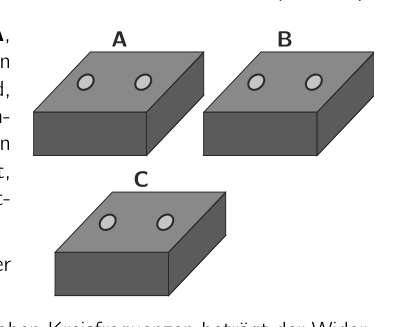 circuit diagrams for the three black boxes
Topic: Circuits, Oscillations & Waves Metodi: Equivalent Circuit Reduction, Kirchhoff’s Laws, Physical Modeling Competenze: Mathematical Modeling, Physical Reasoning, Diagrammatic Reasoning Objects: Resistor, Inductor, Capacitor Fonte: Testo (PDF) — p.2
Problema 1 Cassa nera (17 pag.) You are to investigate the contents of three electrical black boxes (A, B e C), each with two terminals, I circuiti sono tutti costruiti da componenti identici, a. resistori con resistenza , inductors con inductance e capacitors with capacitance . In scatole A e B, esattamente uno di ogni componente è installato, mentre in casella C, un totale di quattro elementi arbitrari sono collegati insieme. Quando l’impedenza è misurata come funzione del angular frequency, the boxes show the following behavior: Box A - Per un voltage applicato DC e ad frequenze angolari molto elevate la resistenza è circa . At an angular frequency , however, it rises without bound. Box B - Both at DC voltage and at very high angular frequencies this box has an
- di resistenza arbitraramente elevata1. A frequenza angolare , tuttavia, la sua resistenza è . Box C - Il valore di resistenza misurato per box C è , indipendente dalla frequenza angolare del voltage applicata. a) Utilizzo delle informazioni fornite, state all possible, distinct circuit diagrams2 per le tre scatole nere A, B e C. Giustificare la scelta dei circuiti. (9 punti) Per alcune delle possibili realizzazioni delle tre caselle nere le informazioni fornite sono sufficienti per determinare i valori caratteristici dei componenti. b) Per questi casi, esprimere le quantità , e in termini di e . Determine, per e , i rispettivi valori di , e . (3,5 punti) Se le scatole A e B utilizzate in parte b) sono collegate in serie, ci sono frequenze angolari at which the resistance of this series combination is exactly . c) Determina le frequenze angolari. (4,5 punti) Si può assumere che i componenti siano ideali e che gli elementi in tutte le scatole siano integrati in il circuito, cioè non sono né short-circuited né hanno terminali aperti. 1Thus l’impedenza rises without bound in these cases. 2Circuiti che differiscono solo scambiando l’ordine degli elementi in una combinazione di serie o il Le varie branche in combinazione parallela possono essere considerate equivalenti. 44° IPhO 2013 - Problemi del secondo round
circuit diagrams for the three black boxes
Topic: Circuits, Oscillations & Waves Metodi: Equivalent Circuit Reduction, Kirchhoff’s Laws, Physical Modeling Competenze: Mathematical Modeling, Physical Reasoning, Diagrammatic Reasoning Objects: Resistor, Inductor, Capacitor Fonte: Testo (PDF) — p.2
Problem 1 is Black boxes The Commission’s proposal for a directive on the protection of workers’ rights You are to investigate the contents of three electrical black boxes (A, B and C), each with two terminals, circuits are all built from identical components, namely resistors with resistance , inductors with inductance and capacitors with capacitance . In boxes A and B exactly one of each component is installed, whereas in box C a total of four arbitrary elements are connected together. When the impedance is measured as a function of the angular frequency, the boxes show the following behavior: Box A - For an applied DC voltage and at very high angular frequencies the resistance is about . At an angular frequency , however, it rises without bound. Box B - Both at DC voltage and at very high angular frequencies this box has an arbitrarily high resistance1. At the angular frequency , however, its resistance is . Box C - The resistance value measured for box C is , independent of the angular frequency of the the applied voltage. (a) Using the given information, state all possible, distinct circuit diagrams2 For the three black boxes A, B and C. Justify the choice of your circuits. The Commission has not yet adopted a proposal. For some of the possible realizations of the three black boxes the given information is sufficient to determine the characteristic values of the components. (b) For these cases, express the quantities , and in terms of and . Determine whether the and , the respective values of , and . (iii) the number of employees If the boxes A and B used in part b) are connected in series, there are angular frequencies at which the resistance of this series combination is exactly . (c) Determine these angular frequencies. (4.5 points) You may assume the components to be ideal and that the elements in all boxes are integrated into the the circuit, i.e. are neither short-circuited nor have open terminals. 1Thus the impedance rises without bound in these cases. 2Circuits that differ only by swapping the order of the elements in a series combination or the The arrangement of the individual branches in a parallel combination may be considered equivalent. 44th IPhO 2013 - Problems of the 2nd Round
circuit diagrams for the three black boxes
Topic: Circuits, Oscillations & Waves Metodi: Equivalent Circuit Reduction, Kirchhoff’s Laws, Physical Modeling Competenze: Mathematical Modeling, Physical Reasoning, Diagrammatic Reasoning Objects: Resistor, Inductor, Capacitor Fonte: Testo (PDF) — p.2
Problem 2 Rotating Liquids (23 pts.) A thin-walled, cylindrical glass of height and radius is, as sketched in the adjacent figure, filled up to a height with an incompressible liquid. If the glass is slowly rotated about its cylinder axis, the liquid also begins to rotate due to friction, and the liquid surface deforms. Now the angular velocity of the rotation is to be slowly increased. a) Derive an expression for the height of the liquid surface as a function of the distance from the rotation axis. Determine also at which angular velocity the glass begins to overflow. (9 points) In the calculations you may assume a value of Fig. 1: Sketch of the rotating glass. for the gravitational acceleration of the Earth and neglect effects due to surface tension. It becomes more interesting if one fills two liquids of different densities and into the glass3 and then sets it into rotation. Since the viscosities of the liquids can be quite different, the liquids take up the rotational motion of the glass at different rates and may have different rotation speeds. At www.ipho.info you will find, in the section “aufgaben” (problems), a link to a video in which, for water and a type of oil, you can watch how the shapes of the surfaces change during the onset of rotation and during the slowing down. For the study of the surface shapes, assume for simplicity that each of the two liquids rotates with a fixed angular velocity and respectively, that the liquids are not subject to friction, and that the initial fill heights from the bottom of the glass are and respectively. b) Determine the shape of the two liquid surfaces, i.e. give and as functions of the occurring parameters. Restrict yourself to the case in which the interface of the two liquids does not touch the surface of the upper liquid and neither of the liquid surfaces is in contact with the bottom. Furthermore, the glass should not overflow. (8 points) c) Use the values , as well as to investigate the following cases: i. At the onset of rotation the upper liquid is already rotating with an angular velocity , while the lower liquid, due to its lower viscosity, is still at rest. Determine the maximum angular velocity with which the upper liquid can rotate before one of the restrictions stated in part b) is violated. Sketch the shapes of the liquid surfaces for this case. (2.5 points) ii. After some time the lower liquid also rotates with the same angular velocity . Determine the maximum vertical distance of the liquid surfaces for this case and likewise sketch the shapes of the liquid surfaces. (2 points) 3You may assume that the liquids are incompressible and do not mix. 44th IPhO 2013 - Problems of the 2nd Round iii. During the slowing down, the upper liquid now first comes to rest, while the lower one keeps rotating for a while at approximately the angular velocity before it too is slowed down. Determine the maximum rise height of the lower liquid occurring during this process and compare the shape of the lower liquid surface with that from part a). (1.5 points)
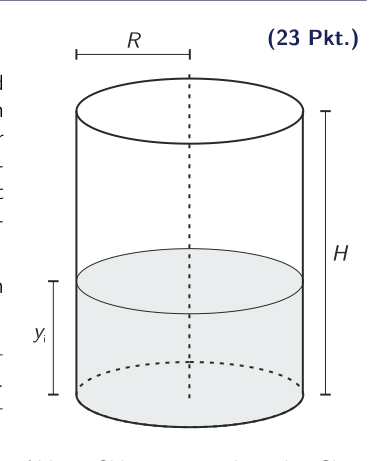 cylindrical glass with rotating liquid
Topic: Fluid Mechanics, Newtonian Mechanics Metodi: Hydrostatic Equilibrium, Calculus-Integration, Physical Modeling Competenze: Mathematical Modeling, Physical Reasoning, Diagrammatic Reasoning Objects: Container, Cylinder Fonte: Testo (PDF) — p.3
Problema 2 Fabbricazioni di plastica (cfr. Un cristallo di altezza di una superficie di >= 10 mm radius is, as sketched in the adjacent figure, filled up to a height with an liquido incompressibile. Se il vetro è lentamente rotato intorno al suo asse cilindrico, il liquido inizia anche a rotare a causa di frattura, e la superficie liquida
- Deformato. Now the angular velocity of the rotation is to be slowly aumento. a) Derivare un’espressione per l’altezza della superficie liquida come funzione della distanza dall’asse di rotazione. Determine also at which angular velocity the glass begins to overflow. (9 punti) In calcoli, si può assumere un valore di Fig. Sketch del vetro rotante. Per l’accelerazione gravitazionale della Terra e gli effetti di trascuramento dovuti alla tensione superficiale. It becomes more interesting if one fills two liquids of different densities and into the glass3 e poi lo mette in rotazione. Poiché le viscosità dei liquidi possono essere molto diverse, I liquidi assumono il movimento rotazionale del vetro a tassi diversi e possono avere velocità di rotazione diverse. Al sito www.ipho.info troverai nella sezione “Testi” (problemi), un link a un video in cui, per l’acqua e un tipo di olio, potete vedere come le forme delle superfici cambiano durante l’inizio della rotazione e durante il rallentamento. Per lo studio delle forme di superficie, supponiamo per semplicità che ciascuno dei due liquidi ruota con una velocità angolare fissa e rispettivamente, che i liquidi non siano soggetti a frattura, e che le altezze iniziali di riempimento dal fondo del vetro sono e rispettivamente. b) Determina la forma delle due superfici liquide, cioè give and Le funzioni di parametri che si verificano. Restrict yourself to the case in which the Interface of the two liquids non tocca la superficie del liquido superiore e né di tutte le superfici liquide è in contatto con il fondo. Inoltre, il vetro non dovrebbe sovrafflow. (8 punti) c) Usare i valori , e per indagare i seguenti casi: i. Al momento dell’inizio della rotazione il liquido superiore è già in rotazione con una velocità angolare , mentre il liquido inferiore, a causa della sua viscosità inferiore, è ancora a
- Il resto. Determine the maximum angular velocity with which the upper liquid può rotare prima che una delle restrizioni di cui alla parte b) sia violata. Sketch le forme delle superfici liquide per questo caso. (2.5 punti) ii. After some time the lower liquid also rotates with the same angular velocity . Determine la massima distanza verticale delle superfici liquide per questo caso e di conseguenza, schizziare le forme delle superfici liquide. (2 punti) 3Si può presumere che i liquidi siano incompressibili e non si mescolino. 44° IPhO 2013 - Problemi del secondo round iii. Durante il rallentamento, il liquido superiore ora prima viene a riposare, mentre il liquido inferiore rimane a rotazione per un po’ a approximately the angular velocity before it too is
- Si è rallentato. Determina la massima altezza di ascesa del liquido inferiore che si verifica durante questo processo e confronta la forma della superficie del liquido inferiore con quella di parte a). (1,5 punti)
cylindrical glass with rotating liquid
Topic: Fluid Mechanics, Newtonian Mechanics Metodi: Hydrostatic Equilibrium, Calculus-Integration, Physical Modeling Competenze: Mathematical Modeling, Physical Reasoning, Diagrammatic Reasoning Objects: Container, Cylinder Fonte: Testo (PDF) — p.3
Problem 2 Rotating liquids (Page 231) A thin-walled, cylindrical glass of height and radius is, as sketched in the adjacent figure, filled up to a height with an The following is the list of the substances used in the preparation: If the glass is slowly rotated about its cylinder axis, the liquid also begins to rotate due to friction, and the liquid surface Deformed. Now the angular velocity of the rotation is to be slowly increased. (a) Derive an expression for the height of the liquid surface as a function of the distance from the rotation axis. Determine also at which angular velocity the glass begins to overflow. The Commission has not yet adopted a proposal. In the calculations you may assume a value of Fig. Sketch of the rotating glass. For the gravitational acceleration of the Earth and neglect effects due to surface tension. It becomes more interesting if one fills two liquids of different densities and into the glass3 And then sets it into rotation. Since the viscosities of the liquids can be quite different, The liquids take up the rotational motion of the glass at different rates and may have different rotation speeds. At www.ipho.info you will find, in the “tasks” (problems) section, a link to a video in which, for water and a type of oil, You can watch how the shapes of the surfaces change during the onset of rotation and during the slowdown. For the study of the surface shapes, assume for simplicity that each of the two liquids rotates with a fixed angular velocity and respectively, that the liquids are not subject to friction, and that the initial fill heights from the bottom of the glass are and respectively. (b) Determine the shape of the two liquid surfaces, i.e. give and as functions of the occurring parameters. Restrict yourself to the case in which the interface of the two liquids does not touch the surface of the upper liquid and neither of the liquid surfaces is in contact with the bottom. Furthermore, the glass should not overflow. (80 points) (c) Use the values , as well as to investigate the following cases: i. At the onset of rotation the upper liquid is already rotating with an angular velocity , while the lower liquid, due to its lower viscosity, is still at The rest. Determine the maximum angular velocity with which the upper liquid can rotate before one of the restrictions set out in Part (b) is violated. Sketch the shapes of the liquid surfaces for this case. (b) the number of participants ii. After some time the lower liquid also rotates with the same angular velocity . Determine the maximum vertical distance of the liquid surfaces for this case and likewise sketch the shapes of the liquid surfaces. (two points) 3You may assume that the liquids are incompressible and do not mix. 44th IPhO 2013 - Problems of the 2nd Round (iii) the following: During the slowing down, the upper liquid now first comes to rest, while the lower one keeps rotating for a while at approximately the angular velocity before it too is slowed down. Determine the maximum rise height of the lower liquid occurring during this process and compare the shape of the lower liquid surface with that from part a). (including the following)
cylindrical glass with rotating liquid
Topic: Fluid Mechanics, Newtonian Mechanics Metodi: Hydrostatic Equilibrium, Calculus-Integration, Physical Modeling Competenze: Mathematical Modeling, Physical Reasoning, Diagrammatic Reasoning Objects: Container, Cylinder Fonte: Testo (PDF) — p.3
Problem 3 Shot Tower (25 pts.) The production of lead pellets for shotgun ammunition was a very laborious process, until at the beginning of the 19th century the use of so-called shot towers for production prevailed, with which a large quantity of balls could be produced in a short time. The operating principle of a shot tower is relatively simple. In the upper part of the tower lead is heated until it melts. The liquid lead is poured through a sieve. While falling in the tower, spherical lead droplets form due to surface tension; these cool down and solidify during the fall. At the lower end of the tower the lead pellets are caught in a water basin. In this problem you are to estimate the fall height of a tower necessary to produce a certain type of lead shot. The cooling of the pellets during the fall can occur via convection, heat conduction or radiation. The heat flow of the pellets produced by convection and heat conduction can be modeled by the relation where denotes the surface area of the pellets, gives the temperature of the pellets and is the ambient temperature. The factor is the so-called (mean) heat transfer coefficient, which, in contrast to the thermal conductivity , is not a material constant but depends on the prevailing conditions for the heat exchange. To characterize the heat transfer coefficient one can use the dimensionless Nusselt number , which gives the ratio of the above heat flow to the mean heat-conduction power over a length for the same surface area and temperature difference. Thus The length is a characteristic length of the given configuration. For the case of the lead pellets in air this corresponds to the diameter of the pellets. The Nusselt number thus allows the comparison of heat transfer between mutually similar configurations. For many situations empirical formulas exist for calculating the Nusselt number. For the sphere with air flowing around it you may use the following experimentally determined relation: Here denotes the velocity of the sphere relative to the air. and give the density and the dynamic viscosity of the air. For working on the problems use the following data: In the shot tower to be investigated, lead pellets with a diameter of are to be produced. The lead is initially heated to just above the melting temperature. You may assume that the lead droplets immediately take on a spherical shape. The pellets falling into the water basin at the lower end of the drop tower should have a temperature just below the boiling temperature of water in order to avoid excessive vapor formation. The ambient temperature is constant and equal to . Furthermore, there is no air flow present in the tower. 44th IPhO 2013 - Problems of the 2nd Round a) Show that the heat transport from the lead pellets to the surroundings occurs mainly through convection. (6 points) The fall of the pellets is slowed by air friction, so that after some time the velocity of the pellets approaches a constant terminal velocity . Figure 2 gives the ratio, occurring for the pellets used, of the instantaneous fall velocity with respect to the surrounding air to the terminal velocity, as a function of time. Fig. 2: Graph of the ratio of the instantaneous fall velocity of a lead pellet to the terminal velocity as a function of time. b) Estimate the minimum necessary fall height for the described shot tower and state after what approximate fall distance the pellets solidify. This is not about an exact calculation but about approximating the result sensibly and as well as possible. State the approximations you have made. (12 points) To reduce the height of the drop tower, one can blow air into the tower from below. c) Estimate what wind speed would have to be present in the drop tower to reduce the minimum necessary fall distance by half. For this, assume that all the air in the tower moves upward with a constant velocity. (7 points) For the problem you may use the following data: Gravitational acceleration on Earth Density of lead Melting temperature of lead Specific heat capacity of lead Specific heat of fusion of lead Density of air Thermal conductivity of air Dynamic viscosity of air The values may be assumed constant. Should you need further data, please state the sources used. 44th IPhO 2013 - Problems of the 2nd Round
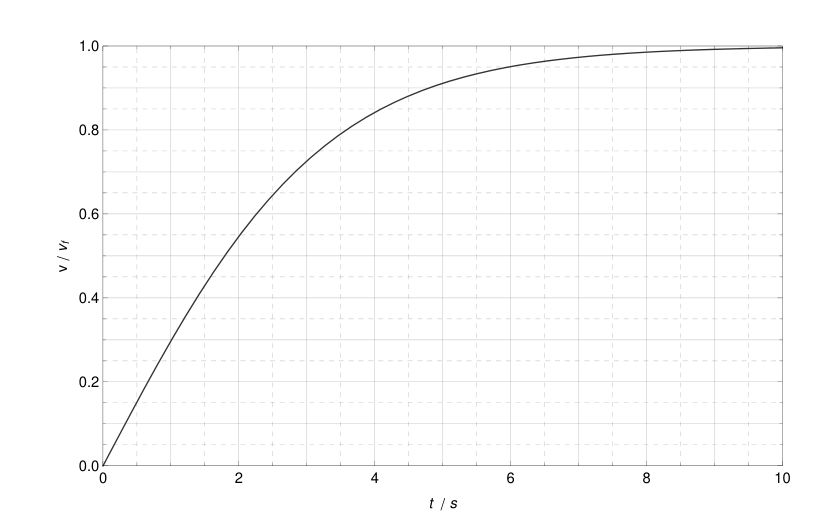 graph of v/vf as a function of time
Topic: Thermodynamics, Fluid Mechanics Metodi: Physical Modeling, Dimensional Analysis, Approximation & Series Expansion Competenze: Estimation & Approximation, Mathematical Modeling, Physical Reasoning Objects: Droplet, Sphere Fonte: Testo (PDF) — p.4
Problema 3 Torri di scatto (25 punti) La produzione di pallottole di piombo per le munizioni da cannone fu un processo molto laborioso, fino all’inizio del XIX secolo l’uso di cosiddette torri da sparo per la produzione prevalse, con cui una grande quantità di palle potrebbe essere prodotta in un breve tempo. Il principio operativo di una torre da fuoco è relativamente semplice. Nella parte superiore della torre il piombo è riscaldato fino a quando non si scioglie. Il liquido è versato attraverso una sette. Mentre cade nella torre, spherical lead droplets formate a causa di superficie Tensione: queste si raffreddano e solidificano durante la caduta. Al basso Finite la torre, i pioli di piombo sono intrappolati in un bacino d’acqua. In questo problema Si deve stimare l’altezza di caduta di una torre necessaria per produrre un certo tipo di lead shot. Il raffreddamento dei pellet durante la caduta può verificarsi tramite convezione, conduzione termico o radiazione. Il flusso di calore dei pellet prodotti da convezione e conduzione può essere essere modellato dalla relazione dove indica l’area di superficie dei pellet, dà la temperatura dei pellet e è il temperatura ambientale. Il fattore è il cosiddetto (mean) coefficiente di trasferimento di calore, che, contrariamente alla conductività termico , non è una costante materiale ma dipende dalla prevalente condizioni per lo scambio di calore. Per caratterizzare il coefficiente di trasferimento di calore si può usare il numero di nuclei dimensionless , che dà il rapporto di quanto sopra calore di corrente per la media di potenza di conduzione del calore su una lunghezza per la stessa superficie e differenze di temperatura. Così La lunghezza è una lunghezza caratteristica della configurazione data. Per il caso dei pelleti di piombo in aria questo corrisponde al diametro dei pelleti. Il numero di Nusselt permette quindi comparato di trasferimento di calore tra configurazioni mutuamente simili. Per molte situazioni esistono formule empiriche per calcolare il numero di Nusselt. Per la sfera con aria che scorre intorno a esso si può usare la seguente relazione determinata sperimentalmente: Qui indica la velocità della sfera relativa all’aria. and give the density e la viscosità dinamica dell’aria. Per lavorare sui problemi utilizzare i seguenti dati: sono da produrre pelleti di lead con un diametro di . Il Lead è inizialmente riscaldato a appena sopra la temperatura di fusione. Potete presumere che il Le gocce di lead assumono immediatamente una forma sferica. I granuli che cadono nel bacino d’acqua all’estremità inferiore della torre di scarico dovrebbero avere una temperatura appena inferiore alla temperatura di bolli dell’acqua per evitare un’eccessiva formazione di vapore. La temperatura ambiente è costante e pari a . Inoltre, non c’è alcun flusso d’aria presente nella torre. 44° IPhO 2013 - Problemi del secondo round a) Sostengono che il trasporto del calore dai pellet di piombo ai dintorni si verifica principalmente convezione. (6 punti) La caduta dei granelli è rallentata da attrito d’aria, in modo che dopo qualche tempo la velocità del i pellets si avvicinano a velocità terminale costante . Figura 2 dà il ratio, occurring for the pellets used, of the instantaneous fall velocity con riguardo all’aria circostante alla velocità terminale, come funzione del tempo. Fig. 2: Grafico del rapporto della velocità di caduta istantanea di un pellet di lead alla velocità terminale come funzione di tempo. b) Estimare il minimo necessario di altezza di cascata per la torre e lo stato descritto Dopo che si è avvicinati a distanza, i pellet si solidificano. Questo non è un Esatto calcolo, ma circa l’approssimazione del risultato sensibilmente e il più possibile. Stato le approssimative che avete fatto. (12 punti) Per ridurre l’altezza della torre di caduta, si può soffiare aria nella torre da sotto. c) Estimare che velocità di vento dovrebbe essere presente nella torre di scarico per ridurre il
- La minima distanza necessaria per caso. Per questo, supponiamo che tutti i L’aria della torre si muove verso l’alto a velocità costante. 7 punti) Per il problema si possono utilizzare i seguenti dati: Accelerazione gravitazionale sulla Terra Densità di lead Temperatura di fusione di lead Specific heat capacity of lead Specific heat of fusion of lead Densità di aria Condutività termica dell’aria Viscosità dinamica dell’aria I valori possono essere presunti costanti. Se avete bisogno di ulteriori dati, per favore state the sources used. 44° IPhO 2013 - Problemi del secondo round
grafico di v/vf come funzione di tempo
Topic: Thermodynamics, Fluid Mechanics Metodi: Physical Modeling, Dimensional Analysis, Approximation & Series Expansion Competenze: Estimation & Approximation, Mathematical Modeling, Physical Reasoning Objects: Droplet, Sphere Fonte: Testo (PDF) — p.4
Problem 3 Shot tower (c) the number of persons The production of lead pellets for shotgun ammunition was a very laborious process, until at the beginning of the 19th century the use of so-called shot towers for production prevailed, With which a large quantity of balls could be produced in a short time. The operating principle Of a shot tower is relatively simple. In the upper part of the tower lead is heated until it melts. The liquid lead is poured through a seven. While falling into the tower, spherical lead droplets form due to surface These cool down and solidify during the fall. At the lower The lead pellets are caught in a water basin. In this problem You are to estimate the fall height of a tower necessary to produce a certain type of lead shot. The cooling of the pellets during the fall can occur via convection, heat conduction or radiation. The heat flow of the pellets produced by convection and heat conduction can be modeled by the relation where denotes the surface area of the pellets, gives the temperature of the pellets and is the the ambient temperature. The factor is the so-called (mean) heat transfer coefficient, which, in contrast to the thermal conductivity , is not a material constant but depends on the prevailing conditions for the heat exchange. To characterize the heat transfer coefficient one can use the dimensionless kernel number , which gives the ratio of the above heat flow to the mean heat-conduction power over a length for the same surface area and temperature difference. Thus The length is a characteristic length of the given configuration. For the case of lead pellets in air this corresponds to the diameter of the pellets. The Nusselt number thus allows the comparison of heat transfer between mutually similar configurations. For many situations empirical formulas exist for calculating the Nusselt number. For the sphere with air flowing around it you may use the following experimentally determined relation: Here denotes the velocity of the sphere relative to the air. and give the density and the dynamic viscosity of the air. For working on the problems use the following data: In the shot tower to be investigated, lead pellets with a diameter of are to be produced. The Lead is initially heated to just above the melting temperature. You may assume that the Lead droplets immediately take on a spherical shape. The pellets falling into the water basin at the lower end of the drop tower should have a temperature just below the boiling temperature of water to avoid excessive vapor formation. The ambient temperature is constant and equal to . Furthermore, there is no air flow present in the tower. 44th IPhO 2013 - Problems of the 2nd Round (a) Show that the heat transport from the lead pellets to the surrounding area occurs mainly in the through convection. (seventh and sixth points) The fall of the pellets is slowed by air friction, so that after some time the velocity of the pellets approaches a constant terminal velocity . Figure 2 gives the ratio, occurring for the pellets used, of the instantaneous fall velocity with respect to the surrounding air to the terminal velocity, as a function of time. Fig. 2: Graph of the ratio of the instantaneous fall velocity of a lead pellet to the terminal velocity as a function of time. b) Estimate the minimum necessary fall height for the described shot tower and state After what approximate fall distance the pellets solidify. This isn ‘t about an The first is that the results are not exactly calculations but approximations of the results are sensible and as good as possible. State of the Union the approximations you’ve made. (A) the number of points To reduce the height of the drop tower, one can blow air into the tower from below. (c) Estimate what wind speed would have to be present in the drop tower to reduce the minimum necessary case distance by half. For this, assume that all the Air in the tower moves upward at a constant velocity. (seventh and final points) For the problem you may use the following data: Gravitational acceleration on Earth Density of lead Melting temperature of lead Specific heat capacity of lead Specific heat of fusion of lead Density of air Thermal conductivity of air Dynamic viscosity of air The values may be assumed to be constant. Should you need further data, please state the sources used. 44th IPhO 2013 - Problems of the 2nd Round
graph of v/vf as a function of time
Topic: Thermodynamics, Fluid Mechanics Metodi: Physical Modeling, Dimensional Analysis, Approximation & Series Expansion Competenze: Estimation & Approximation, Mathematical Modeling, Physical Reasoning Objects: Droplet, Sphere Fonte: Testo (PDF) — p.4
Problem 4 Experimental Problem - Physics with Jelly (35 pts.) In the experimental problem you are to determine the density and the torsion modulus of jelly, which is also called gelatin dessert or “Wackelpeter”. First obtain ready-made jelly4. Alternatively, you can also prepare jelly powder or, as a substitute, gelatin according to the corresponding instructions on the packaging. The color of the jelly may be chosen freely. For the experiments you may furthermore use only the following materials: • Ruler(s) • Knife, scissors or similar (for cutting the jelly) • Container with water • Drinking straws • Toothpicks/matches • Modeling clay • Stopwatch • Writing materials It is not permitted to weigh masses directly with a scale. Fig. 3: A block of delicious jelly. a) Using a suitable experimental setup, determine the density of the jelly or gelatin. You may assume that the density of water is . State the error of your result. (17 points) To twist a solid, elastic cylinder whose base is fixed, as sketched in the adjacent figure, by a small angle , a torque must act on the top of the cylinder, which can be expressed using the torsion modulus of the cylinder material and the notation in the figure as
- B. Derive the expression (4.1). (4 points)
- C. Determine the torsion modulus of jelly experimentally. State the error of your result and name the main factors on which the result depends. If in part a) you did not obtain a result for the density of the jelly, you may, if necessary, use a density of for the jelly as a substitute. (14 points) Fig. 4: Sketch of the twisted cylinder. Describe your theoretical considerations, the experimental setups, the experimental procedure and the evaluation in such a way that they are easy to follow.
- Good luck ! - 4You should pour any vanilla sauce that may be included only after the experiment.
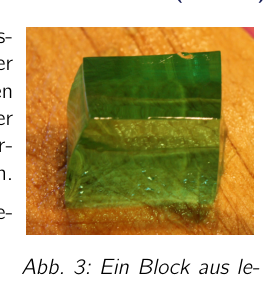 block of jelly (gelatin)
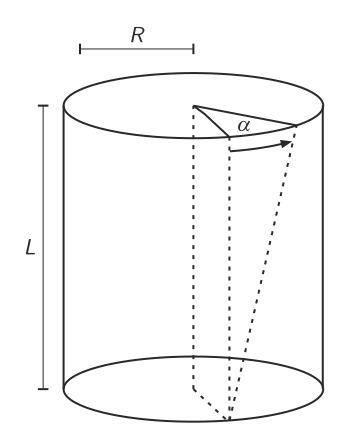 elastic cylinder twisted by angle alpha
Topic: Elasticity & Materials, Fluid Mechanics Metodi: Stress-Strain Analysis, Hydrostatic Equilibrium, Physical Modeling Competenze: Measurement & Instrumentation, Error Propagation, Mathematical Modeling Objects: Cylinder Fonte: Testo (PDF) — p.6
Problema 4 Problema sperimentale - Physics with Jelly (punto 35) Nel problema sperimentale si deve determinare la densità e il modulo di torsione della gelatina, che è anche chiamato gelatin dessert o “Wackelpeter”. Prima ottenere pronto-made Jelly4. In alternativa, puoi anche preparare gelatina in polvere o, come sostituto, gelatinato secondo le istruzioni corrispondenti sull’imballaggio. Il colore della gelatina può essere scelto liberamente. Per gli esperimenti potete inoltre utilizzare solo i seguenti materiali: • Ruler • coltelli, scissori o simili (per tagliare la gelé) • Container with water • Strossie da bere • Toothpicks/matches • Modellazione di argilla • Stopwatch • materiali scritti Non è permesso pesare masse direttamente con una scala. Fig. Tre: un blocco di gelatina deliziosa. a) Usando un appropriato setup sperimentale, determinare la densità della gelé o
- Non è così. Si può supporre che la densità di acqua sia . Stato l’errore del tuo risultato. (17 punti) Per girare un cilindro solido elastico la cui base è fissa, as sketched in the adjacent figure, by a small angle , a Torque must act on the top of the cylinder, which can be expressed using the torsion modulus of the cylinder material and the notation in the figure as
- B. Derive the expression (4.1). (4 punti)
- C. Determine the torsion modulus of jelly experimentally. State the error of your result and name I fattori principali di cui dipende il risultato. Se in parte a) non si ottiene un risultato per la densità della gelatina, se necessario, use a density of for the jelly as a substitute. (14 punti) Fig. 4: Sketch of the twisted
- Cacciaio. Descrivere le vostre considerazioni teoriche, le configurazioni sperimentali, la procedura sperimentale e l’evaluamento in modo che siano facili da seguire.
- Buona fortuna ! - 4You should pour any vanilla sauce that may be included only after the experiment.
*block of jelly (latina) *
elastic cylinder twisted by angle alpha
Topic: Elasticity & Materials, Fluid Mechanics Metodi: Stress-Strain Analysis, Hydrostatic Equilibrium, Physical Modeling Competenze: Measurement & Instrumentation, Error Propagation, Mathematical Modeling Objects: Cylinder Fonte: Testo (PDF) — p.6
The problem is 4 Experimental problem - Physics with jelly (A) the number of employees In the experimental problem you are to determine the density and the torsion modulus of jelly, which is also called gelatin dessert or “Wackelpeter”. First obtain ready-made Jelly4. Alternatively, you can also prepare jelly powder or, as a substitute, gelatin according to the corresponding instructions on the packaging. The color of the jelly may be chosen freely. For the experiments you may furthermore use only the following materials: • Ruler (s) • Knives, scissors or similar (for cutting the jelly) • Container with water • Drinking straws • Toothpicks/matches • Modelling clay • Stopwatch • Writing materials It is not permitted to weigh masses directly with a scale. Fig. Three: A block of delicious jelly. (a) Using a suitable experimental setup, determine the density of the jelly or I’m not going to. You may assume that the density of water is . State of the Union the error of your result. (Article 17 of the Treaty) To twist a solid, elastic cylinder whose base is fixed, as sketched in the adjacent figure, by a small angle , a torque must act on the top of the cylinder, which can be expressed using the torsion modulus of the cylinder material and the notation in the figure as
- B. Derive the expression (4.1). (four points)
- C. Determine the torsion modulus of jelly experimentally. State the error of your result and name The main factors on which the result depends. If in part a) you did not obtain a result for the density of the jelly, you may, if necessary, use a density of for the jelly as a substitute. (fourteen points) Fig. 4: Sketch of the twisted The cylinder. Describe your theoretical considerations, the experimental setups, the experimental procedure and the evaluation in such a way that they are easy to follow.
- Good luck with that . - 4You should pour any vanilla sauce that may be included only after the experiment.
*block of jelly (Gelatin) *
elastic cylinder twisted by angle alpha
Topic: Elasticity & Materials, Fluid Mechanics Metodi: Stress-Strain Analysis, Hydrostatic Equilibrium, Physical Modeling Competenze: Measurement & Instrumentation, Error Propagation, Mathematical Modeling Objects: Cylinder Fonte: Testo (PDF) — p.6