Problem 1 Resuscitation (20 pts.) Defibrillators are used to restore the heart rhythm of an irregularly beating heart. For this, a large fraction of the heart muscle cells is simultaneously stimulated electrically by an electric shock. Consider a simple defibrillator consisting of a capacitor that discharges, via two electrodes connected to the patient’s chest, over a period of 150 ms to about 5% of the voltage of the fully charged capacitor. The resistance of the chest between the electrodes is about and the energy necessary for the defibrillation is 200 J. a) Estimate what capacitance the capacitor must have and to what voltage it must at least be charged for operation. (5 pts.) In mobile defibrillators, such as those found in some public places, the capacitor is charged via a battery. Since the voltage of the battery is lower than the necessary capacitor voltage, it must be stepped up. One way to do this is provided by a so-called boost converter, as sketched in the following figure. The switch S opens and closes periodically, being closed for a fraction of the period and open for a fraction . The period should be very small compared to the time constant of the capacitor- resistor system. The quantity is called the duty cycle. The drawn-in, very high-ohmic resistor R represents the ohmic behavior of the capacitor. All components may be assumed ideal, i.e. in particular that the diode blocks completely in the reverse direction and causes no voltage drop in the forward direction. Fig. 1: Circuit diagram for the boost converter.
- B. Derive an expression for the maximum capacitor voltage that is established after some time, in terms of the occurring quantities. (14 pts.)
- C. Determine how large the duty cycle must be chosen in order to charge a capacitor of capacitance C of with an ohmic resistance component of via a 12.0 V battery to a voltage of 500 V, if the inductance L of the coil is 5.0 mH. (1 pt.)
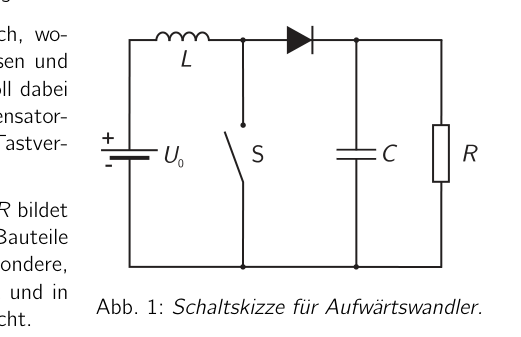 circuit diagram of boost converter with L, S, C, R
Topic: Circuits, Electromagnetism Metodi: Physical Modeling, Differential Equations, Energy Conservation Method Competenze: Mathematical Modeling, Physical Reasoning Objects: Capacitor, Battery, Switch, Inductor Fonte: Testo (PDF) — p.2
Problema 1 Risuscitazione (cfr. I defibrillatori sono usati per ripristinare il ritmo cardiaco di un cuore che batte irregolarmente. Per questo, una grande frazione delle cellule muscolari del cuore è stimolata simultaneamente elettricamente
- E’ stato colpito da un’elettricità. Considerate un defibrillatore semplice consistente in un condensatore che scarica, tramite due elettrodi collegati al petto del paziente, per un periodo di 150 ms a circa il 5% del voltage del condensatore completamente carico. La resistenza del petto tra i electrodes is about and the energy necessary for the defibrillation is 200 J. a) Estimare quale capacità deve avere il condensatore e a quale voltage deve almeno essere accusato di operazione. (cfr. Nei defibrillatori mobili, come quelli trovati in alcuni luoghi pubblici, il condensatore è carico tramite una batteria. Since the voltage of the battery is lower than the necessary Voltaggio di condensatore, deve essere aumentato. Un modo per farlo è fornito da un cosiddetto Boost Converter, come illustrato nella figura seguente. The switch S opens and closes periodically, being closed for a fraction of the period and open for a fraction . Il periodo dovrebbe essere molto piccolo rispetto alla costante di tempo del condensatore sistema di resistenza. Il quantitativo è chiamato il ciclo di servizio. Il resistore di alta resistenza ohmica R rappresenta il comportamento ohmico del condensatore. Tutti i componenti può essere presumito ideale, cioè in particolare che il diodo blocca completamente nella direzione inversa e non causa alcuna caduta di tensione nel Direzione in avanti. Fig. 1: diagramma di circuito per il convertitore di impulso.
- B. Derivare un’espressione per la massima tensione di condensatore che è stabilita dopo qualche tempo, in termini di quantità che si verificano. (14 pag.)
- C. Determine how large the duty cycle must be chosen in order to charge a capacitor of Capacità C di with an ohmic resistance component of via a 12,0 V batteria a una volta di 500 V, se l’inductanza L della bobina è di 5,0 mH. (1 pt.)
circuit diagram of boost converter with L, S, C, R
Topic: Circuits, Electromagnetism Metodi: Physical Modeling, Differential Equations, Energy Conservation Method Competenze: Mathematical Modeling, Physical Reasoning Objects: Capacitor, Battery, Switch, Inductor Fonte: Testo (PDF) — p.2
Problem 1 Resuscitation The Commission shall adopt implementing acts in accordance with Article 21 of this Regulation. Defibrillators are used to restore the heart rhythm of an irregularly beating heart. For this, a large fraction of the heart muscle cells is simultaneously stimulated electrically by an electric shock. Consider a simple defibrillator consisting of a capacitor that discharges, via two electrodes connected to the patient’s chest, over a period of 150 ms to about 5% of the voltage of the fully charged capacitor. The resistance of the chest between the electrodes is about and the energy necessary for the defibrillation is 200 J. (a) Estimate what capacitance the capacitor must have and to what voltage it Must at least be charged for operation. (five points) In mobile defibrillators, such as those found in some public places, the capacitor is charged via a battery. Since the voltage of the battery is lower than the necessary Capacitor voltage, it must be stepped up. One way to do this is provided by a so-called boost converter, as outlined in the following figure. The switch S opens and closes periodically, being closed for a fraction of the period and open for a fraction . The period should be Very small compared to the time constant of the capacitor The resistor system. The quantity is called the duty cycle. The drawn-in, very high-ohmic resistor R represents The ohmic behavior of the capacitor. All components may be assumed to be ideal, i.e. In particular, That the diode blocks completely in the reverse direction and causes no voltage drop in the forward direction. Fig. 1: Circuit diagram for the boost converter.
- B. Derive an expression for the maximum capacitor voltage that is established after some time, in terms of the occurring quantities. (Page 14)
- C. Determine how large the duty cycle must be chosen in order to charge a capacitor of Capacity C of with an ohmic resistance component of via a 12.0 V battery to a voltage of 500 V, if the inductance L of the coil is 5.0 mH. (1 pt.)
circuit diagram of boost converter with L, S, C, R
Topic: Circuits, Electromagnetism Metodi: Physical Modeling, Differential Equations, Energy Conservation Method Competenze: Mathematical Modeling, Physical Reasoning Objects: Capacitor, Battery, Switch, Inductor Fonte: Testo (PDF) — p.2
Problem 2 Crystal Vibrations and Diffraction of Light (20 pts.) (Idea: Manuel Bärenz) Characteristic of a crystal is the regular arrangement of its building blocks, i.e. the atoms or molecules of which it consists. This regularity allows collective phenomena that cannot be observed in the individual building blocks. In this problem you are to investigate the vibrational excitations of crystals. For this, consider for simplicity a one-dimensional crystal in which a very large number of atoms are arranged along an axis, as in the adjacent figure. The atoms each have mass m and are located at positions with . The rest position of the i-th atom is at , where a is the lattice constant of the crystal. Fig. 2: Sketch of the atoms of the one-dimensional crystal at their respective rest positions. The interaction of the atoms with one another can, in a simple approximation, be modeled as the force of a spring of spring constant D between neighboring atoms. The i-th atom thus exerts on the -th atom a force of magnitude a) Set up the equation of motion for the position of the i-th atom in the crystal lattice and show that the equations of motion of the atoms are solved by standing waves of the form For the solution, give in terms of D, m, a and k, and determine the maximum value of in terms of the parameters of the crystal. In addition, sketch the behavior of as a function of k. (5 pts.) The quantity k is called the wavenumber and is the circular or angular frequency of the wave. They are related to the wavelength and the frequency f of the oscillation via as well as If the lattice constant of the crystal is very small compared to the wavelength, the wave “feels” the inhomogeneity of the crystal lattice hardly at all. It then behaves like light in a homogeneous medium and is approximately proportional to k. Thus the propagation velocity of the waves is roughly constant and wave packets can propagate over larger distances in the crystal. This is the reason why sound can travel through crystalline solids without large distortions. b) Express the speed of sound c in the crystal for wavelengths that are large compared to the atomic spacing a, in terms of the quantities D, m and a. (1 pt.) In many cases sound does not occur as a standing wave but as a traveling wave. c) Show that the standing wave considered in part a) can be represented as plus a combination of several traveling waves of the form The wavenumbers and the phases may take any real values, whereas the angular frequencies may only be positive. (2 pts.)
In the following, sound waves in a cuboidal diamond crystal are now considered as a concrete example. The diamond is to be oriented so that its edges run parallel to a Cartesian coordinate system. Effects of the three-dimensional structure of the crystal are to be neglected, so that the previous results can still be used. You can use the following values for the diamond crystal: Atomic spacing in the diamond crystal: Atomic mass for diamond: (u is the atomic mass unit) Speed of sound in diamond: Refractive index of diamond: In the crystal, a standing sound wave of frequency GHz is generated in the z-direction. d) Determine the wavelength of the standing wave and show that at the given frequency the proportionality between the angular frequency and the wavenumber k holds to a good approximation. (2 pts.) The crystal is now additionally irradiated along the x-axis with a laser beam of wavelength nm. On passing through the crystal, the laser beam is scattered more strongly at the locations where the standing sound wave is compressed than at other locations. These locations therefore form an optical grating for the laser beam. e) Determine the angle to the undiffracted beam at which the first principal maximum of the diffraction pattern behind the crystal can be seen. (4 pts.) The sound waves considered can also be interpreted quantum mechanically. Just as a laser beam consists of individual light quanta, the photons, one imagines the sound wave to be composed of a number of vibration quanta. The quantum of the sound waves is called a “phonon”. For the present situation, assume that a phonon has the same properties as a photon. In particular, its energy should be related to the frequency via , where h denotes Planck’s constant. The photons of the laser beam can, with a certain probability, absorb phonons. f) Explain the principal maxima occurring above and below the undiffracted beam with the help of the quantum mechanical picture. Determine, also for this point of view, the angle to the undiffracted beam at which the first principal maximum of the diffraction pattern behind the crystal can be seen. State what condition the wavelengths and must satisfy so that the classically determined diffraction angle agrees well with that from the quantum mechanical consideration. (6 pts.)
Topic: Oscillations & Waves, Wave Optics, Modern-Quantum Physics Metodi: Wave Equation, Simple Harmonic Motion Analysis, Interference & Diffraction Analysis, Superposition Principle Competenze: Mathematical Modeling, Physical Reasoning Objects: Atom, Spring, Diffraction Grating, Photon Fonte: Testo (PDF) — p.3
Problema 2 Vibrazioni cristalline e diffrazione della luce (cfr. (idea: Manuel Bärenz) Caratteristico di un cristallo è l’arrangimento regolare dei suoi blocchi di costruzione, cioè i atomi o molecole di cui è composto. Questa regolarità consente fenomeni collettivi che non possono essere osservati nei singoli blocchi di costruzione. In questo problema si sono per indagare le eccitazioni vibrazionali di cristalli. Per questo, considerate per semplicità un cristallo unidimensional in cui un numero molto grande di Atomi sono disposti lungo in un asse, come nella figura adiacente. Gli atomi hanno massa m e sono posizionati in posizioni with . La posizione restante dell’atomo ith è at , dove a è la costante lattice del cristallo. Fig. 2: Sketch of the atoms of the one-dimensional Crystal at their respective rest positions. L’interazione degli atomi tra loro può, in una semplice approssimazione, essere modellata come la forza di una primavera di Prossima costante D tra atomi vicini. Il primo atomo così esercita sul -th atomo a force of magnitude a) Setting up the equation of motion for the position of the ith atom in the crystal lattice e mostrare che le equazioni di movimento degli atomi sono risolte da onde in piedi del forma Per la soluzione, dare in termini di D, m, a e k, e determinare il il valore massimo di in termini dei parametri del cristallo. Inoltre, il comportamento di come funzione di k. (cfr. La quantità k è chiamata la frequenza d’onda e è la frequenza circolare o angolare dell’onda. - Sono sono correlati alla lunghezza d’onda e alla frequenza f dell’oscillazione via e Se la costante lattice del cristallo è molto piccola rispetto alla lunghezza d’onda, l’onda “senti” La disumogeneità della cristallina non è che molto. Si comporta quindi come luce in un medio omogeneo e è approssimativamente proporzionale a k. Così la velocità di propagazione del Le onde sono più o meno costanti e i pacchetti di onde possono diffondersi a più grandi distanze nel cristallo. Questo è il motivo per cui il suono può viaggiare attraverso solidi cristallini senza grandi
- le distorsioni. b) Esprimere la velocità del suono c nel cristallo per lunghezze d’onda che sono grandi rispetto al spaziamento atomico a, in termini di quantità D, m e a. (1 pt.) In molti casi il suono non si presenta come un’onda in piedi ma come un’onda in viaggio. c) Sosteni che la standing wave considerata in parte a) può essere rappresentata come più una combinazione di diverse onde viaggianti della forma I numeri d’onda e le fasi possono prendere qualsiasi valore reale, mentre le frequenze angolari possono essere solo positive. - 2 punti
In the following, onde sonore in un cristallo di diamante cuboidal sono ora considerati come un esempio concreto. Il diamante è da essere orientato in modo che i suoi bordi corrano paralleli a un sistema di coordinate cartesiane. Gli effetti della struttura tridimensionale del cristallo sono da essere Negliziati, in modo che i risultati precedenti possano essere utilizzati. Tu puoi utilizzare i seguenti valori per il cristallo di diamante: Spaziamento atomico nel cristallo di diamante: Massa atomica per diamante: (u è l’unità di massa atomica) Speed of sound in diamond: Indice refrattivo di diamante: Nel cristallo, una ondata di suono di frequenza GHz è generata nella direzione z. d) Determine la lunghezza d’onda della onda in piedi e mostra che alla data frequenza la proporzionalità tra la frequenza angolare e il numero d’onda k si mantiene a un buon Approximation. - 2 punti Il cristallo è ora irradiato ulteriormente lungo l’asse x con un raggio laser di lunghezza d’onda nm. Passando attraverso il cristallo, il fascio laser è sparso più fortemente nei luoghi dove il stand Sound wave is compressed than at other locations. Questi luoghi formano quindi una griglia ottica per il raggio laser. e) Determine l’angolo all’indiffracted beam at which the first principal maximum of the si può vedere il modello di diffrazione dietro il cristallo. - 4 punti Le onde sonore considerate possono anche essere interpretate quantum mechanically. Proprio come un raggio laser è composto da singoli quantitativi di luce, i fotoni, si immagina che l’onda sonora sia composta da un Numero di vibrazione quantica. Il quantum delle onde sonore è chiamato un “phonon”. Per la situazione attuale, supponiamo che un fonone abbia le stesse proprietà che
- Un fotone. In particolare, la sua energia dovrebbe essere correlata alla frequenza via , dove h indica la costante di Planck. I fotoni del fascio laser possono, con un
- Certo probabilità, assorbire fononi. (f) Esplorare il massimo principale che si verifica sopra e sotto il fascio non sfocato con l’aiuto della macchine quantistiche. Determine, quindi per questo punto di vista, l’angolo a un fascio non frazionato, al quale il primo massimo principale del modello di diffrazione è stato Crystal può essere visto. State what condition the wavelengths and must satisfy so that the classically determined diffraction angle agrees well with that from the quantum mechanical consideration. (6 punti)
Topic: Oscillations & Waves, Wave Optics, Modern-Quantum Physics Metodi: Wave Equation, Simple Harmonic Motion Analysis, Interference & Diffraction Analysis, Superposition Principle Competenze: Mathematical Modeling, Physical Reasoning Objects: Atom, Spring, Diffraction Grating, Photon Fonte: Testo (PDF) — p.3
Problem 2 Crystal vibrations and diffraction of light The Commission shall adopt implementing acts in accordance with Article 21 of this Regulation. (Ideas: Manuel Bärenz) Characteristic of a crystal is the regular arrangement of its building blocks, i.e. The atoms or molecules of which it consists. This regularity allows for collective phenomena that cannot be observed in the individual building blocks. In this problem you are to investigate the vibrational excitations of The crystals. For this, consider for simplicity a one-dimensional crystal in which a very large number of Atoms are arranged along on an axis, as in the adjacent figure. The atoms each have mass m and are located at positions with . The rest position of the i-th atom is at , where a is the lattice constant of the crystal. Fig. 2: Sketch of the atoms of the one-dimensional crystal at their respective rest positions. The interaction of the atoms with each other can, in a simple approximation, be modeled as the force of a spring of spring constant D between neighboring atoms. The i-th atom thus exerts on the -th atom a force of magnitude (a) Set up the equation of motion for the position of the ith atom in the crystal lattice and Show that the equations of motion of the atoms are solved by standing waves of the form For the solution, give in terms of D, m, a and k, and determine the maximum value of in terms of the parameters of the crystal. In addition, sketch the behavior of as a function of k. (five points) The quantity k is called the wavenumber and is the circular or angular frequency of the wave. They are related to the wavelength and the frequency f of the oscillation via as well as If the lattice constant of the crystal is very small compared to the wavelength, the wave “feels” The inhomogeneity of the crystal lattice hardly at all. It then behaves like light in a homogeneous medium and is approximately proportional to k. Thus the propagation velocity of the Waves is roughly constant and wave packets can propagate over larger distances in the crystal. This is the reason why sound can travel through crystalline solids without large The Commission will take the necessary steps to ensure that the Commission is able to take the necessary measures. (b) Express the speed of sound c in the crystal for wavelengths that are large compared to the atomic spacing a, in terms of the quantities D, m and a. (1 pt.) In many cases sound does not occur as a standing wave but as a traveling wave. (c) Show that the standing wave considered in part (a) can be represented as plus a combination of several traveling waves of the form The wavenumbers and the phases may take any real values, whereas the angular frequencies may only be positive. (c) the number of persons who are not members of the
In the following, sound waves in a cuboidal diamond crystal are now considered a concrete example. The diamond is to be oriented so that its edges run parallel to a Cartesian coordinate system. Effects of the three-dimensional structure of the crystal are to be neglected, so that the previous results can still be used. You can use the following values for the diamond crystal: Atomic spacing in the diamond crystal: Atomic mass for diamond: (u is the atomic mass unit) Speed of sound in diamond: Refractive index of diamond: In the crystal, a standing sound wave of frequency GHz is generated in the z-direction. d) Determine the wavelength of the standing wave and show that at the given frequency the proportionality between the angular frequency and the wavenumber k holds to a good The approximation is (c) the number of persons who are not members of the The crystal is now additionally irradiated along the x-axis with a laser beam of wavelength nm. On passing through the crystal, the laser beam is scattered more strongly at the locations where the standing Sound wave is compressed than at other locations. These locations therefore form an optical grating for the laser beam. e) Determine the angle to the undiffracted beam at which the first principal maximum of the diffraction pattern behind the crystal can be seen. The Commission has also adopted a proposal for a directive on the protection of workers’ rights. The sound waves considered can also be interpreted quantum mechanically. Just as a laser beam consists of individual light quantities, the photons, one imagines the sound wave to be composed of a number of vibration quantum. The quantum of sound waves is called a “phonon”. For the present situation, assume that a phonon has the same properties as The first is a photon. In particular, its energy should be related to the frequency via , where h denotes Planck’s constant. The photons of the laser beam can, with a It’s a very small number of people. Explain the principal maxima occurring above and below the undiffracted beam with the help of the of the quantum mechanical picture. Determine, therefore for this point of view, the angle to the undiffracted beam at which the first principal maximum of the diffraction pattern behind the crystal can be seen. State what condition the wavelengths and must satisfy so that the classically determined diffraction angle agrees well with that from the quantum mechanical consideration. (Page 66)
Topic: Oscillations & Waves, Wave Optics, Modern-Quantum Physics Metodi: Wave Equation, Simple Harmonic Motion Analysis, Interference & Diffraction Analysis, Superposition Principle Competenze: Mathematical Modeling, Physical Reasoning Objects: Atom, Spring, Diffraction Grating, Photon Fonte: Testo (PDF) — p.3
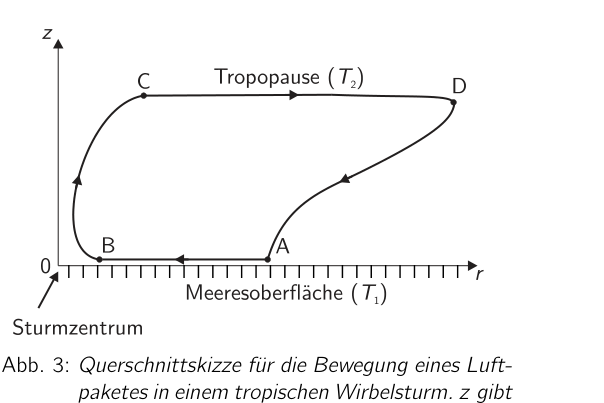
Problem 3 Tropical Cyclones (30 pts.) Storm systems in tropical latitudes can have significantly higher wind speeds and thereby be significantly more destructive than most storms, for example in Germany. The large-area heated sea surface near the equator plays an essential role as an energy supplier for the storms. Fundamental properties of these cyclones can be investigated with a simplified thermodynamic model, as shown in Figure 3. Consider a small air parcel of mass that moves, at the level of the sea surface, from the high-pressure region at A to the outer edge of the storm center (B). Fig. 3: Cross-section sketch for the motion of an air parcel in a tropical cyclone. z gives the height above the sea surface and r the distance from the center of the storm. The temperature of the air remains constant and equal to the sea temperature ; however, seawater continually evaporates, so that the humidity in the air parcel increases. Near the storm center the air is then saturated and the additionally absorbed humidity rains out. As a result the air masses rise to great heights and cool down to the temperature of the tropopause. This process from B to the region marked C in the figure proceeds, to a good approximation, without heat exchange with the surroundings. At roughly constant temperature the air then travels along the tropopause again from the center of the storm outward and releases heat in the form of radiation. Finally the cooled air sinks down again to region A. This process too occurs without significant heat exchange. In this way a thermodynamic cycle arises, which in this model is assumed to be reversible. a) Determine the heat absorbed by the air parcel along the path from A to B. The partial pressure of the water vapor may at all times be assumed very small compared to the air pressure. Express the result in terms of the mass , the mass of the absorbed water vapor, the pressures and at A and B respectively, the temperature as well as occurring constants. (10 pts.) b) Derive an expression for the total work W done on the air parcel during the cycle and express it in terms of the quantities used in part a) as well as . (6 pts.) Assume that about 50% of the work done on the air parcel leads directly to an increase of the rotational energy of the air parcel about the center of the storm on the path from A to B. c) Give the rotation speed of the cyclone at the edge of the center in terms of the quantities used in the previous parts and the rotation speed at the outer edge of the storm. (3 pts.)
For the last parts use the following numerical values: Universal gas constant Temperature at the sea surface Temperature at the tropopause Air pressure at A (edge of the cyclone) Air pressure at B (edge of the storm center) Saturation vapor pressure over water at pressure and temperature Mean molar mass of air Molar mass of water Heat of vaporization of water at temperature Relative humidity of the air at A d) Determine, for , the rotation speed of the cyclone at the edge of the center. (4 pts.) Note: If you were unable to determine the value for the rotation speed, you may use the substitute value for the following parts. The rotation speed v of the air in a cyclone is, outside the center of the storm, approximately proportional to the inverse square root of the distance r, i.e. . e) Calculate the approximate diameter of the cyclone considered, under the assumption that the point B is at km. (2 pts.) f) Estimate the rotational energy of the entire cyclone and compare this value with the annual primary energy consumption in Germany, which in 2011 was about 14 exajoules. For this, assume a constant air density of and a height of the cyclone of about 12 km. (4 pts.) g) When the cyclone hits land, its energy supply is cut off and it becomes weaker. Assume that the cyclone considered completely dissipates on land within about 10 days and estimate what average power the cyclone releases in doing so. (1 pt.)
 cross-section of tropical cyclone, z-r
Topic: Thermodynamics, Fluid Mechanics, Newtonian Mechanics Metodi: First Law of Thermodynamics, Thermodynamic Cycle Analysis, Ideal Gas Law Competenze: Mathematical Modeling, Estimation & Approximation Objects: Gas Fonte: Testo (PDF) — p.5
Il problema 3 Cicloni tropicali (punto 30) I sistemi di tempesta in latitudini tropicali può avere velocità di vento significativamente più elevate e quindi essere significativamente più elevate La maggior parte delle tempeste In Germania, per esempio. Il grande area di superficie di mare riscaldato vicino al L’equatore svolge un ruolo essenziale come fornitore di energia per il Le tempeste. Le proprietà fondamentali di questi cicloni possono essere investigate con un sistema di modello termodinamico, come mostrato in figura 3. Consider a small air parcel of mass che si muove, al livello della superficie del mare, dal livello di pressione alta all’esterno edge of the storm center (B). Fig. 3: Sketch di sezione incrociata per il movimento di un paesino d’aria in un ciclone tropicale. z dà l’altezza sopra la superficie del mare e r l’ Distanza dal centro della tempesta. The temperature of the air remains constant and equal to the sea temperature ; however, seawater evapora continuamente, aumentando l’umidità nell’aria. Vicino al centro della tempesta l’aria è quindi satura e l’umidità ulteriormente assorbita piove. Come risultato le masse d’aria salire a grandi altezze e raffreddare verso il temperatura della tropopausa. Questo processo da B alla regione ha segnato C in La figura procede, in buona approssimazione, senza scambi di calore con l’ambiente circostante. A temperatura costante l’aria quindi viaggia lungo la tropopausa di nuovo dal centro della tempesta l’esterno e rilascia calore sotto forma di radiazioni. Finalmente l’aria fresca scende di nuovo a regione A. Questo processo si verifica anche senza uno scambio di calore significativo. In questo Il modello di questo ciclo è stato rivisto come un ciclo termodinamico. a) Determine the heat absorbed by the air parcel along the path from A to B. La pressione parziale del vapore d’acqua può essere considerata molto piccola rispetto al
- Presione dell’aria. Express the result in terms of the mass , the mass of the absorbed water vapor, the pressures and at A and B respectively, the temperature e delle costanti che si verificano. (cfr. b) Derivare un’espressione per il totale del lavoro svolto durante il ciclo e esprimere in termini di quantità utilizzate in parte a) come pure . (6 punti) Supponiamo che circa il 50% del lavoro svolto sull’aria porta direttamente ad un aumento del energia rotazionale dell’aria parcel about the center of the storm on the path from A to B. c) Date la velocità di rotazione del ciclone all’orlo del centro in termini di quantità utilizzate nelle parti precedenti e la velocità di rotazione at the outer edge of the storm. (3 punti)
Per le ultime parti utilizzare i seguenti valori numerici: Costante universale del gas Temperatura al mare Temperature al tropopause A. Pressione dell’aria a A (edge of the cyclone) Pressione dell’aria a B (edge of the storm center) Saturation vapor pressure over water a pressione e temperatura Mean molar mass of air Mollar mass of water Calore di vaporizzazione di acqua a temperatura Relative humidity of the air at A d) Determinare, per , la velocità di rotazione del ciclone all’orlo del centro. - 4 punti Nota: se non sei stato in grado di determinare il valore della velocità di rotazione, puoi utilizzare il valore sostitutivo per le seguenti parti. La velocità di rotazione V dell’aria in un ciclone è, fuori dal centro della tempesta, Approximativamente proporzionale alla radice quadrata inversa della distanza r, cioè . e) Calcolare il diametro approssimativo del ciclone considerato, che il punto B è a km. - 2 punti f) Estimare l’energia di rotazione dell’intero ciclone e confrontare questo Il valore con il consumo annuo di energia primaria in Germania, che nel 2011 era di circa 14 esajoules. Per questo, assumere una densità di aria costante di e un’altezza del ciclone di circa 12 km. - 4 punti g) Quando il ciclone colpisce il paese, il suo approvvigionamento energetico è tagliato e diventa
- Si’, è più debole. Supponiamo che il ciclone considerato completamente dissipates su terra entro circa 10 giorni e stimare il potere medio del ciclone
- E’ un’idea che la gente non può fare nulla. (1 pt.)
cross-section of tropical cyclone, z-r
Topic: Thermodynamics, Fluid Mechanics, Newtonian Mechanics Metodi: First Law of Thermodynamics, Thermodynamic Cycle Analysis, Ideal Gas Law Competenze: Mathematical Modeling, Estimation & Approximation Objects: Gas Fonte: Testo (PDF) — p.5
Problem 3 Tropical cyclones (Page 30 of the report) Storm systems in tropical latitudes can have significantly higher wind speeds and thus be significantly more destructive than most storms, for The Commission has already adopted a number of proposals. The large-area heated sea surface near the The equator plays an essential role as an energy supplier for The storms. Fundamental properties of these cyclones can be investigated with a simplified The thermodynamic model, as shown in Figure 3. Consider a small air parcel of mass that moves, at the level of the sea surface, from the high-pressure region at A to the outer edge of the storm center (B). Fig. 3: Cross-section sketch for the motion of an air parcel in a tropical cyclone. z gives the height above the sea surface and r the distance from the center of the storm. The temperature of the air remains constant and equal to the sea temperature ; however, seawater continuously evaporates, so that the humidity in the air parcel increases. Near the storm center the air is then saturated and the additionally absorbed humidity rains out. As a result the air masses rise to great heights and cool down to the temperature of the tropopause. This process from B to the region marked C in The figure proceeds, to a good approximation, without heat exchange with the surroundings. At roughly constant temperature the air then travels along the tropopause again from the center of the storm outward and releases heat in the form of radiation. Finally the cool air sinks down again to region A. This process also occurs without significant heat exchange. In this way a thermodynamic cycle arises, which in this model is assumed to be reversible. (a) Determine the heat absorbed by the air parcel along the path from A to B. The partial pressure of the water vapor may at all times be assumed very small compared to the air pressure. Express the result in terms of the mass , the mass of the absorbed water vapor, the pressures and at A and B respectively, the temperature as well as occurring constants. (Page 10) (b) Derive an expression for the total work W done on the air parcel during the cycle and express it in terms of the quantities used in part a) as well as . (Page 66) Assume that about 50% of the work done on the air parcel leads directly to an increase in the rotational energy of the air parcel about the center of the storm on the path from A to B. (c) Give the cyclone’s rotation speed at the edge of the center in terms of the quantities used in the previous parts and the rotation speed at the outer edge of the storm. (Page 3 of this report)
For the last parts use the following numerical values: Universal gas constant Temperature at the sea surface Temperature at the tropopause Air pressure at A (edge of the cyclone) Air pressure at B (edge of the storm center) Saturation vapor pressure over water at pressure and temperature Mean molar mass of air Molar mass of water Heat of vaporization of water at temperature Relative humidity of the air at A (d) Determine, for , the rotation speed of the cyclone at the edge of the The center. The Commission has also adopted a proposal for a directive on the protection of workers’ rights. Note: If you were unable to determine the value for the rotation speed, you may use the substitute value for the following parts. The rotation speed v of the air in a cyclone is, outside the center of the storm, approximately proportional to the inverse square root of the distance r, i.e. . (e) Calculate the approximate diameter of the cyclone considered, under the assumption that the point B is at km. (c) the number of persons who are not members of the (f) Estimate the rotational energy of the entire cyclone and compare this The value of the energy consumption in Germany is estimated to be about 14 exajoules per year. For this, assume a constant air density of and a height of the cyclone of about 12 km. The Commission has also adopted a proposal for a directive on the protection of workers’ rights. (g) When the cyclone hits land, its energy supply is cut off and it becomes Weaker. Assume that the cyclone considered completely dissipates on land within about 10 days and estimate what average power the cyclone releases in doing so. (1 pt.)
cross-section of tropical cyclone, z-r
Topic: Thermodynamics, Fluid Mechanics, Newtonian Mechanics Metodi: First Law of Thermodynamics, Thermodynamic Cycle Analysis, Ideal Gas Law Competenze: Mathematical Modeling, Estimation & Approximation Objects: Gas Fonte: Testo (PDF) — p.5
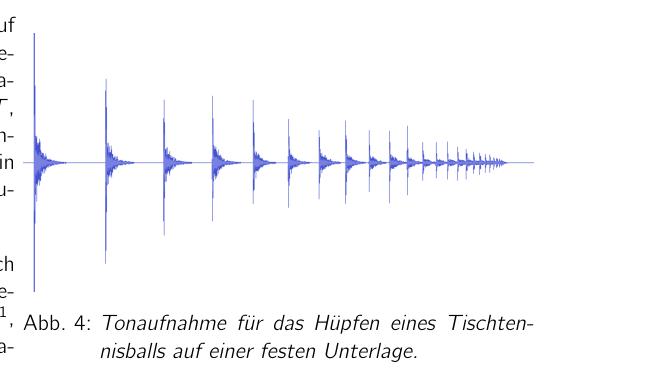
Problem 4 Experimental Problem - Big Jumps with Small Balls (30 pts.) If one lets a table tennis ball fall vertically onto a solid surface, it usually bounces many times before coming to rest. In doing so, the bounce duration T, i.e. the time between two successive impacts with the surface, slowly decreases. In this problem you are to investigate these impacts with the help of audio recording software. As materials you may use in this experiment table tennis balls, a computer or other device with audio recording software1, a ruler, various surfaces as well as paper. Fig. 4: Audio recording of the bouncing of a table tennis ball on a solid surface. For the mass m and the diameter d of a table tennis ball you may use the values prescribed for competitions, and . You may also determine the values for your ball with a scale and a caliper, e.g. at school. Theoretical preliminary considerations Since the ball is relatively light, the influence of the surrounding air cannot necessarily be neglected. If a body falls with a velocity v through a gaseous medium of density , it is slowed, over a large range of velocities, by a friction force Here A denotes the cross-sectional area of the body perpendicular to the motion and the so-called drag coefficient, which depends on the shape of the body. For a sphere . In the following problems use the value for the density of air and for the gravitational acceleration on Earth. a) The stated mass of the ball is the mass that a scale displays under atmospheric conditions. Calculate what mass the scale would display in a vacuum. (1 pt.) b) Estimate theoretically up to which bounce duration T the motion of the table tennis ball is only weakly slowed by air friction, i.e. for which range of the bounce duration the influence of air friction on the motion can be neglected to a good approximation. (2 pts.) Investigation without taking air friction into account At each impact with the surface the table tennis ball loses a relatively small part of its kinetic energy. If the ball strikes the surface with a kinetic energy , then for the kinetic energy directly after the impact The factor , assumed constant, is a measure of the elasticity of the impact. 1Suitable, for example, is the free open-source software Audacity, which is available for various platforms. c) Determine experimentally the elasticity factor for the impact of the table tennis ball for two different surfaces. For this, let the ball fall from a fixed height onto the surface. Carry out the experiment in such a way that you can neglect air friction and estimate the error of your result. (11 pts.) d) Determine from your measurements, in each case, the time from the first impact on the surface until the ball stops bouncing. Also carry out an error estimate for this. (3 pts.) Bouncing with air friction taken into account Taking air friction into account makes the investigation of the ball’s motion more involved. In a fall from a very great height the ball moves, after a longer fall distance, with a constant velocity, the terminal velocity . More precisely, for the fall velocity v of the ball as a function of the fall time t, Here it is assumed that the ball is initially at rest. For an upward motion that begins with the vertical velocity at , however, as long as the argument of the tangent is positive. If the velocity of the ball during bouncing is small compared to the terminal velocity, the rise and fall durations between two impacts with the floor are, to a good approximation, equal. In the evaluation, approximations for the occurring trigonometric functions can also be helpful. Thus, for , for example e) Compare the bounce durations for each pair of two successive bounces and now determine experimentally, taking air friction into account, the elasticity factor again for bouncing on the two surfaces. Compare the obtained values with those you determined without taking air friction into account. (9 pts.) f) Determine from your measured values also the drag coefficient of the table tennis ball. An error estimate is not required for this part. (4 pts.) General note In all parts, describe your theoretical considerations, the approximations made, the experimental setups, the experimental procedure and the evaluation in such a way that they are easy to follow. The IPhO team wishes you much fun and success in the 2nd Round!
 audio recording of ping-pong ball bounces
Topic: Newtonian Mechanics, Fluid Mechanics Metodi: Experimental Data Analysis, Approximation & Series Expansion, Energy Conservation Method Competenze: Experimental Data Analysis, Error Propagation, Graph Linearization Objects: Ball Fonte: Testo (PDF) — p.7
Problema 4 Problema sperimentale: Big Jumps with Small Balls (punto 30) Se uno lascia un pallone di tennis cadere verticalmente su Una superficie solida, di solito rimbalza molte volte prima di riposare. In questo modo, il bounce duration T, i.e. Il tempo tra due impatti successivi con la superficie, lentamente diminuisce. In Questo problema è che si può indagare su questi impatti con l’aiuto di software di registrazione audio. Come materiali che potete utilizzare in questo esperimento Calci di calcio, a computer o a qualsiasi altro dispositivo con software di registrazione audio1, un rullo, diverse superfici e carta. Fig. 4: Audio recording del bouncing di una palla da tavolo su una superficie solida. Per la massa m e il diametro d di una palla da tavolo puoi usare i valori prescritti per le competizioni, e . Potete anche determinare il valori per la tua palla con una scala e un calibro, ad esempio: - A scuola. Preliminari considerazioni teoriche Poiché la palla è relativamente leggera, l’influenza dell’aria circostante non può essere necessariamente trascurata. Se un corpo cade con velocità v attraverso un mezzo gassoso di densità , è rallentato, over a large range of velocities, by a friction force Here A denota l’area cross-sectional del corpo perpendicolare al movimento e il cosiddetto coefficiente di attrito, che dipende dalla forma del corpo. Per una sfera . In questi problemi utilizzare il valore per la densità di aria e for the gravitational acceleration on Earth. a) La massa dichiarata della palla è la massa che una scala mostra in condizioni atmosferiche. Calcolare cosa la massa della scala avrebbe mostrato in un vuoto. (1 pt.) b) Estimate theoretically up to which bounce duration T il movimento della palla di tennis da tavolo è solo a) di un’attività di controllo di temperatura inferiore a 10 °C, per quale range of the bounce duration L’influenza dell’aria sul movimento può essere trascurata per una buona approssimazione. - 2 punti Investigation without taking air friction into account A ogni impatto con la superficie il table tennis ball perde una parte relativamente piccola del suo kinetic energia. If the ball strikes the surface with a kinetic energy , then for the energia cinetica directly after the impact Il fattore , assumito costante, è una misura dell’elasticità dell’impatto. 1Suitable, per esempio, è il software open source gratuito Audacity, che è disponibile per varie piattaforme. c) Determinare sperimentalmente il elasticità factor for the impact of the table tennis ball for two
- Le superfici sono diverse. Per questo, lasciate che la palla cadga da una quota fissa sulla superficie. Eseguire l’esperimento in modo da poter trascurare l’aria e la friczione estimate the error of your result. (11 pag.) d) Determine dalle tue misurazioni, in ogni caso, il tempo dal primo impatto sulla superficie Finché la palla non smette di saltare. Quindi, eseguire una stima di errore per questo. (3 punti) Bouncing with air friction accounted Prendere in considerazione l’attrito aereo rende l’indagine sul movimento della palla più coinvolta. In un caso di caduta da un’altezza molto grande la palla si muove, dopo una più lunga distanza di caduta, con un velocità costante, velocità terminale . Più precisamente, per la velocità di caso v di the ball as a function of the fall time t, Qui si presume che la palla sia inizialmente a riposo. Per un movimento ascendente che inizia con la velocità verticale a , tuttavia, finché l’argomento del tangente è positivo. Se la velocità del pallone durante il bouncing è piccolo rispetto alla velocità terminale, la durata di ascesa e caduta tra due impatti con il pavimento sono, per una buona approssimazione, uguali. In questo caso, la Commissione ha deciso di Per le funzioni trigonometriche che si verificano può essere utile. Quindi, per , per esempio e) Compare le durate di bounce per ogni coppia di due bounce successive e determinare ora experimentally, taking air friction into account, the elasticity factor again for Bouncing sulle due superfici. Compare i valori ottenuti con quelli determinati senza prendendo in considerazione la friczione dell’aria. (9, p. f) Determine dal tuo valore misurato anche il coefficiente di drag del pallone da tavolo. Per questa parte non è richiesta una stima di errore. - 4 punti Nota generale In tutte le parti, descrivere le vostre considerazioni teoriche, le approssimazioni fatte, il I sistemi di creazione sperimentali, la procedura sperimentale e la valutazione in modo che siano facili da seguire. Il team dell’IPhO vi augura molto divertimento e successo nel secondo round!
audio recording of ping-pong ball bounces
Topic: Newtonian Mechanics, Fluid Mechanics Metodi: Experimental Data Analysis, Approximation & Series Expansion, Energy Conservation Method Competenze: Experimental Data Analysis, Error Propagation, Graph Linearization Objects: Ball Fonte: Testo (PDF) — p.7
Problem 4 Experimental problem - Big jumping with small balls (Page 30 of the report) If one lets a table tennis ball fall vertically onto A solid surface, it usually bounces many times before coming to rest. In doing so, the bounce duration T, i.e. The time between two successive impacts with the surface, slowly decreases. In This problem you are to investigate these impacts with the help of audio recording software. As materials you may use in this experiment Table tennis balls, a computer or other device with audio recording software1, A roller, various surfaces as well as paper. Fig. 4: Audio recording of the bouncing of a table tennis ball on a solid surface. For the mass m and the diameter d of a table tennis ball you may use the values prescribed for competitions, and . You may also determine the values for your ball with a scale and a caliper, e.g. At school. Theoretical preliminary considerations Since the ball is relatively light, the influence of the surrounding air cannot necessarily be neglected. If a body falls with a velocity v through a gaseous medium of density , it is slowed, over a large range of velocities, by a friction force Here A denotes the cross-sectional area of the body perpendicular to the motion and The so-called drag coefficient, which depends on the shape of the body. For a sphere . In the following problems use the value for the density of air and for the gravitational acceleration on Earth. (a) The stated mass of the ball is the mass that a scale displays under atmospheric conditions. Calculate what mass the scale would display in a vacuum. (1 pt.) b) Estimate theoretically up to which bounce duration T the motion of the table tennis ball is only weakly slowed by air friction, i.e. for which range of the bounce duration the The effect of air friction on motion can be neglected to a good approximation. (c) the number of persons who are not members of the Investigation without taking air friction into account At each impact with the surface the table tennis ball loses a relatively small part of its kinetic Energy. If the ball strikes the surface with a kinetic energy , then for the kinetic energy directly after the impact The factor , assumed constant, is a measure of the elasticity of the impact. 1Suitable, for example, is the free open-source software Audacity, which is available for various platforms. c) Determine experimentally the elasticity factor for the impact of the table tennis ball for two different surfaces. For this, let the ball fall from a fixed height onto the surface. Carry out the experiment in such a way that you can neglect air friction and estimate the error of your result. (Page 11) (d) Determine from your measurements, in each case, the time from the first impact on the surface Until the ball stops bouncing. So carry out an error estimate for this. (Page 3 of this report) Bouncing with air friction taken into account Taking air friction into account makes the investigation of the ball’s motion more involved. In a fall from a very great height the ball moves, after a longer fall distance, with a The terminal velocity is . More precisely, for the case velocity v of the ball as a function of the fall time t, Here it is assumed that the ball is initially at rest. For an upward motion that begins with the vertical velocity at , however, As long as the argument of the tangent is positive. If the velocity of the ball during bouncing is small compared to the terminal velocity, the rise and fall durations between two impacts with the floor are, to a good approximation, equal. In the evaluation, approximations For the occurring trigonometric functions can also be helpful. Thus, for , for example e) Compare the bounce durations for each pair of two successive bounces and now determine experimentally, taking air friction into account, the elasticity factor again for bouncing on the two surfaces. Compare the obtained values with those you determined without taking air friction into account. (Page 9 of the report) f) Determine from your measured values also the drag coefficient of the table tennis ball. An error estimate is not required for this part. The Commission has also adopted a proposal for a directive on the protection of workers’ rights. General note In all parts, describe your theoretical considerations, the approximations made, the The experimental setups, the experimental procedure and the evaluation in such a way that they are easy to follow. The IPhO team wishes you much fun and success in the 2nd round!
audio recording of ping-pong ball bounces
Topic: Newtonian Mechanics, Fluid Mechanics Metodi: Experimental Data Analysis, Approximation & Series Expansion, Energy Conservation Method Competenze: Experimental Data Analysis, Error Propagation, Graph Linearization Objects: Ball Fonte: Testo (PDF) — p.7