Problem 1 Up the Hill (25 + 5* pts.) Two homogeneous cones glued together at their bases, with base-circle radius R and opening angle , lie, as seen in the adjacent figure, on two thin rails that have an opening angle . The plane spanned by the rails makes an angle with the horizontal. A denotes the lowest point of the rails. The mass of the double cone is m. The center of mass of the double cone is initially located, with respect to the plane spanned by the two rails, vertically above the point A. After being released, the double cone rolls by itself along the rails - that is, uphill. In doing so, the base of the cones is always centered between the rails. You may assume that the plane spanned by the connecting lines between the cone’s center of mass and the contact points of the double cone with the rails is always perpendicular to the plane of the rails. A double cone d 2R rails Fig. 1: Double cone on rails (top view of the rail plane). 1.a) Explain physically how it is possible that, after being released at point A, the double cone apparently rolls uphill. State which condition(s) the angles , and must satisfy for this and justify your answer. (8 pts.) 1.b) Show that the moment of inertia I of the double cone for rotation about the axis through the two cone tips is (5 pts.) 1.c) Determine an expression for the velocity of the center of mass of the double cone as a function of the distance d rolled in the rail plane. (5 pts.) 1.d) Calculate, for the values , , , and , the distance that the double cone rolls uphill in total, as well as the maximum velocity reached in doing so. (7 pts.) You may assume that the double cone rolls without slipping. Bonus problem: With the following part you can earn 5 bonus points. 1.e) The assumption that the plane spanned by the connecting lines between the cone’s center of mass and the contact points of the double cone with the rails is always perpendicular to the plane of the rails is, strictly speaking, not correct. Investigate at which points the rails actually touch the double cone in the case described in the previous part and find out what actually happens upon release at point A. (5 pts.)
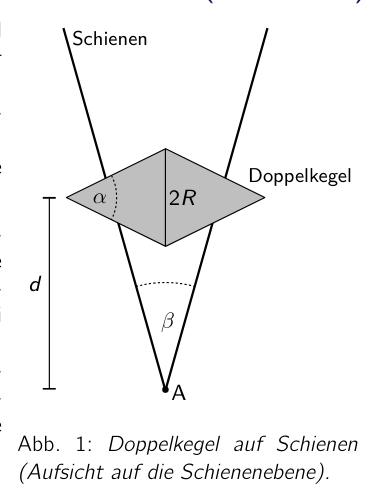 double cone on rails, top view
Topic: Rotational Dynamics, Newtonian Mechanics, Conservation of Energy Metodi: Torque & Angular Momentum Analysis, Energy Conservation Method, Calculus-Integration Competenze: Physical Reasoning, Mathematical Modeling, Diagrammatic Reasoning Objects: Cylinder, Rod Fonte: Testo (PDF) — p.2
Problema 1 Up the Hill (Ponti di cui al punto 25 + 5*) Due coni omogenei incollati alle loro basi, con radius base-circle R and opening angle , lie, as seen in the adiacente figure, su due thin rails che hanno un angolo di apertura . The plane spanned by the rails makes an angle with the horizontal. Un denota il punto più basso dei binari. La massa di cui il doppio cono è m. Il centro di massa del doppio cono è inizialmente situato, rispetto al piano spanned by the two rails, verticalmente sopra il punto A. Dopo essere stato rilasciato, il doppio cono ruota da solo lungo i binari - cioè, in salita. In questo modo, La base dei coni è sempre centrata tra
- Le ferrovie. Si può supporre che l’aereo spanned da linee di connessione tra il centro di massa del cono e i punti di contatto del cono doppio con i binari è sempre perpendicolare al piano dei binari. A conione doppia d 2R tratti Fig. 1: Conone doppio su binari (top view del piano ferroviario). 1.a) Spiegare fisicamente come sia possibile che, dopo essere stato rilasciato al punto A, il doppio cono Apparentemente, si sta facendo a rotoli. State which condition(s) the angles , and must satisfy per questo e giustificare la tua risposta. (8 p.) 1.b) Mostra che il momento di inerzia I del doppio cono per rotazione circa l’asse attraverso il due punti di cono è (cfr. 1.c) Determina un’espressione per la velocità del centro di massa del doppio cono come a funzione della distanza d rotolato nel piano ferroviario. (cfr. 1.d) Calcolare, per i valori , , , e , la distanza che il doppio cono ruota verso l’alto in totale, così come la velocità massima raggiunta nel farlo. (7 punti) Potete presumere che il doppio cono ruoli senza scivolare. Problema bonus: con la parte seguente puoi guadagnare 5 punti bonus. 1.e) L’ipotesi che il piano spanned by the connecting lines between the cone’s center of mass and the contact points of the double cone with the rails is always perpendicular to the Plan of the Rails non è corretto. Investigate at which points i binari effettivamente toccano il doppio cono nel caso descritto nella parte precedente E scopri cosa succede effettivamente dopo il rilascio al punto A. (5 pts.)
double cone on rails, top view
Topic: Rotational Dynamics, Newtonian Mechanics, Conservation of Energy Metodi: Torque & Angular Momentum Analysis, Energy Conservation Method, Calculus-Integration Competenze: Physical Reasoning, Mathematical Modeling, Diagrammatic Reasoning Objects: Cylinder, Rod Fonte: Testo (PDF) — p.2
Problem 1 Up the Hill (25 + 5* pts.) Two homogeneous cones glued together at their bases, with base-circle radius R and opening angle , lie, as seen in the adjacent figure, on two thin rails that have an opening angle . The plane spanned by the rails makes an angle with the horizontal. A denotes the lowest point of the rails. The mass of the double cone is m. The center of mass of the double cone is initially located, with respect to the plane spanned by the two rails, vertically above point A. After being released, the double cone rolls by itself along the rails - that is, uphill. In doing so, The base of the cones is always centered between The rails. You may assume that the plane spanned by the connecting lines between the cone’s center of mass and the contact points of the double cone with the rails is always perpendicular to the plane of the rails. A double cone d 2R railway Fig. 1: Double cone on rails (top view of the rail plane).
- (a) Explain physically how it is possible that, after being released at point A, the double cone Apparently rolls up. State which condition(s) the angles , and must satisfy for this and justify your answer. (Page 86) 1.b) Show that the moment of inertia I of the double cone for rotation about the axis through the Two cone tips is (five points) 1.c) Determine an expression for the velocity of the center of mass of the double cone as a function of the distance d rolled in the rail plane. (five points)
- (d) Calculate, for the values , , , and , the distance That the double cone rolls upward in total, as well as the maximum velocity reached in doing so. (Page 77) You can assume that the double cone rolls without slipping. Bonus problem: With the following part you can earn 5 bonus points. 1.e) The assumption that the plane spanned by the connecting lines between the cone’s center of mass and the contact points of the double cone with the rails is always perpendicular to the plane of the rails is, strictly speaking, not correct. Investigate at which points The rails actually touch the double cone in the case described in the previous part and find out what actually happens upon release at point A. (5 pts.)
double cone on rails, top view
Topic: Rotational Dynamics, Newtonian Mechanics, Conservation of Energy Metodi: Torque & Angular Momentum Analysis, Energy Conservation Method, Calculus-Integration Competenze: Physical Reasoning, Mathematical Modeling, Diagrammatic Reasoning Objects: Cylinder, Rod Fonte: Testo (PDF) — p.2
Problem 2 Lens at the Aquarium (20 pts.) In a large, water-filled, cuboidal aquarium there is a small luminous object. The flat side of a plano-convex lens with focal length f is glued from the outside onto a side wall of the aquarium such that the object is on the optical axis of the lens. The refractive index of water is 1.33, that of the lens material 1.50. Both the wall of the aquarium and the lens can be regarded as very thin. You may furthermore restrict yourself to considering rays close to the optical axis. 2.a) Determine the location of possible images of the object on the optical axis as a function of the location of the object itself. In each case state whether it is a real or virtual, an upright or inverted, and an enlarged or reduced image. (11 pts.) 2.b) Calculate what values the image distance and the magnification take when the object distance equals 2.5 times the focal length f. (3 pts.) 2.c) Carry out the consideration from part 2.b) for the case that the lens is glued, in an analogous way, to the inside of the aquarium wall. (6 pts.)
Topic: Geometric Optics Metodi: Thin Lens & Mirror Equation, Snell’s Law, Ray Tracing Competenze: Physical Reasoning, Mathematical Modeling, Diagrammatic Reasoning Objects: Lens, Container Fonte: Testo (PDF) — p.3
Problema 2 Lens at the Aquarium (cfr. In un grande acquario cuboideo pieno di acqua c’è un piccolo oggetto luminoso. Il lato piatto di un obiettivo convex piano con distanza focale f è incollato dall’esterno su un muro laterale dell’acquario in modo tale che l’oggetto sia sull’asse ottico della lente. L’indice di refraczione dell’acqua è di 1,33, quello del materiale dell’obiettivo di 1,50. Entrambi il muro del l’acquario e la lente possono essere considerati molto sottili. You may furthermore limitarsi a considerare i raggi vicini all’asse ottico. 2.a) Determinare la posizione di possibili immagini dell’oggetto sull’asse ottico come funzione della posizione dell’oggetto stesso. In each case state whether it is a real O virtuale, o verticale o inversa, e un’immagine ingrandita o ridotta. (11 pag.) 2.b) Calcolare cosa vale la distanza dell’immagine e la taglia di ingrandimento quando la distanza dell’oggetto è pari a 2,5 volte la distanza focale f. (3 punti) 2.c) Per il caso in cui il lente sia glued, effettuare la considerazione da parte 2.b) Come, all’interno del muro dell’acquario. (6 punti)
Topic: Geometric Optics Metodi: Thin Lens & Mirror Equation, Snell’s Law, Ray Tracing Competenze: Physical Reasoning, Mathematical Modeling, Diagrammatic Reasoning Objects: Lens, Container Fonte: Testo (PDF) — p.3
Problem 2 Lens at the Aquarium The Commission shall adopt implementing acts in accordance with Article 21 of this Regulation. In a large, water-filled, cuboidal aquarium there is a small luminous object. The flat side of a plano-convex lens with focal length f is glued from the outside onto a side wall of the aquarium such that the object is on the optical axis of the lens. The refractive index of water is 1.33, that of the lens material 1.50. Both the wall of the The lens and the aquarium can be considered very thin. You may furthermore Restrict yourself to considering rays close to the optical axis. 2.a) Determine the location of possible images of the object on the optical axis as a function of the location of the object itself. In each case state whether it is a real or virtual, an upright or inverted, and an enlarged or reduced image. (Page 11) 2.b) Calculate what values the image distance and the magnification take when the object distance equals 2.5 times the focal length f. (Page 3 of this report) 2.c) Carry out the consideration from part 2.b) for the case that the lens is glued, in an analogue way, to the inside of the aquarium wall. (Page 66)
Topic: Geometric Optics Metodi: Thin Lens & Mirror Equation, Snell’s Law, Ray Tracing Competenze: Physical Reasoning, Mathematical Modeling, Diagrammatic Reasoning Objects: Lens, Container Fonte: Testo (PDF) — p.3
Problem 3 Heating with a Chest Freezer (25 pts.) Peter, Paul and Petra are on vacation in a small log cabin. On their arrival at the cabin it is quite cold. Fortunately, they can quickly heat the interior to a comfortable temperature with the stove. They wonder what they would have done if the stove had not been there. Then they notice the chest freezer in the cabin … Take the thought of the three vacationers further and imagine the following situation: A solitary, well-insulated log cabin is located in a region where the sun does not shine and the outside temperature is constant at . The cabin is empty except for a full chest freezer whose interior is kept at a constant temperature of . By means of the chest freezer the cabin is “heated” to a temperature of . Assume that the chest freezer works like an ideal heat pump. When the freezer is taken outside and switched off, its contents slowly warm up. A quarter of an hour after switching off, the temperature of the contents is still , half an hour after switching off . Assume for simplicity that the temperature of the contents is the same everywhere and that the heat capacity of the full freezer is about . 3.a) Determine what temperature would approximately be established in the cabin after a longer time if a second, identical chest freezer were operated in the cabin simultaneously with the first. The interior temperatures of the chest freezers should remain constant at . (13 pts.) 3.b) Calculate approximately, for both cases, the electrical power taken up by the chest freezer or freezers. (7 pts.) 3.c) Estimate what maximum cabin temperature can be established after a longer time if a larger chest freezer is used that works in the same way as those considered so far, that is similarly well insulated and that likewise has a constant interior temperature of . (5 pts.)
Topic: Thermodynamics Metodi: First Law of Thermodynamics, Thermodynamic Cycle Analysis, Experimental Data Analysis Competenze: Mathematical Modeling, Physical Reasoning, Estimation & Approximation Objects: Heat Engine, Container Fonte: Testo (PDF) — p.3
Problema 3 riscaldamento con un freezer del petto (25 punti) Peter, Paul e Petra sono in vacanza in una piccola cabina di log. All’arrivo alla cabina Fa freddo. Fortunatamente, possono riscaldare rapidamente l’interno a un conforto temperatura con il forno. Si chiedono cosa avrebbero fatto se il forno non fosse stato lì. Poi notano il freezer del torace nella cabina … Prendi il pensiero dei tre vacanzieri e immagina la seguente situazione: Una solitaria cabina di tronchi ben isolata si trova in una regione dove il sole non brilla e la temperatura esterna è costante a . La cabina è vuota, tranne che per un freezer full chest. il cui interno è mantenuto a una temperatura costante di . Per mezzo del freezer del petto la cabina è “riscalda” a una temperatura di . Supponiamo che il freezer del petto funziona come
- Una pompa di calore ideale. Quando il congelatore viene preso fuori e spento, il suo contenuto si riscalda lentamente. A quarter of an hour after switching off, the temperature of the contents is still , half an ora dopo aver spento . Supponiamo per semplicità che la temperatura del contenuto è lo stesso ovunque e che la capacità di calore del freezer completo è circa .
- (a) Determine what temperature would approximately be established in the cabin after a longer time se un secondo, identico frigorifero del petto sono stati operati nella cabina simultaneamente con il primo. Le temperature interne dei freezer del torace dovrebbero rimanere costanti a . (13 pag.) 3.b) Calcolare approssimativamente, per entrambi i casi, la potenza elettrica preso dal frigorifero del petto. (7 punti) 3.c) Estimare cosa può essere stabilito dopo un periodo di tempo più lungo se viene utilizzato un freezer più grande che funziona nello stesso modo di quelli considerati finora, che è similarly well insulated and that similarly has a constant internal temperature of . (cfr.
Topic: Thermodynamics Metodi: First Law of Thermodynamics, Thermodynamic Cycle Analysis, Experimental Data Analysis Competenze: Mathematical Modeling, Physical Reasoning, Estimation & Approximation Objects: Heat Engine, Container Fonte: Testo (PDF) — p.3
Problem 3 Heating with a chest freezer (c) the number of persons Peter, Paul and Petra are on vacation in a small log cabin. On their arrival at the cabin It’s quite cold. Fortunately, they can quickly heat the interior to a comfortable temperature with the stove. They wonder what they would have done if the stove hadn’t been there. Then they notice the chest freezer in the cabin … Take the thought of the three vacationers further and imagine the following situation: A solitary, well-insulated log cabin is located in a region where the sun does not shine and the outside temperature is constant at . The cabin is empty except for a full chest freezer whose interior is kept at a constant temperature of . By means of the chest freezer the cabin is “heated” to a temperature of . Assume that the chest freezer works like It’s an ideal heat pump. When the freezer is taken outside and switched off, its contents slowly warm up. A quarter of an hour after switching off, the temperature of the contents is still , half an hour after switching off . Assume for simplicity that the temperature of the The content is the same everywhere and that the heat capacity of the full freezer is about . 3. (a) Determine what temperature would approximately be established in the cabin after a longer time if a second, identical chest freezer were operated in the cabin simultaneously with the first. The internal temperatures of the chest freezers should remain constant at . (Page 13) 3. (b) Calculate approximately, for both cases, the electrical power taken up by the chest freezer or freezers. (Page 77) 3.c) Estimate what maximum cabin temperature can be established after a longer time If a larger chest freezer is used that works the same way as those considered so far, that is similarly well insulated and that likewise has a constant internal temperature of . (five points)
Topic: Thermodynamics Metodi: First Law of Thermodynamics, Thermodynamic Cycle Analysis, Experimental Data Analysis Competenze: Mathematical Modeling, Physical Reasoning, Estimation & Approximation Objects: Heat Engine, Container Fonte: Testo (PDF) — p.3
Problem 4 Experimental Problem - Surface Tension (30 pts.) (Idea: Axel Boeltzig) In this problem you are to determine the surface tension of a soap-bubble solution in three different ways. The surface tension is defined via the work that must be applied to increase a surface of the liquid by . Thus . A simple soap-bubble solution can be made from water, dishwashing liquid and sugar in the mass ratio 8:1:1. You may also use another soap-bubble solution. In any case, state the recipe you used. Besides the soap-bubble solution, you may use the following materials for experimenting: a kitchen scale, a stopwatch, a chain, a ruler, a rod, thread, wire, drinking straws and other typical household items. Soap bubbles With a drinking straw previously dipped into the soap-bubble solution, soap bubbles can easily be produced. On a moist surface, hemispherical soap bubbles form. If one pierces such a bubble with a straw, the air flows out. The outflow of the air is described to a good approximation by the law of Hagen-Poiseuille, according to which the volume flow , i.e. the gas volume flowing out per unit time, is given by Here r and denote the radius and the length of the straw respectively, the pressure difference between its ends and the viscosity of air, which at has a value of . You may assume an uncertainty of 1% for the value of the viscosity. The viscosity increases with temperature by about 0.27% per . 4.a) Show that the time for completely releasing the air from a soap bubble is proportional to the fourth power of its initial radius. In this way, determine experimentally the surface tension of the soap-bubble solution. (11 pts.) Catenary If the ends of a chain are held fixed, a catenary forms as a result of gravity. If the chain encloses a soap surface, this shape changes due to the influence of surface tension. Under certain conditions the chain forms a triangular shape, as sketched in the adjacent figure. 4.b) Using this configuration, determine experimentally the surface tension of the soap-bubble solution. (8 pts.) Note: If the chain you use is too light to determine its mass accurately with the kitchen scale, you may also determine it with a laboratory balance, e.g. at school. Fig. 2: Sketch of a hanging chain without (solid) and with enclosed soap film (dashed). Force measurement Following its definition, the surface tension can also be determined by investigating a force. 4.c) Determine the surface tension of the soap-bubble solution as directly as possible with a suitable experimental setup. (9 pts.) Comparison and discussion 4.d) Compare the results and uncertainties obtained in the three experiments for the surface tension of the soap-bubble solution. (2 pts.) General notes In all parts, describe your theoretical preliminary considerations and applied approximations, the experimental setups used, the experimental procedure and the evaluation in such a way that they are easy to follow.
Topic: Fluid Mechanics, Newtonian Mechanics Metodi: Physical Modeling, Experimental Data Analysis, Error Propagation Competenze: Experimental Data Analysis, Measurement & Instrumentation, Error Propagation Objects: Bubble, Tube, String, Wire Fonte: Testo (PDF) — p.4
Problema 4 Problema sperimentale - Tensione superficiale (punto 30) (idea: Axel Boeltzig) In questo problema si deve determinare la tensione di superficie di una soluzione di una bolla di sapone in tre diversi
- Le mie vie. La superficie di tensione è definita attraverso il lavoro che deve essere applicato per aumentare una superficie del liquido da . Così . Una semplice soluzione di sapone e bolla può essere fatta con acqua, liquido e zucchero in massa 8:1:1. Potresti anche usare un’altra soluzione di soap bubble. In ogni caso, State la ricetta che avete usato. Oltre alla soluzione di soap-bubble, puoi usare i seguenti materiali per sperimentare: una scala di cucina, un stopwatch, una catena, un ruler, un rod, un thread, un wire, una canna da bere e altri tipici oggetti domestici. Bubble di sapone Con una canna da bere precedentemente immersa nella soluzione di bolle di sapone, le bolle di sapone possono essere facilmente prodotte. Su una superficie umida, forme di bolle di sapone emisferiche. Se uno perfora una bolla come questa con uno straw, l’aria scorre. L’esordio dell’aria è descritto a una buona approssimazione dalla legge di Hagen-Poiseuille, secondo la quale il volume flow , i.e. il volume di gas che scorre per unità di tempo, è dato da Qui r e indicano il raggio e la lunghezza della canna rispettivamente, la differenza di pressione tra i due il cui punto di fine e la viscosità di aria, che a ha un valore di . Si può assumere un’incertezza dell’1% per il valore della viscosità. La viscosità aumenta con temperatura di circa 0,27% per .
- (a) Sosteni che il tempo per rilasciare completamente l’aria da una bolla di sapone è proporzionale al Quarto potere del suo raggio iniziale. In questo modo, determinare sperimentalmente la tensione superficiale della soluzione di bolla di sapone. (11 pag.) Catenario Se le estremità di una catena sono tenute fisse, un catenario forma come un
- Il risultato della gravità. Se il chain encloses a soap surface, this shape changes a causa dell’influenza della tensione superficiale. In determinate condizioni la catena forma una forma triangolare, come descritto nella figura adiacente. 4.b) Usando questa configurazione, determinare sperimentalmente la tensione superficiale della soluzione di soap bubble. (8 p.) Nota: se la catena che utilizzi è troppo leggera per determinare la sua massa accuratamente con la scala della cucina, tu puoi anche determinarlo con un equilibrio di laboratorio, ad esempio: at scuola. Fig. 2: Sketch of a hanging chain without (solid) and with enclosed soap film (dashed). Misurazione della forza Seguendo la sua definizione, la tensione di superficie può anche essere determinata indagando una forza. 4.c) Determina la tensione superficiale della soluzione di soap-bubble, il più direttamente possibile, con una configurazione sperimentale appropriata. (9, p. Comparare e discutere 4.d) Compare i risultati e le incertezze ottenute nei tre esperimenti per il la tensione superficiale della soluzione di bolla di sapone. - 2 punti Nota generale In tutte le parti, descrivere le vostre considerazioni preliminari teoriche e approssimazioni applicate, le configurazioni sperimentali utilizzate, la procedura sperimentale e l’evaluation in modo tale che sono facili da seguire.
Topic: Fluid Mechanics, Newtonian Mechanics Metodi: Physical Modeling, Experimental Data Analysis, Error Propagation Competenze: Experimental Data Analysis, Measurement & Instrumentation, Error Propagation Objects: Bubble, Tube, String, Wire Fonte: Testo (PDF) — p.4
The following problems are identified: (Page 30 of the report) (Ideas: Axel Boeltzig) In this problem you are to determine the surface tension of a soap bubble solution in three different The way. The surface tension is defined via the work that must be applied to increase a surface of the liquid by . Thus . A simple soap bubble solution can be made from water, dishwashing liquid and sugar in the mass ratio 8:1:1. You may also use another soap bubble solution. In any case, state the recipe you used. In addition to the soap-bubble solution, you may use the following materials for experimenting: a kitchen scale, a stopwatch, a chain, a ruler, a rod, thread, wire, drinking straws and Other typical household items. Soap bubbles With a drinking straw previously dipped into the soap bubble solution, soap bubbles can easily be produced. On a moist surface, hemispherical soap bubbles form. If one pierces such a bubble with a straw, the air flows out. The outflow of air is described to a good approximation by the law of Hagen-Poiseuille, according to which the volume flow , i.e. The gas volume flowing out per unit time is given by Here r and denote the radius and the length of the straw respectively, the pressure difference between the straw and the straw. its ends and the viscosity of air, which at has a value of . You can assume an uncertainty of 1% for the value of the viscosity. The viscosity increases with temperature by about 0.27% per . 4. (a) Show that the time for completely releasing the air from a soap bubble is proportional to the Fourth power of its initial radius. In this way, we can determine experimentally The surface tension of the soap bubble solution. (Page 11) Catenary If the ends of a chain are held fixed, a catenary forms as a The result of gravity. If the chain encloses a soap surface, this shape changes due to the influence of surface tension. Under certain conditions the chain forms a triangular shape, as sketched in the adjacent figure. 4.b) Using this configuration, experimentally determine the surface tension of the soap bubble solution. (Page 86) Note: If the chain you use is too light to determine its mass accurately with the kitchen scale, you may also determine it with a laboratory balance, e.g. at school. Fig. 2: Sketch of a hanging chain without (solid) and with enclosed soap film (dashed). Force measurement Following its definition, the surface tension can also be determined by investigating a force. 4.c) Determine the surface tension of the soap bubble solution as directly as possible with a suitable experimental setup. (Page 9 of the report) Comparison and discussion 4.d) Compare the results and uncertainties obtained in the three experiments for the surface tension of the soap bubble solution. (c) the number of persons who are not members of the General notes In all parts, describe your theoretical preliminary considerations and applied approximations, the experimental setups used, the experimental procedure and the evaluation in such a way that They’re easy to follow.
Topic: Fluid Mechanics, Newtonian Mechanics Metodi: Physical Modeling, Experimental Data Analysis, Error Propagation Competenze: Experimental Data Analysis, Measurement & Instrumentation, Error Propagation Objects: Bubble, Tube, String, Wire Fonte: Testo (PDF) — p.4