Problem 1 (10 points) A blurry image A ruler is photographed. Far behind the ruler there is a string of fairy lights whose small bulbs appear blurred in the photo. As a simplification, you may assume that the image is formed by a single thin lens. Using the photo, determine the diameter of the camera lens.
 blurred photo of a ruler with bokeh
Topic: Geometric Optics Metodi: Thin Lens & Mirror Equation, Physical Modeling, Ray Tracing Competenze: Physical Reasoning, Mathematical Modeling Objects: Lens Fonte: Testo (PDF) — p.2
Problema 1 (10 punti) Un’immagine sfocata Un ruoter è stato fotografato. Molto dietro il guidatore c’è una serie di luci di fiaba i cui piccoli bulbi sembrano sfocati nella foto. Per semplificazione, potete supporre che l’immagine sia formata da una singola lente sottile. Usando la foto, determinare il diametro della lente della fotocamera.
Foto di un ruler con bokeh
Topic: Geometric Optics Metodi: Thin Lens & Mirror Equation, Physical Modeling, Ray Tracing Competenze: Physical Reasoning, Mathematical Modeling Objects: Lens Fonte: Testo (PDF) — p.2
The following points are added: A blurry image A ruler is photographed. Far behind the ruler there is a string of fairy lights whose small bulbs appear blurred in the photo. As a simplification, you may assume that the image is formed by a single thin lens. Using the photo, determine the diameter of the camera lens.
Blurred photo of a ruler with bokeh
Topic: Geometric Optics Metodi: Thin Lens & Mirror Equation, Physical Modeling, Ray Tracing Competenze: Physical Reasoning, Mathematical Modeling Objects: Lens Fonte: Testo (PDF) — p.2
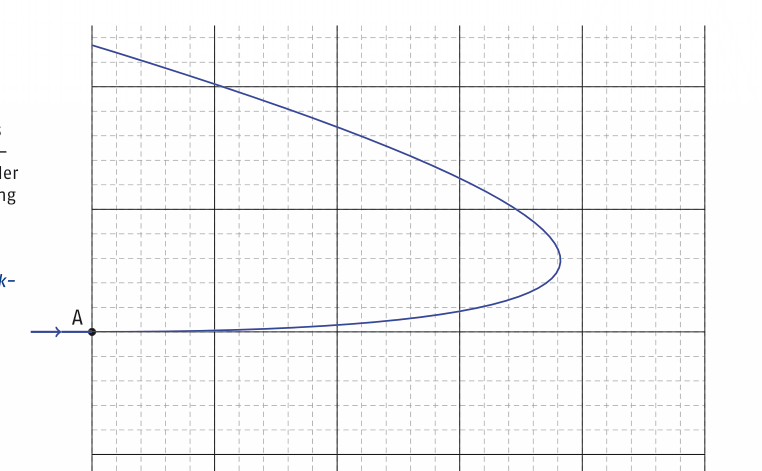
Problem 2 (10 points) Quite a tricky one A crossword puzzle entirely without Greek gods and Swiss cantons? It can be done! Solve the following crossword puzzle and find the solution word. Across: 1 model for microscopic objects with opposing halves 4 the human acoustic “organ” 5 wave phenomenon perceivable with the eyes 6 numerical value 7 capacity to store charge 8 continuously elapses at every 40 10 state of a body with a time-varying position 11 unit of electric potential differences 12 irrotational 15 half of a magnet (conventionally marked red) 18 descriptive model of reality 21 liquid or gas in motion 22 helped in the detection of time dilation 23 longitudinal pressure wave 24 abbreviation for mean sea level 25 negatively charged elementary particle 27 sensible simplification 30 fourth state of matter 32 calculation rule 33 much-discussed picture of a function 34 totality of the objects under consideration 35 particle property that is conserved overall 38 unlimited in time 39 rotational motion 40 point in space 44 indicator of specific particles 46 physical quantity that varies periodically in time and space 47 family of the smallest bird species with the highest wingbeat frequency 49 microscope that “scans” a surface with electrons 50 material that partially expels external magnetic fields 51 at constant pressure 52 Earth’s gravity 53 postulated uncertainty 55 control element of a transistor 56 elongation caused by an applied force 57 measure of spread, e.g. for measured values 58 way of verifying 18 Down: 1 diagonally opposite 2 conserved in every collision 3 measuring instrument for determining temperature 5 straight, not curved 9 displacement of charge carriers by an external electric field 11 spatial volume 13 not indivisible 14 unit of amount of substance 16 branch of mechanics that studies 10 as the cause of forces 17 obsolete unit of force 19 cannot be created or destroyed, only converted 20 SI unit named after a British physicist 26 component that conducts only when activated 28 combined method of NMR and ESR spectroscopy, also the name of the forest moon near the second Death Star 29 momentum transferred by a gas per unit time and area onto the walls of its container 31 immovable, unchanging 35 orthogonal connection, also a device 36 pole of a voltage source 37 unit for the data volume of storage media 39 mechanical effect by which kinetic energy decreases 41 microscope that “illuminates” thin samples with electrons 42 unit of measure found on beakers 43 joining by means of glue and adhesion 45 cosmic means of transport 46 specially calibrated force meter 48 model for conduction in solids, also a group of musicians 54 non-SI unit for large areas, also the chemical symbol for a noble gas Solution word The solution word has something to do with the hosts of IPhO 2016 and is formed from the cells marked with circles (row by row, from left to right). 1 2 3 4 5 6 7 8 9 10 11 12 13 14 15 16 17 18 19 20 21 22 23 24 25 26 27 28 29 30 31 32 33 34 35 36 37 38 39 40 41 42 43 44 45 46 47 48 49 50 51 52 53 54 55 56 57 58 Sign up now at www.ipho.info for the competition! Problem 4 (10 points) Deflected An electron, previously accelerated through a voltage of 100 V, enters a homogeneous electric field at point A. The path of the electron is shown in the following figure. The spacing of the dashed lines in the figure corresponds to 4.0 mm, and the motion of the electron takes place in the plane of the drawing. a) Determine the magnitude and direction of the electric field that causes the deflection of the electron. (7 pts.) b) Calculate the time the electron needs to travel along this path. (3 pts.)
Topic: Electrostatics, Newtonian Mechanics Metodi: Kinematic Equations, Energy Conservation Method, Free-Body Diagram Competenze: Physical Reasoning, Mathematical Modeling Objects: Electron Fonte: Testo (PDF) — p.2
Problema 2 (10 punti) Un’altra cosa difficile Un puzzle di parole incrociate completamente senza dei greci e cantoni svizzeri? - Si può fare! Risolvi il seguente puzzle e trova la parola soluzione. Across: 1 model for microscopic objects with opposing halves 4 the human acoustic “organ” 5 wave phenomenon perceivable with the eyes 6 numerical value 7 capacity to store charge 8 continuamente elapses at every 40 10 state of a body with a time-varying position 11 unità di differenze di potenziale elettrico 12 irrotation 15 half of a magnet (conventionally marked red) 18 descriptivo model of reality 21 liquid or gas in motion 22 helped in the detection of time dilation 23 longitudinal pressure wave 24 abbreviation for mean sea level 25 negatively charged elementary particle 27 30 fourth state of matter 32 calculation rule 33 much-discussed picture of a function 34 totality of the objects under consideration 35 particle property that is conserved overall 38 unlimited in time 39 movimento rotativo 40 punti in spazio 44 indicatore di particelle specifiche 46 quantità fisica che varia periodicamente in tempo e spazio 47 famiglia delle specie di uccelli più piccole con la più alta frequenza di wingbeat 49 microscopio che “scansa” una superficie con elettroni 50 materiale che espelle parzialmente campi magnetici esterni 51 a pressione costante 52 Gravità della Terra 53 postulato incertezza 55 control element of a transistor 56 elongation caused by an applied force 57 measure of spread, e.g. per measured values 58 way of verifying 18
- A terra: 1 diagonalmente opposto 2 conservato in every collision 3 measuring instrument for determining temperature 5 straight, not curved 9 displacement of charge carriers by an external electric field 11 spatial volume 13 not indivisible 14 unit of Quantità di sostanza 16 Branch of mechanics that studies 10 as the cause of forces 19 non può essere creato o distrutto, solo convertito 20 SI unit named after a British physicist 26 component that conducts only when activated 28 combined method of NMR and ESR spectroscopy, il nome della luna forestale vicino alla seconda stella della morte 29 di momentum trasferito da un gas per unità di tempo e area sulle pareti del suo contenitore 31 immovabile, immutabile 35 collegamento ortogonale, cioè un dispositivo 36 pole of a voltage source 37 unit for the data volume of storage media 39 meccanico effect by which kinetic energy decreases 41 microscopio che “illuminate” thin samples with electrons 42 unit of measure found on beakers 43 joining by means of glue and adhesion 45 cosmic means of transport 46 specially calibrated force meter 48 model for conduction in solids, also a group of musicians 54 non-SI unit for large areas, also the chemical symbol for a noble gas Soluzione The solution word ha qualcosa a che fare con gli ospiti di IPhO 2016 ed è formato dalle cellule segnate con cerchi (row by row, da sinistra a destra). 1 2 3 4 5 6 7 8 9 10 11 12 13 14 15 16 17 18 19 20 21 22 23 24 25 26 27 28 29 30 31 32 33 34 35 36 37 38 39 40 41 42 43 44 45 46 47 48 49 50 51 52 53 54 55 56 57 58 Iscriviti ora a www.ipho.info per il La concorrenza! Problema 4 (10 punti) Deflected Un elettrone, precedentemente accelerato attraverso una voltage di 100 V, entra in un campo elettrico omogeneo al punto A. Il percorso dell’elettrone è mostrato nella figura seguente. Lo spaziamento delle linee dashed nella figura corrisponde a 4.0 mm, e il movimento dell’elettrone si svolge nel piano del disegno. a) Determina la magnitudo e la direzione del campo elettrico che causa la deflessione dell’elettrone. (7 punti) b) Calcolare il tempo che l’elettrone deve viaggiare lungo questo percorso. (3 punti)
Topic: Electrostatics, Newtonian Mechanics Metodi: Kinematic Equations, Energy Conservation Method, Free-Body Diagram Competenze: Physical Reasoning, Mathematical Modeling Objects: Electron Fonte: Testo (PDF) — p.2
Problem 2 (10 points) Quite a tricky one A crossword puzzle entirely without Greek gods and Swiss cantons? It can be done! Solve the following crossword puzzle and find the solution word. Across the street: 1 model for microscopic objects with opposing halves 4 the human acoustic “organ” 5 wave phenomenon perceivable with the eyes 6 numerical value 7 capacity to store charge 8 continuously elapses at every 40 10 state of a body with a time-varying position 11 unit of electric potential differences 12 irrotational 15 half of a magnet (conventionally marked red) 18 descriptive model of reality 22 helped in the detection of time dilation 23 longitudinal pressure wave 24 abbreviation for mean sea level 25 negatively charged elementary particle 27 sensible simplification 30 fourth state of matter 32 calculation rule 33 much-discussed picture of a function 34 totality of the objects under consideration 35 particle property that is conserved overall 38 unlimited in time 39 rotational motion 40 points in space 44 indicator of specific particles 46 physical quantity that varies periodically in time and space 47 family of the smallest bird species with the highest wingbeat frequency 50 material that partially expels external magnetic fields 51 at constant pressure 52 Earth’s gravity 53 postulated uncertainty 55 control element of a transistor 56 elongation caused by an applied force 57 measure of spread, e.g. for measured values 58 way of verifying 18 Down: 1 diagonally opposite 2 conserved in every collision 3 measuring instrument for determining temperature 5 straight, not curved 9 displacement of charge carriers by an external electric field 11 spatial volume 13 not indivisible 14 unit of amount of substance 16 branch of mechanics that studies 10 as the cause of forces 17 obsolete unit of force 19 cannot be created or destroyed, only converted 20 SI unit named after a British physicist 26 component that conducts only when activated 28 combined method of NMR and ESR spectroscopy, also the name of the forest moon near the second Death Star 29 momentum transferred by a gas per unit time and area onto the walls of its container 31 immovable, unchanging 35 orthogonal connection, i.e. a device 36 pole of a voltage source 37 unit for the data volume of storage media 39 mechanical effect by which kinetic energy decreases 41 microscope that “illuminates” thin samples with electrons 42 unit of measure found on beakers 43 joining by means of glue and adhesion 45 cosmic means of transport 46 specially calibrated force meter 48 model for conduction in solids, also a group of musicians 54 non-SI unit for large areas, also the chemical symbol for a noble gas Solution word The solution word has something to do with the hosts of IPhO 2016 and is formed from the cells marked with circles (row by row, from left to right). 1 2 3 4 5 6 7 8 9 10 11 12 13 14 15 16 17 18 19 20 21 22 23 24 25 26 27 28 29 30 31 32 33 34 35 36 37 38 39 40 41 42 43 44 45 46 47 48 49 50 51 52 53 54 55 56 57 58 Sign up now at The Commission has also adopted a proposal for a regulation on the protection of the environment. for the Competition! Problem 4 (10 points) Deflected An electron, previously accelerated through a voltage of 100 V, enters a homogeneous electric field at point A. The path of the electron is shown in the following figure. The spacing of the dashed lines in the figure corresponds to 4.0 mm, and the motion of the electron takes place in the plane of the drawing. (a) Determine the magnitude and direction of the electric field that causes the deflection of the electron. (Page 77) (b) Calculate the time the electron needs to travel along this path. (Page 3 of this report)
Topic: Electrostatics, Newtonian Mechanics Metodi: Kinematic Equations, Energy Conservation Method, Free-Body Diagram Competenze: Physical Reasoning, Mathematical Modeling Objects: Electron Fonte: Testo (PDF) — p.2
Problem 3 (10 points) Sliding and tipping Peter claims that, using only a ruler, a full pack of salt, and a table, he can determine the coefficient of static friction between the table and the pack of salt. To prove it, he tilts the table until the pack of salt begins to slide. This happens at an inclination angle of . With this information he determines the coefficient of static friction. “I can do better,” replies Sofie, and pushes against the side of the pack, as indicated in the figure alongside. As a result it begins to slide. If, however, she pushes a little higher up against the pack, it begins to tip instead of slide. From the inclination angle measured by Peter, calculate the coefficient of static friction between the pack of salt and the table. Explain, in addition, how Sofie can determine the coefficient of static friction by her approach, and determine at what height she can push against the pack of salt so that the pack of salt just barely slides. Junior problem (10 points) Balanced A broom is repurposed for a physics experiment and is balanced on a narrow supporting edge with the help of a weight of mass 1.0 kg. When the distance between the supporting edge and the right end of the broom is 70 cm, the weight must be hung 25 cm from that end to balance the broom. If the supporting edge is now shifted 10 cm to the left, the weight must be moved 19 cm so that the broom is again in equilibrium. Determine the mass of the broom and the distance of its center of gravity from the right end. Find out how you can determine the center of gravity of a broom with a simple experiment without any aids, and explain your idea. 2016 What do you need to be able to do? Enjoyment of physics puzzles, solid mathematical knowledge, skill in experimentation, and above all the right intuition for the problems are important ingredients for a successful result. Thematically, the competition is oriented toward what is taught in school, but it can also go beyond the school curriculum. Important topic areas can be found on the IPhO website www.ipho.info. A good point of contact for questions about the competition is also the association of former participants at www.orpheus-verein.de. Good luck!
around the wide world The International Physics Olympiad – IPhO for short – is a competition for young people passionate about physics from all over the world, who once a year measure their abilities and compete for medals. States from all over the world take part - by now almost 90. The competition itself consists of two five-hour exams, one theoretical and one experimental. Alongside there is an extensive supporting program - and of course many opportunities for contacts with people from all over the world. The 47th IPhO takes place in July 2016 in Zurich, Switzerland. and in Germany Each participating country sends up to five Olympians to the IPhO, who compete individually. The German team is made up of the best from the selection competition supported by the Federal Ministry of Education and Research and the Standing Conference of the Ministers of Education. This competition consists of four rounds, about which further information can be found on the back of the problem leaflet. In addition to participation in the international competition, many attractive prizes beckon. The problems printed on this leaflet for the 1st round are solved as homework. Only individual work is permitted. The submission deadline for the worked solutions of the 1st round to the subject teachers is 07.09.2015. In individual cases, other dates may also be agreed between participants and their teachers. By 22.09., however, the work must in any case be corrected and forwarded to the regional coordinators. For qualification to the 2nd round, 30 of 40 possible points are required. Participants who in the 2015/2016 school year have not yet reached the second-to-last grade level can earn a bonus point with the junior problem.
To register Contact Secretariat Lulu Hoffmeister Tel.: 04 31 / 8 80-53 87 Fax: 04 31 / 8 80-31 48 E-mail: sekretariat@ipho.info Competition management Dr. Stefan Petersen Tel.: 04 31 / 8 80-51 20 E-mail: petersen@ipho.info IPN • Olshausenstr. 62 • D-24118 Kiel The International Physics Olympiad 2016 scienceolympiaden.de Show your talent! Who is the IPhO for? Student If you are a student, the IPhO and the German IPhO selection competition offer you many opportunities to engage intensively with physics questions, to test your own limits, and not least to get to know interesting people. In preparation for the 3rd and 4th rounds, a problem-solving training is carried out, in which you receive detailed tips on your solutions and can thus improve your problem-solving skills once more. Even if you do not make it that far, simply passing the first round is already a special achievement and a real distinction. So, take heart! Teacher As a teacher, you can offer a challenge to students who are particularly capable or interested in physics, using the problems of the selection competition, and encourage them to engage more deeply with physics topics. In this way the IPhO can serve as an instrument of individual support. In particular, the problems of the 1st round are suitable not only for the best in an Abitur class. Rather, it turns out that an early engagement with the competition problems is an important building block for later successful participation, and can also be a lot of fun along the way. So feel free to encourage your students to submit solutions to individual problems as well; for only those who do not take part can lose. School By encouraging participation in competitions, schools can sharpen their profile and use them, in the sense of enrichment, as a complement to school offerings. Competitions thereby offer diverse, differentiated learning environments for participating students. In the area of the STEM subjects, the Olympiads represent, at least in the later rounds, a competition aimed at especially motivated and high-performing young people. Nevertheless, participation in the entry rounds too is not only worthwhile but can also contribute to a lasting motivation for STEM topics. In many federal states, by the way, participation in the competition can be recognized as a special learning achievement of your students for the Abitur. Interested in more than physics? The IPhO is one of the six nationwide science competitions organized by the IPN – the ScienceOlympiaden. Alongside the selection competitions for the international Olympiads in Biology (IBO), Chemistry (IChO), and Physics (IPhO), these include the International Junior Science Olympiad (IJSO), the European Science Olympiad (EUSO), as well as the Federal Environmental Competition (BUW). Together they address students from the beginning of secondary education through the end of school years and, with their close networking, offer the possibility of lasting support for scientific abilities and interests. Further information about the Science Olympiads can be found at www.scienceolympiaden.de. 1st round When? Registration from April 2015. Submission of the solution to the subject teacher by 07.09. Receipt of the assessment and the work by the responsible regional coordinators by 22.09. Who? All who in the 2015/2016 school year attend a general-education German school and were born after 30.06.1996
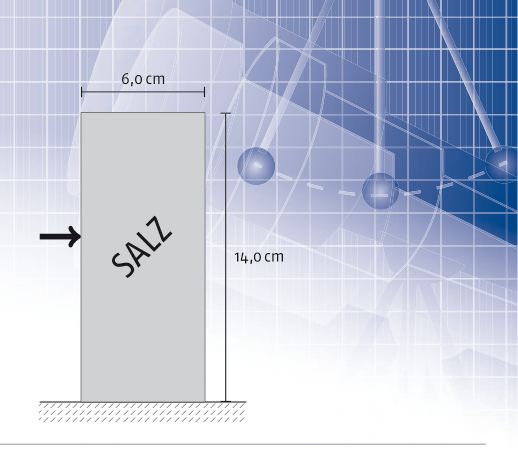 SALT box on a surface with arrow
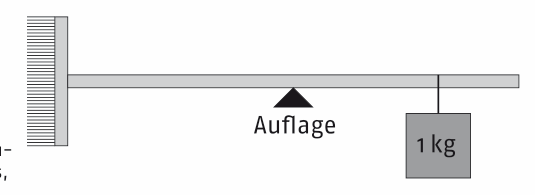 beam on a fulcrum with a 1 kg mass
Topic: Newtonian Mechanics, Rigid Body Statics Metodi: Free-Body Diagram, Torque & Angular Momentum Analysis, Conservation Laws Competenze: Physical Reasoning, Mathematical Modeling, Diagrammatic Reasoning Objects: Block, Inclined Plane, Beam, Lever Fonte: Testo (PDF) — p.3
Figure
Figure
Figure
Figure
Figure
Figure
Figure
Figure
Figure
Figure
Figure
Figure
Quesito 4 — electron trajectory on a grid, point A
Problema 3 (10 punti) Sliding and tipping Peter sostiene che, utilizzando solo un regolare, un pacchetto completo di sale e una tavola, può determinare il coefficiente di attrito statico tra la tavola e il pacchetto di sale. Per provarlo, tende il tavolo fino a quando il pacchetto di sale inizia a scivolare. Questo accade ad un angolo di inclination di . Con queste informazioni determina il coefficiente di attrito statico. “Io posso fare meglio”, risponde Sofie, e spinge contro il lato del branco, come indicato nella figura accanto. Come risultato, inizia a slide. Se, tuttavia, lei spinge un po ‘più in alto contro il branco, inizia a puntare invece di scivolare. Dal punto di vista dell’inclinazione misurato da Peter, calcolare il coefficiente di attrito statico tra il pacchetto di sale e il tavolo. Spiegare, inoltre, come Sofie può determinare il coefficiente di attrito statico per il suo approccio, e determinare a che altezza può spingere contro il pacchetto di sale in modo che il pacchetto di sale solo a malapena scorre. Problema minore (10 punti) Balanciato Un broom è repurposed for a physics experiment and is balanced on a narrow supporting edge with the help of a weight of mass 1.0 kg. Quando la distanza tra il bordo di supporto e la parte destra della scopa è di 70 cm, il peso deve essere appeso a 25 cm da quella parte per bilanciare la scopa. Se il bordo di supporto è stato spostato 10 cm a sinistra, il peso deve essere spostato 19 cm in modo che la scopa sia di nuovo in equilibrio. Determina la massa del broom e la distanza del suo centro di gravità dalla fine destra. Scopri come puoi determinare il centro di gravità di un broom con un semplice esperimento senza alcun aiuto, e spiega la tua idea. 2016 Cosa devi essere in grado di fare? Il divertimento di puzzle di fisica, solide conoscenze matematiche, abilità nell’esperimentare, e soprattutto la giusta intuzione per i problemi sono ingredienti importanti per un risultato di successo. Tematicamente, la competizione è orientata verso ciò che viene insegnato a scuola, ma può anche andare oltre il curriculum scolastico. Le aree di tema importanti possono essere trovate sul sito IPhO www.ipho.info. Un buon punto di contatto per domande sulla competizione è anche l’associazione di ex partecipanti a www.orpheus-verein.de.
- Buona fortuna!
around the wide world L’International Physics Olympiad IPhO for short è una competizione per giovani appassionati di fisica da tutto il mondo, che una volta all’anno misurano le loro abilità e competono per medaglie. Stati di tutto il mondo partecipano - ormai quasi 90. Il concorso consiste di due esami di cinque ore, uno teorico e uno sperimentale. C’è un ampio programma di supporto - e naturalmente molte opportunità di contatti con persone da tutto il mondo. Il 47° IPhO si svolgerà a luglio 2016 a Zurigo, in Svizzera. e in Germania Ogni paese partecipante invia fino a cinque olimpici all’IPhO, che competono individualmente. Il team tedesco è composto dal best from the selection competition sostenuto dal Ministero federale dell’istruzione e della ricerca e dalla Conferenza permanente dei ministri dell’istruzione. Questa competizione è composta da quattro round, su cui ulteriori informazioni possono essere trovate sul back of the problem leaflet. In aggiunta alla partecipazione alla competizione internazionale, molti premi attraenti sono stati ottenuti. I problemi stampati su questo foglio per il primo round sono risolti come compiti. Solo lavoro individuale è consentito. Il termine di presentazione per le soluzioni lavorate del primo round ai docenti è il 07.09.2015. In singoli casi, altri appuntamenti possono essere concordati tra i partecipanti e i loro insegnanti. Tuttavia, entro il 22 settembre, il lavoro deve essere corretto e trasmesso ai coordinatori regionali. Per qualificarsi al secondo round, sono necessari 30 punti su 40 possibili. I partecipanti che nell’anno scolastico 2015/2016 non hanno ancora raggiunto il livello second-to-last possono guadagnare un bonus point con il problema junior.
Per il registro Contatto Segretariato Lulu Hoffmeister Tel.: 04 31 / 8 80-53 87 Fax: 04 31 / 8 80-31 48 E-mail: segretariat@ipho.info Gestione della concorrenza Dr. Stefan Petersen Tel.: 04 31 / 8 80-51 20 E-mail: petersen@ipho.info IPN • Olshausenstr. 62 • D-24118 Kiel L’Olimpiade Internazionale di Fisica 2016 sciencesolymppiaden.de Mostra il tuo talento! Chi è l’IPhO per? Studente Se sei uno studente, l’IPhO e il concorso di selezione tedesco dell’IPhO ti offrono molte opportunità per impegnarti intensamente con le domande di fisica, per testare i tuoi limiti, e non ultimo per conoscere persone interessanti. In preparazione per i 3 e 4 round, si svolge un training di problem solving, in cui ricevi dettagliati suggerimenti sulle tue soluzioni e puoi quindi migliorare le tue capacità di problem solving ancora una volta. Anche se non si arriva fino a quel punto, semplicemente passare il primo round è già un risultato speciale e una vera distinzione. Allora, prendi il cuore! Docente Come insegnante, puoi offrire una sfida agli studenti che sono particolarmente capaci o interessati alla fisica, utilizzando i problemi della competizione di selezione, e incoraggiarli a impegnarsi più profondamente con i temi della fisica. In questo modo l’IPhO può servire come strumento di sostegno individuale. In particolare, i problemi del primo round sono adatti non solo per il meglio in una classe di abitur. Piuttosto, si scopre che un coinvolgimento precoce con i problemi della concorrenza è un importante blocco di costruzione per la partecipazione successiva, e può anche essere molto divertente lungo il percorso. Quindi sentitevi liberi di incoraggiare i vostri studenti a presentare soluzioni anche ai problemi individuali; solo coloro che non partecipano possono perdere. Scuola Incoraggiando la partecipazione a competizioni, le scuole possono accentuare il loro profilo e usarli, nel senso di arricchimento, come complemento alle offerte scolastiche. Le competizioni offrono così ambienti di apprendimento diversificati e differenziati per gli studenti partecipanti. Nel settore delle materie STEM, le Olimpiadi rappresentano, almeno nei prossimi round, una competizione rivolta a giovani particolarmente motivati e ad alto rendimento. Tuttavia, partecipare ai round di entrata non solo vale la pena, ma può anche contribuire a una motivazione duratura per i temi STEM. In molti stati federali, comunque, la partecipazione al concorso può essere riconosciuta come un particolare successo di apprendimento dei vostri studenti per l’abitur. Interessato in più della fisica? L’IPhO è uno dei sei concorsi scientifici nazionali organizzati dall’IPN the ScienceOlympics. Oltre alle competizioni di selezione per le Olimpiadi internazionali in Biologia (IBO), Chimica (IChO), e Fisica (IPhO), queste includono l’International Junior Science Olympiad (IJSO), l’European Science Olympiad (EUSO), nonché la Federal Environmental Competition (BUW). Insieme si rivolge agli studenti dall’inizio dell’istruzione secondaria fino alla fine degli anni scolastici e, con la loro stretta rete, offre la possibilità di supporto duraturo alle capacità e agli interessi scientifici. Ulteriori informazioni sulle Olimpiadi di Scienza sono disponibili su www.scienceolympiaden.de. 1° round Quando? Registrazione dall’aprile 2015. Submission of the solution to the subject teacher by 07.09. Receipt of the assessment and the work by the responsible regional coordinators by 22.09.
- Chi? Tutti coloro che nell’anno scolastico 2015/2016 frequentano una scuola tedesca di istruzione generale e sono nati dopo il 30.06.1996
SALT box on a surface with arrow
beam on a fulcrum with a 1 kg mass
Topic: Newtonian Mechanics, Rigid Body Statics Metodi: Free-Body Diagram, Torque & Angular Momentum Analysis, Conservation Laws Competenze: Physical Reasoning, Mathematical Modeling, Diagrammatic Reasoning Objects: Block, Inclined Plane, Beam, Lever Fonte: Testo (PDF) — p.3
# Figura
# Figura
# Figura
# Figura
# Figura
# Figura
# Figura
# Figura
# Figura
# Figura
# Figura
# Figura
Quesito 4 trajectory of electron on a grid, point A
Problem 3 (10 points) Sliding and tipping Peter claims that, using only a ruler, a full pack of salt, and a table, he can determine the coefficient of static friction between the table and the pack of salt. To prove it, he tilts the table until the pack of salt starts to slide. This happens at an inclination angle of . With this information he determines the coefficient of static friction. “I can do better”, replies Sofie, and pushes against the side of the pack, as indicated in the figure next to it. As a result, it starts to slide. If, however, she pushes a little higher up against the pack, it begins to tip instead of slide. From the inclination angle measured by Peter, calculate the coefficient of static friction between the pack of salt and the table. Explain, in addition, how Sofie can determine the coefficient of static friction by her approach, and determine at what height she can push against the pack of salt so that the pack of salt just barely slides. The first is the ‘Junior Problem’ (10 points). Balanced A broom is repurposed for a physics experiment and is balanced on a narrow supporting edge with the help of a weight of 1.0 kg. When the distance between the supporting edge and the right end of the broom is 70 cm, the weight must be hung 25 cm from that end to balance the broom. If the supporting edge is now shifted 10 cm to the left, the weight must be moved 19 cm so that the broom is again in balance. Determine the mass of the broom and the distance of its center of gravity from the right end. Find out how you can determine the center of gravity of a broom with a simple experiment without any aids, and explain your idea. 2016 What do you need to be able to do? Enjoyment of physics puzzles, solid mathematical knowledge, skill in experimentation, and above all the right intuition for the problems are important ingredients for a successful result. Thematically, the competition is oriented towards what is taught in school, but it can also go beyond the school curriculum. Important topic areas can be found on the IPhO website www.ipho.info. A good point of contact for questions about the competition is also the association of former participants at www.orpheus-verein.de. Good luck with that!
around the wide world The International Physics Olympiad IPhO for short is a competition for young people passionate about physics from all over the world, who once a year measure their abilities and compete for medals. States from all over the world take part - by now almost 90. The competition itself consists of two five-hour exams, one theoretical and one experimental. Alongside there is an extensive supporting program - and of course many opportunities for contacts with people from all over the world. The 47th IPhO takes place in July 2016 in Zurich, Switzerland. and in Germany Each participating country sends up to five Olympians to the IPhO, who compete individually. The German team is made up of the best from the selection competition supported by the Federal Ministry of Education and Research and the Standing Conference of the Ministers of Education. This competition consists of four rounds, about which further information can be found on the back of the problem leaflet. In addition to participation in the international competition, many attractive prizes are awarded. The problems printed on this leaflet for the first round are solved as homework. Only individual work is permitted. The submission deadline for the worked solutions of the 1st round to the subject teachers is 07.09.2015. In individual cases, other dates may also be agreed between participants and their teachers. However, by 22.09. the work must in any case be corrected and forwarded to the regional coordinators. For qualification to the second round, 30 of 40 possible points are required. Participants who in the 2015/2016 school year have not yet reached the second-to-last grade level can earn a bonus point with the junior problem.
To register Contact Secretariat Lulu Hoffmeister Telephone number: 04 31 / 8 80-53 87 Fax: 04 31 / 8 80-31 48 The Commission has also adopted a number of measures to improve the quality of life of the European Union. Competition management Dr. The Commission shall adopt implementing acts in accordance with Article 21 of this Regulation. Telephone number: 04 31 / 8 80-51 20 The Commission has also adopted a number of proposals for the implementation of the programme. The Commission has also adopted a number of proposals for the implementation of the programme. The Commission has also adopted a number of proposals. The International Physics Olympiad is held in 2016 The European Commission has decided to extend the period of validity of the decision. Show your talent! Who is the IPhO for? Student If you are a student, the IPhO and the German IPhO selection competition offer you many opportunities to engage intensively with physics questions, to test your own limits, and not least to get to know interesting people. In preparation for the 3rd and 4th rounds, a problem-solving training is carried out, in which you receive detailed tips on your solutions and can thus improve your problem-solving skills once again. Even if you don’t make it that far, simply passing the first round is already a special achievement and a real distinction. So, take heart! Teacher As a teacher, you can offer a challenge to students who are particularly capable or interested in physics, using the problems of the selection competition, and encourage them to engage more deeply with physics topics. In this way the IPhO can serve as an instrument of individual support. In particular, the problems of the 1st round are suitable not only for the best in an Abitur class. Rather, it turns out that early engagement with the competition problems is an important building block for later successful participation, and can also be a lot of fun along the way. So feel free to encourage your students to submit solutions to individual problems as well; for only those who do not take part can lose. School By encouraging participation in competitions, schools can sharpen their profile and use them, in the sense of enrichment, as a complement to school offerings. Competitions thus offer diverse, differentiated learning environments for participating students. In the area of STEM subjects, the Olympiads represent, at least in the later rounds, a competition aimed at especially motivated and high-performing young people. Nevertheless, participation in the entry rounds is not only worthwhile but can also contribute to a lasting motivation for STEM topics. In many federal states, by the way, participation in the competition can be recognized as a special learning achievement of your students for the Abitur. Interested in more than physics? The IPhO is one of the six national science competitions organised by the IPN the ScienceOlympics. Alongside the selection competitions for the international Olympiads in Biology (IBO), Chemistry (IChO), and Physics (IPhO), these include the International Junior Science Olympiad (IJSO), the European Science Olympiad (EUSO), as well as the Federal Environmental Competition (BUW). Together they address students from the beginning of secondary education through the end of school years and, with their close networking, offer the possibility of lasting support for scientific skills and interests. Further information about the Science Olympiads can be found at www.scienceolympiaden.de. 1st round When? Registration from April 2015. Submission of the solution to the subject teacher by 07.09. Receipt of the assessment and the work by the responsible regional coordinators by 22.09. Who? All who in the 2015/2016 school year attend a general education German school and were born after 30.06.1996
SALT box on a surface with arrow
*beam on a fulcrum with a mass of 1 kg *
Topic: Newtonian Mechanics, Rigid Body Statics Metodi: Free-Body Diagram, Torque & Angular Momentum Analysis, Conservation Laws Competenze: Physical Reasoning, Mathematical Modeling, Diagrammatic Reasoning Objects: Block, Inclined Plane, Beam, Lever Fonte: Testo (PDF) — p.3
# Figure
# Figure
# Figure
# Figure
# Figure
# Figure
# Figure
# Figure
# Figure
# Figure
# Figure
# Figure
The following is the list of the most commonly used methods for calculating the value of the electron: