Problem 1 White Dwarfs (6+9+7+8 pts.) 1.1 The discovery of Sirius B The star Sirius A, located about 8.6 light-years from Earth, has, with a mass of about , a luminosity about 25 times as great as the Sun’s. The star therefore emits about 25 times the radiant power of the Sun, whose radiant power is . Because of its relatively small distance from the solar system, Sirius A, with an apparent magnitude1 of mag, is the brightest star in the night sky and therefore has long been the subject of astronomical investigations. Around the middle of the 19th century, a companion of this star was inferred from irregularities in the motion of Sirius. In the following decades it was confirmed that Sirius is a binary star system. The second star, Sirius B, has about half the mass of Sirius A and a surface temperature of approximately . This caused a great stir, since the star, with an apparent magnitude of 8.44 mag, shines much more faintly than one would have expected based on these data. Sirius B therefore had to be very small and very dense. Figure 1: Sirius A and Sirius B photographed by the Hubble Space Telescope (NASA, ESA, H. Bond (STScI), and M. Barstow (U. of Leicester), lic. CC BY 3.0). The English astronomer Arthur Stanley Eddington summarised this as follows: We learn about the stars by receiving and interpreting the messages which their light brings to us. The message of the Companion of Sirius when it was decoded ran: “I am composed of material 3,000 times denser than anything you have ever come across; a ton of my material would be a little nugget that you could put in a matchbox.” What reply can one make to such a message? The reply which most of us made in 1914 was “Shut up. Don’t talk nonsense.” (Eddington, A.S. (1927). Stars and Atoms. Clarendon Press, p.50.) 1.a) Using the information given in the text, estimate the luminosity of the companion star Sirius B and its radius. Note that, owing to the higher surface temperature, the spectrum of Sirius B is shifted relative to that of Sirius A and, as a consequence, the luminosity determined from the apparent magnitude is too low by about a factor of 10. (4 pts.) 1.b) Using this, calculate roughly how much a cubic centimetre of matter of Sirius B weighs on average and how large the gravitational acceleration at its surface approximately is. (2 pts.) The results of the above problems show that Sirius B must be a very special star. Indeed, it belongs to a class of stars called white dwarfs. White dwarfs are very compact remnants of stars in which the fusion processes have already ceased. But what prevents these stars from collapsing further in on themselves? This question you are to address in the following problems. 1The apparent magnitude m of an object is a measure of how bright it appears to an observer on Earth. It is defined via the radiant power arriving on Earth per unit area from the object within a certain wavelength range. For the apparent magnitude one has , where is a fixed reference value for the radiant power in the considered wavelength range. The apparent magnitude is given as a number and carries the suffix mag for “magnitude”.
1.2 Phase-space consideration and degenerate Fermi gas In classical mechanics, the state of a point particle is described by its position and its velocity . Alternatively, instead of the velocity, the momentum of the particle can also be used. The position and momentum of the particle can be regarded as coordinates in the so-called phase space. Every possible state of the particle corresponds to a position in phase space. Since there are three dimensions each for position and momentum, the phase space in this case has six dimensions. The Heisenberg uncertainty relation of quantum mechanics now states that the position and momentum of a particle cannot be determined simultaneously with arbitrary precision. For the uncertainties and in an arbitrary spatial direction , Heisenberg’s formulation gives Here J s denotes the Planck constant. Thus a particle state corresponds less to a point in phase space than to a volume of size . For so-called fermions2, which include electrons as well as protons and neutrons, the Pauli principle additionally holds, according to which two particles of the same kind cannot exist simultaneously in the same state. Therefore the phase-space volumes just described do not overlap for these particles. Owing to the two possible spin orientations of fermions, however, each phase-space volume element can accommodate two particles. Consider a gas of one kind of fermionic particles of mass m. Let the gas be distributed over a spherical volume of radius R and have a particle density n. Assume that the number of particles is very large. In the ground state, i.e. at the zero point of temperature, the fermions occupy a state of the lowest possible energy and thus also have the lowest possible momentum. Owing to the above considerations, however, the particles cannot all have a very small momentum and thus a low kinetic energy. 1.c) Using the above considerations, determine the maximum momentum magnitude of a particle in the Fermi gas at the zero point of temperature. Take into account only the described quantum-mechanical effects and neglect all other interactions. Show that the corresponding kinetic energy , the so-called Fermi energy, of a particle is given by (3 pts.) If the thermal energy of the particles is significantly smaller than the Fermi energy, the latter also determines the behaviour of a Fermi gas above the zero point of temperature. The gas can then be treated approximately as if it were at the zero point of temperature. In this case one speaks of a degenerate Fermi gas. 1.d) Determine the total kinetic energy of the degenerate Fermi gas as a function of the particle mass, the radius and the particle density. (3 pts.) If the radius of the gas volume is reduced, its kinetic energy increases according to the above consideration. Work must therefore be done against a pressure in order to compress the gas volume. This pressure is called degeneracy pressure. 2The complete description of a Fermi gas actually takes place within the framework of quantum statistics. The presented semiclassical treatment, however, reproduces the dependencies that arise correctly.
1.e) Determine the outward-directed force of the non-relativistic Fermi gas resulting from the degeneracy pressure. Compare the magnitude of this force for an electron gas and a proton gas. Use this to justify why the degeneracy pressure in a star is brought about almost exclusively by the electrons. (3 pts.) 1.3 Stellar evolution But now back to the stars: In a star like our Sun, the radiation pressure produced by the fusion processes in the interior counteracts the contraction of the star due to gravity. 1.f) Derive an expression for the potential energy that a star of radius , constant density and mass possesses due to its gravitational field. (3 pts.) When the fusion processes cease, the star cools down and contracts. Once the star has cooled sufficiently, the radiation pressure no longer plays a dominant role and the fermion gases in the star become fully degenerate. Assume that the extinguished star consists entirely of helium, i.e.
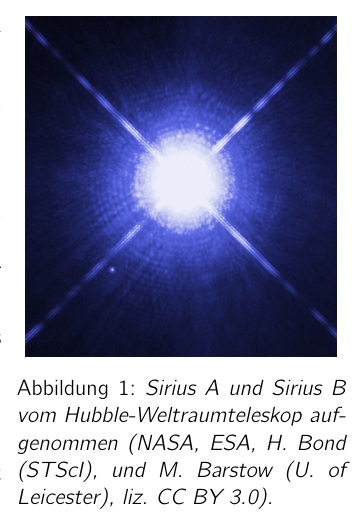 Sirius A and B from the Hubble telescope
Topic: Astrophysics, Modern-Quantum Physics, Gravitation Metodi: Newton’s Law of Gravitation, Calculus-Integration, Physical Modeling Competenze: Mathematical Modeling, Physical Reasoning, Estimation & Approximation Objects: Star, Gas, Electron Fonte: Testo (PDF) — p.3
Problema 1 Noni bianchi (cfr. punto 6+9+7+8) 1.1 La scoperta di Sirius B La stella Sirius A, situata a circa 8,6 anni luce dalla Terra, ha, con una massa di circa , una luminosità di circa 25 volte Grande come il Sole. La stella emette quindi circa 25 volte la potenza radiante del Sole, la cui potenza radiante è . A causa della sua relativamente piccola distance from the solar system, Sirius A, with an apparent magnitude1 of mag, is the brightest star in the night sky E quindi è stato oggetto di ricerche astronomiche per molto tempo. Intorno al mezzo del 19 ° secolo, un compagno di questa stella che inferito da
- Non è vero. Nei decenni successivi è stato confermato che Sirius è un sistema stellare binario. La seconda stella, Sirius B, ha circa la massa di Sirius A e una temperatura di superficie di circa . Questo ha causato un grande tumulto, dal la stella, con una magnitudo apparente di 8,44 mag, splende molto di più “Svelto di quanto si aspettasse”. basandosi su questi dati. Sirius B doveva quindi essere molto piccolo e molto denso. Figura 1: Sirius A e Sirius B Foto del telescopio spaziale Hubble (NASA, ESA, H. Bond (STScI), e M. Barstow (U. of Leicester, lic. CC BY 3.0). L’astronomo inglese Arthur Stanley Eddington ha riassunto questo come segue: Impareremo sulle stelle ricevendone e interpretando i messaggi che la loro luce porta to us. Il messaggio del compagno di Sirius quando è stato decodificato ran: materiale 3.000 volte più denso di qualsiasi cosa tu abbia mai incontrato; un tonnellata di mio materiale sarebbe un piccolo nugget che potresti mettere in una scatola di match. What reply can one make
- Un messaggio simile? La risposta che la maggior parte di noi ha fatto nel 1914 è stata “Shut up”. Non parlare
- Non è una cosa. (Eddington, A.S. (1927). Star and Atoms. La Commissione ha adottato una decisione che prevede che il regime di pesca sia stato applicato. 1.a) Usando le informazioni fornite nel testo, stimare la luminosità della stella compagnia Sirius B e il suo raggio. Si noti che, a causa del più alto La temperatura di superficie, lo spettro di Sirius B è spostato rispetto a quello di Sirius A e, come conseguenza, la luminosità determinata dal La magnitudo apparente è troppo bassa per circa un fattore di 10. - 4 punti 1.b) Con questo calcolo, calcola approssimativamente quanto pesa un centimetro cubo di materia di Sirio B in media e quanto grande è l’accelerazione gravitazionale alla sua superficie circa. - 2 punti I risultati dei problemi sopra indicano che Sirius B deve essere una stella molto speciale. In effetti, appartiene a una classe di stelle chiamate nane bianche. Bianco Le stelle sono molto compatte, in cui i processi di fusione hanno già
- Non lo so. Ma cosa impedisce a queste stelle di collassare ulteriormente su se stesse? Questa domanda le seguenti problematiche. 1La magnitudo apparente m di un oggetto è una misura di quanto brillante appare ad un osservatore sulla Terra. It è definito attraverso la potenza radiante che arriva sulla Terra per unità di area dall’oggetto all’interno di un certo intervallo di lunghezza d’onda. Per la magnitudo apparente uno ha , dove è un valore di riferimento fisso per la potenza radiante nella gamma di lunghezza d’onda considerata. La magnitudine apparente è data come un numero e porta il suffisso mag per “magnitude”.
1.2 Considerare lo spazio di fase e degenerare il gas Fermi In meccanica classica, lo stato di una particella di punto è descritto dalla sua posizione e dal suo velocità . Alternatively, instead of the velocity, the momentum of the particle can also be used. La posizione e il momento della particella possono essere considerati come coordinate nel cosiddetto
- Stazione spaziale. Ogni possibile stato della particella corrisponde a una posizione nello spazio di fase. Poiché ci sono tre dimensioni ciascuna per posizione e impulso, lo spazio di fase in Questo caso ha sei dimensioni. The Heisenberg uncertainty relation of quantum mechanics now afferma che la posizione e il momento di un la particella non può essere determinata simultaneamente con precisione arbitraria. Per le incertezze e in an arbitrary spatial direction , Heisenberg’s formulation gives Qui J’s denota la costante di Planck. Così un stato di particella corrisponde meno a un punto in fase space che a un volume di dimensioni . Per i cosiddetti fermioni2, che includono elettroni, così come protoni e neutroni, il principio di Pauli è inoltre Holds, secondo il quale due particelle dello stesso genere non possono esistere contemporaneamente nello stesso stato. Pertanto i volumi di fase-spazio appena descritti non si sovrappongono per queste particelle. A causa dei due possibili orientamenti di spin dei fermioni, tuttavia, ogni elemento di volume di fase-spazio può ospitare due particelle. Considerate un gas di un tipo di particelle fermioniche di massa m. Lasciate che il gas sia distribuito su un volume sferico di raggio R e abbiate una densità di particelle n. Supponiamo che il numero di particelle è molto grande. In stato di base, cioè A zero temperature, i fermioni occupano un La velocità di attuazione è la massima. Tuttavia, a causa delle considerazioni di cui sopra, le particelle non possono avere un picco di impulso e Quindi, ha una bassa energia cinetica. 1.c) Using the above considerations, determine the maximum momentum magnitude of a particle nel gas di Fermi al punto zero di temperatura. Prendendo in considerazione solo gli effetti quantomeccanici descritti e trascurando tutte le altre interazioni. Mostrare che la corrispondente energia cinetica , la cosiddetta energia di Fermi, di una particella è data per (punto 3) Se l’energia termica delle particelle è significativamente inferiore all’energia di Fermi, quest’ultima determina anche il comportamento di un gas di Fermi sopra il punto zero di temperatura. Il gas può quindi essere trattato come se fosse al punto zero di temperatura. In questo caso si parla di
- Un gas Fermi degenerato. 1.d) Determinare l’energia cinetica totale del gas Fermi degenerato a funzione della massa, del raggio e della densità delle particelle. (3 punti) Se il raggio del volume del gas è ridotto, la sua energia cinetica aumenta secondo la considerazione sopra. Il lavoro deve quindi essere fatto contro una pressione per comprimere il volume del gas. Questa pressione è chiamata pressione degenerativa. 2La descrizione completa di un gas di Fermi effettivamente si svolge all’interno del quadro delle statistiche quantistiche. Il presentato Il trattamento semiclassico, tuttavia, riproduce le dipendenze che si presentano correttamente.
1.e) Determina la forza esterna del gas Fermi non relativistico risultante dalla pressione di degenerazione. Confrontare la magnitudine di questa forza per un gas elettronico e un gas protonico. Usare questo per giustificare perché la pressione degenerazione in una stella è portato circa quasi esclusivamente
- Gli elettroni. (3 punti) 1.3 Evoluzione stellare Ma ora torniamo alle stelle: in una stella come il nostro Sole, la pressione radiativa prodotta dai processi di fusione in the interior contraddice la contrazione della stella a causa della gravità. 1.f) Derivo di espressione per la potenziale energia che una stella di radius , costante density and mass possede a causa del suo campo gravitazionale. (3 punti) Quando i processi di fusione cessano, la stella si raffredda e si contrae. Una volta La stella si è raffreddata sufficientemente, la pressione delle radiazioni non svolge più un ruolo dominante e la temperatura del pianeta è aumentata. I gas fermionici nella stella sono completamente degenerati. Supponiamo che la stella estinuta sia composta interamente da I prodotti di cui all’allegato I sono stati modificati per la prima volta.
Sirius A and B from the Hubble telescope
Topic: Astrophysics, Modern-Quantum Physics, Gravitation Metodi: Newton’s Law of Gravitation, Calculus-Integration, Physical Modeling Competenze: Mathematical Modeling, Physical Reasoning, Estimation & Approximation Objects: Star, Gas, Electron Fonte: Testo (PDF) — p.3
Problem 1 White Dwarfs The following points shall be added: 1.1 The discovery of Sirius B The star Sirius A, located about 8.6 light-years from Earth, has, with a mass of about , a luminosity of about 25 times as great as the Sun’s. The star therefore emits about 25 times the radiant power of the Sun, whose radiant power is . Because of its relatively small distance from the solar system, Sirius A, with an apparent magnitude of mag, is the brightest star in the night sky And therefore has long been the subject of astronomical investigations. Around the middle of the 19th century, a companion of this star what inferred from Irregularities in the motion of Sirius. In the following decades it was confirmed that Sirius is a binary star system. The second star, Sirius B, has about half the mass of Sirius A and a surface temperature of approximately . This caused a great stir, since The star, with an apparent magnitude of 8.44 mag, shines much more Weakly than one would have expected based on these data. Sirius B therefore had to be very small and very dense. Figure 1: Sirius A and Sirius B The first of these is the Hubble Space Telescope (NASA, ESA, H. Bond (STScI), and M. The Commission has also adopted a proposal for a regulation on the of The Commission has not yet adopted a proposal. CC BY 3.0). The English astronomer Arthur Stanley Eddington summarized this as follows: We learn about the stars by receiving and interpreting the messages that their light brings. to us. The message of the Companion of Sirius when it was decoded ran: material 3,000 times denser than anything you’ve ever come across; a ton of my material would be a little nugget that you could put in a matchbox. What answer can one make to such a message? The answer most of us made in 1914 was shut up. Don ‘t talk It ‘s nonsense . (Eddington, A.S. (1927). Stars and Atoms. The Commission has also adopted a number of amendments to the Directive. 1.a) Using the information given in the text, estimate the luminosity of the companion star Sirius B and its radius. Note that, due to the higher surface temperature, the spectrum of Sirius B is shifted relative to that of Sirius A and, as a consequence, the luminosity determined from the Apparent magnitude is too low by about a factor of 10. The Commission has also adopted a proposal for a directive on the protection of workers’ rights. 1.b) Using this, calculate roughly how much a cubic centimeter of matter of Sirius B weighs on average and How large is the gravitational acceleration at its surface approximately. (c) the number of persons who are not members of the The results of the above problems show that Sirius B must be a very special star. Indeed, it belongs to a class of stars called white dwarfs. White dwarfs are very compact remnants of stars in which the fusion processes have already I’m not going to. But what prevents these stars from collapsing further into themselves? This question you are to address in the following problems. 1The apparent magnitude m of an object is a measure of how bright it appears to an observer on Earth. It is defined via the radiant power arriving on Earth per unit area from the object within a certain wavelength range. For the apparent magnitude one has , where is a fixed reference value for the radiant power in the considered wavelength range. The apparent magnitude is given as a number and carries the suffix mag for “magnitude”.
1.2 Phase-space consideration and degenerate Fermi gas In classical mechanics, the state of a point particle is described by its position and its velocity . Alternatively, instead of the velocity, the momentum of the particle can also be used. The position and momentum of the particle can be considered as coordinates in the so-called phase space. Every possible state of the particle corresponds to a position in phase space. Since there are three dimensions each for position and momentum, the phase space in This case has six dimensions. The Heisenberg uncertainty relation of quantum mechanics now states that the position and momentum of a Particle cannot be determined simultaneously with arbitrary precision. For the uncertainties and in an arbitrary spatial direction , Heisenberg’s formulation gives Here J s denotes the Planck constant. Thus a particle state corresponds less to a point in phase space than to a volume of size . For so-called fermions2, which include electrons as well as protons and neutrons, the Pauli principle additionally holds, according to which two particles of the same kind cannot exist simultaneously in the same state. Therefore the phase-space volumes just described do not overlap for these particles. Due to the two possible spin orientations of fermions, however, each phase-space volume element can accommodate two particles. Consider a gas of one kind of fermionic particles of mass m. Let the gas be distributed over a spherical volume of radius R and have a particle density n. Assume that the number of particles is very large. In the ground state, i.e. At the zero point of temperature, the fermions occupy a The current energy level is the lowest possible energy and therefore also have the lowest possible momentum. However, due to the above considerations, the particles cannot all have a very small momentum and So it’s a low kinetic energy. 1.c) Using the above considerations, determine the maximum momentum magnitude of a particle In the Fermi gas at the zero point of temperature. Take into account only the described quantum-mechanical effects and neglect all other interactions. Show that the corresponding kinetic energy , the so-called Fermi energy, of a particle is given by (3 pts.) If the thermal energy of the particles is significantly smaller than the Fermi energy, the latter also determines the The behavior of a Fermi gas above the zero point of temperature. The gas can then be treated approximately as if it were at the zero point of temperature. In this case one speaks of A degenerate Fermi gas.
-
(d) Determine the total kinetic energy of the degenerate Fermi gas as a function of the particle mass, the radius and the particle density. (Page 3 of this report) If the radius of the gas volume is reduced, its kinetic energy increases according to the above consideration. Work must therefore be done against a pressure in order to compress the gas volume. This pressure is called degeneration pressure. 2The complete description of a Fermi gas actually takes place within the framework of quantum statistics. The presented The semiclassical treatment, however, reproduces the dependencies that arise correctly.
-
(e) Determine the outward-directed force of the non-relativistic Fermi gas resulting from the degeneration pressure. Compare the magnitude of this force for an electron gas and a proton gas. Use this to justify why the degeneration pressure in a star is brought about almost exclusively by the electrons. (Page 3 of this report) 1.3 Stellar evolution But now back to the stars: In a star like our Sun, the radiation pressure produced by the fusion processes In the interior counters the contraction of the star due to gravity. 1.f) Derive an expression for the potential energy that a star of radius , constant density and mass possesses due to its gravitational field. (Page 3 of this report) When the fusion processes cease, the star cools down and contracts. Once The star has cooled sufficiently, the radiation pressure no longer plays a dominant role and the Fermion gases in the star become fully degenerate. Assume that the extinguished star consists entirely of Helium, i.e.
Sirius A and B from the Hubble telescope
Topic: Astrophysics, Modern-Quantum Physics, Gravitation Metodi: Newton’s Law of Gravitation, Calculus-Integration, Physical Modeling Competenze: Mathematical Modeling, Physical Reasoning, Estimation & Approximation Objects: Star, Gas, Electron Fonte: Testo (PDF) — p.3
Problem 2 Diode Physics (14+5+11 pts.) (Semiconductor) diodes are electrical components that find a wide variety of uses in everyday life. They are characterised by the fact that they conduct current very well in one direction, the so-called forward direction, above a certain applied voltage, and act as very good insulators in the other direction, the reverse direction. Because of this they can be used, for example, for rectifying current. Light-emitting diodes – LEDs for short – can convert electric current directly into light. Because of their high efficiency and robustness, they have become ever more popular as light sources in recent years. The band gap of the semiconductor material used determines the wavelength and thus the colour of the light emitted by an LED. The following problems deal with some aspects of light-emitting diodes. 2.1 LED in a circuit The adjacent Figure 2 shows the current- voltage characteristic of an LED in the forward direction. 2.a) From the characteristic, roughly estimate the dominant wavelength of the light emitted by the LED and state what colour the light has. (3 pts.) The LED is installed in the circuit shown in Figure 3. Besides the LED, the circuit contains a switch, a voltage source supplying a voltage , a resistor with resistance and a capacitor of capacitance . The switch is initially open and the capacitor is uncharged. 2.b) Using the characteristic, determine the magnitude of the current flowing through the LED immediately after closing the switch, and the voltage dropping across the LED. (5 pts.) The nonlinear shape of the diode characteristic makes a more detailed analysis of the circuit’s behaviour difficult. Approximately, however, one can capture the electrical behaviour of the LED by an equivalent circuit in which a voltage source and an ohmic resistor are connected in series with an ideal diode that is fully insulating in the reverse direction and perfectly conducting in the forward direction. 0,5 1,0 1,5 2,0 2,5 3,0 10 20 30 40 / V / mA Figure 2: Behaviour of the diode current as a function of the diode voltage in the forward direction. Switch LED + Figure 3: Circuit with LED. 2.c) Determine the parameters of such an equivalent circuit for the LED used. Using this, calculate the total energy converted in the LED during the charging of the capacitor. (6 pts.)
2.2 Design of an LED An LED of typical design consists, as sketched alongside, of a small light-emitting surface, the semiconductor crystal, which is encapsulated in a transparent plastic housing. This protects the diode and shapes the spatial emission characteristic of the LED. In many cases one wants to use the LED as a directional emitter that radiates as much light as possible in one direction. For this, a characteristic plastic housing is used, consisting of a cylindrical part of length and a hemispherical cap of radius . The radius is significantly larger than the dimension of the semiconductor crystal. Good focusing results when all rays exiting near the symmetry axis of the cylinder leave the housing in parallel. 2.d) Determine how long the cylinder length must be chosen, as a function of the radius , for this, if the refractive index of the housing material is . (5 pts.) Figure 4: Sketch of light rays in the LED housing. 2.3 Efficiency of an LED The high efficiency of LEDs is a major reason for their increasing use as light sources. Compared with incandescent lamps, which emit a large part of the power they take in as thermal radiation, LEDs can be constructed so that they emit almost exclusively radiation in the visible spectral range. Under certain conditions, LEDs can even be operated with an electrical efficiency greater than 100%. They then emit more radiant power than the electrical power they take in. This is possible if the LED takes in heat from the surroundings and converts it into radiation. Even though the precise mechanism of this process is complicated, some thermodynamic considerations can be made without precise knowledge of the process. The LED can be regarded as a heat pump that takes in heat from the surroundings and gives off heat in the form of radiation. The radiation spectrum of an incandescent lamp at a temperature , for temperatures far above the room temperature , can be described by Planck’s radiation law, which is typical of a thermal radiator. Accordingly, the power radiated per unit area by the radiator in a narrow frequency interval with is given by Here denotes the Planck constant, the vacuum speed of light and the Boltzmann constant. The total radiant power emitted per unit area is obtained by integrating the above expression over all possible frequencies. Under certain conditions the spectrum of an LED can also be described approximately in a similar way. However, to account for the spectral distribution of the LED, only contributions above a certain frequency are taken into account in the integration, so that the radiant power of a homogeneously luminous surface of size comes out as Here, however, denotes not the temperature of the LED but the effective temperature of the emitted light. Consider an LED with a surface of and a radiant power of . Let the light emitted by the LED have wavelengths no greater than 700 nm and let the ambient temperature be . 2.e) Estimate the theoretically maximum achievable electrical efficiency of the LED. The electrical efficiency is defined here as the ratio of the radiant power emitted by the LED to the electrical power it takes in. (11 pts.)
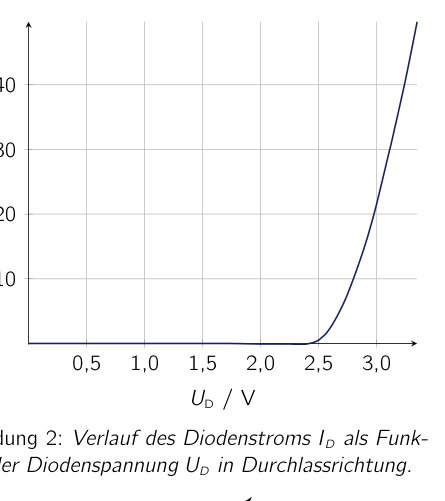 LED current-voltage characteristic
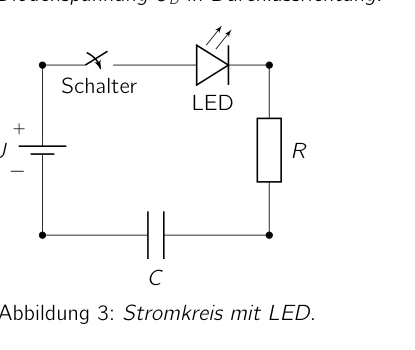 Circuit with LED, resistor and capacitor
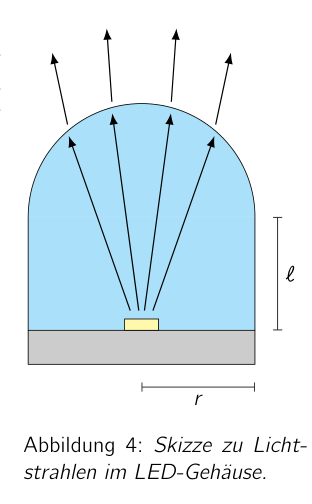 Cylindrical geometry of the LED body
Topic: Circuits, Geometric Optics, Thermodynamics Metodi: Kirchhoff’s Laws, Snell’s Law, Thermodynamic Cycle Analysis Competenze: Graph Linearization, Mathematical Modeling, Physical Reasoning Objects: Resistor, Capacitor, Switch, Battery Fonte: Testo (PDF) — p.6
Problema 2 Diode fisica 14+5+11 punti) I diodi sono componenti elettrici che trovano una vasta gamma di usi nella vita quotidiana. - Sono sono caratterizzati dal fatto che conducono correnti molto bene in una direzione, la cosiddetta direzione in avanti, sopra un Certo voltage applicato, e agire come molto bene Isolatori nell’altra direzione, l’inverso. Per questo possono essere utilizzati, per esempio, per la rettifica di corrente. I diodi di emissione di luce LED for short possono convertire il corrente elettrica direttamente in luce. A causa del loro alto efficienza e robustezza, sono diventate sempre più popolari come fonti di luce negli ultimi anni. Il band gap of the semiconductor material used determinerà la lunghezza d’onda e quindi il colore del luce emessa da un LED. I seguenti problemi riguardano alcuni aspetti dei diodi di emissione di luce. 2.1 LED in un circuito La figura 2 adiacente mostra l’attuale voltage caratteristico di un LED in direzione anteriore. 2.a) Dal carattere caratteristico, approssimativamente stimato, L’intensità di luce di cui sopra è superiore a quella di un’onda di luminosità di LED. e stato che colore ha la luce. (3 punti) Il LED è installato nel circuito mostrato in figura 3. Oltre al LED, il circuito contiene un switch, una fonte di voltage che fornisce una voltage , una resistore con resistenza and a capacitor of capacitance . Il switch è inizialmente aperto e Il condensatore non è carico. 2.b) Usando il caratteristico, determinare il magnitude of the current flowing through the LED immediately after closing the Scendiamo, e la tensione scende attraverso il LED. (cfr. La forma non lineare del diodo caratteristica rende un’analisi più dettagliata del comportamento del circuito difficile. Approximately, however, one can Capture the electrical behavior of the LED by an equivalent circuit in which a voltage source and an ohmic resistor are connected in series with an ideal diode that is completamente isolante nella direzione inversa e perfettamente conduttore nella direzione anteriore. 0,5 1,0 1,5 2,0 2,5 3,0 10 20 30 40 / V / mA Figura 2: comportamento della corrente diodo come funzione della tensione diodo nella direzione anteriore. Scendi LED + Figura 3: Circuito con LED. 2.c) Determine i parametri di un circuito equivalente per il LED utilizzato. Usando questo, calcolare l’energia totale convertita nel LED durante la ricarica del condensatore. (6 punti)
2.2 Design di un LED Un LED di design tipico consiste, come disegnato accanto, di una piccola superficie di emissioni di luce, il cristallo semiconduttore, che è incapsulato in una casa in plastica trasparente. Questo protegge il diodo e fa sì che l’emissione spaziale sia caratteristica del LED. In molti casi si vuole usare il LED come un emittente direzionale che irradia il più possibile di luce in una direzione. Per questo, a characteristic plastic housing is used, consistente di un’edilizia di parte cilindrica di lunghezza e una cappa emisferica di radius . Il raggio è significativamente più grande di la dimensione del cristallo semiconduttore. Buoni risultati di focus quando tutti i raggi usciranno vicino all’asse di simmetria del cilindro Lasciare le case in parallelo. 2.d) Determine come lungo la lunghezza del cilindro deve essere scelto, a funzione del raggio , se il rifractive index del materiale di alloggiamento è . (cfr. Figura 4: Sketch di raggi luminosi nella struttura LED. 2.3 Efficienza di un LED L’elevata efficienza dei LED è una delle ragioni principali per il loro crescente uso come fonti di luce. Comparati con le lampade incandescenti, che emettono una grande parte del potere che assumono come radiazione termica, I LED possono essere costruiti in modo che emettano quasi esclusivamente radiazioni nel mondo visibile.
- Spettrale. In determinate condizioni, i LED possono essere anche utilizzati con un efficienza elettrica superiore al 100%. E ’ quindi più radiante di energia che la potenza elettrica che consumano. Questo è possibile se il LED prende calore dal ambiente circostante e lo converte in radiazioni. Anche se il meccanismo preciso di questo processo Le considerazioni termodinamiche possono essere fatte senza una conoscenza precisa del processo. Il LED può essere considerato come una pompa di calore che prende in calore dal ambiente E emette calore sotto forma di radiazioni. Il spettro di radiazioni di una lampada incandescente a una temperatura , per temperature molto al di sopra della temperatura ambiente , può essere descritto dalla legge di radiazione di Planck, che è tipica di un radiatore termico. In base a questo, la potenza radiata per unità di area dal radiatore in un intervallo di frequenza ristretto with è dato da Qui indica la costante di Planck, la velocità di luce in vuoto e la velocità di luce in vuoto. Boltzmann costante. La potenza radiante totale emessa per unità di area è ottenuta integrando l’espressione sopra su tutte le frequenze possibili. In alcuni casi, il spettro di un LED può essere descritto in modo simile.
- Come? Tuttavia, per tenere conto della distribuzione spettrale del LED, solo i contributi sopra una certa frequenza sono presi in considerazione nell’integrazione, in modo che il la potenza radiante di una superficie omogeneo di dimensioni viene fuori come Qui, tuttavia, non indica la temperatura del LED ma la temperatura efficace della luce emessa. Considerare un LED con una superficie di e una potenza radiante di . Lasciate che la luce emessa dal LED abbia lunghezze d’onda non superiori a 700 nm e lasciare che la temperatura ambientale sia . 2.e) Estimare la massima efficienza elettrica raggiungibile teoricamente del LED. Il L’efficienza elettrica è definita qui come il rapporto di energia radiante emessa per la potenza elettrica che prende. (11 pag.)
LED current-voltage characteristic
Circuito con LED, resistore e capacitore
Gioometria cilindrica del corpo LED
Topic: Circuits, Geometric Optics, Thermodynamics Metodi: Kirchhoff’s Laws, Snell’s Law, Thermodynamic Cycle Analysis Competenze: Graph Linearization, Mathematical Modeling, Physical Reasoning Objects: Resistor, Capacitor, Switch, Battery Fonte: Testo (PDF) — p.6
Problem 2 Diode physics The following points shall be added: (Semiconductor) diodes are electrical components that find a wide variety of uses in everyday life. They are characterized by the fact that they conduct current very well in one direction, the so-called forward direction, above a certain applied voltage, and act as very good Insulators in the other direction, the reverse direction. Because of this they can be used, for example, for rectifying current. Light-emitting diodes LEDs for short can convert electric current directly into light. Because of their high efficiency and robustness, they have become increasingly popular as light sources in recent years. The band gap of the semiconductor material used determines the wavelength and thus the color of the Light emitted by an LED. The following problems deal with some aspects of light-emitting diodes. 2.1 LED in a circuit The adjacent Figure 2 shows the current voltage characteristic of an LED in the forward direction. 2. (a) From the characteristic, roughly estimate the dominant wavelength of the light emitted by the LED and state What color the light has. (Page 3 of this report) The LED is installed in the circuit shown in Figure 3. In addition to the LED, the circuit contains a switch, a voltage source supplying a voltage , a resistor with resistance and a capacitor of capacitance . The switch is initially open and The capacitor is uncharged. 2. (b) Using the characteristic, determine the magnitude of the current flowing through the LED immediately after closing the switch, and the voltage dropping across the LED. (five points) The nonlinear shape of the diode characteristic makes a more detailed analysis of the circuit’s behavior difficult. Approximately, however, one can Capture the electrical behavior of the LED by an equivalent circuit in which a voltage source and an ohmic resistor are connected in series with an ideal diode that is fully insulating in the reverse direction and perfectly conducting in the forward direction. 0,5 1,0 1,5 2,0 2,5 3,0 10 20 30 40 / V / mA Figure 2: Behaviour of the diode current as a function of the diode voltage in the forward direction. Switch LEDs + Figure 3: Circuit with LED. 2.c) Determine the parameters of such an equivalent circuit for the LED used. Using this, calculate the total energy converted into the LED during the charging of the capacitor. (Page 66)
2.2 Design of an LED A LED of typical design consists of, as sketched alongside, of a small light-emitting surface, the semiconductor crystal, which is Encapsulated in a transparent plastic housing. This protects the diode and shapes the spatial emission characteristic of the I’m going to get a LED. In many cases one wants to use the LED as a directional emitter that radiates as much light as possible in one direction. For this, a characteristic plastic housing is used, consisting of a cylindrical part of length and a hemispherical cap of radius . The radius is significantly larger than The dimension of the semiconductor crystal. Good focusing results When all rays exiting near the symmetry axis of the cylinder Leave the housing in parallel. 2. (d) Determine how long the cylinder length must be chosen, as a function of the radius , for this, if the refractive index of the housing material is . (five points) Figure 4: Sketch of light rays in the LED housing. 2.3 Efficiency of an LED The high efficiency of LEDs is a major reason for their increasing use as light sources. Compared with incandescent lamps, which emit a large part of the power they take in as thermal radiation, LEDs can be constructed so that they emit almost exclusively radiation in the visible Spectral range. Under certain conditions, LEDs can even be operated with an electrical efficiency greater than 100%. They then emit more radiant power than the electrical power they take in. This is possible if the LED takes in heat from the surroundings And it converts it into radiation. Even though the precise mechanism of this process is complicated, some thermodynamic considerations can be made without precise knowledge of the process. The LED can be considered as a heat pump that takes in heat from the surroundings and emits heat in the form of radiation. The radiation spectrum of an incandescent lamp at a temperature , for temperatures far above the room temperature , can be described by Planck’s radiation law, which is typical of a thermal radiator. Accordingly, the power radiated per unit area by the radiator in a narrow frequency interval with is given by Here denotes the Planck constant, the vacuum speed of light and the Boltzmann is constant. The total radiant power emitted per unit area is obtained by integrating the above expression over all possible frequencies. In some cases, the spectrum of an LED can also be described approximately in a similar I’m not going to. However, to account for the spectral distribution of the LED, only contributions above a certain frequency are taken into account in the integration, so that the radiant power of a homogeneously luminous surface of size comes out as Here, however, denotes not the temperature of the LED but the effective temperature of the emitted light. Consider an LED with a surface of and a radiant power of . Let the light emitted by the LED have wavelengths no greater than 700 nm and let the ambient temperature be . 2. (e) Estimate the theoretically maximum achievable electrical efficiency of the LED. The Electrical efficiency is defined here as the ratio of the radiant power emitted by the LED to the electrical power it takes in. (Page 11)
The following information shall be provided:
Circuit with LED, resistor and capacitor
The LED body shall be designed to be capable of operating in a continuous manner.
Topic: Circuits, Geometric Optics, Thermodynamics Metodi: Kirchhoff’s Laws, Snell’s Law, Thermodynamic Cycle Analysis Competenze: Graph Linearization, Mathematical Modeling, Physical Reasoning Objects: Resistor, Capacitor, Switch, Battery Fonte: Testo (PDF) — p.6
Problem 3 Experimental Problem - Oscillating Chopsticks (20+6+14 pts.) The chopsticks widely used in Asia generally have a square or circular cross-section that tapers from the upper to the lower end. With these chopsticks one can do more than just pick up food, however. In this problem you are to carry out some physics experiments with chopsticks. Besides chopsticks3 you may use the following materials for experimenting: stopwatch, ruler, thread, adhesive tape and, in addition, any other typical household items. General notes on the experimental problem • Describe and document your procedure in enough detail that every step is easy to follow. In particular, sketch your experimental setups. • Carry out all your experiments so that the results are as accurate as possible. • In addition, estimate the errors of all results sensibly. 3.1 A chopstick as a pendulum Hang a chopstick, as sketched alongside in Fig. 5, from two slightly taut threads so that it hangs as vertically as possible. It is advisable to fasten the chopstick with a tight loop or a knot so that it does not slip. If you deflect the chopstick a little from the vertical rest position, it performs oscillations about the suspension point. 3.a) Determine the oscillation period of the chopstick as a function of the distance d between the thicker end of the chopstick and the suspension point. Produce a graph showing this relationship. (8 pts.) 3.b) Using your measurement results, determine the gravitational acceleration g on Earth. (4 pts.) Chopstick Thread d Figure 5: Sketch of the suspension of the chopstick. 3.c) Using the graph, determine the distance of the centre of gravity of the chopstick from its thicker end. Various approaches are conceivable for this. Describe at least two different evaluation methods and compare the results obtained with them with respect to their accuracy. (7 pts.) The centre of gravity can of course be determined much more simply in another way. 3.d) Determine the centre-of-gravity position also by balancing the chopstick on a narrow edge and compare the result with the previous ones. (1 pt.) 3The necessary purchase of chopsticks is perhaps also a good opportunity to cook Asian food or visit an Asian restaurant and thereby train one’s skills in eating with chopsticks.
3.2 Striking the chopstick Place a chopstick on a smooth (table) surface. Strike it, for example with another chopstick, as sketched in Fig. 6, lightly from the side. The strike should be perpendicular to the main axis of the chopstick. 3.e) Observe the motion of the chopstick immediately after the strike. Experimentally determine the distance d between the strike point and the thicker end of the chopstick at which the thinner end of the chopstick does not move immediately after the strike. Give the ratio of the found value of d to the total length of the chopstick. (3 pts.) 3.f) Calculate how large this ratio is theoretically for a very thin rod. (3 pts.) Chopstick d Figure 6: Striking the chopstick. 3.3 Damped oscillation When a magnet is moved over a conducting surface, it induces eddy currents in it that lead to a decelerating force. The force depends in particular on the electrical properties of the surface. This effect allows the investigation of the resistivity of metals4. Consider a magnet attached to the end of a chopstick suspended as in the first part of the problem. If the chopstick with the magnet is allowed to swing over a suitable piece of metal, the oscillation is decelerated due to the eddy currents. A damped oscillation takes place. For a weakly damped oscillation, the period is not significantly changed compared with the undamped oscillation. However, the amplitude of the oscillation decreases with time . It follows an exponential law of the form Here denotes the initial amplitude at time , a factor that reflects the geometry of the arrangement, and the resistivity of the metal. 3.g) Justify theoretically why the amplitude in the weakly damped oscillation follows the above exponential relationship. You may assume small deflections and assume that the amplitude changes only slightly with each oscillation. (3 pts.) At www.ipho.info you will find, under the heading “aufgaben”, a link to three videos in which a corresponding pendulum experiment is shown. In one of the videos the chopstick with the magnet swings largely freely. In the other two videos there is a metal plate of aluminium or copper under the magnet. The two plates have the same dimensions and are at the same position. The resistivity of copper is about . 3.h) Use the videos5 to justify that the pendulum motions over the metal plates are weakly damped oscillations. (3 pts.) 3.i) Using the videos, determine a value for the resistivity of aluminium and compare it with the literature value. (8 pts.) 4This works only for dia- or paramagnetic materials, however. If the metal possesses a permanent magnetic moment, as e.g. in ferromagnetic materials, the magnet is permanently attracted or repelled. That would overlay the effect to be investigated. 5The analysis of the videos is probably easier if you download them and watch them with a media player such as the VLC media player or the QuickTime Player.
Topic: Oscillations & Waves, Rotational Dynamics, Electromagnetic Induction Metodi: Simple Harmonic Motion Analysis, Torque & Angular Momentum Analysis, Faraday’s Law of Induction Competenze: Experimental Data Analysis, Error Propagation, Graph Linearization Objects: Pendulum, Rod, Magnet Fonte: Testo (PDF) — p.9
Problema 3 Problema sperimentale - Chopsticks oscillatori (cfr. punto 20+6+14) I bastoncini ampiamente usati in Asia generalmente hanno una sezione quadrata o circolare che si taperano dall’alto alla parte inferiore. Con questi bastoncini, uno può Fa’ di più che solo prendere cibo, comunque. In questo problema, dovete fare qualche esperimento di fisica con
- I bastoncini. Oltre ai chopsticks3 potete usare i seguenti materiali per sperimentare: stopwatch, Ruler, thread, tape adesive e, in aggiunta, qualsiasi altro tipo di articoli domestici. Nota generale sul problema sperimentale • Descrivere e documentare la procedura in sufficiente dettaglio in modo che ogni passo sia facile da seguire. In particolare, schizziare le tue configurazioni sperimentali. • eseguire tutti i tuoi esperimenti in modo che i risultati siano il più accurati possibile. • Inoltre, stimare sensibilmente gli errori di tutti i risultati. 3.1 Un bastone come pendolo Hang un bastone, come disegnato insieme in Fig. 5, da due fili leggermente stretti in modo che sia appeso il più verticalmente possibile. È consigliabile fissare il bastone con un loop stretto O un nodo in modo che non scivoli. Se tu deflect il bastone un po’ dalla posizione di riposo verticale, esegue oscillazioni circa il punto di sospensione. 3.a) Determina il periodo di oscillazione del bastone come funzione della distanza d tra la fine più spessa del il bastone e il punto di sospensione. Produce a graph mostrando questa relazione. (8 p.) 3.b) Usando i risultati delle sue misurazioni, determinare l’accelerazione gravitazionale g sulla Terra. - 4 punti Cucina Thread d Figura 5: Sketch della sospensione del bastone. 3.c) Determina la distanza del centro di gravità del bastone da esso
- Più spessa. Per questo ci sono vari approcci. Descrivere almeno Due metodi di valutazione diversi e confrontare i risultati ottenuti con loro per quanto riguarda la loro accuratezza. (7 punti) Il centro di gravità può, naturalmente, essere determinato molto più semplicemente in un altro modo. 3.d) Determina la posizione del centro di gravità quindi balanzando il chopstick su un narrow edge e compare il risultato con quelli precedenti. (1 pt.) 3Il necessario acquisto di bastoncini è forse anche una buona opportunità per cucinare cibo asiatico o visitare Asian restaurant and thereby train one’s skills in eating with chopsticks.
3.2 Striking the chopstick Place a chopstick on a smooth (table) surface. Strike it, per esempio con un altro bastone, come illustrato in Fig. 6, lightly from Il lato. Il strike dovrebbe essere perpendicolare all’asse principale del bastone. 3.e) Osservare il movimento del bastone immediatamente dopo lo sciopero. Per determinare sperimentalmente la distanza d tra il punto di attacco e l’estremità più spessa del bastone, a cui il più sottile dell’estremità del bastone non si muove immediatamente dopo lo sciopero. Date il rapporto del valore trovato di d alla lunghezza totale del bastone. (3 punti) 3.f) Calcolare quanto grande sia questo rapporto teoricamente per una canna molto sottile. (3 punti) Cucina d Figura 6: Striking
- Il bastone. 3.3 Oscillazione a vapore Quando un magnete è spostato su una superficie conduttrice, induce correnti eddy in esso che portano a una forza decelerante. La forza dipende in particolare dalle proprietà elettriche della superficie. Questo effetto consente di studiare la resistività dei metalli4. Considerare un magnete attaccato alla fine di un bastone sospeso come nella prima parte del problema. Se il bastone con il magnete è permesso di svingere su un pezzo di metallo adatto, L’oscillazione è decelerata a causa delle correnti eddy. A vapore l’oscillazione si svolge. Per un’oscillazione a bassa pressione, il periodo non è significativamente cambiato rispetto all’oscillazione non a bassa pressione. Tuttavia, l’ampiezza dell’oscillazione decreases with time . Segue una legge esponenziale della forma Qui denota l’ampiezza iniziale a tempo , un fattore che riflette la geometria del arrangement, and the resistivity of the metal.
- g) giustificare teoricamente perché l’ampiezza nell’oscillazione debolmente dampata segue il
- per esempio, il rapporto di riferimento. Si possono assumere piccole deflezioni E supponiamo che l’ampiezza cambia solo leggermente con ogni oscillazione. (3 punti) Al sito www.ipho.info troverai, sotto il titolo “Testi”, un link a tre video in cui è mostrato un esperimento di pendolo corrispondente. In uno dei video, il palo con il magnete oscilla in gran parte liberamente. In altri due video c’è una targa di metallo di alluminio o rame sotto il magnete. Le due piastre hanno le stesse dimensioni e sono al
- La stessa posizione. La resistività del rame è circa . 3.h) Usare i video5 per giustificare che il pendolo si muove sopra il Le piastre metalliche sono oscillazioni debolmente vaporizzate. (3 punti)
- (i) Usando i video, determinare un valore per la resistività di alluminio e confrontarlo con il valore letterario. (8 p.) 4This funziona solo per materiali dia- o paramagnetic, tuttavia. Se il metallo possiede un momento magnetico permanente, come ad esempio: in ferromagnetico Le materie, il magnete è permanentemente attratto o respinto. Questo superpone l’effetto da indagare. 5L’analisi dei video è probabilmente più facile se li scarichi e li guardi con un media player come il lettore multimediale VLC o il lettore QuickTime.
Topic: Oscillations & Waves, Rotational Dynamics, Electromagnetic Induction Metodi: Simple Harmonic Motion Analysis, Torque & Angular Momentum Analysis, Faraday’s Law of Induction Competenze: Experimental Data Analysis, Error Propagation, Graph Linearization Objects: Pendulum, Rod, Magnet Fonte: Testo (PDF) — p.9
Problem 3 Experimental problem - Oscillating chopsticks The following points shall be added: The chopsticks widely used in Asia generally have a square or circular cross-section that tapers from the upper to the lower end. With these chopsticks one can Do more than just pick up food, though. In this problem you are to carry out some physics experiments with I’m not going to eat chopsticks. In addition to chopsticks3 you may use the following materials for experimenting: stopwatch, Ruler, thread, adhesive tape and, in addition, any other typical household items. General notes on the experimental problem • Describe and document your procedure in sufficient detail that every step is easy to follow. In particular, sketch your experimental setups. • Perform all your experiments so that the results are as accurate as possible. • In addition, estimate the errors of all results sensibly. 3.1 A chopstick as a pendulum Hang a chopstick, as sketched alongside in Fig. 5, from two slightly taut threads so that it hangs as vertically as possible. It is advisable to fasten the chopstick with a tight loop Or a knot so it doesn’t slip. If you deflect the chopstick a little from the vertical rest position, It performs oscillations about the suspension point. 3. (a) Determine the oscillation period of the chopstick as a function of the distance d between the thicker end of the Chopstick and the suspension point. Produce a graph showing this relationship. (Page 86) 3.b) Using your measurement results, determine the gravitational acceleration g on Earth. The Commission has also adopted a proposal for a directive on the protection of workers’ rights. Other, of a kind used for the manufacture of foodstuffs Thread d Figure 5: Sketch of the suspension of the chopstick. 3.c) Using the graph, determine the distance of the centre of gravity of the chopstick from its thicker end. Various approaches are conceivable for this. Describe at least Two different evaluation methods and compare the results obtained with them with respect to their accuracy. (Page 77) The center of gravity can of course be determined much more simply in another way. 3.d) Determine the centre of gravity position thus by balancing the chopstick on a narrow edge and compare the result with the previous ones. (1 pt.) 3The necessary purchase of chopsticks is perhaps also a good opportunity to cook Asian food or visit Asian restaurant and thereby train one’s skills in eating with chopsticks.
3.2 Striking the chopstick Place a chopstick on a smooth (table) surface. Strike it, for example with another chopstick, as sketched in Fig. 6, lightly from The side. The strike should be perpendicular to the main axis of the chopstick. 3.e) Observe the motion of the chopstick immediately after the strike. Experimentally determine the distance d between the strike point and the thicker end of the chopstick at which the thinner end of the chopstick does not move immediately after the strike. Give the ratio of the found value of d to the total length of the chopstick. (Page 3 of this report) 3.f) Calculate how large this ratio is theoretically for a very thin rod. (Page 3 of this report) Other, of a kind used for the manufacture of foodstuffs d Figure 6: Striking The chopstick. 3.3 Damped oscillation When a magnet is moved over a conducting surface, it induces eddy currents in it that lead to a decelerating force. The force depends in particular on the electrical properties of the surface. This effect allows the investigation of the resistivity of metals4. Consider a magnet attached to the end of a chopstick suspended as in the first part of the problem. If the chopstick with the magnet is allowed to swing over a suitable piece of metal, The oscillation is decelerated due to the eddy currents. A damped Oscillation takes place. For a weakly damped oscillation, the period is not significantly changed compared to the undamped oscillation. However, the amplitude of the oscillation decreases with time . It follows an exponential law of the form Here denotes the initial amplitude at time , a factor that reflects the geometry of the arrangement, and the resistivity of the metal. 3.g) Theoretically justify why the amplitude in the weakly damped oscillation follows the The first is the exponential relationship. You may assume small deflections And assume that the amplitude changes only slightly with each oscillation. (Page 3 of this report) At www.ipho.info you will find, under the heading “tasks”, a link to three videos in which a corresponding pendulum experiment is shown. In one of the videos the chopstick with the magnet swings largely freely. In the other two videos there is a metal plate of aluminum or copper Under the magnet. The two plates have the same dimensions and are at the The same position. The resistivity of copper is about . 3.h) Use the videos5 to justify that the pendulum moves over the Metal plates are weakly damped oscillations. (Page 3 of this report) 3. (i) Using the videos, determine a value for the resistivity of aluminium and compare it with the literature value. (Page 86) 4This works only for dia- or paramagnetic materials, however. If the metal possesses a permanent magnetic moment, as e.g. in ferromagnetic The magnet is permanently attracted or repelled. That would overlay the effect to be investigated. 5The analysis of the videos is probably easier if you download them and watch them with a media player such as the VLC media player or the QuickTime player.
Topic: Oscillations & Waves, Rotational Dynamics, Electromagnetic Induction Metodi: Simple Harmonic Motion Analysis, Torque & Angular Momentum Analysis, Faraday’s Law of Induction Competenze: Experimental Data Analysis, Error Propagation, Graph Linearization Objects: Pendulum, Rod, Magnet Fonte: Testo (PDF) — p.9