Problem 1 (10 points) Ultrasound diagnostics In medicine, ultrasound waves are used for imaging by sending them into the body and analyzing the reflections that occur at the boundaries between different tissues. When a sound wave strikes such a boundary perpendicularly, a fraction of the sound intensity is reflected. The quantities and denote the acoustic impedances of the two types of tissue. To a good approximation, the acoustic impedance of a tissue can be calculated as the product of the speed of sound in it and its density. Information about the travel time of the reflected signal and its intensity thus allows conclusions to be drawn about the body region under examination. The table below lists the densities and speeds of sound of several media and typical body tissues. a) Calculate the fraction of the incident sound intensity that is reflected at the transition from fatty tissue to muscle tissue, and explain why a water-based gel is usually applied to the skin before an ultrasound examination. Ultrasound waves are attenuated exponentially in body tissue, where to a good approximation the attenuation is proportional to the frequency of the ultrasound wave. In the right-hand column of the table you will find some typical attenuation constants. On the other hand, a higher frequency leads to better spatial resolution. Therefore, the maximum ultrasound frequency at which the detected signal is still not too weak for evaluation is usually chosen for the examination. b) Consider a 10 cm thick layer of muscle tissue. Determine the maximum frequency an ultrasound wave may have if its intensity, after passing through the layer, is to be at least one thousandth of the initial value. Estimate the resolving power achievable with this, assuming that the resolution corresponds roughly to the wavelength of the ultrasound wave. Now you can attempt your first simple “ultrasound examination”. The adjacent figure shows a body in water that is to be examined using ultrasound waves. To do this, the ultrasound probe is positioned at one of the points A to D and emits sound waves of frequency in short pulses along the direction of the arrow. The graph shows the intensity profile of the reflected ultrasound pulse measured by the ultrasound probe. c) Determine from which of the points A to D the examination was carried out, and justify whether the body is more likely made of fatty tissue or muscle tissue. Medium/ Tissue Density in Speed of sound in Attenuation constant in Air 0.0012 340 38 Fat 0.92 1450 11 Water 1.00 1480 0.05 Muscle 1.07 1580 25 Bone 1.6 4080 200 Register now at www.ipho.info for the competition! 0 2 4 6 8 10 12 14 16 mm A B C D Water Baby’s foot as an ultrasound image. 2 4 6 8 10 12 14 16 18 20 Time / Intensity of the reflected signal
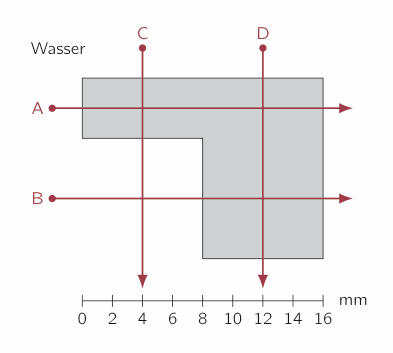 Body in water, points A B C D
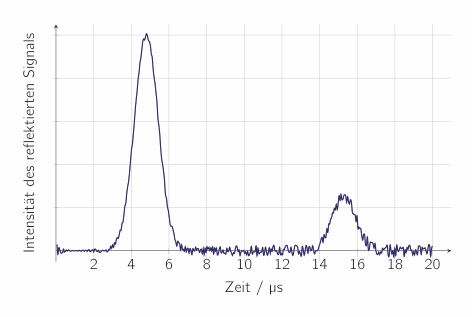 Reflected ultrasound intensity vs time
Topic: Oscillations & Waves Metodi: Wave Equation, Physical Modeling, Approximation & Series Expansion Competenze: Physical Reasoning, Estimation & Approximation, Mathematical Modeling Objects: — Fonte: Testo (PDF) — p.2
Problema 1 (10 punti) Diagnostiche ad ultrasuoni In medicina, le onde ultrasuoni vengono utilizzate per l’imaging inviandole nel corpo e analizzando le riflessioni che si verificano ai confini tra diversi tessuti. Quando un’onda sonora colpisce un limite perpendicolare, una frazione dell’intensità del suono viene riflessa. Le quantità e indicano le impedanze acustiche dei due tipi di tessuto. Per una buona approssimazione, l’impedenza acustica di un tessuto può essere calcolata come il prodotto della velocità del suono in esso e della sua densità. Le informazioni sul tempo di viaggio del segnale riflesso e la sua intensità consentono quindi di trarre conclusioni sulla regione del corpo sotto esame. La tabella seguente elenca le densità e le velocità di suono di diversi media e tipici tessuti corporei. a) Calcolare la frazione di intensità del suono incidente che si riflette al passaggio da tessuto adiposo a tessuto muscolare, e spiegare perché un gel basato sull’acqua è solitamente applicato alla pelle prima di un esame ultrasound. Le onde ultrasonore sono attenuate esponenzialmente nel tessuto corporeo, dove, a buona approssimazione, l’attenuazione è proporzionale alla frequenza dell’onda ultrasonora. Nella colonna a destra della tabella troverete alcune costanti tipiche di attenuazione. D’altra parte, una frequenza più alta porta a una migliore risoluzione spaziale. Pertanto, la frequenza massima di ultrasuoni a cui il segnale rilevato non è ancora troppo debole per l’evaluare è solitamente scelta per l’esame. b) Considerare un strato di muscolo di 10 cm di spessore. Determina la frequenza massima che un’onda ad ultrasuoni può avere se la sua intensità, dopo aver attraversato lo strato, deve essere almeno un migliaio del valore iniziale. Estimare la potenza di risoluzione raggiungibile con questo, assumendo che la risoluzione corrisponda approssimativamente alla lunghezza d’onda dell’ultrasuono. Ora puoi provare il tuo primo semplice esame ad ultrasuoni. The adjacent figure shows a body in water that is to be examined using ultrasound waves. Per fare questo, la sonda ultrasuonica è posizionata a uno dei punti A a D ed emette onde sonore di frequenza in brevi impulsi lungo la direzione della freccia. Il grafico mostra il profilo di intensità del polso di ultrasuono riflesso misurato dal campione di ultrasuoni. c) Determinare da quale dei punti A a D è stata effettuata l’esame e giustificare se il corpo è più probabile fatto di tessuto adiposo o muscolare. Medium/ Tissue Densità in Velocità del suono in Attenuazione costante in Air 0.0012 340 38 Grasso 0.92 1450 11 Acqua 1.00 1480 0.05 Muscolo 1.07 1580 25 Bone 1.6 4080 200 Registrare ora a www.ipho.info per il La concorrenza! 0 2 4 6 8 10 12 14 16 mm A B C D Acqua Il piede del bambino come immagine ad ultrasuoni. 2 4 6 8 10 12 14 16 18 20 Tempo / Intensità del segnale riflesso
*Body in water, points A B C D *
Reflected ultrasound intensity vs time
Topic: Oscillations & Waves Metodi: Wave Equation, Physical Modeling, Approximation & Series Expansion Competenze: Physical Reasoning, Estimation & Approximation, Mathematical Modeling Objects: — Fonte: Testo (PDF) — p.2
The following points are added: Ultrasound diagnostics In medicine, ultrasound waves are used for imaging by sending them into the body and analyzing the reflections that occur at the boundaries between different tissues. When a sound wave strikes such a boundary perpendicularly, a fraction of the sound intensity is reflected. The quantities and denote the acoustic impedances of the two types of tissue. To a good approximation, the acoustic impedance of a tissue can be calculated as the product of the speed of sound in it and its density. Information about the travel time of the reflected signal and its intensity thus allows conclusions to be drawn about the body region under examination. The table below lists the densities and speeds of sound of several media and typical body tissues. (a) Calculate the fraction of the incident sound intensity that is reflected at the transition from fatty tissue to muscle tissue, and explain why a water-based gel is usually applied to the skin before an ultrasound examination. Ultrasound waves are attenuated exponentially in body tissue, where to a good approximation the attenuation is proportional to the frequency of the ultrasound wave. In the right-hand column of the table you will find some typical attenuation constants. On the other hand, a higher frequency leads to better spatial resolution. Therefore, the maximum ultrasound frequency at which the detected signal is still not too weak for evaluation is usually chosen for the examination. (b) Consider a 10 cm thick layer of muscle tissue. Determine the maximum frequency an ultrasound wave may have if its intensity, after passing through the layer, is to be at least one thousandth of the initial value. Estimate the resolving power achievable with this, assuming that the resolution corresponds roughly to the wavelength of the ultrasound wave. Now you can try your first simple “ultrasound examination”. The adjacent figure shows a body in water that is to be examined using ultrasound waves. To do this, the ultrasound probe is positioned at one of the points A to D and emits sound waves of frequency in short pulses along the direction of the arrow. The graph shows the intensity profile of the reflected ultrasound pulse measured by the ultrasound probe. (c) Determine from which of the points A to D the examination was carried out, and justify whether the body is more likely made of fatty tissue or muscle tissue. Medium Tissue Density in Speed of sound in Attenuation constant in Air 0.0012 340 38 Fat 0.92 1450 11 Water 1.00 1480 0.05 Muscle 1.07 1580 25 Bone 1.6 4080 200 Register now at The Commission has also adopted a proposal for a regulation on the protection of the environment. for the Competition! 0 2 4 6 8 10 12 14 16 mm A B C D Water Baby’s foot as an ultrasound image. 2 4 6 8 10 12 14 16 18 20 Time / Intensity of the reflected signal
*Body in water, points A B C D *
The measurement of the intensity of the ultrasound is based on the measurement of the intensity of the ultrasound.
Topic: Oscillations & Waves Metodi: Wave Equation, Physical Modeling, Approximation & Series Expansion Competenze: Physical Reasoning, Estimation & Approximation, Mathematical Modeling Objects: — Fonte: Testo (PDF) — p.2
Problem 2 (10 points) Decay chain A nucleus decays radioactively. The resulting nucleus is also radioactive and decays further. This decay chain continues until, at the end, a stable atom is produced. Assume that only - and -decays occur in the decay chain, and determine by calculation how many - and how many -decays must occur at a minimum in the decay chain.
Topic: Nuclear & Particle Physics Metodi: Conservation Laws, Radioactive Decay Law Competenze: Physical Reasoning, Mathematical Modeling Objects: Nucleus, Atom Fonte: Testo (PDF) — p.3
Problema 2 (10 punti) Decay chain A nucleo decade radioattivamente. Il nucleo risultante è radioattivo e decade ulteriormente. Questa catena di decadimento continua fino a quando, alla fine, un atomo stabile viene prodotto. Supponiamo che solo e decadi si verificino nella catena di decadenza, e determinate calcolatamente quanti e quanti decadi devono verificarsi al minimo nella catena di decadenza.
Topic: Nuclear & Particle Physics Metodi: Conservation Laws, Radioactive Decay Law Competenze: Physical Reasoning, Mathematical Modeling Objects: Nucleus, Atom Fonte: Testo (PDF) — p.3
Problem 2 (10 points) Decay chain A nucleus decays radioactively. The resulting nucleus is also radioactive and decays further. This decay chain continues until, at the end, a stable atom is produced. Assume that only and decays occur in the decay chain, and determine by calculation how many and how many decays must occur at a minimum in the decay chain.
Topic: Nuclear & Particle Physics Metodi: Conservation Laws, Radioactive Decay Law Competenze: Physical Reasoning, Mathematical Modeling Objects: Nucleus, Atom Fonte: Testo (PDF) — p.3
Problem 3 (10 points) Hidden collision Two boxes that can slide without friction on a horizontal rail collide. The adjacent superimposed photograph shows the positions of the two boxes at the times s, s, s and s. The boxes remain within the image area the whole time. Determine when and at which point on the rail the collision of the two boxes took place. Show that the solution is unique.
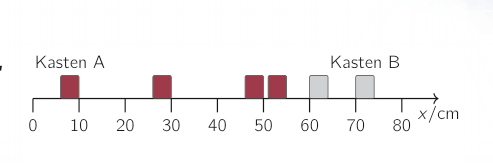 Positions of boxes A and B on the rail
Topic: Newtonian Mechanics, Conservation of Momentum Metodi: Conservation of Momentum, Kinematic Equations, Physical Modeling Competenze: Physical Reasoning, Mathematical Modeling Objects: Block Fonte: Testo (PDF) — p.3
Problema 3 (10 punti) Collizione nascosta Due scatole che possono scivolare senza attrito su un collasso di rotaia orizzontale. La fotografia superimposta adiacente mostra le posizioni delle due scatole al momento s, s, s e s. Le scatole restano all’interno dell’area dell’immagine tutto il tempo. Determine quando e a quale punto sul binario si è verificato il collasso delle due scatole. Mostrare che la soluzione è unica.
Positions of boxes A and B on the rail
Topic: Newtonian Mechanics, Conservation of Momentum Metodi: Conservation of Momentum, Kinematic Equations, Physical Modeling Competenze: Physical Reasoning, Mathematical Modeling Objects: Block Fonte: Testo (PDF) — p.3
Problem 3 (10 points) Hidden collision Two boxes that can slide without friction on a horizontal rail collision. The adjacent superimposed photograph shows the positions of the two boxes at the times s, s, s and s. The boxes remain within the image area the whole time. Determine when and at what point on the rail the collision of the two boxes took place. Show that the solution is unique.
Positions of boxes A and B on the rail
Topic: Newtonian Mechanics, Conservation of Momentum Metodi: Conservation of Momentum, Kinematic Equations, Physical Modeling Competenze: Physical Reasoning, Mathematical Modeling Objects: Block Fonte: Testo (PDF) — p.3
Problem 4 (10 pts.) Shifted straw A straw is dipped into the middle of a glass partially filled with a transparent liquid. When you observe the glass from the side and move the straw perpendicular to the line of sight and along the diameter, the straw inside the liquid appears to be displaced relative to the straw above the liquid. The photo, fitted with a scale, shows the situation in which the part of the straw in the liquid appears to be just separating from the part above. The diameter of the thin-walled glass used here is cm. Assume that the glass is viewed from a distance that is large compared with the diameter of the glass. Determine approximately the refractive index of the liquid. Junior problem (10 pts.) Ice diet “What on earth are you doing?” Hanna asks her neighbor, who comes home with a whole carton of ice cream. “Starting today, I’m going on an ice-cream diet,” he replies. “I beg your pardon?” “Quite simple,” Tom explains, and shows her the packaging. “The ice cream has an energy value of about 350 kJ per 100 g. But to warm up and melt the ice cream while eating it, my body has to expend far more energy. That way I can eat as much ice cream as I like and even lose weight in the process!” Can this really work? Hanna remains skeptical. Using suitable estimates, judge whether Tom’s diet plan can succeed. Look up any additional numerical values you need in a book or on the internet. 0 10 20 30 40 50 60 70 80 x/cm Box A Box B 0 1 2 3 4 5 cm scienceolympiaden.de Show your talent! Who is the IPhO aimed at? Pupils If you are a pupil, the IPhO and the PhysikOlympiade in Germany offer you many opportunities to engage intensively with physics problems, to experience physics as an exciting scientific discipline, to test your own limits and, not least, to meet interesting people. To prepare for the 3rd and 4th rounds, a problem-solving training is held in which you receive detailed tips on your work and can thus improve your problem-solving skills once again. Even if you don’t make it that far, simply passing the first round is already a special achievement and a genuine distinction. So, be brave! Teachers As a teacher, you can use the problems of the selection competition to offer a challenge to pupils who are especially capable or interested in physics, and encourage them toward a deeper engagement with physics topics. In this way the IPhO can serve as an instrument of individual support. The problems of the 1st round in particular are not only suitable for the best in an Abitur class. Rather, it turns out that an early engagement with the competition problems is an important building block for later successful participation, and can also be a lot of fun along the way. So feel free to encourage your pupils to submit solutions to individual problems as well; for only those who do not take part can truly lose. Schools By encouraging participation in competitions, schools can sharpen their profile and use these, in the sense of enrichment, as a complement to school offerings. Competitions thereby provide varied, differentiated learning environments for participating pupils. In the area of STEM subjects, the Olympiads—at least in the later rounds—represent a competition aimed at especially motivated and high-performing young people. Nevertheless, participation in the entry rounds too is not only worthwhile but can also contribute to a lasting motivation for STEM topics. In many federal states, by the way, participation can be recognized as a special learning achievement or as a subject/seminar paper for your pupils’ Abitur. Interested in more than physics? The IPhO is one of the six nationwide science competitions for pupils organized by the IPN—the ScienceOlympiaden. Besides the selection competitions for the international Olympiads in Biology (IBO), Chemistry (IChO) and Physics (IPhO), these include the International Junior Science Olympiad (IJSO), the European Science Olympiad (EUSO) as well as the Federal Environment Competition (BUW). Together they address pupils from the beginning of secondary school to after the end of their school years, and, through close networking, offer the possibility of lasting support for scientific abilities and interests. Further information about the ScienceOlympiaden can be found at www.scienceolympiaden.de. Dear pupils, dear parents, dear teachers, those who enjoy solving mathematical problems, who have fun with physics, biology and chemistry, who are fascinated by technology—they are in exactly the right place at the ScienceOlympiaden of the Leibniz Institute. While solving exciting and challenging problems, young talents gain insights into scientific research. Within the framework of the Federal Environment Competition, they additionally develop their own ideas and projects on environmental or sustainability topics. For many years, the Federal Ministry of Education and Research has been committed to helping children and young people discover the world of the natural sciences and their possibilities. For science is not a fortress of facts, but a dynamic process, fed by curiosity and the joy of discovery. People with scientific knowledge can ask more precise questions, for example about climate change or genetic engineering. That is why we want to consciously awaken the fascination that emanates from science and research, and we support various youth competitions on STEM topics—mathematics, computer science, natural sciences and technology. We want to encourage pupils to demonstrate their abilities beyond the subject lessons.
My thanks go to the teachers and parents who inspire young people for the natural sciences and support them in projects and competitions. Germany needs young scientific talents who drive progress forward and help shape our future. I hope that many pupils will be seized by the desire to take part in the competitions, and I wish them all great success. Prof. Dr. Johanna Wanka Federal Minister of Education and Research Dear pupils, dear teachers, dear parents, the ScienceOlympiaden are a great opportunity to try out, foster and demonstrate scientific interest and talent—even more intensively and independently than is often possible in lessons. Competitions like the ScienceOlympiaden support our pupils in unfolding and further developing their individual talents. They motivate them to extraordinary achievements. But they also convey that participation is worthwhile in itself, regardless of one’s personal result. The Standing Conference of the Ministers of Education and Cultural Affairs therefore gladly recommends participation in the various competitions of the ScienceOlympiaden. Thousands of pupils already take part year after year. We need them, these young scientific talents. Young people should learn to deal responsibly with nature, the environment and technology. They should recognize the scientific dimension of our existence, and they should help to solve humanity’s problems such as climate change, energy scarcity and the threat to natural living conditions. For this they need sound scientific knowledge and competencies. The ScienceOlympiaden make an important contribution to this
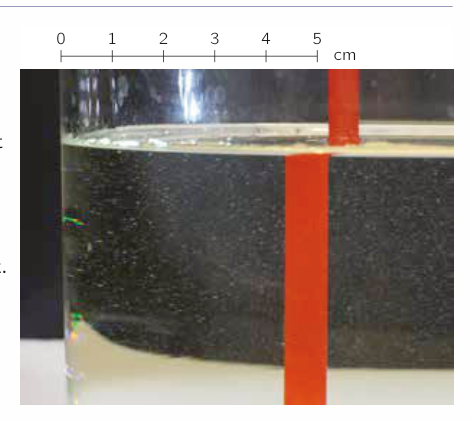 Photo of straw in glass with scale
Topic: Geometric Optics, Thermodynamics, Order-of-Magnitude Estimation Metodi: Snell’s Law, Ray Tracing, Order-of-Magnitude Estimation, First Law of Thermodynamics Competenze: Physical Reasoning, Estimation & Approximation, Diagrammatic Reasoning Objects: Container Fonte: Testo (PDF) — p.3
Il problema 4 (10 punti) Sciacca di scambio Una canna è immersa nel mezzo di un bicchiere partialmente riempito di un liquido trasparente. Quando si osserva il vetro dal lato e si muove la canna perpendicolare alla linea di vista e lungo il diametro, la canna all’interno del liquido sembra essere spostata rispetto alla canna sopra il liquido. La foto, equipaggiata con una scala, mostra la situazione in cui la parte dello stucco nel liquido sembra essere appena separata dalla parte sopra. Il diametro del vetro a sottile parete utilizzato è cm. Supponiamo che il vetro sia visto da una distanza che è grande rispetto al diametro del vetro. Determina circa l’indice di refraczione del liquido. Problema minore (10 punti) Dieta di ghiaccio “Che diavolo stai facendo?” Hanna chiede al vicino, che torna a casa con un intero cartone di gelato. “A partire da oggi, sto seguendo una dieta con gelato”, risponde. “Mi scusi?” “Quasi semplice”, spiega Tom, e mostra la confezione. “Il gelato ha un valore energetico di circa 350 kJ per 100 g. Ma per riscaldarsi e far fondere l’icone mentre lo mangia, il mio corpo deve spendere molto più energia. Così posso mangiare il più gelato che voglio e persino perdere peso nel processo!”
- Questo può funzionare? Hanna rimane scettica. Usando estimate adeguate, giudicate se il piano di dieta di Tom può avere successo. Cerca qualsiasi valore numerico aggiuntivo che ti serve in un libro o su Internet. 0 10 20 30 40 50 60 70 80 x/cm Cassa A Cassa B 0 1 2 3 4 5 cm sciencesolymppiaden.de Mostra il tuo talento! Chi è l’IPhO mirato? Alunni Se sei un allievo, l’IPhO e la PhysicsOlympic in Germania ti offrono molte opportunità per impegnarti intensamente con i problemi della fisica, per sperimentare la fisica come una disciplina scientifica eccitante, per testare i tuoi limiti e, non ultimo, per incontrare persone interessanti. Per prepararsi ai 3 e 4 round, si svolge un training di problem solving in cui ricevi consigli dettagliati sul tuo lavoro e puoi quindi migliorare le tue capacità di problem solving ancora una volta. Anche se non si arriva a quel punto, semplicemente passare il primo round è già un risultato speciale e una vera distinzione. Bene, be brave! Docenti Come insegnante, puoi usare i problemi della competizione di selezione per offrire una sfida agli studenti che sono particolarmente capaci o interessati alla fisica, e incoraggiarli verso un impegno più profondo con i temi della fisica. In questo modo l’IPhO può servire come strumento di sostegno individuale. I problemi del primo round in particolare non sono solo adatti al meglio in una classe di abitur. Piuttosto, si scopre che un coinvolgimento precoce con i problemi della concorrenza è un importante elemento di costruzione per la partecipazione successiva, e può anche essere molto divertente lungo il percorso. Quindi sentitevi liberi di incoraggiare i vostri alunni a presentare soluzioni anche ai problemi individuali, perché solo coloro che non partecipano possono veramente perdere. Scuole Incoraggiando la partecipazione a competizioni, le scuole possono accentuare il loro profilo e utilizzare questi, nel senso di arricchimento, come complemento alle offerte scolastiche. Le competizioni forniscono così ambienti di apprendimento diversificati e differenziati per gli studenti partecipanti. Nel settore delle materie STEM, le olimpiadi, almeno nelle fasi successive, rappresentano una competizione rivolta a giovani particolarmente motivati e ad alto rendimento. Tuttavia, partecipare ai round di entrata non solo vale la pena, ma può anche contribuire a una motivazione duratura per i temi STEM. In molti stati federali, comunque, la partecipazione può essere riconosciuta come un’impresa speciale di apprendimento o come un documento di tema/seminario per l’abito dei vostri alunni. Interessato in più della fisica? L’IPhO è uno dei sei concorsi scientifici nazionali per gli studenti organizzati dall’IPNthe ScienceOlympics. Oltre alle competizioni di selezione per le Olimpiadi internazionali in Biologia (IBO), Chimica (IChO) e Fisica (IPhO), queste includono l’International Junior Science Olympiad (IJSO), l’European Science Olympiad (EUSO) e il Federal Environment Competition (BUW). Insieme si rivolge agli studenti dall’inizio della scuola secondaria fino alla fine del loro anno scolastico e, attraverso una stretta rete, offre la possibilità di sostenere duratamente le abilità e gli interessi scientifici. Ulteriori informazioni sulle ScienceOlympiaden si trovano su www.scienceolympiaden.de. Cari studenti, cari genitori, cari insegnanti, coloro che amano risolvere problemi matematici, che si divertono con la fisica, la biologia e la chimica, che sono affascinati dalla tecnologia, sono esattamente nel posto giusto ai ScienceOlympiads dell’Istituto Leibniz. Solvendo problemi eccitanti e difficili, i giovani talenti acquisiscono informazioni sulla ricerca scientifica. Nell’ambito del concorso federale per l’ambiente, sviluppano inoltre le proprie idee e progetti su temi ambientali o di sostenibilità. Per molti anni, il Ministero federale dell’Educazione e della Ricerca si è impegnato ad aiutare i bambini e i giovani a scoprire il mondo delle scienze naturali e le loro possibilità. Perché la scienza non è una fortezza di fatti, ma un processo dinamico, alimentato dalla curiosità e dalla gioia della scoperta. Le persone con conoscenze scientifiche possono fare domande più precise, per esempio sul cambiamento climatico o sull’ingegneria genetica. Ecco perché vogliamo svegliare coscientemente il fascino che emana dalla scienza e dalla ricerca, e sosteniamo varie competizioni giovanili su argomenti STEM: matematica, informatica, scienze naturali e tecnologia. Vogliamo incoraggiare gli studenti a dimostrare le loro capacità al di là delle lezioni di materia.
Grazie a tutti i nostri insegnanti e genitori che ispirano i giovani alle scienze naturali e li sostengono in progetti e concorsi. La Germania ha bisogno di giovani talenti scientifici che guidino il progresso e contribuiscano a plasmare il nostro futuro. Spero che molti studenti saranno colpiti dal desiderio di partecipare ai concorsi, e auguro loro tutti grandi successi. Prof. Dr. Johanna Wanka Ministro federale dell’istruzione e della ricerca Cari studenti, cari insegnanti, cari genitori, Le ScienceOlympiades sono una grande opportunità per provare, promuovere e dimostrare interesse scientifico e talento anche più intensamente e indipendentemente di quanto spesso sia possibile nelle lezioni. Competitions like the ScienceOlympiads support our pupils in unfolding and further developing their individual talents. Li motivano a realizzare risultati straordinari. Ma trasmettono anche che la partecipazione vale la pena in se stessa, indipendentemente dal risultato personale. La Conferenza permanente dei ministri dell’istruzione e degli affari culturali raccomanda quindi con piacere la partecipazione ai vari concorsi delle ScienceOlympics. Migliaia di studenti già partecipano anno dopo anno. Abbiamo bisogno di loro, di questi giovani talenti scientifici. I giovani dovrebbero imparare a trattare in modo responsabile la natura, l’ambiente e la tecnologia. Dovrebbero riconoscere la dimensione scientifica della nostra esistenza e contribuire a risolvere i problemi dell’umanità come il cambiamento climatico, la scarsità di energia e la minaccia alle condizioni di vita naturali. Per questo hanno bisogno di conoscenze e competenze scientifiche. Le ScienceOlympics fanno un importante contributo a questo
Foto di stalla in vetro con scala
Topic: Geometric Optics, Thermodynamics, Order-of-Magnitude Estimation Metodi: Snell’s Law, Ray Tracing, Order-of-Magnitude Estimation, First Law of Thermodynamics Competenze: Physical Reasoning, Estimation & Approximation, Diagrammatic Reasoning Objects: Container Fonte: Testo (PDF) — p.3
The following is the list of the problems: Shifted straw A straw is dipped into the middle of a glass partially filled with a transparent liquid. When you observe the glass from the side and move the straw perpendicular to the line of sight and along the diameter, the straw inside the liquid appears to be displaced relative to the straw above the liquid. The photo, fitted with a scale, shows the situation in which the part of the straw in the liquid appears to be just separating from the part above. The diameter of the thin-walled glass used here is cm. Assume that the glass is viewed from a distance that is large compared to the diameter of the glass. Determine approximately the refractive index of the liquid. The following is the list of the problems: Ice diet “What the hell are you doing?” Hanna asks her neighbor, who comes home with a whole carton of ice cream. “Starting today, I’m going on an ice cream diet”, he replies. “I beg your pardon?” “Quite simple”, Tom explains, and shows her the packaging. “The ice cream has an energy value of about 350 kJ per 100 g. But to warm up and melt the ice cream while eating it, my body has to expend much more energy. That way I can eat as much ice cream as I like and even lose weight in the process!” Can this really work? Hanna remains skeptical. Using suitable estimates, judge whether Tom’s diet plan can succeed. Look up any additional numerical values you need in a book or on the internet. 0 10 20 30 40 50 60 70 80 x/cm Box A Box B 0 1 2 3 4 5 cm The European Commission has decided to extend the period of validity of the decision. Show your talent! Who is the IPhO aimed at? The following is a list of the activities: If you are a student, the IPhO and the PhysicsOlympic in Germany offer you many opportunities to engage intensively with physics problems, to experience physics as an exciting scientific discipline, to test your own limits and, not least, to meet interesting people. To prepare for the 3rd and 4th rounds, a problem-solving training is held in which you receive detailed tips on your work and can thus improve your problem-solving skills once again. Even if you don’t make it that far, simply passing the first round is already a special achievement and a genuine distinction. So, be good! Teachers As a teacher, you can use the problems of the selection competition to offer a challenge to students who are especially capable or interested in physics, and encourage them towards a deeper engagement with physics topics. In this way the IPhO can serve as an instrument of individual support. The problems of the 1st round in particular are not only suitable for the best in an Abitur class. Rather, it turns out that early engagement with the competition problems is an important building block for later successful participation, and can also be a lot of fun along the way. So feel free to encourage your students to submit solutions to individual problems as well; for only those who do not participate can truly lose. Schools By encouraging participation in competitions, schools can sharpen their profile and use these, in the sense of enrichment, as a complement to school offerings. Competitions thus provide varied, differentiated learning environments for participating pupils. In the area of STEM subjects, the Olympiadsat least in the later roundsrepresent a competition aimed at especially motivated and high-performing young people. Nevertheless, participation in the entry rounds is not only worthwhile but can also contribute to a lasting motivation for STEM topics. In many federal states, participation can be recognized as a special learning achievement or as a subject/seminar paper for your pupils’ graduation. Interested in more than physics? The IPhO is one of the six national science competitions for pupils organised by the IPNthe ScienceOlympics. In addition to the selection competitions for the international Olympiads in Biology (IBO), Chemistry (IChO) and Physics (IPhO), these include the International Junior Science Olympiad (IJSO), the European Science Olympiad (EUSO) as well as the Federal Environment Competition (BUW). Together they address pupils from the beginning of secondary school to after the end of their school years, and, through close networking, offer the possibility of lasting support for scientific abilities and interests. Further information about the ScienceOlympics can be found at www.scienceolympiaden.de. Dear pupils, dear parents, dear teachers, Those who enjoy solving mathematical problems, who have fun with physics, biology and chemistry, who are fascinated by technology, they are in exactly the right place at the ScienceOlympics of the Leibniz Institute. While solving exciting and challenging problems, young talents gain insights into scientific research. In the framework of the Federal Environment Competition, they also develop their own ideas and projects on environmental or sustainability topics. For many years, the Federal Ministry of Education and Research has been committed to helping children and young people discover the world of natural sciences and their possibilities. For science is not a fortress of facts, but a dynamic process, fed by curiosity and the joy of discovery. People with scientific knowledge can ask more precise questions, for example about climate change or genetic engineering. That’s why we want to consciously awaken the fascination that emanates from science and research, and we support various youth competitions on STEM topics: math, computer science, natural sciences and technology. We want to encourage students to demonstrate their abilities beyond the subject lessons.
My thanks go to the teachers and parents who inspire young people to learn the natural sciences and support them in projects and competitions. Germany needs young scientific talents who drive progress forward and help shape our future. I hope that many pupils will be seized by the desire to take part in the competitions, and I wish them all great success. The Commission is not responsible for the implementation of this Regulation. Dr. The Commission shall adopt implementing acts in accordance with Article 21 of this Regulation. Federal Minister for Education and Research Dear pupils, dear teachers, dear parents, The ScienceOlympics are a great opportunity to try out, foster and demonstrate scientific interest and talent even more intensively and independently than is often possible in lessons. Competitions like the ScienceOlympics support our pupils in unfolding and further developing their individual talents. They motivate them to extraordinary achievements. But they also convey that participation is worthwhile in itself, regardless of one’s personal outcome. The Standing Conference of the Ministers of Education and Cultural Affairs therefore gladly recommends participation in the various competitions of the ScienceOlympics. Thousands of pupils already take part year after year. We need them, these young scientific talents. Young people should learn to deal responsibly with nature, the environment and technology. They should recognize the scientific dimension of our existence, and they should help solve humanity’s problems like climate change, energy scarcity and the threat to natural living conditions. For this they need sound scientific knowledge and competencies. The ScienceOlympics make an important contribution to this
Photo of straw in glass with scale
Topic: Geometric Optics, Thermodynamics, Order-of-Magnitude Estimation Metodi: Snell’s Law, Ray Tracing, Order-of-Magnitude Estimation, First Law of Thermodynamics Competenze: Physical Reasoning, Estimation & Approximation, Diagrammatic Reasoning Objects: Container Fonte: Testo (PDF) — p.3