Problem 1 Mechanical Amusements (10+10 pts.) Time for physics amusements! In a hands-on exhibition evidently set up especially for people enthusiastic about physics, there is all kinds of things to discover. Take a closer look at two mechanical exhibits and convince yourself. 1.1 Water feature At one of the first stations you can pour water at the upper end into a channel of length , which runs out of the channel at the lower end. The channel is, as shown alongside, fixed at the lower end at a height above the ground. The upper end of the channel, however, you can vary in height. The height of the upper end evidently influences how far a water jet travels before it hits the ground. 1.a) Determine approximately the maximum horizontal range, measured from the lower end of the channel, that you can reach with the water jet, and what angle the channel must make with the horizontal to do so. (10 pts.) You may assume that the water moves without friction and that it is poured into the channel with negligible velocity. h L Figure 1: Setup of the water feature. 1.2 Air-cushion track and friction against a wall Another highlight of the exhibition is the air-cushion track, on which a small, flat cuboid of mass m moves without friction, as sketched in the adjacent figure. The air-cushion track is bounded on two sides by fixed walls a distance b apart. Consider the case in which you launch the cuboid from the left wall with a velocity at an angle of to the wall. With each collision with a wall, the velocity of the cuboid along the walls decreases, even though the deformations occurring can be assumed elastic. After the fifth collision, the cuboid has practically no velocity along the walls any more and merely moves back and forth perpendicularly between the walls. b Air-cushion track Figure 2: Top view of the air-cushion track at the launch of the cuboid. 1.b) Determine the coefficient of kinetic friction between wall and cuboid and give an expression for the total distance travelled by the cuboid along the walls (upwards in the sketch) as a function of the given quantities. (10 pts.) For the solution, assume that the cuboid does not rotate during the motion. 49th IPhO 2018 - Problems of the 2nd Round 4 / 7
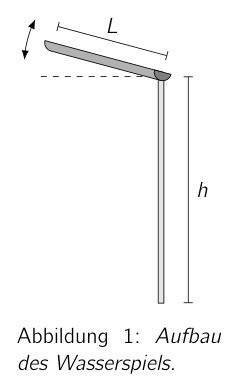 Setup of the water feature
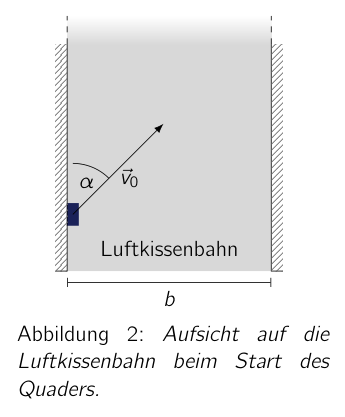 Top view of the air-cushion track at the start
Topic: Newtonian Mechanics, Fluid Mechanics Metodi: Kinematic Equations, Energy Conservation Method, Free-Body Diagram, Conservation of Energy Competenze: Mathematical Modeling, Physical Reasoning Objects: Tube, Block Fonte: Testo (PDF) — p.3
Il problema 1 è quello dei meccanici di divertimento (cfr. punto 10 + 10) E’ ora di divertirsi con la fisica! In una mostra di mani a mani evidentemente messa in piedi specialmente per persone entusiaste della fisica, ci sono tutti i tipi di cose da scoprire. Date un’occhiata a due mostre meccaniche E convincere te stesso. 1.1 Water feature A una delle prime stazioni si può versare acqua all’estremità superiore in un canale di lunghezza , che scorre fuori dal canale alla fine inferiore. Il canale è, come mostrato accanto, fisso all’estremità inferiore a height above the ground. L’estremità superiore del canale, Tuttavia, puoi variare in altezza. L’altezza dell’alto fine evidentemente influisce su quanto lontano viaggia un jet d’acqua prima di colpire il suolo. 1.a) Determina circa il massimo di gamma orizzontale, dall’estremità inferiore del canale, che si può raggiungere con il jet d’acqua, e quale angolo il canale deve fare con l’orizzontale per farlo. (cfr. Potete presumere che l’acqua si muova senza attrito e che E’ versato nel canale con velocità negligible. h L Figura 1: Impostazione della caratteristica dell’acqua. 1.2 Air cushion track and friction against a wall Un altro punto saliente dell’esposizione è il tracciato dell’aria cuscina, su che un piccolo, piatto cuboide di massa m si muove senza attrito, come illustrato nella figura adiacente. Il tracciato dell’aria cuscina è limitato su due lati da pareti fisse a distanza b
- È strano. Considerare il caso in cui lanciare il cuboid dal muro sinistro con a velocità at an angle of to the wall. Con ogni collisione con un muro, la velocità del La cuboide lungo le pareti diminuisce, anche se le deformazioni che si verificano possono essere presunte elastic. Dopo il Quinto collasso, il cuboide ha praticamente nessuna velocità lungo i muri, più e più, si muove avanti e indietro perpendicolare tra i muri. b Traccia a cuscino Figura 2: Top vista of La pista di cuscino aereo at La lancio di
- Cuboide. 1.b) Determine il coefficiente di frattura cinetica tra muro e cuboide e dà un’espressione per la distanza totale percorsa dal cuboide lungo le pareti (upwards in the sketch) come funzione delle quantità indicate. (cfr. Per la soluzione, supponiamo che il cuboide non ruota durante il movimento. 49° IPhO 2018 - Problemi del 2° round 4 / 7
Setup of the water feature
Top view of the air-cushion track at the start
Topic: Newtonian Mechanics, Fluid Mechanics Metodi: Kinematic Equations, Energy Conservation Method, Free-Body Diagram, Conservation of Energy Competenze: Mathematical Modeling, Physical Reasoning Objects: Tube, Block Fonte: Testo (PDF) — p.3
Problem 1 Mechanical amusements (including the following: Time for physics fun! In a hands-on exhibition evidently set up especially for people enthusiastic about physics, there is all kinds of things to discover. Take a closer look at two mechanical exhibits and convince yourself. 1.1 Water feature At one of the first stations you can pour water at the upper end into a channel of length , which runs out of the channel at the lower end. The channel is, as shown alongside, fixed at the lower end at a height above the ground. The upper end of the channel, However, you can vary in height. The height of the upper end evidently influences how far a water jet travels before it hits the ground.
- (a) Determine approximately the maximum horizontal range, measured from the lower end of the channel, that you can reach with the water jet, And what angle the channel must make with the horizontal to do so. (Page 10) You may assume that the water moves without friction and that It’s poured into the channel with negligible velocity. h L Figure 1: Setup of the water feature. 1.2 Air cushion track and friction against a wall Another highlight of the exhibition is the air-cushion track, on which a small, flat cuboid of mass m moves without friction, as sketched in the adjacent figure. The air cushion track is bounded on two sides by fixed walls a distance b It’s weird. Consider the case in which you launch the cuboid from the left wall with a velocity at an angle of to the wall. With each collision with a wall, the velocity of the cuboid along the walls decreases, even though the deformations occurring can be assumed elastic. After the Fifth collision, the cuboid has practically no velocity along the walls any more and merely moves back and forth perpendicularly between the walls. b Air cushion track Figure 2: Top of the line view of The Air cushion track at The launch of the The cuboid. 1.b) Determine the coefficient of kinetic friction between wall and cuboid and give an expression for the total distance travelled by the cuboid along the walls (upwards in the sketch) as a function of the given quantities. (Page 10) For the solution, assume that the cuboid does not rotate during motion. 49th IPhO 2018 - Problems of the 2nd Round 4 / 7
Setup of the water feature
Top view of the air cushion track at the start
Topic: Newtonian Mechanics, Fluid Mechanics Metodi: Kinematic Equations, Energy Conservation Method, Free-Body Diagram, Conservation of Energy Competenze: Mathematical Modeling, Physical Reasoning Objects: Tube, Block Fonte: Testo (PDF) — p.3
Problem 2 Quantum Effects of Electrons in Magnetic Fields (23+17 pts.) The Bohr atomic model, developed at the beginning of the 20th century, for the first time allowed a theoretical explanation of the size of atoms as well as of spectral lines in the hydrogen atom. Even though the model is based on postulates that contradict, for example, classical mechanics and electrodynamics, and although more precise experiments revealed inadequacies of the model, it was extraordinarily successful. Even today, many depictions of atoms feature the orbits of the electrons around the atomic nucleus typical of the Bohr atomic model. The basic assumption of the Bohr atomic model is that the electrons of an atom move without loss of energy in circular orbits around the atomic nucleus. Only those circular orbits are allowed for which the orbital angular momentum is an integer multiple of the reduced Planck constant with J s. This condition can be expressed via the momentum of the electron along the circular orbit and its radius by
with an arbitrary integer that labels the quantum level1. When an atom is in an external magnetic field, this quantisation condition must be modified. For an electron of charge moving on a circular orbit oriented perpendicular to the direction of a homogeneous and constant magnetic field whose magnetic flux density has magnitude , the quantisation condition reads2
With the help of this quantisation condition, a number of fascinating quantum phenomena can be explained. That is exactly what you are to work through in the following. For this, assume in this problem that the electrons can be treated as non-relativistic particles and neglect the magnetic moment of the electron due to its spin3. According to the Pauli principle, each quantum state can then contain only one electron. 2.1 Unexpected currents Classically, a current proportional to the voltage across the material flows through a piece of metal connected to a voltage source. In a very small and thin metal ring, however, a current can flow at low temperatures even entirely without an external voltage source. To explain this current, consider a ring of radius r containing a large number N of conduction electrons of mass m. Assume that the electrons can move only along the ring and are thus restricted to one-dimensional motion. 2.a) Calculate the energy levels with of the electrons that are possible according to Bohr quantisation under the influence of a magnetic field of flux density oriented perpendicular to the motion. Show that for the energy levels and are different. (4 pts.) 1In many depictions of the Bohr atomic model only positive values for n are considered. The negative values account for the two possible senses of revolution of the electron, and the inclusion of the value n = 0 also allows the quantum-mechanically possible state with vanishing orbital angular momentum. 2cf. e.g. Canuto & Kelly (1972). Hydrogen atom in intense magnetic field. Astrophysics and Space Science, 17(2), 277-291. 3For electrons in strong magnetic fields this is a suitable assumption, since their spin aligns in the magnetic field. 49th IPhO 2018 - Problems of the 2nd Round 5 / 7 When the strength of the magnetic field is increased, the possible energy levels of the electrons also change. For certain values of the change of the magnetic flux density, however, the spectrum of energy levels is mapped onto itself. 2.b) Determine the smallest nonzero value of for which the spectrum of energy levels remains unchanged. (3 pts.) 2.c) Give an expression for the current in the ring produced by an electron in the -th quantum level. (2 pts.) Electrons are fermions. According to the Pauli principle, each quantum state can therefore be occupied by at most one electron. At very low temperatures the electrons in the ring occupy the states with the lowest possible energies. 2.d) Derive an expression for the total current flowing through the ring at very low temperatures and for a given number of electrons N as a function of the magnetic flux density, and sketch qualitatively the behaviour of . The magnetic flux density should vary over a range of a few around . (8 pts.) 2.e) Calculate the maximum current produced by this effect in an aluminium ring with a radius of and an electron density along the ring of . The quantity gives the number of electrons per ring length. Compare the value of the maximum current with the estimate . Here is the so-called Fermi velocity of an electron, which is obtained by setting the kinetic energy of the electron equal to the Fermi energy of aluminium. (3 pts.) At higher temperatures the electrons occupy not only the lowest energy levels but also states of higher energy. The investigated effect then disappears. 2.f) For the ring from the last part of the problem, roughly estimate the temperature above which the effect no longer occurs. (3 pts.) 2.2 The quantum Hall effect With the help of Bohr quantisation, the quantum Hall effect can also be explained on a model system. To this end, consider a system of electrons at low temperatures that can move exclusively in a plane. The electrons are in a strong magnetic field of constant flux density B, oriented perpendicular to the plane. When a voltage U is applied along a direction in the plane, this leads to a current of magnitude in the plane, but perpendicular to the voltage. Unlike the classical Hall effect, the Hall current in the quantum Hall effect is not a linear function of the magnetic field strength, but can take only the values with . The quantity is called the von Klitzing constant. 2.g) The von Klitzing constant is a quantity composed of fundamental constants of nature. Determine an expression for that involves only the Planck constant , the elementary charge and the speed of light . Any numerical factors may be set to 1. (3 pts.) The next parts of the problem are intended to illustrate the mechanism that leads to the quantum Hall effect, with the help of the Bohr quantisation condition. 49th IPhO 2018 - Problems of the 2nd Round 6 / 7 2.h) Under the influence of the magnetic field, the electrons in the plane move on circular orbits, the so-called cyclotron orbits. Use the Bohr quantisation condition and determine the radii of the quantised cyclotron orbits as well as their energy levels . (3 pts.) Now consider an additional, weak electric field of constant field strength applied in the plane. 2.i) Show, without taking quantum effects into account, that the cyclotron orbits of the electrons under the influence of the electric and magnetic fields perform a drift motion perpendicular to the electric and magnetic fields with a drift velocity of magnitude . (5 pts.) In the following, the situation shown in Figure 3 is to be studied. The electrons move in an annulus with inner radius and outer radius with . A voltage U is applied between the inner and outer radius. Assume that the voltage leads to a radial electric field of constant field strength E in the annulus. Perpendicular to the annulus runs a magnetic field of constant flux density B. Owing to the magnetic field, the electrons move on quantised cyclotron orbits whose radius is assumed to be much smaller than the distance .
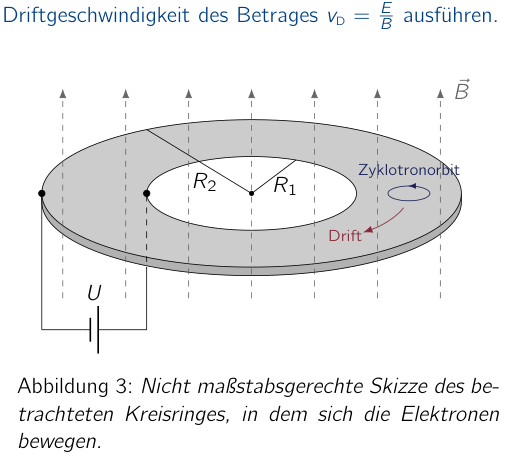 Annulus with cyclotron orbits
Topic: Modern-Quantum Physics, Magnetism, Circuits Metodi: Bohr Model & Quantization, Lorentz Force Analysis, Dimensional Analysis, Simple Harmonic Motion Analysis Competenze: Mathematical Modeling, Physical Reasoning, Estimation & Approximation Objects: Electron, Atom, Nucleus Fonte: Testo (PDF) — p.4
Problema 2 Effetti quantistici degli elettroni nei campi magnetici (cfr. 23+17 pts.) Il modello atomico di Bohr, sviluppato all’inizio del XX secolo, per la prima volta ha permesso un teorico spiegazione della dimensione degli atomi e delle linee spettrali nell’atomo di idrogeno. Anche se il modello è basato su postulati che contraddicono, per esempio, la meccanica classica e l’elettrodinamica, e anche se esperimenti più precisi hanno rivelato inadeguatezza del modello, è stato straordinariamente successo. Anche oggi, molte rappresentazioni di atomi presentano le orbite degli elettroni intorno al nucleo atomico tipico del foraggio. modello atomico. L’ipotesi di base del modello atomico di Bohr è che gli elettroni di un atomo si muovono senza perdita di energia in orbite circolari intorno al nucleo atomico. Solo quelle orbite circolari sono permesse per le quali il momento angolare orbitale è un multiple intero della costante di Planck ridotta con Js. Questa condizione può essere espressa attraverso il momentum dell’elettrone lungo il Circolare e radius by
con un intero arbitrario che etichetta il livello quantistico1. Quando un atomo è in un campo magnetico esterno, questa condizione di quantizzazione deve essere modificata. Per un elettrone di carica che si muove su un’orbita circolare orientata perpendicolare alla direzione di un campo magnetico omogeneo e costante il cui flusso magnetico è densità ha magnitude , the quantisation condition reads2
Con l’aiuto di questa condizione di quantizzazione, un certo numero di fenomeni quantistici affascinanti può essere spiegato. Questo è esattamente quello che si deve lavorare attraverso nel seguente. Per questo, supponiamo in questo problema che gli elettroni possono essere trattati come particelle non relativistiche e trascurano il momento magnetico dell’elettrone a causa del suo spin3. Secondo il Il principio di Pauli, ogni stato quantistico può quindi contenere solo un elettrone. 2.1 Correnti inaspettati Classicamente, una corrente proporzionale alla tensione attraverso il materiale scorre attraverso un pezzo di metallo collegato a una fonte di tensione. In un anello metallico molto piccolo e sottile, tuttavia, una corrente può fluire a basso temperature pari completamente senza una fonte di tensione esterna. Per spiegare questo corrente, considerate un anello di raggio r contenente un numero grande N di massa m. Supponiamo che gli elettroni possano muoversi solo lungo l’anello e sono quindi limitati al movimento unidimensional. 2.a) Calcolare i livelli di energia con degli elettroni che sono possibili secondo la quantizzazione di un forno under the influence of a magnetic field of flux density oriented perpendicular to the motion. Show that for the energy levels and are different. - 4 punti 1In molte descrizioni del modello atomico di Bohr sono considerati solo valori positivi per n. I valori negativi account for the two possible senses of revolution of the electron, and the inclusion of the value n = 0 permette anche lo stato quantomeccanically possible with vanishing orbital angular momentum. 2cf. e.g. Canuto & Kelly (1972). Atomo di idrogeno in un campo magnetico intenso. Astrophysics and Space Science, 17 277-291. 3Per gli elettroni in campi magnetici forti questa è un’ipotesi appropriata, poiché il loro spin si allinea nel campo magnetico. 49° IPhO 2018 - Problemi del 2° round 5 / 7 Quando la forza del campo magnetico è aumentata, i possibili livelli di energia del campo magnetico sono aumentati. Gli elettroni cambiano. Per alcuni valori del cambiamento della densità del flusso magnetico, tuttavia, lo spettro è stato di livelli di energia è mappato su se stesso. 2.b) Determina il più piccolo valore non-zero di per il quale il spettro di livelli di energia rimane invariato. (3 punti) 2.c) Give an expression for the current in the ring produced by an electron in the -th Il livello quantistico. - 2 punti Gli elettroni sono fermioni. Secondo il principio di Pauli, ogni stato quantistico può quindi essere occupato da un elettrone. A temperature molto basse gli elettroni nell’anello occupano il Stati con le energie più basse possibili. 2.d) Derivare un’espressione per il corrente totale che fluisce attraverso il ring a temperature molto basse e per un determinato numero di elettroni N a funzione della densità del flusso magnetico, e schizzi qualitativamente il comportamento di . La densità del flusso magnetico dovrebbe variare oltre un range of a few around . (8 p.) 2.e) Calcolare il massimo corrente prodotto da questo effetto in un anello di alluminio con un radius di e una densità di elettroni lungo l’anello di . La quantità dà il numero di elettroni per lunghezza di anello. Compare il valore del massimo corrente con l’estimo . Qui è il cosiddetto Fermi velocity of an electron, which is obtained by setting the kinetic energy di l’elettrone pari alla energia Fermi di alluminio. (3 punti) A temperature più elevate gli elettroni occupano non solo i livelli di energia più bassi, ma anche Stati di energia superiore. L’effetto investigato allora scompare. 2.f) Per il ring from the last part of the problem, approximate the temperature above which the effect non più occorre. (3 punti) 2.2 L’effetto quantum Hall Con l’aiuto della quantizzazione di Bohr, l’effetto Hall quantum può anche essere spiegato su un sistema modello. Per questo, consideriamo un sistema di elettroni a basse temperature che possono muoversi esclusivamente in un piano. Gli elettroni sono in un forte campo magnetico di densità di flusso costante B, orientato perpendicolare al piano. Quando un voltage U è applicato lungo una direzione nel piano, Questo porta a un corrente di magnitudo nel piano, ma perpendicolare al voltage. A differenza dell’effetto classico Hall, il corrente di Hall nel effetto Hall quantum non è un Funzione lineare della forza del campo magnetico, ma può prendere solo i valori con . La quantità è chiamata costante di Klitzing. 2. g) La costante di Klitzing è una quantità composta da costanti fondamentali di natura. Determine un’espressione per che coinvolge solo la costante di Planck , il carico elementare e la velocità di luce . Any numerical factors may be set to 1. (3 punti) Le parti successive del problema sono intese ad illustrare il meccanismo che porta all’effetto Hall quantum, con l’aiuto di di questa condizione di quantizzazione. 49° IPhO 2018 - Problemi del 2° round 6 / 7 2.h) Sotto l’influenza del campo magnetico, gli elettroni del piano si muovono in orbite circolari, le cosiddette orbite del ciclotrone. Usare la condizione di quantizzazione di Bohr e determinare il raggio delle orbite di ciclotrone quantizzate e i loro livelli di energia . (3 punti) Now consider an additional, weak electric field of constant field strength applied in the
- Pianificare.
- (i) Sosteni, senza prendere in considerazione gli effetti quantistici, che le orbite degli elettroni sotto il ciclotrone l’influenza dei campi elettrici e magnetici eseguono un movimento di deriva perpendicolare ai campi elettrici e magnetici con una velocità di deriva di magnitudo . (cfr. In seguito, la situazione mostrata in figura 3 è da studiare. Gli elettroni si muovono in un annulo con raggio interno e radius esterno with . Una voltage U è applicata tra il raggio interno ed esterno. Supponiamo che il voltage conduce a un campo elettrico radial di forza di campo costante E nell’annulo. Perpendicolare all’annulo campo magnetico di densità di flusso costante B. A causa del campo magnetico, gli elettroni si muovono su orbite ciclotroniche quantizzate il cui raggio è presunto essere molto più piccolo della distanza .
Annulus with cyclotron orbits
Topic: Modern-Quantum Physics, Magnetism, Circuits Metodi: Bohr Model & Quantization, Lorentz Force Analysis, Dimensional Analysis, Simple Harmonic Motion Analysis Competenze: Mathematical Modeling, Physical Reasoning, Estimation & Approximation Objects: Electron, Atom, Nucleus Fonte: Testo (PDF) — p.4
Problem 2 Quantum effects of electrons in magnetic fields (including the following: The Bohr atomic model, developed at the beginning of the 20th century, for the first time allowed a theoretical The explanation of the size of atoms as well as of spectral lines in the hydrogen atom. Even though the model It was based on postulates that contradicted, for example, classical mechanics and electrodynamics, and although more precise experiments revealed inadequacies of the model, it was extraordinarily successful. Even today, many depictions of atoms feature the orbits of the electrons around the atomic nucleus typical of the bore. The atomic model. The basic assumption of the Bohr atomic model is that the electrons of an atom move without loss of energy in circular orbits around the atomic nucleus. Only those circular orbits are allowed for which the orbital angular momentum is an integer multiple of the reduced Planck constant with Js. This condition can be expressed via the momentum of the electron along the circular orbit and its radius by
with an arbitrary integer that labels the quantum level1. When an atom is in an external magnetic field, this quantization condition must be modified. For an electron of charge moving on a circular orbit oriented perpendicular to the direction of a homogeneous and constant magnetic field whose magnetic flux density has magnitude , the quantization condition reads2
With the help of this quantization condition, a number of fascinating quantum phenomena can be explained. That’s exactly what you’re going to work through in the following. For this, assume in this problem that the electrons can be treated as non-relativistic particles and neglect the magnetic moment of the electron due to its spin3. According to the Pauli principle, each quantum state can then contain only one electron. 2.1 Unexpected currents Classically, a current proportional to the voltage across the material flows through a piece of metal connected to a voltage source. In a very small and thin metal ring, however, a current can flow at low temperatures even entirely without an external voltage source. To explain this current, consider a ring of radius r containing a large number N of conduction electrons of mass m. Assume that the electrons can move only along the ring and are thus restricted to one-dimensional motion. 2.a) Calculate the energy levels with of the electrons that are possible according to bore quantization under the influence of a magnetic field of flux density oriented perpendicular to the motion. Show that for the energy levels and are different. The Commission has also adopted a proposal for a directive on the protection of workers’ rights. 1In many depictions of the Bohr atomic model only positive values for n are considered. The negative values account for the two possible senses of revolution of the electron, and the inclusion of the value n = 0 also allows The quantum-mechanically possible state with vanishing orbital angular momentum. 2cf. e.g. Canuto and Kelly (1972). Hydrogen atom in an intense magnetic field. The following is a list of the countries of the European Union: 277-291. 3For electrons in strong magnetic fields this is a suitable assumption, since their spin aligns in the magnetic field. 49th IPhO 2018 - Problems of the 2nd Round 5 / 7 When the strength of the magnetic field is increased, the possible energy levels of the magnetic field are increased. electrons change. For certain values of the change of the magnetic flux density, however, the spectrum of energy levels is mapped onto itself. 2.b) Determine the smallest nonzero value of for which the spectrum of energy levels remains unchanged. (Page 3 of this report) 2.c) Give an expression for the current in the ring produced by an electron in the -th The quantum level. (c) the number of persons who are not members of the Electrons are fermions. According to the Pauli principle, each quantum state can therefore be occupied by at most One electron. At very low temperatures the electrons in the ring occupy the States with the lowest possible energy. 2.d) Derive an expression for the total current flowing through the ring at very low temperatures and for a given number of electrons N as a function of the magnetic flux density, and qualitatively sketch the behaviour of . The magnetic flux density should vary over a range of a few around . (Page 86) 2.e) Calculate the maximum current produced by this effect in an aluminium ring with a radius of and an electron density along the ring of . The quantity gives the number of electrons per ring length. Compare the value of the maximum current with the estimate . Here is the so-called Fermi velocity of an electron, which is obtained by setting the kinetic energy of the electron equal to the Fermi energy of aluminium. (Page 3 of this report) At higher temperatures the electrons occupy not only the lowest energy levels but also the lowest energy levels. The Commission has already adopted a proposal for a regulation on the use of the energy sector in the Community. The investigated effect then disappears. 2.f) For the ring from the last part of the problem, roughly estimate the temperature above which the effect No more occurs. (Page 3 of this report) 2.2 The quantum Hall effect With the help of Bohr quantization, the quantum Hall effect can also be explained on a model system. To this end, consider a system of electrons at low temperatures that can move exclusively in a plane. The electrons are in a strong magnetic field of constant flux density B, oriented perpendicular to the plane. When a voltage U is applied along a direction in the plane, This leads to a current of magnitude in the plane, but perpendicular to the
- What? Unlike the classical Hall effect, the Hall current in the quantum Hall effect is not a linear function of the magnetic field strength, but can take only the values with . The quantity is called the von Klitzing constant.
- (g) The von Klitzing constant is a quantity composed of fundamental constants of nature. Determine an expression for that involves only the Planck constant , the elementary charge and the speed of light . Any numerical factors may be set to 1. (Page 3 of this report) The next parts of the problem are intended to illustrate the mechanism that leads to the quantum Hall effect, with the help of the of the drill quantity condition. 49th IPhO 2018 - Problems of the 2nd Round 6 / 7 2.h) Under the influence of the magnetic field, the electrons in the plane move on circular orbits, The so-called cyclotron orbits. Use the Bohr quantization condition and determine the radii of the quantised cyclotron orbits as well as their energy levels . (Page 3 of this report) Now consider an additional, weak electric field of constant field strength applied in the I’m going to plan.
- (i) Show, without taking quantum effects into account, that the cyclotron orbits of the electrons under the influence of the electric and magnetic fields perform a drift motion perpendicular to the electric and magnetic fields with a drift velocity of magnitude . (five points) In the following, the situation shown in Figure 3 is to be studied. The electrons move into an annulus with inner radius and outer radius with . A voltage U is applied between the inner and outer radius. Assume that the voltage leads to a radial electric field of constant field strength E in the annulus. Perpendicular to the annulus runs a magnetic field of constant flux density B. Because of the magnetic field, the electrons move on quantized cyclotron orbits whose radius is assumed to be much smaller than the distance .
Annulus with cyclotron orbits
Topic: Modern-Quantum Physics, Magnetism, Circuits Metodi: Bohr Model & Quantization, Lorentz Force Analysis, Dimensional Analysis, Simple Harmonic Motion Analysis Competenze: Mathematical Modeling, Physical Reasoning, Estimation & Approximation Objects: Electron, Atom, Nucleus Fonte: Testo (PDF) — p.4
Problem 3 Experimental Problem - Nothing but Air (20+20 pts.) For an ideal gas4, the equation of state, also called the general gas equation,
establishes a relation between the pressure , the volume , the amount of substance and the temperature of the gas. The quantity J denotes the universal gas constant. Air can to a good approximation be regarded as an ideal gas. In this problem you are to carry out two experiments with air and thereby determine the thermal volume expansion coefficient of air as well as the air pressure. The experiments are intended as home experiments. You should therefore not resort to the full equipment of the school’s collection, but devise a suitable experimental setup yourself. Besides air, you may use the following materials for the experiments: thermometer, various vessels, tubes, plug material for sealing the tubes, ruler, folding rule or jointed measuring stick, adhesive tape, warm and cold water as well as other typical household items. Please use only the specified materials. Otherwise a deduction of points may result. General notes on the experimental problem • Carry out all experiments so that the results are as accurate as possible. Note that the results are generally more accurate if you determine your results from series of measurements rather than from single measurements. • Describe and document your procedure in enough detail that every step is easy to follow. In particular, sketch your experimental setups. • In addition, estimate the errors of all results sensibly. 3.1 Volume expansion When a gas is heated, it expands. For changes of the temperature that are small compared with the initial temperature , the change of the gas volume at constant pressure is approximately proportional to and to the gas volume at temperature . Thus:
The quantity is the thermal volume expansion coefficient, which for this problem you may assume to be constant in the range of around room temperature. 3.a) Experimentally determine the thermal volume expansion coefficient of air at room temperature. Derive an expression for the value theoretically expected for an ideal gas and compare it with your result. (20 pts.) 3.2 Air pressure 3.b) Experimentally determine the air pressure and compare your value with the current air pressure at the experiment site. The latter you can either research on the internet or determine with the help of another barometer. (20 pts.) For the gravitational acceleration on Earth you may use the value and for the density of water . 4An ideal gas denotes an idealised model conception of a gas in which the gas particles are assumed to be point-like and can move freely apart from collisions. Many gases behave to a good approximation like ideal gases.
Topic: Thermodynamics Metodi: Ideal Gas Law, Experimental Data Analysis, Error Propagation Competenze: Experimental Data Analysis, Error Propagation, Graph Linearization Objects: Gas, Tube Fonte: Testo (PDF) — p.7
Problema 3 Problema sperimentale - Niente ma aria (cfr. Per un gas ideale4, l’equazione di stato, chiamata anche l’equazione generale del gas,
Stabilisce una relazione tra la pressione , il volume , la quantità di sostanza e la temperatura del gas. La quantità J indica la costante universale del gas. Air La sua capacità di riproduzione è di circa un milione di unità. In questo problema dovete fare due esperimenti. con aria e determinare quindi il coefficiente di espansione del volume termico dell’aria e il
- Presione dell’aria. Gli esperimenti sono destinati a essere fatti a casa. Non dovresti quindi ricorrere alla completa attrezzatura della collezione della scuola, ma ideare una configurazione sperimentale appropriata da solo. Oltre all’aria, puoi usare i seguenti materiali per gli esperimenti: termometri, vari vascelli, tubi, materiale di plug per la sigillazione dei tubi, ruoli, regola di ripiegamento o jointed measuring stick, adesive tape, warm and cold water, nonché altri tipici oggetti domestici. Per favore, utilizzate solo i materiali specificati. In caso contrario, una deduzione di punti può essere
- il risultato. Nota generale sul problema sperimentale • eseguire tutti gli esperimenti in modo che i risultati siano il più accurati possibile. Si noti che il I risultati sono generalmente più accurati se si determinano i risultati da serie di misurazioni piuttosto che da
- misurazioni singole. • Descrivere e documentare la procedura in sufficiente dettaglio in modo che ogni passo sia facile da seguire. In particolare, schizziare le tue configurazioni sperimentali. • Inoltre, stimare sensibilmente gli errori di tutti i risultati. 3.1 Espansione del volume Quando un gas si riscaldano, si espandono. Per i cambiamenti della temperatura che sono piccoli rispetto al La temperatura iniziale , il cambiamento del volume del gas a pressione costante è circa proporzionale a e al volume del gas a temperatura . Così:
Il quantity è il coefficiente di espansione del volume termico, che per questo problema si può assumere di essere costante nel range di attorno alla temperatura ambiente. 3. (a) Determinare sperimentalmente il coefficiente di espansione del volume termico dell’aria a temperatura ambiente. Derive an expression for the value theoretically expected for an ideal gas e confrontalo con il tuo risultato. (cfr. 3.2 Presione dell’aria 3.b) Determina sperimentalmente la pressione dell’aria e confronta il tuo valore con la pressione corrente dell’aria
- Al sito dell’esperimento. L’ultimo è possibile ricercare su Internet o determinare con l’aiuto di
- Un altro barometro. (cfr. Per l’accelerazione gravitazionale sulla Terra si può usare il valore e per la densità di water . 4Un gas ideale indica un modello idealizzato di concezione di un gas in cui le particelle del gas sono presunte di essere punt-like e possono muoversi liberamente separate dalle collisioni. Molti gas si rivendicano ad una buona approssimazione Come i gas ideali.
Topic: Thermodynamics Metodi: Ideal Gas Law, Experimental Data Analysis, Error Propagation Competenze: Experimental Data Analysis, Error Propagation, Graph Linearization Objects: Gas, Tube Fonte: Testo (PDF) — p.7
Problem 3 Experimental problem - Nothing but air (including the following: For an ideal gas4, the equation of state, also called the general gas equation,
establishes a relation between the pressure , the volume , the amount of substance and the temperature of the gas. The quantity J denotes the universal gas constant. Air can be considered an ideal gas. In this problem you are to carry out two experiments with air and thereby determine the thermal volume expansion coefficient of air as well as the air pressure. The experiments are intended as home experiments. You should therefore not resort to the full equipment of the school’s collection, but devise a suitable experimental setup yourself. In addition to air, you may use the following materials for the experiments: thermometer, various vessels, tubes, plug material for sealing the tubes, ruler, folding rule or jointed measuring stick, adhesive tape, warm and cold water as well as other typical household items. Please use only the specified materials. Otherwise a deduction of points may be The result. General notes on the experimental problem • Perform all experiments so that the results are as accurate as possible. Note that the The results are generally more accurate if you determine your results from series of measurements rather than from The following information is provided for in the Annex to this Regulation: • Describe and document your procedure in sufficient detail that every step is easy to follow. In particular, sketch your experimental setups. • In addition, estimate the errors of all results sensibly. 3.1 Volume expansion When a gas is heated, it expands. For changes of the temperature that are small compared with the initial temperature , the change of the gas volume at constant pressure is approximately proportional to and to the gas volume at temperature . Thus:
The quantity is the thermal volume expansion coefficient, which for this problem you may assume to be constant in the range of around room temperature. 3. (a) Experimentally determine the thermal volume expansion coefficient of air at room temperature. Derive an expression for the value theoretically expected for an ideal gas and compare it with your result. The Commission shall adopt implementing acts in accordance with Article 21 of this Regulation. 3.2 Air pressure 3.b) Experimentally determine the air pressure and compare your value with the current air pressure At the experiment site. The latter you can either research on the internet or determine with the help of Another barometer. The Commission shall adopt implementing acts in accordance with Article 21 of this Regulation. For the gravitational acceleration on Earth you may use the value and for the density of water . 4An ideal gas denotes an idealised model conception of a gas in which the gas particles are assumed to be point-like and can move freely apart from collisions. Many gases claim to a good approximation like ideal gases.
Topic: Thermodynamics Metodi: Ideal Gas Law, Experimental Data Analysis, Error Propagation Competenze: Experimental Data Analysis, Error Propagation, Graph Linearization Objects: Gas, Tube Fonte: Testo (PDF) — p.7