Problem 1 (10 points) Circuit puzzle Sophie has built a circuit using two identical light bulbs, a battery and a few resistors, in which both bulbs glow equally brightly. She decides to pose a riddle to her physics teacher: she draws the circuit diagram of her arrangement on a puzzle and gives her teacher the individual pieces. Help the teacher and indicate how the puzzle pieces must be assembled. Justify why, in this arrangement, both bulbs glow equally brightly and why this can be the only possible solution.
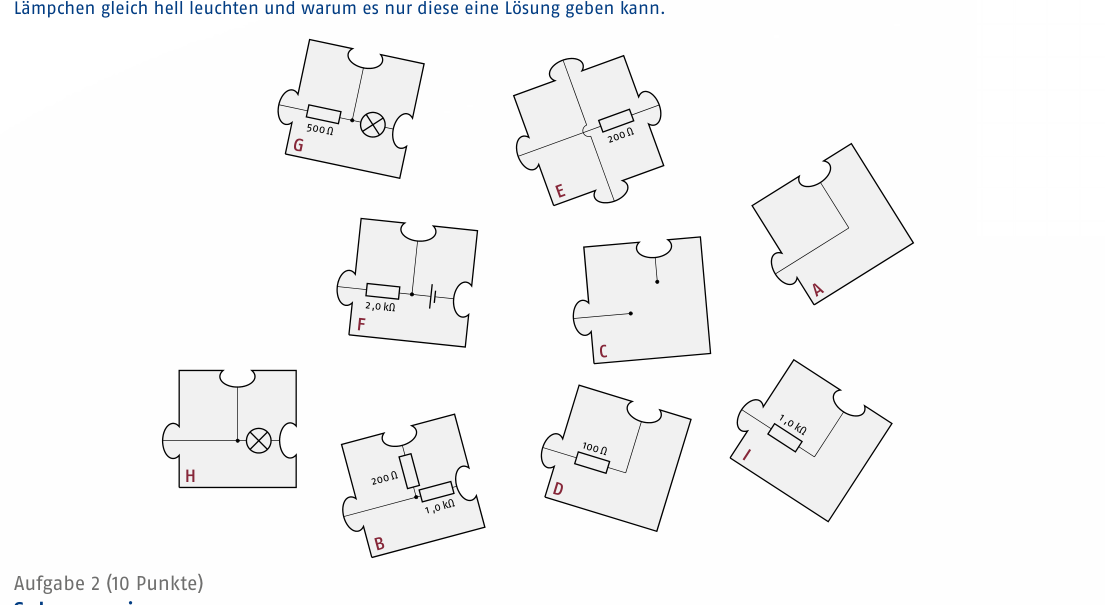 circuit puzzle with resistors and bulbs
Topic: Circuits Metodi: Equivalent Circuit Reduction, Kirchhoff’s Laws, Symmetry Argument Competenze: Physical Reasoning, Diagrammatic Reasoning Objects: Battery, Resistor Fonte: Testo (PDF) — p.2
Problema 1 (10 punti) Puzzle di circuito Sophie ha costruito un circuito utilizzando due lampadine identiche, una batteria e alcuni resistori, in cui entrambe le lampadine brillano ugualmente. Decide di mettere un enigma al suo insegnante di fisica: disegna il circuito di un piano di arrangiamento su un puzzle e dà al suo insegnante i singoli pezzi. Aiuta il maestro e indica come devono essere assemblati i pezzi del puzzle. Giustificare perché, in questo accordo, entrambe le lampadine brillano ugualmente brillante e perché questo può essere l’unica soluzione possibile.
circuit puzzle with resistors and bulbs
Topic: Circuits Metodi: Equivalent Circuit Reduction, Kirchhoff’s Laws, Symmetry Argument Competenze: Physical Reasoning, Diagrammatic Reasoning Objects: Battery, Resistor Fonte: Testo (PDF) — p.2
The following points are added: Circuit puzzle Sophie has built a circuit using two identical light bulbs, a battery and a few resistors, in which both bulbs glow equally brightly. She decides to pose a riddle to her physics teacher: she draws the circuit diagram of her arrangement on a puzzle and gives her teacher the individual pieces. Help the teacher and indicate how the puzzle pieces must be assembled. Justify why, in this arrangement, both bulbs glow equally brightly and why this can be the only possible solution.
circuit puzzle with resistors and bulbs
Topic: Circuits Metodi: Equivalent Circuit Reduction, Kirchhoff’s Laws, Symmetry Argument Competenze: Physical Reasoning, Diagrammatic Reasoning Objects: Battery, Resistor Fonte: Testo (PDF) — p.2
Problem 2 (10 points) Solar energy In some regions of Israel the sun shines on more than 300 days a year. For a long time, therefore, attempts have been made to make solar radiation usable as a source of energy for the inhabitants of the country. a) Calculate the power of the solar radiation striking one square meter of the Earth’s atmosphere at perpendicular incidence. For the distance from the Sun to the Earth use and for the radius of the Sun itself the value . The surface temperature of the Sun is about . This value is lower at the Earth’s surface owing to attenuation by the Earth’s atmosphere. In what follows, assume a maximum radiation power per unit area of . A few years ago, experiments were carried out in Israel with large parabolic mirrors that focus the incoming sunlight onto a small module. The module can make 75% of the incoming radiation power usable. Of this, one third is converted into electrical energy by photovoltaics. The remaining energy heats water, which is needed for the hot-water supply. b) The parabolic mirror has an effective area of . Calculate the maximum electrical power that the arrangement can provide. c) The water to be heated is pumped into the module at a temperature of about and leaves it at a temperature of . Estimate how much water must be pumped through the module per minute so that it is kept at a constant temperature. Register now at www.ipho.info for the competition! 100 Ω D 1 ,0 kΩ 200 Ω B C 500 Ω G 200 Ω E 2,0 kΩ F A H 1 ,0 kΩ I
Topic: Astrophysics, Thermodynamics Metodi: Physical Modeling, Conservation of Energy, Energy Conservation Method Competenze: Mathematical Modeling, Estimation & Approximation Objects: Star, Mirror Fonte: Testo (PDF) — p.2
Problema 2 (10 punti) Energia solare In alcune regioni di Israele il sole splende su più di 300 giorni all’anno. Per molto tempo, quindi, si sono fatti tentativi di rendere le radiazioni solari utilizzabili come fonte di energia per gli abitanti del paese. a) Calcolare la potenza della radiazione solare che colpisce un metro quadrato dell’atmosfera terrestre ad incidenza perpendicolare. Per la distanza dal Sole alla Terra utilizzare e per il raggio del Sole stesso il valore . La temperatura superficiale del Sole è di circa . Questo valore è inferiore alla superficie terrestre a causa dell’attuazione dell’atmosfera terrestre. In what follows, assume una massima potenza di radiazione per unità di area di . Qualche anno fa, in Israele, sono stati condotti esperimenti con grandi specchi parabolici che concentrano la luce solare in arrivo su un piccolo modulo. Il modulo può rendere utilizzabile il 75% della potenza delle radiazioni in arrivo. Di questo, un terzo è convertito in energia elettrica da fotovoltaica. L’energia residuale riscalda l’acqua, che è necessaria per la fornitura di acqua calda. b) Il parabolic mirror ha un’area efficace di . Calcolare la massima potenza elettrica che l’arrangimento può fornire. c) L’acqua da riscaldare è pompata nel modulo a una temperatura di circa e la lascia a una temperatura di . Estimare quanto acqua deve essere pompata attraverso il modulo al minuto in modo che sia mantenuta a temperatura costante. Registrare ora a www.ipho.info per il La concorrenza! 100 Ω D 1 ,0 kΩ 200 Ω B C 500 Ω G 200 Ω E 2,0 kΩ F A H 1 ,0 kΩ I
Topic: Astrophysics, Thermodynamics Metodi: Physical Modeling, Conservation of Energy, Energy Conservation Method Competenze: Mathematical Modeling, Estimation & Approximation Objects: Star, Mirror Fonte: Testo (PDF) — p.2
Problem 2 (10 points) Solar energy In some regions of Israel, the sun shines on more than 300 days a year. For a long time, therefore, attempts have been made to make solar radiation usable as a source of energy for the inhabitants of the country. (a) Calculate the power of the solar radiation striking one square meter of the Earth’s atmosphere at perpendicular incidence. For the distance from the Sun to the Earth use and for the radius of the Sun itself the value . The surface temperature of the Sun is about . This value is lower at the Earth’s surface due to attenuation by the Earth’s atmosphere. In what follows, assume a maximum radiation power per unit area of . A few years ago, experiments were conducted in Israel with large parabolic mirrors that focus the incoming sunlight on a small module. The module can make 75% of the incoming radiation power usable. Of this, one third is converted into electrical energy by photovoltaics. The remaining energy heats water, which is needed for the hot water supply. (b) The parabolic mirror has an effective area of . Calculate the maximum electrical power that the arrangement can provide. (c) The water to be heated is pumped into the module at a temperature of about and leaves it at a temperature of . Estimate how much water must be pumped through the module per minute so that it is kept at a constant temperature. Register now at The Commission has also adopted a proposal for a regulation on the protection of the environment. for the Competition! 100 Ω D 1 ,0 kΩ 200 Ω B C 500 Ω G 200 Ω E 2,0 kΩ F A H 1 ,0 kΩ I
Topic: Astrophysics, Thermodynamics Metodi: Physical Modeling, Conservation of Energy, Energy Conservation Method Competenze: Mathematical Modeling, Estimation & Approximation Objects: Star, Mirror Fonte: Testo (PDF) — p.2
Problem 3 (10 points) Smoke trails Two ships travel at a constant speed of 16 knots along straight courses. The accompanying scale drawing shows the crossing paths of the ships as well as the smoke trails emanating from the ships’ funnels, viewed from above. A wind blowing at constant speed from a constant direction carries the smoke along with it. Determine the wind direction and the wind speed.
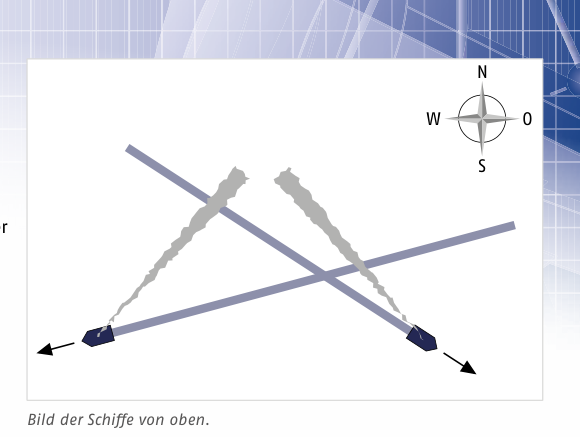 ships crossing, smoke and compass
Topic: Newtonian Mechanics Metodi: Vector Decomposition, Physical Modeling, Kinematic Equations Competenze: Diagrammatic Reasoning, Physical Reasoning Objects: — Fonte: Testo (PDF) — p.3
Problema 3 (10 punti) Tracce di fumo Due navi viaggiano a velocità costante di 16 nodi lungo rotte rette. Il disegno di scala che accompagna mostra i percorsi di attraversamento delle navi e i sentieri di fumo che emettono dai funelli delle navi, visti da sopra. Un vento che soffia a velocità costante da una direzione costante porta il fumo insieme con esso. Determina la direzione del vento e la velocità del vento.
ships crossing, smoke and compass
Topic: Newtonian Mechanics Metodi: Vector Decomposition, Physical Modeling, Kinematic Equations Competenze: Diagrammatic Reasoning, Physical Reasoning Objects: — Fonte: Testo (PDF) — p.3
Problem 3 (10 points) Smoke trails Two ships travel at a constant speed of 16 knots along straight courses. The accompanying scale drawing shows the crossing paths of the ships as well as the smoke trails emanating from the ships’ funnels, viewed from above. A wind blowing at a constant speed from a constant direction carries the smoke along with it. Determine the wind direction and wind speed.
ships crossing, smoke and compass
Topic: Newtonian Mechanics Metodi: Vector Decomposition, Physical Modeling, Kinematic Equations Competenze: Diagrammatic Reasoning, Physical Reasoning Objects: — Fonte: Testo (PDF) — p.3
Problem 4 (10 points) The pleasure of sucking sweets Experience tells us that a sweet slowly dissolves in the mouth as it is sucked. But how exactly does the size of a sweet change over time? Consider a spherical sweet of homogeneous composition lying in a large quantity of liquid. a) Using suitable assumptions, justify that the diameter of the sweet changes linearly with the “sucking time” as it dissolves. You should also investigate the dissolution behavior experimentally. To do this, obtain a few sweets that are as spherical as possible and of homogeneous composition. b) Place one of the sweets in a fairly large vessel of water and investigate how its size changes over time until it has completely dissolved. Describe your experimental setup and draw up a table of measured values for the diameter of the sweet as a function of time*. c) Produce a graph of the diameter of the sweet as a function of time and check to what extent the expected linear behavior can be confirmed experimentally. In doing so, state possible sources of error in your measurements. *The shape of the sweet will change during dissolution, so you must average the diameter appropriately. Junior problem (10 points) Tokyo Tower The Tokyo Tower, a well-known landmark of the Japanese capital Tokyo, is a steel tower about 333 m tall with a total mass of about 4000 t. a) Estimate by how much the height of the Tokyo Tower varies over the course of a year, and justify your estimate. An ambitious hobbyist builds a realistic model of the Tokyo Tower at a scale of 1:100. In doing so, he uses the same materials as are used in the original. b) Determine the mass of the model. In addition, give the ratio of the pressures that the model and the original exert on the ground. N O S W Photo of the Tokyo Tower. Image of the ships viewed from above. scienceolympiaden.de Show your talent! Who is the IPhO aimed at? Pupils and students If you are a pupil or student, the IPhO and the PhysikOlympiade in Germany offer you many opportunities to engage intensively with physics questions, to experience physics as an exciting scientific discipline, to test your own limits and, not least, to meet interesting people. To prepare for the competition rounds there are learning materials and training problems that help you to deepen your knowledge and problem-solving skills. At the Orpheus seminars you will also meet many other young people who are enthusiastic about physics. Even if you do not make it to the final two rounds, taking part is therefore worthwhile. Moreover, simply passing the first round is already a special achievement and a genuine distinction. So, take heart! Teachers As a teacher, you can use the problems of the selection competition to offer a challenge to pupils who are especially capable in or interested in physics and to encourage them to engage more deeply with physics topics. The IPhO can thus serve as an instrument of individual support. The problems of the first round in particular are not only suited to the very best in a final-year class. Rather, it turns out that engaging early with the competition problems is an important building block for later successful participation and, incidentally, can also be a lot of fun. So do encourage your pupils to submit solutions to individual problems as well; for only those who do not take part can lose. Schools By encouraging participation in competitions, schools can sharpen their profile and use these, in the sense of enrichment, as a complement to the school’s offerings. Competitions provide varied, differentiated learning environments for participating pupils. In the field of the STEM subjects, the Olympiads represent, at least in the later rounds, a competition aimed at especially motivated and high-performing young people. Nevertheless, taking part in the entry rounds too is not only worthwhile but can also contribute to a lasting motivation for STEM topics. In many federal states, by the way, participation can be recognized as a special academic achievement or as a subject/seminar paper for the Abitur by your pupils. Interested in more than just physics? The IPhO is one of the six nationwide science competitions for pupils organized by the IPN – the ScienceOlympiaden. Besides the selection competitions for the international Olympiads in Biology (IBO), Chemistry (IChO) and Physics (IPhO), these include the International JuniorScienceOlympiad (IJSO), the European Science Olympiad (EUSO) and the Federal Environment Competition (BUW). Together they address pupils from the beginning of lower secondary school through to the end of their school years and, with close networking, offer the possibility of lasting support for scientific abilities and interests. Further information can be found at www.scienceolympiaden.de. Dear pupils, dear parents, dear teachers, who would not like to win Olympic gold at least once? The chance to do so is not reserved for exceptional athletes. Young people who are enthusiastic about biology, chemistry and physics can measure their strengths at the ScienceOlympiaden and win medals. A wonderful opportunity for pupils to experience the fascination of the natural sciences. Every year around 10,000 pupils nationwide from the 5th grade onwards register for the science competitions organized by the Leibniz Institute for Science and Mathematics Education and for the Federal Environment Competition. Exciting and tricky problems await them, with which they can discover and further develop their talents. Germany needs these scientific talents. Scientific and technical progress is accelerating rapidly. We cannot predict the future, but we can shape it. And whoever knows a great deal about biology, chemistry, physics and the environment has the best opportunities to take an active part in shaping it. That is why the Federal Ministry of Education and Research has for many years been committed to helping young people discover the world of the natural sciences. For example, we support various competitions for pupils and young people on STEM topics – mathematics, computer science, the natural sciences and technology. It is worthwhile to take part in the competitions. I invite pupils, but also teachers and parents, to discover the ScienceOlympiaden and the Federal Environment Competition together with us, and I wish you much success and enjoyment in doing so. Prof. Dr. Johanna Wanka Federal Minister of Education and Research Dear pupils, dear teachers, dear parents, the ScienceOlympiaden are an excellent opportunity to test, foster and demonstrate scientific talent – even more intensively and independently than is often possible in regular lessons. Competitions such as the ScienceOlympiaden support our pupils in unfolding and further developing their individual gifts. They motivate them to outstanding achievements. But they also convey that participation alone is already worthwhile - regardless of one’s personal result. The Standing Conference of the Ministers of Education and Cultural Affairs therefore gladly recommends participation in the various competitions of the ScienceOlympiaden. Thousands of pupils already take part year after year. For the future viability of a country, the support of high-performing pupils is indispensable. Therefore e
Topic: Fluid Mechanics, Elasticity & Materials, Thermodynamics Metodi: Physical Modeling, Differential Equations, Dimensional Analysis Competenze: Experimental Data Analysis, Graph Linearization, Estimation & Approximation Objects: Sphere Fonte: Testo (PDF) — p.3
Problema 4 (10 punti) Il piacere di succhiare dolci L’esperienza ci dice che un dolce si dissolve lentamente nella bocca quando viene assorbito. Ma come esattamente cambia la dimensione di un dolce nel tempo? Considerare un dolce sferica di composizione omogenea che giace in una grande quantità di liquido. a) Usando ipotesi appropriate, giustificare che il diametro del dolce cambia linearmente con il “sucking time” quando si dissolve. Dovresti anche indagare sul comportamento della dissoluzione sperimentalmente. Per fare questo, ottenere alcuni dolci che sono più sferici possibile e di composizione omogenea. b) Metti uno dei dolci in un vascello abbastanza grande di acqua e indagare come la sua dimensione cambia nel tempo fino a quando non si è completamente dissolto. Descrivere la vostra configurazione sperimentale e disegnare una tabella di valori misurati per il diametro del dolce come funzione di tempo*. c) Produci un grafico del diametro del dolce come funzione di tempo e controlla fino a che punto il comportamento lineare atteso può essere confermato sperimentalmente. In tal modo, indicare possibili fonti di errore nelle vostre misurazioni. La forma del dolce cambierà durante la dissoluzione, quindi devi averne il diametro appropriatamente. Problema minore (10 punti) Torri di Tokyo La Torre di Tokyo, un bel punto di riferimento della capitale giapponese Tokyo, è una torre in acciaio alta circa 333 metri con una massa totale di circa 4000 t. a) Estimare quanto la altezza della Torre di Tokyo varia nel corso di un anno, e giustificare la tua stima. Un ambizioso hobbyist costruisce un modello realistico della Torre di Tokyo su una scala di 1:100. In questo modo, utilizza gli stessi materiali utilizzati nell’originale. b) Determina la massa del modello. Inoltre, si deve indicare il rapporto delle pressioni che il modello e l’originale esercitano sul terreno. N O S W Foto della Torre di Tokyo. Immagine delle navi viste da sopra. sciencesolymppiaden.de Mostra il tuo talento! Chi è l’IPhO mirato? Alunni e studenti Se sei un allievo o studente, l’IPhO e la PhysicsOlympicade in Germania ti offrono molte opportunità per impegnarti intensamente con le domande di fisica, per sperimentare la fisica come una disciplina scientifica eccitante, per testare i tuoi limiti e, non ultimo, per incontrare persone interessanti. Per prepararsi ai round di competizione ci sono materiali di apprendimento e problemi di formazione che ti aiuteranno a approfondire le tue conoscenze e capacità di risoluzione dei problemi. Ai seminari di Orpheus incontrerai anche molti altri giovani entusiasti di fisica. Anche se non arrivi ai due round finali, è quindi utile partecipare. Inoltre, semplicemente passare il primo round è già un risultato speciale e una vera distinzione. Allora, prendi il cuore! Docenti Come insegnante, puoi usare i problemi della competizione di selezione per offrire una sfida agli studenti che sono particolarmente capaci o interessati alla fisica e per incoraggiarli a impegnarsi più profondamente con argomenti di fisica. L’IPhO può quindi servire come strumento di sostegno individuale. I problemi del primo round in particolare non sono solo adatti al meglio in una classe di ultimo anno. Piuttosto, si scopre che l’impegno precoce con i problemi della concorrenza è un importante elemento di costruzione per la partecipazione successiva e, incidentalmente, può anche essere molto divertente. Quindi incoraggi i tuoi alunni a presentare soluzioni anche a problemi individuali, perché solo coloro che non partecipano possono perdere. Scuole Incoraggiando la partecipazione a competizioni, le scuole possono accentuare il loro profilo e utilizzare questi, nel senso di arricchimento, come complemento delle offerte della scuola. Le competizioni forniscono ambienti di apprendimento diversificati e differenziati per gli studenti partecipanti. Nel campo delle materie STEM, le Olimpiadi rappresentano, almeno nei prossimi round, una competizione rivolta a giovani particolarmente motivati e ad alto rendimento. Tuttavia, partecipare ai round di entrata è non solo utile ma può anche contribuire a una motivazione duratura per i temi STEM. In molti stati federali, comunque, la partecipazione può essere riconosciuta come un’academic achievement speciale o come un topic/seminar paper for the Abitur by your pupils. Interessato in più di fisica? L’IPhO è uno dei sei concorsi scientifici nazionali per gli alunni organizzati dall’IPN the ScienceOlympics. Oltre alle competizioni di selezione per le Olimpiadi internazionali in Biologia (IBO), Chimica (IChO) e Fisica (IPhO), queste includono l’International JuniorScienceOlympiad (IJSO), l’European Science Olympiad (EUSO) e la Federal Environment Competition (BUW). Insieme si rivolge agli studenti dall’inizio della scuola secondaria inferiore fino alla fine dei loro anni di scuola e, con una stretta rete, offre la possibilità di supporto duraturo per abilità e interessi scientifici. Ulteriori informazioni sono disponibili su www.scienceolympiaden.de. Cari studenti, cari genitori, Cari insegnanti, Chi non vorrebbe vincere l’oro olimpico almeno una volta? La possibilità di farlo non è riservata agli atleti eccezionali. I giovani che sono entusiasti di biologia, chimica e fisica possono misurare i loro punti di forza alle ScienceOlympics e vincere medaglie. Una meravigliosa opportunità per gli studenti di sperimentare il fascino delle scienze naturali. Ogni anno circa 10.000 studenti a livello nazionale dalla quinta elementare in poi si iscrivono ai concorsi scientifici organizzati dall’Istituto Leibniz per l’istruzione scientifica e matematica e al concorso federale per l’ambiente. Problemi eccitanti e difficili li attendono, con cui possono scoprire e sviluppare ulteriormente i loro talenti. La Germania ha bisogno di questi talenti scientifici. Il progresso scientifico e tecnico è in rapida espansione. Non possiamo prevedere il futuro, ma possiamo plasmarlo. E chi sa molto di biologia, chimica, fisica e ambiente ha le migliori opportunità di prendere parte attiva a formarlo. Ecco perché il Ministero federale dell’Educazione e della Ricerca si è impegnato per molti anni ad aiutare i giovani a scoprire il mondo delle scienze naturali. Per esempio, supportiamo varie competizioni per studenti e giovani su argomenti STEM: matematica, informatica, scienze naturali e tecnologia. È utile partecipare alle competizioni. Invito gli studenti, ma anche gli insegnanti e i genitori a scoprire insieme a noi le ScienceOlympics e il Federal Environment Competition, e vi auguro grande successo e piacere nel farlo. Prof. Dr. Johanna Wanka Ministro federale dell’istruzione e della ricerca Cari studenti, cari insegnanti, cari genitori, Le ScienceOlympiades sono un’ottima opportunità per testare, promuovere e dimostrare il talento scientifico anche più intensamente e indipendentemente di quanto spesso sia possibile nelle lezioni regolari. Concorsi come i ScienceOlympics supportano i nostri alunni a sviluppare e sviluppare ulteriormente i loro doni individuali. Li motivano a raggiungere risultati eccezionali. Ma anche che la partecipazione da sola è già meritevole, indipendentemente dal risultato personale. La Conferenza permanente dei ministri dell’istruzione e degli affari culturali raccomanda quindi con piacere la partecipazione ai vari concorsi delle ScienceOlympics. Migliaia di studenti già partecipano anno dopo anno. Per la futura vitalità di un paese, il sostegno degli studenti ad alto rendimento è indispensabile. Pertanto, e
Topic: Fluid Mechanics, Elasticity & Materials, Thermodynamics Metodi: Physical Modeling, Differential Equations, Dimensional Analysis Competenze: Experimental Data Analysis, Graph Linearization, Estimation & Approximation Objects: Sphere Fonte: Testo (PDF) — p.3
Problem 4 (10 points) The pleasure of sucking sweets Experience tells us that a sweet slowly dissolves in the mouth as it is sucked. But how exactly does the size of a sweet change over time? Consider a spherical sweet of homogeneous composition lying in a large quantity of liquid. (a) Using appropriate assumptions, justify that the diameter of the sweet changes linearly with the “sucking time” as it dissolves. You should also investigate the dissolution behavior experimentally. To do this, obtain a few sweets that are as spherical as possible and of homogeneous composition. (b) Place one of the sweets in a fairly large vessel of water and investigate how its size changes over time until it has completely dissolved. Describe your experimental setup and draw up a table of measured values for the diameter of the sweet as a function of time*. c) Produce a graph of the diameter of the sweet as a function of time and check to what extent the expected linear behavior can be confirmed experimentally. In doing so, state possible sources of error in your measurements. The shape of the sweet will change during dissolution, so you must average the diameter appropriately. The first is the ‘Junior Problem’ (10 points). The Tokyo Tower The Tokyo Tower, a well-known landmark of the Japanese capital Tokyo, is a steel tower about 333 m high with a total mass of about 4000 t. (a) Estimate by how much the height of the Tokyo Tower varies over the course of a year, and justify your estimate. An ambitious hobbyist builds a realistic model of the Tokyo Tower at a scale of 1:100. In doing so, he uses the same materials as are used in the original. (b) Determine the mass of the model. In addition, give the ratio of the pressures that the model and the original exert on the ground. N O S W Photo of the Tokyo Tower. Image of the ships viewed from above. The European Commission has decided to extend the period of validity of the decision. Show your talent! Who is the IPhO aimed at? Pupils and students If you are a student or student, the IPhO and the PhysicsOlympicade in Germany offer you many opportunities to engage intensively with physics questions, to experience physics as an exciting scientific discipline, to test your own limits and, not least, to meet interesting people. To prepare for the competition rounds there are learning materials and training problems that help you to deepen your knowledge and problem-solving skills. At the Orpheus seminars you will also meet many other young people who are enthusiastic about physics. Even if you don’t make it to the final two rounds, taking part is therefore worthwhile. Moreover, simply passing the first round is already a special achievement and a genuine distinction. So, take heart! Teachers As a teacher, you can use the problems of the selection competition to offer a challenge to pupils who are especially capable in or interested in physics and to encourage them to engage more deeply with physics topics. The IPhO can thus serve as an instrument of individual support. The problems of the first round in particular are not only suited to the very best in a final-year class. Rather, it turns out that engaging early with the competition problems is an important building block for later successful participation and, incidentally, can also be a lot of fun. So encourage your pupils to submit solutions to individual problems as well; for only those who do not take part can lose. Schools By encouraging participation in competitions, schools can sharpen their profile and use these, in the sense of enrichment, as a complement to the school’s offerings. Competitions provide varied, differentiated learning environments for participating pupils. In the field of STEM subjects, the Olympiads represent, at least in the later rounds, a competition aimed at especially motivated and high-performing young people. Nevertheless, taking part in the entry rounds too is not only worthwhile but can also contribute to a lasting motivation for STEM topics. In many federal states, participation can be recognized as a special academic achievement or as a subject/seminar paper for the Abitur by your pupils. Interested in more than just physics? The IPhO is one of the six national science competitions for pupils organised by the IPN the ScienceOlympics. In addition to the selection competitions for the international Olympiads in Biology (IBO), Chemistry (IChO) and Physics (IPhO), these include the International JuniorScienceOlympiad (IJSO), the European Science Olympiad (EUSO) and the Federal Environment Competition (BUW). Together they address pupils from the beginning of lower secondary school through to the end of their school years and, with close networking, offer the possibility of lasting support for scientific abilities and interests. Further information can be found at www.scienceolympiaden.de. Dear pupils, dear parents, Dear teachers, Who wouldn’t want to win Olympic gold at least once? The chance to do so is not reserved for exceptional athletes. Young people who are enthusiastic about biology, chemistry and physics can measure their strengths at the ScienceOlympics and win medals. A wonderful opportunity for students to experience the fascination of the natural sciences. Every year around 10,000 pupils nationwide from the 5th grade onwards register for the science competitions organised by the Leibniz Institute for Science and Mathematics Education and for the Federal Environment Competition. Exciting and tricky problems await them, with which they can discover and further develop their talents. Germany needs these scientific talents. Scientific and technical progress is accelerating rapidly. We can’t predict the future, but we can shape it. And whoever knows a great deal about biology, chemistry, physics and the environment has the best opportunities to take an active part in shaping it. That is why the Federal Ministry of Education and Research has for many years been committed to helping young people discover the world of natural sciences. For example, we support various competitions for pupils and young people on STEM topics mathematics, computer science, the natural sciences and technology. It’s worth taking part in the competitions. I invite students, but also teachers and parents, to discover the ScienceOlympics and the Federal Environmental Competition together with us, and I wish you much success and enjoyment in doing so. The Commission is not responsible for the implementation of this Regulation. Dr. The Commission shall adopt implementing acts in accordance with Article 21 of this Regulation. Federal Minister for Education and Research Dear pupils, dear teachers, dear parents, The ScienceOlympics are an excellent opportunity to test, foster and demonstrate scientific talent even more intensively and independently than is often possible in regular lessons. Competitions such as the ScienceOlympics support our pupils in unfolding and further developing their individual gifts. They motivate them to outstanding achievements. But they also convey that participation alone is already worthwhile - regardless of one’s personal outcome. The Standing Conference of the Ministers of Education and Cultural Affairs therefore gladly recommends participation in the various competitions of the ScienceOlympics. Thousands of pupils already take part year after year. For the future viability of a country, the support of high-performing pupils is indispensable. Therefore, e
Topic: Fluid Mechanics, Elasticity & Materials, Thermodynamics Metodi: Physical Modeling, Differential Equations, Dimensional Analysis Competenze: Experimental Data Analysis, Graph Linearization, Estimation & Approximation Objects: Sphere Fonte: Testo (PDF) — p.3