Problem 1 (10 points) A quick thought Fit for the IPhO? For each of the following five questions, find the correct answer letter and justify your choice physically. a) The end of a ruler rests on a cylindrical can, which in turn rests on a table. The ruler is moved horizontally so that the can rolls across the table. Neither the ruler nor the can slips in the process.
By what distance has the ruler moved relative to the table once the can has completed one full revolution?
A Half the circumference of the can
B The circumference of the can
C Twice the circumference of the can
D More than twice the circumference of the can b) A very small puck can move without friction on an air-cushion table. It is attached by a thin thread to a fixed rod and is then given a push so that it rotates around the rod, with the always-taut thread winding up around the rod.
How does the orbital speed of the puck behave during the motion?
A It stays constant. B It increases. C It decreases. D This cannot be determined as stated. c) A thin converging lens forms an image of an object located at a distance from the lens, with the image likewise at a distance from the lens.
At what distance from the lens is the image formed if the distance between the object and the lens is doubled?
A about B about C about D about d) A single battery can keep a light bulb glowing for a time . Assume for simplicity that the bulb glows with constant brightness until the battery is empty, and that the resistance of the bulb is constant.
Which statement is correct if two of these batteries are used to operate two of the light bulbs?
A If the batteries are connected in series and the bulbs in series, the bulbs can be operated for about a time .
B If the batteries are connected in series and the bulbs in parallel, the bulbs can be operated for about a time .
C If the batteries are connected in parallel and the bulbs in series, the bulbs can be operated for about a time .
D If the batteries are connected in parallel and the bulbs likewise in parallel, the bulbs can be operated for about a time . e) A piece of metal at a temperature of emits thermal radiation with a power .
How large is the radiated power if the temperature of the metal is raised to ?
A about B about C about D about
 Ruler, can and table with arrow
Topic: Newtonian Mechanics, Geometric Optics, Circuits Metodi: Torque & Angular Momentum Analysis, Thin Lens & Mirror Equation, Kirchhoff’s Laws, Physical Modeling Competenze: Physical Reasoning, Estimation & Approximation Objects: Cylinder, String, Lens, Battery Fonte: Testo (PDF) — p.2
Problema 1 (10 punti) Un pensiero veloce
- Per l’IPhO? Per ciascuna delle cinque domande seguenti, trova la lettera corretta di risposta e giustifica la tua scelta fisicamente. a) L’estremità di un ruotore è su una scatola cilindrica, che a sua volta è su una tavola. Il ruoter è spostato orizzontalmente in modo che il can ruota attraverso il tavolo. Né il ruotatore né il can scivolare nel processo.
Per quale distanza si è spostato il rucker rispetto al tavolo una volta che il lattino ha completato una rivoluzione completa?
A Half the circumference of the can
B La circonferenza del can
C Due volte la circonferenza del contenitore
D Più di due volte la circonferenza del contenitore b) Un piccolo puck può muoversi senza attrito su un tavolo a cuscino d’aria. È attaccato da un filo sottile a un bastone fisso e viene quindi dato un push in modo che ruota intorno al bastone, con il filo sempre-taut che si snoda intorno al bastone.
Come si comporta la velocità orbitale del puck durante il movimento?
A It sta costante. B: aumenta. C diminuisce. D Questo non può essere determinato come indicato. c) Un thin converging lens forma un’immagine di un oggetto situato a una distanza dal lente, con l’immagine simile a una distanza from the lens.
A che distanza dalla lente si forma l’immagine se la distanza tra l’oggetto e la lente è raddoppiata?
A about B about C about D about d) A single battery can keep a light bulb glowing for a time . Supponiamo per semplicità che la lampadina brilla con costante luminosità fino a quando la batteria non è vuota e che la resistenza della lampadina è costante.
Quale dichiarazione è corretta se due di queste batterie vengono utilizzate per operare due delle lampadine?
A If the batteries are connected in series and the bulbs in series, the bulbs can be operated for about a time .
B If the batteries are connected in series and the bulbs in parallel, the bulbs can be operated for about a time .
C If the batteries are connected in parallel and the bulbs in series, the bulbs can be operated for about a time .
D If the batteries are connected in parallel and the bulbs likewise in parallel, the bulbs can be operated for about a time . e) Un pezzo di metallo a una temperatura di emette radiazioni termiche con una potenza .
Quanto grande è la potenza irradiata se la temperatura del metallo è sollevata a ?
A about B about C about D about
Ruler, can and table with arrow
Topic: Newtonian Mechanics, Geometric Optics, Circuits Metodi: Torque & Angular Momentum Analysis, Thin Lens & Mirror Equation, Kirchhoff’s Laws, Physical Modeling Competenze: Physical Reasoning, Estimation & Approximation Objects: Cylinder, String, Lens, Battery Fonte: Testo (PDF) — p.2
The following points are added: A quick thought Fit for the IPhO? For each of the following five questions, find the correct answer letter and justify your choice physically. (a) The end of a ruler rests on a cylindrical can, which in turn rests on a table. The ruler is moved horizontally so that the can rolls across the table. Neither the ruler nor the can slips in the process.
By what distance has the ruler moved relative to the table once the can has completed one full revolution?
A half the circumference of the can
B The circumference of the can
C Twice the circumference of the can
D More than twice the circumference of the can (b) A very small puck can move without friction on an air cushion table. It is attached by a thin thread to a fixed rod and is then given a push so that it rotates around the rod, with the always-taut thread winding up around the rod.
How does the orbital speed of the puck behave during motion?
A It stays constant. B It increases. C It decreases. D This cannot be determined as stated. c) A thin converging lens forms an image of an object located at a distance from the lens, with the image likewise at a distance from the lens.
At what distance from the lens is the image formed if the distance between the object and the lens is doubled?
A about B about C about D about d) A single battery can keep a light bulb glowing for a time . Assume for simplicity that the bulb glows with constant brightness until the battery is empty, and that the resistance of the bulb is constant.
Which statement is correct if two of these batteries are used to operate two of the light bulbs?
A If the batteries are connected in series and the bulbs in series, the bulbs can be operated for about a time .
B If the batteries are connected in series and the bulbs in parallel, the bulbs can be operated for about a time .
C If the batteries are connected in parallel and the bulbs in series, the bulbs can be operated for about a time .
D If the batteries are connected in parallel and the bulbs are also in parallel, the bulbs can be operated for about a time . (e) A piece of metal at a temperature of emits thermal radiation with a power .
How large is the radiated power if the temperature of the metal is raised to ?
A about B about C about D about
Ruler, can and table with arrow
Topic: Newtonian Mechanics, Geometric Optics, Circuits Metodi: Torque & Angular Momentum Analysis, Thin Lens & Mirror Equation, Kirchhoff’s Laws, Physical Modeling Competenze: Physical Reasoning, Estimation & Approximation Objects: Cylinder, String, Lens, Battery Fonte: Testo (PDF) — p.2
Problem 2 (10 points) Well held! Holding a ball with your fingers is not difficult, one might think. It becomes harder, however, when only two fingertips may be used to do so. In the adjacent figure, a ball of mass is held at only two points, namely once exactly from above and once from the side. The ball does not stick to the fingers, and the maximum force with which a finger can press on the ball is five times the weight of the ball. Show that it is indeed possible to hold the ball in this way, and determine the minimum required coefficient of static friction between finger and ball surface. Sign up now at www.ipho.info for the competition! Ruler Can Table M
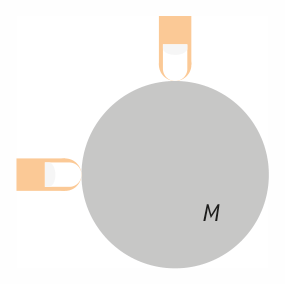 Ball M held by two fingers
Topic: Rigid Body Statics, Newtonian Mechanics Metodi: Free-Body Diagram, Torque & Angular Momentum Analysis, Vector Decomposition Competenze: Physical Reasoning, Mathematical Modeling Objects: Ball Fonte: Testo (PDF) — p.2
Problema 2 (10 punti) Beh, eroe! Tenere una palla con le dita non è difficile, si potrebbe pensare. Diventa più difficile, tuttavia, quando solo due punta di dita possono essere utilizzate per farlo. In la figura adiacente, una palla di massa Il è tenuto a solo due punti, vale a dire una volta esattamente dall’alto e una volta dal lato. La palla non si attacca alle dita, e la forza massima con cui un dito può premere sulla palla è Cinque volte il peso della palla. Mostrare che è davvero possibile tenere la palla in questo modo, e determinare il minimo il coefficiente di friczione statica tra la superficie del dito e della palla. Iscriviti ora a www.ipho.info per il La concorrenza! Ruler Can Tavola M
Ball M held by two fingers
Topic: Rigid Body Statics, Newtonian Mechanics Metodi: Free-Body Diagram, Torque & Angular Momentum Analysis, Vector Decomposition Competenze: Physical Reasoning, Mathematical Modeling Objects: Ball Fonte: Testo (PDF) — p.2
Problem 2 (10 points) Well, hero! Holding a ball with your fingers is not difficult, one might think. It becomes harder, however, when only two fingertips may be used to do so. In the adjacent figure, a ball of mass is held at only two points, namely once exactly from above and once from the side. The ball doesn ‘t stick to the fingers, and the maximum force with which a finger can press on the ball is Five times the weight of the ball. Show that it is indeed possible to hold the ball in this way, and determine the minimum required coefficient of static friction between finger and ball surface. Sign up now at The Commission has also adopted a proposal for a regulation on the protection of the environment. for the Competition! Other vehicles Can Table M
Ball M held by two fingers
Topic: Rigid Body Statics, Newtonian Mechanics Metodi: Free-Body Diagram, Torque & Angular Momentum Analysis, Vector Decomposition Competenze: Physical Reasoning, Mathematical Modeling Objects: Ball Fonte: Testo (PDF) — p.2
Problem 3 (10 points) Up and away A hot-air balloon with a volume of is filled on the ground with hot air at a temperature of . The balloon envelope together with the basket — containing the burner, gas cylinders and daring balloonists — has a combined mass of . The ambient temperature is , and the air pressure is about . a) Calculate the force with which the balloon must be held down at the ground, and state whether you would be able to hold the balloon down or whether you should rather let go so as not to be pulled up into the air. Assume for simplicity that the ambient temperature does not change with altitude and that, for a change in altitude of 100 m, the air pressure decreases by 1.2 % in each case. b) Determine the acceleration with which the balloon rises immediately after being released. Calculate the altitude the balloon reaches if the temperature inside the balloon stays constant. In reality, the air inside the balloon slowly cools down when the burner is not ignited. As a result, the balloon’s buoyancy decreases at a constant rate of . c) Estimate the maximum time for which the balloon can maintain its altitude by regularly igniting the burner, given that it carries a total gas supply of of propane gas with a calorific value of . For the calculation you may use the following data for air: Mean molar mass
Specific heat capacity at constant pressure
Topic: Thermodynamics, Fluid Mechanics Metodi: Ideal Gas Law, First Law of Thermodynamics, Hydrostatic Equilibrium, Energy Conservation Method Competenze: Mathematical Modeling, Estimation & Approximation Objects: Gas Fonte: Testo (PDF) — p.3
Problema 3 (10 punti) Su e via Un pallone a caldo con un volume di è riempito a terra con aria calda a una temperatura di . Il balloon envelope together with the basket containing the b) il volume di combustione di gas, di gas cilindri e di baloni audaci è di . La temperatura ambiente è , e la pressione dell’aria è circa . a) Calcolare la forza con cui il pallone deve essere tenuto giù a terra e indicare se si sarebbe in grado di tenere il pallone giù o se si dovrebbe piuttosto lasciate andare in modo da non essere tirati in aria. Supponiamo per semplicità che la temperatura ambiente non cambia con l’altitudine e che, per un cambiamento di altitudine di 100 m, la pressione dell’aria diminuisce dell’1,2% in ogni caso. b) Determina l’accelerazione con cui il pallone sale immediatamente dopo essere stato rilasciato. Calcolare l’altitudine che il pallone raggiunge se il La temperatura all’interno del pallone rimane costante. In realtà, l’aria all’interno del palloncino si raffreddera’ lentamente quando il bruciatore non si accende. Come risultato, la buoyance del pallone diminuisce a tasso costante di . c) Calcolare il tempo massimo per il quale il pallone può mantenere la sua altitudine accendendo regolarmente il burner, dato che esso porta a total gas supply of of propane gas with a calorific value of . Per il calcolo si possono utilizzare i seguenti dati per l’aria: Massaggio molare medio
Specific heat capacity at constant pressure
Topic: Thermodynamics, Fluid Mechanics Metodi: Ideal Gas Law, First Law of Thermodynamics, Hydrostatic Equilibrium, Energy Conservation Method Competenze: Mathematical Modeling, Estimation & Approximation Objects: Gas Fonte: Testo (PDF) — p.3
Problem 3 (10 points) Up and away A hot-air balloon with a volume of is filled on the ground with hot air at a temperature of . The balloon envelope together with the basket containing the burners, gas cylinders and daring balloonists has a combined mass of . The ambient temperature is , and the air pressure is about . (a) Calculate the force with which the balloon must be held down at the ground, and state whether you would be able to hold the balloon down or whether you should rather let go so as not to be pulled up into the air. Assume for simplicity that the ambient temperature does not change with altitude and that, for a change in altitude of 100 m, The air pressure decreases by 1.2 percent in each case. (b) Determine the acceleration with which the balloon rises immediately after being released. Calculate the altitude the balloon reaches if the The temperature inside the balloon remains constant. In reality, the air inside the balloon slowly cools down when the burner is not ignited. As a result, the balloon’s buoyancy decreases at a The average rate of the test is the constant rate of . (c) Estimate the maximum time for which the balloon can maintain its altitude by regularly igniting the burner, given that it carries a total gas supply of of propane gas with a calorific value of . For the calculation you may use the following data for air: Mean molar mass
Specific heat capacity at constant pressure
Topic: Thermodynamics, Fluid Mechanics Metodi: Ideal Gas Law, First Law of Thermodynamics, Hydrostatic Equilibrium, Energy Conservation Method Competenze: Mathematical Modeling, Estimation & Approximation Objects: Gas Fonte: Testo (PDF) — p.3
Problem 4 (10 points) Very far away Parallax is an important tool for determining the distances of stars near the Sun. Due to the motion of the Earth along its orbit around the Sun, the position of these stars relative to the background of much more distant stars changes over the course of the year. This apparent shift is called parallax. You can also use parallax with a camera at much smaller distances to determine distances. To do so, you need information about the parameters of the camera you are using. a) Using a digital camera or smartphone camera, photograph a ruler about 2 - 3 m away. Use the photo and the EXIF information stored in the image file about the focal length used to determine the distance between two pixels on the camera’s image sensor. With this you can convert a length measured in pixels on the photo into a distance on the camera’s sensor. Estimate the uncertainty of your result. Hint: When taking the photo, focus on a region that is as far away as possible. b) Take two photos each of a small object at five different distances greater than 4 m. The photos should be taken from positions that are at the same distance from the object but 30 - 60 cm apart from each other. For each of the chosen distances, use parallax to determine the respective distance to the object from the photos and compare the values with those you obtain from a direct length measurement of the distances. c) Assume that the object you photographed is still recognizable in the photo from arbitrary distances. Estimate up to what distance you can still determine the distance to the object with your camera using the parallax method. Junior problem (10 points) two + three = six? The circuit shown consists of a voltage source with constant voltage and two resistors with resistance values and respectively. a) Calculate the voltages that drop across the individual resistors in the circuit. If you measure the voltage drops across the individual resistors one after another with a voltmeter, the measured voltages deviate from the theoretical results. Assume that the measured voltages are across resistor , across resistor and across the voltage source. b) Find out what distinguishes an ideal voltmeter from a real one, and explain why the sum of the measured voltages across the resistors does not equal the voltage of the battery. Determine the value of the voltmeter’s characteristic quantity that leads to the given voltage values. Figure 2: Two photos of a ball with pronounced parallax. Figure 1: Photo of a ruler. V A scienceolympiaden.de Show your talent! Pupils If you are a pupil, the IPhO and the PhysicsOlympiad in Germany offer you many opportunities to engage intensively with physics questions, to experience physics as an exciting scientific discipline, to test your own limits and, not least, to meet interesting people. For the competition rounds there are learning materials and training problems that help you deepen your knowledge and problem-solving skills. At the seminars you meet many other young people enthusiastic about physics. Taking part is therefore worthwhile in any case, regardless of whether you make it into the higher rounds. What matters is taking part. Successfully completing the first round is already a special achievement and a genuine distinction. So, have courage! Teachers As a teacher, you can offer pupils who are especially capable or interested in physics a challenge with the problems of the Physics Olympiad and encourage them to engage more deeply with physics topics. The PhysicsOlympiad can thus serve as an instrument of individual support. In particular, the problems of the first round are suitable not only for the best in a class.
With a wide range of offerings, the PhysicsOlympiad aims to appeal to interested young people broadly and to inspire them lastingly for the natural sciences. This is served by support offerings such as the Orpheus or Identiphy seminars and the accompanying materials for the first round, with which we want to support you in introducing topics of the PhysicsOlympiad. So feel free to encourage your pupils to take part; for only those who do not take part can lose. Schools By encouraging participation in competitions, schools can sharpen their profile and use these, in the sense of enrichment, to complement school offerings. Competitions thereby offer diverse, differentiated learning environments for participating pupils. In the area of STEM subjects, the Olympiads, at least in the later rounds, represent a competition aimed at especially motivated and high-performing young people. Nevertheless, participation is worthwhile even in the entry rounds, not only as a reward but it can also contribute to a lasting motivation for STEM topics. Offerings such as the Orpheus or Identiphy seminars thereby allow the support of a large number of participants. In many federal states, by the way, participation can be recognized as a special learning achievement or subject/seminar paper of your pupils for the Abitur. Interested in more than physics? The IPhO is one of the six nationwide science school competitions organized by the IPN — the ScienceOlympiads. Alongside the selection competitions for the international Olympiads in Biology (IBO), Chemistry (IChO) and Physics (IPhO), these include the International JuniorScienceOlympiad (IJSO), the European ScienceOlympiad (EUSO) as well as the BundesUmwelt Wettbewerb (BUW). Together they appeal to pupils from the start of lower secondary school through to the end of their school years and, with close networking, offer the possibility of a lasting support of scientific abilities and interests. Further information can be found at www.scienceolympiaden.de. Many good reasons to take part in the PhysicsOlympiad Dear pupils, dear parents, dear teachers,
“Scientists have the future in their blood,” as the British scientist and writer Charles Percy Snow once put it. Indeed, the findings of the natural sciences will significantly shape our future. Those who know a lot about the natural sciences, a lot about chemistry, physics, biology and also the environment, therefore have the best opportunities to shape their lives and to advance our country. For the world is changing rapidly. We need knowledge — and people who are enthusiastic about science and research. For this reason, the Federal Ministry of Education and Research has for many years been committed to ensuring that even young people can discover the world of the natural sciences. We support various school and youth competitions on STEM topics — on mathematics, computer science, the natural sciences and technology. In this way we want to awaken curiosity. And make our country fit for the future. The science competitions organized by the Leibniz Institute for Science and Mathematics Education (IPN) in Kiel — the ScienceOlympiads and the BundesUmweltWettbewerb — are also part of this. About ten thousand pupils — already from the 5th grade onward — take part every year. The Olympic motto applies: Taking part is everything! In doing so, the pupils solve tricky problems. S
Topic: Geometric Optics, Circuits Metodi: Thin Lens & Mirror Equation, Error Propagation, Kirchhoff’s Laws, Equivalent Circuit Reduction Competenze: Experimental Data Analysis, Estimation & Approximation, Measurement & Instrumentation Objects: Lens, Resistor, Battery Fonte: Testo (PDF) — p.3
Problema 4 (10 punti) Molto lontano La parallassia è uno strumento importante per determinare le distanze di stelle vicino al Sole. A causa di Il movimento della Terra lungo la sua orbita intorno al Sole, la posizione di queste stelle rispetto allo sfondo di stelle molto più lontane cambia nel corso dell’anno. Questo spostamento apparente è chiamato parallax. You can also use Parallax with a camera at much smaller distances to determine distances. Per farlo, è necessario avere informazioni sui parametri della macchina fotografica che state usando. a) Usando una fotocamera digitale o smartphone, fotografare un ruoter a circa 2 o 3 metri di distanza. Usare la foto e le informazioni EXIF memorizzate nel file di immagini sulla distanza focale utilizzate per determinare la distanza tra due pixel sul sensore di immagine della fotocamera. Con questo puoi convertire una lunghezza misurata in pixel sul Foto in distanza sul sensore della telecamera. Estimare l’incertezza del tuo risultato. Quando fate la foto, concentratevi su una regione che è il più lontano possibile. b) Prendere due foto di un piccolo oggetto a cinque distanze diverse superiori a 4 m. Le foto devono essere prese da posizioni che sono alla stessa distanza dall’oggetto ma 30 - 60 cm di distanza. Per ciascuna delle distanze scelte, utilizzare parallax per determinare la rispettiva distanza dall’oggetto alle foto e confrontare i valori con quelli che si ottengono da un misurazione diretta della lunghezza delle distanze. c) Supponiamo che l’oggetto che hai fotografato sia ancora riconoscibile nella foto da distanze arbitrarie. Estimare fino a che distanza puoi ancora determinare la distanza dall’oggetto con la tua fotocamera usando il metodo parallax. Problema minore (10 punti) Due più tre = sei? Il circuito mostrato è costituito da una voltage source con voltage costante e due resistori con valori di resistenza e , rispettivamente. a) Calcolare le tensioni che cadono attraverso le singole resistori nel circuito. Se si misura il flusso di tensione attraverso le singole resistori uno dopo l’altro con un voltmeter, il Le tensioni misurate deviano dai risultati teorici. Supponiamo che le tensioni misurate siano across resistor , across resistor and across the voltage source. b) Scopri cosa distingue un voltmeter ideale da un vero, e spiega perché la somma è di voltage misurate attraverso le resistori non è uguale alla voltage della batteria. Determina il valore della quantità caratteristica del voltmeter che porta ai dati valori di tensione. Figura 2: Due foto di un ball with pronounced parallax. Figura 1: Foto di un ruotere. V A sciencesolymppiaden.de Mostra il tuo talento! Alunni Se sei un allievo, L’Ipho e la PhysicsOlympiad in Germania offrono molti opportunità di impegnarsi intensamente con la fisica Le domande che si possono fare per sperimentare la fisica come un’eccitante la disciplina scientifica, per testare il vostro
- il limite di cui si dispone Almeno per incontrare persone interessanti. Per i round di competizione ci sono materiali di apprendimento e problemi di formazione che ti aiuteranno a approfondire le tue conoscenze e capacità di risoluzione dei problemi. Ai seminari si incontrano molti altri Giovani entusiasti della fisica. Prendendo Il part is therefore worthwhile in any caso, indipendentemente dal fatto che tu lo faccia
- In un giro più alto. Cosa Le questioni sono state prese in considerazione. Successfully completando il primo Round è già un’impresa speciale e una vera distinzione. Allora, abbi coraggio! Docenti Come insegnante, puoi offrire Alunni che sono particolarmente capaci o interessato in fisica a challenge with i problemi della fisica Olimpiadi e incoraggiarli a impegnarsi più profondamente con argomenti di fisica. Il PhysicsOlympiad può così Serve come strumento di sostegno individuale. In particolare, i problemi dei I primi round sono adatti non solo per: Il migliore di una classe.
Con una vasta gamma di offerte, il PhysicsOlympiad mira ad attrarre i giovani interessati le persone in modo generale e per ispirarle per le scienze naturali. Questo è servito da offerte di supporto come l’Orpheus o l’Identiphy seminari e i materiali che accompagnano il primo round, con il quale vogliamo supportarti introducendo argomenti della PhysicsOlympiad. Quindi sentitevi liberi di incoraggiare i vostri alunni per il Solo chi non partecipa può perdere. Scuole Incoraggiando la partecipazione a competizioni, le scuole Can sharpen their profile e utilizzare questi, nel senso che di enrichment, per completare le offerte scolastiche. Le competizioni offrono così diverse, ambienti di apprendimento differenziati per gli studenti partecipanti. In questo settore, la Le Olimpiadi, almeno in seguito I round, represent a competition aimed at especially motivated e giovani ad alto rendimento. Tuttavia, Participazione è utile anche nell’entrata I round non solo come ricompensa ma come può anche contribuire a una durata motivazione per i temi STEM. Offerte come l’Orpheus o I seminari di identificazione consentono quindi di Il sostegno di un gran numero di partecipanti. In molti stati federali, comunque, La partecipazione può essere riconosciuta come un special learning paper of your achievement or subject/seminar paper of your Alcune delle quali sono state prese in considerazione. Interessato in più di
- La fisica? L’IPhO è uno dei sei centri scientifici nazionali Le competizioni scolastiche organizzate dall’IPN Scienza olimpiadi. Accanto alla selezione Competitions for the International Olimpiadi in biologia (IBO), chimica (IChO) e fisica (IPhO), questi includono La Commissione ha inoltre adottato una proposta di regolamento (UE) n. Concorrenza (BUW). Insieme si rivolge a pupils from the start di scuola secondaria inferiore fino alla fine di anni scolastici e, con La rete, offrono la possibilità di sostenere duratamente le capacità e gli interessi scientifici. Ulteriori informazioni sono disponibili a: www.scienceolympiaden.de Molti buoni motivi per partecipare al PhysicsOlympiad Cari studenti, cari genitori, cari insegnanti,
“Gli scienziati hanno il futuro nel loro sangue”, come il Scienziato e scrittore britannico Charles Percy Snow
- Una volta. In effetti, i risultati della Le scienze naturali influiranno significativamente sul nostro futuro. Quelli che Conoscere molto sulle scienze naturali, molto sulla chimica, la fisica, La biologia e l’ambiente, quindi, hanno il miglior opportunità di plasmare le loro vite e di far progredire il nostro Paese. Perché il mondo sta cambiando rapidamente. Abbiamo bisogno di conoscenze e di persone entusiaste della scienza e della ricerca. Per questo motivo, il Ministero federale di Education and Research ha per molti anni been committed per garantire che anche i giovani possano scoprire il mondo del naturale Scienze. Noi supportiamo vari Concorsi scolastici e giovani su argomenti STEM su matematica, informatica, scienze naturali e tecnologia. In questo modo vogliamo risvegliare la curiosità. E rendere il nostro Paese adatto Il futuro. Le competizioni scientifiche organizzate dall’Istituto Leibniz per la ricerca e la ricerca Scienza e matematica (IPN) a Kiel La Commissione ha inoltre presentato una proposta di direttiva che prevede che le attività di ricerca e di ricerca siano state effettuate in modo che le attività di ricerca e di ricerca siano più efficaci. In merito Diecimila studenti già dal quinto grad in avanti partecipare ogni anno. L’Olimpiade Il motto è: “Taking part is everything”. In questo modo, gli studenti risolvono
- Problemi complicati. S
Topic: Geometric Optics, Circuits Metodi: Thin Lens & Mirror Equation, Error Propagation, Kirchhoff’s Laws, Equivalent Circuit Reduction Competenze: Experimental Data Analysis, Estimation & Approximation, Measurement & Instrumentation Objects: Lens, Resistor, Battery Fonte: Testo (PDF) — p.3
Problem 4 (10 points) Very far away Parallax is an important tool for determining the distances of stars near the Sun. Due to The motion of the Earth along its orbit around the Sun, the position of these stars relative to the background of much more distant stars changes over the course of the year. This apparent shift is called parallax. You can also use Parallax with a camera at much smaller distances to determine distances. To do this, you need information about the parameters of the camera you’re using. a) Using a digital camera or smartphone camera, photograph a ruler about 2 to 3 m away. Use the photo and the EXIF information stored in the image file about the focal length used to determine the distance between two pixels on the camera’s image sensor. With this you can convert a length measured in pixels on the photo into a distance on the camera’s sensor. Estimate the uncertainty of your result. Hint: When taking the photo, focus on a region that’s as far away as possible. (b) Take two photos of a small object at five different distances greater than 4 m. The photos should be taken from positions that are at the same distance from the object but 30 to 60 cm apart from each other. For each of the chosen distances, use parallax to determine the respective distance to the object from the photos and compare the values with those you obtain from a direct length measurement of distances. (c) Assume that the object you photographed is still recognizable in the photo from arbitrary distances. Estimate up to what distance you can still determine the distance to the object with your camera using the parallax method. The first is the ‘Junior Problem’ (10 points). Two plus three is six? The circuit shown consists of a voltage source with constant voltage and two resistors with resistance values and respectively. (a) Calculate the voltages that drop across the individual resistors in the circuit. If you measure the voltage drops across the individual resistors one after another with a voltmeter, the measured voltages deviate from the theoretical results. Assume that the measured voltages are across resistor , across resistor and across the voltage source. b) Find out what distinguishes an ideal voltmeter from a real one, and explain why the sum of the measured voltages across the resistors does not equal the voltage of the battery. Determine the value of the voltmeter’s characteristic quantity that leads to the given voltage values. Figure 2: Two photos of a ball with pronounced parallax. Figure 1: Photo of a ruler. V A The European Commission has also adopted a proposal for a directive on the protection of the environment. Show your talent! The following is a list of the activities: If you are a student, The IPhO and the PhysicsOlympic in Germany offer you many opportunities to engage intensively with physics Questions to experience physics as an exciting scientific discipline, to test your own limits and, not At least, to meet interesting people. For the competition rounds there are learning materials and training problems that help you deepen your knowledge and problem-solving skills. At the seminars you meet many others Young people enthusiastic about physics. Taking Part is therefore worthwhile in any case, regardless of whether you make it into the higher rounds. What Matters is taking part. Successfully completing the first Round is already a special achievement and a genuine distinction. So, have courage! Teachers As a teacher, you can offer pupils who are especially capable or interested in physics a challenge with The problems of the physics Olympiad and encourage them to engage more deeply with physics topics. The PhysicsOlympiad can thus serve as an instrument of individual support. In particular, the problems of the First round are suitable not only for The best in a class.
With a wide range of offerings, the PhysicsOlympiad aims to appeal to interested young people people broadly and to inspire them Lastingly for the natural sciences. This is served by support offerings such as the Orpheus or Identiphy seminars and the accompanying materials for The first round, with which we want to support you in introducing topics of the PhysicsOlympic. So feel free to encourage your pupils to take part; for Only those who do not take part can lose. Schools By encouraging participation in competitions, schools Can sharpen their profile and use these, in the sense The Commission has also adopted a proposal for a directive on the approximation of the laws of the Member States relating to the approximation of the laws of the Member States relating to the approximation of the laws of the Member States relating to the approximation of the laws of the Member States relating to the approximation of the laws of the Member States relating to the approximation of the laws of the Member States relating to the approximation of the laws of the Member States relating to the approximation of the laws of the Member States relating to the approximation of the laws of the Member States relating to the approximation of the laws of the Member States. Competitions thus offer a variety of The aim of the project is to create a differentiated learning environment for participating pupils. In the area of STEM subjects, the The Olympic Games, at least in the later rounds, represent a competition aimed at especially motivated and high-performing young people. Nevertheless, participation is worthwhile even in the entry rounds, not only as a reward but It can also contribute to a lasting The aim of this study is to provide a framework for the study of the impact of STEM on the environment. Offerings such as the Orpheus or Identiphy seminars thus allow the support of a large number of participants. In many federal states, by the way, Participation can be recognized as a special learning achievement or subject/seminar paper of your pupils for the Abitur. Interested in more than
- What about physics? The IPhO is one of the six national science school competitions organised by the IPN the The science olympics. Alongside the selection Competitions for the international The European Commission has also adopted a number of proposals for the European Parliament and the Council. (IChO) and Physics (IPhO), these include The European Science Olympiad (EUSO) and the German Environmental Competition (BUW). Together they appeal to pupils from the start of lower secondary school through to the end of their school years and, with close networking, offer the possibility of a The Commission shall take the necessary measures to ensure that the scientific activities of the Member States are carried out in accordance with the principles laid down in this Regulation. Further information can be found at The Commission has also adopted a proposal for a regulation on the implementation of the European Community’s programme for the prevention of pollution caused by pollution. Many good reasons to take part in the PhysicsOlympiad Dear pupils, dear parents, dear teachers,
“Scientists have the future in their blood”, as the British scientist and writer Charles Percy Snow Once put it. Indeed, the findings of the Natural sciences will significantly shape our future. Those who know a lot about the natural sciences, a lot about chemistry, physics, Biology and also the environment, therefore have the best opportunities to shape their lives and advance our country. For the world is changing rapidly. We need knowledge and people who are enthusiastic about science and research. For this reason, the Federal Ministry of Education and Research has been committed for many years To ensure that even young people can discover the world of the natural The Commission is not a party to the proposal. We support various school and youth competitions on STEM topics on mathematics, computer science, the natural sciences and technology. In this way we want to awaken curiosity. And make our country fit for The future. The science competitions organised by the Leibniz Institute for Science and mathematics education (IPN) in Kiel The ScienceOlympiads and the Bundesumweltwettbewerb are also part of this. About Ten thousand pupils already from the 5th Grade onward take part every year. The Olympic The motto applies: taking part is everything! In doing so, the pupils solve It’s a tricky problem. S
Topic: Geometric Optics, Circuits Metodi: Thin Lens & Mirror Equation, Error Propagation, Kirchhoff’s Laws, Equivalent Circuit Reduction Competenze: Experimental Data Analysis, Estimation & Approximation, Measurement & Instrumentation Objects: Lens, Resistor, Battery Fonte: Testo (PDF) — p.3