Problem 1 Ice cube in a glass (MC problem) (5 pts.) In three glasses filled with water, an ice cube floats in each. The ice cube in glass 1 has an air bubble inside it, the ice cube in glass 2 has a core of liquid water, and in glass 3 floats an ice cube with an aluminium core. What can be said about the water levels in the glasses immediately after the ice cubes have melted? 1 2 3 Figure 1: Not-to-scale sketch of the floating ice cubes with inclusions. A The water level in glass 1 has risen; those in the other glasses are unchanged. B The water level in glass 3 has fallen; those in the other glasses are unchanged. C The water levels in glasses 1 and 3 have risen; the one in glass 2 is unchanged. D The water levels in all glasses are unchanged. Answer section Calculations and explanations Correct answer: 51st IPhO 2020 - 2nd Round exam Code: Code
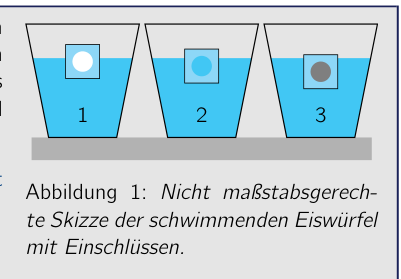 Three glasses with ice cubes
Topic: Fluid Mechanics Metodi: Physical Modeling, Hydrostatic Equilibrium Competenze: Physical Reasoning Objects: Container, Bubble Fonte: Testo (PDF) — p.2
Problema 1 Ice cube in a glass (problema MC) (cfr. In tre bicchieri pieni d’acqua, un cubo di ghiaccio flotta in ciascuno. Il cubo di ghiaccio in vetro 1 ha una bolla d’aria all’interno, il ghiaccio in glass 2 ha un core di acqua liquida, e in glass 3 flotta su un cubo di ghiaccio con un nucleo di alluminio. Cosa si può dire dei livelli d’acqua nei bicchieri immediatamente dopo che i cubetti di ghiaccio si sono sciolti? 1 2 3 Figura 1: Sketch non su scala dei cubetti di ghiaccio galleggianti con inclusioni. A. Il livello di acqua in vetro 1 è aumentato; quelli negli altri bicchieri sono invariati. B Il livello di acqua in vetro 3 è diminuito; quelli negli altri bicchieri sono invariati. C I livelli di acqua nei bicchieri 1 e 3 sono aumentati; quello in bicchiere 2 è invariato. D I livelli di acqua in tutti i bicchieri sono invariati. Answer section Calcoli e spiegazioni Corretta risposta: 51° IPhO 2020 - 2° round exam Codice: Codice
Three glasses with ice cubes
Topic: Fluid Mechanics Metodi: Physical Modeling, Hydrostatic Equilibrium Competenze: Physical Reasoning Objects: Container, Bubble Fonte: Testo (PDF) — p.2
Problem 1 Ice cube in a glass (MC problem) (five points) In three glasses filled with water, an ice cube floats in each. The ice cube in glass 1 has an air bubble inside it, the ice cube in glass 2 has a core of liquid water, and in glass 3 floats on an ice cube with an aluminum core. What can be said about the water levels in the glasses Immediately after the ice cubes melted? 1 2 3 Figure 1: Not-to-scale sketch of the floating ice cubes with inclusions. A The water level in glass 1 has risen; those in the other glasses are unchanged. B The water level in glass 3 has fallen; those in the other glasses are unchanged. C The water levels in glasses 1 and 3 have risen; the one in glass 2 is unchanged. D The water levels in all glasses are unchanged. Answer section Calculations and explanations Correct answer: 51st IPhO 2020 - Second Round exam The code: Code
Three glasses with ice cubes
Topic: Fluid Mechanics Metodi: Physical Modeling, Hydrostatic Equilibrium Competenze: Physical Reasoning Objects: Container, Bubble Fonte: Testo (PDF) — p.2
Problem 2 Refraction of light (MC problem) (5 pts.) A light ray strikes, as shown alongside, an arrangement of two equally sized glass blocks built perpendicular to each other, and is refracted upon entering the first block. The refractive index of the glass is 1.5. Outside the blocks there is air. Which of the following figure excerpts shows the path of the refracted light ray after it exits the second block? The path of the light ray inside the block is not shown, and the dashed line indicates the path of the unrefracted light ray. A B C D Answer section Calculations and explanations Correct answer: 51st IPhO 2020 - 2nd Round exam Code: Code
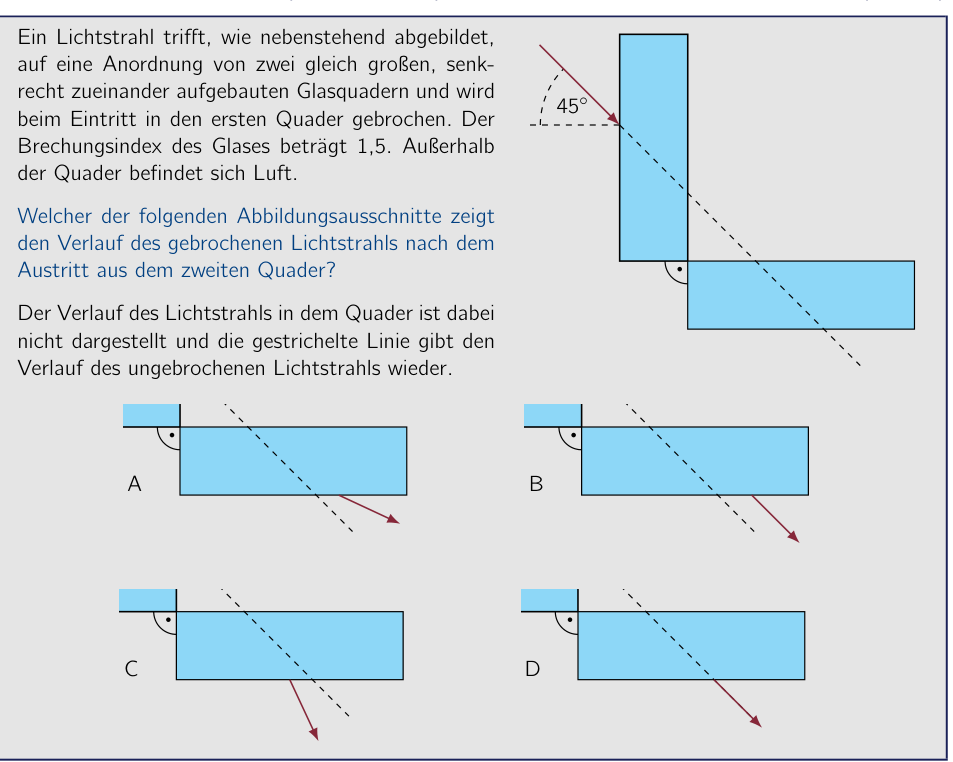 Refraction of light through glass prisms, choices A-D
Topic: Geometric Optics Metodi: Snell’s Law, Ray Tracing Competenze: Physical Reasoning, Diagrammatic Reasoning Objects: Prism Fonte: Testo (PDF) — p.3
Problema 2 Rifrazione della luce (problema MC) (cfr. Un raggio di luce colpisce, come mostrato al fianco, un’arrangimento di due blocchi di vetro di dimensioni uguali costruiti perpendicolare l’uno all’altro, e è refratto Entro il primo blocco. Il l’indice di refraczione del vetro è di 1.5. Al di fuori I blocchi sono aria. Which of the following figure excerpts shows il percorso del raggio di luce refratto dopo di esso Esce dal secondo blocco? Il percorso del raggio di luce all’interno del blocco è non mostrato, e la linea dashed indica il Il percorso del raggio di luce non rifratto. A B C D Answer section Calcoli e spiegazioni Corretta risposta: 51° IPhO 2020 - 2° round exam Codice: Codice
Refrazione della luce attraverso prismi di vetro, scelte A-D
Topic: Geometric Optics Metodi: Snell’s Law, Ray Tracing Competenze: Physical Reasoning, Diagrammatic Reasoning Objects: Prism Fonte: Testo (PDF) — p.3
The problem is that the light is reflected in the reflection. (five points) A light ray strikes, as shown alongside, an arrangement of two equal sized glass blocks built perpendicular to each other, and is refracted upon entering the first block. The The refractive index of the glass is 1.5. Outside The blocks there is air. Which of the following figure excerpts shows The path of the refracted light ray after it Exits the second block? The path of the light ray inside the block is not shown, and the dashed line indicates the path of the unrefracted light ray. A B C D Answer section Calculations and explanations Correct answer: 51st IPhO 2020 - Second Round exam The code: Code
Refraction of light through glass prisms, choices A-D
Topic: Geometric Optics Metodi: Snell’s Law, Ray Tracing Competenze: Physical Reasoning, Diagrammatic Reasoning Objects: Prism Fonte: Testo (PDF) — p.3
Problem 3 Oscillation with an obstacle (MC problem) (5 pts.) A small metal ball hangs, as sketched alongside, from a thin string of length from the ceiling. When this string pendulum is deflected slightly to the side and released, it swings with an oscillation period parallel to the wall. Now a nail is driven firmly into the wall at a distance of from the ceiling. While swinging to the right, the string pendulum hits the nail and is obstructed by it. The ball is now released from the position shown on the right in Figure 2. Nail Figure 2: Sketch of the pendulum without (left) and with the nail in the wall (right). Which of the following figures shows the position of the ball after release? A Nail B Nail C Nail D Nail Answer section Calculations and explanations Correct answer: 51st IPhO 2020 - 2nd Round exam Code: Code
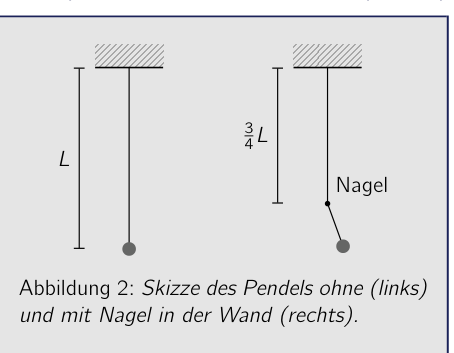 Pendulum with nail in wall
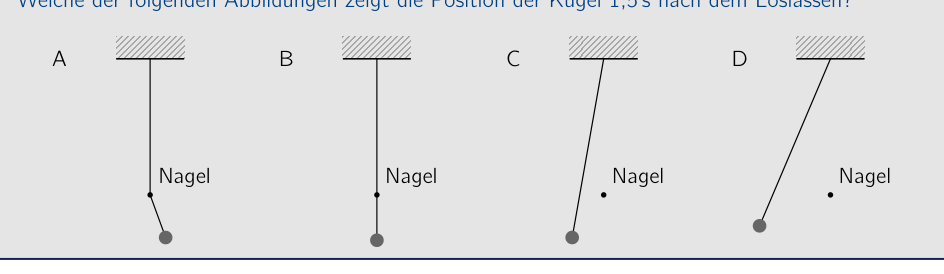 Four pendulum positions A-D
Topic: Oscillations & Waves Metodi: Simple Harmonic Motion Analysis, Physical Modeling Competenze: Physical Reasoning, Mathematical Modeling Objects: Pendulum, Ball, String Fonte: Testo (PDF) — p.4
Problema 3 Oscillazione con un ostacolo (problema MC) (cfr. Un piccolo metal ball hangs, come disegnato alongside, from a thin string of length from Il soffitto. Quando questo pendolo di corda è deflected leggermente al lato e rilasciato, si svinge con a periodo di oscillazione in parallelo
- Al muro. Now a nail is driven firmly into the wall at a distance of from Il soffitto. Mentre swinging a destra, il pendolo di corda colpisce il nail and is obstructed by it. Il ballo è ora rilasciato dalla posizione mostrata sulla destra nella figura 2. Nail Figura 2: Sketch of the pendulum without (sinistra) e con il chiodo nel muro. Which of the following figures shows the position of the ball after release? A Nail B Nail C Nail D Nail Answer section Calcoli e spiegazioni Corretta risposta: 51° IPhO 2020 - 2° round exam Codice: Codice
Pendulum with nail in wall
Four pendulum positions A-D
Topic: Oscillations & Waves Metodi: Simple Harmonic Motion Analysis, Physical Modeling Competenze: Physical Reasoning, Mathematical Modeling Objects: Pendulum, Ball, String Fonte: Testo (PDF) — p.4
Problem 3 Oscillation with an obstacle (MC problem) (five points) A small metal ball hangs, as sketched alongside, from a thin string of length from The ceiling. When this string pendulum is deflected slightly to the side and released, it swings with at an oscillation period parallel to the To the wall. Now a nail is driven firmly into the wall at a distance of from The ceiling. While swinging to the right, the string pendulum hits the nail and is obstructed by it. The ball is now released from the position shown on the right in Figure 2. Nail Figure 2: Sketch of the pendulum without (left) And with the nail in the wall. Which of the following figures shows the position of the ball after release? A Nail B Nail C Nail D Nail Answer section Calculations and explanations Correct answer: 51st IPhO 2020 - Second Round exam The code: Code
Pendulum with nail in wall
Four pendulum positions A-D
Topic: Oscillations & Waves Metodi: Simple Harmonic Motion Analysis, Physical Modeling Competenze: Physical Reasoning, Mathematical Modeling Objects: Pendulum, Ball, String Fonte: Testo (PDF) — p.4
Problem 4 Interference (MC problem) (5 pts.) In an experiment, monochromatic laser light falls perpendicularly onto an optical grating with 300 lines per mm. Behind the grating, the interference pattern is observed on a screen. The distance from the screen to the grating is very large compared with the extent of the interference pattern. The grayscale images alongside show the interference patterns produced on the screen when two lasers with different wavelengths but otherwise identical experimental setup are used. The wavelength of the light emitted by the first laser is 650 nm. Figure 3: Interference patterns on the screen for a wavelength of 650 nm (top) and a second unknown wavelength (bottom). The images show the same section of the screen. What is the wavelength of the laser light emitted by the second laser? A about 450 nm B about 530 nm C about 610 nm D about 690 nm Answer section Calculations and explanations Correct answer: 51st IPhO 2020 - 2nd Round exam Code: Code
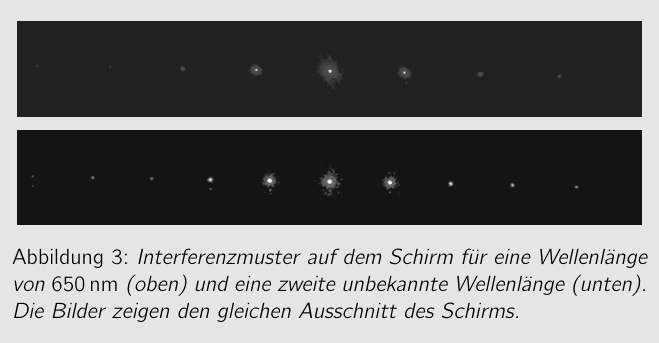 Two interference patterns on a screen
Topic: Wave Optics Metodi: Interference & Diffraction Analysis, Superposition Principle Competenze: Physical Reasoning, Experimental Data Analysis Objects: Diffraction Grating, Screen Fonte: Testo (PDF) — p.5
Problema 4 Interferenza (problema MC) (cfr. In un esperimento, la luce laser monocromatica cade perpendicolare su una griglia ottica con 300 linee per mm. Behind the grating, il pattern di interferenza è osservato su uno schermo. La distanza dal la dimensione della rete è molto grande rispetto all’entità del modello di interferenza. Il immagini a grayscale Al fianco show La interferenza modello Prodotto sullo schermo quando 2 di laser con differente lunghezze d’onda ma Altrimenti identica Setting di sperimentazione sono utilizzati. Il lunghezza d’onda of La luce emettuto dal first laser is 650 nm. Figura 3: Patterns di interferenza sullo schermo per una lunghezza d’onda di 650 nm (top) e di una seconda lunghezza d’onda sconosciuta (bottom). Le immagini mostrano la stessa sezione dello schermo. Qual è la lunghezza d’onda della luce laser emessa dal secondo laser? A circa 450 nm B circa 530 nm C circa 610 nm D circa 690 nm Answer section Calcoli e spiegazioni Corretta risposta: 51° IPhO 2020 - 2° round exam Codice: Codice
Due schemi di interferenza su uno schermo
Topic: Wave Optics Metodi: Interference & Diffraction Analysis, Superposition Principle Competenze: Physical Reasoning, Experimental Data Analysis Objects: Diffraction Grating, Screen Fonte: Testo (PDF) — p.5
Problem 4 Interference (MC problem) (five points) In an experiment, monochromatic laser light falls perpendicularly onto an optical grating with 300 lines per mm. Behind the grating, the interference pattern is observed on a screen. The distance from the screen to the grating is very large compared to the extent of the interference pattern. The The following is the list of the categories of products: alongside Show The interference patterns produced On the screen When two Other with different Wavelengths but Otherwise identical experimental setup are used. The Wavelength of The light issued by the first laser is 650 nm. Figure 3: Interference patterns on the screen for a wavelength of 650 nm (top) and a second unknown wavelength (bottom). The images show the same section of the screen. What is the wavelength of the laser light emitted by the second laser? A about 450 nm B about 530 nm C about 610 nm D about 690 nm Answer section Calculations and explanations Correct answer: 51st IPhO 2020 - Second Round exam The code: Code
Two interference patterns on a screen
Topic: Wave Optics Metodi: Interference & Diffraction Analysis, Superposition Principle Competenze: Physical Reasoning, Experimental Data Analysis Objects: Diffraction Grating, Screen Fonte: Testo (PDF) — p.5
Problem 5 Radioactive decay (MC problem) (5 pts.) In the following, three radioactive samples are considered. Initially, at time , they consist 100 % of a single radioactive isotope, the respective parent nuclide. The initial activity of the samples is denoted by in each case. The direct decay products, the daughter nuclides, are themselves radioactive and decay as well. Any further subsequent decays are no longer considered. The parent and daughter nuclides of the three samples are: Sample 1 : () () Sample 2 : () () Sample 3 : () () Here, and denote the half-lives of the respective nuclides. The following graphs show the time evolution of the activities of both the parent nuclide and the daughter nuclide as well as the total activity for the three samples. 10 20 30 40 1 2 0 0 I 1 2 3 1 2 0 0 II 1 2 3 4 5 1 2 0 0 III Figure 4: Time evolution of the activities of both the parent nuclide and the daughter nuclide as well as the total activity of the samples relative to the initial activity of the parent nuclide. The time axes are scaled in multiples of the half-life of the respective daughter nuclide. Which of the three nuclide pairs belongs to which diagram? A 1 2 3 I II III B 1 2 3 II III I C 1 2 3 III II I D 1 2 3 III I II Answer section Calculations and explanations Correct answer: 51st IPhO 2020 - 2nd Round exam Code: Code
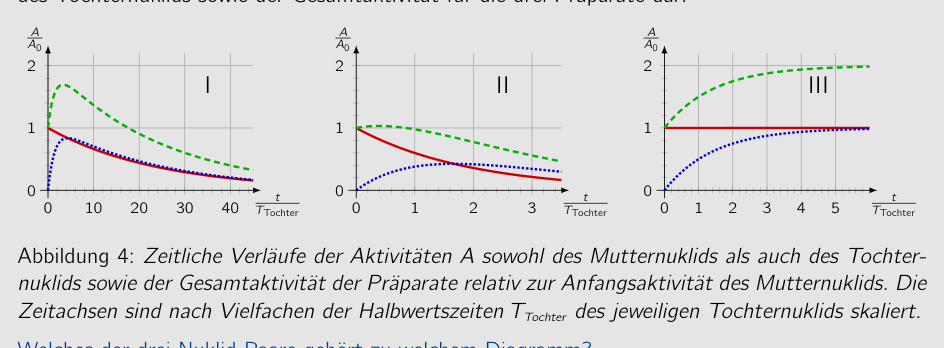 Three graphs of radioactive activity vs time
Topic: Nuclear & Particle Physics Metodi: Radioactive Decay Law, Physical Modeling Competenze: Graph Linearization, Physical Reasoning, Mathematical Modeling Objects: Nucleus Fonte: Testo (PDF) — p.6
Problema 5 Decadimento radioattivo (problema MC) (cfr. In seguito, tre campioni radioattivi sono considerati. Inizialmente, a tempo , Sono costituiti al 100% da un singolo isotopo radioattivo, il rispettivo nucleide genitore. La prima attività of the samples is denoted by in each case. I prodotti di decadimento diretto, I nuclidi della figlia sono radioattivi e si decompongono. Any further subsequent decays are no longer considerato. I nuclidi genitori e figli dei tre campioni sono: Sample 1 : () () Esemplare 2: () () Esemplare 3: () () Qui, e indicano le half-lives dei rispettivi nuclidi. The following graphs show the time evolution of the activities of both the parent nuclide and il daughter nuclide e l’attività totale dei tre campioni. 10 20 30 40 1 2 0 0 I 1 2 3 1 2 0 0 II 1 2 3 4 5 1 2 0 0 III Figura 4: Evoluzione temporale delle attività di entrambi i nuclidi genitori e dei nuclidi figli e dell’attività totale dei campioni rispetto all’attività iniziale del nuclide genitore. Il time axes are scaled in multiples of the half-life of the respective daughter nuclide. Quale delle tre coppie di nuclidi appartiene a quale diagramma? A 1 2 3 I II III B 1 2 3 II III I C 1 2 3 III II I D 1 2 3 III I II Answer section Calcoli e spiegazioni Corretta risposta: 51° IPhO 2020 - 2° round exam Codice: Codice
Three graphs of radioactive activity vs time
Topic: Nuclear & Particle Physics Metodi: Radioactive Decay Law, Physical Modeling Competenze: Graph Linearization, Physical Reasoning, Mathematical Modeling Objects: Nucleus Fonte: Testo (PDF) — p.6
The following is the list of the types of waste and waste management and the types of waste and waste management and the types of waste and waste management and the types of waste and waste management and the types of waste and waste management and the types of waste and waste management and the types of waste and waste management and the types of waste and waste management and the types of waste and waste management and the types of waste and waste management and the types of waste and waste management and the types of waste and waste management and the types of waste and waste management and the types of waste and waste management and the types of waste and waste management and the types of waste and waste management and the types of waste and waste management and the waste management and the types of waste and waste management and waste management and the waste management and the waste management and disposal of waste management and the waste management and the waste management and disposal of waste management and the waste management and disposal of waste. (five points) In the following, three radioactive samples are considered. Initially, at time , They consist of 100 percent of a single radioactive isotope, the respective parent nucleid. The initial activity of the samples is denoted by in each case. The direct decay products, the daughter nuclides, are themselves radioactive and decay as well. Any further subsequent decays are no longer considered. The parent and daughter nuclides of the three samples are: Sample 1 : () () Sample 2 : () () Sample 3 : () () Here, and denote the half-lives of the respective nuclides. The following graphs show the time evolution of the activities of both the parent nuclide and the daughter nuclide as well as the total activity for the three samples. 10 20 30 40 1 2 0 0 I 1 2 3 1 2 0 0 II 1 2 3 4 5 1 2 0 0 The Commission Figure 4: Time evolution of the activities of both the parent nuclide and the daughter nuclide as well as the total activity of the samples relative to the initial activity of the parent nuclide. The time axes are scaled in multiples of the half-life of the respective daughter nuclide. Which of the three nuclide pairs belongs to which diagram? A 1 2 3 I II The Commission B 1 2 3 II The Commission I C 1 2 3 The Commission II I D 1 2 3 The Commission I II Answer section Calculations and explanations Correct answer: 51st IPhO 2020 - Second Round exam The code: Code
Three graphs of radioactive activity vs time
Topic: Nuclear & Particle Physics Metodi: Radioactive Decay Law, Physical Modeling Competenze: Graph Linearization, Physical Reasoning, Mathematical Modeling Objects: Nucleus Fonte: Testo (PDF) — p.6
Problem 6 Diode and resistors (MC problem) (5 pts.) A diode is an electronic component that, in a simplified view, acts in one direction, the reverse direction, as a complete insulator. In the opposite direction, the forward direction, the diode also lets almost no current pass up to a certain voltage. Above this voltage, however, it behaves approximately like an ideal conductor. In the circuit shown below, a diode ( ) and two resistors with resistance values and are installed. The graph alongside shows measured values of the current in the circuit as a function of the applied voltage . 0,5 1,0 1,5 2,0 2 4 6 8 10 12 / V / mA Which resistance values best match the displayed measured values? A and B and C and D and Answer section Calculations and explanations Correct answer: 51st IPhO 2020 - 2nd Round exam Code: Code
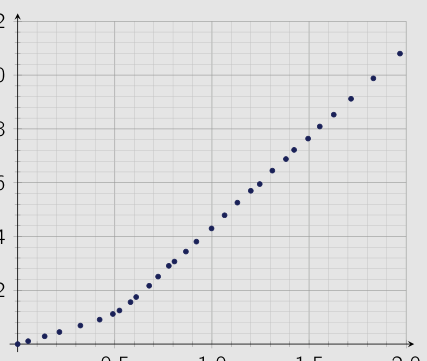 I-V graph of a diode
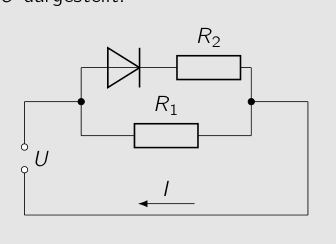 Circuit with diode and resistors
Topic: Circuits Metodi: Kirchhoff’s Laws, Equivalent Circuit Reduction, Experimental Data Analysis Competenze: Experimental Data Analysis, Physical Reasoning Objects: Resistor Fonte: Testo (PDF) — p.7
Problema 6 Diodi e resistori (problema MC) (cfr. Un diodo è un componente elettronico che, in una vista semplificata, agisce in una direzione, il direzione inversa, come un isolante completo. In La direzione opposta, la direzione avanzata, il diodo permette quasi nessun passaggio di corrente fino a una certa tensione. Above this voltage, tuttavia, afferma Approximativamente come un conduttore ideale. Nel circuito mostrato qui sotto, a diodo ( ) e due resistori con valori di resistenza e sono installati. The graph alongside shows i valori misurati del corrente nel circuito come funzione del voltage applicato . 0,5 1,0 1,5 2,0 2 4 6 8 10 12 / V / mA Quali valori di resistenza corrispondono meglio ai valori misurati mostrati? A e B e C e D e Answer section Calcoli e spiegazioni Corretta risposta: 51° IPhO 2020 - 2° round exam Codice: Codice
I-V grafico di un diodo
Circuito con diodo e resistori
Topic: Circuits Metodi: Kirchhoff’s Laws, Equivalent Circuit Reduction, Experimental Data Analysis Competenze: Experimental Data Analysis, Physical Reasoning Objects: Resistor Fonte: Testo (PDF) — p.7
Problem 6 Diode and resistors (MC problem) (five points) A diode is an electronic component that, in a simplified view, acts in one direction, the Reverse direction, as a complete insulator. In The opposite direction, the forward direction, the diode also lets almost no current pass up to a certain voltage. Above this voltage, however, it claims approximately like an ideal conductor. In the circuit shown below, a diode ( ) and two resistors with resistance values and are installed. The graph alongside shows measured values of the current in the circuit as a function of the applied voltage . 0,5 1,0 1,5 2,0 2 4 6 8 10 12 / V / mA Which resistance values best match the measured values displayed? A and B and C and D and Answer section Calculations and explanations Correct answer: 51st IPhO 2020 - Second Round exam The code: Code
I-V graph of a diode
Circuit with diode and resistors
Topic: Circuits Metodi: Kirchhoff’s Laws, Equivalent Circuit Reduction, Experimental Data Analysis Competenze: Experimental Data Analysis, Physical Reasoning Objects: Resistor Fonte: Testo (PDF) — p.7
Problem 7 Heat conduction (MC problem) (5 pts.) The ends of three round metal rods made of identical material are each kept at constant temperatures. The following data are known for the rods: Rod I - diameter: , length: , temperatures of the rod ends: and Rod II - diameter: , length: , temperatures of the rod ends: and Rod III - diameter: , length: , temperatures of the rod ends: and How do the heat powers transferred through the rods by heat conduction, , and , relate to one another (the powers may all be assumed positive)? A B C D Answer section Calculations and explanations Correct answer: 51st IPhO 2020 - 2nd Round exam Code: Code Long problems Work on the following three problems likewise in the boxes provided for them. Unlike the multiple-choice problems, no answer options are given. Describe your solution method in such a way that it is easy to follow but not unnecessarily long. So, for example, if you use the law of conservation of energy, write this down briefly.
Topic: Thermodynamics Metodi: Physical Modeling, Dimensional Analysis Competenze: Physical Reasoning, Mathematical Modeling Objects: Rod Fonte: Testo (PDF) — p.8
Problema 7 Conduzione del calore (problema MC) (cfr. Le estremità di tre barre di metallo rotondo made of identical material are each kept at constant
- le temperature. I seguenti dati sono noti per le barre: Rod I - diametro: , lunghezza: , temperature delle estremità del rod: e Rod II - diametro: , lunghezza: , temperature delle estremità del rod: e Rod III - diametro: , lunghezza: , temperature delle estremità del rod: e Come si trasferiscono i poteri del calore attraverso le barre per conduzione del calore, , e , si riferiscono a vicenda (i poteri possono essere tutti presunti positivi)? A B C D Answer section Calcoli e spiegazioni Corretta risposta: 51° IPhO 2020 - 2° round exam Codice: Codice Long problemi La Commissione ha inoltre presentato una serie di proposte di risoluzione sulle misure di sicurezza e di sicurezza. A differenza dei problemi di scelta multipla, non sono state indicate le opzioni di risposta. Descrivere il metodo di soluzione in un modo simile che è facile da seguire ma non troppo lungo. Quindi, per esempio, se usi la legge della conservazione dell’energia, scrivi questo brevemente.
Topic: Thermodynamics Metodi: Physical Modeling, Dimensional Analysis Competenze: Physical Reasoning, Mathematical Modeling Objects: Rod Fonte: Testo (PDF) — p.8
The problem is that the heat is not conductive. (five points) The ends of three round metal rods made of identical material are each kept at constant The temperature is very high. The following data are known for the rods: Rod I - diameter: , length: , temperatures of the rod ends: and Rod II - diameter: , length: , temperatures of the rod ends: and Rod III - diameter: , length: , temperatures of the rod ends: and How do the heat powers transferred through the rods by heat conduction, , and , relate to each other (the powers may all be assumed positive)? A B C D Answer section Calculations and explanations Correct answer: 51st IPhO 2020 - Second Round exam The code: Code Long problems Work on the following three problems also in the boxes provided for them. Unlike the Multiple-choice problems, no answer options are given. Describe your solution method in such a way That it’s easy to follow but not unnecessarily long. So, for example, if you use the law of conservation of energy, write this down briefly.
Topic: Thermodynamics Metodi: Physical Modeling, Dimensional Analysis Competenze: Physical Reasoning, Mathematical Modeling Objects: Rod Fonte: Testo (PDF) — p.8
Problem 8 Coated lens (17 pts.) In the manufacture of optical lenses, these are often provided with a thin coating in order to reduce reflections in certain wavelength ranges. Consider a lens made of a material with a refractive index of 1.40. It is to be coated with a coating, as thin as possible, of a transparent material with refractive index 1.24, in order to minimize reflections at normal incidence of light with a wavelength of 500 nm. 8.a) Determine how thick this coating should be in order to minimize the intensity of the reflected light. (5 pts.) When light falls perpendicularly onto a transition from a medium with refractive index to one with refractive index , a fraction of the incoming light intensity is reflected. Since the reflected fractions are very small under the given conditions, it is sufficient to consider only single reflections. 8.b) Compare the intensity of the light reflected in total at the coated lens at the given wavelength with the intensity of the light that is reflected at an uncoated lens. To do this, calculate the ratio of these intensities. (7 pts.) Despite the coating described, the intensity of the reflected light is small but not zero. 8.c) State and justify how the coating would have to be changed in order to achieve a significantly better anti-reflection effect at the considered wavelength. (5 pts.) Answer section 8.a) Calculations and explanations Result for the required thickness of the coating: 51st IPhO 2020 - 2nd Round exam Code: Code 8.b) Calculations and explanations Result for the ratio of the intensities: 8.c) Calculations and explanations 51st IPhO 2020 - 2nd Round exam Code: Code
Topic: Wave Optics Metodi: Interference & Diffraction Analysis, Superposition Principle, Physical Modeling Competenze: Mathematical Modeling, Physical Reasoning Objects: Lens Fonte: Testo (PDF) — p.9
Problema 8 Lenti a rivestimento (17 pag.) In produzione di lenti ottiche, queste sono spesso fornite con un rivestimento sottile per Riduce le riflessioni in determinati ranghi di lunghezza d’onda. Considerate un obiettivo fatto di materiale con un indice di refraczione di 1,40. È da essere rivestito con un rivestimento, quanto più sottile possibile, di un materiale trasparente con indice di refraczione 1.24, per ridurre al minimo le riflessioni ad incidenza normale di luce con una lunghezza d’onda di 500 nm. 8. (a) Determine quanto deve essere spessa questa copertura per ridurre al minimo l’intensità del rilassato
- No, non è chiaro. (cfr. Quando la luce cade perpendicularmente su una transizione da un mezzo con indice refraettivo a uno con Indice di refrazione , a frazione di intensità della luce in arrivo è riflessa. Poiché le frazioni riflesse sono molto piccole nelle condizioni indicate, è sufficiente considerare solo le singole riflessioni. 8.b) Compare l’intensità della luce riflessa in totale al lente rivestita alla data lunghezza d’onda con l’intensità della luce che è riflessa a un non rivestito
- Il mio corpo è un’arma. Per fare questo, calcolare il rapporto di queste intensità. (7 punti) Nonostante il rivestimento descritto, l’intensità della luce riflessa è piccola ma Non zero. 8.c) State and justify how the coating would have to be changed in order to achieve a significantly migliore effetto anti-riflessione alla lunghezza d’onda considerata. (cfr. Answer section 8.a) Calcoli e spiegazioni Risultato per lo spessore richiesto del rivestimento: 51° IPhO 2020 - 2° round exam Codice: Codice 8.b) Calcoli e spiegazioni Risultato per il rapporto delle intensità: 8.c) Calcoli e spiegazioni 51° IPhO 2020 - 2° round exam Codice: Codice
Topic: Wave Optics Metodi: Interference & Diffraction Analysis, Superposition Principle, Physical Modeling Competenze: Mathematical Modeling, Physical Reasoning Objects: Lens Fonte: Testo (PDF) — p.9
Problem 8 Coated lens The Commission’s proposal for a directive on the protection of workers’ rights In the manufacture of optical lenses, these are often provided with a thin coating in order to reduce reflections in certain wavelength ranges. Consider a lens made of a material with a refractive index of 1.40. It is to be coated with a coating, as thin as possible, of a transparent material with refractive index 1.24, in order to minimize reflections at normal incidence of light with a wavelength of 500 nm. 8. (a) Determine how thick this coating should be in order to minimize the intensity of the reflected Light. (five points) When light falls perpendicularly onto a transition from a medium with refractive index to one with refractive index , a fraction of the incoming light intensity is reflected. Since the reflected fractions are very small under the given conditions, it is sufficient to consider only single reflections. 8. (b) Compare the intensity of the light reflected in total at the coated lens at the given wavelength with the intensity of the light that is reflected at an uncoated I’m not going to be able to see it. To do this, calculate the ratio of these intensities. (Page 77) Despite the coating described, the intensity of the reflected light is small but Not zero. 8.c) State and justify how the coating would have to be changed in order to achieve a significantly better anti-reflection effect at the considered wavelength. (five points) Answer section 8.a) Calculations and explanations Result for the required thickness of the coating: 51st IPhO 2020 - Second Round exam The code: Code 8.b) Calculations and explanations Result for the ratio of the intensities: 8.c) Calculations and explanations 51st IPhO 2020 - Second Round exam The code: Code
Topic: Wave Optics Metodi: Interference & Diffraction Analysis, Superposition Principle, Physical Modeling Competenze: Mathematical Modeling, Physical Reasoning Objects: Lens Fonte: Testo (PDF) — p.9
Problem 9 Faster than the wind (20 pts.) The photo on the right shows the experimental vehicle Blackbird. The vehicle has no energy store of its own, such as batteries or fuel, but is driven solely by the wind. For propulsion, the vehicle contains only a gearbox that can transfer energy between the wheels and the propeller. With the Blackbird, test runs were carried out on level ground at constant wind direction and speed - both with as well as directly against the wind. The velocity of the vehicle was therefore the whole time parallel or antiparallel to the wind velocity . You may assume that in the test runs a constant speed was reached in each case. Figure 5: Photo of the wind-driven Blackbird. (Source en.wikipedia.org; Stephen Morris; CC BY-SA 3.0). The designers of the Blackbird claimed that on runs in the direction of the wind velocity they had travelled faster than the wind, i.e. at a constant velocity for which . This was criticized by some people as unphysical and therefore impossible. But is it? 9.a) Justify why, at constant wind speed , it is in principle possible to travel with a constant speed in the direction of the wind. State whether, in doing so, energy is transferred from the propeller to the wheels or vice versa. (8.0 pts.) For an estimate of the attainable speed, assume that in the transfer of energy between the surrounding air and the ground and vice versa, a fraction of the available power is lost for further use. So if, for example, energy is transferred from the surrounding air via the propeller, the gearbox and the wheels to the ground, then only a fraction of the energy transferred to the vehicle by the wind can be used for propulsion. 9.b) Determine the speed that the vehicle can reach when travelling in the wind direction. Express your result in terms of and . (6.0 pts.) 9.c) Determine the attainable speed for travelling directly against the wind. Express this too in terms of and , and justify whether in this case as well it is possible to be faster than the wind. (6.0 pts.) Answer section 9.a) Calculations and explanations 51st IPhO 2020 - 2nd Round exam Code: Code Calculations and explanations (continued) 9.b) Calculations and explanations Result for the speed when travelling in the wind direction: 51st IPhO 2020 - 2nd Round exam Code: Code 9.c) Calculations and explanations Result for the speed when travelling against the wind direction: 51st IPhO 2020 - 2nd Round exam Code: Code
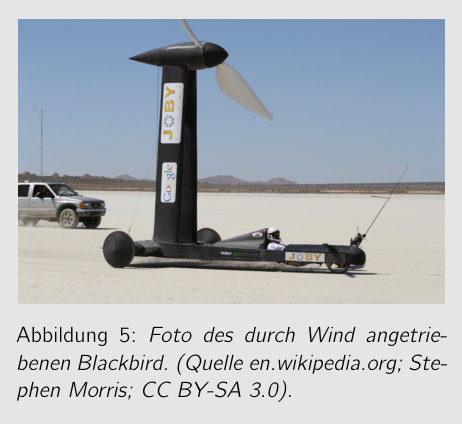 Photo of the wind-powered Blackbird vehicle
Topic: Newtonian Mechanics, Conservation of Energy Metodi: Conservation Laws, Energy Conservation Method, Physical Modeling Competenze: Physical Reasoning, Mathematical Modeling Objects: Wheel Fonte: Testo (PDF) — p.11
Problema 9 Più veloce del vento (cfr. La foto sulla destra mostra il veicolo sperimentale
- Il nero. Il veicolo non ha magazzino di energia di suo come batterie o combustibile, ma è solo guidato dal vento. Per la propulsione, il veicolo contiene solo una gearbox che Can transfer energy between the wheels e la propeller. Con il Blackbird, test run sono stati effettuati su terra a livello a costante direzione e velocità del vento - sia con che con Direttamente contro il vento. La velocità del Il sistema di controllo è stato quindi il tutto tempo parallelo O antiparallel to the wind velocity . Tu può assumere che nel test corre una costante velocità raggiunta in ogni caso. Figura 5: Foto del Blackbird a vento. (Source en.wikipedia.org; Stephen Morris; CC BY-SA 3.0) I progettisti del Blackbird sostenevano che in corsa nella direzione della velocità del vento avevano viaggiato più velocemente del vento, cioè a velocità costante per il quale . Questo è stato criticato da alcune persone come non fisico e quindi impossibile. Ma è?
- (a) Justify why, at constant wind speed , it is in principle possible to travel with a velocità costante nella direzione del vento. Stato se, In questo modo, l’energia viene trasferita dal propellore alle ruote o viceversa. (8,0 pts.) Per una stima della velocità raggiungibile, supponiamo che nel trasferimento di energia tra l’aria circostante e il terreno e viceversa, una frazione del Potenza perduta per ulteriori utilizzi. Quindi se, per esempio, l’energia viene trasferita dall’aria circostante attraverso il propellente, la casella di ingranaggi e le ruote al suolo, allora only a fraction of the energy transferred to the vehicle by the wind can be used for propulsion. 9.b) Determina la velocità che il veicolo può raggiungere quando viaggia nella direzione del vento. Esprimere il tuo risultato in termini di e . (6,0 p.p.) 9.c) Determina la velocità raggiungibile per viaggiare direttamente contro il vento. Esprimi anche questo in terms of and , and justify whether in this case as well it is possible to be faster
- più del vento. (6,0 p.p.) Answer section 9.a) Calcoli e spiegazioni 51° IPhO 2020 - 2° round exam Codice: Codice Calcoli e spiegazioni (continuato) 9.b) Calcoli e spiegazioni Result for the speed when travelling in the wind direction: 51° IPhO 2020 - 2° round exam Codice: Codice 9.c) Calcoli e spiegazioni Risultato per la velocità quando si viaggia contro la direzione del vento: 51° IPhO 2020 - 2° round exam Codice: Codice
Photo of the wind-powered Blackbird vehicle
Topic: Newtonian Mechanics, Conservation of Energy Metodi: Conservation Laws, Energy Conservation Method, Physical Modeling Competenze: Physical Reasoning, Mathematical Modeling Objects: Wheel Fonte: Testo (PDF) — p.11
Problem 9 Faster than the wind The Commission shall adopt implementing acts in accordance with Article 21 of this Regulation. The photo on the right shows the experimental vehicle Blackbird, you know. The vehicle has no energy store of its own, such as batteries or fuel, But is driven solely by the wind. For propulsion, the vehicle contains only a gearbox that Can transfer energy between the wheels and the propeller. With the Blackbird, test runs were carried out on level ground at constant wind direction and speed - both with as well as Directly against the wind. The velocity of the vehicle which therefore the whole time parallel or antiparallel to the wind speed . You may assume that in the test runs a constant speed as reached in each case. Figure 5: Photo of the wind-driven blackbird. The Commission has also adopted a number of measures to ensure that the Commission is able to take appropriate measures to ensure that the Commission is able to take appropriate measures to ensure that the measures taken are consistent with the objectives of the programme. The designers of the Blackbird claimed that on runs in the direction of the wind velocity they had traveled faster than the wind, i.e. at a constant velocity for which . This was criticized by some people as unphysical and therefore impossible. But is it? 9. (a) Justify why, at constant wind speed , it is in principle possible to travel with a constant speed in the direction of the wind. State whether, In doing so, energy is transferred from the propeller to the wheels or vice versa. (8.0 pts.) For an estimate of the attainable speed, assume that in the transfer of energy between the surrounding air and the ground and vice versa, a fraction of the available Power is lost for further use. So if, for example, energy is transferred from the surrounding air via the propeller, the gearbox and the wheels to the ground, then only a fraction of the energy transferred to the vehicle by the wind can be used for propulsion. 9. (b) Determine the speed that the vehicle can reach when travelling in the wind direction. Express your result in terms of and . (6.0 pts) 9. (c) Determine the attainable speed for travelling directly against the wind. Express this too in terms of and , and justify whether in this case as well it is possible to be faster than the wind. (6.0 pts) Answer section 9.a) Calculations and explanations 51st IPhO 2020 - Second Round exam The code: Code Calculations and explanations (continued) 9.b) Calculations and explanations Result for the speed when travelling in the wind direction: 51st IPhO 2020 - Second Round exam The code: Code 9.c) Calculations and explanations Result for the speed when travelling against the wind direction: 51st IPhO 2020 - Second Round exam The code: Code
Photo of the wind-powered Blackbird vehicle
Topic: Newtonian Mechanics, Conservation of Energy Metodi: Conservation Laws, Energy Conservation Method, Physical Modeling Competenze: Physical Reasoning, Mathematical Modeling Objects: Wheel Fonte: Testo (PDF) — p.11
Problem 10 Nuclear fusion (22 pts.) Controlled nuclear fusion could in the future make an important contribution to the energy supply and is therefore intensively researched in plasma physics. In the following, you are to investigate the merging or fusion of nuclei of the two hydrogen isotopes deuterium () and tritium (). As products of the fusion, a helium nucleus and a neutron are formed. The reaction can be represented as Here, denotes the energy released in the fusion in the form of kinetic energy. The rest masses of the particles and nuclei are: Deuterium nucleus: Tritium nucleus: Helium nucleus: Neutron: 10.a) Calculate the energy released in a single nuclear fusion by the above reaction. Determine the fractions of the energy attributed respectively to the helium nucleus and to the neutron, and , for the case that the initial kinetic energy of the hydrogen isotopes is negligible. Give your results in the unit MeV, with . (8.0 pts.) For the fusion reaction to take place, the hydrogen nuclei must come close enough together. This can be achieved by heating an initially electrically neutral gas of these isotopes to very high temperatures. The gas is then fully ionized and is called a plasma. 10.b) Estimate how high the temperature of the plasma must be at least, so that the hydrogen nuclei can come together to a distance of less than and thus a fusion reaction becomes possible. For this, assume that all nuclei of one isotope move with the same speed. (4.0 pts.) In reality, the speed of the nuclei is not identical for all nuclei. Because some nuclei have more kinetic energy than others, nuclear fusion can already set in at lower temperatures. In the following, consider a plasma that consists in equal parts of deuterium and tritium nuclei with a particle density of each. Let the temperature of the plasma be . In order to keep the plasma at these high temperatures and thereby maintain the nuclear fusion over a longer period, the energy losses of the plasma must be compensated. The electrically neutral neutrons released in the fusion leave the plasma very quickly and their kinetic energy is no longer available to the plasma. In addition, energy losses occur through radiation and transport. The total resulting loss power of the plasma can be expressed by means of the internal thermal energy of the plasma and the so-called energy confinement time as 51st IPhO 2020 - 2nd Round exam Code: Code You may assume that the plasma behaves to a good approximation like an ideal gas, and for the energy confinement time use the value . The helium nuclei produced in the fusion, on the other hand, remain in the plasma and their kinetic energy heats the plasma. The heating power is a function of the nuclear reaction rate density , i.e. the mean number of fusion reactions per unit time and volume, the plasma volume as well as the kinetic energy of the helium nuclei, and is 10.c) Determine the mean nuclear reaction rate density for the plasma at constant temperature. Note that the overall electrically neutral plasma, besides the ions, also contains electrons. (4.0 pts.) For the technical use of nuclear fusion, beyond maintaining the temperature it is also necessary to confine the plasma spatially for as long as possible. To compensate for the plasma pressure and thereby confine the plasma, a magnetic field is applied. The pressure produced by this field can, in a simplified estimate, be expressed by the magnetic flux density and (numerical factors that arise may be set to 1). 10.d) Estimate how large the magnetic flux density must be in order to confine the described plasma. (6.0 pts.) Answer section 10.a) Calculations and explanations 51st IPhO 2020 - 2nd Round exam Code: Code Calculations and explanations (continued) Result for the kinetic energies: 10.b) Calculations and explanations Result for the temperature of the plasma: 51st IPhO 2020 - 2nd Round exam Code: Code 10.c) Calculations and explanations (continued) Result for the mean nuclear reaction rate density: 10.d) Calculations and explanations Result for the magnetic flux density: 51st IPhO 2020 - 2nd Round exam Code: Code Additional worksheet 51st IPhO 2020 - 2nd Round exam Code: Code Additional worksheet 51st IPhO 2020 - 2nd Round exam Code: Code Additional worksheet 51st IPhO 2020 - 2nd Round exam Code: Code Additional worksheet 51st IPhO 2020 - 2nd Round exam Code: Code Additional worksheet Graph Graph
Topic: Nuclear & Particle Physics, Thermodynamics, Magnetism Metodi: Mass-Energy Equivalence, Ideal Gas Law, Conservation of Momentum, Order-of-Magnitude Estimation Competenze: Mathematical Modeling, Physical Reasoning, Estimation & Approximation Objects: Nucleus, Gas Fonte: Testo (PDF) — p.14
Problema 10 Fusione nucleare (22 pag.) La fusione nucleare controllata potrebbe in futuro contribuire in modo significativo all’approvvigionamento energetico e è quindi molto studiato in fisica del plasma. In questo articolo, si intende studiare la fusione o fusione di nuclei dei due isotopi di idrogeno. diuterium () e tritium (). Come prodotti della fusione, un nucleo di elio e un neutrone sono formati. La reazione può essere rappresentata come Qui, denota l’energia rilasciata nella fusione sotto forma di energia cinetica. Il rest masses of the particles and nuclei sono: Il nucleo di deuterio: Tritium nucleus: nucleo di elio: Neutron: 10. (a) Calcolare l’energia rilasciata in una singola fusione nucleare dalla reazione sopra indicata. Determine le frazioni di energia attribuite rispettivamente al nucleo di elio e al neutrone, e , per il caso che l’energia cinetica iniziale degli isotopi di idrogeno sia trascurabile. Give your results in the unit MeV, with . (8,0 pts.) Per la reazione di fusione che deve avvenire, i nuclei di idrogeno devono arrivare abbastanza vicino
- insieme. Questo può essere ottenuto riscaldando un gas inizialmente elettricamente neutro di questi Isotopi a temperature molto elevate. Il gas è quindi completamente ionizzato e Si chiama plasma. 10.b) Estimare quanto alta deve essere la temperatura del plasma almeno, in modo che i nuclei di idrogeno possano venire insieme a una distanza di meno di e quindi a La reazione di fusione diventa possibile. Per questo, supponiamo che tutti i nuclei di un isotopo si muovano con il
- La stessa velocità. (4,0 p.) In realtà, la velocità dei nuclei non è identica per tutti i nuclei. Perché Alcuni nuclei hanno più energia cinetica di altri, la fusione nucleare può già essere installata a
- le temperature inferiori. In questo caso, considerate un plasma che è costituito da parti uguali. di deuterium e tritium nuclei con una densità di particelle di ciascuno. Let the temperature of the plasma be . Per mantenere il plasma a queste alte temperature e quindi mantenere la fusione nucleare per un periodo più lungo, le perdite energetiche del plasma devono essere compensate. I neutroni elettricamente neutri rilasciati nella fusione lasciano il plasma molto rapidamente e la loro energia cinetica non è più disponibile al plasma. Inoltre, le perdite energetiche si verificano attraverso la radiazione e il trasporto. Il totale di perdita risultante del plasma can be expressed by means of the internal thermal energy of the plasma and the so-called energia confinement time as 51° IPhO 2020 - 2° round exam Codice: Codice Potete presumere che il plasma si appoggia a una buona approssimazione come un gas ideale, e per il tempo di confinamento energetico utilizzare il valore . Gli elio nuclei prodotti nella fusione, d’altra parte, rimangono nel plasma e la loro energia cinetica Il plasma è caldo. Il potere di riscaldamento è una funzione del tasso di reazione nucleare , cioè La media di reazioni di fusione per unità di tempo e volume, il volume plasmatico e il motore di energia dei nuclei di elio, e è 10.c) Determina il mean nuclear reaction rate density per il plasma a temperatura costante. Si noti che il plasma elettricamente neutro, oltre agli ioni, contiene elettroni. (4,0 p.) Per l’uso tecnico della fusione nucleare, oltre a mantenere la temperatura è anche necessario limitare il plasma spazialmente per il più lungo possibile. Per compensare il La pressione plasmatica e quindi la concentrazione plasmatica sono limitate, un campo magnetico viene applicato. Il La pressione prodotta da questo campo può, in una stima semplificata, essere espressa dalla densità del flusso magnetico e (numerical factors that arise may be set to 1). 10.d) Estimare how large the magnetic flux density must be in order to confine the described plasma. (6,0 p.p.) Answer section 10.a) Calcoli e spiegazioni 51° IPhO 2020 - 2° round exam Codice: Codice Calcoli e spiegazioni (continuato) Result for the kinetic energies: 10.b) Calcoli e spiegazioni Result for the temperature of the plasma: 51° IPhO 2020 - 2° round exam Codice: Codice 10.c) Calcoli e spiegazioni (continuato) Risultato per la densità media del tasso di reazione nucleare: 10.d) Calcoli e spiegazioni Result for the magnetic flux density: 51° IPhO 2020 - 2° round exam Codice: Codice Ulteriori fogli di lavoro 51° IPhO 2020 - 2° round exam Codice: Codice Ulteriori fogli di lavoro 51° IPhO 2020 - 2° round exam Codice: Codice Ulteriori fogli di lavoro 51° IPhO 2020 - 2° round exam Codice: Codice Ulteriori fogli di lavoro 51° IPhO 2020 - 2° round exam Codice: Codice Ulteriori fogli di lavoro Grafico Grafico
Topic: Nuclear & Particle Physics, Thermodynamics, Magnetism Metodi: Mass-Energy Equivalence, Ideal Gas Law, Conservation of Momentum, Order-of-Magnitude Estimation Competenze: Mathematical Modeling, Physical Reasoning, Estimation & Approximation Objects: Nucleus, Gas Fonte: Testo (PDF) — p.14
Problem 10 Nuclear fusion (Page 226) Controlled nuclear fusion could in the future make an important contribution to the energy supply and is therefore intensively researched in plasma physics. In the following, you are to investigate the merging or fusion of nuclei of the two hydrogen isotopes deuterium () and tritium (). As products of the fusion, a helium nucleus and a neutron are formed. The reaction can be represented as Here, denotes the energy released in the fusion in the form of kinetic energy. The The rest masses of the particles and nuclei are: The following is a list of the chemical substances used: The following is the list of the active substances in Annex I: Helium nucleus: Neutron: 10.a) Calculate the energy released in a single nuclear fusion by the above reaction. Determine the fractions of energy attributed to the helium nucleus and to the neutron, respectively, and , for the case that the initial kinetic energy of the hydrogen isotopes is negligible. Give your results in the unit MeV, with . (8.0 pts.) For the fusion reaction to take place, the hydrogen nuclei must come close enough together. This can be achieved by heating an initially electrically neutral gas of these isotopes at very high temperatures. The gas is then fully ionized and It’s called a plasma. 10.b) Estimate how high the temperature of the plasma must be at least, so that the hydrogen nuclei can come together to a distance of less than and thus a The fusion reaction becomes possible. For this, assume that all nuclei of one isotope move with the Same speed. (4.0 p.m.) In reality, the speed of the nuclei is not identical for all nuclei. Because Some nuclei have more kinetic energy than others, nuclear fusion can already set in at lower temperatures. In the following, consider a plasma that consists of equal parts of deuterium and tritium nuclei with a particle density of each. Let the temperature of the plasma be . In order to keep the plasma at these high temperatures and thereby maintain the nuclear fusion over a longer period, the energy losses of the plasma must be compensated. The electrically neutral neutrons released in the fusion leave the plasma very quickly and their kinetic energy is no longer available to the plasma. In addition, energy losses occur through radiation and transport. The total resulting loss power of the plasma can be expressed by means of the internal thermal energy of the plasma and the so-called energy confinement time as 51st IPhO 2020 - Second Round exam The code: Code You may assume that the plasma behaves to a good approximation like an ideal gas, and for the energy confinement time use the value . The helium nuclei produced in the fusion, on the other hand, remain in the plasma and their kinetic energy Heats the plasma. The heating power is a function of the nuclear reaction rate density , i.e. The mean number of fusion reactions per unit time and volume, the plasma volume as well as the kinetic energy of the helium nuclei, and is 10. (c) Determine the mean nuclear reaction rate density for the plasma at constant temperature. Note that the overall electrically neutral plasma, besides the ions, is therefore contains electrons. (4.0 p.m.) For the technical use of nuclear fusion, beyond maintaining the temperature it is also necessary to confine the plasma spatially for as long as possible. To compensate for the plasma pressure and thus confine the plasma, a magnetic field is applied. The pressure produced by this field can, in a simplified estimate, be expressed by the magnetic flux density and (numerical factors that arise may be set to 1). 10.d) Estimate how large the magnetic flux density must be in order to confine the described plasma. (6.0 pts) Answer section 10.a) Calculations and explanations 51st IPhO 2020 - Second Round exam The code: Code Calculations and explanations (continued) Result for the kinetic energies: 10.b) Calculations and explanations Result for the temperature of the plasma: 51st IPhO 2020 - Second Round exam The code: Code 10.c) Calculations and explanations (continued) Result for the mean nuclear reaction rate density: 10.d) Calculations and explanations Result for the magnetic flux density: 51st IPhO 2020 - Second Round exam The code: Code Additional worksheet 51st IPhO 2020 - Second Round exam The code: Code Additional worksheet 51st IPhO 2020 - Second Round exam The code: Code Additional worksheet 51st IPhO 2020 - Second Round exam The code: Code Additional worksheet 51st IPhO 2020 - Second Round exam The code: Code Additional worksheet Graph Graph
Topic: Nuclear & Particle Physics, Thermodynamics, Magnetism Metodi: Mass-Energy Equivalence, Ideal Gas Law, Conservation of Momentum, Order-of-Magnitude Estimation Competenze: Mathematical Modeling, Physical Reasoning, Estimation & Approximation Objects: Nucleus, Gas Fonte: Testo (PDF) — p.14