Problem 1 Temperature units (MC problem) (5 pts.) The fictitious temperature unit Nups is defined by setting Nups, Nups and a linear variation with temperature. Which temperature in corresponds most closely to 0 Nups? A B C D Answer section Calculations and explanations Correct answer: 51st IPhO 2021 - 2nd Round exam Code: Code
Topic: Thermodynamics Metodi: Dimensional Analysis, Physical Modeling Competenze: Mathematical Modeling Objects: — Fonte: Testo (PDF) — p.2
Problema 1 Temperature units (problema MC) (cfr. The fictitious temperature unit Nups is defined by setting Nups, Nups e una variazione lineare con la temperatura. Quale temperatura in corrisponde più strettamente a 0 Nups? A B C D Answer section Calcoli e spiegazioni Corretta risposta: 51° IPhO 2021 - 2° round exam Codice: Codice
Topic: Thermodynamics Metodi: Dimensional Analysis, Physical Modeling Competenze: Mathematical Modeling Objects: — Fonte: Testo (PDF) — p.2
The following is the list of the parameters of the test: (five points) The fictitious temperature unit Nups is defined by setting Nups, Nups and a linear variation with temperature. Which temperature in corresponds most closely to 0 nups? A B C D Answer section Calculations and explanations Correct answer: 51st IPhO 2021 - 2nd round exam The code: Code
Topic: Thermodynamics Metodi: Dimensional Analysis, Physical Modeling Competenze: Mathematical Modeling Objects: — Fonte: Testo (PDF) — p.2
Problem 2 Black hole in the Milky Way (MC problem) (5 pts.) The 2020 Nobel Prize in Physics was awarded for the discovery of a very massive, compact object at the centre of our galaxy, the Milky Way. Much evidence indicates that this object is a black hole. The figure alongside shows the position of a star observed at various dates relative to the presumed position of the centre of the Milky Way. The position is given in multiples of the Sun- Earth distance, that is, in astronomical units with . On galactic length scales the star is therefore located close to the centre of the Milky Way. For simplicity, assume that the orbit of the star lies in the plane of the drawing and that the orbit is not influenced by relativistic effects. What mass can be estimated from the data for the black hole presumed at the centre of the Milky Way, expressed as a multiple of the solar mass with ? The mass of the black hole corresponds most closely to … A … solar masses. B … solar masses. C … solar masses. D … solar masses. Offset / au Offset / au Answer section Calculations and explanations 51st IPhO 2021 - 2nd Round exam Code: Code Calculations and explanations (continued) Correct answer: 51st IPhO 2021 - 2nd Round exam Code: Code
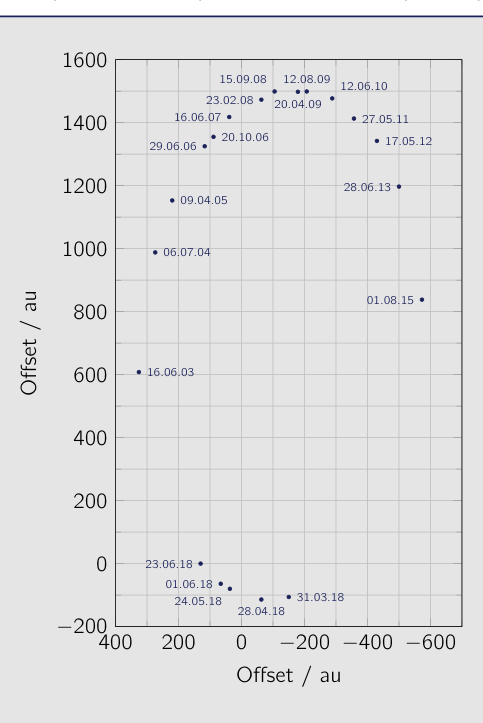 Orbita stella attorno al centro galattico
Topic: Astrophysics, Gravitation Metodi: Kepler’s Laws, Newton’s Law of Gravitation, Order-of-Magnitude Estimation Competenze: Estimation & Approximation, Graph Linearization Objects: Black Hole, Star Fonte: Testo (PDF) — p.3
Problema 2 Buco nero nella Via Lattea (problema MC) (cfr. Il premio Nobel per la fisica del 2020 è stato assegnato per la scoperta di un oggetto molto massiccio e compatto al centro della nostra galassia, la Via Lattea. Molte prove indicano che this object is a black
- Prendila. La figura al fianco mostra la posizione di una stella osservata a varie date relative alla presunta posizione del centro della Via Lattea. Il posizione è data in multipli del Sole Distanza terrestre, cioè, in unità astronomiche con . Su scala galattica di lunghezza la stella è quindi situato vicino al centro del Latty
- Oh, sì. Per semplicità, supponiamo che l’orbita del Star è nel piano del disegno e che L’orbita non è influenzata da effetti relativistici. What mass can be estimated from the data for the buco nero presunto al centro della Via Lattea, espresso come un multiple della massa solare con ? La massa del buco nero corrisponde al più
- Proprio a me … A … solar masses. B … solar masses. C … solar masses. D … solar masses. Offset / au Offset / au Answer section Calcoli e spiegazioni 51° IPhO 2021 - 2° round exam Codice: Codice Calcoli e spiegazioni (continuato) Corretta risposta: 51° IPhO 2021 - 2° round exam Codice: Codice
Orbita stella attorno al centro galattico
Topic: Astrophysics, Gravitation Metodi: Kepler’s Laws, Newton’s Law of Gravitation, Order-of-Magnitude Estimation Competenze: Estimation & Approximation, Graph Linearization Objects: Black Hole, Star Fonte: Testo (PDF) — p.3
Problem 2 Black hole in the Milky Way (MC problem) (five points) The 2020 Nobel Prize in Physics was awarded for the discovery of a very massive, compact object at the center of our galaxy, the Milky Way. Much evidence indicates that this object is a black
- I’ll take it. The figure next to shows the position of a star observed at various dates relative to the presumed position of the center of the Milky Way. The position is given in multiples of the Sun Earth distance, that is, in astronomical units with M_\text{Sonne} = 1{,}99 \cdot 10^{30}\ \text{kg}1 \cdot 10^52 \cdot 10^64 \cdot 10^78 \cdot 10^8$ Offset / au Offset / au Answer section Calculations and explanations 51st IPhO 2021 - 2nd round exam The code: Code Calculations and explanations (continued) Correct answer: 51st IPhO 2021 - 2nd round exam The code: Code
The following table shows the results of the evaluation of the results of the evaluation:
Topic: Astrophysics, Gravitation Metodi: Kepler’s Laws, Newton’s Law of Gravitation, Order-of-Magnitude Estimation Competenze: Estimation & Approximation, Graph Linearization Objects: Black Hole, Star Fonte: Testo (PDF) — p.3
Problem 3 Two plates in vacuum (MC problem) (5 pts.) Two conducting, parallel plates of area are located a distance apart in vacuum. Owing to the quantum-mechanical Casimir effect, a force acts between the plates that depends on the speed of light in vacuum and the reduced Planck constant . Which of the following expressions could represent a suitable expression for the force with which the plates are pressed together? A B C D Answer section Calculations and explanations Correct answer: 51st IPhO 2021 - 2nd Round exam Code: Code
Topic: Modern-Quantum Physics Metodi: Dimensional Analysis Competenze: Mathematical Modeling Objects: Capacitor Fonte: Testo (PDF) — p.5
Problema 3 Due piastre in vuoto (problema MC) (cfr. Due conducenti, plates parallele di area sono situate a distanza separate in vuoto. A causa di l’effetto quantomeccanico di Casimir, una forza che agisce tra i piatti che dipende dal velocità di luce in vacuum e la costante di planck ridotta. Which of the following expressions could represent a suitable expression for the force with
- Which the plates are pressed together? - Cosa? A B C D Answer section Calcoli e spiegazioni Corretta risposta: 51° IPhO 2021 - 2° round exam Codice: Codice
Topic: Modern-Quantum Physics Metodi: Dimensional Analysis Competenze: Mathematical Modeling Objects: Capacitor Fonte: Testo (PDF) — p.5
Problem 3 Two plates in vacuum (MC problem) (five points) Two conducting, parallel plates of area are located a distance apart in vacuum. Due to The quantum-mechanical Casimir effect, a force acts between the plates that depends on the speed of light in vacuum and the reduced Planck constant . Which of the following expressions could represent a suitable expression for the force with Which plates are pressed together? A B C D Answer section Calculations and explanations Correct answer: 51st IPhO 2021 - 2nd round exam The code: Code
Topic: Modern-Quantum Physics Metodi: Dimensional Analysis Competenze: Mathematical Modeling Objects: Capacitor Fonte: Testo (PDF) — p.5
Problem 4 Two transmitters (MC problem) (5 pts.) Two identical electric transmitting dipoles, oriented perpendicular to the plane of the drawing, radiate in phase from the points and into space with frequency . A receiver E is moved, starting from , along a circle around . The intensity measured at the receiver as a function of the angle is shown in the diagram and exhibits clear maxima and minima. If the receiver comes too close to the transmitter , it overloads, so that no measurement is possible. What is the frequency of the radiation? A 1,5 GHz B 3,0 GHz C 4,5 GHz D 6,0 GHz E 20 cm Fig. 1. Transmitter and receiver. Fig. 2. Intensity distribution in relative units. Answer section Calculations and explanations Correct answer: 51st IPhO 2021 - 2nd Round exam Code: Code
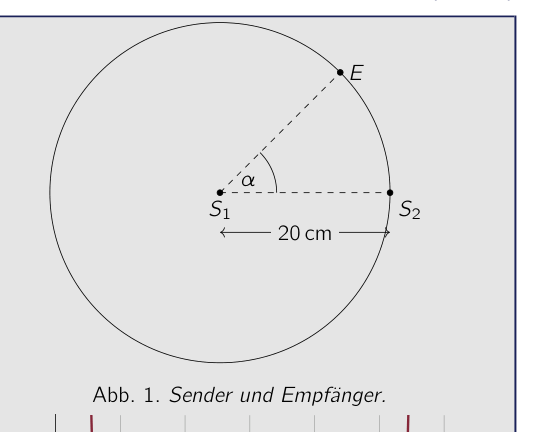 Schema due emettitori e ricevitore
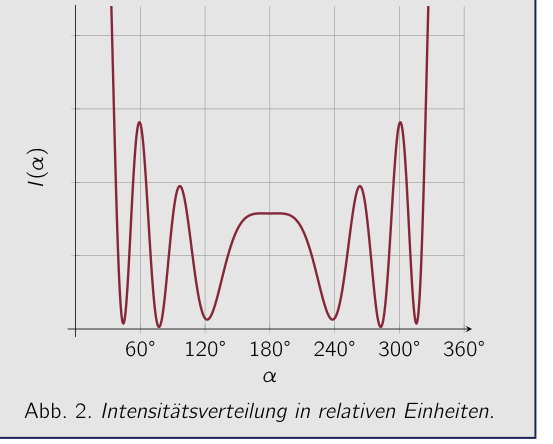 Distribuzione intensità vs angolo alpha
Topic: Oscillations & Waves, Wave Optics Metodi: Interference & Diffraction Analysis, Superposition Principle, Wave Equation Competenze: Mathematical Modeling Objects: Magnetic Dipole Fonte: Testo (PDF) — p.6
Problema 4 Due trasmettitori (problema MC) (cfr. Due identici dipoli elettrici trasmettenti, orientati perpendicolare al piano del disegno, che irradiano in fase dai punti e into space with frequency . A receiver E is moved, starting from , along a circle around . L’intensità misurata al ricevitore come funzione del angle is shown in the diagram e mostra i massimi e i minimi. Se il ricevitore viene anche close to the transmitter , it overloads, so that no misurazione è possibile. Qual è la frequenza della radiazione? A 1,5 GHz B 3,0 GHz C 4,5 GHz D 6,0 GHz E 20 cm Fig. 1. Trasmettitore e ricevitore. Fig. 2. Distribuzione dell’intensità in unità relative. Answer section Calcoli e spiegazioni Corretta risposta: 51° IPhO 2021 - 2° round exam Codice: Codice
Schema due emettitori e ricevitore
Distribuzione intensità vs angolo alpha
Topic: Oscillations & Waves, Wave Optics Metodi: Interference & Diffraction Analysis, Superposition Principle, Wave Equation Competenze: Mathematical Modeling Objects: Magnetic Dipole Fonte: Testo (PDF) — p.6
Problem 4 Two transmitters (MC problem) (five points) Two identical electric transmitting dipoles, oriented perpendicular to the plane of the drawing, radiate in phase from the points and into space with frequency . A receiver E is moved, starting from , along a circle around . The intensity measured at the receiver as a function of the angle is shown in the diagram and exhibits clear maxima and minima. If the receiver comes too close to the transmitter , it overloads, so that no measurement is possible. What is the frequency of the radiation? A. 1,5 GHz B. 3,0 GHz C 4,5 GHz D 6.0 GHz E 20 cm Fig. 1. Transmitter and receiver. Fig. 2. Intensity distribution in relative units. Answer section Calculations and explanations Correct answer: 51st IPhO 2021 - 2nd round exam The code: Code
Schema due emettitori e ricevitore
Distribuzione intensità vs angolo alpha
Topic: Oscillations & Waves, Wave Optics Metodi: Interference & Diffraction Analysis, Superposition Principle, Wave Equation Competenze: Mathematical Modeling Objects: Magnetic Dipole Fonte: Testo (PDF) — p.6
Problem 5 Charged dust (MC problem) (5 pts.) Six identical, initially resting dust particles with mass and charge are arranged in vacuum, as sketched alongside, in a regular hexagon of edge length . At the centre of the hexagon there is a seventh dust particle, likewise initially at rest, with the same mass but opposite charge . The particles are now released. What is the velocity of one of the positively charged dust particles relative to the negatively charged dust particle after the particles have moved far apart from one another? A about B about C about D about q q q q q q a Fig. 3. Sketch of the arrangement. The outer particles each have a mass and a charge , the central particle likewise a mass but a charge . Answer section Calculations and explanations Correct answer: 51st IPhO 2021 - 2nd Round exam Code: Code
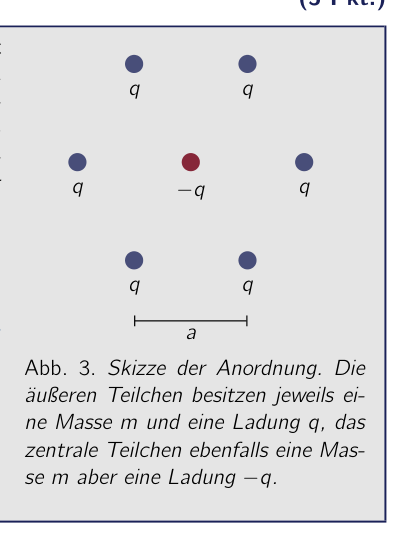 Disposizione esagonale cariche elettriche
Topic: Electrostatics, Conservation of Energy Metodi: Coulomb’s Law, Conservation of Energy, Conservation of Momentum Competenze: Mathematical Modeling Objects: Point Charge Fonte: Testo (PDF) — p.7
Problema 5 Polvere carica (problema MC) (cfr. 6 particelle di polvere identiche, inizialmente restanti con mass and charge sono disposti in vuoto, come schizziati insieme, in un hexagono regolare di lunghezza di bordo . Al centro dell’esagono c’è una settima particella di polvere, anch’essa inizialmente a riposo, con la stessa mass but opposite charge . Il le particelle sono ora rilasciate. What is the velocity of one of the positively charged particelle di polvere relative alla particella di polvere a carica negativa dopo che le particelle si sono mosse lontano l’una dall’altra? A about B about C about D about q q q q q q a Fig. 3. Sketch dell’arrangimento. Il Le particelle esterne hanno una massa e una carica , un’unità di massa ma una carica . Answer section Calcoli e spiegazioni Corretta risposta: 51° IPhO 2021 - 2° round exam Codice: Codice
Disposizione esagonale cariche elettriche
Topic: Electrostatics, Conservation of Energy Metodi: Coulomb’s Law, Conservation of Energy, Conservation of Momentum Competenze: Mathematical Modeling Objects: Point Charge Fonte: Testo (PDF) — p.7
The following is the list of the types of dust that are charged: (five points) Six identical initially resting dust particles with mass and charge are arranged in vacuum, as sketched alongside, in a regular hexagon of edge length . At the center of the hexagon there is a seventh dust particle, similarly initially at rest, with the same mass but opposite charge . The particles are now released. What is the velocity of one of the positively charged dust particles relative to the negatively charged dust particle After the particles have moved far apart from each other? A about B about C about D about q q q q q q a Fig. 3. Sketch of the arrangement. The outer particles each have a mass and a charge , the central particle likewise a mass but a charge . Answer section Calculations and explanations Correct answer: 51st IPhO 2021 - 2nd round exam The code: Code
Disposizione esagonale cariche elettriche
Topic: Electrostatics, Conservation of Energy Metodi: Coulomb’s Law, Conservation of Energy, Conservation of Momentum Competenze: Mathematical Modeling Objects: Point Charge Fonte: Testo (PDF) — p.7
Problem 6 Galactic message in a bottle (MC problem) (5 pts.) A spaceship departs from Earth at the constant velocity , where denotes the speed of light in vacuum. After 100 h on board, the astronauts throw a message in a bottle with velocity relative to the spaceship in the direction of Earth. How long must the inhabitants of Earth wait between the departure of the spaceship and the arrival of the message in a bottle? A about 256 h B about 320 h C about 400 h D about 525 h Answer section Calculations and explanations Correct answer: 51st IPhO 2021 - 2nd Round exam Code: Code
Topic: Special Relativity Metodi: Lorentz Transformation, Relativistic Energy-Momentum Competenze: Mathematical Modeling Objects: Satellite Fonte: Testo (PDF) — p.8
Problema 6 Messaggio galattico in bottiglia (problema MC) (cfr. Una nave spaziale parte dalla Terra alla velocità costante , dove indica la velocità della luce in vuoto. Dopo 100 ore a bordo, gli astronauti lanciano un messaggio in una bottiglia. con velocità relativa alla nave spaziale nella direzione della Terra. Quanto tempo dovranno aspettare gli abitanti della Terra tra la partenza della nave spaziale e l’arrivo del messaggio in bottiglia? A circa 256 h B circa 320 h C circa 400 ore D circa 525 h Answer section Calcoli e spiegazioni Corretta risposta: 51° IPhO 2021 - 2° round exam Codice: Codice
Topic: Special Relativity Metodi: Lorentz Transformation, Relativistic Energy-Momentum Competenze: Mathematical Modeling Objects: Satellite Fonte: Testo (PDF) — p.8
Problem 6 Galactic message in a bottle (MC problem) (five points) A spacecraft departs from Earth at the constant velocity , where denotes the speed of light in vacuum. After 100 hours on board, the astronauts throw a message in a bottle with velocity relative to the spacecraft in the direction of Earth. How long must the inhabitants of Earth wait between the departure of the spacecraft and the arrival of the message in a bottle? A about 256 h B about 320 h C about 400 h D about 525 h Answer section Calculations and explanations Correct answer: 51st IPhO 2021 - 2nd round exam The code: Code
Topic: Special Relativity Metodi: Lorentz Transformation, Relativistic Energy-Momentum Competenze: Mathematical Modeling Objects: Satellite Fonte: Testo (PDF) — p.8
Problem 7 Falling conducting loop in a magnetic field (MC problem) (5 pts.) A square conducting loop with edge length , resistance and mass falls, as sketched alongside, from rest into a sharply bounded region of width with a homogeneous magnetic field of flux density , oriented into the plane of the drawing. The graphs A, B, C and D are intended to represent the time evolution of the velocity of the conducting loop for various magnetic field strengths. Which of the graphs shows a physically possible process? Conducting loop Region with magnetic field a b A 0 t v B 0 t v C 0 t v D 0 t v Answer section Calculations and explanations Correct answer: 51st IPhO 2021 - 2nd Round exam Code: Code Long-answer problems Work on the following three problems likewise in the boxes provided for them. Unlike the multiple-choice problems, no answer options are given. Describe your solution method so that it is easy to follow but not unnecessarily long. So if, for example, you use the conservation of energy law, write this down briefly.
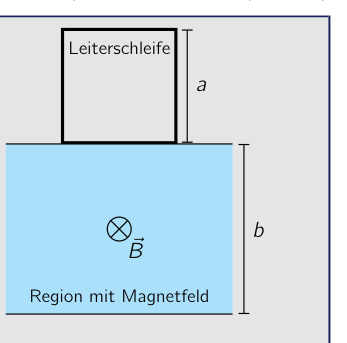 Leiterschleife che cade in campo magnetico
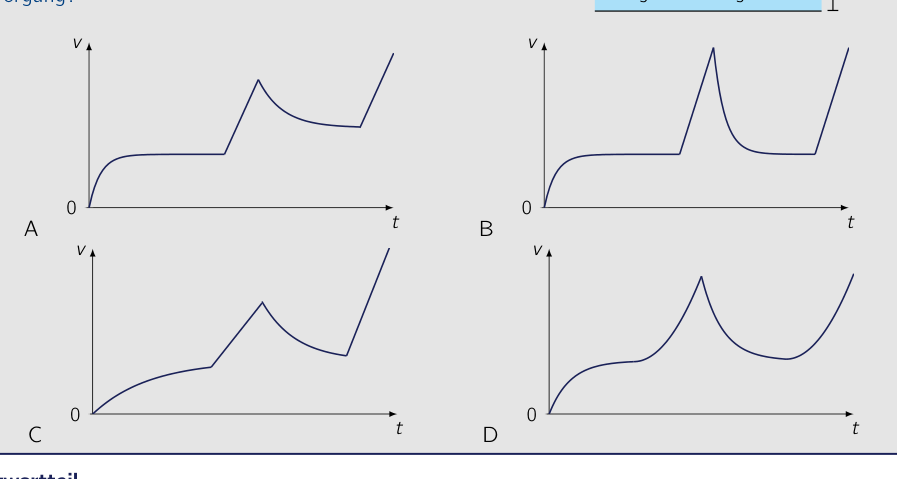 Grafici v(t) per vari campi magnetici
Topic: Electromagnetic Induction, Newtonian Mechanics Metodi: Faraday’s Law of Induction, Lenz’s Law, Free-Body Diagram Competenze: Diagrammatic Reasoning, Physical Reasoning Objects: Coil, Magnet Fonte: Testo (PDF) — p.9
Problema 7 Falling conducting loop in a magnetic field (problema MC) (cfr. A square conducting loop with edge length , resistance and mass falls, as sketched alongside, from rest into a sharply bounded region of width con un campo magnetico omogeneo di densità di flusso , orientato verso il piano del disegno. I grafici A, B, C e D sono destinati a rappresentare la tempo evoluzione della velocità del loop di conduttore per varie forze di campo magnetico. Which of the graphs shows a physically possible processo? Conducting loop Regione con campo magnetico a b A 0 t v B 0 t v C 0 t v D 0 t v Answer section Calcoli e spiegazioni Corretta risposta: 51° IPhO 2021 - 2° round exam Codice: Codice Problemi di risposta lunga La Commissione ha inoltre presentato una serie di proposte di risoluzione sulle misure di sicurezza e di sicurezza. A differenza dei problemi di scelta multipla, non sono state indicate le opzioni di risposta. Descrivi il tuo metodo di soluzione in questo modo: che è facile da seguire ma non troppo lungo. Quindi se, per esempio, si utilizza la legge sulla conservazione dell’energia, scrivete brevemente.
*Leichi di condotta che cadono in campo magnetico *
Grafici per vari campi magnetici
Topic: Electromagnetic Induction, Newtonian Mechanics Metodi: Faraday’s Law of Induction, Lenz’s Law, Free-Body Diagram Competenze: Diagrammatic Reasoning, Physical Reasoning Objects: Coil, Magnet Fonte: Testo (PDF) — p.9
Problem 7 Falling conducting loop in a magnetic field (MC problem) (five points) A square conducting loop with edge length , resistance and mass falls, as sketched alongside, from Rest into a sharply bounded region of width with a homogeneous magnetic field of flux density , oriented into the plane of the drawing. The graphs A, B, C and D are intended to represent the time evolution of the velocity of the conducting loop for various magnetic field strengths. Which of the graphs shows a physically possible process? Conducting loop Region with magnetic field a b A 0 t v B 0 t v C 0 t v D 0 t v Answer section Calculations and explanations Correct answer: 51st IPhO 2021 - 2nd round exam The code: Code Long-response problems Work on the following three problems also in the boxes provided for them. Unlike the Multiple-choice problems, no answer options are given. Describe your solution method That it’s easy to follow but not unnecessarily long. So if, for example, you use the conservation of energy law, write this down briefly.
The following table shows the results of the tests:
Graphically determined by magnetic fields
Topic: Electromagnetic Induction, Newtonian Mechanics Metodi: Faraday’s Law of Induction, Lenz’s Law, Free-Body Diagram Competenze: Diagrammatic Reasoning, Physical Reasoning Objects: Coil, Magnet Fonte: Testo (PDF) — p.9
Problem 8 Coriolis fountain (10 pts.) The Coriolis fountain shown alongside consists of a ring out of which water jets emerge at regular intervals through small holes in the direction of the centre. The ring is located at a fixed height parallel above the ground and can rotate about its central axis. The figures show the Coriolis fountain from above with the path of the water jets up to the point where they strike the ground. In the left figure the Coriolis fountain is at rest. In the right part it rotates with a constant angular velocity . r r Fig. 4. To-scale representation of the Coriolis fountain and the water jets from above in the resting case (left) and during rotation with angular velocity (right). The inner radius of the ring is and the exit velocity of the water in the direction of the centre of the ring is . State in which direction the ring in the right figure rotates and determine the angular velocity of the rotation. Answer section Calculations and explanations 51st IPhO 2021 - 2nd Round exam Code: Code Calculations and explanations (continued) Result for angular velocity and direction of rotation: 51st IPhO 2021 - 2nd Round exam Code: Code
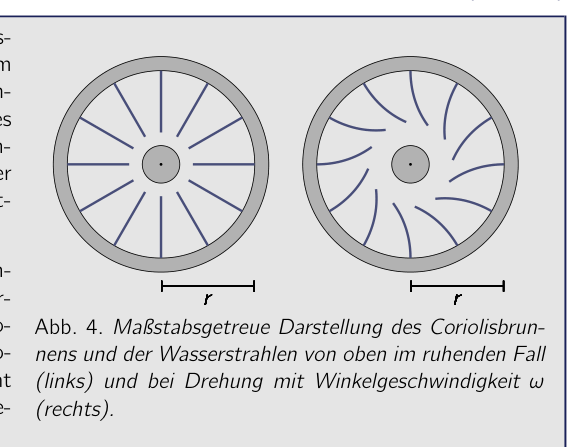 Coriolisbrunnen da sopra due viste
Topic: Newtonian Mechanics, Rotational Dynamics Metodi: Physical Modeling, Kinematic Equations, Vector Decomposition Competenze: Physical Reasoning, Mathematical Modeling Objects: — Fonte: Testo (PDF) — p.10
Problema 8 Fontana di Coriolis (cfr. La fontana di Coriolis mostrato accanto consiste di un anello fuori di cui I jetti d’acqua emergono a intervalli regolari attraverso piccoli fori nella direzione del
- Centro. L’ anello è situato ad una quota fissa parallela sopra Il terreno può ruotare intorno al suo asse centrale. Le cifre mostrano la fontana di Coriolis dall’alto con il percorso dei getti d’acqua fino al punto in cui colpiscono il terreno. Nella figura sinistra, la fontana di Coriolis è a riposo. In the right part it rotates con velocità angolare costante . r r Fig. 4. To-scale representation of the Coriolis fountain and the water jets from above in the resting case (left) and during rotation with angular velocity (Ritto) Il raggio interno del ring è e la velocità di uscita dell’acqua in la direzione del centro del ring è . State in which direction the ring in the right figure rotates and determine the angular velocity of the rotation. Answer section Calcoli e spiegazioni 51° IPhO 2021 - 2° round exam Codice: Codice Calcoli e spiegazioni (continuato) Result for angular velocity and direction of rotation: 51° IPhO 2021 - 2° round exam Codice: Codice
Fonte di corioli da sopra due viste
Topic: Newtonian Mechanics, Rotational Dynamics Metodi: Physical Modeling, Kinematic Equations, Vector Decomposition Competenze: Physical Reasoning, Mathematical Modeling Objects: — Fonte: Testo (PDF) — p.10
The following is the list of the following problems: (Page 10) The Coriolis fountain shown alongside consists of a ring out of which Water jets emerge at regular intervals through small holes in the direction of the The centre. The ring is located at a fixed height parallel above The ground and can rotate about its central axis. The figures show the Coriolis fountain from above with the path of the water jets up to the point where they strike the ground. In the left figure the Coriolis fountain is at rest. In the right part it rotates with a constant angular velocity . r r Fig. 4. To-scale representation of the Coriolis fountain and the water jets from above in the resting case (left) and during rotation with angular velocity (right) The inner radius of the ring is and the exit velocity of the water in the direction of the centre of the ring is . State in which direction the ring in the right figure rotates and determine the angular velocity of the rotation. Answer section Calculations and explanations 51st IPhO 2021 - 2nd round exam The code: Code Calculations and explanations (continued) Result for angular velocity and direction of rotation: 51st IPhO 2021 - 2nd round exam The code: Code
Coriolisbrunnen da sopra due viste
Topic: Newtonian Mechanics, Rotational Dynamics Metodi: Physical Modeling, Kinematic Equations, Vector Decomposition Competenze: Physical Reasoning, Mathematical Modeling Objects: — Fonte: Testo (PDF) — p.10
Problem 9 Deflected electrons (15 pts.) An electron beam of width enters a magnetic field. The electrons move, as sketched in Figure 5, initially in parallel with a velocity . The magnetic field is of such a nature that all electrons pass through point A and, after traversing the magnetic field, the beam continues in the same direction but widened to a width . A d Electron beam v 2d Fig. 5. Sketch of the path of the electron beam. Design as simple as possible a configuration of the magnetic field that leads to the described path of the electron beam. You may use different fields for different regions. Explain your configuration and justify why it leads to the described path of the electron beam. Assume that the electrons do not influence one another and restrict yourself to a motion of the electrons in the plane of the drawing. Answer section Calculations and explanations 51st IPhO 2021 - 2nd Round exam Code: Code Space for sketches Calculations and explanations (continued) 51st IPhO 2021 - 2nd Round exam Code: Code
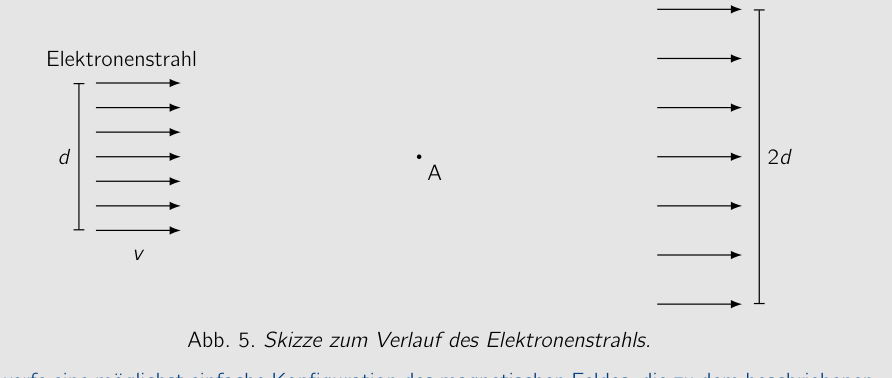 Schizzo fascio elettroni divergente
Topic: Magnetism, Newtonian Mechanics Metodi: Lorentz Force Analysis, Physical Modeling, Free-Body Diagram Competenze: Diagrammatic Reasoning, Physical Reasoning Objects: Electron, Particle Beam Fonte: Testo (PDF) — p.12
Problema 9 Electroni deflessi 15 punti) Un fascio di elettroni di larghezza , che attraversa un campo magnetico. Gli elettroni si muovono, come Sotto il profilo di un’elevata velocità di , Il campo magnetico è di tale tipo Naturalmente, tutti gli elettroni passano attraverso il punto A e, dopo aver attraversato il campo magnetico, il fascio continua nella stessa direzione ma si allarga a una larghezza . A d Fonte di controllo v 2d Fig. 5. Sketch del percorso del raggio di elettroni. Design as simple as possible a configuration of the magnetic field that leads to the described il percorso del fascio di elettroni. You may use different campi per diverse regioni. Spiega la tua configurazione e giustifica perché porta al descritto il percorso del fascio di elettroni. Supponiamo che gli elettroni non influenzino l’uno l’altro e si limitino a un movimento degli elettroni nel piano del disegno. Answer section Calcoli e spiegazioni 51° IPhO 2021 - 2° round exam Codice: Codice Spazio per gli schizzi Calcoli e spiegazioni (continuato) 51° IPhO 2021 - 2° round exam Codice: Codice
Schizzo fascio elettroni divergente
Topic: Magnetism, Newtonian Mechanics Metodi: Lorentz Force Analysis, Physical Modeling, Free-Body Diagram Competenze: Diagrammatic Reasoning, Physical Reasoning Objects: Electron, Particle Beam Fonte: Testo (PDF) — p.12
Problem 9 Deflected electrons (Figure 15) An electron beam of width entering a magnetic field. The electrons move, as sketched in Figure 5, initially in parallel with a velocity . The magnetic field is of such a The electrons pass through point A and, after traversing the magnetic field, the beam continues in the same direction but widened to a width . A d Electron beam v 2d Fig. 5. Sketch of the path of the electron beam. Design as simple as possible a configuration of the magnetic field that leads to the described path of the electron beam. You may use different fields for different regions. Explain your configuration and justify why it leads to the described path of the electron beam. Assume that the electrons do not influence each other and restrict yourself to A motion of the electrons in the plane of the drawing. Answer section Calculations and explanations 51st IPhO 2021 - 2nd round exam The code: Code Space for sketches Calculations and explanations (continued) 51st IPhO 2021 - 2nd round exam The code: Code
Schizzo fascio elettroni divergente
Topic: Magnetism, Newtonian Mechanics Metodi: Lorentz Force Analysis, Physical Modeling, Free-Body Diagram Competenze: Diagrammatic Reasoning, Physical Reasoning Objects: Electron, Particle Beam Fonte: Testo (PDF) — p.12
Problem 10 Tropical cyclones as heat engines (20 pts.) Cyclones at tropical latitudes can exhibit markedly higher wind speeds and thereby act markedly more destructively than other storms. The extensively heated sea surface near the equator plays an essential role here as an energy supplier for the storms. With a simple thermodynamic model, as represented in Figure 6, basic properties of these cyclones can be investigated. Consider a small air parcel of mass that moves, at the level of the sea surface, from the high-pressure region at A to the outer edge of the storm centre at B. Sea surface () r z Tropopause () A B C D Storm centre Fig. 6. Sketch of the motion of an air parcel in a tropical cyclone. z gives the height above the sea surface and r the distance from the middle of the storm centre. The temperature of the air remains approximately constant, equal to the sea temperature . However, sea water continuously evaporates, so that the humidity in the air parcel increases. Near the storm centre the air is then saturated and the additionally absorbed humidity rains out. Along the path from A to B, heat is thus supplied to the air parcel, which is composed of the heat of vaporization of the absorbed water vapour and the work done on the parcel by the pressure difference. Denote by the mass of the absorbed water vapour and by the heat of vaporization of water at temperature . Then the absorbed heat can be expressed as
(10.1)
Here is the gas constant and the molar mass of air. Furthermore and denote the air pressures at A and B. You may use the relation (10.1) in what follows. At the edge of the centre the air masses then rise to great heights and thereby cool to the temperature of the tropopause. This process from B up to the region marked C in the figure proceeds, to a good approximation, without heat exchange with the surroundings. At approximately constant temperature the air then travels along the tropopause away from the centre of the storm again. Finally the air cools through heat release in the form of radiation and sinks from the region marked D back down to region A. This sinking likewise occurs without appreciable heat exchange with the surroundings. In this way a thermodynamic cyclic process arises, which in this model is assumed to be reversible. 10.a) Derive an expression for the total work done on the air parcel in one cycle of the cyclic process and express it in terms of the quantities used in (10.1) as well as . (6 pts.) 51st IPhO 2021 - 2nd Round exam Code: Code Assume that about 50 % of the work done on the air parcel leads directly to an increase in the rotational energy of the air parcel about the centre of the storm on the path from A to B. 10.b) Derive an expression for the rotational velocity of the cyclone at the edge of the centre in terms of the quantities used in the previous parts of the problem and the rotational velocity at the outer edge of the storm. (2 pts.) For the last parts of the problem use the following numerical values: Universal gas constant Temperature at the sea surface Temperature at the tropopause Air pressure at A (edge of the cyclone) Air pressure at B (edge of the storm centre) Saturation vapour pressure over water at pressure and temperature Relative humidity of the air at A Mean molar mass of air Molar mass of water Heat of vaporization of water at temperature 10.c) Determine, for , the rotational velocity of the cyclone at the edge of the centre. (5 pts.) Note: If you cannot determine the value for the rotational velocity, you may use the substitute value for the following sub-problems. The rotational velocity of the air in a cyclone is, outside the centre of the storm, approximately proportional to the inverse square root of the distance , i.e. holds. 10.d) Calculate the approximate diameter of the cyclone considered under the assumption that point B lies at . (2 pts.) 10.e) Estimate the rotational energy of the entire cyclone and compare the value with the annual primary energy consumption in Germany, which in 2019 was about . For this, assume a constant air density of and a height of the cyclone of about 12 km. (4 pts.) 10.f) When the cyclone strikes land, its energy supply is cut off and it weakens. Assume that the cyclone considered dissolves completely on land within about 10 days and estimate what average power the cyclone releases in doing so. (1 pt.) 51st IPhO 2021 - 2nd Round exam Code: Code Answer section 10.a) Calculations and explanations Expression for the work done on the air parcel: 10.b) Calculations and explanations Expression for the rotational velocity of the cyclone at the edge of the centre: 51st IPhO 2021 - 2nd Round exam Code: Code 10.c) Calculations and explanations Result for the rotational velocity of the cyclone at the edge of the centre: 51st IPhO 2021 - 2nd Round exam Code: Code 10.d) Calculations and explanations Result for the diameter of the cyclone 10.e) Calculations and explanations Result for the rotational energy of the cyclone and comparison with the primary energy consumption: 10.f) Calculations and explanations Result for the average power released by the cyclone: 51st IPhO 2021 - 2nd Round exam Code: Code Additional worksheet 51st IPhO 2021 - 2nd Round exam Code: Code Additional worksheet 51st IPhO 2021 - 2nd Round exam Code: Code Additional worksheet 51st IPhO 2021 - 2nd Round exam Code: Code Additional worksheet Graph
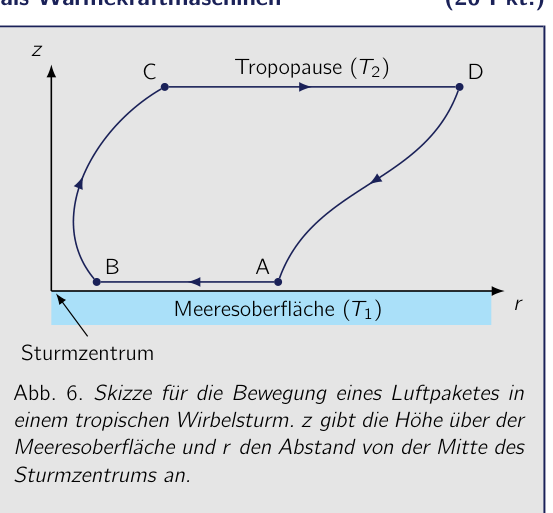 Schema ciclo termodinamico ciclone tropicale
Topic: Thermodynamics, Fluid Mechanics, Rotational Dynamics Metodi: Thermodynamic Cycle Analysis, First Law of Thermodynamics, Ideal Gas Law, Conservation of Energy Competenze: Mathematical Modeling, Estimation & Approximation Objects: Gas, Heat Engine Fonte: Testo (PDF) — p.14
Il problema 10 cicloni tropicali come motori di calore (cfr. I cicloni a latitudini tropicali possono mostrare velocità di vento notevolmente più elevate e quindi “Aggettare in modo molto più distruttivo di altre tempeste”. Il extensively riscaldato La superficie del mare vicino all’equatore svolge un ruolo essenziale qui come fornitore di energia per il Le tempeste. Con una semplice termodinamica modello, come rappresentato nella figura 6, Le proprietà fondamentali di questi cicloni possono essere indagate. Considerare un piccolo parcel di aria di massa che si muove, al livello della superficie del mare, dalla regione ad alta pressione a A a l’esterno del centro tempestale at B. superficie mare () r z Tropopausa () A B C D Centro tempesta Fig. 6. Sketch of the motion of an air parcel in un ciclone tropicale. z dà l’altezza sopra il la distanza dal mezzo del
- Storm Center. La temperatura dell’aria rimane approssimativamente costante, pari alla temperatura del mare . Tuttavia, l’acqua di mare evapora continuamente, aumentando l’umidità nell’aria. Near L’aria è quindi satura e l’umidità è inoltre assorbita
- Rains out. - È tutto ok. L’energia è quindi fornita all’aria, che è composto dal calore di vaporizzazione del vapore d’acqua assorbito e dal lavoro fatto sul pacco per la differenza di pressione. Denote by the mass di vapore di acqua assorbito e di il calore di vaporizzazione di acqua a temperatura . Quindi il calore assorbito può essere espresso come
(10.1)
Qui è la costante del gas e la massa molare dell’aria. Inoltre e indicano il Pressioni d’aria a A e B. You may use the relation (10.1) in what follows. Al limite del centro le masse d’aria poi salire a grandi altezze e quindi freddo al temperatura della tropopausa. This process from B up to the region marked C in the figure proceeds, to a good approximation, without heat exchange with the surroundings. A temperatura costante circa l’aria quindi viaggia lungo la tropopausa lontano dal Centro della tempesta di nuovo. Finalmente l’aria si raffreddano attraverso il rilascio di calore sotto forma di radiazioni e si scende dalla regione segnata D verso il basso alla regione A. Questo Il processo di scarico si verifica anche senza apprezzabile scambio di calore con l’ambiente circostante. In questo modo si verifica un processo ciclico termodinamico, che in questo modello è presunto essere reversibile. 10.a) Derive an expression for the total work done on the air parcel in one cycle of the cyclic process and express it in terms of the quantities used in (10.1) come pure . (6 punti) 51° IPhO 2021 - 2° round exam Codice: Codice Supponiamo che circa il 50% del lavoro fatto sull’aeroporto porti direttamente ad un aumento del energia rotazionale dell’aria parcel about the center of the storm on the path from A to B. 10.b) Derivo di un’espressione per la velocità di rotazione del ciclone all’orlo del Centrale in termini di quantità utilizzate nelle precedenti parti del problema e la velocità di rotazione all’esterno del temporale. - 2 punti Per le ultime parti del problema utilizzare i seguenti valori numerici: Costante universale del gas Temperatura al mare Temperature al tropopause A. Pressione dell’aria a A (edge of the cyclone) Pressione dell’aria a B (edge of the storm centre) Saturation vapore pressure over water a pressione e temperatura Relative humidity of the air at A Mean molar mass of air Mollar mass of water Calore di vaporizzazione di acqua a temperatura 10.c) Determina, per , la velocità di rotazione del ciclone all’orlo di centro. (cfr. Nota: se non si può determinare il valore della velocità di rotazione, si può utilizzare il valore sostitutivo per i seguenti sub-problemi. The rotational velocity of the air in a cyclone is, outside the centre of the Storm, approximately proporzionale all’inverso della radice quadrata della distanza , cioè è solido. 10.d) Calcolare il diametro approssimativo del ciclone considerato sotto l’assunzione che punto B si trova a . - 2 punti 10.e) Estimare l’energia di rotazione dell’intero ciclone e confrontare il valore con Il consumo annuo di energia primaria in Germania, che nel 2019 era di circa . Per questo, assumere una densità di aria costante di e un’altezza del ciclone di Circa 12 chilometri. - 4 punti 10.f) Quando il ciclone colpisce il paese, il suo approvvigionamento energetico è interrotta e si
- Infatti. Supponiamo che il ciclone considerato si dissolva completamente su terra all’interno circa 10 giorni e stimare cosa media potenza rilasci di cicloni nel farlo. (1 pt.) 51° IPhO 2021 - 2° round exam Codice: Codice Answer section 10.a) Calcoli e spiegazioni Expression for the work done on the air parcel: 10.b) Calcoli e spiegazioni Espressione per la velocità di rotazione del ciclone at the edge of the centre: 51° IPhO 2021 - 2° round exam Codice: Codice 10.c) Calcoli e spiegazioni Risultato per la velocità di rotazione del ciclone at the edge of the centre: 51° IPhO 2021 - 2° round exam Codice: Codice 10.d) Calcoli e spiegazioni Result for the diameter of the cyclone 10.e) Calcoli e spiegazioni Risultato per l’energia rotazionale del ciclone e confronto con il consumo di energia primaria: 10.f) Calcoli e spiegazioni Result for the average power released by the cyclone: 51° IPhO 2021 - 2° round exam Codice: Codice Ulteriori fogli di lavoro 51° IPhO 2021 - 2° round exam Codice: Codice Ulteriori fogli di lavoro 51° IPhO 2021 - 2° round exam Codice: Codice Ulteriori fogli di lavoro 51° IPhO 2021 - 2° round exam Codice: Codice Ulteriori fogli di lavoro Grafico
Schema ciclo termodinamico ciclone tropicale
Topic: Thermodynamics, Fluid Mechanics, Rotational Dynamics Metodi: Thermodynamic Cycle Analysis, First Law of Thermodynamics, Ideal Gas Law, Conservation of Energy Competenze: Mathematical Modeling, Estimation & Approximation Objects: Gas, Heat Engine Fonte: Testo (PDF) — p.14
Problem 10 Tropical cyclones as heat engines The Commission shall adopt implementing acts in accordance with Article 21 of this Regulation. Cyclones at tropical latitudes can exhibit markedly higher wind speeds and thus Act markedly more destructively than other storms. The extensively heated Sea surface near the equator plays an essential role here as an energy supplier for The storms. With a simple thermodynamic model as shown in Figure 6, The basic properties of these cyclones can be investigated. Consider a small air parcel of mass that moves, at the level of the sea surface, from the high-pressure region at A to The outer edge of the storm centre at B. Sea surface () r z Tropopause () A B C D Storm centre Fig. 6. Sketch of the motion of an air parcel in A tropical cyclone. z gives the height above the sea surface and r the distance from the middle of the Storm Center. The temperature of the air remains approximately constant, equal to the sea temperature . However, sea water continuously evaporates, so that the humidity in the air parcel increases. Near The storm centre the air is then saturated and the additionally absorbed humidity It rains out. Along the path from A to B, heat is thus supplied to the air parcel, which is composed of the heat of vaporization of the absorbed water vapour and the Work done on the parcel by the pressure difference. Denote by the mass of the absorbed water vapour and by the heat of vaporization of water at The temperature of the test is . Then the absorbed heat can be expressed as
(10.1)
Here is the gas constant and the molar mass of air. Furthermore and denotes the air pressures at A and B. You may use the relation (10.1) in what follows. At the edge of the centre the air masses then rise to great heights and thereby cool to the temperature of the tropopause. This process from B up to the region marked C In the figure proceeds, to a good approximation, without heat exchange with the surroundings. At approximately constant temperature the air then travels along the tropopause away from the The center of the storm again. Finally the air cools through heat release in the form of radiation and sinks from the region marked D back down to region A. This sinking also occurs without appreciable heat exchange with the surroundings. This way a thermodynamic cyclic process arises, which in this model is assumed to be reversible. 10.a) Derive an expression for the total work done on the air parcel in one cycle of the cyclic process and express it in terms of the quantities used in (10.1) as well as . (Page 66) 51st IPhO 2021 - 2nd round exam The code: Code Assume that about 50% of the work done on the air parcel leads directly to an increase in the rotational energy of the air parcel about the center of the storm on the path from A to B. 10.b) Derive an expression for the rotational velocity of the cyclone at the edge of the The Commission’s proposal for a regulation on the use of the Community’s energy resources in the field of energy efficiency and energy efficiency the rotational velocity at the outer edge of the storm. (c) the number of persons who are not members of the For the last parts of the problem use the following numerical values: Universal gas constant Temperature at the sea surface Temperature at the tropopause Air pressure at A (edge of the cyclone) Air pressure at B (edge of the storm centre) Saturation vapour pressure over water at pressure and temperature Relative humidity of the air at A Mean molar mass of air Molar mass of water Heat of vaporization of water at temperature 10.c) Determine, for , the rotational velocity of the cyclone at the edge of the center. (five points) Note: If you cannot determine the value for the rotational velocity, you may use the substitute value for the following sub-problems. The rotational velocity of the air in a cyclone is, outside the centre of the storm, approximately proportional to the inverse square root of the distance , i.e. holds. 10. (d) Calculate the approximate diameter of the cyclone considered under the assumption that point B is at . (c) the number of persons who are not members of the 10.e) Estimate the rotational energy of the entire cyclone and compare the value with The annual primary energy consumption in Germany, which in 2019 was about . For this, assume a constant air density of and a height of the cyclone of About 12 miles. The Commission has also adopted a proposal for a directive on the protection of workers’ rights. 10.f) When the cyclone strikes land, its energy supply is cut off and it is Weakness. Assume that the cyclone considered dissolves completely on land within About 10 days and estimate what average power the Cyclone releases in doing so. (1 pt.) 51st IPhO 2021 - 2nd round exam The code: Code Answer section 10.a) Calculations and explanations Expression for the work done on the air parcel: 10.b) Calculations and explanations Expression for the rotational velocity of the cyclone at the edge of the centre: 51st IPhO 2021 - 2nd round exam The code: Code 10.c) Calculations and explanations Result for the rotational velocity of the cyclone at the edge of the centre: 51st IPhO 2021 - 2nd round exam The code: Code 10.d) Calculations and explanations Result for the diameter of the cyclone 10.e) Calculations and explanations Result for the rotational energy of the cyclone and comparison with the primary energy consumption: 10.f) Calculations and explanations Result for the average power released by the cyclone: 51st IPhO 2021 - 2nd round exam The code: Code Additional worksheet 51st IPhO 2021 - 2nd round exam The code: Code Additional worksheet 51st IPhO 2021 - 2nd round exam The code: Code Additional worksheet 51st IPhO 2021 - 2nd round exam The code: Code Additional worksheet Graph
Schema ciclo termodinamico ciclone tropicale
Topic: Thermodynamics, Fluid Mechanics, Rotational Dynamics Metodi: Thermodynamic Cycle Analysis, First Law of Thermodynamics, Ideal Gas Law, Conservation of Energy Competenze: Mathematical Modeling, Estimation & Approximation Objects: Gas, Heat Engine Fonte: Testo (PDF) — p.14