Problem 1 Stone in a Glass of Water (MC problem) (5 pts.) A glass filled with water of density stands on a balance. By placing a mass piece on it, the balance is brought into equilibrium. Now, as shown in the figure, a stone with a volume of and a density of is immersed in the water, hanging from a thin thread attached to a stand, without touching the bottom. Which of the following statements is correct? ? To bring the balance into equilibrium, one must … A … do nothing, since the balance remains in equilibrium. B … place a mass piece of mass on the left side of the balance. C … place a mass piece of mass on the left side of the balance. D … place a mass piece of mass on the left side of the balance. Answer section Calculations and explanations Correct answer:
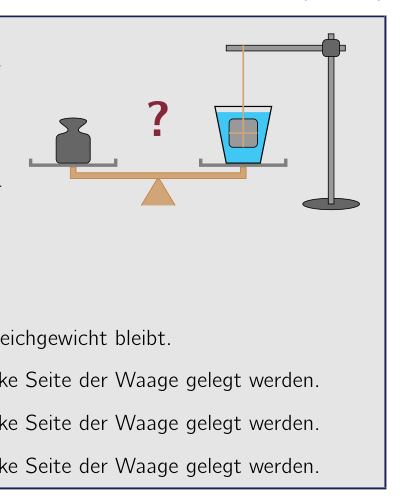 balance with glass of water and stone
Topic: Fluid Mechanics, Newtonian Mechanics Metodi: Hydrostatic Equilibrium, Free-Body Diagram, Physical Modeling Competenze: Physical Reasoning, Diagrammatic Reasoning Objects: Container, String Fonte: Testo (PDF) — p.2
Problema 1 Pietra in un bicchiere d’acqua (problema MC) (cfr. Un bicchiere pieno di acqua di densità stands on a balance. Mettendo un pezzo di massa su di esso, il equilibrio viene portato in equilibrio. Ora, come mostrato nella figura, una pietra con un volume di e a density di è immerso nell’acqua, appeso a un filo sottile attaccato a un stand, senza toccare il fondo. Quale delle seguenti affermazioni è corretta? ? Per mettere in equilibrio il bilancio, bisogna fare un’azione… A … Non fare nulla, poiché il bilancio resta in equilibrio. B … Place a mass piece of mass on the left side of the balance. C … Place a mass piece of mass on the left side of the balance. D … Place a mass piece of mass on the left side of the balance. Answer section Calcoli e spiegazioni Corretta risposta:
balance with glass of water and stone
Topic: Fluid Mechanics, Newtonian Mechanics Metodi: Hydrostatic Equilibrium, Free-Body Diagram, Physical Modeling Competenze: Physical Reasoning, Diagrammatic Reasoning Objects: Container, String Fonte: Testo (PDF) — p.2
Problem 1 Stone in a glass of water (MC problem) (five points) A glass filled with water of density stands on a balance. By placing a mass piece on it, the balance is brought into balance. Now, as shown in the figure, a stone with a volume of and a density of is immersed in the water, hanging from a thin thread attached to a stand, without touching the bottom. Which of the following statements is correct? ? To bring the balance into balance, one must… A … Do nothing, since the balance remains in balance. B … Place a mass piece of mass on the left side of the balance. C … Place a mass piece of mass on the left side of the balance. D … Place a mass piece of mass on the left side of the balance. Answer section Calculations and explanations Correct answer:
balance with glass of water and stone
Topic: Fluid Mechanics, Newtonian Mechanics Metodi: Hydrostatic Equilibrium, Free-Body Diagram, Physical Modeling Competenze: Physical Reasoning, Diagrammatic Reasoning Objects: Container, String Fonte: Testo (PDF) — p.2
Problem 2 Humid Bathroom Air (MC problem) (5 pts.) After a long shower, the temperature in the bathroom is and the relative humidity is 80 %. The adjacent figure shows the saturation vapor pressure curve for water vapor. It gives the maximum water vapor pressure that is possible at a temperature before the water vapor in the air condenses. How much water vapor (in ) is present in the air in the bathroom? For the molar mass of water use the value . 5 10 15 20 25 30 35 40 1 2 3 4 5 6 7 Fig. 1. Saturation vapor pressure curve for water vapor. A about B about C about D about Answer section Calculations and explanations Correct answer:
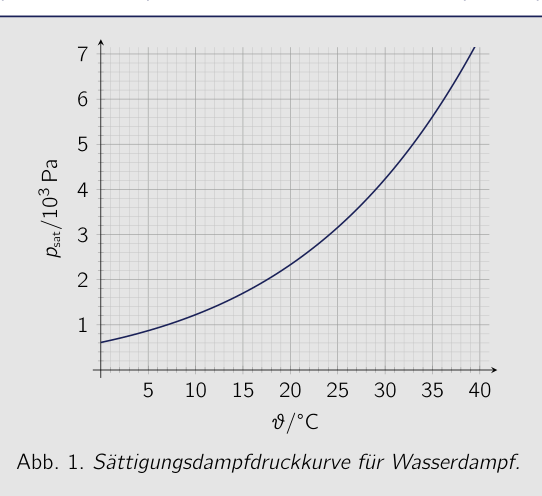 saturation vapor pressure curve vs temperature
Topic: Thermodynamics, Kinetic Theory Metodi: Ideal Gas Law, Physical Modeling Competenze: Physical Reasoning, Mathematical Modeling Objects: Gas Fonte: Testo (PDF) — p.3
Problema 2 Umido aria del bagno (problema MC) (cfr. Dopo una lunga doccia, il temperatura in bagno è e l’umidità relativa è 80 %. Il numero adiacente mostra il saturazione curva di pressione del vapore per il vapore d’acqua. It gives the maximum water vapor pressure that is possible at a temperature before the vapor d’acqua nel condensatore d’aria. Quanto vapore d’acqua (in ) è presente nell’aria del bagno? Per la massa molar di acqua utilizzare il valore . 5 10 15 20 25 30 35 40 1 2 3 4 5 6 7 Fig. 1. Saturation vapor pressure curve per vapore d’acqua. A about B about C about D about Answer section Calcoli e spiegazioni Corretta risposta:
saturation vapor pressure curve vs temperature
Topic: Thermodynamics, Kinetic Theory Metodi: Ideal Gas Law, Physical Modeling Competenze: Physical Reasoning, Mathematical Modeling Objects: Gas Fonte: Testo (PDF) — p.3
Problem 2 Humid bathroom air (MC problem) (five points) After a long shower, the temperature in the bathroom is and the relative humidity is 80 %. The adjacent figure shows the saturation vapor pressure curve for water vapor. It gives the maximum water vapor pressure that is possible at a temperature before the Water vapor in the air condenses. How much water vapor (in ) is present in the air in the bathroom? For the molar mass of water use the value . 5 10 15 20 25 30 35 40 1 2 3 4 5 6 7 Fig. 1. Saturation vapor pressure curve for water vapor. A about B about C about D about Answer section Calculations and explanations Correct answer:
The following table shows the results of the calculations:
Topic: Thermodynamics, Kinetic Theory Metodi: Ideal Gas Law, Physical Modeling Competenze: Physical Reasoning, Mathematical Modeling Objects: Gas Fonte: Testo (PDF) — p.3
Problem 3 Fall on an Exoplanet (MC problem) (5 pts.) On the surface of an extrasolar planet - exoplanet for short - the fall time of a body from a small height , neglecting all friction effects, is exactly twice as large as on Earth. Which of the following statements is compatible with this, assuming a spherically symmetric structure of the exoplanet? The exoplanet has … A … half the mass of Earth and twice the radius of Earth. B … exactly the mass of Earth and four times the radius of Earth. C … twice the mass of Earth and twice the radius of Earth. D … four times the mass of Earth and four times the radius of Earth. Answer section Calculations and explanations Correct answer:
Topic: Gravitation, Newtonian Mechanics Metodi: Newton’s Law of Gravitation, Kinematic Equations, Dimensional Analysis Competenze: Physical Reasoning, Estimation & Approximation Objects: Planet Fonte: Testo (PDF) — p.5
Problema 3 Casso di esoplanet (problema MC) (cfr. On the surface of an extrasolar planet - exoplanet for short - the fall time of a body from a small height , neglecting all friction effects, is exactly twice as large as sulla Terra. Which of the following statements is compatible with this, assuming a spherically symmetric La struttura dell’esoplaneta? Il pianeta è morto … A … metà della massa terrestre e due volte il raggio terrestre. B … esattamente la massa della Terra e quattro volte il raggio della Terra. C … Due volte la massa della Terra e due volte il raggio della Terra. D … quattro volte la massa della Terra e quattro volte il raggio della Terra. Answer section Calcoli e spiegazioni Corretta risposta:
Topic: Gravitation, Newtonian Mechanics Metodi: Newton’s Law of Gravitation, Kinematic Equations, Dimensional Analysis Competenze: Physical Reasoning, Estimation & Approximation Objects: Planet Fonte: Testo (PDF) — p.5
The problem is that the number of stars in the universe is not a single planet. (five points) On the surface of an extrasolar planet - exoplanet for short - the fall time of a body from a small height , neglecting all friction effects, is exactly twice as large as on Earth. Which of the following statements is compatible with this, assuming a spherically symmetrical The structure of the exoplanet? The exoplanet has … A … half the mass of Earth and twice the radius of Earth. B … exactly the mass of Earth and four times the radius of Earth. C … twice the mass of Earth and twice the radius of Earth. D … Four times the mass of the Earth and four times the radius of the Earth. Answer section Calculations and explanations Correct answer:
Topic: Gravitation, Newtonian Mechanics Metodi: Newton’s Law of Gravitation, Kinematic Equations, Dimensional Analysis Competenze: Physical Reasoning, Estimation & Approximation Objects: Planet Fonte: Testo (PDF) — p.5
Problem 4 Lead-Glass Window (MC problem) (5 pts.) Rooms with X-ray equipment are shielded by thick walls and windows made of lead glass. A lead-glass window with a thickness of can already shield 75 % of the intensity of X-radiation. How thick must the lead-glass window be so that the intensity of the radiation behind the window is only 1 % of the intensity in front of the window? A about B about C about D about Answer section Calculations and explanations Correct answer:
Topic: Nuclear & Particle Physics, Modern-Quantum Physics Metodi: Approximation & Series Expansion, Physical Modeling Competenze: Physical Reasoning, Mathematical Modeling Objects: Photon Fonte: Testo (PDF) — p.6
Problema 4 finestra di vetro di piombo (problema MC) (cfr. Le camere con apparecchiature a raggi X sono protette da pareti e finestre spesse di vetro di piombo. A Le vetrate di lead con un spessore di possono già proteggere il 75% dell’intensità delle radiazioni X. How thick must the lead-glass window be in modo che l’intensità della radiazione dietro la finestra sia solo Un percento dell’intensità di fronte alla finestra? A about B about C about D about Answer section Calcoli e spiegazioni Corretta risposta:
Topic: Nuclear & Particle Physics, Modern-Quantum Physics Metodi: Approximation & Series Expansion, Physical Modeling Competenze: Physical Reasoning, Mathematical Modeling Objects: Photon Fonte: Testo (PDF) — p.6
The following is the list of the types of lead glass windows: (five points) Rooms with X-ray equipment are shielded by thick walls and windows made of lead glass. A Lead-glass window with a thickness of can already shield 75 % of the intensity of X-rays. How thick must the lead-glass window be so that the intensity of the radiation behind the window is only One percent of the intensity in front of the window? A about B about C about D about Answer section Calculations and explanations Correct answer:
Topic: Nuclear & Particle Physics, Modern-Quantum Physics Metodi: Approximation & Series Expansion, Physical Modeling Competenze: Physical Reasoning, Mathematical Modeling Objects: Photon Fonte: Testo (PDF) — p.6
Problem 5 Pendulum in an Elevator (MC problem) (5 pts.) Two elevator cabins of masses and with hang from the ends of a long rope that runs over a fixed pulley. The mass of the pulley and the rope can be neglected. In the left cabin hangs a string pendulum of length . With the cabins at rest and for small deflections, the period of the pendulum is . When the cabins are released, they move without friction under the influence of gravity. How must the length of the string pendulum in the left cabin be chosen so that, after the cabin is released, it oscillates with period ? A B C D Answer section Calculations and explanations Correct answer:
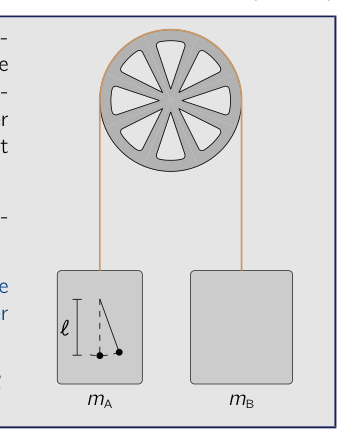 pulley with cabins and pendulum
Topic: Oscillations & Waves, Newtonian Mechanics Metodi: Simple Harmonic Motion Analysis, Free-Body Diagram, Physical Modeling Competenze: Physical Reasoning, Mathematical Modeling Objects: Pendulum, String, Pulley Fonte: Testo (PDF) — p.7
Problema 5 Pendolo in ascensore (problema MC) (cfr. Due elevator cabins di masse e con hang from the ends of a long rope that runs over a fixed pulley. La massa della polla e della corda può essere trascurata. In la cabina sinistra appeso un pendolo di stringhe di lunghezza . Con le cabine a riposo e per piccole deflezioni, il periodo del pendolo è . Quando le cabine sono rilasciate, si muovono senza attrito sotto l’influenza della gravità. How must the length of the string pendulum in the left cabin essere scelto in modo che, dopo che la cabina è rilasciata, oscilla con Periodo ? A B C D Answer section Calcoli e spiegazioni Corretta risposta:
pulley with cabins and pendulum
Topic: Oscillations & Waves, Newtonian Mechanics Metodi: Simple Harmonic Motion Analysis, Free-Body Diagram, Physical Modeling Competenze: Physical Reasoning, Mathematical Modeling Objects: Pendulum, String, Pulley Fonte: Testo (PDF) — p.7
Problem 5 Pendulum in an elevator (MC problem) (five points) Two elevator cabins of masses and with hang from the ends of a long rope that runs over a fixed pulley. The mass of the pulley and the rope can be neglected. In the left cabin hangs a string pendulum of length . With the cabins at rest and for small deflections, the period of the pendulum is . When the cabins are released, they move without friction under the influence of gravity. How must the length of the string pendulum in the left cabin be chosen so that, after the cabin is released, it oscillates with period ? A B C D Answer section Calculations and explanations Correct answer:
pulley with cabins and pendulum
Topic: Oscillations & Waves, Newtonian Mechanics Metodi: Simple Harmonic Motion Analysis, Free-Body Diagram, Physical Modeling Competenze: Physical Reasoning, Mathematical Modeling Objects: Pendulum, String, Pulley Fonte: Testo (PDF) — p.7
Problem 6 Spectra (MC problem) (5 pts.) The atoms of a fictitious element occupy states on the energy levels where is a constant. Only the lines of the series of transitions to the ground state lie in the optical range, but these completely. Which of the spectra shown below, scaled linearly in wavelength, correctly represents the emission lines of the described element? A B C D Fig. 2. Optical emission spectra. Answer section Calculations and explanations Correct answer:
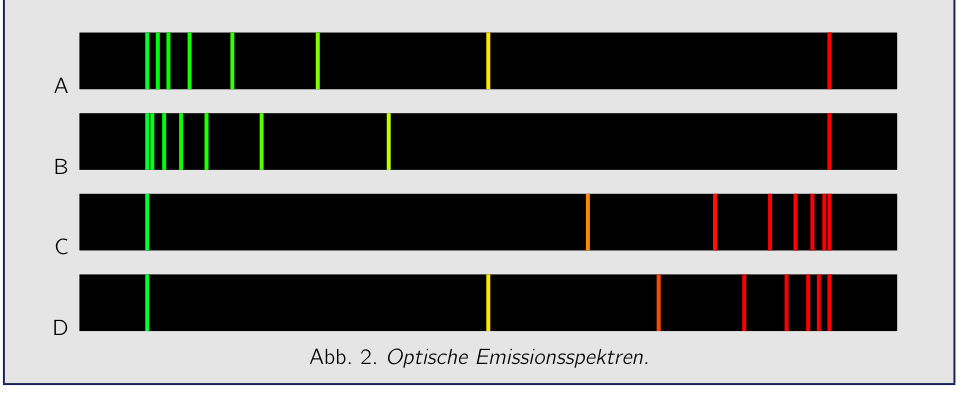 optical emission spectra A B C D
Topic: Modern-Quantum Physics Metodi: Bohr Model & Quantization, Photon Energy Relation, Physical Modeling Competenze: Physical Reasoning, Diagrammatic Reasoning Objects: Atom Fonte: Testo (PDF) — p.9
Problema 6 Spectra (problema MC) (cfr. The atoms of a fictitious element occupy states on the energy levels dove è una costante. Only the lines of the series of transitions to the ground state Si trovava nella gamma ottica, ma questi completamente. Quale dei spettrini mostrati di seguito, scalato linearmente in lunghezza d’onda, rappresenta correttamente le linee di emissione dell’elemento descritto? A B C D Fig. 2. Spettro di emissione ottica. Answer section Calcoli e spiegazioni Corretta risposta:
*optical emission spectra A B C D *
Topic: Modern-Quantum Physics Metodi: Bohr Model & Quantization, Photon Energy Relation, Physical Modeling Competenze: Physical Reasoning, Diagrammatic Reasoning Objects: Atom Fonte: Testo (PDF) — p.9
The problem is that the number of samples is not as high as the number of samples. (five points) The atoms of a fictitious element occupy states on the energy levels where is a constant. Only the lines of the series of transitions to the ground state They were in the optical range, but these completely. Which of the spectra shown below, scaled linearly in wavelength, correctly represents the emission lines of the described element? A B C D Fig. 2. Optical emission spectra. Answer section Calculations and explanations Correct answer:
optical emission spectra A B C D
Topic: Modern-Quantum Physics Metodi: Bohr Model & Quantization, Photon Energy Relation, Physical Modeling Competenze: Physical Reasoning, Diagrammatic Reasoning Objects: Atom Fonte: Testo (PDF) — p.9
Problem 7 Stopping Global Warming (MC problem) (5 pts.) The mad scientist Knox has found a method to stop global warming. To do so, he wants to increase the radius of Earth’s orbit, assumed to be circular, by 1.0 %. By how much could the mean temperature at Earth’s surface, which is currently about , approximately decrease as a result? A about 0.7 K B about 1.4 K C about 2.8 K D about 5.6 K Answer section Calculations and explanations Correct answer: Long-answer problems Work on the following three problems likewise in the boxes provided. Unlike the multiple-choice problems, no answer options are given. Describe your solution method so that it is easy to follow but not unnecessarily long. So if, for example, you use the law of conservation of energy, write this down briefly.
Topic: Astrophysics, Thermodynamics Metodi: Kepler’s Laws, Approximation & Series Expansion, Physical Modeling Competenze: Physical Reasoning, Estimation & Approximation Objects: Planet, Star Fonte: Testo (PDF) — p.11
Il problema 7 STOPING GLOBAL WARMING (problema MC) (cfr. Lo scienziato pazzo Knox ha trovato un metodo per fermare il riscaldamento globale. To do so, he wants to increase the radius of Earth’s orbit, assumed to be circular, by 1.0 %. By how much could the mean temperature at Earth’s surface, which is currently about , circa diminuire come risultato? A circa 0,7 K B circa 1,4 K C circa 2,8 K D circa 5,6 K Answer section Calcoli e spiegazioni Corretta risposta: Problemi di risposta lunga Work on the following three problems similarly in the boxes provided. A differenza dei problemi di scelta multipla, non sono state indicate le opzioni di risposta. Descrivi il tuo metodo di soluzione in questo modo: che è facile da seguire ma non troppo lungo. Quindi se, per esempio, si usa la legge della conservazione dell’energia, scrivete brevemente.
Topic: Astrophysics, Thermodynamics Metodi: Kepler’s Laws, Approximation & Series Expansion, Physical Modeling Competenze: Physical Reasoning, Estimation & Approximation Objects: Planet, Star Fonte: Testo (PDF) — p.11
Problem 7 Stopping global warming (MC problem) (five points) The mad scientist Knox has found a method to stop global warming. To do so, he wants to increase the radius of Earth’s orbit, assumed to be circular, by 1.0 %. By how much could the mean temperature at Earth’s surface, which is currently about , approximately decrease as a result? A about 0.7 K B about 1.4 K C about 2.8 K D about 5.6 K Answer section Calculations and explanations Correct answer: Long-response problems Work on the following three problems also in the boxes provided. Unlike the Multiple-choice problems, no answer options are given. Describe your solution method That it’s easy to follow but not unnecessarily long. So if, for example, you use the law of conservation of energy, write this down briefly.
Topic: Astrophysics, Thermodynamics Metodi: Kepler’s Laws, Approximation & Series Expansion, Physical Modeling Competenze: Physical Reasoning, Estimation & Approximation Objects: Planet, Star Fonte: Testo (PDF) — p.11
Problem 8 Negative Refractive Index (10 pts.) Certain materials possess, usually for a narrow wavelength range of electromagnetic radiation, a negative refractive index. When a light ray passes from a medium with a refractive index into a medium with a refractive index , the law of refraction still holds: However, the angle is then negative. A very small object is located, as sketched alongside, at a distance in front of a large slab of thickness , made of a material with refractive index . The refractive index of the rest of space is 1. Construct the image of the object to be seen on the other side of the slab. State where the image is located, what magnification it has, whether the image is real or virtual, mirrored or rotated. In doing so, take into account that can take any positive value. Object Answer section Calculations and explanations
Topic: Geometric Optics Metodi: Snell’s Law, Ray Tracing, Thin Lens & Mirror Equation Competenze: Physical Reasoning, Diagrammatic Reasoning, Mathematical Modeling Objects: — Fonte: Testo (PDF) — p.12
Problema 8 Indice refrattivo negativo (cfr. Alcuni materiali possedono, solitamente per una gamma di lunghezza d’onda ristretta di radiazioni elettromagnetiche, un indice di refrazione negativo. Quando un raggio di luce passa da un mezzo con un indice di refraczione into a medium with a refractive index , the law of refraction contiene: Tuttavia, l’angolo è quindi negativo. Un oggetto molto piccolo è situato, come disegnato accanto, a una distanza di fronte a un grande oggetto. Slab di spessore , made of a material with refractive index . Il tasso di refrazione del Rest of space è 1. Construct the image of the object Da vedere dall’altra parte della slab. Stato in cui il l’immagine è situata, che magnificazione ha, l’immagine è reale o virtuale, mirrored o rotated. In tal modo, si deve tenere conto che può prendere qualsiasi positivo Valore. Object Answer section Calcoli e spiegazioni
Topic: Geometric Optics Metodi: Snell’s Law, Ray Tracing, Thin Lens & Mirror Equation Competenze: Physical Reasoning, Diagrammatic Reasoning, Mathematical Modeling Objects: — Fonte: Testo (PDF) — p.12
Problem 8 Negative refractive index (Page 10) Certain materials possess, usually for a narrow wavelength range of electromagnetic radiation, a negative refractive index. When a light ray passes from a medium with a refractive index into a medium with a refractive index , the law of refraction still holds: However, the angle is then negative. A very small object is located, as sketched alongside, at a distance in front of a large slab of thickness , made of a material with refractive index . The refractive index of the The rest of space is 1. Construct the image of the object to be seen on the other side of the slab. State where the image is located, what magnification it has, whether The image is real or virtual, mirrored or rotated. In doing so, take into account that can take any positive value. The object Answer section Calculations and explanations
Topic: Geometric Optics Metodi: Snell’s Law, Ray Tracing, Thin Lens & Mirror Equation Competenze: Physical Reasoning, Diagrammatic Reasoning, Mathematical Modeling Objects: — Fonte: Testo (PDF) — p.12
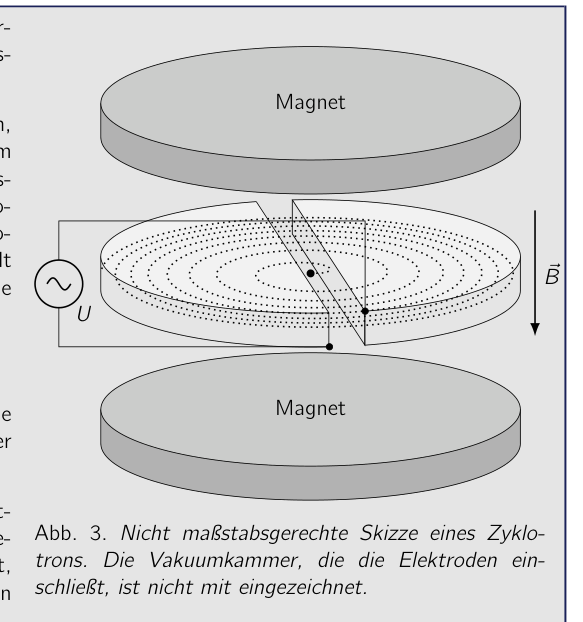
Problem 9 Cyclotron (20 pts.) Until the 1950s of the last century, cyclotrons were the most powerful particle accelerators. A cyclotron consists of two hollow, semicircular electrodes in a homogeneous magnetic field of flux density oriented perpendicular to the electrodes. Between the electrodes there is a very narrow gap across which a high-frequency voltage depending on time , of the form is applied. Here denotes the amplitude and the angular frequency of the voltage. Charged particles are introduced into the center of the arrangement. The frequency of the voltage is set so that the particles are accelerated each time they cross the gap. Magnet Magnet U Fig. 3. Not-to-scale sketch of a cyclotron. The vacuum chamber enclosing the electrodes is not drawn in. As a result, they move approximately along a spiral path outward, until after many revolutions they reach the edge of the arrangement, where they leave the cyclotron (cf. Fig. 3). Consider a cyclotron as developed by its inventor E.O. Lawrence at the end of the 1930s. The electrodes of the cyclotron had a radius of , and the magnetic flux density, approximately constant over the cyclotron cross-section, was . In the cyclotron, protons with a charge and a mass were accelerated. The amplitude of the high-frequency voltage was . Neglect relativistic effects in your considerations. 9.a) Derive an expression for the angular frequency necessary to accelerate the protons and give the value of the angular frequency for the described setup. (4 pts.) 9.b) Determine the kinetic energy as well as the velocity of the protons upon leaving the cyclotron. Justify why neglecting relativistic effects is a good approximation for this problem. (4 pts.) 9.c) Calculate the number of revolutions a proton makes at minimum in the cyclotron before it exits, and also the time it spends in the cyclotron. (5 pts.) If instead of the protons one accelerates electrons, which have a mass of , relativistic effects come into play more quickly. 9.d) Consider electrons that have been accelerated to the kinetic energy determined in problem 9.b) and show that their velocity is very close to the speed of light. (4 pts.) At these very high velocities, the relativistic increase in mass of the electrons must be taken into account, which leads to the velocity of the electrons in the cyclotron no longer increasing on each revolution to the extent that would be required to be accelerated again on the next revolution. One way to circumvent this is to make the magnetic field stronger toward the outside while keeping the high-voltage frequency fixed. 9.e) Derive an expression for the magnetic flux density required for this as a function of the distance from the center of the cyclotron. (3 pts.) Answer section 9.a) Calculations and explanations Expression and value for the angular frequency : 9.b) Calculations and explanations Result for the kinetic energy and velocity of the protons: 9.c) Calculations and explanations Result for the number of revolutions and time in the cyclotron for the protons: 9.d) Calculations and explanations 9.e) Calculations and explanations Expression for the magnetic flux density:
 cyclotron diagram with magnets and dees
Topic: Magnetism, Special Relativity, Newtonian Mechanics Metodi: Lorentz Force Analysis, Relativistic Energy-Momentum, Conservation of Energy Competenze: Mathematical Modeling, Physical Reasoning Objects: Magnet, Particle Beam Fonte: Testo (PDF) — p.14
Problema 9 Ciclotrone (20 punti) Fino agli anni ‘50 del secolo scorso, i ciclotroni erano gli acceleratori di particelle più potenti. Un ciclotrone è costituito da due elettrodi cavi, semicircolari, immersi in un campo magnetico omogeneo di densità di flusso orientato perpendicolarmente agli elettrodi. Tra gli elettrodi c’è un intervallo molto stretto attraverso il quale viene applicata una tensione ad alta frequenza dipendente dal tempo , della forma Qui indica l’ ampiezza e la frequenza angolare della tensione. Le particelle cariche vengono introdotte al centro del dispositivo. La frequenza della tensione è impostata in modo che le particelle vengano accelerate ogni volta che attraversano l’intervallo. Magnete Magnete U Fig. 3. Schizzo non in scala di un ciclotrone. La camera a vuoto che racchiude gli elettrodi non è disegnata. Di conseguenza, esse si muovono approssimativamente lungo un percorso a spirale verso l’esterno, finché dopo molte rivoluzioni raggiungono il bordo del dispositivo, dove lasciano il ciclotrone (cfr. Fig. 3). Considera un ciclotrone come quello sviluppato dal suo inventore E.O. Lawrence alla fine degli anni ‘30. Gli elettrodi del ciclotrone avevano un raggio di , e la densità di flusso magnetico, approssimativamente costante sulla sezione trasversale del ciclotrone, era . Nel ciclotrone venivano accelerati protoni con carica e massa . L’ampiezza della tensione ad alta frequenza era . Trascura gli effetti relativistici nelle tue considerazioni. 9.a) Ricava un’espressione per la frequenza angolare necessaria per accelerare i protoni e fornisci il valore della frequenza angolare per il dispositivo descritto. (4 punti) 9.b) Determina l’energia cinetica e la velocità dei protoni all’uscita dal ciclotrone. Giustifica perché trascurare gli effetti relativistici è una buona approssimazione per questo problema. (4 punti) 9.c) Calcola il numero minimo di rivoluzioni che un protone compie nel ciclotrone prima di uscire, e anche il tempo che trascorre nel ciclotrone. (5 punti) Se invece dei protoni si accelerano elettroni, che hanno una massa di , gli effetti relativistici entrano in gioco più rapidamente. 9.d) Considera elettroni che sono stati accelerati all’energia cinetica determinata nel problema 9.b) e mostra che la loro velocità è molto vicina alla velocità della luce. (4 punti) A queste velocità molto elevate, si deve tenere conto dell’aumento relativistico della massa degli elettroni, il che fa sì che la velocità degli elettroni nel ciclotrone non aumenti più a ogni rivoluzione nella misura necessaria per essere accelerati di nuovo alla rivoluzione successiva. Un modo per aggirare questo problema è rendere il campo magnetico più intenso verso l’esterno mantenendo fissa la frequenza dell’alta tensione. 9.e) Ricava un’espressione per la densità di flusso magnetico necessaria a questo scopo in funzione della distanza dal centro del ciclotrone. (3 punti) Sezione delle risposte 9.a) Calcoli e spiegazioni Espressione e valore della frequenza angolare : 9.b) Calcoli e spiegazioni Risultato per l’energia cinetica e la velocità dei protoni: 9.c) Calcoli e spiegazioni Risultato per il numero di rivoluzioni e il tempo nel ciclotrone per i protoni: 9.d) Calcoli e spiegazioni 9.e) Calcoli e spiegazioni Espressione per la densità di flusso magnetico:
diagramma del ciclotrone con magneti e dee
Topic: Magnetism, Special Relativity, Newtonian Mechanics Metodi: Lorentz Force Analysis, Relativistic Energy-Momentum, Conservation of Energy Competenze: Mathematical Modeling, Physical Reasoning Objects: Magnet, Particle Beam Fonte: Testo (PDF) — p.14
Problem 9 Cyclotron (20 pts.) Until the 1950s of the last century, cyclotrons were the most powerful particle accelerators. A cyclotron consists of two hollow, semicircular electrodes in a homogeneous magnetic field of flux density oriented perpendicular to the electrodes. Between the electrodes there is a very narrow gap across which a high-frequency voltage depending on time , of the form is applied. Here denotes the amplitude and the angular frequency of the voltage. Charged particles are introduced into the center of the arrangement. The frequency of the voltage is set so that the particles are accelerated each time they cross the gap. Magnet Magnet U Fig. 3. Not-to-scale sketch of a cyclotron. The vacuum chamber enclosing the electrodes is not drawn in. As a result, they move approximately along a spiral path outward, until after many revolutions they reach the edge of the arrangement, where they leave the cyclotron (cf. Fig. 3). Consider a cyclotron as developed by its inventor E.O. Lawrence at the end of the 1930s. The electrodes of the cyclotron had a radius of , and the magnetic flux density, approximately constant over the cyclotron cross-section, was . In the cyclotron, protons with a charge and a mass were accelerated. The amplitude of the high-frequency voltage was . Neglect relativistic effects in your considerations. 9.a) Derive an expression for the angular frequency necessary to accelerate the protons and give the value of the angular frequency for the described setup. (4 pts.) 9.b) Determine the kinetic energy as well as the velocity of the protons upon leaving the cyclotron. Justify why neglecting relativistic effects is a good approximation for this problem. (4 pts.) 9.c) Calculate the number of revolutions a proton makes at minimum in the cyclotron before it exits, and also the time it spends in the cyclotron. (5 pts.) If instead of the protons one accelerates electrons, which have a mass of , relativistic effects come into play more quickly. 9.d) Consider electrons that have been accelerated to the kinetic energy determined in problem 9.b) and show that their velocity is very close to the speed of light. (4 pts.) At these very high velocities, the relativistic increase in mass of the electrons must be taken into account, which leads to the velocity of the electrons in the cyclotron no longer increasing on each revolution to the extent that would be required to be accelerated again on the next revolution. One way to circumvent this is to make the magnetic field stronger toward the outside while keeping the high-voltage frequency fixed. 9.e) Derive an expression for the magnetic flux density required for this as a function of the distance from the center of the cyclotron. (3 pts.) Answer section 9.a) Calculations and explanations Expression and value for the angular frequency : 9.b) Calculations and explanations Result for the kinetic energy and velocity of the protons: 9.c) Calculations and explanations Result for the number of revolutions and time in the cyclotron for the protons: 9.d) Calculations and explanations 9.e) Calculations and explanations Expression for the magnetic flux density:
cyclotron diagram with magnets and dees
Topic: Magnetism, Special Relativity, Newtonian Mechanics Metodi: Lorentz Force Analysis, Relativistic Energy-Momentum, Conservation of Energy Competenze: Mathematical Modeling, Physical Reasoning Objects: Magnet, Particle Beam Fonte: Testo (PDF) — p.14
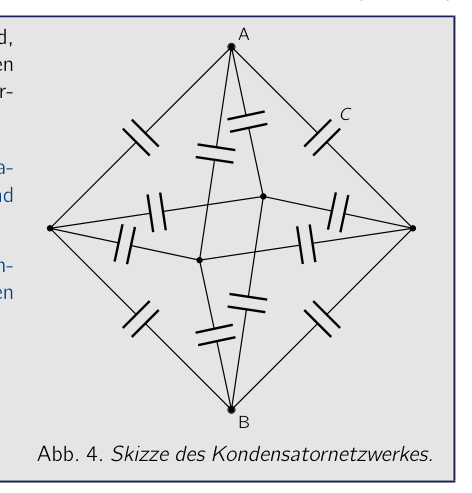
Problem 10 Capacitive Octahedral Network (15 pts.) Twelve identical capacitors of capacitance are, as shown alongside, connected in a symmetric capacitor network in the shape of an octahedron. 10.a) Determine the total capacitance of the capacitor network between vertices A and B. (5 pts.) 10.b) Determine the total capacitance of the capacitor network between two adjacent vertices. (10 pts.) A B C Fig. 4. Sketch of the capacitor network. Answer section 10.a) Calculations and explanations Result for the capacitance of the capacitor network between vertices A and B: 10.b) Calculations and explanations Result for the capacitance of the capacitor network between adjacent vertices: Additional worksheet Graph
 capacitor network in the shape of an octahedron
Topic: Electrostatics, Circuits Metodi: Equivalent Circuit Reduction, Symmetry Argument, Physical Modeling Competenze: Physical Reasoning, Mathematical Modeling, Diagrammatic Reasoning Objects: Capacitor Fonte: Testo (PDF) — p.18
Problema 10 Capacitive Octahedral Network 15 punti) 12 capacitori identici di capacità sono, come mostrato al fianco, collegato in un simmetrico una rete di capacitori in forma di ottaedro. 10. (a) Determina la capacità totale della rete di condensatori tra vertici A e B. (cfr. 10.b) Determina la capacità totale della rete di condensatori tra due adiacenti
- Le vertici. (cfr. A B C Fig. 4. Sketch della rete dei condensatori. Answer section 10.a) Calcoli e spiegazioni Risultato per la capacità della rete di condensatori tra vertici A e B: 10.b) Calcoli e spiegazioni Result for the capacitance of the capacitor network between adjacent vertices: Ulteriori fogli di lavoro Grafico
network di condensatori in forma di octaedro
Topic: Electrostatics, Circuits Metodi: Equivalent Circuit Reduction, Symmetry Argument, Physical Modeling Competenze: Physical Reasoning, Mathematical Modeling, Diagrammatic Reasoning Objects: Capacitor Fonte: Testo (PDF) — p.18
Problem 10 Capacitive Octahedral Network (Figure 15) Twelve identical capacitors of capacitance are, as shown alongside, connected in a symmetric Capacitor network in the shape of an octahedron. 10. (a) Determine the total capacitance of the capacitor network between vertices A and B. (five points) 10. (b) Determine the total capacitance of the capacitor network between two adjacent The number of vertices. (Page 10) A B C Fig. 4. Sketch of the capacitor network. Answer section 10.a) Calculations and explanations Result for the capacitance of the capacitor network between vertices A and B: 10.b) Calculations and explanations Result for the capacitance of the capacitor network between adjacent vertices: Additional worksheet Graph
capacitor network in the shape of an octahedron
Topic: Electrostatics, Circuits Metodi: Equivalent Circuit Reduction, Symmetry Argument, Physical Modeling Competenze: Physical Reasoning, Mathematical Modeling, Diagrammatic Reasoning Objects: Capacitor Fonte: Testo (PDF) — p.18