Problem 1 Sinking Body (MC problem) (5 pts.) When a solid body of density sinks at constant velocity in viscous oil of density , then … A … no gravitational force acts on the body. B … the mass of the body equals the mass of the displaced fluid. C … the gravitational force on the body is in equilibrium with the friction force. D … the buoyant force on the body equals the friction force. Answer section Calculations and explanations Correct answer:
Topic: Fluid Mechanics, Newtonian Mechanics Metodi: Free-Body Diagram, Hydrostatic Equilibrium, Physical Modeling Competenze: Physical Reasoning Objects: — Fonte: Testo (PDF) — p.2
Problema 1 Sinking Body (problema MC) (cfr. Quando un corpo solido di densità si scende a velocità costante in olio viscoso di densità , allora … A … Non c’è forza gravitazionale sul corpo. B … la massa del corpo è uguale alla massa del liquido spostato. C … La forza gravitazionale sul corpo è in equilibrio con la forza di attrito. D … La forza buoyant sul corpo è uguale alla forza di attrito. Answer section Calcoli e spiegazioni Corretta risposta:
Topic: Fluid Mechanics, Newtonian Mechanics Metodi: Free-Body Diagram, Hydrostatic Equilibrium, Physical Modeling Competenze: Physical Reasoning Objects: — Fonte: Testo (PDF) — p.2
The problem is that the body is sinking. (five points) When a solid body of density sinks at constant velocity in viscous oil of density , then … A … No gravitational force acts on the body. B … The mass of the body is equal to the mass of the displaced fluid. C … The gravitational force on the body is in equilibrium with the friction force. D … The booyant force on the body equals the friction force. Answer section Calculations and explanations Correct answer:
Topic: Fluid Mechanics, Newtonian Mechanics Metodi: Free-Body Diagram, Hydrostatic Equilibrium, Physical Modeling Competenze: Physical Reasoning Objects: — Fonte: Testo (PDF) — p.2
Problem 2 Induction in conducting loops (MC problem) (5 pts.) The four conducting loops shown in the figure (a to d) each have edge lengths or . They move at constant velocity into a sharply bounded region containing a uniform magnetic field of flux density , oriented into the plane of the drawing. How do the voltages to induced in the loops directly upon entering the region with the magnetic field compare to one another? A B C D Region with magnetic field d c b a Answer section Calculations and explanations Correct answer:
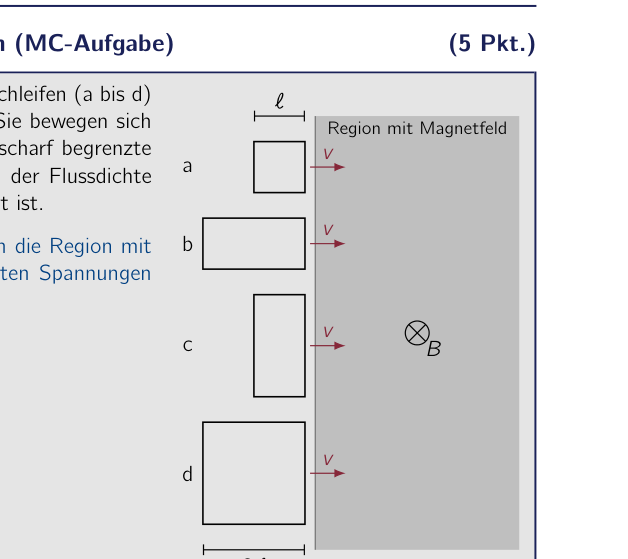 Four loops moving toward a magnetic field
Topic: Electromagnetic Induction Metodi: Faraday’s Law of Induction, Lorentz Force Analysis, Superposition Principle Competenze: Physical Reasoning Objects: Coil Fonte: Testo (PDF) — p.3
Problema 2 Induzione nei loops di condotta (problema MC) (cfr. I quattro circuiti di conduzione mostrati nella figura (a a d) ogni singolo gruppo ha lunghezze di bordo o . Si muovono a velocità costante into a sharply bounded regione contenente un campo magnetico uniforme di densità di flusso , orientato verso il piano del disegno. Come fare i voltaggi to induciuti nei loops direttamente all’entrata nella regione con il campo magnetico si confronta? A B C D Regione con campo magnetico d c b a Answer section Calcoli e spiegazioni Corretta risposta:
Four loops moving towards a magnetic field
Topic: Electromagnetic Induction Metodi: Faraday’s Law of Induction, Lorentz Force Analysis, Superposition Principle Competenze: Physical Reasoning Objects: Coil Fonte: Testo (PDF) — p.3
The following is the list of the types of induction in conducting loops: (five points) The four conducting loops shown in the figure (a to d) Each have edge lengths or . They move at constant velocity into a sharply bounded region containing a uniform magnetic field of flux density , oriented into the plane of the drawing. How do the voltages to induced in the loops directly upon entering the region with The magnetic field compares to each other? A B C D Region with magnetic field d c b a Answer section Calculations and explanations Correct answer:
Four loops moving towards a magnetic field
Topic: Electromagnetic Induction Metodi: Faraday’s Law of Induction, Lorentz Force Analysis, Superposition Principle Competenze: Physical Reasoning Objects: Coil Fonte: Testo (PDF) — p.3
Problem 3 Resistor heating (MC problem) (5 pts.) Two resistors of identical design are connected in parallel to a voltage source with a voltage of . A total current of flows. The adjacent image of the circuit is taken with an infrared camera. After calibration, the camera can also determine the surface temperatures of the two resistors. They are and . The ambient temperature is . What are the approximate values of the two resistors? Fig. 1. Infrared image of the resistors. A and B and C and D and Answer section Calculations and explanations Correct answer:
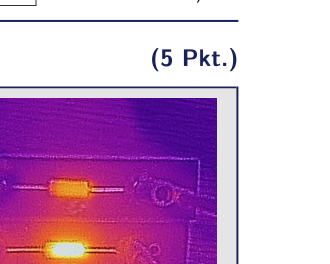 Infrared thermography of the resistors
Topic: Circuits, Thermodynamics Metodi: Kirchhoff’s Laws, Physical Modeling, Experimental Data Analysis Competenze: Physical Reasoning, Estimation & Approximation Objects: Resistor, Battery Fonte: Testo (PDF) — p.4
Problema 3 Risistore di riscaldamento (problema MC) (cfr. Due resistori di design identico sono collegati in parallelo a una fonte di tensione con una tensione di . A il flusso totale di . L’immagine adiacente del circuito è presa con una fotocamera infrarossa. Dopo la calibrazione, la macchina fotografica può Quindi, determinare le temperature superficiali dei due resistori. Sono e . Il la temperatura ambientale è . Quali sono i valori approssimativi dei due resistori? Fig. 1. Immagine infrarossa del
- I resistori. A e B e C e D e Answer section Calcoli e spiegazioni Corretta risposta:
Termografia infrarossa dei resistori
Topic: Circuits, Thermodynamics Metodi: Kirchhoff’s Laws, Physical Modeling, Experimental Data Analysis Competenze: Physical Reasoning, Estimation & Approximation Objects: Resistor, Battery Fonte: Testo (PDF) — p.4
The following is the list of the types of heating systems used: (five points) Two resistors of identical design are connected in parallel to a voltage source with a voltage of . A Total current of flows. The adjacent image of the circuit is taken with an infrared camera. After calibration, the camera can So determine the surface temperatures of the two resistors. They are and . The ambient temperature is . What are the approximate values of the two resistors? Fig. 1. Infrared image of the The resistors. A and B and C and D and Answer section Calculations and explanations Correct answer:
Infrared thermography of the resistors
Topic: Circuits, Thermodynamics Metodi: Kirchhoff’s Laws, Physical Modeling, Experimental Data Analysis Competenze: Physical Reasoning, Estimation & Approximation Objects: Resistor, Battery Fonte: Testo (PDF) — p.4
Problem 4 Double spring pendulum (MC problem) (5 pts.) In each of the two spring pendulums shown in the figure, a body of mass oscillates without friction. However, the spring constants and of the two Hookean springs are different. Therefore, after being displaced, the bodies oscillate at different frequencies and . What is the oscillation frequency (natural frequency) of the system shown below, in which the springs are coupled? A B C D Answer section Calculations and explanations Correct answer:
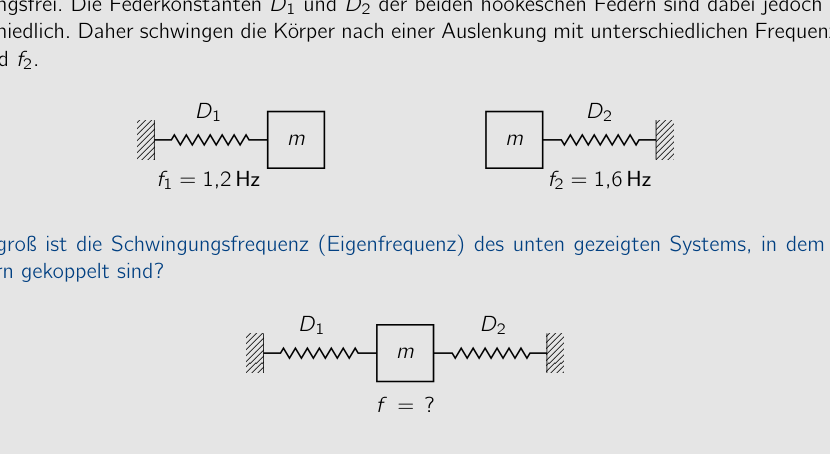 Single and coupled spring pendulums
Topic: Oscillations & Waves Metodi: Simple Harmonic Motion Analysis, Hooke’s Law, Superposition Principle Competenze: Mathematical Modeling Objects: Spring Fonte: Testo (PDF) — p.5
Problema 4 PENDULA DEL PRIMPIO DEL PRINCIPIO (problema MC) (cfr. In each of the two spring pendulums shown in the figure, a body of mass oscillates senza attrito. Tuttavia, le costanti di primavera e delle due Hookean springs sono diverse. Pertanto, dopo essere stati spostati, i corpi oscillavano a diverse frequenze. e . Qual è la frequenza di oscillazione (natural frequency) del sistema mostrato qui sotto, in cui il sistema oscillazione è le sorgenti sono accoppiate? A B C D Answer section Calcoli e spiegazioni Corretta risposta:
Single and coupled spring pendulums
Topic: Oscillations & Waves Metodi: Simple Harmonic Motion Analysis, Hooke’s Law, Superposition Principle Competenze: Mathematical Modeling Objects: Spring Fonte: Testo (PDF) — p.5
The problem is that the two-dimensional pendulum (MC) (five points) In each of the two spring pendulums shown in the figure, a body of mass oscillates without friction. However, the spring constants and of the two Hookean springs are different. Therefore, after being displaced, the bodies oscillate at different frequencies and . What is the oscillation frequency (natural frequency) of the system shown below, in which the
- springs are coupled? A B C D Answer section Calculations and explanations Correct answer:
Single and coupled spring pendulums
Topic: Oscillations & Waves Metodi: Simple Harmonic Motion Analysis, Hooke’s Law, Superposition Principle Competenze: Mathematical Modeling Objects: Spring Fonte: Testo (PDF) — p.5
Problem 5 Tidal heating (MC problem) (5 pts.) Although a thick layer of ice reflects most of the sunlight incident on Saturn’s moon Enceladus, the space probe Cassini was able to photograph water plumes several hundred kilometers high on its surface. The moon draws the energy needed for this from tidal forces that heat it as they are converted into frictional work. Consider a celestial body of radius orbiting a planet of mass on an orbit with semi-major axis and eccentricity . For closed orbits, the eccentricity is a value with , indicating how much the orbit deviates from a circular orbit. The heating power experienced by the body can be expressed as What are the values of the exponents , , and ? A , and . B , and . C , and . D , and . Answer section Calculations and explanations Correct answer:
Topic: Astrophysics, Gravitation Metodi: Dimensional Analysis, Newton’s Law of Gravitation, Kepler’s Laws Competenze: Estimation & Approximation Objects: Planet Fonte: Testo (PDF) — p.6
Problema 5 Risoluzione del problema del sistema di riscaldamento del mare (cfr. Sebbene un’épace strata di ghiaccio rifletta la maggior parte dell’incidente di luce solare sulla luna di Saturno Enceladus, la sonda spaziale Cassini è stata in grado di fotografare acqua plume a diverse centinaia di chilometri di altezza sulla sua superficie. La luna attira l’energia necessaria per questo da Le forze di marea che lo riscaldano quando vengono convertite in lavoro fratturoso. Consider a celestial body of radius orbiting a planet of mass on an orbit con semi-major axis e eccentricità . Per le orbite chiuse, l’eccentricità è un valore con , indicando quanto l’orbita deviasse da un’orbita circolare. Il potere di riscaldamento sperimentato dal corpo può essere espresso come Quali sono i valori degli esponenti , e ? A , e . B , e . C , e . D , e . Answer section Calcoli e spiegazioni Corretta risposta:
Topic: Astrophysics, Gravitation Metodi: Dimensional Analysis, Newton’s Law of Gravitation, Kepler’s Laws Competenze: Estimation & Approximation Objects: Planet Fonte: Testo (PDF) — p.6
Problem 5 Tidal heating (MC problem) (five points) Although a thick layer of ice reflects most of the sunlight incident on Saturn’s moon Enceladus, the space probe Cassini was able to photograph water plumes several hundred kilometers high on its surface. The moon draws the energy needed for this from tidal forces that heat it as they are converted into frictional work. Consider a celestial body of radius orbiting a planet of mass on an orbit with semi-major axis and eccentricity . For closed orbits, the eccentricity is a value with , indicating how much the orbit deviates from a circular orbit. The heating power experienced by the body can be expressed as What are the values of the exponents , , and ? A , and . B , and . C , and . D , and . Answer section Calculations and explanations Correct answer:
Topic: Astrophysics, Gravitation Metodi: Dimensional Analysis, Newton’s Law of Gravitation, Kepler’s Laws Competenze: Estimation & Approximation Objects: Planet Fonte: Testo (PDF) — p.6
Problem 6 Coaxial cable (MC problem) (5 pts.) As shown in the left cross-section adjacent, a coaxial cable consists of a long narrow cylinder with resistivity surrounded by a hollow cylinder with resistivity . A current of magnitude flows through the cable. A second coaxial cable, shown on the right, looks the same from the outside as the first, but on the inside consists of only one material. The resistivity of this material is and the current in the second cable is likewise . A B C A B C Fig. 2. Cross-section of the first (left) and second (right) coaxial cable. At how many of the marked points A, B, and C do the magnetic fields produced by the respective cable differ? A 0 B 1 C 2 D 3 Answer section Calculations and explanations Correct answer:
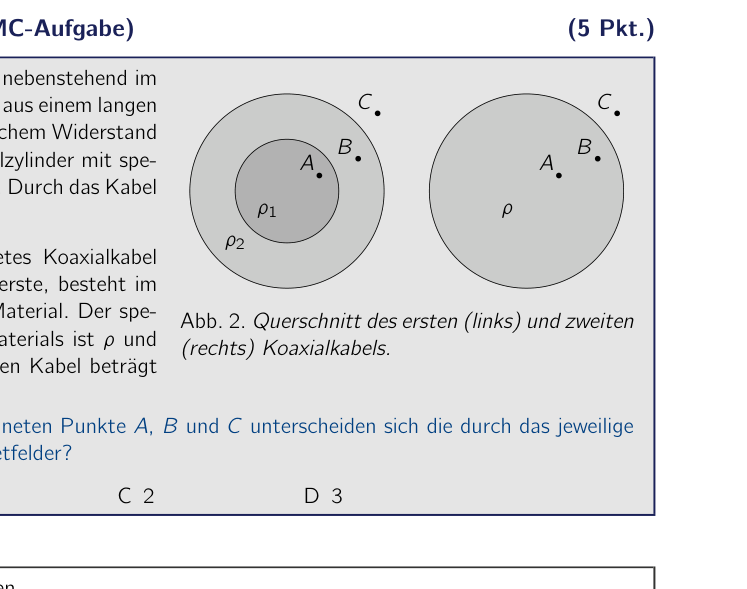 Cross-section of two coaxial cables
Topic: Magnetism, Electromagnetism Metodi: Ampère’s Law, Symmetry Argument, Physical Modeling Competenze: Physical Reasoning Objects: Wire, Cylinder Fonte: Testo (PDF) — p.7
Problema 6 Cable coaxial (problema MC) (cfr. Come mostrato nella sezione incrociata sinistra adiacente, un cavo coaxial è costituito da un lungo cilindro con resistività surrounded by a hollow cylinder with resistivity . A corrente di magnitudo fluisce attraverso il cavo. Un secondo cavo coaxial, mostrato sulla destra, Sembra lo stesso dall’esterno come il primo, ma sul inside è composto da un solo materiale. La resistività di questo materiale è e il corrente nel secondo cavo è di tipo simile . A B C A B C Fig. 2. Cross-section of the first (left) and second (destra) cavo coaxial. A how many of the marked points A, B, and C do the magnetic fields produciti dal rispettivo cavo differ? A 0 B 1 C 2 D 3 Answer section Calcoli e spiegazioni Corretta risposta:
Cross-section of two coaxial cables
Topic: Magnetism, Electromagnetism Metodi: Ampère’s Law, Symmetry Argument, Physical Modeling Competenze: Physical Reasoning Objects: Wire, Cylinder Fonte: Testo (PDF) — p.7
The problem is that the coaxle cable is not a coaxle cable. (five points) As shown in the left cross-section adjacent, a coaxial cable consists of a long narrow cylinder with resistivity surrounded by a hollow cylinder with resistivity . A current of magnitude flows through the cable. A second coaxial cable, shown on the right, looks the same from the outside as the first, but on the Inside consists of only one material. The resistivity of this material is and The current in the second cable is likewise . A B C A B C Fig. 2. Cross-section of the first (left) and second (right) coaxial cable. At how many of the marked points A, B, and C do the magnetic fields produced by the respective cable differ? A 0 B 1 C 2 D 3 Answer section Calculations and explanations Correct answer:
Cross-section of two coaxial cables
Topic: Magnetism, Electromagnetism Metodi: Ampère’s Law, Symmetry Argument, Physical Modeling Competenze: Physical Reasoning Objects: Wire, Cylinder Fonte: Testo (PDF) — p.7
Problem 7 Glass block (5 pts.) A laser beam running in the plane of the drawing strikes a glass block (refractive index ) with side lengths and from the left at an angle of incidence . As indicated in the not-to-scale sketch in Figure 3, inside the glass block it finally strikes exactly the lower right corner. Fig. 3. Not-to-scale sketch of the laser beam in the glass block, side view. What is the distance of the entry point from the upper boundary surface of the block? A
B
C
D
Answer section Calculations and explanations Correct answer: Long-answer problems Work on the following three problems also in the boxes provided. Unlike the multiple-choice problems, no answer options are given. Describe your solution method so that it is easy to follow but not unnecessarily long. So if, for example, you use the law of conservation of energy, write this down briefly.
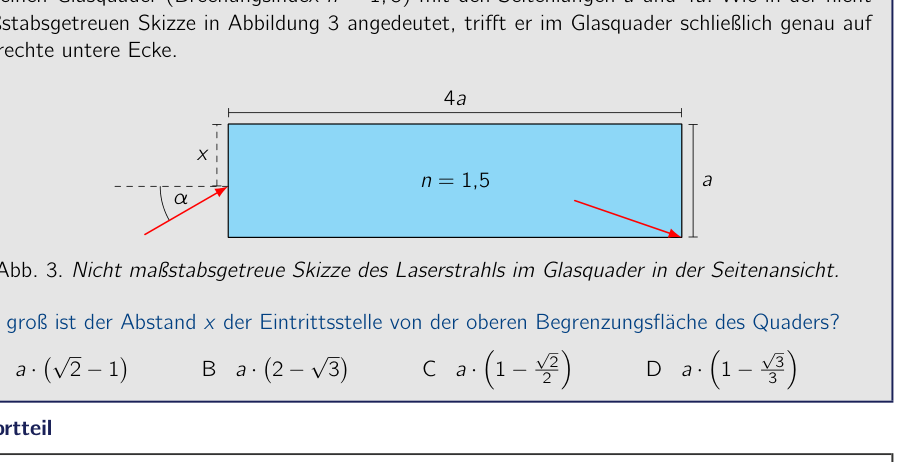 Laser beam in the glass block
Topic: Geometric Optics Metodi: Snell’s Law, Ray Tracing, Vector Decomposition Competenze: Mathematical Modeling Objects: — Fonte: Testo (PDF) — p.8
Problema 7 Blocco di vetro (cfr. Un laser beam running in the plane of the drawing strikes a glass block (refractive index ) con lunghezze laterali e dalla sinistra ad un angolo di incidenza . Come indicato nella not-to-scale Sketch in Figura 3, all’interno del blocco di vetro, finalmente colpisce esattamente
- Il lato inferiore destro. Fig. 3. Sketch non a scala del raggio laser nel blocco di vetro, vista laterale. Qual è la distanza del punto di ingresso dalla superficie di confine superiore del blocco? A
B
C
D
Answer section Calcoli e spiegazioni Corretta risposta: Problemi di risposta lunga La Commissione ha inoltre presentato una serie di proposte di risoluzione. A differenza dei problemi di scelta multipla, non sono state indicate le opzioni di risposta. Descrivi il tuo metodo di soluzione in questo modo: che è facile da seguire ma non troppo lungo. Quindi se, per esempio, si usa la legge della conservazione dell’energia, scrivete brevemente.
Laser beam in the glass block
Topic: Geometric Optics Metodi: Snell’s Law, Ray Tracing, Vector Decomposition Competenze: Mathematical Modeling Objects: — Fonte: Testo (PDF) — p.8
Problem 7 Glass block (five points) A laser beam running in the plane of the drawing strikes a glass block (refractive index ) with side lengths and from the left at an angle of incidence . As indicated in the not-to-scale Sketch in Figure 3, inside the glass block it finally strikes exactly The lower right corner. Fig. 3. Not-to-scale sketch of the laser beam in the glass block, side view. What is the distance of the entry point from the upper boundary surface of the block? A
B
C
D
Answer section Calculations and explanations Correct answer: Long-response problems Work on the following three problems also in the boxes provided. Unlike the Multiple-choice problems, no answer options are given. Describe your solution method That it’s easy to follow but not unnecessarily long. So if, for example, you use the law of conservation of energy, write this down briefly.
Laser beam in the glass block
Topic: Geometric Optics Metodi: Snell’s Law, Ray Tracing, Vector Decomposition Competenze: Mathematical Modeling Objects: — Fonte: Testo (PDF) — p.8
Problem 8 Laser rangefinder (15 pts.) Laser rangefinders are often used for measuring rooms. Laser rangefinders available in hardware stores can usually determine distances ranging from a few centimeters up to about with an accuracy of a few millimeters. To measure distance, the device emits a laser beam and receives the beam reflected from an object. 8.a) Calculate the travel time of laser light at a measurement distance of . Determine how precise this travel-time measurement would have to be in order to achieve a measurement accuracy of . (4.0 pts.) Such high time resolution is not achieved by typical laser rangefinders. Instead, the distance is determined from the phase shift between the emitted and received signal. However, this is not relevant for the following problems. The accuracy of the measurement is, however, also affected by what is located along the light path. 8.b) You want to measure the length of a thin-walled aquarium filled with water. Explain qualitatively why a measurement through the aquarium gives different values than a measurement with a ruler. (2.0 pts.) This effect can be used to determine the refractive index of a transparent material with a laser rangefinder. In the experiment sketched adjacent, a fixed-mounted laser rangefinder is used to measure the distance to the bottom of a glass cylinder partially filled with a liquid. The distance values displayed by the laser rangefinder for various liquid volumes are shown in the table below. The inner diameter of the glass cylinder is . 8.c) Using the series of measurements, determine the refractive index of the liquid. To do so, create a suitable graph. (9.0 pts.) Measured values of the distance measured by the laser rangefinder as a function of the liquid volume contained in the cylinder
| / L | / m | / L | / m |
|---|---|---|---|
| 0,00 | 0,602 | 0,95 | 0,668 |
| 0,07 | 0,607 | 1,22 | 0,687 |
| 0,15 | 0,611 | 1,42 | 0,697 |
| 0,27 | 0,619 | 1,56 | 0,705 |
| 0,37 | 0,622 | 1,64 | 0,709 |
| 0,51 | 0,636 | 1,76 | 0,718 |
| 0,67 | 0,647 | 1,85 | 0,727 |
| 0,77 | 0,657 | 1,93 | 0,733 |
Answer section 8.a) Calculations and explanations Calculations and explanations (continued) Result for travel time: Result for accuracy of the travel-time measurement: 8.b) Calculations and explanations 8.c) Graph Calculations and explanations Result for refractive index of the liquid:
Topic: Geometric Optics, Wave Optics Metodi: Snell’s Law, Graph Linearization, Experimental Data Analysis Competenze: Experimental Data Analysis, Graph Linearization, Mathematical Modeling Objects: Cylinder Fonte: Testo (PDF) — p.9
Problema 8 Laser rangefinder 15 punti) I laser sono spesso utilizzati per misurare le stanze. Rango-sensori laser disponibili in hardware stores possono solitamente determinare distanze che vanno da pochi centimetri fino ad circa con un’accuratezza di pochi millimetri. Per misurare la distanza, il dispositivo emette un raggio laser e riceve il raggio riflesso da un oggetto. 8.a) Calcolare il tempo di viaggio della luce laser a una distanza di misurazione di . Determine come Precisamente questo tempo di viaggio dovrebbe essere necessario per raggiungere una accuratezza di misurazione di . (4,0 p.) Tale alta risoluzione non è raggiunta da tipici laser rangefinders. Invece, la distanza è determinata dal passaggio di fase tra il segnale emesso e ricevuto. Tuttavia, questo non è rilevante per i seguenti problemi. L’accuratezza della misurazione è, tuttavia, influenzata anche da ciò che è situato lungo il percorso della luce. 8.b) Vuoi misurare la lunghezza di un acquario a sottili pareti pieno di acqua. Spiega qualitativamente perché una misurazione attraverso l’acquario dà valori diversi che una misurazione con un ruler. (punto 2.0) Questo effetto può essere utilizzato per determinare l’indice di refraczione di un materiale trasparente con un rangefinder laser. Nell’esperimento sketched adjacent, un rangefinder laser a montaggio fisso è usato per misurare la distanza verso il fondo di un cilindro di vetro. partialmente riempito di un liquido. I valori di distanza visualizzati dal laser rangefinder per vari volumi di liquidi sono mostrati nella tabella seguente. Il diametro interno del cilindro di vetro è . 8.c) Usando la serie di misure, determinare l’indice di refrazione del liquido. Per farlo, creare un grafico appropriato. (9,0 p.s.) Valori misurati della distanza measured by the laser rangefinder as a function of the liquid volume contenuti nel cilindro
| / L | / m | / L | / m |
|---|---|---|---|
| 0,00 | 0,602 | 0,95 | 0,668 |
| 0,07 | 0,607 | 1,22 | 0,687 |
| 0,15 | 0,611 | 1,42 | 0,697 |
| 0,27 | 0,619 | 1,56 | 0,705 |
| 0,37 | 0,622 | 1,64 | 0,709 |
| 0,51 | 0,636 | 1,76 | 0,718 |
| 0,67 | 0,647 | 1,85 | 0,727 |
| 0,77 | 0,657 | 1,93 | 0,733 |
Answer section 8.a) Calcoli e spiegazioni Calcoli e spiegazioni (continuato) Result for travel time: Risultato per l’accuratezza della misurazione del tempo di viaggio: 8.b) Calcoli e spiegazioni 8.c) Grafico Calcoli e spiegazioni Result for refractive index of the liquid:
Topic: Geometric Optics, Wave Optics Metodi: Snell’s Law, Graph Linearization, Experimental Data Analysis Competenze: Experimental Data Analysis, Graph Linearization, Mathematical Modeling Objects: Cylinder Fonte: Testo (PDF) — p.9
The problem is that the laser rangefinder (Figure 15) Laser rangefinders are often used for measuring rooms. Laser rangefinders available in hardware stores can usually determine distances ranging from a few centimeters up to about with an accuracy of a few millimeters. To measure distance, the device emits a laser beam and receives the beam reflected from an object. 8. (a) Calculate the travel time of laser light at a measurement distance of . Determine how This travel time measurement would have to be in order to achieve a measurement accuracy of . (4.0 p.m.) Such high time resolution is not achieved by typical laser rangefinders. Instead, the distance is determined from the phase shift between the emitted and received signal. However, this is not relevant for the following problems. The accuracy of the measurement is, however, also affected by what is located along the light path. 8.b) You want to measure the length of a thin-walled aquarium filled with water. Explain qualitatively why a measurement through the aquarium gives different values than a measurement with a ruler. (b) the number of persons who have been This effect can be used to determine the refractive index of a transparent material with a laser rangefinder. In the experiment sketched adjacent, a fixed-mounted laser rangefinder is used to measure the distance to the bottom of a glass cylinder partially filled with a liquid. The distance values displayed by the laser rangefinder for various liquid volumes are shown in the table below. The inner diameter of the glass cylinder is . 8.c) Using the series of measurements, determine the refractive index of the liquid. To do that, create a suitable graph. (9.0 pts.) Measured values of the distance measured by the laser rangefinder as a function of the liquid volume contained in the cylinder
| / L | / m | / L | / m |
|---|---|---|---|
| 0,00 | 0,602 | 0,95 | 0,668 |
| 0,07 | 0,607 | 1,22 | 0,687 |
| 0,15 | 0,611 | 1,42 | 0,697 |
| 0,27 | 0,619 | 1,56 | 0,705 |
| 0,37 | 0,622 | 1,64 | 0,709 |
| 0,51 | 0,636 | 1,76 | 0,718 |
| 0,67 | 0,647 | 1,85 | 0,727 |
| 0,77 | 0,657 | 1,93 | 0,733 |
Answer section 8.a) Calculations and explanations Calculations and explanations (continued) Result for travel time: Result for accuracy of the travel-time measurement: 8.b) Calculations and explanations 8.c) Graph Calculations and explanations Result for refractive index of the liquid:
Topic: Geometric Optics, Wave Optics Metodi: Snell’s Law, Graph Linearization, Experimental Data Analysis Competenze: Experimental Data Analysis, Graph Linearization, Mathematical Modeling Objects: Cylinder Fonte: Testo (PDF) — p.9
Problem 9 Rocket launches and satellites (20 pts.) The number of rocket launches has increased sharply in recent years - in 2021 there were more than 140 launches aiming to reach an Earth orbit. During the launch phase, rockets and their payloads are exposed to enormous loads. The aerodynamic load due to friction in the atmosphere plays a major role. As a simple model, consider a rocket with a cone-shaped tip that has a diameter of and an opening angle of at the cone tip. The rocket flies at a velocity through the atmosphere, which at the current altitude has a density of . You may assume that the motion of the air molecules in the atmosphere is negligible compared with the rocket’s velocity. Through collisions of the rocket tip with the air molecules, treated for simplicity as elastic, the rocket experiences a friction force. 9.a) Derive an expression for the friction force acting on the rocket as a function of the parameters , , , and . Determine the magnitude of the friction force for the values , , and . (4.0 pts.) R O C K E T S C I E N C E The friction force acting on a rocket changes during the rocket’s flight. The following figures show the velocity of a rocket after launch as a function of flight altitude (left) and the atmospheric pressure as a function of altitude above the ground (right). It is assumed for simplicity that the temperature of the atmosphere is constant. 10 20 30 40 50 0,5 1,0 1,5 2,0 / km / km s 10 20 30 40 50 0,1 0,2 0,3 0,4 0,5 0,6 0,7 0,8 0,9 1,0 / km / Pa Fig. 4. Velocity of the rocket (left) and air pressure of the atmosphere (right) as a function of the altitude above the ground. 9.b) Using the data from the graphs, estimate the altitude above the ground at which the friction force on the rocket is maximal. (6.0 pts.) This point, critical during a launch, is called Max Q and designates the place and time of greatest aerodynamic load on the rocket. To put satellites into an Earth orbit, the rocket must accelerate further. Let denote the mass of the Earth and the Earth’s radius. 9.c) Determine the velocity to which the rocket must accelerate before the engines are switched off in order to orbit the Earth in a low Earth orbit outside the atmosphere without crashing onto the Earth. Also state the orbital period of the orbit. (3.0 pts.) 9.d) Determine likewise the minimum velocity to which the rocket must accelerate before the engines are switched off in order to escape the Earth’s influence completely. State the ratio of this velocity to the one determined in the previous part. (3.0 pts.) Now assume that a satellite orbits the Sun on an orbit whose radius corresponds to the mean Earth orbital radius around the Sun of about . The satellite is far away from the Earth and all other celestial bodies. The mass of the Sun is about and the radius of the Sun can be assumed to be very small compared with the Earth’s orbital radius. Suddenly the satellite comes to a complete stop relative to the Sun. 9.e) Estimate how long it takes until the satellite crashes into the Sun. Depending on the solution approach, Kepler’s laws may be helpful for this. (4.0 pts.) Answer section 9.a) Calculations and explanations Calculations and explanations (continued) Expression for the friction force: Value of the friction force: 9.b) Calculations and explanations Graph Calculations and explanations (continued) Result for altitude at maximum friction: 9.c) Calculations and explanations Result for velocity and orbital period: 9.d) Calculations and explanations Result for velocity and velocity ratio: 9.e) Calculations and explanations Result for time:
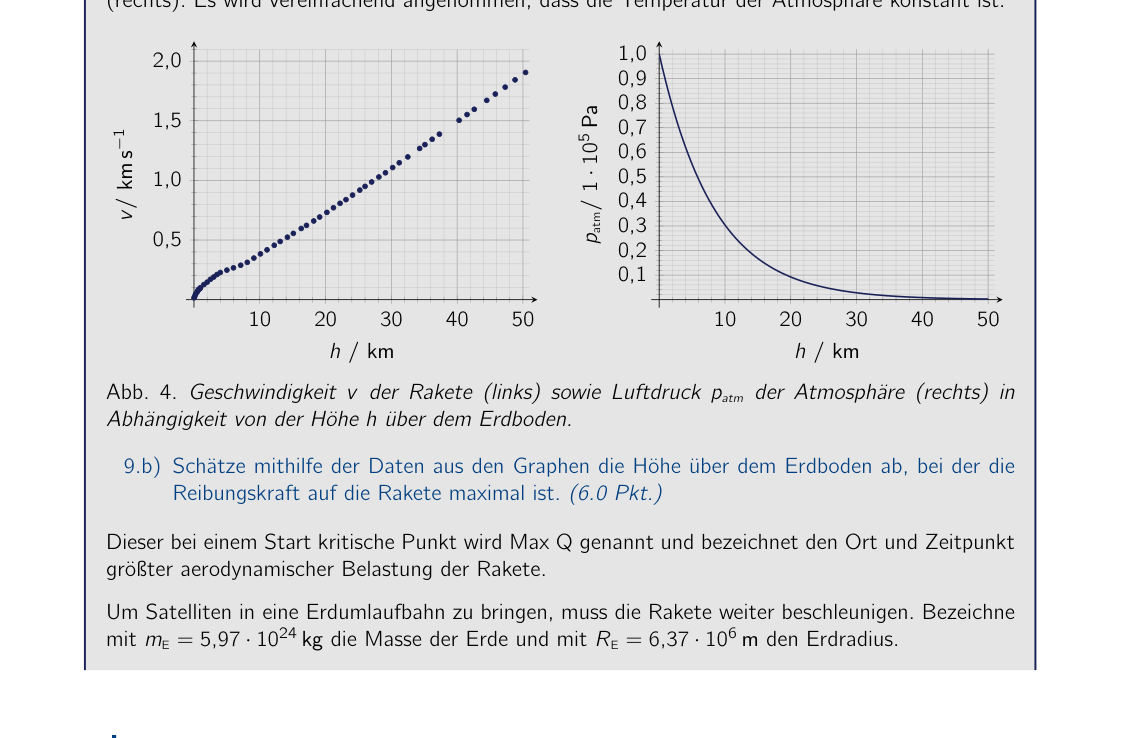 Rocket velocity and air density vs altitude
Topic: Newtonian Mechanics, Gravitation, Astrophysics Metodi: Conservation Laws, Newton’s Law of Gravitation, Kepler’s Laws, Dimensional Analysis Competenze: Mathematical Modeling, Estimation & Approximation Objects: Projectile, Planet, Satellite, Star Fonte: Testo (PDF) — p.13
Problema 9 Lanci di razzi e satelliti (cfr. Il numero di lanci di razzi è aumentato notevolmente negli ultimi anni. Nel 2021 ci sono stati più di 140 lanci che hanno lo scopo di raggiungere l’orbita terrestre. Durante la fase di lancio, i razzi e i loro carichi sono esposti a enormi
- Loads. Il carico aerodinamico dovuto a La friczione nell’atmosfera gioca un ruolo importante. Come modello semplice, considerate un razzo con una punta a forma di cono che ha un diametro di e un angolo di apertura di alla punta del cono. Il razzo vola a velocità attraverso il atmosfera, che all’altitudine corrente ha una densità di . Tu può supporre che il movimento delle molecole d’aria nell’atmosfera sia insignificante rispetto alla velocità del razzo. Attraverso Le collisioni della punta del razzo con le molecole d’aria, trattate per semplicità come elastica, il razzo sperimenta una forza di attrito. 9.a) Derivo di un’espressione per la forza di frizione che agisce sul razzo come a function of the parameters , , , and . Determinazione la magnitudo della forza di frizione per i valori , , e . (4,0 p.) R O C K E T S C I E N C E La forza di attrito che agisce su un razzo cambia durante il volo del razzo. Il seguente Figure mostrano la velocità di un razzo dopo il lancio come funzione di L’altitudine di volo (sinistra) e la pressione atmosferica a funzione dell’altitudine sopra il suolo (Ritto) Si presume per semplicità che la temperatura dell’atmosfera sia costante. 10 20 30 40 50 0,5 1,0 1,5 2,0 / km / km s 10 20 30 40 50 0,1 0,2 0,3 0,4 0,5 0,6 0,7 0,8 0,9 1,0 / km / Pa Fig. 4. Velocity of the rocket (left) and air pressure of the atmosphere (right) as a funzione dell’altitudine sopra il suolo. 9.b) Usando i dati dei grafici, stimare l’altitudine sopra il terreno a cui il La forza di attrito sul razzo è massima. (6,0 p.p.) Questo punto, critico durante un lancio, è chiamato Max Q e designa il luogo e l’ora di maggiore carico aerodinamico sul razzo. Per mettere i satelliti in orbita terrestre, il razzo deve accelerare ulteriormente. Let indica la massa della Terra e il raggio della Terra. 9.c) Determina la velocità alla quale il razzo deve accelerare prima che i motori siano spenti per orbitare la Terra in un’orbita terrestre bassa fuori dall’atmosfera senza schiantarsi sulla Terra. Quindi, afferma il periodo orbitale dell’orbita. (Punto di riferimento) 9.d) Determinare anche la velocità minima alla quale il razzo deve accelerare prima che i motori siano spenti per poter sfuggire completamente all’influenza terrestre. State il rapporto di questa velocità con quello determinato nella parte precedente. (Punto di riferimento) Ora supponiamo che un satellite orbita il Sole in un’orbita il cui raggio corrisponde alla media Radius orbitale della Terra intorno al Sole di circa . Il satellite è lontano dal Terra e tutti gli altri corpi celesti. La massa del Sole è circa e Il raggio del Sole può essere considerato molto piccolo rispetto al raggio orbitale della Terra. All’improvviso il satellite arriva a un completo stop rispetto al Sole. 9.e) Estimare quanto tempo ci vorrà prima che il satellite crolla nel Sole. In base all’approccio di soluzione, Le leggi di Kepler potrebbero essere utili per questo. (4,0 p.) Answer section 9.a) Calcoli e spiegazioni Calcoli e spiegazioni (continuato) Espressione per la forza di frizione: Valore della forza di frizione: 9.b) Calcoli e spiegazioni Grafico Calcoli e spiegazioni (continuato) Risultato per altitudine a massima frizione: 9.c) Calcoli e spiegazioni Result for velocity and orbital period: 9.d) Calcoli e spiegazioni Risultato per velocità e velocità ratio: 9.e) Calcoli e spiegazioni Result for time:
Rocket velocity and air density vs altitude
Topic: Newtonian Mechanics, Gravitation, Astrophysics Metodi: Conservation Laws, Newton’s Law of Gravitation, Kepler’s Laws, Dimensional Analysis Competenze: Mathematical Modeling, Estimation & Approximation Objects: Projectile, Planet, Satellite, Star Fonte: Testo (PDF) — p.13
Problem 9 Rocket launches and satellites The Commission shall adopt implementing acts in accordance with Article 21 of this Regulation. The number of rocket launches has increased sharply in recent years - In 2021, there were more than 140 launches aiming to reach Earth orbit. During the launch phase, rockets and their payloads are exposed to enormous Loads. The aerodynamic load due to friction in the atmosphere plays a major role. As a simple model, consider a rocket with a cone-shaped tip that has a diameter of and an opening angle of at the cone tip. The rocket flies at a velocity through the atmosphere, which at the current altitude has a density of . You may assume that the motion of the air molecules in the atmosphere is negligible compared to the rocket’s velocity. Through The rocket experiences a friction force. 9. (a) Derive an expression for the friction force acting on the rocket as a function of the parameters , , , and . Determine the magnitude of the friction force for the values , , and . (4.0 p.m.) R O C K E T S C I E N C E The friction force acting on a rocket changes during the rocket’s flight. The following Figures show the velocity of a rocket after launch as a function of flight altitude (left) and the atmospheric pressure as a function of altitude above the ground (right) It is assumed for simplicity that the temperature of the atmosphere is constant. 10 20 30 40 50 0,5 1,0 1,5 2,0 / km / km s 10 20 30 40 50 0,1 0,2 0,3 0,4 0,5 0,6 0,7 0,8 0,9 1,0 / km / Pa Fig. 4. Velocity of the rocket (left) and air pressure of the atmosphere (right) as a function of the altitude above the ground. 9.b) Using the data from the graphs, estimate the altitude above the ground at which the friction force on the rocket is maximum. (6.0 pts) This point, critical during a launch, is called Max Q and designates the place and time of greatest aerodynamic load on the rocket. To put satellites into Earth orbit, the rocket must accelerate further. Let ‘s see denotes the mass of the Earth and the Earth’s radius. 9.c) Determine the velocity at which the rocket must accelerate before the engines are switched off in order to orbit the Earth in a low Earth orbit outside the atmosphere without crashing onto the Earth. So state the orbital period of the orbit. (including the following) 9. (d) Determine also the minimum velocity to which the rocket must accelerate before the engines are switched off in order to escape the Earth’s influence completely. State the ratio of this velocity to the one determined in the previous part. (including the following) Now suppose that a satellite orbits the Sun on an orbit whose radius corresponds to the mean Earth orbital radius around the Sun of about . The satellite is far away from the Earth and all other celestial bodies. The mass of the Sun is about and The radius of the Sun can be assumed to be very small compared to the Earth’s orbital radius. Suddenly the satellite comes to a complete stop relative to the Sun. 9.e) Estimate how long it will take until the satellite crashes into the Sun. Depending on the solution approach, Kepler’s laws may be helpful for this. (4.0 p.m.) Answer section 9.a) Calculations and explanations Calculations and explanations (continued) Expression for the friction force: Value of the friction force: 9.b) Calculations and explanations Graph Calculations and explanations (continued) Result for altitude at maximum friction: 9.c) Calculations and explanations Result for velocity and orbital period: 9.d) Calculations and explanations Result for velocity and velocity ratio: 9.e) Calculations and explanations Result for time:
Rocket velocity and air density vs altitude
Topic: Newtonian Mechanics, Gravitation, Astrophysics Metodi: Conservation Laws, Newton’s Law of Gravitation, Kepler’s Laws, Dimensional Analysis Competenze: Mathematical Modeling, Estimation & Approximation Objects: Projectile, Planet, Satellite, Star Fonte: Testo (PDF) — p.13
Problem 10 Goethe barometer (15 pts.) A Goethe barometer can be used to measure changes in air pressure. It consists of a vessel closed at the top, filled with air in its upper part and water in its lower part. This lower part is connected to the atmosphere via a vertical riser tube open at the top. Due to changes in the external air pressure, the water level in the “spout” of the barometer falls or rises. At constant ambient temperature, the change in air pressure is the sole cause of a change in water level in the riser tube. Consider a simple Goethe barometer, as shown in the sketch. The cross-sectional areas of the riser tube and the vessel are and , respectively. At an air pressure of , the difference between the water levels in the riser tube and the vessel is , and the air volume enclosed in the vessel at pressure is . The vapor pressure of the water is to be neglected. When the air pressure increases by , the water level in the riser tube falls. Let , , , and denote the quantities that result at the changed air pressure, according to the figure. (a) Photo of a Goethe barometer, CC BY-SA 3.0) (b) Simple Goethe barometer with constant cross-sections. The red arrows indicate the displacement upon a pressure increase. Fig. 5. Weather glass or Goethe barometer 10.a) Derive a relationship between the change in air pressure and the corresponding change in water level in the riser tube. Calculate the value of the change in air pressure when the water level in the riser tube falls by . For the density of water use and for the gravitational acceleration . (11.0 pts.) 10.b) Determine approximately how large the change in water level in the riser tube would be for the same pressure change for a Goethe barometer scaled down by a factor of 1:2. (4.0 pts.) Note: For you may use the approximation . Answer section 10.a) Calculations and explanations Calculations and explanations (continued) Relationship between change in air pressure and corresponding change in water level: Value of the change in air pressure: 10.b) Calculations and explanations Change in water level in the riser tube for a scaled-down Goethe barometer: Additional worksheet Additional worksheet Additional worksheet Graph paper
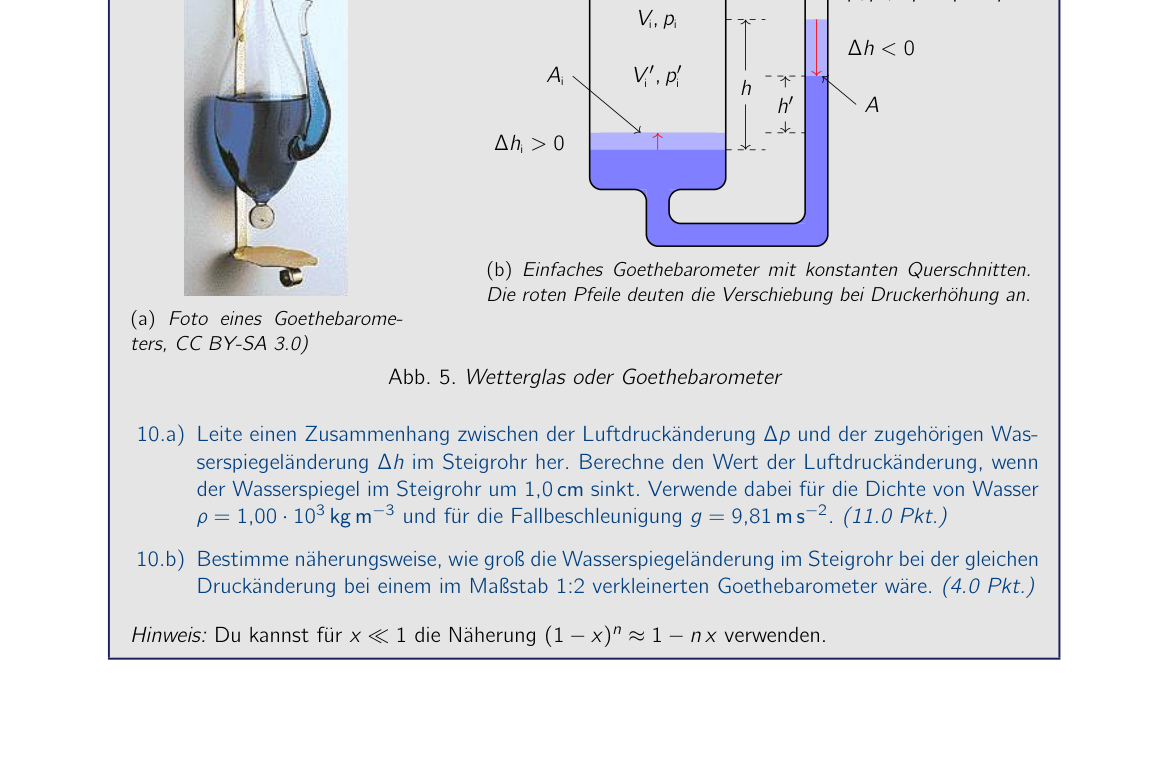 Goethe barometer photo and diagram
Topic: Fluid Mechanics, Thermodynamics Metodi: Ideal Gas Law, Hydrostatic Equilibrium, Approximation & Series Expansion Competenze: Mathematical Modeling, Physical Reasoning Objects: Manometer, Tube, Gas, Container Fonte: Testo (PDF) — p.19
Problema 10 Barometro di Goethe 15 punti) Un barometro di Goethe può essere utilizzato per misurare i cambiamenti nella pressione dell’aria. Consiste in una nave chiuso in cima, pieno di aria nella parte superiore e acqua nella parte inferiore. Questo la parte inferiore è collegata all’atmosfera attraverso un tubo riser verticale aperto in cima. A causa di variazioni della pressione dell’aria esterna, il livello di acqua nello “spout” del Barometro di cassa o di rissi. A temperatura ambiente costante, il cambiamento di pressione dell’aria è la causa sola di un cambiamento di livello di acqua nel tubo riser. Considerate un semplice barometro Goethe, come mostrato nello schizzo. Le aree cross-sectionali del riser tube and the vessel are and , respectively. At an air pressure of , la differenza tra i livelli di acqua nel tubo riser e il recipiente è , e il volume di aria chiuso nel recipiente a pressione è . Il la pressione di vapore dell’acqua deve essere trascurata. Quando la pressione dell’aria aumenta di , il livello dell’acqua nel tubo riser scende. Let , , , e denotano le quantità che risultano alla pressione dell’aria cambiata, secondo la figura. (a) Photo of a Goethe barometer, CC BY-SA 3.0) (b) Barometro Goethe semplice con sezioni incrociate costanti. Le frecce rosse indicano il spostamento a causa di un aumento di pressione. Fig. 5. Meteo e barometri 10.a) Derivare una relazione tra il cambiamento di pressione dell’aria e il corrispondente cambiamento di livello dell’acqua nel tubo riser. Calcolare il valore del cambiamento di pressione dell’aria quando il livello di acqua nel tubo riser si riduce a . Per la densità di uso dell’acqua e per l’accelerazione gravitazionale . (cfr. 10.b) Determina approssimativamente quanto grande sarebbe il cambiamento del livello di acqua nel tubo riser per lo stesso Cambiamento di pressione per un barometro di Goethe ridotto da un fattore di 1:2. (4,0 p.) Nota: per si può usare l’approssimazione . Answer section 10.a) Calcoli e spiegazioni Calcoli e spiegazioni (continuato) Relazione tra cambiamento di pressione dell’aria e corrispondente cambiamento di livello dell’acqua: Valore del cambiamento di pressione dell’aria: 10.b) Calcoli e spiegazioni Cambiamento di livello d’acqua nel tubo riser per un barometro Goethe scaled-down: Ulteriori fogli di lavoro Ulteriori fogli di lavoro Ulteriori fogli di lavoro Carta grafica
Goethe barometer photo and diagram
Topic: Fluid Mechanics, Thermodynamics Metodi: Ideal Gas Law, Hydrostatic Equilibrium, Approximation & Series Expansion Competenze: Mathematical Modeling, Physical Reasoning Objects: Manometer, Tube, Gas, Container Fonte: Testo (PDF) — p.19
The problem is that the barometer is a (Figure 15) A Goethe barometer can be used to measure changes in air pressure. It consists of a vessel closed at the top, filled with air in its upper part and water in its lower part. This Lower part is connected to the atmosphere via a vertical riser tube open at the top. Due to changes in the external air pressure, the water level in the “spout” of the Barometer falls or rises. At constant ambient temperature, the change in air pressure is the sole cause of a change in water level in the riser tube. Consider a simple Goethe barometer, as shown in the sketch. The cross-sectional areas of the riser tube and the vessel are and , respectively. At an air pressure of , the difference between the water levels in the riser tube and the vessel is , and the air volume enclosed in the vessel at pressure is . The The vapor pressure of the water is to be neglected. When the air pressure increases by , the water level in the riser tube falls. Let , , , and denotes the quantities that result at the changed air pressure, according to the figure. (a) Photo of a Goethe barometer, CC BY-SA 3.0) (b) Simple Goethe barometer with constant cross-sections. The red arrows indicate the displacement upon a pressure increase. Fig. 5. Weather glass or Goethe barometer 10. (a) Derive a relationship between the change in air pressure and the corresponding change in water level in the riser tube. Calculate the value of the change in air pressure when the water level in the riser tube falls by . For the density of water use and for the gravitational acceleration . (including the European Parliament and the Council) 10.b) Determine approximately how large the change in water level in the riser tube would be for the same pressure change for a Goethe barometer scaled down by a factor of 1:2. (4.0 p.m.) Note: For you may use the approximation . Answer section 10.a) Calculations and explanations Calculations and explanations (continued) Relationship between change in air pressure and corresponding change in water level: Value of the change in air pressure: 10.b) Calculations and explanations Change in water level in the riser tube for a scaled-down Goethe barometer: Additional worksheet Additional worksheet Additional worksheet Graph paper
Goethe barometer photo and diagram
Topic: Fluid Mechanics, Thermodynamics Metodi: Ideal Gas Law, Hydrostatic Equilibrium, Approximation & Series Expansion Competenze: Mathematical Modeling, Physical Reasoning Objects: Manometer, Tube, Gas, Container Fonte: Testo (PDF) — p.19