Problem 1 Water Jet (MC problem) (5 pts.) The underside of a container filled with water is located, as shown alongside, at a height of = 15 cm above the floor. The water height in the container is = 50 cm. A small hole is now drilled in the container at a height above the underside, so that a water jet pours out of the container, which initially strikes the floor at a distance . Which of the graphs correctly shows the distance of the impact point as a function of the height at which the hole is drilled? Fig. 1. Sketch of the water jet. A 0 0 B 0 0 C 0 0 D 0 0 Answer section Calculations and explanations Correct answer:
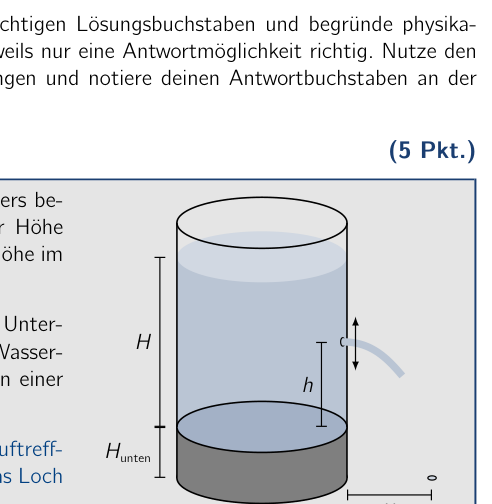 Abb. 1: serbatoio cilindrico con getto
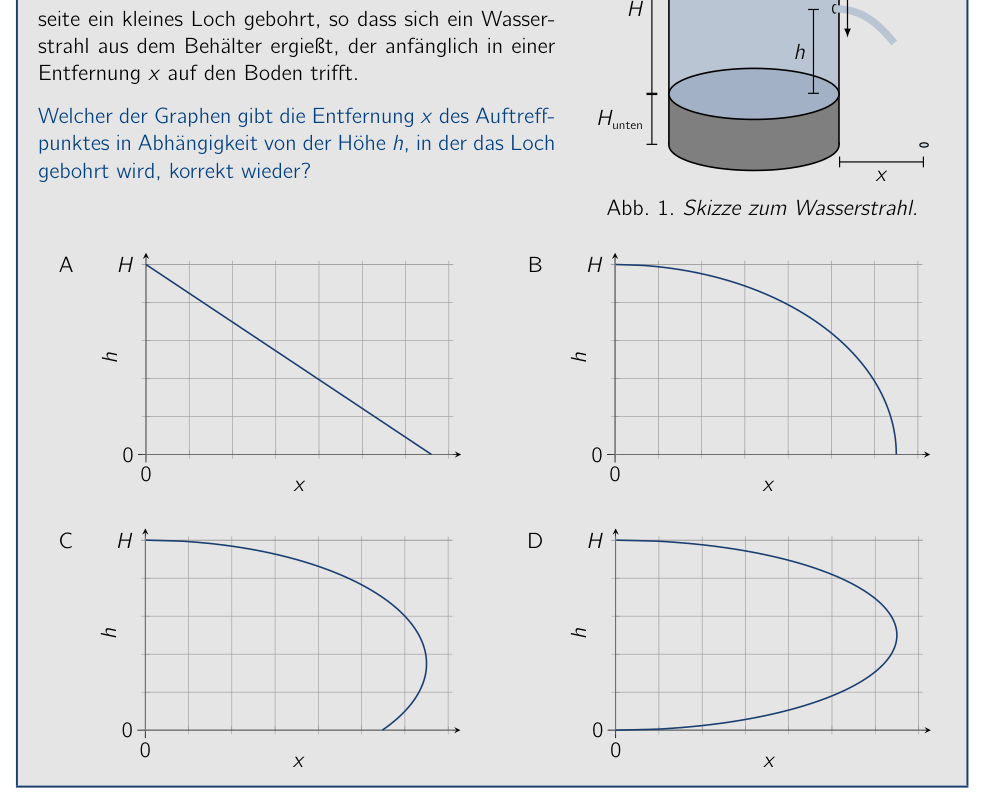 grafici A-D: x vs h del getto
Topic: Fluid Mechanics, Newtonian Mechanics Metodi: Bernoulli’s Equation, Kinematic Equations, Conservation of Energy Competenze: Physical Reasoning, Mathematical Modeling Objects: Container, Projectile Fonte: Testo (PDF) — p.2
Problema 1 Water Jet (problema MC) (cfr. L’insieme di un contenitore pieno di acqua è situato, come mostrato accanto, ad un’altezza di = 15 cm above the floor. L’altezza dell’acqua nel contenitore is = 50 cm. Un piccolo buco è ora perforato nel contenitore ad un’altezza sopra il lato inferiore, in modo che un jet d’acqua versare fuori del contenitore, che inizialmente colpisce il pavimento a Distanza . Which of the graphs correctly shows the distance of the impact point as a function of the height at which the hole
- È drilled? Fig. 1. Sketch del jet d’acqua. A 0 0 B 0 0 C 0 0 D 0 0 Answer section Calcoli e spiegazioni Corretta risposta:
Il programma di ricerca è stato sviluppato in un’area di ricerca e sviluppo. 1: serbatoio cilindrico con getto*
grafici A-D: x vs h del getto
Topic: Fluid Mechanics, Newtonian Mechanics Metodi: Bernoulli’s Equation, Kinematic Equations, Conservation of Energy Competenze: Physical Reasoning, Mathematical Modeling Objects: Container, Projectile Fonte: Testo (PDF) — p.2
The problem is that the water jet is not a water jet. (five points) The underside of a container filled with water is located, as shown alongside, at a height of = 15 cm above the floor. The water height in the container is = 50 cm. A small hole is now drilled in the container at a height above the underside, so that a water jet pours out of the container, which initially strikes the floor at a distance . Which of the graphs correctly shows the distance of the impact point as a function of the height at which the hole Is drilled? Fig. 1. Sketch of the water jet. A 0 0 B 0 0 C 0 0 D 0 0 Answer section Calculations and explanations Correct answer:
Abb. 1: serbatoio cilindrico con getto
grafici A-D: x vs h del getto
Topic: Fluid Mechanics, Newtonian Mechanics Metodi: Bernoulli’s Equation, Kinematic Equations, Conservation of Energy Competenze: Physical Reasoning, Mathematical Modeling Objects: Container, Projectile Fonte: Testo (PDF) — p.2
Problem 2 Two Pictures (MC problem) A photo of a beautiful drinking bottle is taken with a mobile-phone camera; the bottle is located at a distance of about 35 cm from the camera. In the photo the background, about 5.8 m away, appears blurred. If a lens is now placed directly in front of the camera, then the background appears sharp through the lens in the photo. Fig. 2. Photos of the drinking bottle without (left) and with (right) the lens. The lens can be recognized by its edge and is located in the left part of the right-hand photo. What is the focal length of the lens? Note: Positive focal lengths denote converging lenses and negative ones diverging lenses. A about cm B about cm C about 35 cm D about 58 cm Answer section Calculations and explanations Correct answer:
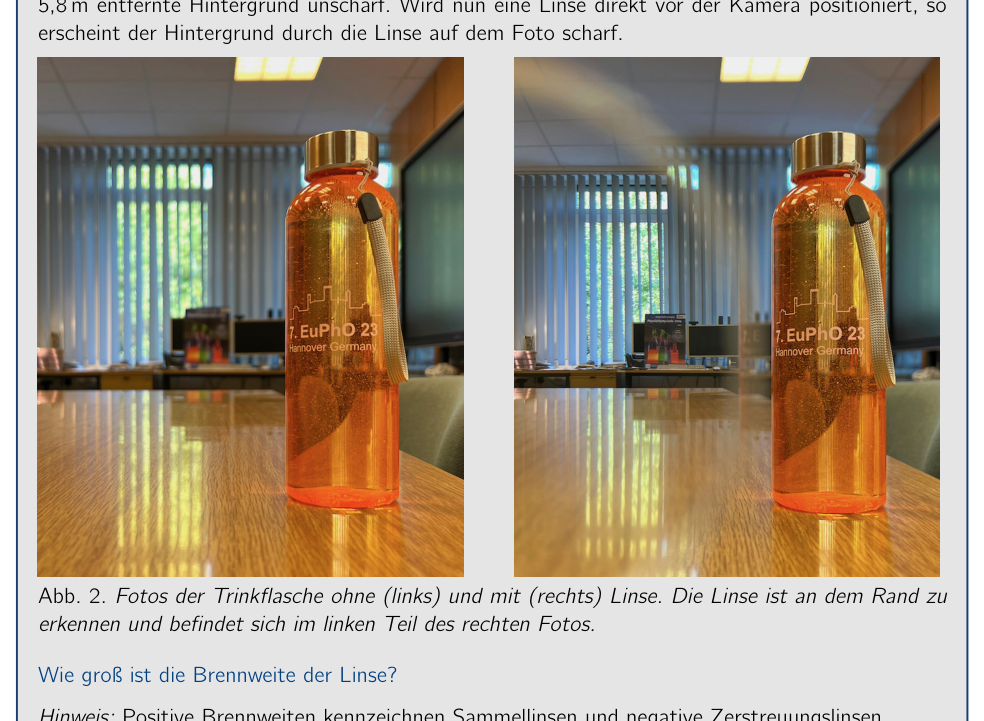 Abb. 2: bottiglie con linea di messa a fuoco
Topic: Geometric Optics Metodi: Thin Lens & Mirror Equation, Physical Modeling Competenze: Physical Reasoning, Mathematical Modeling Objects: Lens Fonte: Testo (PDF) — p.4
Problema 2 Due Pictures (problema MC) A photo of a beautiful drinking bottle is taken with a mobile-phone camera; il bottiglia è situato a una distanza di circa 35 cm dalla fotocamera. In questa foto, il fondo, circa A 5,8 metri di distanza, sembra confuso. Se un obiettivo è ora posto direttamente davanti alla fotocamera, allora Il fondo appare acuto attraverso la lente della foto. Fig. 2. Foto del biberone senza (sinistra) e con (destra) la lente. Il lente può essere riconosciuto dal suo edge and è situato nella parte sinistra della foto a destra. Qual è la lunghezza focale della lente? Nota: le lunghezze focali positive indicano lenti convergenti e quelle negative divergenti. A circa cm B circa cm C circa 35 cm D circa 58 cm Answer section Calcoli e spiegazioni Corretta risposta:
Il programma di ricerca è stato sviluppato in un’area di ricerca e sviluppo. 2: bottiglie con linea di messa a fuoco
Topic: Geometric Optics Metodi: Thin Lens & Mirror Equation, Physical Modeling Competenze: Physical Reasoning, Mathematical Modeling Objects: Lens Fonte: Testo (PDF) — p.4
Problem 2 Two Pictures (MC problem) A photo of a beautiful drinking bottle is taken with a mobile phone camera; the bottle is located At a distance of about 35 cm from the camera. In the photo the background, about 5.8 m away, appears blurred. If a lens is now placed directly in front of the camera, then The background appears sharp through the lens in the photo. Fig. 2. Photos of the drinking bottle without (left) and with (right) the lens. The lens can be recognized by its edge and is located in the left part of the right-hand photo. What is the focal length of the lens? Note: Positive focal lengths denote converging lenses and negative ones diverging lenses. A about cm B about cm C about 35 cm D about 58 cm Answer section Calculations and explanations Correct answer:
The Commission shall adopt implementing acts in accordance with Article 21 of this Regulation. The Commission has also adopted a proposal for a directive on the protection of workers’ rights.
Topic: Geometric Optics Metodi: Thin Lens & Mirror Equation, Physical Modeling Competenze: Physical Reasoning, Mathematical Modeling Objects: Lens Fonte: Testo (PDF) — p.4
Problem 3 Falling Magnet (MC problem) (5 pts.) A cylindrical magnet is dropped through three different, vertically positioned tubes. The tubes have identical dimensions but are made of different materials - one of Plexiglas, one of brass and one of aluminium. For a fall distance of = 1.0 m in the tubes, the following fall times of the magnet are measured: Plexiglas = 0.46 s Brass = 2.15 s Aluminium = 3.81 s The electrical conductivity of the material from which the aluminium tube is made is = . What value is obtained from the fall times as an estimate for the electrical conductivity of the material of the brass tube? A B C D Answer section Calculations and explanations Correct answer:
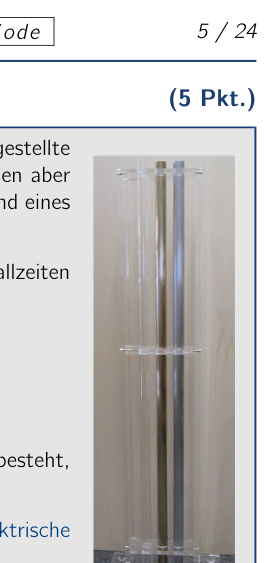 fotografia tubi Magnetfall verticali
Topic: Electromagnetic Induction Metodi: Faraday’s Law of Induction, Lenz’s Law, Approximation & Series Expansion Competenze: Physical Reasoning, Estimation & Approximation Objects: Magnet, Tube, Cylinder Fonte: Testo (PDF) — p.5
Problema 3 Magnete cadente (problema MC) (cfr. Un magnete cilindrico è stato scaricato attraverso tre differenti posizioni verticali
- Tubi. I tubi hanno dimensioni identiche ma sono fatti di diverse materie - uno di plexiglas, uno di brass e uno di di alluminio. Per una distanza di caduta di = 1,0 m in the tubes, the following fall times di magneto sono misurati: Cose di plastica = 0.46 s Fabbricazione di calcio = 2.15 s Alumini = 3.81 s La conductività elettrica del materiale da cui è fatto il tubo di alluminio is = . What value is obtained from the fall times as an estimate for the electrical conductivity of the material of the brass tube? A B C D Answer section Calcoli e spiegazioni Corretta risposta:
fotografia tubi Magnetico caso verticali
Topic: Electromagnetic Induction Metodi: Faraday’s Law of Induction, Lenz’s Law, Approximation & Series Expansion Competenze: Physical Reasoning, Estimation & Approximation Objects: Magnet, Tube, Cylinder Fonte: Testo (PDF) — p.5
The following is the list of the types of magnetic fields used: (five points) A cylindrical magnet is dropped through three different, vertically positioned
- You know what? The tubes have identical dimensions but are made of different materials - one of plexiglass, one of brass and one of aluminium. For a fall distance of = 1.0 m in the tubes, the following fall times of the magnet are measured: Other, of a thickness of not more than 0,15 mm = 0.46 s Other, of a kind used for the manufacture of goods = 2.15 s Aluminium = 3.81 s The electrical conductivity of the material from which the aluminium tube is made is = . What value is obtained from the fall times as an estimate for the electrical conductivity of the material of the brass tube? A B C D Answer section Calculations and explanations Correct answer:
fotografia tubi Magnetfall verticali
Topic: Electromagnetic Induction Metodi: Faraday’s Law of Induction, Lenz’s Law, Approximation & Series Expansion Competenze: Physical Reasoning, Estimation & Approximation Objects: Magnet, Tube, Cylinder Fonte: Testo (PDF) — p.5
Problem 4 Power of Wind Turbines (MC problem) (5 pts.) Wind turbines generate electrical power by using energy from the wind to drive generators. At a moderate wind speed, the power made available by the wind to a turbine, and therefore the theoretically maximum usable power, is . What power made available by the wind to the turbine results when the wind speed is doubled? A B C D Answer section Calculations and explanations Correct answer:
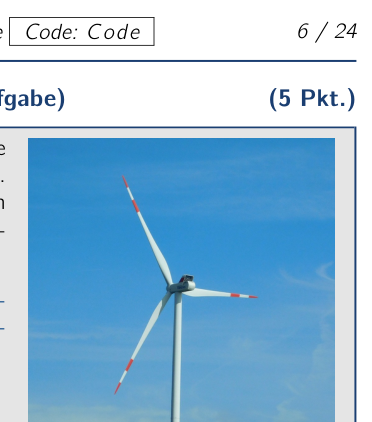 fotografia impianto eolico
Topic: Fluid Mechanics, Conservation of Energy Metodi: Dimensional Analysis, Conservation of Energy Competenze: Physical Reasoning, Estimation & Approximation Objects: — Fonte: Testo (PDF) — p.6
Il problema 4 Power of Wind Turbines (problema MC) (cfr. Turbine a vento generare energia elettrica utilizzando energia dal vento per generatori di motore. A una moderata velocità del vento, la potenza resa disponibile dal il vento a una turbina, e quindi la potenza usable teoricamente massima, è . Che potenza è resa disponibile dal vento alla turbina quando la velocità del vento è raddoppiata? A B C D Answer section Calcoli e spiegazioni Corretta risposta:
fotografia impianto eolico
Topic: Fluid Mechanics, Conservation of Energy Metodi: Dimensional Analysis, Conservation of Energy Competenze: Physical Reasoning, Estimation & Approximation Objects: — Fonte: Testo (PDF) — p.6
The following is the list of the main problems: (five points) Wind turbines generate electrical power by using Energy from the wind to drive generators. At a moderate wind speed, the power made available by the wind to a turbine, and therefore the theoretically maximum usable power, is . What power is made available by the wind to the turbine results when the wind speed is doubled? A B C D Answer section Calculations and explanations Correct answer:
The following is a list of the main features of the product:
Topic: Fluid Mechanics, Conservation of Energy Metodi: Dimensional Analysis, Conservation of Energy Competenze: Physical Reasoning, Estimation & Approximation Objects: — Fonte: Testo (PDF) — p.6
Problem 5 Kettle with Ice Cube (MC problem) (5 pts.) Water is heated in a kettle. During the heating, an ice cube at temperature is thrown into the water. Figure 3 shows the temperature of the water as a function of time. The temperature of the water is initially equal to room temperature and can at all times be assumed to be the same throughout the whole kettle. 50 100 150 200 250 30 40 50 60 70 80 90 0 20 / s / C Fig. 3. Temperature in the kettle as a function of the heating time . The heating power of the kettle is 900 W. For the specific heat capacity of water the value may be used, and for the specific heat of fusion (or enthalpy of fusion) of ice . What mass did the ice cube have when it was thrown into the water? A 16 g B 26 g C 56 g D 145 g Answer section Calculations and explanations Calculations and explanations (continued) Correct answer:
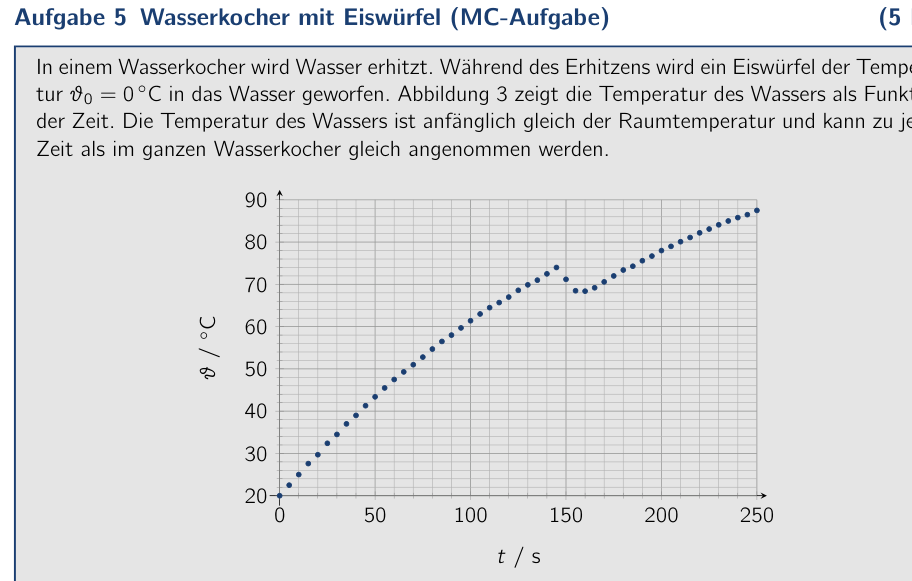 Abb. 3: temperatura θ vs tempo t
Topic: Thermodynamics Metodi: First Law of Thermodynamics, Experimental Data Analysis Competenze: Physical Reasoning, Experimental Data Analysis Objects: Container Fonte: Testo (PDF) — p.7
Problema 5 Kettle with Ice Cube (problema MC) (cfr. L’acqua è riscaldata in una bombola. Durante il riscaldamento, un cubo di ghiaccio a temperatura viene gettato nell’acqua. Figura 3 mostra la temperatura dell’acqua come funzione
- Non è tempo. La temperatura dell’acqua è inizialmente pari a temperatura ambiente e può essere a tutti Le volte sono state presunte per essere le stesse in tutto il cottone. 50 100 150 200 250 30 40 50 60 70 80 90 0 20 / s / C Fig. 3. Temperatura in caldaia a funzione del tempo di riscaldamento . Il potere di riscaldamento del cottura è di 900 W. Per la specificità di calore dell’acqua il valore può essere utilizzato, e per il specific heat of fusion (o enthalpy of fusion) of ice . Che massa aveva il cubo di ghiaccio quando fu gettato in acqua? A 16 g B 26 g C 56 g D 145 g Answer section Calcoli e spiegazioni Calcoli e spiegazioni (continuato) Corretta risposta:
Il programma di ricerca è stato sviluppato in un’area di ricerca e sviluppo. 3: temperatura θ vs tempo t*
Topic: Thermodynamics Metodi: First Law of Thermodynamics, Experimental Data Analysis Competenze: Physical Reasoning, Experimental Data Analysis Objects: Container Fonte: Testo (PDF) — p.7
Problem 5 Kettle with Ice Cube (MC problem) (five points) Water is heated in a kettle. During the heating, an ice cube at temperature is thrown into the water. Figure 3 shows the temperature of the water as a function of time. The temperature of the water is initially equal to room temperature and can at all Times are assumed to be the same throughout the whole kettle. 50 100 150 200 250 30 40 50 60 70 80 90 0 20 / s / C Fig. 3. Temperature in the kettle as a function of the heating time . The heating power of the kettle is 900 W. For the specific heat capacity of water the value may be used, and for the specific heat of fusion (or enthalpy of fusion) of ice . What mass did the ice cube have when it was thrown into the water? A 16 g B 26 g C 56 g D 145 g Answer section Calculations and explanations Calculations and explanations (continued) Correct answer:
Abb. 3: temperatura θ vs tempo t
Topic: Thermodynamics Metodi: First Law of Thermodynamics, Experimental Data Analysis Competenze: Physical Reasoning, Experimental Data Analysis Objects: Container Fonte: Testo (PDF) — p.7
Problem 6 Oscillating Circuits (MC problem) (5 pts.) A circuit made of an ideal inductor and an ideal capacitor is called an oscillating circuit (LC circuit). The two electrical oscillating circuits shown above, with the same inductance but different capacitances , oscillate completely without resistance at the indicated frequencies. What is the oscillation frequency (natural frequency) of the following coupled system? = ??? A B C D Answer section Calculations and explanations Correct answer:
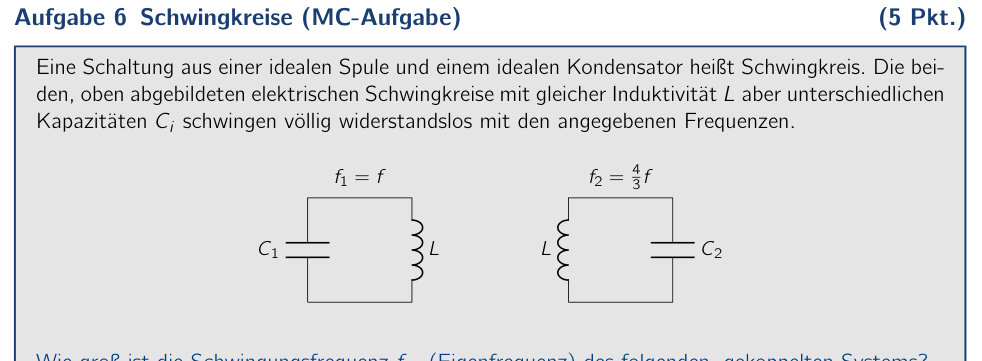 circuiti LC separati con frequenze f1 e f2
 circuito LC accoppiato f12
Topic: Circuits, Oscillations & Waves Metodi: Simple Harmonic Motion Analysis, Equivalent Circuit Reduction Competenze: Physical Reasoning, Mathematical Modeling Objects: Inductor, Capacitor Fonte: Testo (PDF) — p.9
Problema 6 Circuiti oscillanti (problema MC) (cfr. Un circuito fatto di un induttore ideale e di un condensatore ideale è chiamato circuito oscillatore (LC). I due circuiti oscillanti elettrici mostrati sopra, con la stessa inductanza ma diversi capacità , oscillazione completamente senza resistenza alle frequenze indicate. Qual è la frequenza di oscillazione (frequenza naturale) del seguente sistema accoppiato? = ??? A B C D Answer section Calcoli e spiegazioni Corretta risposta:
circuiti LC separati con frequenze f1 e f2
circuito LC accoppiato f12
Topic: Circuits, Oscillations & Waves Metodi: Simple Harmonic Motion Analysis, Equivalent Circuit Reduction Competenze: Physical Reasoning, Mathematical Modeling Objects: Inductor, Capacitor Fonte: Testo (PDF) — p.9
The following is the list of the types of oscillating circuits used: (five points) A circuit made of an ideal inductor and an ideal capacitor is called an oscillating circuit (LC circuit). The two electrical oscillating circuits shown above, with the same inductance but different capacitances , oscillate completely without resistance at the indicated frequencies. What is the oscillation frequency of the following coupled system? = ??? A B C D Answer section Calculations and explanations Correct answer:
circuiti LC separati con frequenze f1 e f2
circuito LC accoppiato f12
Topic: Circuits, Oscillations & Waves Metodi: Simple Harmonic Motion Analysis, Equivalent Circuit Reduction Competenze: Physical Reasoning, Mathematical Modeling Objects: Inductor, Capacitor Fonte: Testo (PDF) — p.9
Problem 7 Reflection from a Water Layer (MC problem) (5 pts.) The surface of a smooth, horizontal glass plate is covered with a thin, flat layer of water. Monochromatic light of wavelength 680 nm falls from above onto the water surface at an angle to the surface normal. The refractive index of the glass plate is 1.50 and that of the water 1.33. Due to the evaporation of the water, the intensity of the reflected light changes periodically. Between the occurrence of two intensity maxima, a time of 15 minutes elapses. Air Water Glass Fig. 4. Sketch of the incidence of light. At what rate does the thickness of the water layer on the glass decrease? A about B about C about D about Answer section Calculations and explanations Correct answer: Long-answer problems Work on the following three problems likewise in the boxes provided for them. Unlike the multiple-choice problems, no answer options are given. Describe your solution method in such a way that it is easy to follow but not unnecessarily long. So if, for example, you use the law of conservation of energy, write this down briefly.
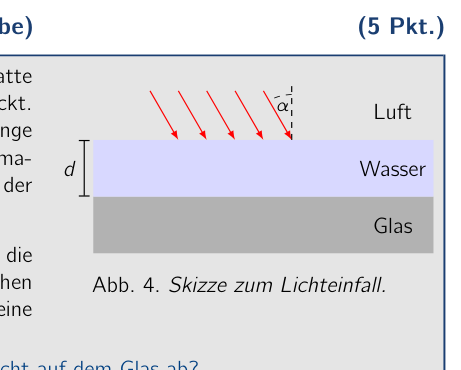 Abb. 4: riflessione luce strato d’acqua su vetro
Topic: Wave Optics, Geometric Optics Metodi: Interference & Diffraction Analysis, Snell’s Law Competenze: Physical Reasoning, Mathematical Modeling Objects: — Fonte: Testo (PDF) — p.10
Problema 7 Riflezione da un livello di acqua (problema MC) (cfr. La superficie di una piastra di vetro liscia e orizzontale è coperto da un sottile e piatto strato d’acqua. Luce monocromatica di lunghezza d’onda 680 nm cade da sopra sulla superficie dell’acqua ad un angolo alla superficie normale. Il tasso di refrazione del La piastra di vetro è di 1,50 e quella dell’acqua di 1,33. A causa dell’evaporazione dell’acqua, il l’intensità della luce riflessa cambia periodicamente. Tra l’occurrenza di due intensità massime, a tempo di 15 minuti di elapses. Air Acqua La luce Fig. 4. Sketch dell’incidenza della luce. At what rate does the thickness of the water layer on the glass decrease? A about B about C about D about Answer section Calcoli e spiegazioni Corretta risposta: Problemi di risposta lunga La Commissione ha inoltre presentato una serie di proposte di risoluzione sulle misure di sicurezza e di sicurezza. A differenza dei problemi di scelta multipla, non sono state indicate le opzioni di risposta. Descrivere il metodo di soluzione in un modo simile che è facile da seguire ma non troppo lungo. Quindi se, per esempio, si usa la legge della conservazione dell’energia, scrivete brevemente.
Abb. 4: riflessione luce strato d’acqua su vetro
Topic: Wave Optics, Geometric Optics Metodi: Interference & Diffraction Analysis, Snell’s Law Competenze: Physical Reasoning, Mathematical Modeling Objects: — Fonte: Testo (PDF) — p.10
Problem 7 Reflection from a water layer (MC problem) (five points) The surface of a smooth, horizontal glass plate is covered with a thin, flat layer of water. Monochromatic light of wavelength 680 nm falls from above onto the water surface at an angle to the normal surface. The refractive index of the Glass plate is 1.50 and that of the water is 1.33. Due to the evaporation of the water, the The intensity of the reflected light changes periodically. Between the occurrence of two intensity maxima, a time of 15 minutes elapses. Air Water Glass Fig. 4. Sketch of the incidence of light. At what rate does the thickness of the water layer on the glass decrease? A about B about C about D about Answer section Calculations and explanations Correct answer: Long-response problems Work on the following three problems also in the boxes provided for them. Unlike the Multiple-choice problems, no answer options are given. Describe your solution method in such a way That it’s easy to follow but not unnecessarily long. So if, for example, you use the law of conservation of energy, write this down briefly.
Abb. 4: riflessione luce strato d’acqua su vetro
Topic: Wave Optics, Geometric Optics Metodi: Interference & Diffraction Analysis, Snell’s Law Competenze: Physical Reasoning, Mathematical Modeling Objects: — Fonte: Testo (PDF) — p.10
Problem 8 Cylinders in Water (18 pts.) A cylindrical tube, closed at the bottom, is partially filled with water of density . The inner diameter of the tube is cm. In the water there are, as shown schematically in Figure 5, several cylinders rigidly connected to one another by thin rods. The cylinders are all made of the same material and have the same size. The lowest cylinder initially rests on the bottom of the tube. By pulling on the thread, the cylinders are raised. The graph in Figure 6 shows the force necessary for the lifting as a function of the lift height . At the highest value of , all cylinders are above the water surface. In all the problems, neglect the extent of the thin rods that connect the cylinders. 8.a) Explain the shape of the force curve physically and determine the number of cylinders in the tube. (5.0 pts.) 8.b) Determine the following quantities (13.0 pts.) • the water volume in the tube • the density of the cylinder material • the radius of the cylinders • the length of the cylinders Fig. 5. Schematic sketch of the cylinders in the tube. 10 20 30 40 1,0 2,0 3,0 4,0 5,0 6,0 / cm / N Fig. 6. Force necessary for the lifting as a function of the lift height . Answer section 8.a) Calculations and explanations Result for the number of cylinders: 8.b) Calculations and explanations Calculations and explanations
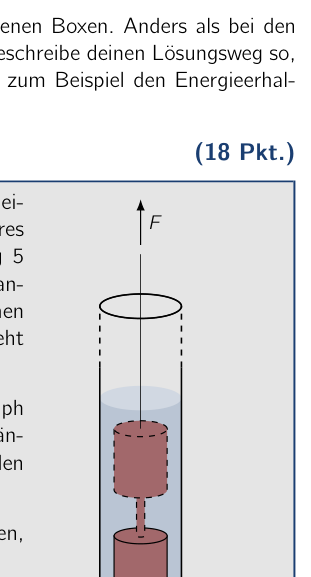 Abb. 5: cilindro in acqua schema
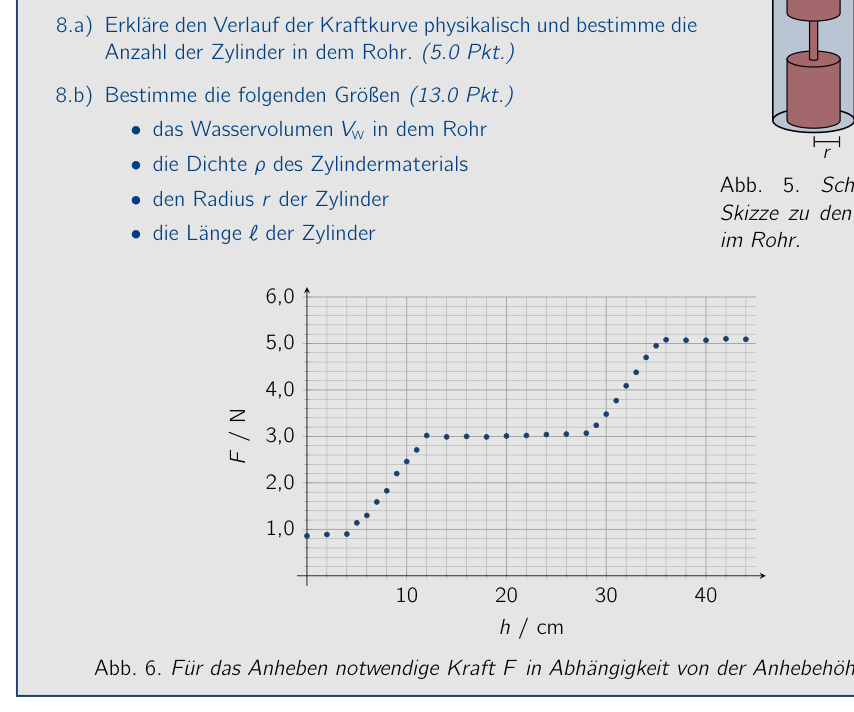 Abb. 6: forza di galleggiamento F vs h
Topic: Fluid Mechanics, Newtonian Mechanics Metodi: Hydrostatic Equilibrium, Experimental Data Analysis, Graph Linearization Competenze: Physical Reasoning, Experimental Data Analysis, Mathematical Modeling Objects: Cylinder, Container, Rod Fonte: Testo (PDF) — p.11
Problema 8 cilindri in acqua (cfr. Un tubo cilindrico, chiuso al fondo, è parzialmente riempito di acqua di densità . Il diametro interno del tubo is cm. In acqua ci sono, come mostrato schematicamente in figura 5, diversi cilindri rigidamente collegati tra loro da rigidi bastoni. I cilindri sono tutti fatti dello stesso materiali e hanno la stessa dimensione. Il cilindro più basso iniziale rest
- sul fondo del tubo. Attirando sul filo, i cilindri sono sollevati. Il grafico in Figura 6 mostra la forza necessaria per il sollevamento a funzione della altezza del sollevamento . Al massimo valore di , Tutti i cilindri sono sopra la superficie dell’acqua. In tutti i problemi, negligenza l’entità dei bastoni sottili che collegano i cilindri.
- (a) Esplorare fisicamente la forma della curva di forza e determinare il numero di cilindri nel tubo. (5,0 p. d.) 8.b) Determina le seguenti quantità (13,0 pts.) • il volume di acqua nel tubo • la densità del materiale cilindrico • il raggio dei cilindri • la lunghezza dei cilindri Fig.
Schematic Sketch of the cylinders
- In tubo. 10 20 30 40 1,0 2,0 3,0 4,0 5,0 6,0 / cm / N Fig. 6. Forza necessaria per il lifting a function of the lift height . Answer section 8.a) Calcoli e spiegazioni Risultato per il numero di cilindri: 8.b) Calcoli e spiegazioni Calcoli e spiegazioni
Il programma di ricerca è stato sviluppato in modo da consentire la creazione di un’organizzazione di ricerca e di sviluppo. 5 cilindro in acqua schema
Il programma di ricerca è stato sviluppato in modo da consentire la creazione di un’organizzazione di ricerca e di sviluppo. 6: forza di galleggiamento F vs h*
Topic: Fluid Mechanics, Newtonian Mechanics Metodi: Hydrostatic Equilibrium, Experimental Data Analysis, Graph Linearization Competenze: Physical Reasoning, Experimental Data Analysis, Mathematical Modeling Objects: Cylinder, Container, Rod Fonte: Testo (PDF) — p.11
Problem 8 cylinders in water The Commission’s proposal for a directive on the protection of workers’ rights A cylindrical tube, closed at the bottom, is partially filled with water of density . The inner diameter of the tube is cm. In the water there are, as shown schematically in Figure 5, Several cylinders rigidly connected to each other by thin rods. The cylinders are all made of the same material and have the same size. The lowest cylinder initially rests on the bottom of the tube. By pulling on the thread, the cylinders are raised. The graph In Figure 6 shows the force necessary for the lifting as a function of the lift height . At the highest value of , All cylinders are above the water surface. In all the problems, neglect the extent of the thin rods That connect the cylinders. 8. (a) Explain the shape of the force curve physically and determine the number of cylinders in the tube. (5.0 p.p.) 8. (b) Determine the following quantities (13.0 pts.) • the water volume in the tube • the density of the cylinder material • the radius of the cylinders • the length of the cylinders Fig. 5. Schematic sketch of the cylinders In the tube. 10 20 30 40 1,0 2,0 3,0 4,0 5,0 6,0 / cm / N Fig. 6. Force necessary for the lifting as a function of the lift height . Answer section 8.a) Calculations and explanations Result for the number of cylinders: 8.b) Calculations and explanations Calculations and explanations
The Commission shall adopt implementing acts in accordance with Article 21 of this Regulation. The following is the list of the types of vehicles used:
The Commission shall adopt implementing acts in accordance with Article 21 of this Regulation. The following is the list of the main factors:
Topic: Fluid Mechanics, Newtonian Mechanics Metodi: Hydrostatic Equilibrium, Experimental Data Analysis, Graph Linearization Competenze: Physical Reasoning, Experimental Data Analysis, Mathematical Modeling Objects: Cylinder, Container, Rod Fonte: Testo (PDF) — p.11
Problem 9 Up and Away (15 pts.) A hot-air balloon with a volume of is filled on the ground with hot air at a temperature of . The balloon envelope and the basket, filled with burner, gas bottles and daredevil balloonists, together have a mass of 900 kg. The ambient temperature is , and the air pressure is about Pa. 9.a) Calculate the force with which the balloon must be held to the ground, and state whether you would be able to hold the balloon down or whether you should rather let go so as not to be pulled up into the air. (4.0 pts.) Assume for simplicity that the ambient temperature does not change with altitude and that the air pressure decreases by 1.2 % for each change in altitude of 100 m. 9.b) Determine the acceleration with which the balloon rises immediately after being released. Calculate the altitude the balloon reaches if the temperature inside the balloon remains constant. (6.0 pts.) In reality, the air in the balloon cools down slowly if the burner is not ignited. As a result, the buoyancy of the balloon decreases at a constant rate of . 9.c) Estimate how long the balloon can at most maintain its altitude by regularly igniting the burner, if it carries a gas supply of 80 kg of propane gas in total, which has a calorific value of . (5.0 pts.) For the calculation you may use the following data for air: Density at temperature and air pressure Pa Specific heat capacity at constant pressure Answer section 9.a) Calculations and explanations Calculations and explanations (continued) Result for the force: 9.b) Calculations and explanations Calculations and explanations (continued) Result for the acceleration: Result for the altitude: 9.c) Calculations and explanations Estimate for the time:
Topic: Thermodynamics, Fluid Mechanics Metodi: Ideal Gas Law, Hydrostatic Equilibrium, First Law of Thermodynamics Competenze: Physical Reasoning, Estimation & Approximation, Mathematical Modeling Objects: Gas, Container Fonte: Testo (PDF) — p.15
Problema 9 Up and Away 15 punti) Un pallone a aria calda con un volume di è pieno sul terreno con aria calda a una temperatura of . Il balloon envelope and the basket, filled with burner, gas bottles and daredevil balloonists, together have a mass of 900 kg. La temperatura ambiente è , e la pressione dell’aria è circa Pa. 9. (a) Calcolare la forza con cui il pallone deve essere tenuto a terra e indicare se si sarebbe in grado di tenere il pallone giù o se si dovrebbe piuttosto lasciare andare così che non essere
- Si è tirato in aria. (4,0 p.) Supponiamo per semplicità che la temperatura ambiente non cambia con l’altitudine e che la pressione dell’aria diminuisce di 1,2 per cento per ogni variazione di altitudine di 100 m. 9.b) Determina l’accelerazione con cui il pallone sale immediatamente dopo essere stato rilasciato. Calcolare l’altitudine raggiunta dal pallone se la temperatura all’interno del pallone rimane costante. (6,0 p.p.) In realtà, l’aria nel pallone si raffredda lentamente se il bruciatore non è acceso. Come risultato, la buoyancy del pallone diminuisce a un ritmo costante di . 9.c) Estimare quanto tempo il pallone può mantenere l’altitudine al massimo, accendendo regolarmente il burner, se porta un approvvigionamento di gas di 80 kg di propano in totale, che ha un valore calorico di . (5,0 p. d.) Per il calcolo si possono utilizzare i seguenti dati per l’aria: Density at temperature and air pressure Pa Specific heat capacity at constant pressure Answer section 9.a) Calcoli e spiegazioni Calcoli e spiegazioni (continuato) Result for the force: 9.b) Calcoli e spiegazioni Calcoli e spiegazioni (continuato) Risultato dell’accelerazione: Result for the altitude: 9.c) Calcoli e spiegazioni Estimate for the time:
Topic: Thermodynamics, Fluid Mechanics Metodi: Ideal Gas Law, Hydrostatic Equilibrium, First Law of Thermodynamics Competenze: Physical Reasoning, Estimation & Approximation, Mathematical Modeling Objects: Gas, Container Fonte: Testo (PDF) — p.15
Problem 9 Up and Away (Figure 15) A hot-air balloon with a volume of is filled on the ground with hot air at a temperature of . The balloon envelope and the basket, filled with burners, gas bottles and daredevil balloonists, together have a mass of 900 kg. The ambient temperature is , and the air pressure is about Pa. 9. (a) Calculate the force with which the balloon must be held to the ground, and state whether you Would be able to hold the balloon down or whether you should rather let go so as not to be pulled up into the air. (4.0 p.m.) Assume for simplicity that the ambient temperature does not change with altitude and that the air pressure decreases by 1.2 % for each change in altitude of 100 m. 9.b) Determine the acceleration with which the balloon rises immediately after being released. Calculate the altitude the balloon reaches if the temperature inside the balloon remains constant. (6.0 pts) In reality, the air in the balloon cools down slowly if the burner is not ignited. As a result, the buoyancy of the balloon decreases at a constant rate of . 9. (c) Estimate how long the balloon can at most maintain its altitude by regularly igniting the burner, if it carries a gas supply of 80 kg of propane gas in total, which has a calorific value of . (5.0 p.p.) For the calculation you may use the following data for air: Density at temperature and air pressure Pa Specific heat capacity at constant pressure Answer section 9.a) Calculations and explanations Calculations and explanations (continued) Result for the force: 9.b) Calculations and explanations Calculations and explanations (continued) Result for the acceleration: Result for the altitude: 9.c) Calculations and explanations Estimate for the time:
Topic: Thermodynamics, Fluid Mechanics Metodi: Ideal Gas Law, Hydrostatic Equilibrium, First Law of Thermodynamics Competenze: Physical Reasoning, Estimation & Approximation, Mathematical Modeling Objects: Gas, Container Fonte: Testo (PDF) — p.15
Problem 10 Approach or Repel? (12 pts.) Two point particles with masses and () and equal positive charge are located, as sketched alongside, initially at a separation in an infinitely extended, homogeneous electric field . At the start, both charges are at rest. Assume that in what follows the particles move only along the line joining them. Fig. 7. Charges in the electric field. 10.a) Determine the relative acceleration of the particles as a function of their separation from one another. Show that this can be written as a force equation in the form and express the quantities , and in terms of the given quantities. (4.0 pts.) The force equation describes the motion of an effective particle of mass and charge in a potential , which is produced by the charge and the electric field . The potential here is the potential energy of the effective particle divided by its charge. 10.b) Sketch the shape of the potential as a function of the separation and state at which separation the minimum of the potential is located. (4.0 pts.) 10.c) Determine the maximum separation of the particles during their motion and express it in terms of the given quantities. (4.0 pts.) Answer section 10.a) Calculations and explanations Calculations and explanations (continued) Expressions for the quantities: 10.b) Sketch Calculations and explanations Result for the separation of the minimum: 10.c) Calculations and explanations Result for the maximum separation: Additional worksheet Additional worksheet Additional worksheet Graph paper
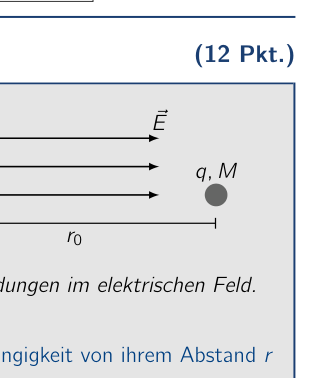 Abb. 7: cariche ±q nel campo elettrico
Topic: Electrostatics, Newtonian Mechanics Metodi: Coulomb’s Law, Conservation of Energy, Electric Potential Method Competenze: Physical Reasoning, Mathematical Modeling, Diagrammatic Reasoning Objects: Point Charge Fonte: Testo (PDF) — p.19
Problema 10 Approach o Repel? (12 punti) Due particelle a punto con masse e () e equal positive charge are located, as sketched alongside, initially at a separation in un campo elettrico infinitamente esteso e omogeneo . All’inizio, entrambe le accuse sono in sospeso. Supponiamo che in ciò che segue le particelle si muovono Solo lungo la linea che li unisce. Fig. 7. Cariche nel campo elettrico. 10.a) Determine the relative acceleration of the particles as a function of their separation da uno all’altro. Mostra che questo può essere scritto come un’equazione di forza in forma e esprimere le quantità , e in termini delle quantità indicate. (4,0 p.) The force equation describes the motion of an effective particle of mass and charge in un potenziale , che è prodotto dalla carica e dal campo elettrico . Il potenziale qui è l’energia potenziale della particella efficace divisa per la sua carica. 10.b) Sketch the shape of the potential as a function of the separation and state La separazione minima del potenziale è situata. (4,0 p.) 10.c) Determina la massima separazione delle particelle durante il loro movimento e esprima In termini di quantità indicate. (4,0 p.) Answer section 10.a) Calcoli e spiegazioni Calcoli e spiegazioni (continuato) Espressioni per le quantità: 10.b) Sketch Calcoli e spiegazioni Result for the separation of the minimum: 10.c) Calcoli e spiegazioni Risultato per la separazione massima: Ulteriori fogli di lavoro Ulteriori fogli di lavoro Ulteriori fogli di lavoro Carta grafica
*Abb. 7: cariche ±q nel campo elettrico *
Topic: Electrostatics, Newtonian Mechanics Metodi: Coulomb’s Law, Conservation of Energy, Electric Potential Method Competenze: Physical Reasoning, Mathematical Modeling, Diagrammatic Reasoning Objects: Point Charge Fonte: Testo (PDF) — p.19
Problem 10 Approach or Repel? (c) the number of persons who are not members of the Two point particles with masses and () and equal positive charge are located, as sketched alongside, initially at a separation in an infinitely extended, homogeneous electric field . At the beginning, both charges are at rest. Assume that in what follows the particles move Only along the line joining them. Fig. 7. Charges in the electric field. 10.a) Determine the relative acceleration of the particles as a function of their separation from each other. Show that this can be written as a force equation in the form and express the quantities , and in terms of the given quantities. (4.0 p.m.) The force equation describes the motion of an effective particle of mass and charge in a potential , which is produced by the charge and the electric field . The potential here is the potential energy of the effective particle divided by its charge. 10.b) Sketch the shape of the potential as a function of the separation and state at which separation the minimum of the potential is located. (4.0 p.m.) 10.c) Determine the maximum separation of the particles during their motion and express it In terms of the given quantities. (4.0 p.m.) Answer section 10.a) Calculations and explanations Calculations and explanations (continued) Expressions for the quantities: 10.b) Sketch Calculations and explanations Result for the separation of the minimum: 10.c) Calculations and explanations Result for the maximum separation: Additional worksheet Additional worksheet Additional worksheet Graph paper
Abb. 7: cariche ±q nel campo elettrico
Topic: Electrostatics, Newtonian Mechanics Metodi: Coulomb’s Law, Conservation of Energy, Electric Potential Method Competenze: Physical Reasoning, Mathematical Modeling, Diagrammatic Reasoning Objects: Point Charge Fonte: Testo (PDF) — p.19