Problem 1 Charged Spheres (MC problem) (5.0 pts.) Of the three identical metal spheres shown, sphere A is charged with a charge . Spheres B and C are initially uncharged. First, the two spheres A and B are brought into conducting contact and then separated again. A B C The same is then done in turn with spheres A and C and finally with spheres B and C. You may assume that only the two spheres brought into contact at any given time influence each other, while the third is located far away. What charge does sphere C carry in the end? A B C D Answer section Calculations and explanations Correct answer: 55th IPhO 2025 - 2nd Round Exam Code: Code
Topic: Electrostatics Metodi: Conservation Laws, Physical Modeling Competenze: Physical Reasoning Objects: Conducting Sphere Fonte: Testo (PDF) — p.2
Problema 1 Sfere cariche (problema MC) (5,0 p. d.) Di tre identiche sfere metalliche mostrate, sfera A è carica con una carica . Le sfere B e C sono inizialmente non cariche. Prima di tutto, Le due sfere A e B sono state portate in conduzione Contact and then separated again. A B C Lo stesso viene poi fatto a sua volta con sfere A e C e finalmente con sfere B e C. Si può supporre che solo le due sfere siano state messe in contatto in un dato momento. influenzano l’uno l’altro, mentre il terzo è situato lontano. Che carica sphere C porta alla fine? A B C D Answer section Calcoli e spiegazioni Corretta risposta: 55° IPhO 2025 - 2° Round Exam Codice: Codice
Topic: Electrostatics Metodi: Conservation Laws, Physical Modeling Competenze: Physical Reasoning Objects: Conducting Sphere Fonte: Testo (PDF) — p.2
The problem is that the loaded spheres (MC problem) (5.0 p.p.) Of the three identical metal spheres shown, sphere A is charged with a charge . Spheres B and C are initially uncharged. First of all, The two spheres A and B are brought into conducting contact and then separated again. A B C The same is then done in turn with spheres A and C and finally with spheres B and C. You can assume that only the two spheres brought into contact at any given time influence each other, while the third is located far away. What charge does sphere C carry in the end? A B C D Answer section Calculations and explanations Correct answer: 55th IPhO 2025 - Second Round Exam The code: Code
Topic: Electrostatics Metodi: Conservation Laws, Physical Modeling Competenze: Physical Reasoning Objects: Conducting Sphere Fonte: Testo (PDF) — p.2
Problem 2 Falling Stone (MC problem) (5.0 pts.) A stone falls vertically downward. In the first three seconds of the fall it covers the same distance as in the last second before impact. Friction is to be neglected during the fall. At what speed does the stone hit the ground? A about B about C about D about Answer section Calculations and explanations Correct answer: 55th IPhO 2025 - 2nd Round Exam Code: Code
Topic: Newtonian Mechanics Metodi: Kinematic Equations Competenze: Physical Reasoning, Mathematical Modeling Objects: Projectile Fonte: Testo (PDF) — p.3
Problema 2 Pietra cadente (problema MC) (5,0 p. d.) Una pietra cade verticalmente verso il basso. Nei primi tre secondi del caso copre la stessa distanza Come nell’ultimo secondo prima dell’impatto. La friczione deve essere trascurata durante il caso. A che velocità la pietra colpisce il terreno? A about B about C about D about Answer section Calcoli e spiegazioni Corretta risposta: 55° IPhO 2025 - 2° Round Exam Codice: Codice
Topic: Newtonian Mechanics Metodi: Kinematic Equations Competenze: Physical Reasoning, Mathematical Modeling Objects: Projectile Fonte: Testo (PDF) — p.3
The following is the list of the types of waste and waste management and the types of waste and waste management and the types of waste and waste management and the types of waste and waste management and the types of waste and waste management and the types of waste and waste management and the types of waste and waste management and the types of waste and waste management and the types of waste and waste management and the types of waste and waste management and the types of waste and waste management and the types of waste and waste management and the types of waste and waste management and the types of waste and waste management and the types of waste and waste management and the types of waste and waste management and the following: (5.0 p.p.) A stone falls vertically downwards. In the first three seconds of the case it covers the same distance As in the last second before impact. Friction is to be neglected during the fall. At what speed does the stone hit the ground? A about B about C about D about Answer section Calculations and explanations Correct answer: 55th IPhO 2025 - Second Round Exam The code: Code
Topic: Newtonian Mechanics Metodi: Kinematic Equations Competenze: Physical Reasoning, Mathematical Modeling Objects: Projectile Fonte: Testo (PDF) — p.3
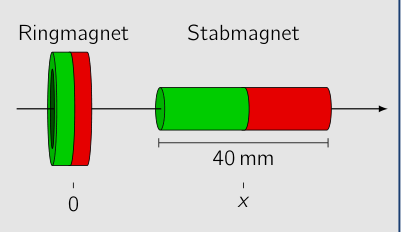
Problem 3 Magnetic Force (MC problem) (5.0 pts.) In an experiment, the force interaction between a ring magnet and a bar magnet is investigated. The poles of the two magnets are, as shown in the figure, oriented in the same direction. The bar magnet can be displaced along the axis shown. The graph shows the force on the bar magnet as a function of its position on the axis. Bar magnet Ring magnet 0 20 40 60 5 10 15 / mm / N Fig. 1. Graph of the force on the bar magnet as a function of position . From the graph, the equilibrium positions of the bar magnet along the axis can be read off. An equilibrium position is called stable if the magnet, after a small displacement, returns to this position. Now the bar magnet is turned around, so that the poles of the magnets are oriented in opposite directions. How many stable equilibrium positions along the axis are there for the bar magnet in this orientation? A 1 B 2 C 3 D 5 Answer section Calculations and explanations 55th IPhO 2025 - 2nd Round Exam Code: Code Calculations and explanations (continued) Correct answer: 55th IPhO 2025 - 2nd Round Exam Code: Code
 schema Ringmagnet e Stabmagnet
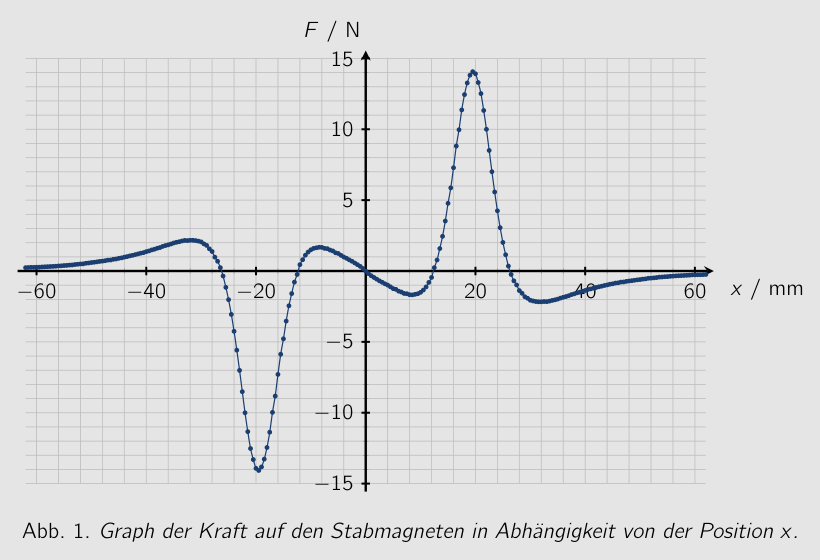 grafico forza su Stabmagnet vs posizione x
Topic: Magnetism Metodi: Physical Modeling, Symmetry Argument Competenze: Diagrammatic Reasoning, Physical Reasoning Objects: Magnet Fonte: Testo (PDF) — p.4
Problema 3 Forza magnetica (problema MC) (5,0 p. d.) In un esperimento, l’interazione di forze tra Un magnetino anello e un magnetino a barre è investigato. I poli dei due magneti sono, come mostrato in la figura, orientata nella stessa direzione. Il magnete a barre può essere spostato lungo il
- Il punto di riferimento è il punto di riferimento. Il grafico mostra la forza sul bar magnet as a function of its position on l’asse. Magnete di ferro Magnete ad anello 0 20 40 60 5 10 15 / mm / N Fig. 1. Grafico della forza sul magnete di barra come funzione di posizione . Dal grafico, le posizioni di equilibrio del magnete lungo l’asse possono essere Leggi. Una posizione di equilibrio è chiamata stabile se il magnete, dopo un piccolo Dislocazione, ritorna a questa posizione. Ora il magnete è girato, così che i poli di magneti sono orientati in direzioni opposte. Come sono molte posizioni di equilibrio stabile lungo l’asse sono lì per il magnete di barra in
- Questo orientamento? A 1 B 2 C 3 D 5 Answer section Calcoli e spiegazioni 55° IPhO 2025 - 2° Round Exam Codice: Codice Calcoli e spiegazioni (continuato) Corretta risposta: 55° IPhO 2025 - 2° Round Exam Codice: Codice
- schema Magnetino anello e magnetino di bastone*
*grafico forza su magnete di staffa vs posizione x *
Topic: Magnetism Metodi: Physical Modeling, Symmetry Argument Competenze: Diagrammatic Reasoning, Physical Reasoning Objects: Magnet Fonte: Testo (PDF) — p.4
The problem is that the magnetic force is not a magnetic force. (5.0 p.p.) In an experiment, the force interaction between A ring magnet and a bar magnet is investigated. The poles of the two magnets are, as shown in The figure, oriented in the same direction. The bar magnet can be displaced along the Axis shown. The graph shows the force on the bar magnet as a function of its position on The axis. Bar magnet Ring magnet 0 20 40 60 5 10 15 / mm / N Fig. 1. Graph of the force on the bar magnet as a function of position . From the graph, the equilibrium positions of the bar magnet along the axis can be Read off. An equilibrium position is called stable if the magnet, after a small Displacement, returns to this position. Now the bar magnet is turned around, so that the poles The magnets are oriented in opposite directions. How many stable equilibrium positions along the axis are there for the bar magnet in This orientation? A 1 B 2 C 3 D 5 Answer section Calculations and explanations 55th IPhO 2025 - Second Round Exam The code: Code Calculations and explanations (continued) Correct answer: 55th IPhO 2025 - Second Round Exam The code: Code
The following table shows the characteristics of the magnetic field:
The following table shows the results of the calculations:
Topic: Magnetism Metodi: Physical Modeling, Symmetry Argument Competenze: Diagrammatic Reasoning, Physical Reasoning Objects: Magnet Fonte: Testo (PDF) — p.4
Problem 4 Gas Expansion (MC problem) (5.0 pts.) A quantity of an ideal gas expands from an initial state to a state with double the volume. Does the gas do more work if the expansion is isobaric, i.e. at constant pressure, or isothermal, i.e. at constant temperature? A The gas does more work in the isobaric expansion. B The gas does more work in the isothermal expansion. C The gas does the same work in both cases. D With the given information it cannot be decided in which case more work is done. Answer section Calculations and explanations Correct answer: 55th IPhO 2025 - 2nd Round Exam Code: Code
Topic: Thermodynamics Metodi: First Law of Thermodynamics, Ideal Gas Law Competenze: Physical Reasoning, Mathematical Modeling Objects: Gas Fonte: Testo (PDF) — p.6
Problema 4 Gas expansion (problema MC) (5,0 p. d.) Una quantità di gas ideale si espandono da uno stato iniziale a uno stato con doppio volume. Il gas funziona meglio se l’espansione è isobarica, cioè a pressione costante, o isotermica, cioè a temperatura costante? A. Il gas non funziona più nell’espansione isobarica. B Il gas non funziona più nell’espansione isotermica. C Il gas funziona allo stesso modo in entrambi i casi. D Con le informazioni fornite non si può decidere in quale caso più lavoro
- E’ finita. Answer section Calcoli e spiegazioni Corretta risposta: 55° IPhO 2025 - 2° Round Exam Codice: Codice
Topic: Thermodynamics Metodi: First Law of Thermodynamics, Ideal Gas Law Competenze: Physical Reasoning, Mathematical Modeling Objects: Gas Fonte: Testo (PDF) — p.6
The following is the list of the problems: (5.0 p.p.) A quantity of an ideal gas expands from an initial state to a state with double the volume. Does the gas do more work if the expansion is isobaric, i.e. at constant pressure, or isothermal, i.e. At a constant temperature? A The gas does more work in the isobaric expansion. B The gas does more work in the isothermal expansion. C The gas does the same job in both cases. D With the given information it cannot be decided in which case more work It’s done. Answer section Calculations and explanations Correct answer: 55th IPhO 2025 - Second Round Exam The code: Code
Topic: Thermodynamics Metodi: First Law of Thermodynamics, Ideal Gas Law Competenze: Physical Reasoning, Mathematical Modeling Objects: Gas Fonte: Testo (PDF) — p.6
Problem 5 Image of a Luminous Ring (MC problem) (5.0 pts.) A luminous ring is imaged with the help of a thin lens. The position and size of the ring are shown in the to-scale figure. The focal length of the lens is and the thickness of the ring can be neglected. Lens optical axis Ring A B C D The ratio of the length of the segment from B to D to the length of the segment from A to C is 1. What is the ratio of the segment lengths between the corresponding points in the image of the ring? A B C D Answer section Calculations and explanations 55th IPhO 2025 - 2nd Round Exam Code: Code Calculations and explanations (continued) Correct answer: 55th IPhO 2025 - 2nd Round Exam Code: Code
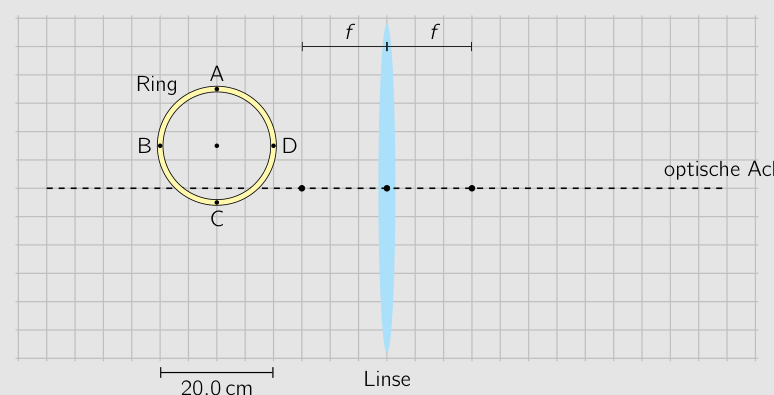 diagramma ottico anello luminoso e lente
Topic: Geometric Optics Metodi: Thin Lens & Mirror Equation, Ray Tracing Competenze: Mathematical Modeling, Diagrammatic Reasoning Objects: Lens Fonte: Testo (PDF) — p.7
Problema 5 Immagine di un anello luminoso (problema MC) (5,0 p. d.) Un anello luminoso è immaginato con l’aiuto di una lente sottile. La posizione e la dimensione del ring sono mostrati nella figura a scala. La lunghezza focale del lente è e la lunghezza focale del lo spessore dell’anello può essere trascurato. Lenti a) Axi ottica Anello A B C D Il rapporto tra la lunghezza del segmento da B a D e la lunghezza del segmento da A a C è 1. Qual è il rapporto tra i punti corrispondenti nell’immagine del segmento
- Un anello? A B C D Answer section Calcoli e spiegazioni 55° IPhO 2025 - 2° Round Exam Codice: Codice Calcoli e spiegazioni (continuato) Corretta risposta: 55° IPhO 2025 - 2° Round Exam Codice: Codice
*diagrafo ottico anello luminoso e lente *
Topic: Geometric Optics Metodi: Thin Lens & Mirror Equation, Ray Tracing Competenze: Mathematical Modeling, Diagrammatic Reasoning Objects: Lens Fonte: Testo (PDF) — p.7
The following is the list of the types of luminous rings: (5.0 p.p.) A luminous ring is imaged with the help of a thin lens. The position and size of the ring are shown in the to-scale figure. The focal length of the lens is and the The thickness of the ring can be neglected. Lens optical axis Ring A B C D The ratio of the length of the segment from B to D to the length of the segment from A to C is 1. What is the ratio of the segment lengths between the corresponding points in the image of the
- What? A B C D Answer section Calculations and explanations 55th IPhO 2025 - Second Round Exam The code: Code Calculations and explanations (continued) Correct answer: 55th IPhO 2025 - Second Round Exam The code: Code
diagramma ottico anello luminoso e lente
Topic: Geometric Optics Metodi: Thin Lens & Mirror Equation, Ray Tracing Competenze: Mathematical Modeling, Diagrammatic Reasoning Objects: Lens Fonte: Testo (PDF) — p.7
Problem 6 Twins on a Journey (MC problem) (5.0 pts.) Max and Sepp are twins. On their shared 20th birthday, Max sets off from Earth on a journey into space at the constant speed , where is the speed of light and . Exactly five years later his twin brother Sepp also sets off and follows Max at . On the day Sepp catches up with his brother Max, they realize that the two can again celebrate their birthday together, but they are puzzled. Max is celebrating his 36th birthday. Which birthday is Sepp celebrating? A Sepp is celebrating his 30th birthday. B Sepp is celebrating his 32nd birthday. C Sepp is celebrating his 34th birthday. D Sepp is celebrating his 40th birthday. Answer section Calculations and explanations Correct answer: 55th IPhO 2025 - 2nd Round Exam Code: Code
Topic: Special Relativity Metodi: Lorentz Transformation Competenze: Mathematical Modeling, Physical Reasoning Objects: — Fonte: Testo (PDF) — p.9
Problema 6 Twigli su un viaggio (problema MC) (5,0 p. d.) Max e Sepp sono gemelli. Il loro 20° compleanno condiviso, Max parte dalla Terra on a journey into space at the constant speed , where is the speed of light e . Exactly five years later suo fratello gemello Sepp anche parte e segue Max a . Il giorno in cui Sepp si ritrova con suo fratello Max, si rendono conto che i due possono ancora festeggiare il loro compleanno insieme, ma sono confusi. Max sta festeggiando il suo 36° compleanno. Che compleanno celebra Sepp? Un Sepp sta festeggiando il suo 30° compleanno. B Sepp sta festeggiando il suo 32° compleanno. C Sepp sta celebrando il suo 34° compleanno. D Sepp sta festeggiando il suo 40° compleanno. Answer section Calcoli e spiegazioni Corretta risposta: 55° IPhO 2025 - 2° Round Exam Codice: Codice
Topic: Special Relativity Metodi: Lorentz Transformation Competenze: Mathematical Modeling, Physical Reasoning Objects: — Fonte: Testo (PDF) — p.9
Problem 6 Twins on a Journey (MC problem) (5.0 p.p.) Max and Sepp are twins. On their shared 20th birthday, Max sets off from Earth on a journey into space at the constant speed , where is the speed of light and . Exactly five years later his twin brother Sepp also sets off and follows Max at . The day Sepp catches up with his brother Max, they realize that the two can celebrate again They’re having their birthday together, but they’re puzzled. Max is celebrating his 36th birthday. Which birthday is Sepp celebrating? A Sepp is celebrating his 30th birthday. B Sepp is celebrating his 32nd birthday. C Sepp is celebrating his 34th birthday. D Sepp is celebrating his 40th birthday. Answer section Calculations and explanations Correct answer: 55th IPhO 2025 - Second Round Exam The code: Code
Topic: Special Relativity Metodi: Lorentz Transformation Competenze: Mathematical Modeling, Physical Reasoning Objects: — Fonte: Testo (PDF) — p.9
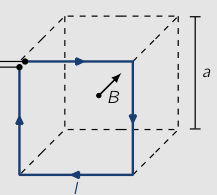
Problem 7 Magnetic Field of a Bent Wire (MC problem) (5.0 pts.) A square conductor is bent from a piece of wire which, as shown alongside, can be regarded as the edges of one face of a cube with edge length . A voltage source with a voltage is connected to the ends of the conductor. As a result, a current of magnitude flows through the conductor. The current generates a magnetic field in the surroundings of the conductor. At the center of the cube this has a magnetic flux density with a magnitude . The magnetic flux density is a measure of the strength of the magnetic field. Another piece of the wire is now bent so that it runs along the edges of the cube shown alongside. A voltage source with a voltage is likewise connected to the ends of the wire. As a result, a current flows through the conductor. The resistance of the leads can be neglected in both configurations. ? What is now the magnitude of the magnetic flux density of the magnetic field generated by the current at the center of the cube? A B C D Answer section Calculations and explanations 55th IPhO 2025 - 2nd Round Exam Code: Code Calculations and explanations (continued) Correct answer: 55th IPhO 2025 - 2nd Round Exam Code: Code Long problems Work on the following three problems likewise in the boxes provided. Unlike the multiple-choice problems, no answer options are given. Describe your solution so that it is easy to follow but not unnecessarily long. So if, for example, you use the law of conservation of energy, write this down briefly.
 filo piegato su cubo (primo schema)
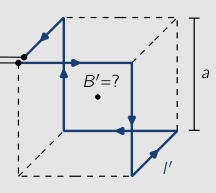 filo piegato su cubo (secondo schema)
Topic: Magnetism Metodi: Biot-Savart Law, Superposition Principle, Symmetry Argument Competenze: Mathematical Modeling, Diagrammatic Reasoning Objects: Wire Fonte: Testo (PDF) — p.10
Problema 7 Campo magnetico di un filo battuto (problema MC) (5,0 p. d.) Un conduttore quadrato è stato creato da un pezzo di filo che, come mostrato insieme, può essere considerato come i bordi di una faccia di un cubo con lunghezza di bordo . A voltage source with a voltage è collegato alle estremità del conduttore. Di conseguenza, una corrente di magnitudo fluisce attraverso il conduttore. La corrente genera un campo magnetico nell’ambiente circostante il conduttore. Al centro del cubo questo ha una densità di flusso magnetico con una magnitudo . La densità del flusso magnetico è un misura della forza del campo magnetico. Un altro pezzo del filo è ora bent così che corre lungo i bordi del cubo mostrato
- Accanto. A voltage source with a voltage è anche collegato alle estremità del filo. Come risultato, un corrente fluisce attraverso il
- Conductor. La resistenza dei lead può essere trascurata in entrambe le configurazioni. ? What is now the magnitude of the magnetic flux density of the magnetic field generato dal
- attuale al centro del cubo? A B C D Answer section Calcoli e spiegazioni 55° IPhO 2025 - 2° Round Exam Codice: Codice Calcoli e spiegazioni (continuato) Corretta risposta: 55° IPhO 2025 - 2° Round Exam Codice: Codice Long problemi Work on the following three problems similarly in the boxes provided. A differenza dei problemi di scelta multipla, non sono state indicate le opzioni di risposta. Descrivere la soluzione Quindi è facile da seguire, ma non è troppo lungo. Quindi se, per esempio, si utilizza La legge della conservazione dell’energia, scrivete brevemente.
*filo piegato su cubo (primo schema) *
*filo piegato su cubo (secondo schema) *
Topic: Magnetism Metodi: Biot-Savart Law, Superposition Principle, Symmetry Argument Competenze: Mathematical Modeling, Diagrammatic Reasoning Objects: Wire Fonte: Testo (PDF) — p.10
Problem 7 Magnetic field of a bent wire (MC problem) (5.0 p.p.) A square conductor is bent from a piece of wire which, As shown alongside, can be considered as the edges of one face of a cube with edge length . A voltage source with a voltage is connected to the ends of the conductor. As a result, a current of magnitude flows through the conductor. The current generates a magnetic field in the surroundings of the conductor. At the center of the cube This has a magnetic flux density with a magnitude . The magnetic flux density is a measurement of the strength of the magnetic field. Another piece of the wire is now bent so That it runs along the edges of the cube shown I’m going to be right next to you. A voltage source with a voltage is also connected to the ends of the wire. As a result, a current flows through the The conductor. The resistance of the leads can be neglected in both configurations. ? What is now the magnitude of the magnetic flux density of the magnetic field generated by the Current at the center of the cube? A B C D Answer section Calculations and explanations 55th IPhO 2025 - Second Round Exam The code: Code Calculations and explanations (continued) Correct answer: 55th IPhO 2025 - Second Round Exam The code: Code Long problems Work on the following three problems also in the boxes provided. Unlike the Multiple-choice problems, no answer options are given. Describe your solution So that it’s easy to follow but not unnecessarily long. So if, for example, you use The Law of Conservation of Energy, write this down briefly.
filo piegato su cubo (primo schema)
filo piegato su cubo (secondo schema)
Topic: Magnetism Metodi: Biot-Savart Law, Superposition Principle, Symmetry Argument Competenze: Mathematical Modeling, Diagrammatic Reasoning Objects: Wire Fonte: Testo (PDF) — p.10
Problem 8 Elevator Oscillations (20.0 pts.) Sophia and Alexander use the elevator of a tall building for physics experiments. When the elevator comes to a stop at a floor, they jump into the air together inside the cabin. They notice that the elevator cabin oscillates vertically right after landing. They want to investigate this more closely and use an acceleration sensor to determine the period of this oscillation. In doing so, they find that the oscillation period depends on the floor at which the elevator currently is. You are to investigate this behavior with a simple model. Assume that the elevator cabin hangs only from a steel cable that behaves like an elastic spring. The spring constant of the cable can be expressed as
(8.1) Here denotes the elastic modulus of the steel cable, its cross-sectional area and the length of the cable. The mass of the cable is to be neglected compared to the mass of the cabin. Assume furthermore that the drive wheel and the cable are completely locked by the brake and that friction can otherwise be neglected. 8.a) Determine an expression for the restoring force on the elevator cabin when it is displaced in the vertical direction by a small distance with from its respective rest position. (2.0 pts.) Counterweight Cabin Drive wheel Cable Brake Fig. 2. Sketch of the elevator with its suspension. The restoring force leads to a vertical oscillation of the elevator cabin 8.b) Give the period of this oscillation and express it in terms of the quantities , , as well as the total mass of the elevator cabin with the people inside it. (3.0 pts.) 55th IPhO 2025 - 2nd Round Exam Code: Code The following table shows the oscillation periods determined by Sophia and Alexander for a stop at various floors. The ground floor (GF) is located approximately at ground level and each floor is about high. Floor 18 16 14 12 10 8 6 4 2 GF / s / s The lower row of the table with values for is only needed in the last part of the problem. 8.c) Make a graph of as a function of the floor. From it, determine the approximate height of the building. (6.0 pts.) The reports of Alexander and Sophie also motivate their circle of friends. They repeat the experiment on another day with an additional mass of in the elevator cabin
- the two evidently have many friends. The oscillation periods determined in this case are listed as in the table above. 8.d) Using the data, approximately determine the mass of the elevator cabin with Sophia and Alexander in it. (7.0 pts.) The model considered is only a more or less good approximation to reality. 8.e) Name at least two physical aspects that in reality probably lead to deviations from the model. (2.0 pts.) Answer section 8.a) Calculations and explanations Expression for the restoring force: 55th IPhO 2025 - 2nd Round Exam Code: Code 8.b) Calculations and explanations Expression for the period: 8.c) Calculations and explanations 55th IPhO 2025 - 2nd Round Exam Code: Code Graph Result for the height of the building: 55th IPhO 2025 - 2nd Round Exam Code: Code 8.d) Calculations and explanations Result for the mass: 8.e) Calculations and explanations 55th IPhO 2025 - 2nd Round Exam Code: Code
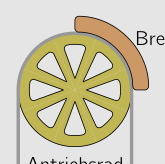 illustrazione ascensore con bilancia e persona
Topic: Oscillations & Waves, Elasticity & Materials Metodi: Simple Harmonic Motion Analysis, Hooke’s Law, Graph Linearization, Experimental Data Analysis Competenze: Graph Linearization, Mathematical Modeling, Experimental Data Analysis Objects: Spring Fonte: Testo (PDF) — p.12
Problema 8 Oscillazioni di ascensore (% di 20%) Sophia e Alexander usano l’ascensore di un edificio alto per esperimenti di fisica. Quando l’ascensore arriva a una fermata a Scalda, saltano in aria insieme all’interno della cabina. Notano che la cabina dell’ascensore oscilla verticalmente a destra dopo l’atterraggio. Vogliono indagare più da vicino e utilizzare un sensore di accelerazione per determinare il periodo di tempo. di questa oscillazione. In tal modo, trovano che il Il periodo di oscillazione dipende dal livello di oscillazione L’ascensore è attualmente in funzione. Dovete indagare su questo comportamento con un modello semplice. Supponiamo che la cabina dell’ascensore sia appesa solo a un cavo di acciaio che si comporta come una molla elastica. La costante di primavera del cavo può essere espressa come
(8.1) Qui denotes the elastic modulus of the steel cable, its area di sezione trasversale e la lunghezza del cavo. La massa del cavo è da trascurare rispetto al massa della cabina. Supponiamo inoltre che la ruota di guida e il cavo siano completamente bloccato dal freno e che la frizione può altrimenti
- Non lo so.
- (a) Determinazione di un’espressione per la forza di ripristino the elevator cabin when it is displaced in the vertical direction by a small distance con dalla sua rispettiva posizione restante. (punto 2.0) Counterweight Cappella Rottura di guida Cable Brake Fig. 2. Sketch dell’ascensore con la sua sospensione. La forza di restauro porta ad un’oscillazione verticale della cabina dell’ascensore 8.b) Date il periodo di questa oscillazione e esprime il periodo in termini di quantità , , as well as the total mass of the elevator cabin with the people inside it. (Punto di riferimento) 55° IPhO 2025 - 2° Round Exam Codice: Codice La tabella seguente mostra i periodi di oscillazione determinati da Sophia e Alexander per Una tappa a vari piani. The ground floor (GF) is located approximately at ground level and each floor is about high. Piano 18 16 14 12 10 8 6 4 2 GF / s / s La riga inferiore della tabella con valori per è necessaria solo nell’ultima parte del problema. 8.c) Fare un grafico di come funzione del pavimento. Dall’altro lato, determinare
- l’altezza approssimativa dell’edificio. (6,0 p.p.) Anche i rapporti di Alexander e Sophie motivano il loro circolo di amici. Ripetono il esperimento in un altro giorno con un’ulteriore massa di nella cabina dell’ascensore
- I due hanno molti amici. I periodi di oscillazione determinati in questo caso sono elencati come nella tabella sopra. 8.d) Usando i dati, approximately determine the mass of the elevator cabin with Sophia E Alexander in esso. (7,0 p.s.) Il modello considerato è solo un approccio più o meno buono alla realtà. 8.e) Indicare almeno due aspetti fisici che in realtà probabilmente portano a deviazioni dal modello. (punto 2.0) Answer section 8.a) Calcoli e spiegazioni Expression for the restoring force: 55° IPhO 2025 - 2° Round Exam Codice: Codice 8.b) Calcoli e spiegazioni Espressione per il periodo: 8.c) Calcoli e spiegazioni 55° IPhO 2025 - 2° Round Exam Codice: Codice Grafico Risultato per l’altezza del edificio: 55° IPhO 2025 - 2° Round Exam Codice: Codice 8.d) Calcoli e spiegazioni Risultato per la massa: 8.e) Calcoli e spiegazioni 55° IPhO 2025 - 2° Round Exam Codice: Codice
illustrazione ascensore con bilancia e persona
Topic: Oscillations & Waves, Elasticity & Materials Metodi: Simple Harmonic Motion Analysis, Hooke’s Law, Graph Linearization, Experimental Data Analysis Competenze: Graph Linearization, Mathematical Modeling, Experimental Data Analysis Objects: Spring Fonte: Testo (PDF) — p.12
Problem 8 Elevator Oscillations (including the following: Sophia and Alexander use the elevator of a tall building for physics experiments. When the elevator comes to a stop at a floor, they jump into the air together inside the cabin. They notice that the elevator cabin oscillates vertically right after landing. They want to investigate this more closely and use an acceleration sensor to determine the period of this oscillation. In doing so, they find that the The oscillation period depends on the floor at which the Elevator is currently on. You’re to investigate this behavior with a simple model. Assume that the elevator cabin hangs only from a steel cable that behaves like an elastic spring. The spring constant of the cable can be expressed as
(8.1) Here denotes the elastic modulus of the steel cable, its cross-sectional area and the length of the cable. The mass of the cable is to be neglected compared to the mass of the cabin. Furthermore, assume that the drive wheel and the cable are completely locked by the brake and that friction can otherwise be neglected. 8. (a) Determining an expression for the restoring force on the elevator cabin when it is displaced in the vertical direction by a small distance with from its respective rest position. (b) the number of persons who are not members of the Counterweight Cabin Drive wheel Cable Brake Fig. 2. Sketch of the elevator with its suspension. The restoring force leads to a vertical oscillation of the elevator cabin 8.b) Give the period of this oscillation and express it in terms of the quantities , , as well as the total mass of the elevator cabin with the people inside it. (including the following) 55th IPhO 2025 - Second Round Exam The code: Code The following table shows the oscillation periods determined by Sophia and Alexander for A stop at various floors. The ground floor (GF) is located approximately at ground level and each floor is about high. Floor 18 16 14 12 10 8 6 4 2 GF / s / s The lower row of the table with values for is only needed in the last part of the problem. 8.c) Make a graph of as a function of the floor. From it, determine the approximate height of the building. (6.0 pts) The reports of Alexander and Sophie also motivate their circle of friends. They repeat the experiment on another day with an additional mass of in the elevator cabin
- The two obviously have many friends. The oscillation periods determined in this case are listed as in the table above. 8.d) Using the data, approximately determine the mass of the elevator cabin with Sophia And Alexander in it. (7.0 pts) The model considered is only a more or less good approximation to reality.
- (e) Name at least two physical aspects that in reality probably lead to deviations from the model. (b) the number of persons who are not members of the Answer section 8.a) Calculations and explanations Expression for the restoring force: 55th IPhO 2025 - Second Round Exam The code: Code 8.b) Calculations and explanations Expression for the period: 8.c) Calculations and explanations 55th IPhO 2025 - Second Round Exam The code: Code Graph Result for the height of the building: 55th IPhO 2025 - Second Round Exam The code: Code 8.d) Calculations and explanations Result for the mass: 8.e) Calculations and explanations 55th IPhO 2025 - Second Round Exam The code: Code
illustrazione ascensore con bilancia e persona
Topic: Oscillations & Waves, Elasticity & Materials Metodi: Simple Harmonic Motion Analysis, Hooke’s Law, Graph Linearization, Experimental Data Analysis Competenze: Graph Linearization, Mathematical Modeling, Experimental Data Analysis Objects: Spring Fonte: Testo (PDF) — p.12
Problem 9 Optical Stretcher (15.0 pts.) Laser beams can be used to manipulate microscopic objects, such as cells, in a targeted way. One tool for this is the so-called Optical Stretcher, which is used to investigate the elastic properties of cells. In this problem you are to investigate how it works. For this, consider a cell, taken in a simplified way to be cube-shaped, with a length of and a refractive index of . The cell is located in water, which has a refractive index of . A laser beam with a power strikes the cell perpendicularly, as sketched alongside. At the interfaces a momentum transfer takes place through reflection. The fraction of the incident photons reflected at the interface between two media with refractive indices and is
Assume that no absorption occurs and that multiple reflections in the cell can be neglected. Fig. 3. A laser beam strikes the cell. Denote by the energy of a photon in the laser beam and by its momentum. With Planck’s constant , the following hold independently of the medium in which the photon is located
Here and denote the frequency and wavelength of the photon, respectively. 9.a) Using the relations above, show that the momentum of the photon in a medium with refractive index can be written as
where denotes the speed of light in vacuum. (2.0 pts.) 9.b) Consider the impact of the laser beam’s photons on the front cell wall and determine an expression for the momentum transfer to the cell wall. (4.0 pts.) 9.c) Derive an expression for each of the forces and that act on the front and rear cell wall, respectively. (4.0 pts.) The two forces lead both to an acceleration of the cell as a whole and to a deformation of the cell along the laser beam. 9.d) Describe in what way the cell is deformed by the forces. Calculate both the total force on the cell and the deformation force . Also give the ratio of the total force to the deformation force. (5.0 pts.) In practice, two counter-propagating laser beams of equal frequency and power are used. This cancels the total force on the cell, leaving only a deforming force. Answer section 55th IPhO 2025 - 2nd Round Exam Code: Code 9.a) Calculations and explanations 9.b) Calculations and explanations Expression for the momentum transfer: 55th IPhO 2025 - 2nd Round Exam Code: Code 9.c) Calculations and explanations Expressions for the forces: 9.d) Calculations and explanations Values for the forces and their ratio: 55th IPhO 2025 - 2nd Round Exam Code: Code
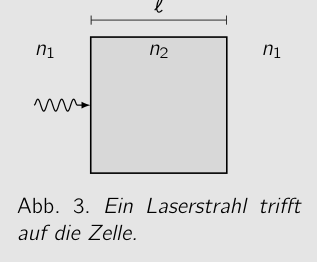 laser che colpisce cellula (Abb. 3)
Topic: Modern-Quantum Physics, Geometric Optics Metodi: Photon Energy Relation, Conservation of Momentum, Physical Modeling Competenze: Mathematical Modeling, Physical Reasoning Objects: Photon Fonte: Testo (PDF) — p.17
Problema 9 Stretcher ottico (5,0 pts.) I raggi laser possono essere utilizzati per manipolare oggetti microscopici, come cellule, in modo mirato. Uno strumento per questo è il cosiddetto stretcher ottico, che viene utilizzato per indagare l’elastic proprietà delle cellule. In questo problema, devi indagare su come funziona. Per questo, considerate una cella, presa in modo semplificato per essere a forma di cubo, con una lunghezza di and a refractive index of . La cellula è situata in acqua, che ha un Indice di refrazione di . Un fascio laser con una potenza colpisce la cellula perpendicolare, come disegnato accanto. At the interfaces Un trasferimento di impulso avviene attraverso la riflessione. La frazione del incident photons reflected at the interface between two media with refractive indices and is
Supponiamo che non si verifichi alcun tipo di assorbimento e che molteplici riflessioni nella cellula possano essere trascurate. Fig. 3. Un laser beam colpisce
- La cella. Denote by the energy of a photon in the laser beam and by its momentum. Con Planck’s constant , the following hold independently of the medium in which the photon is located
Qui e indicano la frequenza e la lunghezza d’onda del fotone, rispettivamente. 9. (a) Usando le relazioni sopra, mostrare che il momento del fotone in un mezzo con index refractive può essere scritto come
dove indica la velocità della luce in vuoto. (punto 2.0) 9.b) Considerare l’impatto dei fotoni del fascio laser sul muro della cella frontale e determinare un’espressione per il trasferimento di momentum al muro della cella. (4,0 p.) 9.c) Derivare un’espressione per ciascuna delle forze e che agiscono sul fronte e sul retro cell wall, rispettivamente. (4,0 p.) Le due forze conducono entrambi ad un’accelerazione della cellula come un tutto e ad un deformazione della cellula lungo il raggio laser. 9.d) Descrivere in che modo la cellula è deformata dalle forze. Calcolare entrambi la forza totale sulla cellula e la forza di deformazione . Quindi dare il rapporto della forza totale alla forza di deformazione. (5,0 p. d.) In pratica, vengono utilizzati due laser a contropropagazione di uguale frequenza e potenza. Questo cancella la forza totale sulla cellula, lasciando solo una forza deformante. Answer section 55° IPhO 2025 - 2° Round Exam Codice: Codice 9.a) Calcoli e spiegazioni 9.b) Calcoli e spiegazioni Espressione per il trasferimento di impulso: 55° IPhO 2025 - 2° Round Exam Codice: Codice 9.c) Calcoli e spiegazioni Espressioni per le forze: 9.d) Calcoli e spiegazioni Valori per le forze e il loro rapporto: 55° IPhO 2025 - 2° Round Exam Codice: Codice
La tecnologia di controllo delle cellule colpiche (Fig. 3)*
Topic: Modern-Quantum Physics, Geometric Optics Metodi: Photon Energy Relation, Conservation of Momentum, Physical Modeling Competenze: Mathematical Modeling, Physical Reasoning Objects: Photon Fonte: Testo (PDF) — p.17
The problem is that the optical stretcher The Commission has also adopted a proposal for a directive on the protection of workers’ rights. Laser beams can be used to manipulate microscopic objects, such as cells, in a targeted way. One tool for this is the so-called Optical Stretcher, which is used to investigate the elastic The properties of cells. In this problem you are to investigate how it works. For this, consider a cell, taken in a simplified way to be cube-shaped, with a length of and a refractive index of . The cell is located in water, which has a The following table shows the results of the measurement of the refractive index of : A laser beam with a power strikes the cell perpendicularly, as sketched alongside. At the interfaces A momentum transfer takes place through reflection. The fraction of the incident photons reflected at the interface between two media with refractive indices and is
Assume that no absorption occurs and that multiple reflections in the cell can be neglected. Fig. 3. A laser beam strikes The cell. Denote by the energy of a photon in the laser beam and by its momentum. With Planck’s constant , the following hold independently of the medium in which the photon is located
Here and denote the frequency and wavelength of the photon, respectively. 9. (a) Using the relations above, show that the momentum of the photon in a medium is with refractive index can be written as
where denotes the speed of light in vacuum. (b) the number of persons who are not members of the 9.b) Consider the impact of the laser beam’s photons on the front cell wall and determine an expression for the momentum transfer to the cell wall. (4.0 p.m.) 9.c) Derive an expression for each of the forces and that act on the front and rear cell wall, respectively. (4.0 p.m.) The two forces lead both to an acceleration of the cell as a whole and to a deformation of the cell along the laser beam. 9. (d) Describe in what way the cell is deformed by the forces. Calculate both the total force on the cell and the deformation force . So give the ratio of the total force to the deformation force. (5.0 p.p.) In practice, two counter-propagating laser beams of equal frequency and power are used. This cancels the total force on the cell, leaving only a deforming force. Answer section 55th IPhO 2025 - Second Round Exam The code: Code 9.a) Calculations and explanations 9.b) Calculations and explanations Expression for the momentum transfer: 55th IPhO 2025 - Second Round Exam The code: Code 9.c) Calculations and explanations Expressions for the forces: 9.d) Calculations and explanations Values for the forces and their ratio: 55th IPhO 2025 - Second Round Exam The code: Code
laser che colpisce cellula (Abb. 3)
Topic: Modern-Quantum Physics, Geometric Optics Metodi: Photon Energy Relation, Conservation of Momentum, Physical Modeling Competenze: Mathematical Modeling, Physical Reasoning Objects: Photon Fonte: Testo (PDF) — p.17
Problem 10 Circuit Tangle (20.0 pts.) In a well-sorted physics collection there are three small boxes, each with two electrical terminals. The boxes contain circuits made of identical components: resistors with resistance value , inductors with inductance and capacitors with capacitance . In boxes A and B exactly one of each component is installed, while in box C a further resistor with resistance value is connected, so that four elements in total are connected together. A B C To find out how the components in the boxes are connected, the boxes are connected to an AC voltage source with variable frequency and the apparent resistance, i.e. the magnitude of the complex impedance, is determined. The following graphs show the curves of the apparent resistances of the boxes as a function of the angular frequency of the AC voltage. A 20 40 60 80 100 120 140 100 200 300 400 500 B 20 40 60 80 100 120 140 100 200 300 400 500 C 20 40 60 80 100 120 140 100 200 300 400 500 Fig. 4. Graphs of the apparent resistances of the three boxes as a function of the angular frequency of the applied AC voltage. You may assume all components to be ideal and assume that the elements in the boxes are neither short-circuited nor have open terminals. Circuits that differ only by swapping the order of the elements in a series connection or the arrangement of the individual branches in a parallel connection may be regarded as equivalent and need not be considered separately. 10.a) Give all possible, distinct circuit diagrams for the construction of the three boxes A, B and C that are compatible with the respective curves of the apparent resistances. Justify your circuits and why no others are possible. (11.0 pts.) 55th IPhO 2025 - 2nd Round Exam Code: Code 10.b) Using the graphs, determine the values , and . (5.0 pts.) If boxes A and B are connected in series, the apparent resistance of the circuit at certain angular frequencies of the applied voltage is exactly . 10.c) Determine the values of these angular frequencies. (4.0 pts.) Answer section 10.a) Calculations and explanations 55th IPhO 2025 - 2nd Round Exam Code: Code 10.b) Calculations and explanations Values for , and : 10.c) Calculations and explanations Values for the angular frequencies: 55th IPhO 2025 - 2nd Round Exam Code: Code Additional worksheet 55th IPhO 2025 - 2nd Round Exam Code: Code Additional worksheet 55th IPhO 2025 - 2nd Round Exam Code: Code Additional worksheet 55th IPhO 2025 - 2nd Round Exam Code: Code Additional worksheet Graph paper
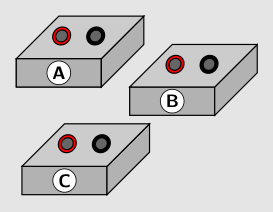 schemi circuiti in scatole A, B, C
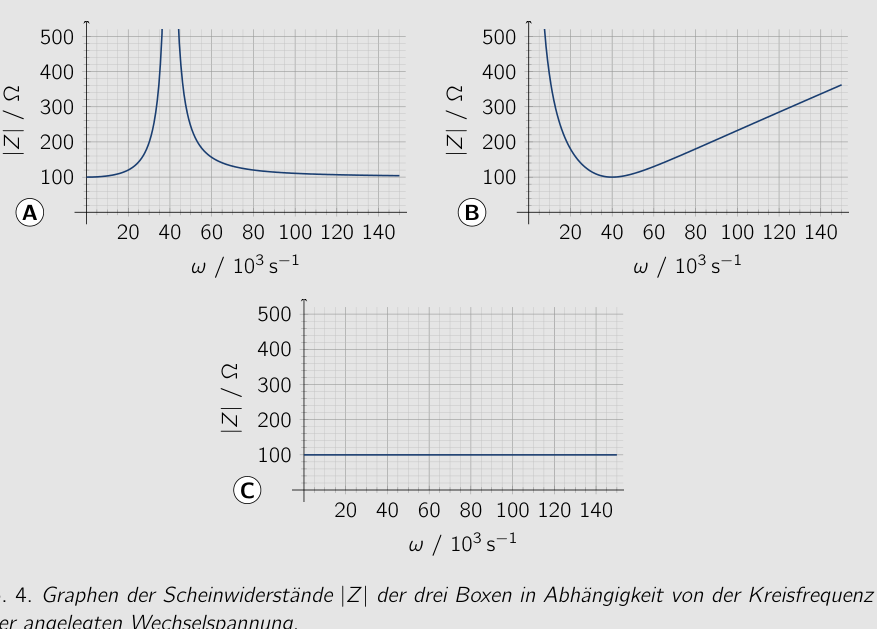 grafici impedenza |Z| vs frequenza A B C
Topic: Circuits, Oscillations & Waves Metodi: Kirchhoff’s Laws, Equivalent Circuit Reduction, Graph Linearization Competenze: Diagrammatic Reasoning, Mathematical Modeling, Experimental Data Analysis Objects: Resistor, Inductor, Capacitor Fonte: Testo (PDF) — p.20
Problema 10 Tangle del circuito (% di 20%) In una collezione di fisica ben ordinata ci sono tre piccoli scatole, ciascuna con due terminali elettrici. Le scatole contengono circuiti fatti di componenti identici: resistori con resistenza , inductors with inductance e capacitors with capacitance . In caselle A e B exactly one di ogni componente è installato, mentre in box C a further resistor with resistance value è connected, in modo che quattro Gli elementi in totale sono collegati. A B C Per scoprire come i componenti delle scatole sono collegati, le scatole sono collegate a una fonte di tensione AC con frequenza variabile e la resistenza apparente, i.e. la magnitudine dell’impedenza complessa, è determinata. Le seguenti grafiche mostrano le curve del le apparenti resistenze delle boxes come funzione della frequenza angolare del voltaggio AC. A 20 40 60 80 100 120 140 100 200 300 400 500 B 20 40 60 80 100 120 140 100 200 300 400 500 C 20 40 60 80 100 120 140 100 200 300 400 500 Fig. 4. Grafici delle apparenti resistenze dei tre box a funzione della frequenza angolare della volta applicata AC. Potete assumere che tutti i componenti siano ideali e che gli elementi presenti nel Le scatole non sono né short-circuited né hanno terminali aperti. Circuiti che differiscono solo da Swap the order of the elements in a series connection or the arrangement of the Gli individui di una connessione parallela possono essere considerati equivalenti e Non è necessario considerarlo separatamente. 10. (a) Fornisci tutti i possibili diagrammi di circuiti distinti per la costruzione dei tre box A, B e C che sono compatibili con le rispettive curve delle resistenze apparenti. Justify I circuiti e il perché di altri non sono possibili. (cfr. 55° IPhO 2025 - 2° Round Exam Codice: Codice 10.b) Usando i grafici, determinare i valori , e . (5,0 p. d.) Se le scatole A e B sono collegate in serie, la resistenza apparente del circuito a certe frequenze angolari della tensione applicata è esattamente . 10.c) Determina i valori di queste frequenze angolari. (4,0 p.) Answer section 10.a) Calcoli e spiegazioni 55° IPhO 2025 - 2° Round Exam Codice: Codice 10.b) Calcoli e spiegazioni Valori per , e : 10.c) Calcoli e spiegazioni Valori per le frequenze angolari: 55° IPhO 2025 - 2° Round Exam Codice: Codice Ulteriori fogli di lavoro 55° IPhO 2025 - 2° Round Exam Codice: Codice Ulteriori fogli di lavoro 55° IPhO 2025 - 2° Round Exam Codice: Codice Ulteriori fogli di lavoro 55° IPhO 2025 - 2° Round Exam Codice: Codice Ulteriori fogli di lavoro Carta grafica
schemi circuiti in scatole A, B, C
*grafica impedenza
Topic: Circuits, Oscillations & Waves Metodi: Kirchhoff’s Laws, Equivalent Circuit Reduction, Graph Linearization Competenze: Diagrammatic Reasoning, Mathematical Modeling, Experimental Data Analysis Objects: Resistor, Inductor, Capacitor Fonte: Testo (PDF) — p.20
Problem 10 Circuit Tangle (including the following: In a well-sorted physics collection there are three small boxes, each with two electrical terminals. The boxes contain circuits made of identical components: resistors with resistance value , inductors with inductance and capacitors with capacitance . In boxes A and B exactly one of each component is installed, while in box C a further resistor with resistance value is connected, so that four Elements in total are connected together. A B C To find out how the components in the boxes are connected, the boxes are connected to an AC voltage source with variable frequency and the apparent resistance, i.e. The magnitude of the complex impedance is determined. The following graphs show the curves of the apparent resistances of the boxes as a function of the angular frequency of the AC voltage. A 20 40 60 80 100 120 140 100 200 300 400 500 B 20 40 60 80 100 120 140 100 200 300 400 500 C 20 40 60 80 100 120 140 100 200 300 400 500 Fig. 4. Graphs of the apparent resistances of the three boxes as a function of the angular frequency of the applied AC voltage. You can assume all components to be ideal and assume that the elements in the boxes are neither short-circuited nor have open terminals. Circuits that differ only by swapping the order of the elements in a series connection or the arrangement of the Individual branches in a parallel connection may be considered equivalent and need not be considered separately. 10. (a) Give all possible, distinct circuit diagrams for the construction of the three boxes A, B and C that are compatible with the respective curves of the apparent resistance. Justify Your circuits and why no others are possible. (including the European Parliament and the Council) 55th IPhO 2025 - Second Round Exam The code: Code 10.b) Using the graphs, determine the values , and . (5.0 p.p.) If boxes A and B are connected in series, the apparent resistance of the circuit at certain angular frequencies of the applied voltage is exactly . 10. (c) Determine the values of these angular frequencies. (4.0 p.m.) Answer section 10.a) Calculations and explanations 55th IPhO 2025 - Second Round Exam The code: Code 10.b) Calculations and explanations The following values are used for , and : 10.c) Calculations and explanations Values for the angular frequencies: 55th IPhO 2025 - Second Round Exam The code: Code Additional worksheet 55th IPhO 2025 - Second Round Exam The code: Code Additional worksheet 55th IPhO 2025 - Second Round Exam The code: Code Additional worksheet 55th IPhO 2025 - Second Round Exam The code: Code Additional worksheet Graph paper
schemi circuits in boxes A, B, C
grafici impedenza |Z| vs frequenza A B C
Topic: Circuits, Oscillations & Waves Metodi: Kirchhoff’s Laws, Equivalent Circuit Reduction, Graph Linearization Competenze: Diagrammatic Reasoning, Mathematical Modeling, Experimental Data Analysis Objects: Resistor, Inductor, Capacitor Fonte: Testo (PDF) — p.20