Cariche in miniatura
Si stimi la carica totale dei soli elettroni presenti nel corpo di un bambino di anni.
Unità di misura: C. Precisione richiesta: 100.0%.
Topic: Electrostatics, Order-of-Magnitude Estimation Metodi: Order-of-Magnitude Estimation, Physical Modeling Competenze: Estimation & Approximation, Mathematical Modeling Objects: Electron Fonte: Testo (PDF) — p.3 Soluzione: Soluzioni (PDF)
The following table shows the results of the calculation of the total weight of the product:
The total charge of the electrons present in the body of a child of years is estimated.
Unit of measurement: C. Accuracy required: 100.0%.
Topic: Electrostatics, Order-of-Magnitude Estimation Metodi: Order-of-Magnitude Estimation, Physical Modeling Competenze: Estimation & Approximation, Mathematical Modeling Objects: Electron Fonte: Testo (PDF) — p.3 Soluzione: Soluzioni (PDF)
Shuriken
Un disco di pietra di massa e raggio presenta due piccoli pezzi di piombo di massa ciascuno, in posizioni diametralmente opposte sulla superficie laterale, come in figura. Il disco, con i piombini solidali, sta ruotando attorno al suo asse con una velocità angolare di . Se ad un certo istante i piombini si staccano improvvisamente, quale sarà la successiva velocità angolare del solo disco?
Unità di misura: rad/s. Precisione richiesta: 0.5%.
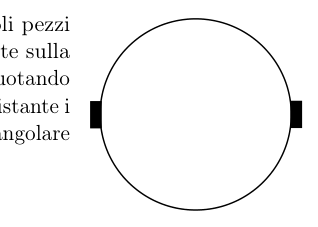 disco con due masse di piombo diametralmente opposte
Topic: Rotational Dynamics, Conservation of Momentum Metodi: Conservation of Momentum, Torque & Angular Momentum Analysis Competenze: Mathematical Modeling, Physical Reasoning, Diagrammatic Reasoning Objects: Disk Fonte: Testo (PDF) — p.3 Soluzione: Soluzioni (PDF)
The following is the list of the Member States’ official languages:
A disc of stone and radius has two small pieces of lead each, in diametrically opposite positions on the side surface, as shown in Figure 1. The disc, with solid-state plumbing, is rotating around its axis at an angular speed of . If at some point the plumbing suddenly breaks off, what will be the next angular velocity of the single disc?
The unit of measurement: rad/s. Precision required: 0.5%.
disc with two lead masses diametrically opposite
Topic: Rotational Dynamics, Conservation of Momentum Metodi: Conservation of Momentum, Torque & Angular Momentum Analysis Competenze: Mathematical Modeling, Physical Reasoning, Diagrammatic Reasoning Objects: Disk Fonte: Testo (PDF) — p.3 Soluzione: Soluzioni (PDF)
Orbite
Una cometa orbita attorno ad una stella con un periodo pari a anni terrestri, passando da una distanza minima dalla stella (pericentro) pari a milioni di km ad una massima (apocentro) pari a milioni di km. Determinare la massa della stella.
Unità di misura: kg. Precisione richiesta: 0.5%.
Topic: Gravitation Metodi: Kepler’s Laws, Newton’s Law of Gravitation, Conservation Laws Competenze: Mathematical Modeling, Physical Reasoning Objects: Star Fonte: Testo (PDF) — p.3 Soluzione: Soluzioni (PDF)
The following table shows the number of samples taken:
A comet orbiting a star with a period equal to Earth years, passing from a minimum distance from the star (pericenter) equal to million km to a maximum (apocenter) equal to million km. Determine the mass of the star .
Unit of measurement: kg. Precision required: 0.5%.
Topic: Gravitation Metodi: Kepler’s Laws, Newton’s Law of Gravitation, Conservation Laws Competenze: Mathematical Modeling, Physical Reasoning Objects: Star Fonte: Testo (PDF) — p.3 Soluzione: Soluzioni (PDF)
Non si torna indietro
Una macchina termica irreversibile, che opera fra due sorgenti di calore aventi temperature e , ha un rendimento e in un ciclo fornisce un lavoro . Questo lavoro viene usato da una seconda macchina termica, reversibile, per pompare calore dalla sorgente a temperatura a quella a temperatura . Determinare la variazione di entropia dell’Universo in un ciclo.
Unità di misura: J/K. Precisione richiesta: 0.5%.
Topic: Thermodynamics Metodi: Thermodynamic Cycle Analysis, First Law of Thermodynamics Competenze: Mathematical Modeling, Physical Reasoning Objects: Heat Engine Fonte: Testo (PDF) — p.3 Soluzione: Soluzioni (PDF)
It’s not going backwards.
An irreversible heat engine operating between two heat sources with temperatures and has a yield and provides a work in a cycle. This work is used by a second, reversible heat machine to pump heat from the source at to that at . Determine the variation in entropy of the universe in a cycle.
The unit of measurement: J/K. Precision required: 0.5%.
Topic: Thermodynamics Metodi: Thermodynamic Cycle Analysis, First Law of Thermodynamics Competenze: Mathematical Modeling, Physical Reasoning Objects: Heat Engine Fonte: Testo (PDF) — p.3 Soluzione: Soluzioni (PDF)
Rotolando
Una sfera cava uniforme ha raggio esterno , raggio interno e massa , come in figura. Essa rotola senza strisciare lungo un piano inclinato di lunghezza e dislivello fra le estremità ; la sfera parte da ferma dall’estremità superiore del piano inclinato. Quale velocità raggiunge alla fine del piano inclinato?
Unità di misura: m/s. Precisione richiesta: 0.5%.
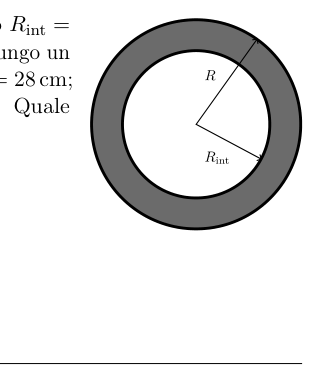 sfera cava con raggi R e R_int
Topic: Rotational Dynamics, Conservation of Energy Metodi: Energy Conservation Method, Torque & Angular Momentum Analysis Competenze: Mathematical Modeling, Diagrammatic Reasoning, Physical Reasoning Objects: Sphere, Inclined Plane Fonte: Testo (PDF) — p.3 Soluzione: Soluzioni (PDF)
The following table shows the number of samples taken:
A uniform hollow sphere has an outer radius , an inner radius and a mass , as shown in Figure 1. It rolls without cracking along an inclined plane of length and height between the ends ; the sphere starts from the upper end of the inclined plane. What speed does it reach at the end of the inclined plane?
The following shall be added: Precision required: 0.5%.
sphere with R and R_int radii
Topic: Rotational Dynamics, Conservation of Energy Metodi: Energy Conservation Method, Torque & Angular Momentum Analysis Competenze: Mathematical Modeling, Diagrammatic Reasoning, Physical Reasoning Objects: Sphere, Inclined Plane Fonte: Testo (PDF) — p.3 Soluzione: Soluzioni (PDF)
Pulegge
Un corpo di massa viene sospeso mediante una fune inestensibile, la quale è appoggiata su una puleggia e arrotolata, all’altra estremità, attorno ad un cilindro di massa e raggio , come in figura. Il cilindro è omogeneo e poggia con una faccia su di un piano orizzontale, sul quale è libero di traslare e ruotare senza attrito. Le masse della fune e della puleggia sono trascurabili. Determinare l’accelerazione del corpo sospeso.
Unità di misura: . Precisione richiesta: 0.5%.
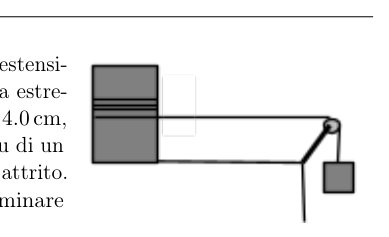 puleggia con cilindro e massa sospesa
Topic: Rotational Dynamics, Newtonian Mechanics Metodi: Free-Body Diagram, Torque & Angular Momentum Analysis, Newton’s Law of Gravitation Competenze: Diagrammatic Reasoning, Mathematical Modeling, Physical Reasoning Objects: Pulley, String, Cylinder, Block Fonte: Testo (PDF) — p.4 Soluzione: Soluzioni (PDF)
The following information is provided for in the Annex to this Regulation:
A mass body is suspended by an inextensible rope, which is supported on a cleaning and rolled, at the other end, around a cylinder of mass and radius , as shown in Figure 1. The cylinder is homogeneous and rests with one face on a horizontal plane, on which it is free to move and rotate without friction. The mass of rope and cleaning is negligible. Determine the acceleration of the suspended body.
The unit of measurement: . Precision required: 0.5%.
cleaning with cylinder and mass suspended
Topic: Rotational Dynamics, Newtonian Mechanics Metodi: Free-Body Diagram, Torque & Angular Momentum Analysis, Newton’s Law of Gravitation Competenze: Diagrammatic Reasoning, Mathematical Modeling, Physical Reasoning Objects: Pulley, String, Cylinder, Block Fonte: Testo (PDF) — p.4 Soluzione: Soluzioni (PDF)
Trasformazione improbabile
Due moli di gas perfetto biatomico sono usate in una macchina termica per compiere il ciclo termodinamico rappresentato nel diagramma in figura. Si calcoli il rendimento di questo ciclo, sapendo che , .
Unità di misura: adimensionale. Precisione richiesta: 0.5%.
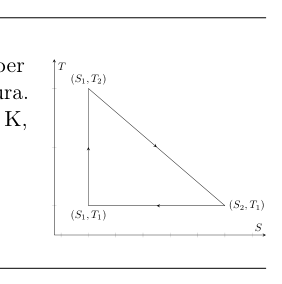 ciclo termodinamico nel piano T-S
Topic: Thermodynamics Metodi: Thermodynamic Cycle Analysis, Calculus-Integration, Ideal Gas Law Competenze: Mathematical Modeling, Physical Reasoning Objects: Gas, Heat Engine Fonte: Testo (PDF) — p.4 Soluzione: Soluzioni (PDF)
The following is the list of the types of products that are subject to the approval procedure:
Two perfect biatomic gas moles are used in a thermal machine to complete the thermodynamic cycle as shown in the diagram in figure. The yield of this cycle is calculated by knowing that , .
Unit of measurement: dimension. Precision required: 0.5%.
The following shall be added to the list of the following:
Topic: Thermodynamics Metodi: Thermodynamic Cycle Analysis, Calculus-Integration, Ideal Gas Law Competenze: Mathematical Modeling, Physical Reasoning Objects: Gas, Heat Engine Fonte: Testo (PDF) — p.4 Soluzione: Soluzioni (PDF)
Lampadine che passione
Su una piccola lampadina a incandescenza per torcia elettrica sono indicate le seguenti caratteristiche: , . Sapendo che il filamento è fatto di lega di tungsteno di forma cilindrica, lungo , e la resistività del tungsteno alla temperatura di funzionamento , si calcoli il raggio del filamento.
Unità di misura: m. Precisione richiesta: 0.5%.
Topic: Circuits Metodi: Physical Modeling, Kirchhoff’s Laws Competenze: Mathematical Modeling, Physical Reasoning Objects: Wire, Resistor Fonte: Testo (PDF) — p.4 Soluzione: Soluzioni (PDF)
The following table shows the number of lamps used:
The following characteristics shall be indicated on a small incandescent light bulb for electrical lamps: , . Knowing that the filament is made of a cylindrical-shaped tungsten alloy, length , and the resistivity of tungsten at operating temperature , the filament radius is calculated.
Unit of measurement: m. Precision required: 0.5%.
Topic: Circuits Metodi: Physical Modeling, Kirchhoff’s Laws Competenze: Mathematical Modeling, Physical Reasoning Objects: Wire, Resistor Fonte: Testo (PDF) — p.4 Soluzione: Soluzioni (PDF)
Semicilindro di vetro
Un semicilindro di vetro, avente raggio e indice di rifrazione , è appoggiato con una delle sue facce semicircolari su un piano. Il centro della faccia è incernierato ad un punto del piano e non può muoversi; tuttavia, il semicilindro è libero di ruotare di qualunque angolo attorno al proprio asse, come in figura. Un raggio laser, radente al piano, viene puntato verso il centro della faccia. Ruotando il semicilindro, il raggio uscente da esso cambia direzione. Si osserva tuttavia che, comunque si orienti il semicilindro, la direzione del raggio uscente non è mai contenuta all’interno di un certo angolo con vertice nell’asse. Quanto vale ?
Unità di misura: °. Precisione richiesta: 0.5%.
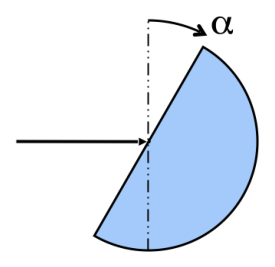 semicilindro di vetro con angolo alpha
Topic: Geometric Optics Metodi: Snell’s Law, Ray Tracing Competenze: Diagrammatic Reasoning, Mathematical Modeling, Physical Reasoning Objects: Cylinder Fonte: Testo (PDF) — p.4 Soluzione: Soluzioni (PDF)
Semicilindro di vetro
A glass semicircular beam with a refractive index shall be supported with one of its semicircular faces on a plane. The center of the face is anchored to a point of the plane and cannot move; however, the semicircular is free to rotate at any angle around its axis, as shown in Figure 1. A laser beam, radiating to the plane, is pointed toward the center of the face. By rotating the semicylinder, the beam out of it changes direction. However, it is noted that, regardless of the direction of the semicircular, the direction of the outgoing beam is never contained within a certain angle with a vertex in the axis. Quanto vale ?
The unit of measurement: °. Precision required: 0.5%.
*half-cylinder glass with alpha angle *
Topic: Geometric Optics Metodi: Snell’s Law, Ray Tracing Competenze: Diagrammatic Reasoning, Mathematical Modeling, Physical Reasoning Objects: Cylinder Fonte: Testo (PDF) — p.4 Soluzione: Soluzioni (PDF)
Finestre multiple
Ognuno dei tre strati del sistema in figura trasmette il della luce incidente, ne riflette il e ne assorbe il . Questo comportamento non dipende dalla direzione di provenienza del raggio incidente. Quanta percentuale di luce riesce a passare attraverso tutti e tre gli strati? Si risponda con la percentuale, ovvero un numero reale compreso fra e .
Unità di misura: %. Precisione richiesta: 0.5%.
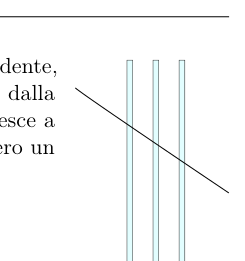 tre strati con raggio luminoso incidente
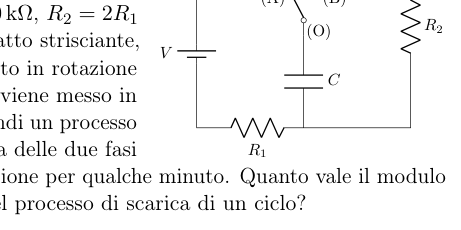 circuito con V, R1, R2, C e interruttore
Topic: Geometric Optics Metodi: Physical Modeling, Superposition Principle Competenze: Mathematical Modeling, Physical Reasoning, Diagrammatic Reasoning Objects: — Fonte: Testo (PDF) — p.5 Soluzione: Soluzioni (PDF)
The following table shows the number of windows:
Each of the three layers of the system in the figure transmits the of the incident light, reflects the and absorbs the . This behaviour does not depend on the direction of origin of the incident beam. How much of the light can pass through all three layers? The percentage is the actual number between and .
Unit of measurement: %. Precision required: 0.5%.
three layers with incident light beam
circuit with V, R1, R2, C and switch
Topic: Geometric Optics Metodi: Physical Modeling, Superposition Principle Competenze: Mathematical Modeling, Physical Reasoning, Diagrammatic Reasoning Objects: — Fonte: Testo (PDF) — p.5 Soluzione: Soluzioni (PDF)
Potenziale debole
Un oggetto di massa è soggetto ad un campo di forza centrale dove è una costante. All’istante iniziale l’oggetto si trova ad una distanza dal centro attrattore e si muove con una velocità . L’angolo che la velocità forma con il segmento che unisce l’oggetto al centro attrattore è . Si calcoli quanto vale la distanza minima fra l’oggetto e il centro attrattore nel moto successivo all’istante iniziale.
Unità di misura: m. Precisione richiesta: 0.5%.
Topic: Newtonian Mechanics, Conservation of Energy, Conservation of Momentum Metodi: Energy Conservation Method, Conservation of Momentum, Conservation Laws Competenze: Mathematical Modeling, Physical Reasoning, Diagrammatic Reasoning Objects: — Fonte: Testo (PDF) — p.5 Soluzione: Soluzioni (PDF)
The following table shows the number of samples taken:
An object of mass is subject to a central force field where is a constant. At the initial moment the object is located at a distance from the centre of attraction and moves at a speed . The angle formed by the velocity with the segment connecting the object to the centre of attraction is . The minimum distance between the object and the centre of attraction in the motion following the initial instant shall be calculated.
Unit of measurement: m. Precision required: 0.5%.
Topic: Newtonian Mechanics, Conservation of Energy, Conservation of Momentum Metodi: Energy Conservation Method, Conservation of Momentum, Conservation Laws Competenze: Mathematical Modeling, Physical Reasoning, Diagrammatic Reasoning Objects: — Fonte: Testo (PDF) — p.5 Soluzione: Soluzioni (PDF)
Circuiti oscillanti
Si consideri il circuito in figura. Un generatore ideale di tensione continua è collegato a due resistenze , e ad un condensatore di capacità . Un contatto strisciante, in figura rappresentato dall’interruttore, viene mantenuto in rotazione da un meccanismo esterno. In questo modo, il polo viene messo in contatto alternativamente con i poli e , creando quindi un processo alternato di carica e scarica del condensatore. Ciascuna delle due fasi dura . Il circuito viene lasciato in questa situazione per qualche minuto. Quanto vale il modulo della carica accumulata sul condensatore al termine del processo di scarica di un ciclo?
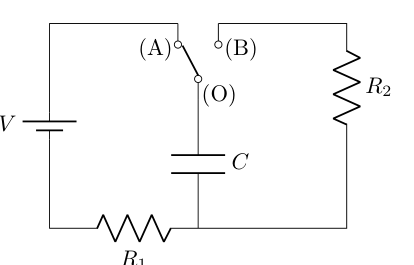 Circuito: generatore , resistenze e , condensatore e interruttore rotante che commuta il polo tra e .
Unità di misura: C. Precisione richiesta: 0.5%.
Topic: Circuits Metodi: Kirchhoff’s Laws, Differential Equations Competenze: Mathematical Modeling, Diagrammatic Reasoning, Physical Reasoning Objects: Battery, Resistor, Capacitor, Switch Fonte: Testo (PDF) — p.5 Soluzione: Soluzioni (PDF)
The following table shows the number of units in the range of the following:
Consider the circuit in the figure. An ideal DC generator is connected to two resistances , and to a capacitor . A crawling contact, as represented by the switch, is kept in rotation by an external mechanism. In this way, the pole is put in contact alternately with the and poles, thus creating an alternate process of capacitor charging and discharging. Each of the two stages is hard. The circuit is left in this situation for a few minutes. What is the value of the cumulative charge on the capacitor at the end of the cycle discharge process?
Circuit: generator , resistances and , capacitor and rotary switch switching the pole between and .
Unit of measurement: C. Precision required: 0.5%.
Topic: Circuits Metodi: Kirchhoff’s Laws, Differential Equations Competenze: Mathematical Modeling, Diagrammatic Reasoning, Physical Reasoning Objects: Battery, Resistor, Capacitor, Switch Fonte: Testo (PDF) — p.5 Soluzione: Soluzioni (PDF)