Orbite cilindriche
Una formica cammina sulla superficie laterale di una lattina di forma cilindrica, il cui raggio di base è . L’insetto si muove lungo una circonferenza parallela al terreno con velocità costante in modulo, compiendo un giro in . Un’ape cammina sulla stessa lattina seguendo un percorso determinato dall’intersezione tra la superficie cilindrica e un piano inclinato di rispetto al terreno e passante per il centro della circonferenza citata precedentemente. Un osservatore nota che i due insetti si stanno muovendo in modo che, in ogni istante, la retta che li congiunge sia parallela all’asse della lattina. Supponendo che all’istante entrambi gli insetti si trovino in un punto di intersezione tra le loro due traiettorie, dopo quanto tempo essi si trovano per la prima volta a una distanza di l’uno dall’altro?
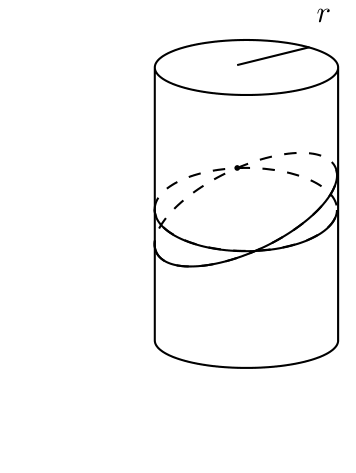 Lattina cilindrica di raggio : circonferenza orizzontale (formica) ed ellisse di intersezione col piano inclinato a (ape).
Unità di misura: s. Precisione richiesta: 0.5%.
Topic: Newtonian Mechanics Metodi: Kinematic Equations, Vector Decomposition, Physical Modeling Competenze: Mathematical Modeling, Diagrammatic Reasoning Objects: Cylinder Fonte: Testo (PDF) — p.3 Soluzione: Soluzioni (PDF)
The following is the list of the following:
An ant walks on the lateral surface of a cylindrical-shaped can, the base radius of which is . The insect moves along a circumference parallel to the ground at a constant speed in the module, completing a spin in . A bee walks on the same can by following a path determined by the intersection of the cylindrical surface and an inclined plane of with respect to the ground and passing through the centre of the above-mentioned circumference. One observer notes that the two insects are moving so that at any given moment the line joining them is parallel to the axis of the can. Assuming that at the moment both insects are at an intersection point between their two trajectories, how long after do they first find themselves at a distance of from each other?
Radio cylindrical plate : horizontal circumference (forest) and cross-sectional ellipses with plane inclined to (bee).
The following shall be added to the list of the units: The following information is provided:
Topic: Newtonian Mechanics Metodi: Kinematic Equations, Vector Decomposition, Physical Modeling Competenze: Mathematical Modeling, Diagrammatic Reasoning Objects: Cylinder Fonte: Testo (PDF) — p.3 Soluzione: Soluzioni (PDF)
Distanza tra piani di grafene
La grafite contenuta nelle matite è costituita da piani (più o meno) paralleli di grafene. Ogni piano di grafene è formato da un reticolo di esagoni regolari di lato . In ogni vertice del reticolo è presente un atomo di carbonio, il cui numero di massa è . Sapendo che la densità della grafite è , quanto vale la distanza tra due piani di grafene consecutivi?
Unità di misura: m. Precisione richiesta: 0.5%.
Topic: Order-of-Magnitude Estimation Metodi: Dimensional Analysis, Physical Modeling Competenze: Mathematical Modeling, Unit Conversion Objects: Atom Fonte: Testo (PDF) — p.3 Soluzione: Soluzioni (PDF)
Distance between graphene planes
The graphite in pencils consists of (more or less) parallel plates of graphene. Each graphene plane is formed by a lattice of regular side hexagons . Each vertex of the lattice contains a carbon atom, the mass number of which is . Knowing that the density of graphite is , what is the distance between two layers of graphene in a row?
The following is the list of the measurement units: The following information is provided:
Topic: Order-of-Magnitude Estimation Metodi: Dimensional Analysis, Physical Modeling Competenze: Mathematical Modeling, Unit Conversion Objects: Atom Fonte: Testo (PDF) — p.3 Soluzione: Soluzioni (PDF)
Autovelox doppler
Una cassa acustica emette un suono di frequenza ed è montata sopra un carrello vincolato a muoversi lungo binari rettilinei. Al tempo la cassa acustica si trova in stato di quiete. Un microfono è fissato sui binari, a una certa distanza dalla posizione iniziale del carrello, per poter registrare il suono emesso dalla cassa in funzione del tempo, campionandolo una volta al secondo. I dati raccolti dal microfono riportano una frequenza sonora che aumenta dello ogni secondo. Supponendo che il carrello non raggiunga mai il microfono durante il campionamento, con quale velocità si muove il carrellino all’istante ? Si consideri la velocità del suono in aria pari a .
Unità di misura: m/s. Precisione richiesta: 0.5%.
Topic: Oscillations & Waves Metodi: Wave Equation, Kinematic Equations, Approximation & Series Expansion Competenze: Mathematical Modeling Objects: Cart Fonte: Testo (PDF) — p.3 Soluzione: Soluzioni (PDF)
The following information is provided for in the Annex to this Regulation:
An acoustic case emits a frequency sound and is mounted on a cart bound to move along straight tracks. At the sound box is in a quiet state. A microphone is fixed on the track, some distance from the initial position of the cart, so that the sound emitted by the box can be recorded in a timely manner, and sampled once a second. The microphone data shows a frequency of sound increasing by every second. Assuming that the cart never reaches the microphone during sampling, at what speed does the cart move at the instant ? Consider the sound speed in air .
The following is the maximum amount of the measurement: The following information is provided:
Topic: Oscillations & Waves Metodi: Wave Equation, Kinematic Equations, Approximation & Series Expansion Competenze: Mathematical Modeling Objects: Cart Fonte: Testo (PDF) — p.3 Soluzione: Soluzioni (PDF)
Una colazione fortunata
A Francesco piace cominciare la giornata nel migliore dei modi. In particolare, adora uno specifico tipo di fetta biscottata rettangolare di massa , con un lato lungo , un lato di lunghezza incognita e spessore trascurabile. Oggi, però, la fetta gli scivola di mano e, cadendo con le sue facce principali parallele al terreno, colpisce un tavolo di altezza sbattendo sullo spigolo, come mostrato in figura. Con l’urto la fetta acquista un momento angolare rispetto al proprio centro geometrico, orientato parallelamente ai lati di lunghezza e di modulo pari a . Francesco nota che, immediatamente dopo l’impatto con il tavolo, la velocità verticale del centro di massa della fetta biscottata è nulla. La marmellata ha una densità superficiale . Francesco oggi è un ragazzo fortunato: la fetta cade perfettamente sul lato non coperto dalla marmellata. Quanto vale al massimo affinché questo sia possibile?
Unità di misura: cm. Precisione richiesta: 0.5%.
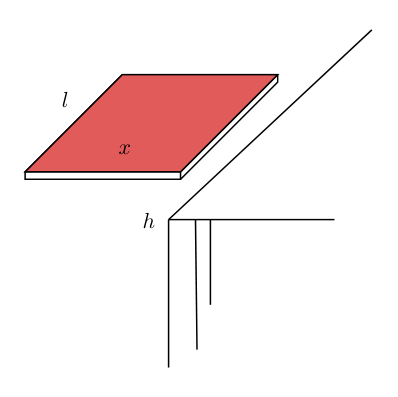 fetta biscottata che colpisce spigolo tavolo
Topic: Rotational Dynamics, Newtonian Mechanics Metodi: Torque & Angular Momentum Analysis, Conservation of Momentum, Free-Body Diagram Competenze: Mathematical Modeling, Diagrammatic Reasoning Objects: — Fonte: Testo (PDF) — p.4 Soluzione: Soluzioni (PDF)
A good breakfast.
Francesco likes to start the day in the best way possible. In particular, she loves a specific type of rectangular biscuit slice of mass , with a long side , a side of unknown length and negligible thickness. Today, however, the slice slips by hand and, falling with its main faces parallel to the ground, hits a table of height by slamming on the handle, as shown in the figure. The impact gives the slice an angular momentum relative to its geometric center, oriented parallel to the sides of length and shape . Francis notes that immediately after impact with the table, the vertical velocity of the mass center of the cookie slice is zero. The marmalade has a surface density . Francesco is a lucky boy today: the slice falls perfectly on the side not covered with jam. What is the maximum value of for this to be possible?
The unit of measurement: * cm. The following information is provided:
sliced biscuit that hits the table top
Topic: Rotational Dynamics, Newtonian Mechanics Metodi: Torque & Angular Momentum Analysis, Conservation of Momentum, Free-Body Diagram Competenze: Mathematical Modeling, Diagrammatic Reasoning Objects: — Fonte: Testo (PDF) — p.4 Soluzione: Soluzioni (PDF)
Se il recipiente ruota
In figura è mostrato un recipiente cilindrico chiuso, completamente pieno d’acqua, al cui interno si trova un cubetto di di volume, la cui densità media è molto minore di quella dell’acqua. Il cubetto è collegato alla base del recipiente tramite una molla di costante elastica e lunghezza a riposo . Il recipiente sta ruotando, da molto tempo, con velocità angolare intorno a un’asta verticale, a cui è collegato tramite una fune lunga , attaccata alla base . Quanto vale la lunghezza della molla?
Unità di misura: cm. Precisione richiesta: 0.5%.
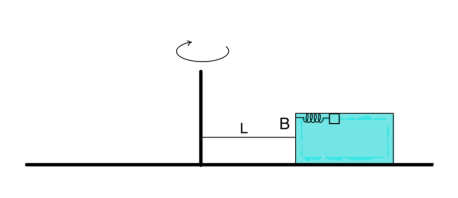 recipiente cilindrico rotante con molla e cubetto
Topic: Fluid Mechanics, Newtonian Mechanics Metodi: Free-Body Diagram, Hydrostatic Equilibrium, Physical Modeling Competenze: Mathematical Modeling, Diagrammatic Reasoning Objects: Spring, Container, String Fonte: Testo (PDF) — p.4 Soluzione: Soluzioni (PDF)
If the container is rotating
A closed cylindrical container, completely filled with water, inside which is a volume cube of , the average density of which is much lower than that of water is shown. The cube shall be connected to the base of the container by means of a spring of constant elasticity and length at rest . The vessel has been spinning, for a long time, at angular speed around a vertical axis, to which it is connected by a long rope attached to the base . How much is the length of the spring?
The unit of measurement: * cm. The following information is provided:
rotating cylindrical container with spring and cube
Topic: Fluid Mechanics, Newtonian Mechanics Metodi: Free-Body Diagram, Hydrostatic Equilibrium, Physical Modeling Competenze: Mathematical Modeling, Diagrammatic Reasoning Objects: Spring, Container, String Fonte: Testo (PDF) — p.4 Soluzione: Soluzioni (PDF)
Equilibrio termico con un bicchierino
Due piscine contengono di acqua, la prima a temperatura , la seconda a temperatura . Margherita vuole rendere uguali il più possibile le temperature delle due piscine, ma dispone solo di un bicchierino di volume . Dunque prende un bicchierino d’acqua dalla piscina più calda e la versa in quella più fredda. Dopo aver aspettato l’equilibrio termico tra l’acqua versata e quella già presente nella piscina, prende un bicchierino d’acqua da questa seconda piscina e lo riversa nella prima. Margherita continua con i travasi di un bicchierino d’acqua per volta fino a quando la differenza delle temperature tra le due piscine non si riduce a meno di un millesimo della differenza di temperatura iniziale. Quante coppie di travasi deve effettuare Margherita? Si supponga, anche se poco credibile, che le piscine non scambino calore con l’ambiente durante i travasi.
Unità di misura: adimensionale. Precisione richiesta: 0.5%.
Topic: Thermodynamics Metodi: Approximation & Series Expansion, Physical Modeling Competenze: Mathematical Modeling Objects: — Fonte: Testo (PDF) — p.4 Soluzione: Soluzioni (PDF)
Heat balance with a glass
Two pools contain of water, the first at and the second at . Margherita wants to make the two swimming pools as warm as possible, but she only has a glass of volume . So he takes a glass of water from the hottest pool and pours it into the coldest. After waiting for the thermal balance between the water being poured and the water already in the pool, he takes a glass of water from this second pool and pours it into the first. Margherita continues to swallow a glass of water at a time until the temperature difference between the two pools is less than one-thousandth of the initial temperature difference. How many pairs of overalls does Margherita have to make? Suppose, though unlikely, that swimming pools do not exchange heat with the environment during the transitions.
The measuring unit: * additional dimension. The following information is provided:
Topic: Thermodynamics Metodi: Approximation & Series Expansion, Physical Modeling Competenze: Mathematical Modeling Objects: — Fonte: Testo (PDF) — p.4 Soluzione: Soluzioni (PDF)
Una piscina bollente
Una piscina olimpionica è riempita di acqua a . La gara non può iniziare se la temperatura è più alta di . Gli impianti di raffreddamento sono rotti, ma fortunatamente vicino alla piscina si trova un bar con freezer pieni di cubetti di ghiaccio. Si stimi quanti di questi cubetti occorre lanciare nella piscina per far cominciare la gara.
Unità di misura: adimensionale. Precisione richiesta: 100.0%.
Topic: Thermodynamics, Order-of-Magnitude Estimation Metodi: Order-of-Magnitude Estimation, First Law of Thermodynamics Competenze: Estimation & Approximation Objects: — Fonte: Testo (PDF) — p.5 Soluzione: Soluzioni (PDF)
A hot pool
An Olympic swimming pool is filled with water at . The race cannot start if the temperature is higher than . The cooling systems are broken, but luckily near the pool is a bar with freezers full of ice cubes. You can estimate how many of these cubes you need to throw into the pool to start the race.
The measuring unit: * additional dimension. The following information is provided for the purpose of this Regulation:
Topic: Thermodynamics, Order-of-Magnitude Estimation Metodi: Order-of-Magnitude Estimation, First Law of Thermodynamics Competenze: Estimation & Approximation Objects: — Fonte: Testo (PDF) — p.5 Soluzione: Soluzioni (PDF)
Pescando su un lago ghiacciato
Helga ama andare a pescare le tregliole, pesci molto sottili che vivono rigorosamente alla temperatura di . In genere Helga va a pescare in un laghetto ghiacciato vicino casa sua, munita di un termometro e un metro a nastro, oltre a una canna da pesca e una sega per tagliare il ghiaccio. Dopo aver misurato la temperatura del ghiaccio sulla superficie del lago, pari a , Helga fa il classico buco circolare nel ghiaccio e vi immerge il termometro attaccato all’estremità del metro a nastro, calandolo sino al fondo del lago. In questo modo, misura in un colpo solo la profondità del lago, pari a incluso lo spessore ghiacciato, e la temperatura dell’acqua sul fondo del lago, pari a . A quale profondità rispetto alla superficie del lago Helga deve immergere l’amo della sua canna da pesca se vuole sperare di pescare una tregliola? Si considerino le conducibilità termiche dell’acqua e del ghiaccio come indipendenti dalla temperatura e pari, rispettivamente, a e .
Unità di misura: m. Precisione richiesta: 0.5%.
Topic: Thermodynamics Metodi: Differential Equations, Physical Modeling Competenze: Mathematical Modeling Objects: — Fonte: Testo (PDF) — p.5 Soluzione: Soluzioni (PDF)
Fishing on an icy lake
Helga loves to go fishing for funnels, very thin fish that live rigorously at . Helga usually goes fishing in an icy pond near her home, equipped with a thermometer and a tape-recorded meter, as well as a fishing rod and a saw to cut ice. After measuring the temperature of the ice on the lake’s surface, equal to , Helga makes the classic circular hole in the ice and immerses the thermometer attached to the end of the tape meter, climbing it to the bottom of the lake. Thus, it measures in one stroke the lake depth, equal to including the ice thickness, and the water temperature at the bottom of the lake, equal to . How deep in relation to the surface of Lake Helga must the ash of its fishing rod be submerged if it is to hope to catch a trawl? The thermal conductivity of water and ice shall be considered as temperature independent and equal to and respectively.
The following is the list of the measurement units: The following information is provided:
Topic: Thermodynamics Metodi: Differential Equations, Physical Modeling Competenze: Mathematical Modeling Objects: — Fonte: Testo (PDF) — p.5 Soluzione: Soluzioni (PDF)
Bomba ad azoto liquido
Lorenzo ha appena finito il corso di termodinamica e, mentre era in laboratorio a fare esperimenti con l’azoto liquido, ha pensato di portarsene un po’ a casa. Decide quindi di versarne dentro la sua borraccia di plastica, approssimabile a un cilindro di di raggio di base e altezza di . Nel versare il liquido nella borraccia, Lorenzo versa al suo interno anche molto gas freddo, alla stessa temperatura del liquido, che va a occupare tutta la regione del recipiente in cui non sono presenti liquidi. Lorenzo sa che l’azoto si trova a una temperatura di , che la sua borraccia ha capacità termica trascurabile e che può sopportare una differenza massima di pressione tra interno ed esterno pari a . Tutto contento va da Francesco per raccontargli il suo piccolo furto. Avendo fatto i calcoli, sapendo che la temperatura del laboratorio è , assicura che la sua borraccia non sarebbe esplosa. Non riesce nemmeno a finire la frase che si sente un boato provenire dalla sua postazione… Ovviamente aveva sbagliato i conti! Per quale massimo valore della temperatura ambiente si sarebbe potuta evitare l’esplosione? La massa molecolare dell’azoto è pari a . Si assuma che al momento dell’esplosione tutto l’azoto all’interno del contenitore si trovi in fase gassosa e che il volume inizialmente occupato dal liquido all’interno della borraccia sia una frazione trascurabile rispetto al volume della borraccia stessa.
Unità di misura: °C. Precisione richiesta: 0.5%.
Topic: Thermodynamics, Kinetic Theory Metodi: Ideal Gas Law, Physical Modeling Competenze: Mathematical Modeling, Unit Conversion Objects: Gas, Cylinder, Container Fonte: Testo (PDF) — p.5 Soluzione: Soluzioni (PDF)
The following is a list of the types of fuel used:
Lorenzo just finished his thermodynamics course and while he was in the lab experimenting with liquid nitrogen, he thought he’d take some home. It then decides to pour into its plastic cork, approximately equivalent to a cylinder of of base radius and height of . When Lorenzo poured the liquid into the drink, he also poured a lot of cold gas inside, at the same temperature as the liquid, which occupied the entire region of the container where no liquids were present. Lorenzo knows that nitrogen is at , that its beverage has negligible thermal capacity and that it can withstand a maximum pressure difference between internal and external . He’s happy to go to Francesco and tell him about his little robbery. Having done the calculations, knowing that the lab temperature is , ensures that his liquor would not explode. He can’t even finish the sentence. He’s hearing a rumor coming from his post. Obviously, he was wrong! What is the maximum ambient temperature at which the explosion could have been avoided? The molecular mass of nitrogen is . It is assumed that at the time of the explosion all the nitrogen inside the container is in the gaseous phase and that the volume initially occupied by the liquid inside the flask is a negligible fraction of the volume of the flask itself.
The following is the list of the measurement units: The following information is provided:
Topic: Thermodynamics, Kinetic Theory Metodi: Ideal Gas Law, Physical Modeling Competenze: Mathematical Modeling, Unit Conversion Objects: Gas, Cylinder, Container Fonte: Testo (PDF) — p.5 Soluzione: Soluzioni (PDF)
Un rilevatore che non rileva
Un sistema ottico è costituito da un “anello” miniaturizzato schematizzato in figura. Un raggio laser, modellizzabile come un’onda piana monocromatica, è emesso con frequenza pari a all’interno dell’anello in corrispondenza del punto . Tale raggio si propaga sia verso destra che verso sinistra. Un sistema di specchi modifica la direzione dei raggi in modo tale che essi si sovrappongano di nuovo al termine di un percorso chiuso, in corrispondenza del punto dove è presente un rilevatore. Il ramo alla sinistra dei punti e è composto da plexiglass (indice di rifrazione ), mentre il ramo di destra è composto da un materiale incognito, trasparente e con indice di rifrazione maggiore di . La distanza percorsa dal laser per andare da ad vale , mentre . Si nota che, in questa situazione, il rilevatore non rileva alcun segnale. Si determini il minimo valore dell’indice di rifrazione del materiale incognito compatibile con la situazione osservata. Si trascurino i processi di riflessione sulle interfacce in corrispondenza di e .
Unità di misura: adimensionale. Precisione richiesta: 0.5%.
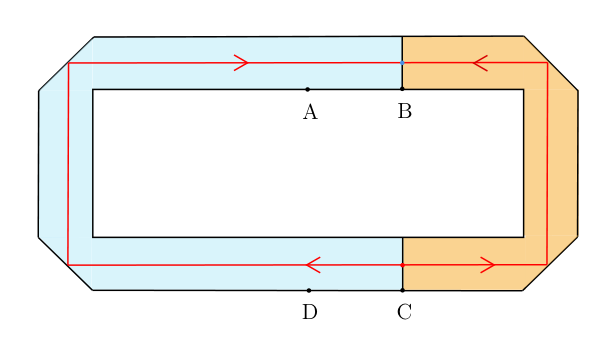 anello ottico con punti A B C D e raggi laser
Topic: Wave Optics Metodi: Interference & Diffraction Analysis, Superposition Principle Competenze: Mathematical Modeling, Diagrammatic Reasoning Objects: Mirror Fonte: Testo (PDF) — p.6 Soluzione: Soluzioni (PDF)
A detector that does not detect
An optical system consists of a miniaturized “ring” outlined in Figure 1. A laser beam, modulable as a monochrome flat wave, is emitted at a frequency of within the ring corresponding to the point. This beam propagates to the right and to the left. A mirror system shall change the direction of the beams so that they overlap again at the end of a closed path, corresponding to the point where a detector is present. The left-hand branch of the and points is made up of plexiglass (refraction index ), while the right-hand branch is made up of an unknown, transparent material with a refraction index greater than . The distance travelled by the laser to to is , while is . It is noted that in this situation the detector detects no signals. The minimum value of the refractive index of the unknown material compatible with the observed situation shall be determined. The reflection processes on the interfaces corresponding to and are ignored.
The measuring unit: * additional dimension. The following information is provided:
optical ring with points A B C D and laser beams
Topic: Wave Optics Metodi: Interference & Diffraction Analysis, Superposition Principle Competenze: Mathematical Modeling, Diagrammatic Reasoning Objects: Mirror Fonte: Testo (PDF) — p.6 Soluzione: Soluzioni (PDF)
Orbitando intorno a un filo
In assenza di gravità, un corpo di carica e massa incognita percorre un’orbita circolare attorno a un filo rettilineo molto lungo, uniformemente carico con densità di carica lineare . Si calcoli la differenza di energia meccanica tra due possibili orbite circolari, aventi l’una un raggio triplo rispetto all’altra.
Unità di misura: J. Precisione richiesta: 0.5%.
Topic: Electrostatics, Newtonian Mechanics Metodi: Gauss’s Law, Energy Conservation Method, Calculus-Integration Competenze: Mathematical Modeling Objects: Point Charge, Wire Fonte: Testo (PDF) — p.6 Soluzione: Soluzioni (PDF)
Orbiting around a wire
In the absence of gravity, a charge body and unknown mass travels in a circular orbit around a very long, uniformly loaded straight wire with a linear charge density . The difference in mechanical energy between two possible circular orbits, one having a radius three times that of the other, is calculated.
The following is the list of the measurement units: The following information is provided:
Topic: Electrostatics, Newtonian Mechanics Metodi: Gauss’s Law, Energy Conservation Method, Calculus-Integration Competenze: Mathematical Modeling Objects: Point Charge, Wire Fonte: Testo (PDF) — p.6 Soluzione: Soluzioni (PDF)
Quando finisce il cavo di rame
Francesco sta costruendo un impianto elettrico e ha esaurito il suo cavo di rame massiccio di raggio . Tuttavia, ha a disposizione dischi di rame di raggio e spessore . Ogni disco è costituito interamente di rame, eccetto una parte coassiale centrale di raggio , la quale ha una resistività nulla. La superficie laterale curva di ogni disco è inoltre ricoperta di una pellicola perfettamente conduttrice. Per costruire un cavo con resistenza uguale a quella del filo originale, di lunghezza , Francesco decide di impilare questi dischi e collegarli tra loro tramite un sottile filo conduttore di resistenza trascurabile, come mostrato in figura, ossia mettendo in contatto il centro di ogni disco con la superficie esterna del disco successivo. Quanti dischi deve usare Francesco? Si trascurino eventuali effetti di bordo e si approssimi il risultato all’intero superiore.
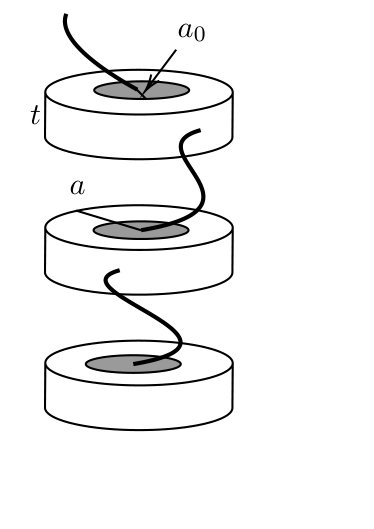 Pila di dischi di rame di raggio e spessore , con nucleo centrale di raggio a resistività nulla, collegati centro-superficie da fili conduttori.
Unità di misura: adimensionale. Precisione richiesta: 0.5%.
Topic: Circuits Metodi: Calculus-Integration, Equivalent Circuit Reduction Competenze: Mathematical Modeling, Diagrammatic Reasoning Objects: Disk, Wire Fonte: Testo (PDF) — p.7 Soluzione: Soluzioni (PDF)
When the copper wire ends
Francesco sta costruendo un impianto elettrico e ha esaurito il suo cavo di rame massiccio di raggio . However, it has copper discs of radius and thickness. Each disc is made entirely of copper, except for a central coaxial part of radius , which has zero resistivity. The curved side surface of each disc is also covered with a perfectly conductive film. To build a cable with resistance equal to that of the original wire, length , Francesco decides to stack these discs and connect them together through a thin conductive wire of negligible resistance, as shown in the figure, that is, by putting the center of each disk in contact with the outer surface of the next disc. How many records does Francesco have to use? Any effects on board are neglected and the result is approximated to the whole top.
Stable of copper discs of radius and thickness , with a centre core of radius with zero resistivity, connected centre-surface by conductive wires.
Unità di misura: adimensionale. Precisione richiesta: 0.5%.
Topic: Circuits Metodi: Calculus-Integration, Equivalent Circuit Reduction Competenze: Mathematical Modeling, Diagrammatic Reasoning Objects: Disk, Wire Fonte: Testo (PDF) — p.7 Soluzione: Soluzioni (PDF)
Un soprammobile magnetico
Sofia è appena tornata da un mercatino dell’usato dove ha comprato un oggetto molto interessante. Si tratta di una teca di vetro al cui interno è presente una spira circolare di massa e raggio incognito in cui scorre una corrente costante . La spira è fissata alle pareti della scatola attraverso dei perni che le permettono di ruotare solamente attorno a un diametro parallelo alla base della teca. Premendo un pulsante si può accendere un campo magnetico omogeneo, perpendicolare alla base della teca, con modulo costante pari a . Se si dà un leggero colpo al soprammobile, la spira inizia a compiere piccole oscillazioni intorno alla sua posizione di equilibrio stabile. Si determini il periodo di queste piccole oscillazioni.
Nota: il momento d’inerzia di una spira circolare vincolata a ruotare attorno a un proprio diametro è pari a .
Unità di misura: s. Precisione richiesta: 0.5%.
Topic: Magnetism, Oscillations & Waves Metodi: Small-Angle Approximation, Simple Harmonic Motion Analysis, Torque & Angular Momentum Analysis Competenze: Mathematical Modeling, Diagrammatic Reasoning Objects: Coil Fonte: Testo (PDF) — p.7 Soluzione: Soluzioni (PDF)
The following table shows the number of units in the unit:
Sofia just got back from a second-hand market where she bought a very interesting item. It is a glass sheet with a circular spiral of mass and an unknown beam inside which a constant current flows. The spire is fixed to the walls of the box through pins which allow it to rotate only around a diameter parallel to the base of the canvas. Pressing a button can ignite a homogeneous magnetic field perpendicular to the base of the cloth, with a constant modulus of . If a slight blow is given to the overhead, the spire begins to make small oscillations around its position of stable equilibrium. The period of these small oscillations is determined.
Note: the moment of inertia of a circular spindle bound to rotate around its own diameter is .
The following shall be added to the list of the units: The following information is provided:
Topic: Magnetism, Oscillations & Waves Metodi: Small-Angle Approximation, Simple Harmonic Motion Analysis, Torque & Angular Momentum Analysis Competenze: Mathematical Modeling, Diagrammatic Reasoning Objects: Coil Fonte: Testo (PDF) — p.7 Soluzione: Soluzioni (PDF)
Auguri dallo spazio
Penelope sta per partire per un lungo viaggio intergalattico con la sua astronave relativistica, proprio il giorno del compleanno del suo amato Ulisse. Dopo averlo salutato appassionatamente, alle 12:00 in punto parte a velocità . Passano i mesi e Penelope sente una gran nostalgia del suo bell’Ulisse. Pensa al momento in cui si sono salutati e le viene in mente di inviargli gli auguri per il suo successivo compleanno, facendoli viaggiare con un segnale luminoso. Penelope vuole che gli auguri arrivino a Ulisse esattamente alla stessa ora in cui si sono salutati. Dopo quanto tempo dall’istante della sua partenza Penelope deve inviare gli auguri a Ulisse? L’anno in questione non è bisestile.
Unità di misura: h. Precisione richiesta: 0.5%.
Topic: Special Relativity Metodi: Lorentz Transformation, Physical Modeling Competenze: Mathematical Modeling Objects: — Fonte: Testo (PDF) — p.7 Soluzione: Soluzioni (PDF)
Auguri from space
Penelope is about to embark on a long intergalactic voyage with her relativistic spacecraft, just on the birthday of her beloved Ulysses. After greeting him passionately, at 12:00 the station departs at speed. Months pass and Penelope feels a great nostalgia for her beautiful Ulysses. She thinks of the moment they greeted each other and she thinks of sending him the best wishes for his next birthday, sending them traveling with a bright signal. Penelope wants her wishes to arrive at the exact same time as they said goodbye. How long after the moment of her departure must Penelope send her greetings to Ulysses? The year in question is not a leap year.
The following is the list of the measurement units: The following information is provided:
Topic: Special Relativity Metodi: Lorentz Transformation, Physical Modeling Competenze: Mathematical Modeling Objects: — Fonte: Testo (PDF) — p.7 Soluzione: Soluzioni (PDF)