Back to the future
Marco ha un orologio molto particolare: la lancetta che segna l’ora ruota in senso antiorario, mentre quella dei minuti ruota normalmente. Se, in un certo istante, le due lancette sono perfettamente sovrapposte, dopo quanto tempo si riallineeranno di nuovo?
Unità di misura: s. Precisione richiesta: 0.5%.
Topic: Newtonian Mechanics Metodi: Kinematic Equations, Physical Modeling Competenze: Mathematical Modeling, Physical Reasoning Objects: — Fonte: Testo (PDF) — p.3 Soluzione: Soluzioni (PDF)
The Commission has also adopted a number of measures to ensure that the Commission is able to take appropriate measures to ensure that the Commission is able to take appropriate measures to ensure that the measures are implemented.
Mark has a very special watch: the time-marking handle rotates counterclockwise, while the minute clock rotates normally. If, at a certain moment, the two hands are perfectly overlapping, how long before they align again?
The following shall be added to the list of the units: The following information is provided:
Topic: Newtonian Mechanics Metodi: Kinematic Equations, Physical Modeling Competenze: Mathematical Modeling, Physical Reasoning Objects: — Fonte: Testo (PDF) — p.3 Soluzione: Soluzioni (PDF)
Alzati!
Un contenitore cilindrico di altezza poggia sul pavimento tramite la sua superficie laterale. Un setto mobile di massa , libero di scorrere senza attrito, divide il contenitore in due scompartimenti uguali, ognuno contenente di un gas perfetto. Il contenitore viene lentamente messo in piedi, in modo da poggiare su una sua base. Supponendo che la temperatura della stanza sia e che sia il setto che le pareti del contenitore siano dei perfetti conduttori di calore, a quale quota dal pavimento si stabilizza il setto?
Unità di misura: m. Precisione richiesta: 0.5%.
Topic: Thermodynamics, Newtonian Mechanics Metodi: Ideal Gas Law, Free-Body Diagram, Hydrostatic Equilibrium Competenze: Mathematical Modeling, Physical Reasoning Objects: Cylinder, Gas, Piston Fonte: Testo (PDF) — p.3 Soluzione: Soluzioni (PDF)
Get up! Get up! Get up!
A cylindrical container of height rests on the floor via its side surface. A free-flowing mass moving set divides the container into two equal compartments, each containing of a perfect gas. The container is slowly put up, so that it rests on its base. Assuming that the room temperature is and that the septum and the container walls are perfect heat conductors, at what altitude from the floor does the septum settle?
The following is the list of the measurement units: The following information is provided:
Topic: Thermodynamics, Newtonian Mechanics Metodi: Ideal Gas Law, Free-Body Diagram, Hydrostatic Equilibrium Competenze: Mathematical Modeling, Physical Reasoning Objects: Cylinder, Gas, Piston Fonte: Testo (PDF) — p.3 Soluzione: Soluzioni (PDF)
Tetraedro molto resistente
Cinque resistori sono collegati tra loro in modo da costituire gli spigoli di un tetraedro come in figura, dove , e . Se agli estremi di viene collegato un generatore da in serie con un amperometro, quanto vale la corrente misurata da quest’ultimo?
Unità di misura: A. Precisione richiesta: 0.5%.
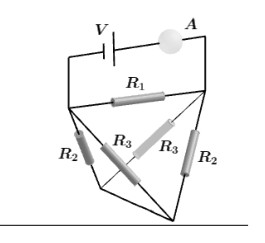 tetraedro con cinque resistori R1 R2 R3
Topic: Circuits Metodi: Kirchhoff’s Laws, Equivalent Circuit Reduction Competenze: Diagrammatic Reasoning, Mathematical Modeling Objects: Resistor, Battery, Galvanometer Fonte: Testo (PDF) — p.3 Soluzione: Soluzioni (PDF)
Very strong tetrahedron
Five resistors are connected to each other to form the tips of a tetrahedron as shown in Figure 1, where , and . If at the ends of a serial generator is connected with an ampere, what is the current measured by the ampere?
The following is the list of the measurement units: The following information is provided:
tetrahedron with five resistors R1 R2 R3
Topic: Circuits Metodi: Kirchhoff’s Laws, Equivalent Circuit Reduction Competenze: Diagrammatic Reasoning, Mathematical Modeling Objects: Resistor, Battery, Galvanometer Fonte: Testo (PDF) — p.3 Soluzione: Soluzioni (PDF)
Gioco di rimbalzi
Antonio vuole lanciare una palla di gomma a Bruno, che abita tre piani sotto di lui. Quindi decide di sfruttare la parete del palazzo accanto, parallela a quella del suo palazzo e distante da essa. La configurazione è schematizzata in figura, dove la finestra è quella di Antonio, mentre la finestra è quella di Bruno. Le finestre sono alte e le quote dei davanzali di e differiscono di . Tenendo conto che sulla parete di fronte è presente una terza finestra , anch’essa aperta, posta più in basso di e di uguali dimensioni, quanto vale il minimo valore del modulo della velocità di lancio per cui la palla riesce a entrare in casa di Bruno? La palla deve essere lanciata dal davanzale della finestra e in direzione orizzontale. Gli urti con le pareti si possono considerare perfettamente elastici.
Unità di misura: m/s. Precisione richiesta: 0.5%.
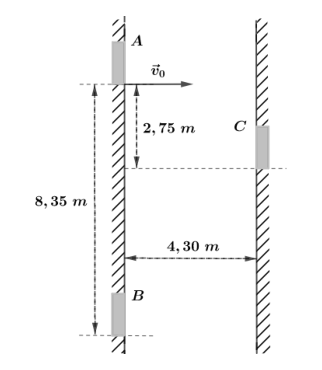 due pareti parallele finestre A B C rimbalzo
Topic: Newtonian Mechanics Metodi: Kinematic Equations, Vector Decomposition, Conservation of Energy Competenze: Diagrammatic Reasoning, Mathematical Modeling, Physical Reasoning Objects: Ball Fonte: Testo (PDF) — p.3 Soluzione: Soluzioni (PDF)
Gioco di rimbalzi
Antonio wants to throw a rubber ball at Bruno, who lives three floors below him. Quindi decide di sfruttare la parete del palazzo accanto, parallela a quella del suo palazzo e distante da essa. The configuration is outlined in Figure, where the window is Antonio’s, while the window is Bruno’s. The windows are high and the window sizes of and differ from . Tenendo conto che sulla parete di fronte è presente una terza finestra , anch’essa aperta, posta più in basso di e di uguali dimensioni, quanto vale il minimo valore del modulo della velocità di lancio per cui la palla riesce a entrare in casa di Bruno? The ball must be thrown from the window sill and in a horizontal direction. The impact on the walls can be considered perfectly elastic.
Unità di misura: m/s. Precisione richiesta: 0.5%.
two parallel walls of windows A B C bounce
Topic: Newtonian Mechanics Metodi: Kinematic Equations, Vector Decomposition, Conservation of Energy Competenze: Diagrammatic Reasoning, Mathematical Modeling, Physical Reasoning Objects: Ball Fonte: Testo (PDF) — p.3 Soluzione: Soluzioni (PDF)
Prima che scoppi
Sotto la campana di vetro di una pompa a vuoto viene posta una sacca chiusa contenente di aria a pressione atmosferica. Il materiale di cui è composta la sacca è un perfetto conduttore di calore. La temperatura del sistema vale , che può essere assunta costante durante tutto il processo. Il meccanismo di aspirazione della pompa fa sì che la pressione dell’aria all’interno della campana sia descritta dalla legge
dove è la pressione atmosferica, è una costante che vale e è il tempo per cui la pompa è rimasta accesa. Quanto calore viene scambiato dall’aria contenuta dentro la sacca con l’ambiente circostante nei primi di funzionamento della pompa? Si supponga che le pareti della sacca non siano mai in tensione.
Unità di misura: J. Precisione richiesta: 0.5%.
Topic: Thermodynamics, Kinetic Theory Metodi: First Law of Thermodynamics, Ideal Gas Law, Calculus-Integration Competenze: Mathematical Modeling, Physical Reasoning Objects: Gas Fonte: Testo (PDF) — p.4 Soluzione: Soluzioni (PDF)
**Before it bursts **
A closed bag containing air at atmospheric pressure is placed under the glass bell of a vacuum pump. The material of the bag is a perfect conductor of heat. The system temperature is , which can be assumed constant throughout the process. The pump’s suction mechanism ensures that the air pressure inside the bell is described by the law
where is the atmospheric pressure, is a constant of and is the time the pump has been on. How much heat is exchanged from the air contained in the bag to the surrounding environment in the first of pump operation? Suppose the bag walls are never tense.
The following is the list of the measurement units: The following information is provided:
Topic: Thermodynamics, Kinetic Theory Metodi: First Law of Thermodynamics, Ideal Gas Law, Calculus-Integration Competenze: Mathematical Modeling, Physical Reasoning Objects: Gas Fonte: Testo (PDF) — p.4 Soluzione: Soluzioni (PDF)
Troppo stabili
Un cilindro di raggio di base viene posto su due blocchi cubici identici di lato e massa , a distanza l’uno dall’altro, come illustrato in figura. Tra i cubi e il pavimento c’è attrito, mentre il cilindro non risente di alcun attrito. Con sorpresa, si nota che il sistema rimane in equilibrio qualsiasi sia la massa del cilindro. Qual è il minimo valore del coefficiente di attrito statico tra i cubi e il pavimento che rende possibile ciò?
Unità di misura: adimensionale. Precisione richiesta: 0.5%.
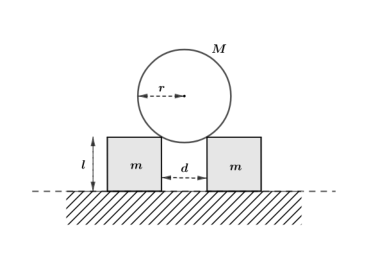 cilindro su due cubi distanti d=r
Topic: Rigid Body Statics, Newtonian Mechanics Metodi: Free-Body Diagram, Vector Decomposition, Torque & Angular Momentum Analysis Competenze: Diagrammatic Reasoning, Mathematical Modeling, Physical Reasoning Objects: Cylinder, Block Fonte: Testo (PDF) — p.4 Soluzione: Soluzioni (PDF)
Troppo stabili
A cylinder of base radius is placed on two identical cubic blocks of side and mass , at a distance from each other, as shown in Figure 1. There is friction between the cubes and the floor, while the cylinder is not affected by any friction. Con sorpresa, si nota che il sistema rimane in equilibrio qualsiasi sia la massa del cilindro. What is the minimum value of the static friction coefficient between the cubes and the floor that makes this possible?
Unità di misura: adimensionale. Precisione richiesta: 0.5%.
cylinder on two cubes d=r
Topic: Rigid Body Statics, Newtonian Mechanics Metodi: Free-Body Diagram, Vector Decomposition, Torque & Angular Momentum Analysis Competenze: Diagrammatic Reasoning, Mathematical Modeling, Physical Reasoning Objects: Cylinder, Block Fonte: Testo (PDF) — p.4 Soluzione: Soluzioni (PDF)
Fontana di Erone
In figura è illustrata una schematizzazione della fontana di Erone, dispositivo ideato dal famoso inventore alessandrino attorno al II secolo d.C. Il vano posto in alto è aperto superiormente e comunica con quello inferiore tramite due sottili condotti verticali, di sezioni trascurabili rispetto a quelle dei contenitori. Le distanze tra le estremità inferiori dei condotti e il fondo del vano inferiore sono molto piccole in confronto alle altezze indicate in figura. Le regioni indicate con , e contengono acqua, mentre contiene aria a pressione leggermente maggiore di quella atmosferica. In un certo momento, le altezze schematizzate in figura valgono , e e, nei condotti verticali, la velocità di salita risulta inferiore del rispetto alla velocità di discesa. Trascurando gli effetti dovuti alla viscosità dell’acqua, quanto vale l’altezza del getto d’acqua in quel momento?
Unità di misura: m. Precisione richiesta: 0.5%.
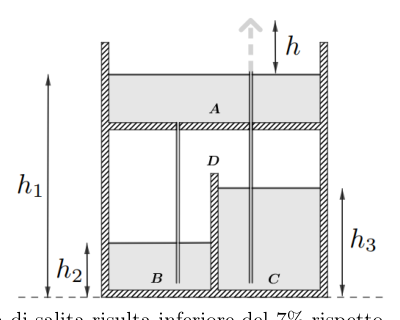 fontana di Erone serbatoi A B C D getto
Topic: Fluid Mechanics Metodi: Bernoulli’s Equation, Hydrostatic Equilibrium, Continuity Equation Competenze: Mathematical Modeling, Physical Reasoning, Diagrammatic Reasoning Objects: Container Fonte: Testo (PDF) — p.4 Soluzione: Soluzioni (PDF)
Fontana di Erone
The figure illustrates a diagram of the Fountain of Erone, a device devised by the famous Alexandrian inventor around the 2nd century AD. The top compartment is open upper and communicates with the bottom compartment through two thin vertical conduits, with sections negligible compared to those of the containers. The distances between the lower ends of the pipes and the bottom of the lower valve are very small compared to the heights shown in the figure. The regions indicated by , and contain water, while contains air at slightly higher atmospheric pressure. At a given point, the heights outlined in the figure are , and and, in vertical pipelines, the climb speed is less than than the descent speed. Trascurando gli effetti dovuti alla viscosità dell’acqua, quanto vale l’altezza del getto d’acqua in quel momento?
Unità di misura: m. Precisione richiesta: 0.5%.
fontana di Erone serbatoi A B C D getto
Topic: Fluid Mechanics Metodi: Bernoulli’s Equation, Hydrostatic Equilibrium, Continuity Equation Competenze: Mathematical Modeling, Physical Reasoning, Diagrammatic Reasoning Objects: Container Fonte: Testo (PDF) — p.4 Soluzione: Soluzioni (PDF)
Trova il colore
In un laboratorio viene svolto l’esperimento delle due fenditure, usando una sorgente di luce monocromatica. Le fenditure utilizzate distano . Sullo schermo, posto a dalle fenditure, vengono misurate le posizioni delle frange di interferenza chiare rispetto a quella centrale. I dati ottenuti sono riportati nella tabella. Quanto vale la lunghezza d’onda della luce emessa dalla sorgente?
| ordine della frangia | distanza [cm] |
|---|---|
| 1 | 1.63 |
| 2 | 3.28 |
| 3 | 4.82 |
| 4 | 6.50 |
| 5 | 8.04 |
| 6 | 9.96 |
Unità di misura: m. Precisione richiesta: 0.5%.
Topic: Wave Optics Metodi: Interference & Diffraction Analysis, Graph Linearization, Experimental Data Analysis Competenze: Graph Linearization, Experimental Data Analysis, Curve Fitting Objects: Slit, Screen Fonte: Testo (PDF) — p.5 Soluzione: Soluzioni (PDF)
Find the color of the MSK1
In a laboratory, the experiment is carried out on the two slits, using a monochrome light source. The cracks used are . On the screen, the position of the clear interference fringes relative to the central fringes is measured at from the cracks. The data obtained are shown in the table. What is the wavelength of light emitted by the source?
♪ The order of the strap ♪ |---|---| | 1 | 1.63 | | 2 | 3.28 | | 3 | 4.82 | | 4 | 6.50 | | 5 | 8.04 | | 6 | 9.96 |
The following is the list of the measurement units: The following information is provided:
Topic: Wave Optics Metodi: Interference & Diffraction Analysis, Graph Linearization, Experimental Data Analysis Competenze: Graph Linearization, Experimental Data Analysis, Curve Fitting Objects: Slit, Screen Fonte: Testo (PDF) — p.5 Soluzione: Soluzioni (PDF)
Sfere fluttuanti nel vuoto
Due sfere perfettamente conduttrici e uguali, di massa , posseggono una certa quantità di carica elettrica. Dopo esser state messe in contatto, vengono allontanate di una distanza molto più grande del loro raggio. Si osserva che, in assenza di vincoli e forze esterne, le posizioni delle due sferette rimangono fisse. In questa situazione, quanto vale, in modulo, la carica presente su una singola sfera?
Unità di misura: C. Precisione richiesta: 0.5%.
Topic: Electrostatics, Gravitation Metodi: Coulomb’s Law, Newton’s Law of Gravitation, Conservation Laws Competenze: Mathematical Modeling, Physical Reasoning Objects: Conducting Sphere Fonte: Testo (PDF) — p.5 Soluzione: Soluzioni (PDF)
The following table shows the number of floating spheres in the vacuum:
Two perfectly conductive and equal spheres, of mass, have a certain amount of electric charge. Once they’ve been put in contact, they’re pushed away a far greater distance than their radius. It is noted that, in the absence of external constraints and forces, the positions of the two spheres remain fixed. In this situation, how much is the charge on a single sphere in the form?
The following is the list of the measurement units: The following information is provided:
Topic: Electrostatics, Gravitation Metodi: Coulomb’s Law, Newton’s Law of Gravitation, Conservation Laws Competenze: Mathematical Modeling, Physical Reasoning Objects: Conducting Sphere Fonte: Testo (PDF) — p.5 Soluzione: Soluzioni (PDF)
Discesa con attrito infinito
Nel libro Come Ti Rovino La Fisica, gli scienziati del pianeta NANA-SANT inventano uno spray che, se spruzzato su superfici solide, riesce a renderne infinito il coefficiente d’attrito. Una sferetta omogenea di massa viene rilasciata da ferma dal punto più alto di una ciotola semisferica capovolta, precedentemente spruzzata con lo spray e fissata al pavimento. La sferetta inizia a muoversi sin da subito di moto puramente rotatorio, mantenuto fino a quando si distacca dalla ciotola. Supponendo che l’accelerazione gravitazionale sulla superficie del pianeta sia pari a quella terrestre, quanto vale la forza di attrito agente sulla sferetta immediatamente prima che avvenga il distacco?
Unità di misura: N. Precisione richiesta: 0.5%.
Topic: Rotational Dynamics, Newtonian Mechanics Metodi: Energy Conservation Method, Free-Body Diagram, Torque & Angular Momentum Analysis Competenze: Diagrammatic Reasoning, Mathematical Modeling, Physical Reasoning Objects: Sphere Fonte: Testo (PDF) — p.5 Soluzione: Soluzioni (PDF)
Descent with infinite friction
In the book How You Ruin Physics, scientists at planet NANA-SANT invent a spray that, when sprayed on solid surfaces, can make the friction coefficient infinite. A homogeneous sphere of mass is released from the top of a pre-sprayed, upturned hemispheric bowl and fixed to the floor. The sphere starts to move from the moment of motion by a purely rotary motion, held until it is detached from the bowl. Assuming that the gravitational acceleration on the planet’s surface is equal to that on Earth, what is the force of friction on the sphere immediately before detachment?
The following is the list of the measurement units: The following information is provided:
Topic: Rotational Dynamics, Newtonian Mechanics Metodi: Energy Conservation Method, Free-Body Diagram, Torque & Angular Momentum Analysis Competenze: Diagrammatic Reasoning, Mathematical Modeling, Physical Reasoning Objects: Sphere Fonte: Testo (PDF) — p.5 Soluzione: Soluzioni (PDF)
Tutti in riga
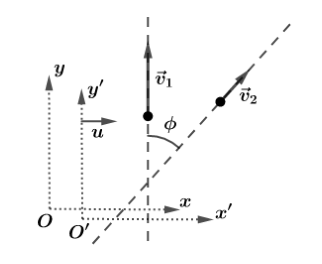
In un dato sistema di riferimento inerziale, due particelle relativistiche si muovono di moto rettilineo uniforme. La prima ha velocità , dove è la velocità della luce, diretta come l’asse , mentre la seconda si muove a velocità lungo una direzione inclinata di rispetto alla prima, come schematizzato in figura. Che velocità dovrebbe avere un osservatore , in moto lungo l’asse , affinché possa vedere le due particelle muoversi su rette parallele tra di loro? Fornire la risposta in unità della velocità della luce .
Unità di misura: adimensionale. Precisione richiesta: 0.5%.
 vettori velocità v1 v2 osservatore O’ asse x
Topic: Special Relativity Metodi: Lorentz Transformation, Vector Decomposition, Relativistic Energy-Momentum Competenze: Mathematical Modeling, Physical Reasoning Objects: — Fonte: Testo (PDF) — p.5 Soluzione: Soluzioni (PDF)
All in line
In a given inertial reference system, two relativistic particles move in a uniform straight-line motion. The first has speed , where is the speed of light, directed as the axis , while the second moves at speed along an inclined direction of with respect to the first, as outlined in the figure. What speed should an observer , moving along the axis, have so that he can see the two particles moving in parallel lines with each other? Provide the response in units of the speed of light .
The measuring unit: * additional dimension. The following information is provided:
The speed of the vehicle shall be determined by the following:
Topic: Special Relativity Metodi: Lorentz Transformation, Vector Decomposition, Relativistic Energy-Momentum Competenze: Mathematical Modeling, Physical Reasoning Objects: — Fonte: Testo (PDF) — p.5 Soluzione: Soluzioni (PDF)
In quel di San Vito
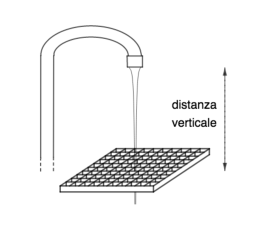
Dal bocchettone di un pozzo artesiano, avente apertura circolare di raggio , fuoriesce un flusso d’acqua di portata di . Vogliamo porre sotto il rubinetto una rete a maglie quadrate, di lato , che non disturbi il flusso dell’acqua, come schematizzato in figura. Assumendo trascurabili la resistenza dell’aria e la viscosità dell’acqua, quanto vale la minima distanza verticale che deve esserci tra la bocca del rubinetto e la griglia?
Unità di misura: m. Precisione richiesta: 0.5%.
 getto acqua rubinetto rete maglie quadrate
 orbita iperbolica asteroide pianeta parametro b
Topic: Fluid Mechanics, Newtonian Mechanics Metodi: Bernoulli’s Equation, Continuity Equation, Kinematic Equations Competenze: Mathematical Modeling, Diagrammatic Reasoning, Physical Reasoning Objects: — Fonte: Testo (PDF) — p.6 Soluzione: Soluzioni (PDF)
In quel di San Vito
From the nozzle of an artesian well, with a circular aperture of radius, a flow of water of flow is produced. Vogliamo porre sotto il rubinetto una rete a maglie quadrate, di lato , che non disturbi il flusso dell’acqua, come schematizzato in figura. Assuming the resistance of the air and the viscosity of the water are negligible, what is the minimum vertical distance that must be between the mouth of the tap and the grill?
Unità di misura: m. Precisione richiesta: 0.5%.
*water tap water net square mesh *
orbita iperbolica asteroide pianeta parametro b
Topic: Fluid Mechanics, Newtonian Mechanics Metodi: Bernoulli’s Equation, Continuity Equation, Kinematic Equations Competenze: Mathematical Modeling, Diagrammatic Reasoning, Physical Reasoning Objects: — Fonte: Testo (PDF) — p.6 Soluzione: Soluzioni (PDF)
Asteroide in orbita
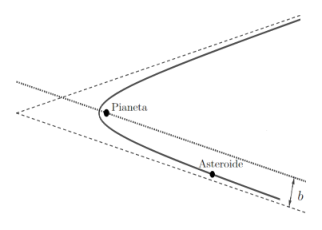
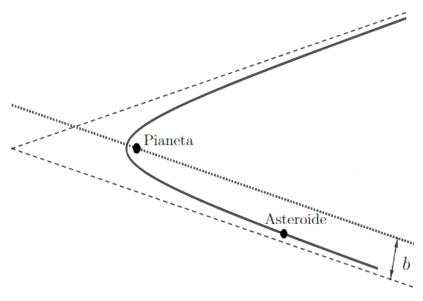
Un asteroide di massa si avvicina a un pianeta su un’orbita iperbolica con parametro di impatto , come mostrato in figura. La velocità dell’asteroide nel punto dell’orbita più vicino al pianeta è . Sapendo che la velocità dello stesso a grandissime distanze dal pianeta è , quanto vale la massa del pianeta?
 Traiettoria iperbolica dell’asteroide attorno al pianeta, con il parametro di impatto indicato.
Unità di misura: kg. Precisione richiesta: 0.5%.
Topic: Gravitation Metodi: Conservation of Energy, Conservation of Momentum, Newton’s Law of Gravitation Competenze: Mathematical Modeling, Physical Reasoning Objects: Planet Fonte: Testo (PDF) — p.6 Soluzione: Soluzioni (PDF)
The following is the list of the asteroids in orbit:
An asteroid of mass approaches a planet in a hyperbolic orbit with an impact parameter , as shown in Figure 1. The speed of the asteroid at the point of orbit nearest the planet is . Knowing that the velocity of the same at very large distances from the planet is , what is the mass of the planet worth?
Hyperbolic trajectory of the asteroid around the planet, with the impact parameter indicated.
The unit of measurement: * kg. The following information is provided:
Topic: Gravitation Metodi: Conservation of Energy, Conservation of Momentum, Newton’s Law of Gravitation Competenze: Mathematical Modeling, Physical Reasoning Objects: Planet Fonte: Testo (PDF) — p.6 Soluzione: Soluzioni (PDF)