Riscalare il tempo
Un oggetto di massa si muove senza attrito e sotto l’effetto della gravità su una guida semicircolare fissata al suolo. La guida è disposta su un piano verticale e il suo diametro, i cui estremi sono i punti e , è orizzontale, come in figura. Sappiamo che l’oggetto impiega per andare da a partendo da fermo. Se il raggio della guida raddoppiasse, quanto tempo impiegherebbe l’oggetto?
Unità di misura: s. Precisione richiesta: .
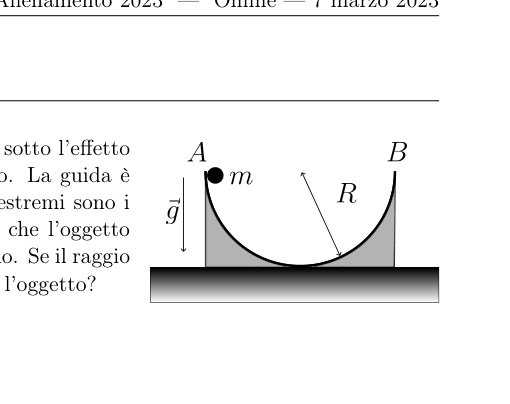 guida semicircolare verticale con AB orizzontale
Topic: Newtonian Mechanics, Oscillations & Waves Metodi: Dimensional Analysis, Small-Angle Approximation Competenze: Mathematical Modeling, Physical Reasoning Objects: — Fonte: Testo (PDF) — p.3 Soluzione: Soluzioni (PDF)
Riscalare il tempo
An object of mass moves without friction and under the influence of gravity on a semi-circular guide fixed to the ground. The guide is arranged on a vertical plane and its diameter, the ends of which are and , is horizontal, as shown in Figure 1. We know that the object uses to go from to starting from the stationary. If the driving radius doubled, how long would it take the object?
Unità di misura: s. Precisione richiesta: .
guida semicircolare verticale con AB orizzontale
Topic: Newtonian Mechanics, Oscillations & Waves Metodi: Dimensional Analysis, Small-Angle Approximation Competenze: Mathematical Modeling, Physical Reasoning Objects: — Fonte: Testo (PDF) — p.3 Soluzione: Soluzioni (PDF)
Biliardo interrotto
Marco sta giocando a biliardo. Egli colpisce una pallina, che raggiunge una velocità di ; questa ne urta altre (in modo parzialmente anelastico), che a loro volta iniziano a muoversi e ad urtare altre palline. La sorellina di Marco passa di lì e ingenuamente prende una pallina dal tavolo. Ella dice a Marco che le palline in movimento restate sul tavolo sono 3 e si muovono:
- con velocità di e angolo di rispetto a ;
- con velocità di e angolo di rispetto a ;
- con velocità di e angolo di rispetto a .
Si assuma che tutte le palline siano identiche, che nessuna abbia sbattuto sui bordi, che gli angoli siano misurati in senso antiorario e che attriti e moti rotatori siano trascurabili. Marco vuole calcolare la velocità della pallina rubata dalla sorellina. Se e sono le componenti di parallela e perpendicolare a , quanto vale ? Se ciò che dice la sorellina è impossibile, rispondere 0.
Unità di misura: m/s. Precisione richiesta: .
Topic: Conservation of Momentum, Newtonian Mechanics Metodi: Conservation of Momentum, Vector Decomposition Competenze: Mathematical Modeling, Physical Reasoning Objects: Ball Fonte: Testo (PDF) — p.3 Soluzione: Soluzioni (PDF)
Biliardo interrotto
Marco is playing pool. He hits a ball, which reaches a speed of ; this hits others (partially anelastically), which in turn start to move and hit other balls. Marco’s little sister walks by and naively takes a ball from the table. She tells Marco that the balls that are left on the table are 3 and they move:
- with a speed of and an angle of with respect to ;
- with a speed of and an angle of with respect to ;
- with a speed of and an angle of with respect to .
It assumes that all balls are identical, that none have hit the edges, that the angles are measured clockwise and that friction and rotational motion are negligible. Marco vuole calcolare la velocità della pallina rubata dalla sorellina. If and are the components of parallel to and perpendicular to , what is ? If what the little sister says is impossible, answer 0.
Unità di misura: m/s. Precisione richiesta: .
Topic: Conservation of Momentum, Newtonian Mechanics Metodi: Conservation of Momentum, Vector Decomposition Competenze: Mathematical Modeling, Physical Reasoning Objects: Ball Fonte: Testo (PDF) — p.3 Soluzione: Soluzioni (PDF)
Bottiglietta in freezer
Consideriamo una bottiglietta rigida alla temperatura di , il cui volume è occupato per una frazione di acqua, e per una frazione di aria a pressione atmosferica. La bottiglietta viene chiusa in modo ermetico e posta in un freezer, che ne porta la temperatura a . Quanto deve valere affinché la pressione finale all’interno della bottiglietta sia ancora uguale a quella atmosferica? Si supponga che l’aria si comporti come un gas perfetto e si trascuri la presenza di vapore acqueo.
Unità di misura: adimensionale. Precisione richiesta: .
Topic: Thermodynamics Metodi: Ideal Gas Law, Physical Modeling Competenze: Mathematical Modeling, Physical Reasoning Objects: Gas, Container Fonte: Testo (PDF) — p.3 Soluzione: Soluzioni (PDF)
Bottle in the freezer
Consider a bottle rigid at , the volume of which is occupied for a fraction of water, and for a fraction of air at atmospheric pressure. The bottle is sealed in a sealed manner and placed in a freezer, which brings the temperature to . How much must be used to ensure that the final pressure inside the bottle remains the same as that in the atmosphere? Suppose the air behaves like a perfect gas and you ignore the presence of water vapor.
Unità di misura: adimensionale. Precisione richiesta: .
Topic: Thermodynamics Metodi: Ideal Gas Law, Physical Modeling Competenze: Mathematical Modeling, Physical Reasoning Objects: Gas, Container Fonte: Testo (PDF) — p.3 Soluzione: Soluzioni (PDF)
Svuotamento di un secchio
Un secchio cilindrico, con area di base pari ad , è riempito di acqua fino ad un’altezza ignota. Sul fondo del secchio viene fatto un foro di sezione , anch’essa sconosciuta. Sapendo che in il secchio si è svuotato di una frazione , quanto vale il tempo rimanente prima dello svuotamento completo?
Unità di misura: s. Precisione richiesta: .
Topic: Fluid Mechanics Metodi: Bernoulli’s Equation, Differential Equations, Calculus-Integration Competenze: Mathematical Modeling, Physical Reasoning Objects: Container Fonte: Testo (PDF) — p.3 Soluzione: Soluzioni (PDF)
Emptying of a bucket
A cylindrical bucket with a base area of shall be filled with water up to an unknown height of . A section hole is made on the bottom of the bucket, which is also unknown. Knowing that in the bucket has emptied itself by a fraction , what is the remaining time before full emptiing?
Unità di misura: s. Precisione richiesta: .
Topic: Fluid Mechanics Metodi: Bernoulli’s Equation, Differential Equations, Calculus-Integration Competenze: Mathematical Modeling, Physical Reasoning Objects: Container Fonte: Testo (PDF) — p.3 Soluzione: Soluzioni (PDF)
Discesa dal cilindro
Un cilindro cavo, di raggio , rotola senza strisciare su una superficie fissa a forma di semicilindro, di raggio , sotto l’effetto della gravità. Sia l’angolo formato dalla verticale con la congiungente i centri dei due oggetti, come in figura. Sapendo che quando la velocità del cilindro è molto piccola, qual è il valore di nel momento in cui il cilindro si stacca dalla superficie?
Unità di misura: rad. Precisione richiesta: .
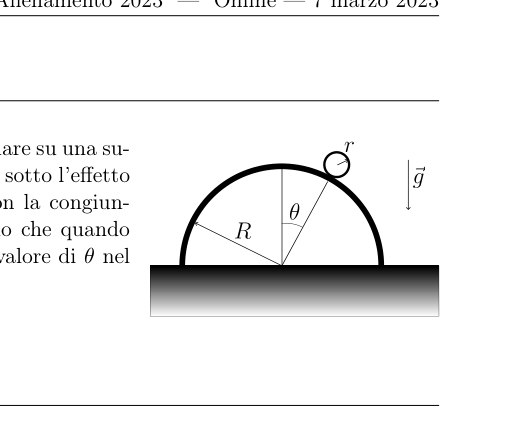 cilindro cavo su semicilindro fisso, angolo θ
Topic: Rotational Dynamics, Conservation of Energy Metodi: Energy Conservation Method, Free-Body Diagram, Torque & Angular Momentum Analysis Competenze: Diagrammatic Reasoning, Mathematical Modeling, Physical Reasoning Objects: Cylinder Fonte: Testo (PDF) — p.4 Soluzione: Soluzioni (PDF)
Descending from the cylinder
A cable cylinder, radius, rolls without slipping on a fixed semicylinder surface, radius, under the effect of gravity. The angle formed by the vertical with the connecting centers of the two objects, as shown in Figure 1 shall be . Sapendo che quando la velocità del cilindro è molto piccola, qual è il valore di nel momento in cui il cilindro si stacca dalla superficie?
Unità di misura: rad. Precisione richiesta: .
cable cylinder on a fixed semicircular, angle θ
Topic: Rotational Dynamics, Conservation of Energy Metodi: Energy Conservation Method, Free-Body Diagram, Torque & Angular Momentum Analysis Competenze: Diagrammatic Reasoning, Mathematical Modeling, Physical Reasoning Objects: Cylinder Fonte: Testo (PDF) — p.4 Soluzione: Soluzioni (PDF)
Equazione del diodo
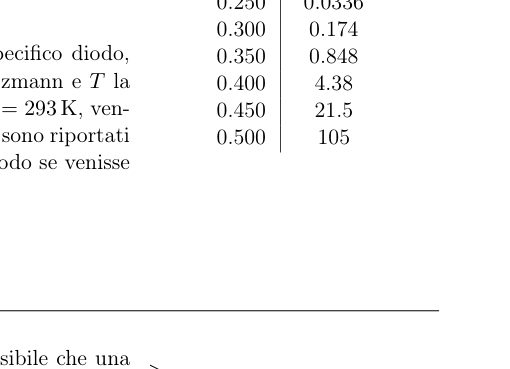
Il diodo è un componente circuitale non lineare. Quando ai suoi capi viene applicata una tensione , la corrente che scorre è determinata dall’equazione di Shockley: dove e sono costanti che dipendono dallo specifico diodo, è la carica elementare, la costante di Boltzmann e la temperatura. In una stanza a vengono effettuate alcune misure su un diodo, riportate in tabella. Quanta corrente scorrerebbe attraverso il diodo se venisse applicata ai suoi capi una tensione di ?
| [V] | [mA] |
|---|---|
| 0.100 | 0.000262 |
| 0.150 | 0.00135 |
| 0.200 | 0.00679 |
| 0.250 | 0.0336 |
| 0.300 | 0.174 |
| 0.350 | 0.848 |
| 0.400 | 4.38 |
| 0.450 | 21.5 |
| 0.500 | 105 |
Unità di misura: mA. Precisione richiesta: .
Topic: Circuits, Modern-Quantum Physics Metodi: Graph Linearization, Curve Fitting, Experimental Data Analysis Competenze: Experimental Data Analysis, Graph Linearization, Curve Fitting Objects: Resistor Fonte: Testo (PDF) — p.4 Soluzione: Soluzioni (PDF)
Equazione del diodo
The diode is a nonlinear circuit component. When a voltage is applied to its heads, the current flowing is determined by the Shockley equation: where and are diode-specific constants, is the elementary charge, the Boltzmann constant and the temperature. In a room at some measurements are made on a diode, as shown in the table. How much current would flow through the diode if a voltage of were applied to its heads?
| [V] | [mA] |
|---|---|
| 0.100 | 0.000262 |
| 0.150 | 0.00135 |
| 0.200 | 0.00679 |
| 0.250 | 0.0336 |
| 0.300 | 0.174 |
| 0.350 | 0.848 |
| 0.400 | 4.38 |
| 0.450 | 21.5 |
| 0.500 | 105 |
Unità di misura: mA. Precisione richiesta: .
Topic: Circuits, Modern-Quantum Physics Metodi: Graph Linearization, Curve Fitting, Experimental Data Analysis Competenze: Experimental Data Analysis, Graph Linearization, Curve Fitting Objects: Resistor Fonte: Testo (PDF) — p.4 Soluzione: Soluzioni (PDF)
Radiazione Cherenkov
In un mezzo trasparente di indice di rifrazione è possibile che una particella si muova a velocità . In tal caso, se la particella è carica, si osserva l’emissione di radiazione elettromagnetica (radiazione Cherenkov) e la conseguente formazione di un “cono d’urto”, in analogia con un aereo supersonico. Calcolare l’angolo di semiapertura del cono (indicato con in figura) per un elettrone che si muove nell’acqua () con velocità .
Unità di misura: °. Precisione richiesta: .
 cono d’urto Cherenkov, semiangolo α
Topic: Oscillations & Waves, Special Relativity Metodi: Superposition Principle, Small-Angle Approximation Competenze: Mathematical Modeling, Physical Reasoning Objects: Electron Fonte: Testo (PDF) — p.4 Soluzione: Soluzioni (PDF)
Radiazione Cherenkov
In a transparent medium of refractive index it is possible for a particle to move at speed. In this case, if the particle is charged, the emission of electromagnetic radiation (Cherenkov radiation) and the resulting formation of a ‘collision cone’ is observed, analogous to a supersonic aircraft. Calculate the cone semiapperture angle (indicated by in Figure) for an electron moving in water () at a speed .
Unità di misura: °. Precisione richiesta: .
cono d’urto Cherenkov, semiangolo α
Topic: Oscillations & Waves, Special Relativity Metodi: Superposition Principle, Small-Angle Approximation Competenze: Mathematical Modeling, Physical Reasoning Objects: Electron Fonte: Testo (PDF) — p.4 Soluzione: Soluzioni (PDF)
Particelle su un segmento
particelle uguali di massa sono vincolate a muoversi su un segmento di lunghezza . Tutti gli urti sono completamente elastici e la temperatura del sistema è . Quanto vale la forza media esercitata dalle particelle più esterne sugli estremi del segmento?
Unità di misura: N. Precisione richiesta: .
Topic: Kinetic Theory, Newtonian Mechanics Metodi: Kinetic Theory of Gases, Statistical Averaging, Impulse-Momentum Theorem Competenze: Mathematical Modeling, Physical Reasoning Objects: Particle Beam Fonte: Testo (PDF) — p.4 Soluzione: Soluzioni (PDF)
Particelle su un segmento
particles of equal mass are bound to move over a length segment . All impacts are fully elastic and the system temperature is . What is the mean force exerted by the outermost particles on the ends of the segment?
Unità di misura: N. Precisione richiesta: .
Topic: Kinetic Theory, Newtonian Mechanics Metodi: Kinetic Theory of Gases, Statistical Averaging, Impulse-Momentum Theorem Competenze: Mathematical Modeling, Physical Reasoning Objects: Particle Beam Fonte: Testo (PDF) — p.4 Soluzione: Soluzioni (PDF)
Lanci da piattaforme rotanti
Una piattaforma circolare, di densità uniforme, massa e raggio , è in grado di ruotare liberamente attorno al proprio centro. Sul bordo della piattaforma è collocato un cannone che lancia un proiettile di massa , con una velocità di rispetto al cannone. Il proiettile viaggia di moto rettilineo uniforme, fino ad essere raccolto da uno schermo di sabbia posto sul bordo di un’identica piattaforma. La velocità del proiettile è tangente ad entrambe le piattaforme e le masse del cannone e della sabbia sono trascurabili. Sapendo che inizialmente le piattaforme sono ferme, quanto vale la velocità angolare finale della seconda piattaforma?
Unità di misura: rad/s. Precisione richiesta: .
 rete a scala di resistenze R e 2R
Topic: Rotational Dynamics, Conservation of Momentum Metodi: Torque & Angular Momentum Analysis, Conservation of Momentum, Symmetry Argument Competenze: Diagrammatic Reasoning, Mathematical Modeling, Physical Reasoning Objects: Disk, Projectile Fonte: Testo (PDF) — p.5 Soluzione: Soluzioni (PDF)
Lanci da piattaforme rotanti
A circular platform, of uniform density, mass and radius , is capable of rotating freely around its centre. A cannon is placed on the edge of the platform, which launches a bullet of mass , with a speed of with respect to the cannon. The bullet travels in a uniform straight-line motion until it is picked up by a sand screen placed on the edge of an identical platform. The speed of the bullet is tangent to both platforms and the mass of the gun and sand is negligible. Knowing that the platforms are initially stationary, what is the final angular velocity of the second platform?
Unità di misura: rad/s. Precisione richiesta: .
*R and 2R resistance scale networks *
Topic: Rotational Dynamics, Conservation of Momentum Metodi: Torque & Angular Momentum Analysis, Conservation of Momentum, Symmetry Argument Competenze: Diagrammatic Reasoning, Mathematical Modeling, Physical Reasoning Objects: Disk, Projectile Fonte: Testo (PDF) — p.5 Soluzione: Soluzioni (PDF)
Filo che si scalda
Un certo filo metallico di forma cilindrica è un conduttore ohmico di corrente e conduce perfettamente il calore. L’ambiente è a temperatura , costante nel tempo. Il filo perde calore per contatto con l’aria con la legge , dove è la potenza dissipata, la differenza tra la temperatura del filo e l’aria e l’area di contatto. La resistività del metallo è dove , è la temperatura del filo e . Se ai capi del filo viene posta una differenza di potenziale , dopo molto tempo si misura . Quale sarebbe la temperatura del filo, dopo molto tempo, se la differenza di potenziale venisse raddoppiata?
Unità di misura: °C. Precisione richiesta: .
Topic: Circuits, Thermodynamics Metodi: Energy Conservation Method, Physical Modeling Competenze: Mathematical Modeling, Physical Reasoning Objects: Wire, Resistor Fonte: Testo (PDF) — p.5 Soluzione: Soluzioni (PDF)
Water to be heated
A certain cylindrical-shaped metal wire is an ohmic conductor of current and conducts heat perfectly. The ambient temperature is , constant over time. The wire loses heat by contact with air with the law , where is the dissipated power, the difference between the wire temperature and the air and the contact area. The resistivity of the metal is where , is the temperature of the wire and . If the thread heads are given a potential difference of , after a long time is measured. What would the temperature of the wire be after a long time, if the potential difference were doubled?
Unità di misura: °C. Precisione richiesta: .
Topic: Circuits, Thermodynamics Metodi: Energy Conservation Method, Physical Modeling Competenze: Mathematical Modeling, Physical Reasoning Objects: Wire, Resistor Fonte: Testo (PDF) — p.5 Soluzione: Soluzioni (PDF)
Superman supersonico
Superman riesce a volare più veloce del suono (che ha velocità ). Muovendosi di moto rettilineo uniforme, egli vola da casa sua ad una cabina telefonica e torna immediatamente indietro alla stessa velocità . Se all’andata egli parla ad una frequenza , qual è il minimo valore di affinché egli possa sentire sulla via del ritorno ciò che aveva detto all’andata (seppur distorto e al contrario)? Si supponga che le sue orecchie siano sensibili a suoni di frequenza compresa tra e .
Unità di misura: m/s. Precisione richiesta: .
Topic: Oscillations & Waves Metodi: Wave Equation, Approximation & Series Expansion, Physical Modeling Competenze: Mathematical Modeling, Physical Reasoning Objects: — Fonte: Testo (PDF) — p.5 Soluzione: Soluzioni (PDF)
Superman supersonico
Superman can fly faster than sound (which has a speed of ). Moving on a uniform straight bike, he flies from his home to a telephone booth and immediately returns at the same speed . If on the way he speaks at a frequency , what is the minimum value of so that he can hear on the way back what he said on the way back (even if distorted and vice versa)? Assume that your ears are sensitive to frequencies ranging from to .
Unità di misura: m/s. Precisione richiesta: .
Topic: Oscillations & Waves Metodi: Wave Equation, Approximation & Series Expansion, Physical Modeling Competenze: Mathematical Modeling, Physical Reasoning Objects: — Fonte: Testo (PDF) — p.5 Soluzione: Soluzioni (PDF)
Scaletta di resistenze
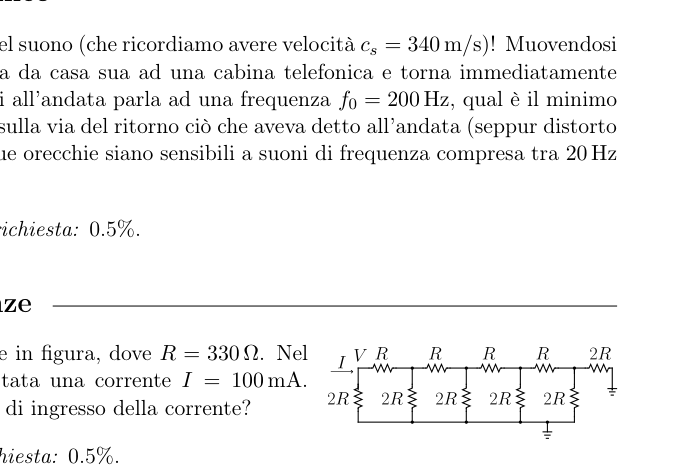
Si consideri la “scaletta” di resistenze in figura, dove . Nel vertice in alto a sinistra viene iniettata una corrente . Quanto vale la tensione nel punto di ingresso della corrente?
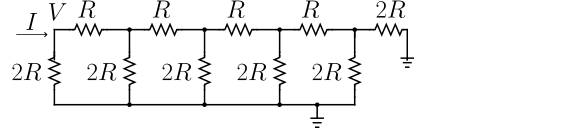 Rete a scala con 5 “pioli”: resistenze orizzontali in alto (l’ultima ) e resistenze verticali verso massa; corrente iniettata nel vertice in alto a sinistra dove si misura .
Unità di misura: V. Precisione richiesta: .
Topic: Circuits Metodi: Kirchhoff’s Laws, Equivalent Circuit Reduction, Symmetry Argument Competenze: Diagrammatic Reasoning, Mathematical Modeling, Physical Reasoning Objects: Resistor Fonte: Testo (PDF) — p.5 Soluzione: Soluzioni (PDF)
Scaletta di resistenze
Consider the resistance ‘scale’ in the figure, where . Inject a current at the top left. What is the voltage at the current input point?
Five-pole scale network: horizontal resistance at the top (last ) and vertical resistance to mass; current injected into the top left where is measured.
Unità di misura: V. Precisione richiesta: .
Topic: Circuits Metodi: Kirchhoff’s Laws, Equivalent Circuit Reduction, Symmetry Argument Competenze: Diagrammatic Reasoning, Mathematical Modeling, Physical Reasoning Objects: Resistor Fonte: Testo (PDF) — p.5 Soluzione: Soluzioni (PDF)