Acque agitate
In un fiume avente larghezza l’acqua fluisce parallelamente alle sponde con velocità massima al centro, , e nulla in corrispondenza delle sponde. Si assuma che il grafico che rappresenta la velocità della corrente in funzione della distanza da una delle due sponde sia una parabola. Un nuotatore (di dimensioni trascurabili) desidera attraversare il fiume. Egli procede nuotando sempre con velocità costante perpendicolare alle sponde, come in figura. Si determini lo spostamento a valle del nuotatore durante l’attraversamento.
Unità di misura: m. Precisione richiesta: 0.5%.
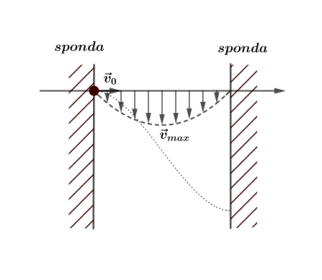 sezione fiume con profilo velocità
Topic: Fluid Mechanics, Newtonian Mechanics Metodi: Calculus-Integration, Vector Decomposition, Kinematic Equations Competenze: Mathematical Modeling, Diagrammatic Reasoning Objects: — Fonte: Testo (PDF) — p.3 Soluzione: Soluzioni (PDF)
The following table shows the results of the calculation of the total amount of the subsidy:
In a river with a width of , the water flows parallel to the shores at maximum speed in the center, , and nothing in line with the shores. The graph representing the speed of the current in relation to the distance from one side of the two sides is assumed to be a parabola. A swimmer (of negligible size) wants to cross the river. He proceeds swimming at constant speed perpendicular to the shores, as shown in Figure 1. The downward movement of the swimmer during the crossing shall be determined.
The following is the list of the measurement units: The following information is provided:
river section with speed profile
Topic: Fluid Mechanics, Newtonian Mechanics Metodi: Calculus-Integration, Vector Decomposition, Kinematic Equations Competenze: Mathematical Modeling, Diagrammatic Reasoning Objects: — Fonte: Testo (PDF) — p.3 Soluzione: Soluzioni (PDF)
Via col vento
Un aereo di linea entra in una zona lunga in cui soffia del vento distribuito omogeneamente. Quando l’aereo viaggia parallelamente al vento e nel suo stesso verso, a regime impiega per percorrere l’intero tratto. Quando, invece, viaggia in verso opposto, impiega . Quanto vale il rapporto tra la velocità dell’aereo e quella del vento?
Unità di misura: adimensionale. Precisione richiesta: 0.5%.
Topic: Newtonian Mechanics Metodi: Kinematic Equations, Vector Decomposition Competenze: Mathematical Modeling, Physical Reasoning Objects: — Fonte: Testo (PDF) — p.3 Soluzione: Soluzioni (PDF)
Wind drive
A line aircraft enters a long zone where uniformly distributed wind is blowing. When the aircraft is travelling parallel to the wind and in its own direction, it uses to travel the entire route. When travelling in the opposite direction, it uses . What is the ratio of the plane’s speed to that of the wind?
The measuring unit: ** additional dimension. The following information is provided:
Topic: Newtonian Mechanics Metodi: Kinematic Equations, Vector Decomposition Competenze: Mathematical Modeling, Physical Reasoning Objects: — Fonte: Testo (PDF) — p.3 Soluzione: Soluzioni (PDF)
The tablecloth trick
Un oggetto di dimensioni trascurabili e massa è appoggiato su un tavolino inamovibile , al centro di una tovaglietta sottile avente massa e lunga ; la figura illustra la situazione iniziale. I coefficienti di attrito statico e dinamico tra i vari oggetti descritti valgono , e . Si desidera rimuovere la tovaglietta spostando al massimo di dal punto iniziale, senza toccarlo. Qual è la forza minima con cui bisogna tirare per realizzare questo proposito? Si assuma che la forza, applicata orizzontalmente, sia costante nel tempo e che durante la sua applicazione la tovaglietta rimanga interamente sul tavolo.
Unità di misura: N. Precisione richiesta: 0.5%.
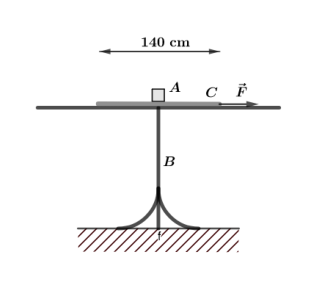 tavolo con oggetto A tovaglietta e forza F
Topic: Newtonian Mechanics Metodi: Free-Body Diagram, Kinematic Equations, Conservation of Energy Competenze: Mathematical Modeling, Diagrammatic Reasoning Objects: Block Fonte: Testo (PDF) — p.3 Soluzione: Soluzioni (PDF)
The tablecloth trick
An object of negligible size and mass is resting on a stationary table , in the centre of a thin towel with mass and length ; the figure illustrates the initial situation. The coefficients of static and dynamic friction between the various described objects are , and . You want to remove the towel by moving to a maximum of from the starting point, without touching it. What is the minimum force to pull to achieve this? The force applied horizontally is assumed to be constant over time and the towel remains entirely on the table during its application.
The following is the list of the measurement units: The following information is provided:
*table subject A towel and force F *
Topic: Newtonian Mechanics Metodi: Free-Body Diagram, Kinematic Equations, Conservation of Energy Competenze: Mathematical Modeling, Diagrammatic Reasoning Objects: Block Fonte: Testo (PDF) — p.3 Soluzione: Soluzioni (PDF)
Gavettone contro un muro
Giovanni lancia un gavettone contro un muro che si trova davanti a lui. Il gavettone parte da un’altezza pari a con una velocità di e un angolo di lancio (rispetto al terreno) di verso l’alto. Sapendo che il muro dista dal punto di lancio e che l’attrito con l’aria è trascurabile, a quale altezza il gavettone si scontra con il muro?
Unità di misura: m. Precisione richiesta: 0.5%.
Topic: Newtonian Mechanics Metodi: Kinematic Equations, Vector Decomposition Competenze: Mathematical Modeling, Diagrammatic Reasoning Objects: Projectile Fonte: Testo (PDF) — p.3 Soluzione: Soluzioni (PDF)
Gavettone contro un muro
John throws a gavel at a wall in front of him. The gauge shall start at a height of with a speed of and a launch angle (as compared to the ground) of upwards. Sapendo che il muro dista dal punto di lancio e che l’attrito con l’aria è trascurabile, a quale altezza il gavettone si scontra con il muro?
Unità di misura: m. Precisione richiesta: 0.5%.
Topic: Newtonian Mechanics Metodi: Kinematic Equations, Vector Decomposition Competenze: Mathematical Modeling, Diagrammatic Reasoning Objects: Projectile Fonte: Testo (PDF) — p.3 Soluzione: Soluzioni (PDF)
Faro relativistico
Un’astronave viaggia a una velocità costante comparabile a quella della luce e passa in prossimità di un faro galattico, che emette luce monocromatica isotropicamente. La luce rilevata dall’astronave in fase di avvicinamento a grande distanza dal faro ha lunghezza d’onda . Quando l’equipaggio vede la luce giungere ortogonalmente alla traiettoria di viaggio, si misura una lunghezza d’onda di . Quale sarà la lunghezza d’onda registrata dall’astronave quando questa avrà lasciato il faro alle sue spalle e sarà molto lontana da esso?
Unità di misura: nm. Precisione richiesta: 0.5%.
Topic: Special Relativity Metodi: Lorentz Transformation, Relativistic Energy-Momentum Competenze: Mathematical Modeling, Physical Reasoning Objects: Star Fonte: Testo (PDF) — p.4 Soluzione: Soluzioni (PDF)
The following table shows the results of the calculations:
A spacecraft travels at a constant speed comparable to that of light and passes near a galactic lighthouse, which emits monochrome light isotropically. The light detected by the spacecraft in close proximity to the beacon has a wavelength of . When the crew sees the light reaching the travel path orthogonal to the travel path, a wavelength of is measured. What will be the wavelength recorded by the spacecraft when it leaves the beacon behind and is far away from it?
The measurement unit is the measurement unit of the measurement unit. The following information is provided:
Topic: Special Relativity Metodi: Lorentz Transformation, Relativistic Energy-Momentum Competenze: Mathematical Modeling, Physical Reasoning Objects: Star Fonte: Testo (PDF) — p.4 Soluzione: Soluzioni (PDF)
L’angioletto di Cartesio
In un grande recipiente aperto superiormente e pieno di acqua fino all’altezza di dal fondo, si pone un’ampolla di vetro di massa e contenente un volume di aria, come illustrato in figura. L’ampolla è molto larga e ha un’altezza trascurabile rispetto a quella dell’acqua. Si fa depositare sul fondo del recipiente l’ampolla, con l’imboccatura rivolta verso il basso, e si attende un lungo periodo di tempo. Successivamente, si dispone il tutto sotto una campana di vetro a tenuta stagna e si riduce molto lentamente la pressione al suo interno da quella atmosferica fino a , osservando che l’ampolla si stacca dal fondo non appena si raggiunge questa pressione. Le condizioni dell’ambiente attorno alla campana di vetro non subiscono variazioni durante il processo. Supponendo che durante l’esperimento non sia fuoriuscita aria dall’ampolla, si calcoli sapendo che la densità del vetro vale e quella dell’aria nel laboratorio vale .
Si ricorda che: .
Unità di misura: . Precisione richiesta: 0.5%.
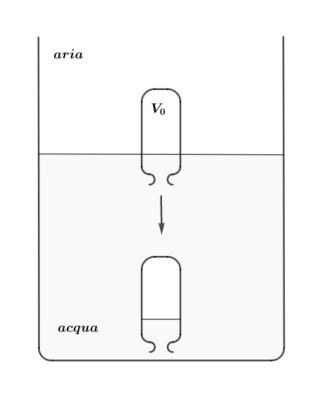 ampolla di vetro immersa in acqua
Topic: Fluid Mechanics, Thermodynamics Metodi: Hydrostatic Equilibrium, Ideal Gas Law, Free-Body Diagram Competenze: Mathematical Modeling, Physical Reasoning Objects: Container, Gas Fonte: Testo (PDF) — p.4 Soluzione: Soluzioni (PDF)
L’angioletto di Cartesio
In a large container open above and filled with water up to from the bottom, a glass vial of mass and containing a volume of air is placed, as shown in Figure 1. The vial is very wide and has a negligible height compared to that of water. The bottle is placed on the bottom of the container, the container facing downwards, and a long period of time is expected. Next, the whole is placed under a stainless steel glass bell and the pressure inside is very slowly reduced from atmospheric to , observing that the vial is detached from the bottom as soon as this pressure is reached. The environmental conditions surrounding the glass bell shall not change during the process. Assuming that no air was leaked from the vial during the experiment, is calculated knowing that the glass density is and that the air density in the laboratory is .
Si ricorda che: .
Unità di misura: . Precisione richiesta: 0.5%.
water-dipped glass bottle
Topic: Fluid Mechanics, Thermodynamics Metodi: Hydrostatic Equilibrium, Ideal Gas Law, Free-Body Diagram Competenze: Mathematical Modeling, Physical Reasoning Objects: Container, Gas Fonte: Testo (PDF) — p.4 Soluzione: Soluzioni (PDF)
Compressione asimmetrica
In un piccolo recipiente di forma cilindrica, chiuso sul fondo e con raggio di base di , sono presenti due pistoni, che lo dividono in due sezioni non comunicanti ( e ), come in figura. I pistoni sono privi di massa e possono scorrere senza attrito, rimanendo perpendicolari all’asse del cilindro; il trasferimento di calore attraverso pistoni e pareti del recipiente è trascurabile. Si pone il recipiente in un laboratorio circondato da aria alla pressione atmosferica. Inizialmente ciascuna delle due sezioni contiene lo stesso volume di gas alla temperatura e i pistoni sono in equilibrio meccanico. Il gas in è monoatomico mentre il gas in è biatomico. Quanto vale la massa che, posta sul pistone superiore, produce una differenza di temperatura tra le sezioni e pari a quando l’equilibrio meccanico viene nuovamente realizzato?
Unità di misura: kg. Precisione richiesta: 0.5%.
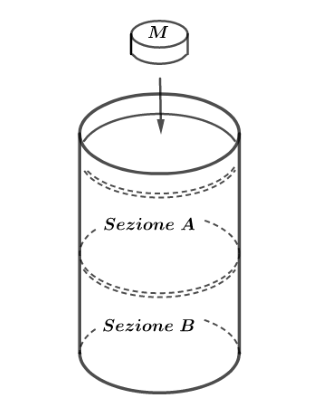 cilindro con pistone M e sezioni A B
Topic: Thermodynamics, Kinetic Theory Metodi: First Law of Thermodynamics, Ideal Gas Law, Free-Body Diagram Competenze: Mathematical Modeling, Physical Reasoning Objects: Cylinder, Piston, Gas Fonte: Testo (PDF) — p.4 Soluzione: Soluzioni (PDF)
The following is the list of the types of products which are subject to the approval procedure:
In a small cylindrical container, closed at the bottom and with a base radius of , there are two pistons, which divide it into two non-communicating sections ( and ), as shown in Figure 1. Pistons are massless and can flow without friction, remaining perpendicular to the cylinder axis; heat transfer through piston and container walls is negligible. Place the container in a laboratory surrounded by air at atmospheric pressure. Initially each of the two sections contains the same volume of gas at temperature and the pistons are in mechanical equilibrium. The gas in is monoatomic while the gas in is biatomic. What is the mass which, when placed on the upper piston, produces a temperature difference between the and sections equal to when the mechanical balance is restored?
The unit of measurement: ** kg. The following information is provided:
M-piston cylinder and A-sections B
Topic: Thermodynamics, Kinetic Theory Metodi: First Law of Thermodynamics, Ideal Gas Law, Free-Body Diagram Competenze: Mathematical Modeling, Physical Reasoning Objects: Cylinder, Piston, Gas Fonte: Testo (PDF) — p.4 Soluzione: Soluzioni (PDF)
Fionda elettrica
Alle estremità di un’asta di lunghezza si trovano due corpi puntiformi aventi masse e e cariche opposte e . L’asta ruota attorno al suo centro con velocità angolare in un piano orizzontale privo di attrito; ad un certo istante i due corpi carichi si staccano da essa, simultaneamente. Calcolare la distanza massima raggiunta tra i due corpi, tenendo presente che l’irraggiamento dovuto all’accelerazione delle cariche elettriche è del tutto trascurabile. Dati numerici: , , , .
Unità di misura: m. Precisione richiesta: 0.5%.
Topic: Electrostatics, Rotational Dynamics Metodi: Conservation of Energy, Conservation of Momentum, Coulomb’s Law Competenze: Mathematical Modeling, Diagrammatic Reasoning Objects: Rod, Point Charge Fonte: Testo (PDF) — p.5 Soluzione: Soluzioni (PDF)
The following table shows the results of the calculations:
At the ends of a length axis are two pointed bodies with masses and and opposite loads and . The axle rotates around its centre with angular speed in a frictionless horizontal plane; at a certain moment the two loaded bodies separate from it simultaneously. Calculate the maximum distance between the two bodies, keeping in mind that the radiation due to the acceleration of electric charges is completely negligible. The following data are available: , , , .
The following is the list of the measurement units: The following information is provided:
Topic: Electrostatics, Rotational Dynamics Metodi: Conservation of Energy, Conservation of Momentum, Coulomb’s Law Competenze: Mathematical Modeling, Diagrammatic Reasoning Objects: Rod, Point Charge Fonte: Testo (PDF) — p.5 Soluzione: Soluzioni (PDF)
Termometro sonoro
È possibile costruire un termometro usando un generatore di suoni armonici e sfruttando la dipendenza della velocità del suono dalla temperatura. Ponendo il generatore all’estremità aperta di un tubo di risonanza, chiuso all’altra estremità, si osserva che, alla temperatura di , si produce un’onda stazionaria alla frequenza di . In una giornata diversa, la stessa onda stazionaria si manifesta alla frequenza di . Quanto vale la temperatura nel secondo caso supponendo che l’espansione termica del tubo sia trascurabile?
Unità di misura: . Precisione richiesta: 0.5%.
Topic: Oscillations & Waves, Thermodynamics Metodi: Simple Harmonic Motion Analysis, Ideal Gas Law, Wave Equation Competenze: Mathematical Modeling, Physical Reasoning Objects: Tube Fonte: Testo (PDF) — p.5 Soluzione: Soluzioni (PDF)
Termometro sonoro
You can build a thermometer using a harmonic sound generator and taking advantage of the dependency of sound speed on temperature. Ponendo il generatore all’estremità aperta di un tubo di risonanza, chiuso all’altra estremità, si osserva che, alla temperatura di , si produce un’onda stazionaria alla frequenza di . On a different day, the same stationary wave is expressed at . What is the temperature value in the second case assuming the thermal expansion of the pipe is negligible?
Unità di misura: . Precisione richiesta: 0.5%.
Topic: Oscillations & Waves, Thermodynamics Metodi: Simple Harmonic Motion Analysis, Ideal Gas Law, Wave Equation Competenze: Mathematical Modeling, Physical Reasoning Objects: Tube Fonte: Testo (PDF) — p.5 Soluzione: Soluzioni (PDF)
Birdwatching
Un appassionato di ornitologia prepara una mangiatoia per uccelli di piccola taglia: essa è costituita da un piatto avente raggio di e massa di , sospeso in posizione orizzontale tramite tre fili perfettamente verticali, inestensibili e di massa trascurabile, vincolati in tre punti posti sul bordo del piatto ed equidistanti tra loro.
Un passero si appoggia sul bordo del piatto, in un punto che si discosta dal punto di sospensione della corda più vicina di un angolo di rispetto al centro del piatto (si assuma che il baricentro dell’uccello si trovi esattamente sopra il bordo). Si ricavi la massa del passero, tenendo presente che il piatto rimane nella posizione iniziale e che, nella nuova configurazione di equilibrio, la tensione del filo più teso risulta doppia rispetto a quella del filo meno teso.
Unità di misura: g. Precisione richiesta: 0.5%.
Topic: Rigid Body Statics, Newtonian Mechanics Metodi: Free-Body Diagram, Torque & Angular Momentum Analysis, Symmetry Argument Competenze: Diagrammatic Reasoning, Mathematical Modeling Objects: Disk, String Fonte: Testo (PDF) — p.5 Soluzione: Soluzioni (PDF)
The following information shall be provided:
A bird lover prepares a small bird feeding area: it consists of a plate with a radius of and mass of , suspended horizontally by three perfectly vertical, inextensible and negligible mass threads, bound in three points on the edge of the plate and equidistant from each other.
A sparrow rests on the edge of the plate, at a point that deviates from the closest rope suspension point at an angle of to the center of the plate (assuming the bird’s barrier is exactly above the edge). The mass of the wire is obtained, taking into account that the plate remains in the initial position and that, in the new equilibrium configuration, the tension of the more tight wire is double that of the less tight wire.
The following shall be added to the list of the following: The following information is provided:
Topic: Rigid Body Statics, Newtonian Mechanics Metodi: Free-Body Diagram, Torque & Angular Momentum Analysis, Symmetry Argument Competenze: Diagrammatic Reasoning, Mathematical Modeling Objects: Disk, String Fonte: Testo (PDF) — p.5 Soluzione: Soluzioni (PDF)
Tensione costante
Per caricare un condensatore piano internamente vuoto un generatore di tensione con resistenza interna di consuma di energia. Una lastra di vetro viene inserita tra le piastre del condensatore quando esso è scarico e scollegato dal generatore. Sapendo che il vetro ha costante dielettrica relativa e che la lastra occupa il della superficie del condensatore, calcolare di quanto è aumentata l’energia che il generatore deve fornire per caricarlo.
Unità di misura: J. Precisione richiesta: 0.5%.
Topic: Electrostatics, Circuits Metodi: Energy Conservation Method, Equivalent Circuit Reduction Competenze: Mathematical Modeling, Diagrammatic Reasoning Objects: Capacitor, Battery, Resistor Fonte: Testo (PDF) — p.5 Soluzione: Soluzioni (PDF)
The following is the list of the main components of the test:
To charge an internally empty flat capacitor a voltage generator with an internal resistance of consumes of energy. A sheet of glass is inserted between the capacitor plates when it is discharged and disconnected from the generator. Knowing that the glass has a relative dielectric constant and that the plate occupies of the capacitor surface, calculate how much energy the generator must supply to charge it.
The following is the list of the measurement units: The following information is provided:
Topic: Electrostatics, Circuits Metodi: Energy Conservation Method, Equivalent Circuit Reduction Competenze: Mathematical Modeling, Diagrammatic Reasoning Objects: Capacitor, Battery, Resistor Fonte: Testo (PDF) — p.5 Soluzione: Soluzioni (PDF)
L’arcobaleno in una stanza
Il pendente di un lampadario ha forma sferica e dimensioni trascurabili. Un fascio di luce bianca, ben collimato, lo colpisce con angolo di rispetto alla normale alla superficie nel punto di incidenza. L’indice di rifrazione del vetro vale per la luce violetta e per la luce rossa. Dopo la rifrazione, il raggio non risulta più collimato. Quanto vale l’apertura angolare della luce rifratta?
Unità di misura: rad. Precisione richiesta: 0.5%.
Topic: Geometric Optics Metodi: Snell’s Law, Vector Decomposition Competenze: Diagrammatic Reasoning, Mathematical Modeling Objects: Sphere Fonte: Testo (PDF) — p.6 Soluzione: Soluzioni (PDF)
The rainbow in a room
The slope of a lampstand is spherical in shape and is of negligible size. A well-collimated white beam of light hits it at an angle of from the normal to the surface at the point of impact. The refractive index of the glass is for violet light and for red light. After refraction, the beam is no longer collimated. How much is the angle of refracted light?
The following is the list of the measurement units: The following information is provided:
Topic: Geometric Optics Metodi: Snell’s Law, Vector Decomposition Competenze: Diagrammatic Reasoning, Mathematical Modeling Objects: Sphere Fonte: Testo (PDF) — p.6 Soluzione: Soluzioni (PDF)
Aria viziata
Il fabbisogno di ossigeno medio di una persona adulta può essere calcolato considerando che, in condizioni normali, da una boccata di aria (avente composizione standard) viene sottratto il dell’ossigeno presente. Stimare in quanto tempo una persona adulta consuma il dell’ossigeno presente in una stanza cubica di di lato, isolata dal mondo esterno.
Unità di misura: s. Precisione richiesta: 100.0%.
Topic: Order-of-Magnitude Estimation, Kinetic Theory Metodi: Order-of-Magnitude Estimation, Ideal Gas Law Competenze: Estimation & Approximation, Mathematical Modeling Objects: Gas Fonte: Testo (PDF) — p.6 Soluzione: Soluzioni (PDF)
The following information is provided for in the Annex to this Regulation:
The average oxygen requirement of an adult can be calculated by taking into account that under normal conditions, of the oxygen present is removed from a breath of air (of a standard composition). Estimate how long an adult consumes of oxygen in a side cubic room of , isolated from the outside world.
The following shall be added to the list of the units: The following information is provided for the purpose of this Regulation:
Topic: Order-of-Magnitude Estimation, Kinetic Theory Metodi: Order-of-Magnitude Estimation, Ideal Gas Law Competenze: Estimation & Approximation, Mathematical Modeling Objects: Gas Fonte: Testo (PDF) — p.6 Soluzione: Soluzioni (PDF)