Carrucole
Il sistema in figura è composto da una carrucola mobile centrale e due carrucole fisse laterali. Gli oggetti appesi alle carrucole fisse hanno masse uguali tra loro e pari a . L’oggetto appeso alla carrucola mobile ha massa pari a . Le masse delle carrucole sono trascurabili. Determinare l’accelerazione in modulo dell’oggetto appeso alla carrucola mobile.
Unità di misura: . Precisione richiesta: 0.5%.
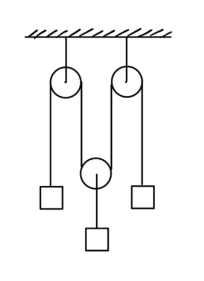 Sistema carrucola mobile e fisse con masse
Topic: Newtonian Mechanics Metodi: Free-Body Diagram, Vector Decomposition, Conservation of Energy Competenze: Diagrammatic Reasoning, Mathematical Modeling Objects: Pulley, Block Fonte: Testo (PDF) — p.2
Carrucole
The system in the figure consists of a central moving carriage and two fixed side carriages. The objects suspended in the fixed cartridges have equal masses to each other and . The object suspended from the mobile trailer shall have a mass of . The masses of the cartridges are negligible. Determine the acceleration in the form of the object suspended from the mobile trailer.
Unità di misura: . Precisione richiesta: 0.5%.
Moving and fixed carriage system with masses
Topic: Newtonian Mechanics Metodi: Free-Body Diagram, Vector Decomposition, Conservation of Energy Competenze: Diagrammatic Reasoning, Mathematical Modeling Objects: Pulley, Block Fonte: Testo (PDF) — p.2
Ingegneri bugiardi
Una ditta automobilistica sostiene di aver brevettato un nuovo paraurti capace di assorbire una grande quantità dell’energia cinetica di due auto nel caso di tamponamenti. In particolare gli ingegneri della ditta affermano che durante un crash test tra due macchine di masse rispettivamente e che si urtano con velocità relativa , i paraurti delle due auto sono riusciti ad assorbire sino al dell’energia cinetica totale.
In realtà gli ingegneri stanno mentendo! Nel crash test condotto quanto può valere la massima percentuale di energia che i paraurti possono assorbire?
Unità di misura: %. Precisione richiesta: 0.5%.
Topic: Conservation of Momentum, Conservation of Energy Metodi: Conservation of Momentum, Conservation of Energy, Conservation Laws Competenze: Physical Reasoning, Mathematical Modeling Objects: — Fonte: Testo (PDF) — p.2
The Commission has already adopted a proposal for a regulation on the protection of the environment.
One car company claims to have patented a new bumper capable of absorbing a large amount of kinetic energy from two cars in the event of buffers. In particular, the company’s engineers claim that during a crash test between two machines of mass and respectively that collide at relative speed , the bumpers of the two cars were able to absorb up to of total kinetic energy.
The engineers are actually lying! In the crash test, what is the maximum amount of energy that the bumpers can absorb?
The following is the maximum number of units of measurement: The following information is provided:
Topic: Conservation of Momentum, Conservation of Energy Metodi: Conservation of Momentum, Conservation of Energy, Conservation Laws Competenze: Physical Reasoning, Mathematical Modeling Objects: — Fonte: Testo (PDF) — p.2
Tante lenti per nulla
Un sistema ottico è costituito da lenti convergenti identiche, disposte lungo lo stesso asse ottico, e tali che la distanza tra due lenti consecutive è pari al doppio della distanza focale. Ponendo un oggetto ad una distanza di a sinistra della prima lente il sistema ottico forma un’immagine reale ad una distanza di dall’oggetto e con ingrandimento in modulo pari a . Di quante lenti è composto il sistema?
Unità di misura: adimensionale. Precisione richiesta: 0.5%.
Topic: Geometric Optics Metodi: Thin Lens & Mirror Equation, Physical Modeling Competenze: Mathematical Modeling, Diagrammatic Reasoning Objects: Lens Fonte: Testo (PDF) — p.2
So many lenses for nothing
An optical system shall consist of identical convergent lenses, arranged along the same optical axis, such that the distance between two consecutive lenses is twice the focal length. By placing an object at a distance of to the left of the first lens, the optical system forms a real image at a distance of from the object and with a modulus magnification equal to . How many lenses is the system made of?
The measuring unit: ** additional dimension. The following information is provided:
Topic: Geometric Optics Metodi: Thin Lens & Mirror Equation, Physical Modeling Competenze: Mathematical Modeling, Diagrammatic Reasoning Objects: Lens Fonte: Testo (PDF) — p.2
Stufetta cubica
Riccardo vuole progettare una stufa elettrica di forma singolare. È costituita da una rete di resistori, tutti di uguale resistenza , disposti a formare un cubo e alimentata da una differenza di potenziale agli estremi di una diagonale del cubo stesso. La stufa è pensata per essere collegata alla rete di casa con alimentazione di . Quale valore di deve scegliere Riccardo affinché la potenza della stufa sia di ?
Unità di misura: . Precisione richiesta: 0.5%.
Topic: Circuits Metodi: Symmetry Argument, Kirchhoff’s Laws, Equivalent Circuit Reduction Competenze: Diagrammatic Reasoning, Mathematical Modeling Objects: Resistor Fonte: Testo (PDF) — p.2
Stufetta cubica
Richard wants to design a unique electric stove. It consists of a network of resistors, all of equal strength , arranged to form a cube and powered by a potential difference at the ends of a diagonal of the cube itself. The stove is designed to be connected to the home network with power. What value of should Riccardo choose to make the stove power ?
Unità di misura: . Precisione richiesta: 0.5%.
Topic: Circuits Metodi: Symmetry Argument, Kirchhoff’s Laws, Equivalent Circuit Reduction Competenze: Diagrammatic Reasoning, Mathematical Modeling Objects: Resistor Fonte: Testo (PDF) — p.2
Complichiamo il piano inclinato
In figura è mostrato un piano inclinato su cui può scivolare un cuneo di massa sopra il quale è poggiato all’estremo destro un blocchetto di massa . L’angolo di inclinazione del piano inclinato, uguale a quello del cuneo, vale . Il lato orizzontale del cuneo su cui è poggiato il blocchetto è lungo , mentre il blocchetto è di dimensioni trascurabili. Non sono presenti attriti tra le singole parti del sistema. Quanto tempo impiega il blocchetto ad arrivare all’estremo sinistro del cuneo quando quest’ultimo viene lasciato libero di scivolare lungo il piano inclinato?
Unità di misura: s. Precisione richiesta: 0.5%.
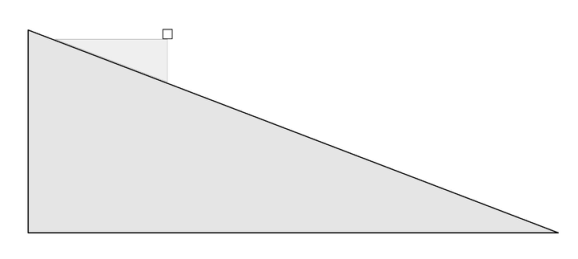 Piano inclinato con cuneo e blocchetto
Topic: Newtonian Mechanics Metodi: Free-Body Diagram, Vector Decomposition, Kinematic Equations Competenze: Diagrammatic Reasoning, Mathematical Modeling Objects: Wedge, Block, Inclined Plane Fonte: Testo (PDF) — p.3
**Complicate the slope of the plane **
The figure shows an inclined plane over which a mass cone can glide over which a mass block is resting on the far right. The angle of inclination of the inclined plane, equal to that of the cone, is . The horizontal side of the cone on which the block is resting is long, while the block is of negligible size. There are no friction between the individual parts of the system. How long does it take the lock to reach the far left of the cune when the cune is left free to slide along the sloping plane?
The following shall be added to the list of the units: The following information is provided:
*Tendered plane with cone and block *
Topic: Newtonian Mechanics Metodi: Free-Body Diagram, Vector Decomposition, Kinematic Equations Competenze: Diagrammatic Reasoning, Mathematical Modeling Objects: Wedge, Block, Inclined Plane Fonte: Testo (PDF) — p.3
Elica protonica
Una regione di spazio è sede di un campo elettrico con e di un campo magnetico con (dove è il versore dell’asse ). Un protone viene immesso nella regione con velocità iniziale di formante un angolo di con l’asse . Calcolare la distanza percorsa lungo l’asse dal protone nel suo primo giro.
Unità di misura: m. Precisione richiesta: 0.5%.
Topic: Electromagnetism, Newtonian Mechanics Metodi: Lorentz Force Analysis, Vector Decomposition, Kinematic Equations Competenze: Mathematical Modeling, Diagrammatic Reasoning Objects: Point Charge Fonte: Testo (PDF) — p.3
The following is a list of the main components of the test:
A region of space is home to an electric field with and a magnetic field with (where is the slope of the axis). A proton is entered into the region with an initial velocity of forming an angle of with the axis . Calculate the distance travelled along the axis from the proton in its first spin.
The following is the list of the measurement units: The following information is provided:
Topic: Electromagnetism, Newtonian Mechanics Metodi: Lorentz Force Analysis, Vector Decomposition, Kinematic Equations Competenze: Mathematical Modeling, Diagrammatic Reasoning Objects: Point Charge Fonte: Testo (PDF) — p.3
Classico termodinamico
Partendo dallo stato , un gas perfetto monoatomico compie un ciclo termodinamico reversibile suddiviso in tre trasformazioni:
- -: Trasformazione del tipo , con
- -: Trasformazione isocora con
- -: Trasformazione isobara che riporta il sistema nello stato
Quanto vale il rendimento del ciclo?
Unità di misura: adimensionale. Precisione richiesta: 0.5%.
Topic: Thermodynamics Metodi: Thermodynamic Cycle Analysis, Ideal Gas Law, Calculus-Integration Competenze: Mathematical Modeling Objects: Gas Fonte: Testo (PDF) — p.3
The following table shows the results of the calculations:
Starting from the state , a perfect monoatomic gas completes a reversible thermodynamic cycle divided into three transformations:
- -: Transformation of the type , with
- -: Isocorate transformation with
- -: Isobaric transformation returning the system to the state
How much is the cycle yield?
The measuring unit: ** additional dimension. The following information is provided:
Topic: Thermodynamics Metodi: Thermodynamic Cycle Analysis, Ideal Gas Law, Calculus-Integration Competenze: Mathematical Modeling Objects: Gas Fonte: Testo (PDF) — p.3
Guscio carico
Sia dato un guscio sferico carico avente densità di carica volumica , raggio interno e raggio esterno . Siano e due punti rispettivamente a distanza e dal centro del guscio sferico. Determinare il rapporto tra il modulo del campo elettrico in e il modulo del campo elettrico in .
Unità di misura: adimensionale. Precisione richiesta: 0.5%.
Topic: Electrostatics Metodi: Gauss’s Law, Calculus-Integration Competenze: Mathematical Modeling, Diagrammatic Reasoning Objects: Sphere Fonte: Testo (PDF) — p.3
The following is the list of the following:
A loaded spherical shell with a volume load density , internal radius and external radius shall be given. The and shall be two points, respectively, away from the centre of the spherical shell and . Determine the ratio of the electric field module in to the electric field module in .
The measuring unit: ** additional dimension. The following information is provided:
Topic: Electrostatics Metodi: Gauss’s Law, Calculus-Integration Competenze: Mathematical Modeling, Diagrammatic Reasoning Objects: Sphere Fonte: Testo (PDF) — p.3
Scalda e spingi
In figura è mostrato un cilindro contenente un gas perfetto con pistone mobile di superficie . Il pistone è collegato ad una molla di costante elastica , a sua volta collegata ad un blocco di massa . Tra il blocco e il piano d’appoggio è presente una forza d’attrito statico di coefficiente . Il cilindro è ancorato al piano d’appoggio e in contatto termico con una sorgente di calore (a sinistra in figura). Il gas è in equilibrio termico e meccanico con l’ambiente per tutto il processo. In particolare all’istante iniziale il gas è a temperatura , pressione e occupa un volume . Mentre la molla è a riposo. A quale temperatura bisogna portare la sorgente di calore (e quindi il gas) affinché il blocco inizi a muoversi?
Unità di misura: K. Precisione richiesta: 0.5%.
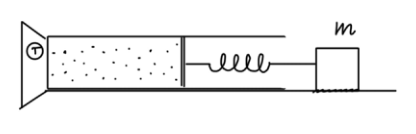 Cilindro gas con pistone, molla e blocco
Topic: Thermodynamics, Newtonian Mechanics Metodi: Ideal Gas Law, Free-Body Diagram, Hooke’s Law Competenze: Mathematical Modeling, Physical Reasoning Objects: Gas, Cylinder, Piston, Spring, Block Fonte: Testo (PDF) — p.4
**Heat and push **
The figure shows a cylinder containing a perfect gas with a movable piston surface . The piston is connected to a spring of constant elasticity , which in turn is connected to a block of mass . Tra il blocco e il piano d’appoggio è presente una forza d’attrito statico di coefficiente . The cylinder is attached to the support plane and in thermal contact with a heat source (left in figure). The gas is in thermal and mechanical balance with the environment throughout the process. In particular, at the initial moment the gas is at temperature, pressure and occupies a volume . While the spring is at rest. At what temperature does the heat source (and therefore the gas) have to be brought in for the block to start moving?
Unità di misura: K. Precisione richiesta: 0.5%.
Gas cylinder with piston, spring and block
Topic: Thermodynamics, Newtonian Mechanics Metodi: Ideal Gas Law, Free-Body Diagram, Hooke’s Law Competenze: Mathematical Modeling, Physical Reasoning Objects: Gas, Cylinder, Piston, Spring, Block Fonte: Testo (PDF) — p.4
Un depuratore scadente
Una sostanza contiene una data concentrazione di un elemento altamente tossico. Per depurarla si utilizza un sistema di filtraggio attraverso un’apposita condotta di opportuna lunghezza in modo da ridurre la concentrazione dell’elemento tossico ad un millesimo di quella iniziale. Il sistema di filtraggio è progettato in modo da riuscire a rimuovere il di impurità quando la sostanza da depurare attraversa di condotta. Però purtroppo quando la sostanza attraversa di condotta se ne disperde il . Quanti litri di sostanza bisogna immettere nel sistema di filtraggio se si vuole ottenere litro di sostanza depurata?
Unità di misura: litri. Precisione richiesta: 0.5%.
Topic: Fluid Mechanics Metodi: Differential Equations, Approximation & Series Expansion, Physical Modeling Competenze: Mathematical Modeling Objects: Tube Fonte: Testo (PDF) — p.4
A poor cleaner
A substance contains a given concentration of a highly toxic element. To purify it, a filtration system is used through a suitable conduit of appropriate length to reduce the concentration of the toxic element to one thousandth of the initial concentration. The filtration system is designed to remove the of impurities when the substance to be purified passes through the of the conduit. But unfortunately when the substance passes through the conduction , the is dispersed. How many litres of substance must be introduced into the filtration system if litres of purified substance are to be obtained?
The unit of measurement: ** litres. The following information is provided:
Topic: Fluid Mechanics Metodi: Differential Equations, Approximation & Series Expansion, Physical Modeling Competenze: Mathematical Modeling Objects: Tube Fonte: Testo (PDF) — p.4
Quanto pesa una bolla di sapone?
Una bolla di sapone riempita di elio galleggia in sospensione in un ambiente contenente esclusivamente vapore acqueo a pressione atmosferica. Elio e vapore acqueo sono in equilibrio termico alla temperatura di , mentre la pressione dell’elio, a causa della tensione della bolla, è del superiore a quella del vapore acqueo. Sapendo che il raggio della bolla è di , quanto vale la massa dell’acqua saponata che forma la bolla? Si trascuri lo spessore della pellicola di acqua saponata rispetto al raggio della bolla.
Unità di misura: kg. Precisione richiesta: 0.5%.
Topic: Fluid Mechanics, Kinetic Theory Metodi: Hydrostatic Equilibrium, Ideal Gas Law Competenze: Mathematical Modeling, Physical Reasoning Objects: Bubble, Gas Fonte: Testo (PDF) — p.4
**How much does a soap bubble weigh? **
A soap bubble filled with helium floats suspended in an atmospheric pressure water vapor-only environment. The heat balance between helium and water vapor is , while the helium pressure, due to the bubble voltage, is higher than that of water vapor. Knowing that the bubble radius is , what is the mass of soap water that forms the bubble? The thickness of the soap water film is neglected relative to the bubble’s radius.
The unit of measurement: ** kg. The following information is provided:
Topic: Fluid Mechanics, Kinetic Theory Metodi: Hydrostatic Equilibrium, Ideal Gas Law Competenze: Mathematical Modeling, Physical Reasoning Objects: Bubble, Gas Fonte: Testo (PDF) — p.4
Il tubo di Venturi
Un tubo di Venturi, o venturimetro, è uno strumento per misurare la velocità di un fluido, nel nostro caso acqua, in una conduttura. Lo strumento viene collegato tra le due sezioni di un condotto come in figura. Le sezioni di entrata e di uscita del tubo di Venturi sono collegate al condotto principale su cui si deve effettuare la misura e queste sezioni devono essere uguali a quella del condotto in cui la velocità è . Tra l’entrata e l’uscita del dispositivo l’acqua passa in una strettoia di sezione . Un manometro, che unisce la sezione più grande a quella più piccola dello strumento, misura una differenza di pressione . Quanto vale la portata dell’acqua nella conduttura?
Unità di misura: . Precisione richiesta: 0.5%.
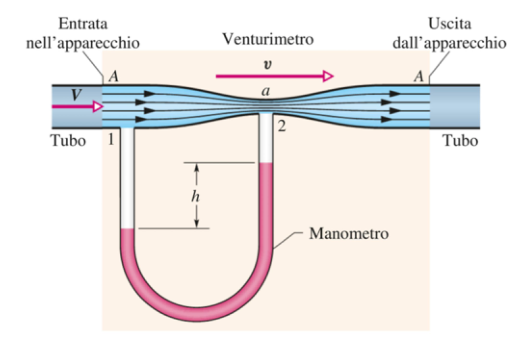 Tubo di Venturi con manometro
Topic: Fluid Mechanics Metodi: Bernoulli’s Equation, Continuity Equation Competenze: Mathematical Modeling Objects: Tube, Manometer Fonte: Testo (PDF) — p.5
Il tubo di Venturi
A Venturi tube, or venturometer, is a device for measuring the speed of a fluid, in our case water, in a pipe. The instrument is connected between the two sections of a pipe as shown in the figure. The sections of the Venturi tube input and output shall be connected to the main pipe on which the measurement shall be carried out and these sections shall be equal to those of the pipe in which the speed is . Between the input and output of the device, water passes through a section narrowing. A pressure gauge, which joins the largest section to the smallest section of the instrument, measures a pressure difference . How much is the flow of water in the pipe?
Unità di misura: . Precisione richiesta: 0.5%.
Venture tube with manometer
Topic: Fluid Mechanics Metodi: Bernoulli’s Equation, Continuity Equation Competenze: Mathematical Modeling Objects: Tube, Manometer Fonte: Testo (PDF) — p.5