Scaldabagno
Uno scaldabagno può essere approssimato come un serbatoio di acqua con una resistenza elettrica che ne scalda il contenuto. Sapendo che uno scaldabagno da e è inizialmente pieno di acqua a , quanto tempo impiegherà come minimo a scaldare tutta l’acqua a ?
Unità di misura: ore. Precisione richiesta: 0.5%.
Topic: Thermodynamics Metodi: Energy Conservation Method, First Law of Thermodynamics Competenze: Unit Conversion, Mathematical Modeling Objects: Container, Resistor Fonte: Testo (PDF) — p.3 Soluzione: Soluzioni (PDF)
The following is the list of the main components of the engine:
A water heater can be approximated as a water tank with an electrical resistance that heats its contents. Knowing that a water heater from and is initially filled with water at , how long will it take at least to heat all the water at ?
The unit of measurement: ** hours. The following information is provided:
Topic: Thermodynamics Metodi: Energy Conservation Method, First Law of Thermodynamics Competenze: Unit Conversion, Mathematical Modeling Objects: Container, Resistor Fonte: Testo (PDF) — p.3 Soluzione: Soluzioni (PDF)
Guida angolosa
Una guida metallica è costituita da due segmenti disposti a V che formano tra loro un angolo di . Tale guida giace in un piano verticale e viene fissata in modo che il vertice sia rivolto verso il basso e la bisettrice dell’angolo sia verticale, come in figura. Una particella sferica molto piccola, tale da potersi considerare puntiforme, viene poi appoggiata su una delle due guide e lasciata scorrere in assenza di attrito. Si determini il valore limite dell’angolo che definisce la V tale che e che la particella atterri sul segmento da cui non è partita, dopo aver effettuato un urto elastico al vertice della guida.
Unità di misura: . Precisione richiesta: 0.5%.
p.3 — Guida a V con particella e gravita
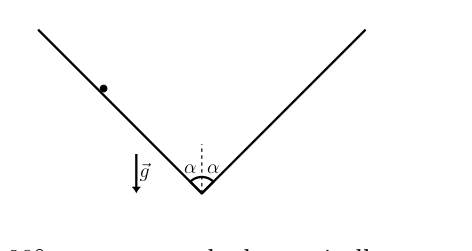
Topic: Newtonian Mechanics, Conservation of Energy Metodi: Energy Conservation Method, Vector Decomposition, Kinematic Equations Competenze: Diagrammatic Reasoning, Mathematical Modeling, Physical Reasoning Objects: — Fonte: Testo (PDF) — p.3 Soluzione: Soluzioni (PDF)
Guida angolosa
A metal guide consists of two segments arranged in V forming an angle of between them. Such a guide shall lie in a vertical plane and be fixed so that the top is facing downward and the angle of the beam is vertical, as shown in the figure. A very small spherical particle, such that it can be considered pointy, is then rested on one of the two guides and left to flow without friction. The limit value of the angle defining the V shall be determined such that and the particle shall land on the segment from which it did not depart after a rubber impact on the top of the wheel.
Unità di misura: . Precisione richiesta: 0.5%.
**p.3 ** V-guide with particle and gravity
Topic: Newtonian Mechanics, Conservation of Energy Metodi: Energy Conservation Method, Vector Decomposition, Kinematic Equations Competenze: Diagrammatic Reasoning, Mathematical Modeling, Physical Reasoning Objects: — Fonte: Testo (PDF) — p.3 Soluzione: Soluzioni (PDF)
Un pianeta sferico di raggio con densità omogenea si trova molto distante da qualsiasi altro corpo celeste. Dati due punti posti a un’altezza rispettivamente sopra e sotto la superficie del pianeta, quanto deve valere affinché le accelerazioni gravitazionali nei due punti siano uguali in modulo?
Unità di misura: adimensionale. Precisione richiesta: 0.5%.
Topic: Gravitation Metodi: Gauss’s Law, Newton’s Law of Gravitation, Symmetry Argument Competenze: Mathematical Modeling, Physical Reasoning Objects: Planet Fonte: Testo (PDF) — p.3 Soluzione: Soluzioni (PDF)
A spherical planet with a radius of with homogeneous density is located very far away from any other celestial body. Given two points at a height above and below the planet’s surface, how much must be worth for gravitational accelerations at the two points to be uniform in form?
The measuring unit: ** additional dimension. The following information is provided:
Topic: Gravitation Metodi: Gauss’s Law, Newton’s Law of Gravitation, Symmetry Argument Competenze: Mathematical Modeling, Physical Reasoning Objects: Planet Fonte: Testo (PDF) — p.3 Soluzione: Soluzioni (PDF)
Urto elastico
Un cilindro viene posizionato con una base su un piano orizzontale talmente liscio da non produrre alcun tipo di attrito. Si imprime al cilindro una velocità orizzontale scelta in modo che urti un secondo cilindro, identico al primo, inizialmente fermo e anch’esso con una base poggiata sul piano. Sapendo che l’urto è elastico e che la velocità iniziale del primo cilindro non è parallela alla retta congiungente i due centri, quanto vale l’angolo tra le velocità dei due cilindri dopo l’urto?
Unità di misura: . Precisione richiesta: 0.5%.
Topic: Conservation of Momentum, Conservation of Energy Metodi: Conservation of Momentum, Conservation of Energy, Vector Decomposition Competenze: Physical Reasoning, Mathematical Modeling Objects: Cylinder Fonte: Testo (PDF) — p.3 Soluzione: Soluzioni (PDF)
Urto elastico
A cylinder is placed with a base on a horizontal plane so smooth that it produces no friction. A horizontal speed is printed on the cylinder so that it hits a second cylinder, identical to the first, initially stationary and also with a base resting on the plane. Knowing that the impact is elastic and that the initial speed of the first cylinder is not parallel to the straight line connecting the two centers, how much is the angle between the velocities of the two cylinders after the impact?
Unità di misura: . Precisione richiesta: 0.5%.
Topic: Conservation of Momentum, Conservation of Energy Metodi: Conservation of Momentum, Conservation of Energy, Vector Decomposition Competenze: Physical Reasoning, Mathematical Modeling Objects: Cylinder Fonte: Testo (PDF) — p.3 Soluzione: Soluzioni (PDF)
Acqua rotante
Un bicchiere cilindrico di diametro interno e altezza contiene dell’acqua, fino a un’altezza di . Si mette in rotazione il bicchiere intorno al suo asse principale con una certa velocità angolare e si osserva che il liquido raggiunge l’orlo del bicchiere. Sapendo che la differenza di altezza fra il bordo del bicchiere e il pelo dell’acqua al centro è pari a , quanto vale ?
Unità di misura: rad/s. Precisione richiesta: 0.5%.
Topic: Fluid Mechanics, Newtonian Mechanics Metodi: Free-Body Diagram, Calculus-Integration, Physical Modeling Competenze: Mathematical Modeling, Physical Reasoning Objects: Container Fonte: Testo (PDF) — p.3 Soluzione: Soluzioni (PDF)
The following table shows the results of the calculation of the total energy consumption of the product:
A cylindrical glass with an internal diameter and a height contains water up to a height of . The glass is rotated around its main axis with a certain angular velocity and the liquid reaches the edge of the glass. Knowing that the height difference between the edge of the glass and the water’s core is , how much is ?
The following shall be added to the list of the following: The following information is provided:
Topic: Fluid Mechanics, Newtonian Mechanics Metodi: Free-Body Diagram, Calculus-Integration, Physical Modeling Competenze: Mathematical Modeling, Physical Reasoning Objects: Container Fonte: Testo (PDF) — p.3 Soluzione: Soluzioni (PDF)
Triangolo di molle
Tre molle di costante elastica , , e hanno le loro estremità a due a due in comune in modo da formare un triangolo. Ad ogni vertice di tale triangolo viene esercitata una forza di modulo . Queste forze sono tali da formare angoli di tra le rispettive direzioni e da avere risultante complessiva nulla. Si determini la lunghezza del lato, e dunque della molla, più corto del triangolo che si viene a formare in una condizione di equilibrio statico. La lunghezza a riposo di tutte le molle è considerabile nulla.
Unità di misura: cm. Precisione richiesta: 0.5%.
Topic: Elasticity & Materials, Rigid Body Statics Metodi: Hooke’s Law, Free-Body Diagram, Vector Decomposition Competenze: Mathematical Modeling, Diagrammatic Reasoning Objects: Spring Fonte: Testo (PDF) — p.4 Soluzione: Soluzioni (PDF)
The following is the list of the types of samples taken:
Three springs of elastic constant , , and have their two-to-two ends in common so as to form a triangle. Each vertex of this triangle shall be subjected to a force of the form . These forces are such that they form angles between their respective directions and result in a total of zero. The length of the side, and therefore of the spring, is determined, which is shorter than the triangle that is formed in a state of static equilibrium. The resting length of all springs is considerable nothing.
The unit of measurement: ** cm. The following information is provided:
Topic: Elasticity & Materials, Rigid Body Statics Metodi: Hooke’s Law, Free-Body Diagram, Vector Decomposition Competenze: Mathematical Modeling, Diagrammatic Reasoning Objects: Spring Fonte: Testo (PDF) — p.4 Soluzione: Soluzioni (PDF)
Quanta energia!
Giovanni è in vacanza e gradirebbe sorbire una tazza di tè, ma non ha nulla con cui scaldare l’acqua. Disperato, decide di buttare un thermos indistruttibile ed ermetico, di capacità termica trascurabile, contenente d’acqua, dalla cima dell’albergo dove alloggia, un edificio di piani incluso il pian terreno, dopo essersi assicurato che non ci sia nessuno vicino al luogo dell’impatto. Si stimi l’aumento di temperatura dell’acqua all’interno del thermos, trascurando anche ogni forma di dissipazione sotto forma di onde sonore.
Unità di misura: K. Precisione richiesta: 100.0%.
Topic: Conservation of Energy, Thermodynamics Metodi: Energy Conservation Method, Order-of-Magnitude Estimation Competenze: Physical Reasoning, Estimation & Approximation Objects: Container Fonte: Testo (PDF) — p.4 Soluzione: Soluzioni (PDF)
How much energy!
John is on vacation and would like to sip a cup of tea, but he has nothing to heat the water with. Desperate, he decides to throw an indestructible, airtight thermos, with negligible thermal capacity, containing of water, from the top of the hotel where he is staying, a building of floors including the ground floor, after making sure that there is no one near the impact site. The temperature of the water inside the thermos is estimated to rise, and any form of dissipation in the form of sound waves is also ignored.
The following is the list of the measurement units: The following information is provided for the purpose of this Regulation:
Topic: Conservation of Energy, Thermodynamics Metodi: Energy Conservation Method, Order-of-Magnitude Estimation Competenze: Physical Reasoning, Estimation & Approximation Objects: Container Fonte: Testo (PDF) — p.4 Soluzione: Soluzioni (PDF)
Cubo emettitore
Si consideri un cubo, costituito da un materiale perfettamente assorbitore ed emettitore, e con un’elevatissima conducibilità termica. Il cubo è illuminato da un ampio fascio luminoso di irradianza . All’equilibrio termico, quanto vale la differenza tra la temperatura massima e la temperatura minima, al variare dell’orientazione del cubo?
Unità di misura: K. Precisione richiesta: 0.5%.
Topic: Thermodynamics Metodi: Symmetry Argument, Calculus-Integration, Physical Modeling Competenze: Mathematical Modeling, Physical Reasoning Objects: — Fonte: Testo (PDF) — p.4 Soluzione: Soluzioni (PDF)
The following information shall be provided:
It is considered a cube, made up of a perfectly absorbent and emitting material, and with a very high thermal conductivity. The cube is illuminated by a broad beam of light of irradiance. At thermal equilibrium, what is the difference between maximum and minimum temperature, when the orientation of the cube varies?
The following is the list of the measurement units: The following information is provided:
Topic: Thermodynamics Metodi: Symmetry Argument, Calculus-Integration, Physical Modeling Competenze: Mathematical Modeling, Physical Reasoning Objects: — Fonte: Testo (PDF) — p.4 Soluzione: Soluzioni (PDF)
Blocchetto che gira su una corda
Una corda inestensibile di massa trascurabile, perfettamente flessibile e avente una lunghezza di , viene posizionata con un’estremità fissata al soffitto e l’altra libera di oscillare sotto di esso. A dal punto di ancoraggio, sulla corda è incollato un punto materiale di massa .
Gigi afferra l’estremo libero della corda e lo fa ruotare a una velocità angolare costante compiendo un giro al secondo su un’orbita circolare di raggio e centro allineato verticalmente sotto al punto di ancoraggio della fune. Il moto del capo della corda avviene in un piano orizzontale distante dal soffitto. Dopo un certo tempo il sistema raggiunge uno stato di equilibrio dinamico in cui entrambi i tratti della corda hanno una tensione costante in modulo e nessun elemento della corda è allineato verticalmente con il punto di ancoraggio. Qual è il rapporto tra la tensione della corda sopra il blocchetto e quella sotto di esso?
Può essere utile ricordare le seguenti terne pitagoriche:
Unità di misura: adimensionale. Precisione richiesta: 0.5%.
Topic: Newtonian Mechanics, Rotational Dynamics Metodi: Free-Body Diagram, Vector Decomposition, Torque & Angular Momentum Analysis Competenze: Diagrammatic Reasoning, Mathematical Modeling Objects: String, Block Fonte: Testo (PDF) — p.4 Soluzione: Soluzioni (PDF)
Block that rotates on a rope
A very flexible, unextensible rope of negligible mass, with a length of , is placed with one end fixed to the ceiling and the other free to swing underneath. A from the anchorage point, a material point of mass shall be affixed to the rope.
Gigi grabs the free end of the rope and makes it rotate at a constant angular speed by completing a spin per second on a circular radius orbit and a center aligned vertically below the rope anchor point. The rope head shall be moved in a horizontal plane from the ceiling. After a certain period of time the system reaches a dynamic equilibrium state in which both strands of the rope have a constant voltage in the form and no element of the rope is aligned vertically with the anchor point. What is the relationship between the tension of the rope above the lock and that under it?
It may be useful to remember the following pitagoric terns:
The measuring unit: ** additional dimension. The following information is provided:
Topic: Newtonian Mechanics, Rotational Dynamics Metodi: Free-Body Diagram, Vector Decomposition, Torque & Angular Momentum Analysis Competenze: Diagrammatic Reasoning, Mathematical Modeling Objects: String, Block Fonte: Testo (PDF) — p.4 Soluzione: Soluzioni (PDF)
Generalmente, il calore specifico dei corpi non è costante. Esso, infatti, dipende dalla loro temperatura. Consideriamo due corpi solidi di masse e , temperature iniziali e e calori specifici e , con e la temperatura del corpo -esimo. Entrambi vengono inseriti in un unico contenitore chiuso con pareti perfettamente isolanti, tali da non consentire alcuno scambio di calore con l’ambiente esterno. Quanto vale la temperatura di equilibrio dei due corpi?
Unità di misura: K. Precisione richiesta: 0.5%.
Topic: Thermodynamics Metodi: Calculus-Integration, Energy Conservation Method, First Law of Thermodynamics Competenze: Mathematical Modeling, Physical Reasoning Objects: — Fonte: Testo (PDF) — p.5 Soluzione: Soluzioni (PDF)
In general, the specific heat of the bodies is not constant. It is, in fact, dependent on their temperature. Consider two solid bodies of and masses, initial temperatures and and specific heat and , with and body temperature -exem. Both are placed in a single closed container with perfectly insulating walls, such that no heat exchange with the external environment is allowed. What’s the equilibrium temperature of the two bodies?
The following is the list of the measurement units: The following information is provided:
Topic: Thermodynamics Metodi: Calculus-Integration, Energy Conservation Method, First Law of Thermodynamics Competenze: Mathematical Modeling, Physical Reasoning Objects: — Fonte: Testo (PDF) — p.5 Soluzione: Soluzioni (PDF)
Potenza massima
Luca ha a disposizione un generatore di tensione costante da nominali e resistenza interna da . Può inoltre scegliere tra un numero molto grande di resistenze di parecchi valori differenti. Il suo obiettivo è quello di collegare in serie una di queste resistenze al generatore e chiudere il semplice circuito così risultante, in modo da massimizzare la potenza dissipata nella resistenza scelta. Si trovi il massimo valore che può essere ottenuto per tale potenza.
Unità di misura: W. Precisione richiesta: 0.5%.
Topic: Circuits Metodi: Kirchhoff’s Laws, Equivalent Circuit Reduction, Calculus-Integration Competenze: Mathematical Modeling, Diagrammatic Reasoning Objects: Battery, Resistor Fonte: Testo (PDF) — p.5 Soluzione: Soluzioni (PDF)
The following is the list of the main components of the engine:
Luca has a constant voltage generator of ratings and internal resistance of . It can also choose from a very large number of resistors of several different values. Its objective is to serial-link one of these resistors to the generator and close the resulting simple circuit, so as to maximize the power dissipated in the chosen resistor. The maximum value that can be obtained for that power is found.
The measuring unit: ** W. The following information is provided:
Topic: Circuits Metodi: Kirchhoff’s Laws, Equivalent Circuit Reduction, Calculus-Integration Competenze: Mathematical Modeling, Diagrammatic Reasoning Objects: Battery, Resistor Fonte: Testo (PDF) — p.5 Soluzione: Soluzioni (PDF)
Protoni all’Autodromo di Monza
John costruisce un acceleratore di particelle per protoni avente un percorso simile a una replica 1:1 di quello dell’Autodromo di Monza. Questo acceleratore è costituito da un percorso piano di lunghezza di . Un protone viene iniettato nell’acceleratore con una velocità iniziale di . Per fare in modo che segua il percorso stabilito, John può attivare in modo istantaneo un campo magnetico temporaneo che permea uniformemente l’intero acceleratore di particelle. Tale campo magnetico è regolabile di volta in volta in intensità e verso, ma è vincolato ad avere sempre direzione perpendicolare al piano del circuito. Il costo di tale campo magnetico per unità di tempo e di intensità è pari a 5000\ \/\mathrm{T}/\mathrm{s}$.
Trascurando tutte le perdite di energia del fascio ed eventuali dispersioni, quanto spenderebbe John per far compiere al protone un milione di giri nell’acceleratore di particelle?
L’acceleratore di particelle è costituito da un percorso con tratti rettilinei alternati alle seguenti curve:
- Curva a destra di , con raggio di curvatura .
- Curva a sinistra di , con raggio di curvatura .
- Curva a destra di , con raggio di curvatura .
- Curva a sinistra di , con raggio di curvatura .
- Curva a destra di , con raggio di curvatura .
- Curva a destra di , con raggio di curvatura .
- Curva a destra di , con raggio di curvatura .
- Curva a sinistra di , con raggio di curvatura .
- Curva a destra di , con raggio di curvatura .
- Curva a sinistra di , con raggio di curvatura .
- Curva a destra di , con raggio di curvatura .
- Curva a destra di , con raggio di curvatura .
Unità di misura: $. Precisione richiesta: 0.5%.
Topic: Magnetism, Newtonian Mechanics Metodi: Lorentz Force Analysis, Calculus-Integration, Physical Modeling Competenze: Mathematical Modeling, Physical Reasoning Objects: Point Charge Fonte: Testo (PDF) — p.6 Soluzione: Soluzioni (PDF)
Protons at the Monza Motor Speedway
John builds a proton particle accelerator with a path similar to a 1:1 replica of that of the Monza Autodrome. This accelerator consists of a plane path of length. A proton is injected into the accelerator at an initial speed of . To ensure that it follows the path set, John can instantly activate a temporary magnetic field that uniformly permeates the entire particle accelerator. Such a magnetic field is adjustable from time to time in intensity and direction, but is bound to always have a direction perpendicular to the plane of the circuit. The cost of such a magnetic field per unit of time and intensity is 5000\ \/\mathrm{T}/\mathrm{s}$.
Ignoring all the energy losses from the beam and any dispersion, how much would John spend to get the proton to do a million rounds in the particle accelerator?
The particle accelerator shall consist of a path with straight lines alternating with the following curves:
- The curve to the right of , with radius of curvature .
- The left curve of , with a radius of curvature .
- The curve to the right of , with radius of curvature .
- The left curve of , with a radius of curvature .
- The curve to the right of , with radius of curvature .
- The curve to the right of , with radius of curvature .
- The curve to the right of , with radius of curvature .
- The left curve of , with a radius of curvature .
- The curve to the right of , with radius of curvature .
- The left curve of , with a radius of curvature .
- The curve to the right of , with radius of curvature .
- The curve to the right of , with radius of curvature .
The unit of measurement: ** $. The following information is provided:
Topic: Magnetism, Newtonian Mechanics Metodi: Lorentz Force Analysis, Calculus-Integration, Physical Modeling Competenze: Mathematical Modeling, Physical Reasoning Objects: Point Charge Fonte: Testo (PDF) — p.6 Soluzione: Soluzioni (PDF)
Levitazione in sfera conduttrice
Una particella puntiforme, di massa e carica , si trova all’interno di un guscio sferico conduttore di raggio , vincolato a stare fermo e collegato a terra. La carica è libera di muoversi ed è soggetta alla forza di gravità, ma si trova in un punto di equilibrio (non necessariamente stabile). Quanto vale la sua distanza dal centro del guscio sferico?
Unità di misura: m. Precisione richiesta: 0.5%.
Topic: Electrostatics Metodi: Coulomb’s Law, Free-Body Diagram, Symmetry Argument Competenze: Mathematical Modeling, Diagrammatic Reasoning, Physical Reasoning Objects: Point Charge, Conducting Sphere Fonte: Testo (PDF) — p.6 Soluzione: Soluzioni (PDF)
Leverage in the conductive sphere
A pointed particle, with a mass and a charge , is located inside a radius conductive spherical shell, bound to stand still and connected to the ground. The charge is free to move and is subject to gravity, but is in a point of equilibrium (not necessarily stable). What’s its distance from the center of the spherical shell?
The following is the list of the measurement units: The following information is provided:
Topic: Electrostatics Metodi: Coulomb’s Law, Free-Body Diagram, Symmetry Argument Competenze: Mathematical Modeling, Diagrammatic Reasoning, Physical Reasoning Objects: Point Charge, Conducting Sphere Fonte: Testo (PDF) — p.6 Soluzione: Soluzioni (PDF)