PRIMA PARTE — Determinazione della distanza incognita tramite triangolazione
L’esperimento consiste nella determinazione di una distanza incognita con il metodo della triangolazione. Dal punto , posto a distanza nota dalla base delle mire (punti a diverse altezze su un pannello verticale), misura l’angolo di elevazione di ciascuna mira usando uno smartphone con app inclinometro (sensibilità ). Ripeti la misura di ogni angolo almeno 5 volte e calcola media e semidispersione. Poi sposta lo smartphone nel punto (a distanza incognita dal pannello, sullo stesso piano orizzontale) e misura i corrispondenti angoli .
Le altezze delle mire valgono:
da cui si ricava:
Misura la distanza con il metro di carta fornito. Calcola per ogni mira e riporta media e semidispersione come incertezza. Usa la formula per trovare e scrivila esplicitamente sul foglio dati.
Foglio dati (Prima Parte): Per ogni mira riporta le 5 misure di e le 5 misure di , la media, la tangente, il valore di ottenuto. Calcola infine:
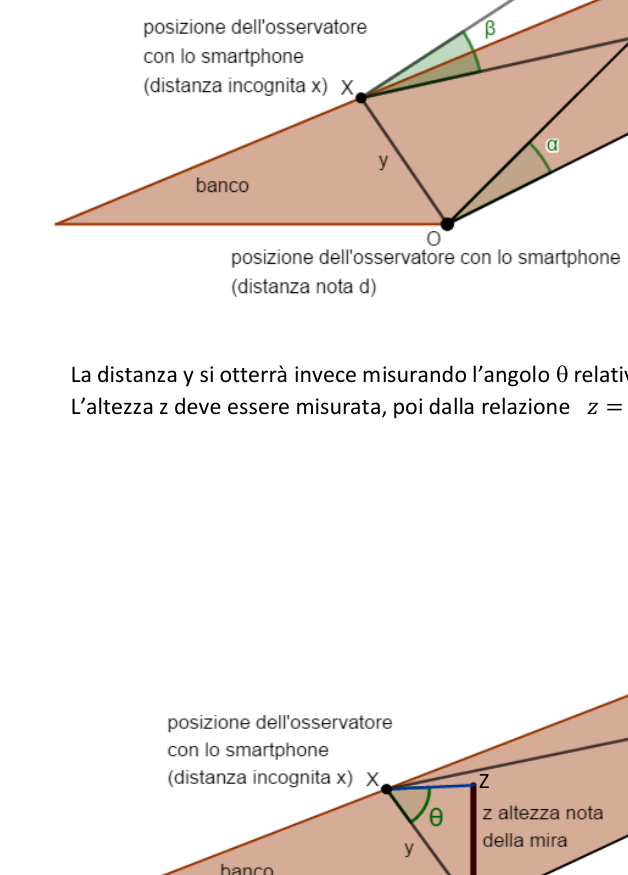 Schema triangolazione: osservatore O, mire A–E, punto X
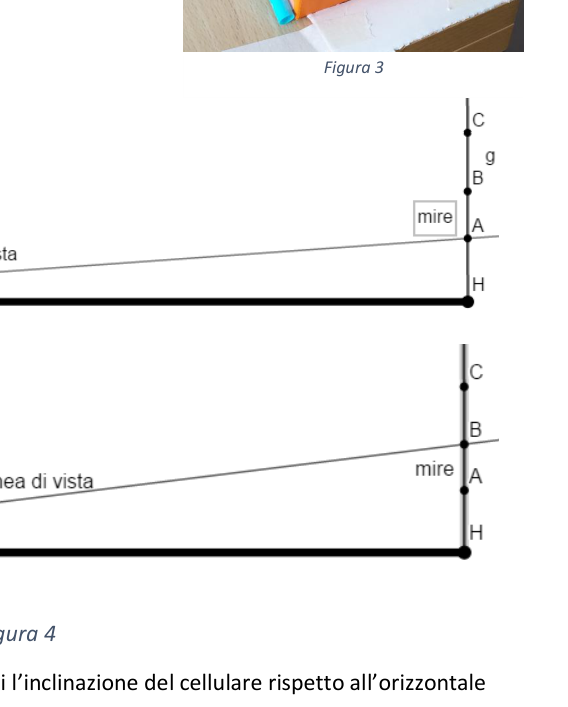 Smartphone su cartone con cannucce, spessore sotto
Topic: Order-of-Magnitude Estimation, Newtonian Mechanics Metodi: Physical Modeling, Statistical Averaging, Error Propagation, Kinematic Equations Competenze: Experimental Data Analysis, Measurement & Instrumentation Objects: — Fonte: Testo (PDF) — p.13
PART 1 Determination of the unknown distance by triangulation
The experiment consists of determining an unknown distance using the triangulation method. From the point, located at a distance known as from the base of the targets ( points at different heights on a vertical panel), the elevation angle of each target is measured using a smartphone with inclinometer app (sensitivity ). Repeat the measurement of each angle at least 5 times and calculate the mean and half-dispersion. Then move the smartphone to the point (uncognito from the panel, on the same horizontal plane) and measure the corresponding angles.
The heights of the targets are:
from which it derives:
Measure the distance with the paper meter provided. Calculates for each target and reports mean and semispersion as uncertainty. Use the formula to find and write it explicitly on the datasheet.
**Data sheet (Part One): ** For each target reports the 5 measurements of and the 5 measurements of , the mean, tangent, value of obtained. Finally, he calculates:
The following is the list of the following:
*Smartphone on cardboard with canvas, thickness below *
Topic: Order-of-Magnitude Estimation, Newtonian Mechanics Metodi: Physical Modeling, Statistical Averaging, Error Propagation, Kinematic Equations Competenze: Experimental Data Analysis, Measurement & Instrumentation Objects: — Fonte: Testo (PDF) — p.13
SECONDA PARTE — Determinazione della distanza incognita tramite angolo di elevazione
Posiziona un’asta verticale di altezza nel punto (misura con la squadretta). Dal punto punta la cima dell’asta e misura l’angolo di elevazione con l’app inclinometro, ripetendo la misura almeno 5 volte.
Dalla relazione:
ricava la distanza :
Calcola media e semidispersione di . Fornisci una stima dell’incertezza su :
Quindi stima l’incertezza su e spiega il ragionamento seguito.
Foglio dati (Seconda Parte): Riporta con unità e incertezza; 5 misure di , media, , incertezza su ; valore di con incertezza e cifre significative corrette.
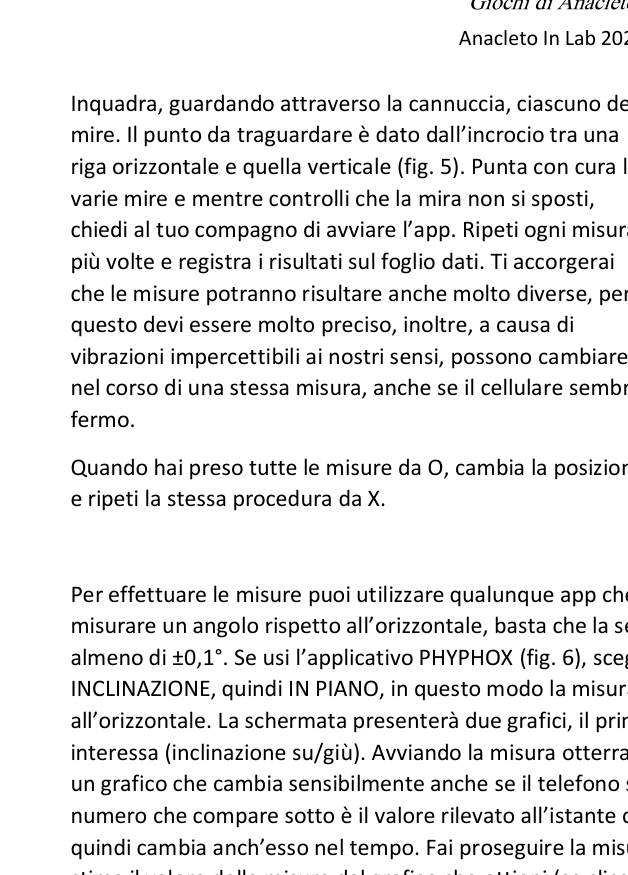 Asta verticale OZ in O, misura angolo θ da X
Topic: Order-of-Magnitude Estimation, Newtonian Mechanics Metodi: Physical Modeling, Error Propagation, Statistical Averaging Competenze: Experimental Data Analysis, Error Propagation Objects: Rod Fonte: Testo (PDF) — p.14
SEQUENTH PART Determination of the unknown distance by elevation angle
Place a vertical axis of height at (measure with the square). From the point , point to the top of the axle and measure the angle of lift with the inclinometer app, repeating the measurement at least 5 times.
From the report:
The distance is:
Calculate mean and half-diffusion of . Provide an estimate of the uncertainty on :
The uncertainty is then estimated at and the reasoning explained below.
Data file (Part Two): Report with unit and uncertainty; 5 measurements of , mean, , uncertainty on ; value of with uncertainty and significantly correct figures.
This vertical OZ in O, measuring angle θ from X
Topic: Order-of-Magnitude Estimation, Newtonian Mechanics Metodi: Physical Modeling, Error Propagation, Statistical Averaging Competenze: Experimental Data Analysis, Error Propagation Objects: Rod Fonte: Testo (PDF) — p.14
TERZA PARTE — Individuazione della posizione sulla piantina
Noti i valori di , e , individua sulla piantina fornita la posizione esatta del punto . Sul foglio è disegnato il segmento di lunghezza . Il punto si trova come intersezione di due circonferenze:
- una di raggio centrata in
- una di raggio centrata in
I punti candidati sono due ( e ). Osserva la piantina con le curve di livello (isoipse): il punto ricade in una zona a quota diversa rispetto al piano su cui si svolge l’esperimento, quindi va escluso. Il punto corretto è .
Sul foglio dati indica:
- la scala del disegno
- la lunghezza di e di nella scala del disegno
- la posizione di nel disegno
- una spiegazione chiara del criterio adottato per individuare e per escludere l’altra soluzione
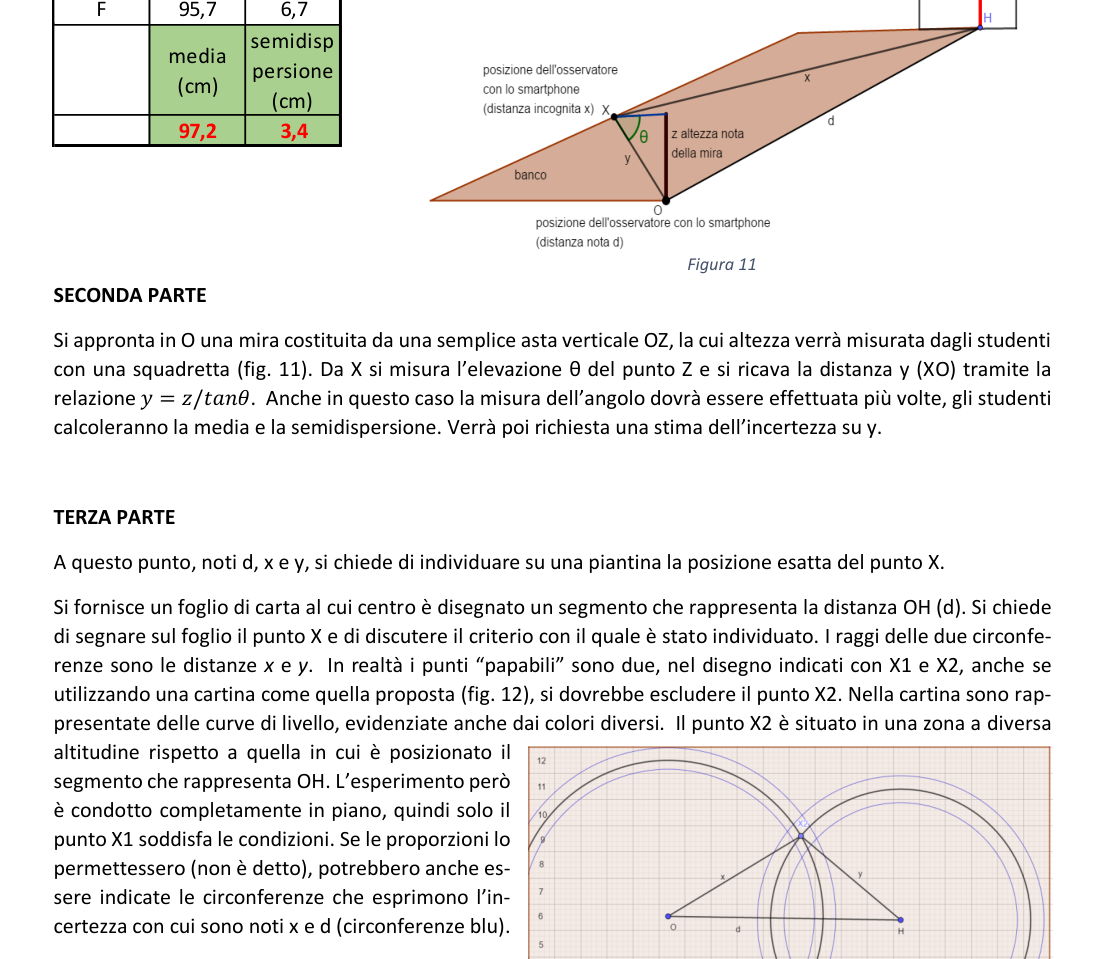 Piantina con isoipse, cerchi di raggi x e y, punti X1 X2
Topic: Order-of-Magnitude Estimation, Newtonian Mechanics Metodi: Physical Modeling, Approximation & Series Expansion Competenze: Diagrammatic Reasoning, Mathematical Modeling Objects: — Fonte: Testo (PDF) — p.14
Third PART Location indication on the plant
Note the values of , and , and indicate on the provided plank the exact location of the point. The segment of length is drawn on the sheet. The point is located as the intersection of two circumferences:
- a radius centred on
- a radius centred on
The candidate points are two ( and ). Observe the plane with the level curves (isoipse): the point falls into a zone at a different altitude from the plane on which the experiment is carried out, so it should be excluded. The correct point is .
On the data sheet it shall indicate:
- the scale of the drawing
- the length of and in the drawing scale
- the position of in the drawing
- a clear explanation of the criterion adopted to identify and to exclude the other solution
*Plant with isoipse, x-ray and y-ray circles, X1 X2 points *
Topic: Order-of-Magnitude Estimation, Newtonian Mechanics Metodi: Physical Modeling, Approximation & Series Expansion Competenze: Diagrammatic Reasoning, Mathematical Modeling Objects: — Fonte: Testo (PDF) — p.14