Eclipses of Jupiter’s Satellite
A long time ago, before scientists could measure the speed of light accurately, O. Rømer, a Danish astronomer, studied the time of eclipses of Jupiter’s satellite. He was able to determine the speed of light from observed periods of a satellite around the planet Jupiter. Figure 1 shows the orbit of the earth around the sun and one of the satellites around the planet Jupiter. (He observed the time spent between two successive emergences of the satellite from behind Jupiter.)
A long series of observations of the eclipses permitted an accurate evaluation of the period of . The observed period depends on the relative position of the earth with respect to the frame of reference as one of the coordinate axes. The average time of revolution is and the maximum observed period is .
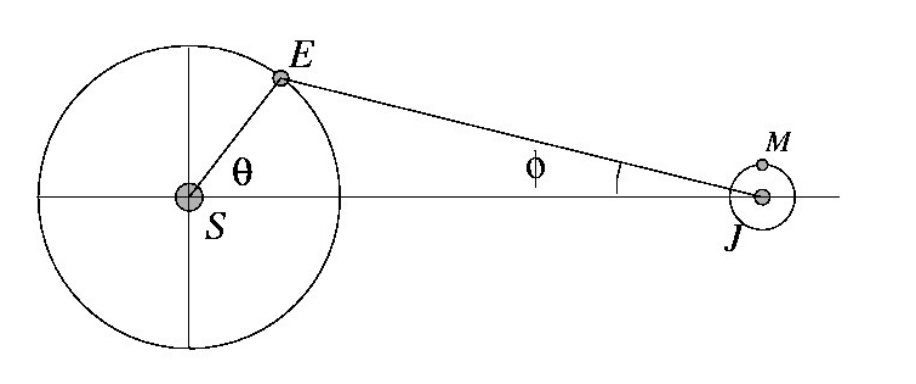 Figure 1: The orbits of the earth around the sun and a satellite around Jupiter . The average distance of the earth to the Sun is . The maximum distance is . The period of revolution of the earth is 365 days and of Jupiter is 11.9 years. The distance of the satellite to the planet Jupiter is .
a. Use Newton’s law of gravitation to estimate the distance of Jupiter to the Sun. Determine the relative angular velocity of the earth with respect to the frame of reference Sun–Jupiter (). Calculate the speed of the earth with respect to .
b. Take a new frame in which Jupiter is at rest with respect to the Sun. Determine the relative angular velocity of the earth with respect to the frame of reference Sun–Jupiter (). Calculate the speed of the earth with respect to .
c. Suppose an observer saw begin to emerge from the shadow when his position was at and the next emergence when he was at , From these observations he got the apparent periods of revolution as a function of time from Figure 1 and then used an approximate expression to explain how the distance influences the observed periods of revolution of . Estimate the relative error of your approximate distance.
d. Derive the relation between and . Plot the period as a function of time of observation . Find the positions of the earth when he observed the maximum period, minimum period and true period of the satellite .
e. Estimate the speed of light from the above result. Point out sources of errors of your estimation and calculate the order of magnitude of the error.
f. We know that the mass of the earth and 1 month . Find the mass of the planet Jupiter.
Fonte: Testo (PDF) — p.1
Topic: Gravitation, Astrophysics Metodi: Newton’s Law of Gravitation, Kepler’s Laws, Approximation & Series Expansion, Graph Linearization Competenze: Estimation & Approximation, Error Propagation Objects: Planet, Satellite, Star
Eclipses di Satellite di Giove
Molto tempo fa, prima che gli scienziati potessero misurare con precisione la velocità della luce, O. Rømer, un astronomo danese, studiò il tempo delle eclissi del satellite di Giove. Fu in grado di determinare la velocità della luce a partire da periodi osservati da un satellite intorno al pianeta Giove. La figura 1 mostra l’orbita della Terra attorno al Sole e uno dei satelliti attorno al pianeta Giove. (Ha osservato il tempo trascorso tra due successive emergenze del satellite da dietro Giove.)
Una lunga serie di osservazioni delle eclissi ha permesso di valutare con precisione il periodo di . Il periodo osservato dipende dalla posizione relativa della terra rispetto al quadro di riferimento come uno degli assi di coordinate. Il tempo medio di rivoluzione è e il periodo massimo osservato è .
Figura 1: Le orbite della terra attorno al sole e di un satellite attorno a Giove . La distanza media della terra dal Sole è . La distanza massima è . Il periodo di rivoluzione della Terra è di 365 giorni e di Giove di 11,9 anni. La distanza del satellite dal pianeta Giove è .
a. Use Newton’s law of gravitation to estimate the distance of Jupiter to the Sun. Determinare la velocità angolare relativa della terra rispetto al quadro di riferimento SoleGiove (). Calcolare la velocità della terra rispetto a .
b. Prendi un nuovo quadro in cui Giove è a riposo rispetto al Sole. Determinare la velocità angolare relativa della terra rispetto al quadro di riferimento SoleGiove (). Calcolare la velocità della terra rispetto a .
c. Supponiamo che un osservatore abbia visto iniziare a emergere dall’ombra quando la sua posizione era a e la successiva emergenza quando era a , Da queste osservazioni ha ottenuto i periodi apparenti di rivoluzione come funzione del tempo dalla figura 1 e quindi ha utilizzato un’espressione approssimativa per spiegare come la distanza influenza i periodi osservati di rivoluzione di . Estima l’errore relativo della tua distanza approssimativa.
d. Derivare la relazione tra e . Tracciare il periodo in funzione del tempo di osservazione . Trova le posizioni della Terra quando ha osservato il periodo massimo, il periodo minimo e il periodo vero del satellite .
e. Estimare la velocità della luce dal risultato sopra indicato. Indicare le fonti di errori della stima e calcolare l’ordine di grandezza dell’errore.
f. We know that the mass of the earth and 1 month . Trova la massa del pianeta Giove.
Fonte: Testo (PDF) — p.1
Topic: Gravitation, Astrophysics Metodi: Newton’s Law of Gravitation, Kepler’s Laws, Approximation & Series Expansion, Graph Linearization Competenze: Estimation & Approximation, Error Propagation Objects: Planet, Satellite, Star
Detection of Alpha Particles
We are constantly being exposed to radiation, either natural or artificial. With the advance of nuclear power reactors and utilization of radioisotopes in agriculture, industry, biology and medicine, the number of man-made prepared (artificial) radioactive sources is also increasing every year. One type of the radiation emitted by radioactive materials is alpha () particles (doubly ionized helium atom having two units of positive charge and four units of nuclear mass).
The detection of particles by electrical means is based on their ability to produce ionization when passing through gas and other substances. For an particle in air at normal (atmospheric) pressure, there is an empirical relation between the mean range and its energy :
where is measured in cm and in MeV.
For monitoring radiation, one can use an ionization chamber, which is a gas-filled detector that operates on the principle of separation of positive and negative charges created during the ionization of gas atoms by the particle. The collection of charges yields a pulse that can be detected, amplified and then recorded. The voltage difference between anode and cathode is kept sufficiently high so that there is a negligible amount of recombination of charges during their passage to the anodes.
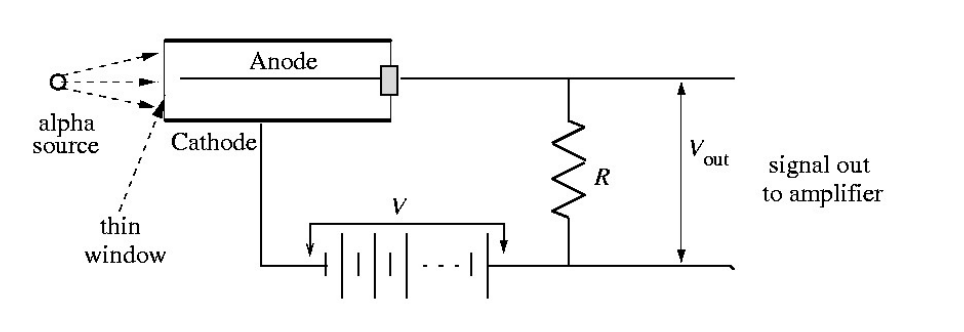 Figure 1: Schematic diagram of ionization chamber circuit.
a. An ionization chamber electrometer system with a capacitance of 45 picofarad is used to detect particles having a range of 5.50 cm. Assume the energy required to produce an ion-pair (consisting of a light negative electron and a heavier positive ion, each carrying one electronic charge of magnitude coulomb) in air is 35 eV. What will be the magnitude of the voltage produced by each particle?
b. The voltage pulses due to the particle of the above problem occur across a resistance . The smallest detectable saturation current (a condition where the current is more or less constant, indicating that the charge is collected at the same rate at which it is being produced by the incident particle) with this instrument is ampere. Calculate the lowest activity (disintegration rate of the emitter radioisotope) of the source that could be detected by this instrument if the range is 5.50 cm, assuming a 10% efficiency for the detector geometry.
c. The above ionization chamber is to be used for pulse counting with a time constant seconds. Calculate the resistance and also the necessary voltage pulse amplification required to produce a 0.25 V signal.
d. Ionization chambers have a geometry such as a cylindrical counter, where the central metal wire (anode) and outer thin metal sheath (cathode) have diameters and , respectively. Derive the expression for the electric field and potential at a radial distance with from the central axis when the wire carries a charge per unit length . Then deduce the capacitance per unit length of the tube. The breakdown field strength of air is 3 MV·m⁻¹ (breakdown for field strengths greater than , the maximum electric field in the substance). If mm and cm, calculate the potential difference between wire and sheath at which breakdown occurs.
Data: ; ; disintegration/second (Curie, the fundamental SI unit of activity ); .
Fonte: Testo (PDF) — p.1
Topic: Electrostatics, Nuclear & Particle Physics Metodi: Gauss’s Law, Electric Potential Method, Radioactive Decay Law, Calculus-Integration Competenze: Physical Reasoning, Unit Conversion Objects: Capacitor, Resistor, Cylinder
Detezione di particelle alfa
Siamo costantemente esposti alle radiazioni, naturali o artificiali. Con l’avanzamento dei reattori nucleari e l’utilizzo di radioisotopi nell’agricoltura, nell’industria, nella biologia e nella medicina, aumenta anche ogni anno il numero di fonti radioattive preparate (artificiali) dall’uomo. Un tipo di radiazione emessa dai materiali radioattivi sono le particelle alfa () (atom di elio doppio ionizzato con due unità di carica positiva e quattro unità di massa nucleare).
La rilevazione delle particelle con mezzi elettrici si basa sulla loro capacità di ionizzazione nel passare attraverso gas e altre sostanze. Per una particella in aria a pressione normale (atmosfera), esiste una relazione empirica tra la gamma media e la sua energia :
dove è misurato in cm e in MeV.
Per il monitoraggio delle radiazioni si può utilizzare una camera di ionizzazione, che è un rilevatore pieno di gas che opera sul principio di separazione delle cariche positive e negative create durante l’ionizzazione degli atomi di gas dalla particella . La raccolta di cariche produce un impulso che può essere rilevato, amplificato e quindi registrato. La differenza di tensione tra anodo e catodo è mantenuta sufficientemente elevata per consentire una ricombinazione trascurabile di cariche durante il loro passaggio agli anodi.
Figura 1: Schema schematica del circuito della camera di ionizzazione.
a. Per rilevare le particelle con un raggio di 5,50 cm viene utilizzato un sistema di elettrometro a camera di ionizzazione con una capacità di 45 picofarad. Supponiamo che l’energia necessaria per produrre una coppia di ioni (composta da un elettrone leggero negativo e da un ione positivo più pesante, ognuno di cui porta una carica elettronica di magnitudo coulomb) nell’aria sia di 35 eV. Qual è la magnitudine della tensione prodotta da ciascuna particella ?
b. Le pulsioni di tensione dovute alla particella del problema sopra indicato si verificano attraverso una resistenza . La corrente di saturazione più piccola rilevabile (condizione in cui la corrente è più o meno costante, indicando che la carica viene raccolta allo stesso ritmo con cui viene prodotta dalla particella incidente) con questo strumento è ampere. Calcolare l’attività (ritmo di disintegrazione del radioisotopo emittente) più bassa della fonte che potrebbe essere rilevata da questo strumento se l’intervallo è di 5,50 cm, presumendo un’efficienza del 10% per la geometria del rilevatore.
c. La camera di ionizzazione di cui sopra deve essere utilizzata per il conteggio dei polsi con una costante temporale secondi. Calcolare la resistenza e anche l’amplificazione necessaria dell’impulso di tensione necessaria per produrre un segnale di 0,25 V.
Le camere di ionizzazione hanno una geometria come un contatore cilindrico, dove il filo metallico centrale (anodo) e la cassa metallica sottile esterna (catodo) hanno diametri e , rispettivamente. Derivare l’espressione per il campo elettrico e il potenziale a distanza radial con dall’asse centrale quando il filo porta una carica per unità di lunghezza . Quindi dedurre la capacità per unità di lunghezza del tubo. La resistenza del campo di rottura dell’aria è di 3 MV·m−1 (rottura per le resistenze del campo superiori a , il campo elettrico massimo nella sostanza). Se mm e cm, calcolare la differenza potenziale tra filo e guaina a cui si verifica il guasto.
**Dati: ** ; ; disintegrazione/secondo (Curie, unità di attività SI fondamentale ); .
Fonte: Testo (PDF) — p.1
Topic: Electrostatics, Nuclear & Particle Physics Metodi: Gauss’s Law, Electric Potential Method, Radioactive Decay Law, Calculus-Integration Competenze: Physical Reasoning, Unit Conversion Objects: Capacitor, Resistor, Cylinder
Stewart–Tolman Effect
In 1917, Stewart and Tolman discovered a flow of current through a coil wound around a cylinder rotated axially with a certain angular acceleration.
Consider a great number of rings, with the radius each, made of a thin metallic wire with resistance . The rings have been put in a uniform way on a very long glass cylinder, which is vacuum inside. Their positions on the cylinder are fixed by gluing the rings to the cylinder. The number of rings per unit length along the symmetry axis is . The planes containing the rings are perpendicular to the symmetry axis of the cylinder.
At some moment the cylinder starts a rotational movement around its symmetry axis with an acceleration . Find the value of the magnetic field at the center of the cylinder (after a sufficiently long time). We assume that the electric charge of an electron, and the electron mass , are known.
Fonte: Testo (PDF) — p.1
Topic: Electromagnetic Induction, Magnetism Metodi: Faraday’s Law of Induction, Ampère’s Law, Free-Body Diagram, Physical Modeling Competenze: Physical Reasoning, Mathematical Modeling Objects: Coil, Cylinder, Wire
StewartTolman Effect
Nel 1917, Stewart e Tolman scoprirono un flusso di corrente attraverso una bobina intorno a un cilindro rotato a senso asse con una certa accelerazione angolare.
Si consideri un gran numero di anelli, con ogni raggio , realizzati in un sottile filo metallico con resistenza . Gli anelli sono stati posti in modo uniforme su un cilindro di vetro molto lungo, che è vuoto all’interno. Le loro posizioni sul cilindro sono fissate collettando gli anelli al cilindro. Il numero di anelli per unità di lunghezza lungo l’asse di simmetria è . I piani contenenti gli anelli sono perpendicolari all’asse di simmetria del cilindro.
In un certo momento il cilindro inizia un movimento di rotazione attorno al suo asse di simmetria con un’accelerazione . Trova il valore del campo magnetico al centro del cilindro (dopo un tempo sufficientemente lungo). Supponiamo che la carica elettrica di un elettrone, e la massa elettronica , sono conosciute.
Fonte: Testo (PDF) — p.1
Topic: Electromagnetic Induction, Magnetism Metodi: Faraday’s Law of Induction, Ampère’s Law, Free-Body Diagram, Physical Modeling Competenze: Physical Reasoning, Mathematical Modeling Objects: Coil, Cylinder, Wire