Measure the mass in the weightless state
In the spacecraft orbiting the Earth, there is a weightless state, so that one cannot use ordinary instruments to measure the weight and then to deduce the mass of the astronaut. Skylab 2 and some other spacecrafts are supplied with a Body Mass Measurement Device which consists of a chair attached to one end of a spring. The other end of the spring is attached to a fixed point of the spacecraft. The axis of the spring passes through the center of mass of the craft. The force constant (the hardness) of the spring is .
1. When the craft is fixed on the pad, the chair (without person) oscillates with the period .
Calculate the mass of the chair. [2 pts]
2. When the craft orbits the Earth the astronaut straps himself into the chair and measures the period of the chair oscillations. He obtains , then calculates roughly his mass. He feels some doubt and tries to find the true value of his mass. He measures again the period of oscillation of the chair (without person), and find .
What is the true value of the astronaut’s mass and the craft’s mass? [4 pts]
Note: The mass of the spring is negligible and the astronaut is floating.
Fonte: Testo (PDF) — p.1
Topic: Oscillations & Waves Metodi: Simple Harmonic Motion Analysis, Hooke’s Law, Conservation of Momentum Competenze: Mathematical Modeling, Significant Figures Objects: Spring, Satellite
Misura la massa nello stato senza peso
Nella sonda spaziale che orbita intorno alla Terra, c’è uno stato di assenza di peso, in modo che non si possa usare strumenti ordinari per misurare il peso e quindi dedurre la massa dell’astronauta. Skylab 2 e alcune altre astronavi sono dotati di un dispositivo di misurazione della massa del corpo che consiste in una sedia attaccata ad una estremità di una molla. L’altra estremità della molla è attaccata a un punto fisso della sonda spaziale. L’asse della molla passa attraverso il centro di massa dell’imbarcazione. La costante di forza (durezza) della molla è .
1. When the craft is fixed on the pad, the chair (without person) oscillates with the period .
Calcolare la massa della sedia. * [2 pts] *
2. When the craft orbits the Earth the astronaut straps himself into the chair and measures the period of the chair oscillations. Ottiene , quindi calcola approssimativamente la sua massa. Sente qualche dubbio e cerca di trovare il vero valore della sua massa. Misura di nuovo il periodo di oscillazione della sedia (senza persona) e trova .
Qual è il vero valore della massa dell’astronauta e della massa dell’astronauta? * [4 pts] *
Nota: la massa della sorgente è trascurabile e l’astronauta galleggia.
Fonte: Testo (PDF) — p.1
Topic: Oscillations & Waves Metodi: Simple Harmonic Motion Analysis, Hooke’s Law, Conservation of Momentum Competenze: Mathematical Modeling, Significant Figures Objects: Spring, Satellite
Optical fiber
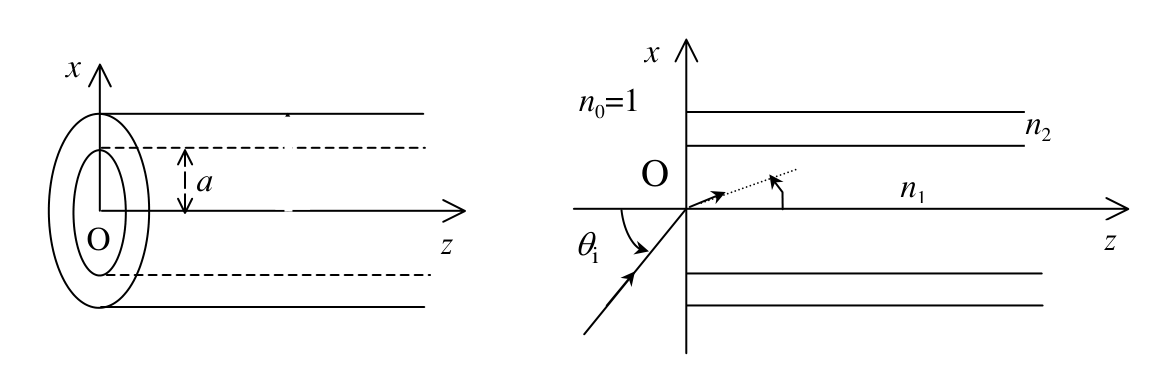
An optical fiber consists of a cylindrical core of radius , made of a transparent material with refraction index varying gradually from the value on the axis to (with ) at a distance from the axis, according to the formula
where is the distance from the core axis and is a constant. The core is surrounded by a cladding made of a material with constant refraction index . Outside the fiber is air, of refractive index .
Let be the axis of the fiber, with O — the center of the fiber end.
Given ; ; , .
1. A monochromatic light ray enters the fiber at point O under an incident angle , the incident plane being the plane .
a. Show that at each point on the trajectory of the light in the fiber, the refractive index and the angle between the light ray and the axis satisfy the relationship where is a constant. Find the expression for in terms of and . [1.0 points]
b. Use the result found in 1.a. and the trigonometric relation , where is the slope of the tangent to the trajectory at point , derive an equation for . Find the full expression for in terms of , and . By differentiating the two sides of this equation versus , find the equation for the second derivative . [1.0 points]
c. Find the expression of as a function of , that is , which satisfies the above equation. This is the equation of the trajectory of light in the fiber. [1.0 points]
d. Sketch one full period of the trajectories of the light rays entering the fiber under two different incident angles . [1.0 points]
2. Light propagates in the optical fiber.
a. Find the maximum incident angle , under which the light ray still can propagate inside the core of the fiber. [1.5 points]
b. Determine the expression for coordinate of the crossing points of a light ray with axis for . [1.5 points]
3. The light is used to transmit signals in the form of very short light pulses (of negligible pulse width).
a. Determine the time it takes the light to travel from point O to the first crossing point with for incident angle and .
The ratio of the coordinate of the first crossing point and is called the propagation speed of the light signal along the fiber. Assume that this speed varies monotonously with . Find this speed (called ) for .
Find also the propagation speed (called ) of the light along the axis .
Compare the two speeds. [3.25 points]
b. The light beam bearing the signals is a converging beam entering the fiber at O under different incident angles with . Calculate the highest repetition frequency of the signal pulses, so that at a distance two consecutive pulses are still separated (that is, the pulses do not overlap). [1.75 points]
Attention
-
The wave properties of the light are not considered in this problem.
-
Neglect any chromatic dispersion in the fiber.
-
The speed of light in vacuum is .
-
You may use the following formulae:
- The length of a small arc element in the plane is
-
-
-
is the inverse function of the sine function. Its value equals the angle the sine of which is , if then .
Fonte: Testo (PDF) — p.1
Topic: Geometric Optics, Mathematics Metodi: Snell’s Law, Ray Tracing, Differential Equations, Calculus-Integration Competenze: Mathematical Modeling, Physical Reasoning Objects: Tube
Fibra ottica
Una fibra ottica è costituita da un nucleo cilindrico di raggio , costituito da un materiale trasparente con un indice di rifrazione che varia gradualmente dal valore sull’asse a (con ) a una distanza dall’asse, secondo la formula
dove è la distanza dall’asse del nucleo e è una costante. Il nucleo è circondato da un rivestimento in materiale con indice di rifrazione costante . Al di fuori della fibra si trova l’aria, con un indice di rifrazione .
Il deve essere l’asse della fibra, con O al centro della fine della fibra.
Se si tratta di ; ; , .
1. Un raggio di luce monocromatico entra nella fibra al punto O sotto un angolo di incidenza , il piano di incidenza essendo il piano .
a. Mostra che in ogni punto della traiettoria della luce nella fibra, l’indice di rifrazione e l’angolo tra il raggio di luce e l’asse soddisfano la relazione dove è una costante. Trova l’espressione per in termini di e . [1,0 punti]
b. Utilizzare il risultato trovato in 1.a. e la relazione trigonometrica , dove è la pendenza della tangente sulla traiettoria al punto , derivano un’equazione per . Trova l’espressione completa per in termini di , e . Differenziando i due lati di questa equazione rispetto a , trovi l’equazione per la seconda derivata . [1,0 punti]
c. Trova l’espressione di come funzione di , cioè , che soddisfa l’equazione sopra. Questa è l’equazione della traiettoria della luce nella fibra. [1,0 punti]
d. Segnare un periodo completo delle traiettorie dei raggi luminosi che entrano nella fibra sotto due angoli di incidenza diversi . [1,0 punti]
**2. ** La luce si propaga nella fibra ottica.
a. Trova l’angolo di incidenza massimo , sotto il quale il raggio di luce può ancora propagarsi all’interno del nucleo della fibra. [1,5 punti]
b. Determinare l’espressione per la coordinata dei punti di attraversamento di un raggio di luce con asse per . [1,5 punti]
La luce viene utilizzata per trasmettere segnali sotto forma di impulsi di luce molto brevi (di larghezza di impulso trascurabile).
a. Determina il tempo necessario per il viaggio della luce dal punto O al primo punto di attraversamento con per l’angolo di incidenza e .
Il rapporto tra le coordinate del primo punto di attraversamento e è chiamato velocità di propagazione del segnale luminoso lungo la fibra. Supponiamo che questa velocità varia monotone con . Trova questa velocità (chiamata ) per .
Trova anche la velocità di propagazione (chiamata ) della luce lungo l’asse .
Confronta le due velocità. [3,25 punti]
Il fascio luminoso che trasporta i segnali è un fascio di convergenza che entra nella fibra a O sotto diversi angoli di incidenza con . Calcolare la frequenza di ripetizione più alta degli impulsi del segnale, in modo che a distanza siano ancora separati due impulsi consecutivi (cioè che gli impulsi non si sovrappongono). [1,75 punti]
Attenzione
-
Le proprietà onduali della luce non sono considerate in questo problema.
-
Non si deve considerare la dispersione cromatica della fibra.
-
La velocità della luce nel vuoto è .
-
È possibile utilizzare le seguenti formule:
- La lunghezza di un piccolo elemento d’arco nel piano è
-
-
-
è la funzione inversa della funzione seno. Il suo valore è pari all’angolo il cui seno è , se allora .
Fonte: Testo (PDF) — p.1
Topic: Geometric Optics, Mathematics Metodi: Snell’s Law, Ray Tracing, Differential Equations, Calculus-Integration Competenze: Mathematical Modeling, Physical Reasoning Objects: Tube
Compression and expansion of a two gases system
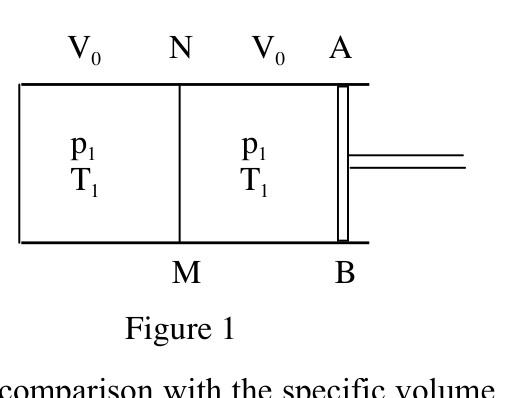
A cylinder is divided in two compartments with a mobile partition NM. The compartment in the left is limited by the fond of the cylinder and the partition NM (Figure 1). This compartment contains one mole of water vapor. The compartment in the right is limited by the partition NM and a mobile piston AB. This compartment contains one mole of nitrogen gas ().
At first, the volumes and temperatures of the gases in two compartments are equal. The partition NM is well heat conductive. His heat capacity is very small and can be neglected.
The specific volume of liquid water is negligible in comparison with the specific volume of water vapor at the same temperature.
The specific latent heat of vaporization is defined as the amount of heat that must be delivered to one unit of mass of substance to convert it from liquid state to vapor at the same temperature. For water at , .
1. Suppose that the piston and the wall of the cylinder are heat conductive, the partition NM can slide freely without friction. The initial state of the gases in the cylinder is defined as follows:
Pressure ; total volume ; temperature .
The piston AB slowly compresses the gases in a quasi-static (quasi-equilibrium) and isothermal process to the final volume .
a. Draw the curve, that is the curve representing the dependence of pressure on the total volume of both gases in the cylinder at temperature . Calculate the coordinates of important points of the curve. [1.5 pts]
Gas constant: or
1 atm. ;
Under the pressure atm., water boils at the temperature .
b. Calculate the work done by the piston in the process of gases compressing. [1.0 pts]
c. Calculate the heat delivered to outside in the process. [1.5 pts]
2. All conditions as in 1. except that there is friction between partition NM and the wall of the cylinder so that NM displaces only when the difference of the pressures acting on its two opposed faces attains 0.5 atm. and over (assuming that the coefficients of static and kinetic friction are equal).
a. Draw the curve representing the pressure in the right compartment as a function of the total volume of both gases in the cylinder at a constant temperature . [1.5 pts]
b. Calculate the work done by the piston in compressing the gases. [0.5 pts]
c. After the volume of gases reaches the value , piston AB displaces slowly to the right and makes a quasi-static and isothermal process of expansion of both substances (water and nitrogen) to the initial total volume . Continue to draw in the diagram in question 2.a. the curve representing this process [2.0 pts]
Hint for 2.
Create a table like the one shown here and use it to draw the curves as required in 2.a. and 2.c.
| State | Left compartment Volume | Pressure | Right compartment Volume | Pressure | Total volume | Pressure on piston AB |
|---|---|---|---|---|
| initial | | 0.5 atm. | | 0.5 atm. | 0.5 atm. | |
| 2 | | | | | ||
| 3 | | | | | ||
| . | | | | | ||
| . | | | | | ||
| . | | | | | ||
| . | | | | | ||
| . | | | | | ||
| final | | | | |
3. Suppose that the wall and the fond of the cylinder and the piston are heat insulator, the partition NM is fixed and heat conductive, the initial state of gases is as in 1. Piston AB moves slowly toward the right side and increases the volume of the right compartment until the water vapor begins to condense in the left compartment.
a. Calculate the final volume of the right compartment. [3 pts]
b. Calculate the work done by the gas in this expansion. [1 pts]
The ratio of isobaric heat capacity to isochoric one for nitrogen is and for water vapor .
In the interval of temperature from 353 K to 393 K one can use the following approximate formula:
where is boiling temperature of water under pressure , — its molar mass. , and are given above.
Fonte: Testo (PDF) — p.1
Topic: Thermodynamics, Kinetic Theory Metodi: Ideal Gas Law, First Law of Thermodynamics, Calculus-Integration, Thermodynamic Cycle Analysis Competenze: Mathematical Modeling, Diagrammatic Reasoning Objects: Cylinder, Piston, Gas
Compressione e espansione di un sistema a due gas
Un cilindro è diviso in due comparti con una partizione mobile NM. Il compartimento a sinistra è limitato dal fond del cilindro e dalla partizione NM (Figura 1). Questo compartimento contiene un mol di vapore d’acqua. Il compartimento a destra è limitato dalla partizione NM e da un pistone mobile AB. Questo compartimento contiene un mole di gas azoto ().
All’inizio, i volumi e le temperature dei gas in due compartimenti sono uguali. La partizione NM è ben calore conduttivo. La sua capacità termico è molto piccola e può essere trascurata.
Il volume specifico di acqua liquida è trascurabile rispetto al volume specifico di vapore idrico alla stessa temperatura.
Il calore latente specifico di vaporizzazione è definito come la quantità di calore che deve essere consegnata a una unità di massa di sostanza per convertire la sostanza dallo stato liquido in vapore alla stessa temperatura. Per l’acqua a , .
1. Supponiamo che il pistone e la parete del cilindro siano conducenti al calore, la partizione NM può scivolare liberamente senza attrito. Lo stato iniziale dei gas nel cilindro è definito come segue:
Pressione ; volume totale ; temperatura .
Il pistone AB comprime lentamente i gas in un processo quasi-statico (quasi-equilibrio) e isotermo al volume finale .
a. Disegna la curva , cioè la curva che rappresenta la dipendenza della pressione sul volume totale di entrambi i gas nel cilindro a temperatura . Calcolare le coordinate dei punti importanti della curva. [1,5 pts]
Costante del gas: o
Un’ATM. ;
Sotto la pressione atm, l’acqua bolle a temperatura .
b. Calcolare il lavoro svolto dal pistone nel processo di compressione dei gas. [1,0 pts]
c. Calcolare il calore trasmesso all’esterno nel processo. [1,5 pts]
2. Tutte le condizioni come in 1. se non è che vi sia attrito tra la partizione NM e la parete del cilindro in modo che NM si sposthi solo quando la differenza delle pressioni che agiscono sulle sue due facce opposte raggiunge 0,5 atm. e sopra (supponendo che i coefficienti di attrito statico e cinetico siano uguali).
a. Disegnare la curva che rappresenta la pressione nel compartimento destro in funzione del volume totale di entrambi i gas nel cilindro a temperatura costante . [1,5 pts]
b. Calcolare il lavoro svolto dal pistone nel comprimere i gas. [0,5 pts]
c. After the volume of gases reaches the value , piston AB displaces slowly to the right and makes a quasi-static and isothermal process of expansion of both substances (water and nitrogen) to the initial total volume . Continuare a disegnare il diagramma della domanda 2.a. la curva che rappresenta questo processo [2.0 pts]
*Suggetta per 2. *
Crea una tabella come quella mostrata qui e usala per disegnare le curve come richiesto nel punto 2.a. e 2.c.
Stato Compartimento sinistro Volume Pressione Compartimento destro Volume Pressione Volume totale Pressione sul pistone AB |---|---|---|---|---| | initial | | 0.5 atm. | | 0.5 atm. | | 0.5 atm. | | 2 | | | | | | | | 3 | | | | | | | | . | | | | | | | | . | | | | | | | | . | | | | | | | | . | | | | | | | | . | | | | | | | | final | | | | | | |
3. Supponiamo che la parete e il fond del cilindro e del pistone siano isolanti termici, la partizione NM sia fissa e termostatica, lo stato iniziale dei gas è come in 1. Il pistone AB si muove lentamente verso il lato destro e aumenta il volume del compartimento destro fino a quando il vapore d’acqua inizia a condensi nel compartimento sinistro.
a. Calcolare il volume finale del compartimento destro. * [3 pts] *
b. Calcolare il lavoro svolto dal gas in questa espansione. [1 pts]
Il rapporto tra capacità termico isobarica e isochorica per l’azoto è e per il vapore acqueo .
Nell’intervallo di temperatura da 353 K a 393 K si può usare la seguente formula approssimativa:
se è la temperatura di bollio dell’acqua sotto pressione , la sua massa molare. I seguenti tipi di , e sono indicati sopra.
Fonte: Testo (PDF) — p.1
Topic: Thermodynamics, Kinetic Theory Metodi: Ideal Gas Law, First Law of Thermodynamics, Calculus-Integration, Thermodynamic Cycle Analysis Competenze: Mathematical Modeling, Diagrammatic Reasoning Objects: Cylinder, Piston, Gas