Rolling Cylinders
A thin-walled cylinder of mass and rough inner surface of radius can rotate about its fixed central horizontal axis OZ. The Z-axis is perpendicular to and out of the page. Another smaller uniform solid cylinder of mass and radius rolls without slipping (except for question 1.8) on the inner surface of about its own central axis which is parallel to OZ.
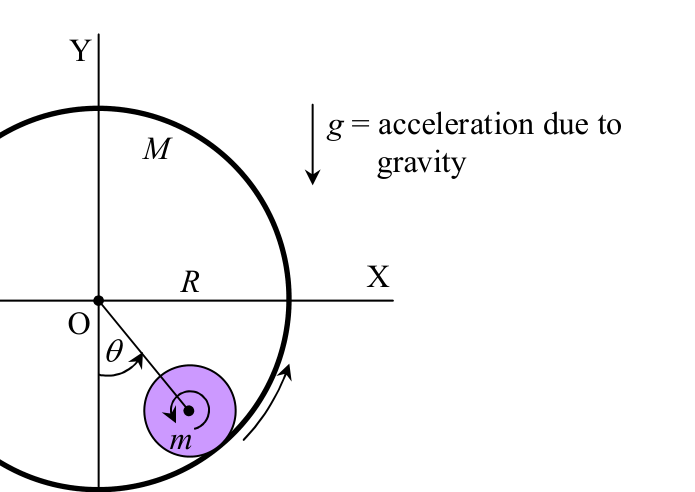
1.1) The rotation of is to be started from rest at the instant when is resting at the lowest point. At a later time the angular position of the centre of mass of is and by then has turned through an angle radians. How many radians (designated ) would have mass turned through about its central axis relative to a fixed line (for example, the negative Y-axis)? Give your answer in terms of , , and . (0.8 point)
1.2) What is the angular acceleration of , , about its own axis through its centre of mass? Give your answer in terms of , and derivatives of and . (0.2 point)
1.3) Derive an equation for the angular acceleration of the centre of mass of , , in terms of , , , , , and the moment of inertia of about its central axis. (1.8 points)
1.4) What is the period of small amplitude oscillation of when is constrained to rotate at a constant angular velocity? Give your answer only in terms of , and . (1.3 point)
1.5) What is the value of for the equilibrium position of in question 1.4? (0.2 point)
1.6) What is the equilibrium position of when is rotating with a constant angular acceleration ? Give your answer in terms of , and . (0.7 point)
1.7) Now is allowed to rotate (oscillate) freely, without constraint, about its central axis OZ while is executing a small-amplitude oscillation by pure rolling on the inner surface of . Find the period of this oscillation. (2.5 points)
1.8) Consider the situation in which is rotating steadily at an angular velocity and is rotating (rolling) about its stationary centre of mass, at the equilibrium position found in question 1.5. is then brought abruptly to a halt. What must be the lowest value of such that will roll up and reach the highest point of the cylindrical surface of ? The coefficient of friction between and is assumed to be sufficiently high that begins to roll without slipping soon after a short skidding right after is stopped. (2.5 points)
Fonte: Testo (PDF) — p.1
Topic: Rotational Dynamics, Oscillations & Waves Metodi: Torque & Angular Momentum Analysis, Simple Harmonic Motion Analysis, Conservation of Energy, Small-Angle Approximation Competenze: Physical Reasoning, Mathematical Modeling Objects: Cylinder
Cilindri a rotoli
Un cilindro a pareti sottili di massa e superficie interna ruvida di raggio può ruotare intorno al suo asse centrale orizzontale fisso OZ. L’asse Z è perpendicolare verso e fuori la pagina. Un altro cilindro solido più piccolo, uniforme, di massa e di raggio ruota senza scivolare (ad eccezione della domanda 1.8) sulla superficie interna di intorno al suo asse centrale, parallelo all’OZ.
**1.1) ** La rotazione di deve essere avviata dal riposo all’istante quando si riposa al punto più basso. In un secondo momento la posizione angolare del centro di massa di è e a quel punto ha attraversato un angolo radiani. Quanti radiani (denominati ) avrebbero massa girata intorno al suo asse centrale rispetto a una linea fissa (ad esempio, l’asse Y negativo)? Rispondi in termini di , , e . *(0,8 punti) *
**1.2) ** Qual è l’accelerazione angolare di , , intorno al suo asse attraverso il suo centro di massa? Rispondi in termini di , e derivati di e . *(0,2 punti) *
**1.3) ** Derivare un’equazione per l’accelerazione angolare del centro di massa di , , in termini di , , , , , e del momento di inerzia di attorno al suo asse centrale. *(1,8 punti) *
**1.4) ** Qual è il periodo di piccola oscillazione di amplitudine di quando è costretto a girare a velocità angolare costante? Rispondi solo in termini di , e . *(1,3 punto) *
**1.5) ** Qual è il valore di per la posizione di equilibrio di nella domanda 1.4? *(0,2 punti) *
**1.6) ** Qual è la posizione di equilibrio di quando ruota con un’accelerazione angolare costante ? Rispondi in termini di , e . *(0,7 punti) *
**1.7) ** Ora può girare (oscillare) liberamente, senza vincoli, intorno al suo asse centrale OZ mentre esegue un’oscillazione di piccola amplitudine per semplice rotolamento sulla superficie interna di . Trova il periodo di questa oscillazione. *(2,5 punti) *
**1.8) ** Considerare la situazione in cui ruota costantemente a velocità angolare e ruota (rollando) intorno al suo centro di massa stazionario, nella posizione di equilibrio trovata nella domanda 1.5. Il viene quindi interromputo improvvisamente. Qual è il valore più basso di tale che si arrotoli e raggiunga il punto più alto della superficie cilindrica di ? Si presume che il coefficiente di attrito tra e sia sufficientemente elevato da consentire alla di iniziare a rotolare senza scivolare poco dopo un breve scivolamento subito dopo l’arresto di . *(2,5 punti) *
Fonte: Testo (PDF) — p.1
Topic: Rotational Dynamics, Oscillations & Waves Metodi: Torque & Angular Momentum Analysis, Simple Harmonic Motion Analysis, Conservation of Energy, Small-Angle Approximation Competenze: Physical Reasoning, Mathematical Modeling Objects: Cylinder
A Self-excited Magnetic Dynamo
A metallic disc of radius mounted on a slender axle is rotating with a constant angular velocity inside a long solenoid of inductance whose two ends are connected to the rotating disc by two brush contacts as shown. The total resistance of the whole circuit is . A small magnetic disturbance can initiate the growth of an induced electromotive force across the terminals P, Q.
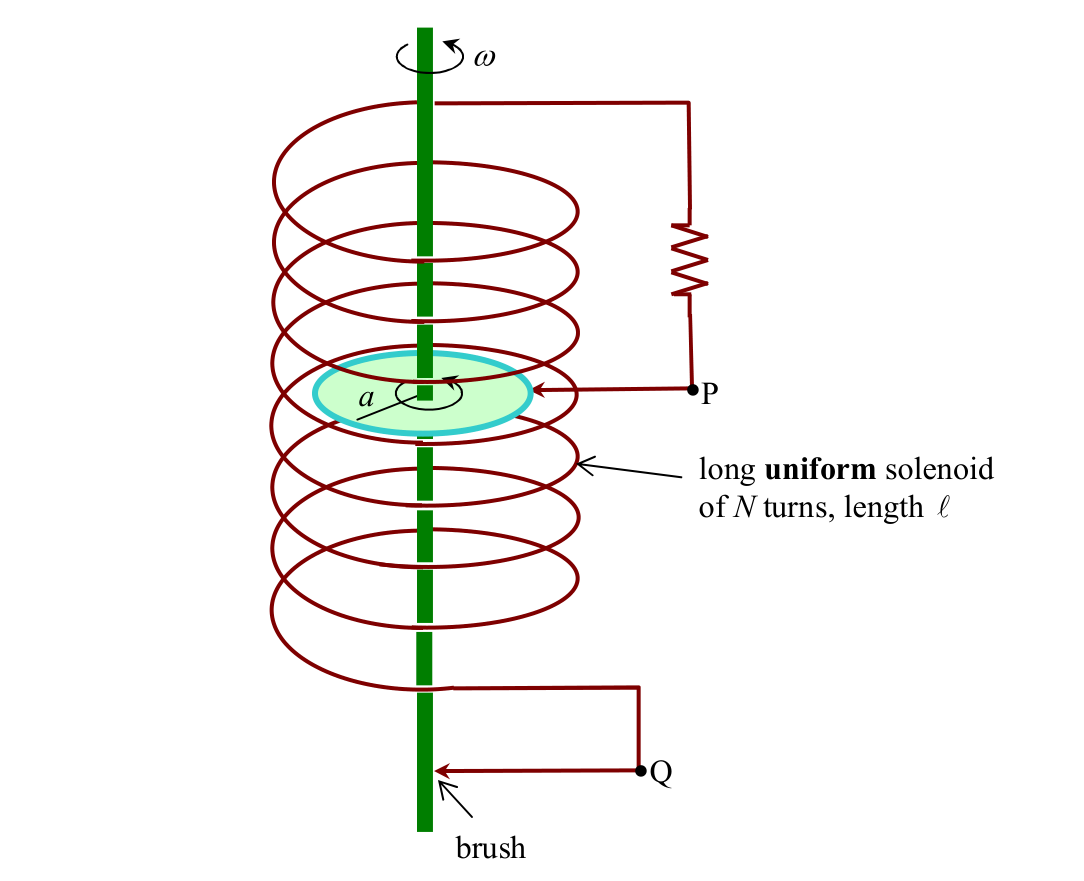
2.1) Write down the differential equation for , the current through the circuit. Express your answer in terms of , and the induced e.m.f. across the terminals P and Q. (1.0 point)
2.2) What is the value of the magnetic flux density in terms of , , and the permeability of free space ? Ignore the magnetic field generated by the disc and the axle. (1.5 points)
2.3) What is the expression for the induced e.m.f. in terms of , , , , and the angular velocity ? (2.0 points)
2.4) Solve the equation in question 2.1 for current at any time in terms of the initial current , and other parameters. (1.5 points)
2.5) What is the minimum value of the angular velocity that will permit the current to grow? Give your answers in terms of , , , and . (2.0 points)
2.6) In order to maintain a certain steady angular velocity , what must be the value of torque applied to the axle at the instant ? (2.0 points)
Fonte: Testo (PDF) — p.1
Topic: Electromagnetic Induction, Circuits Metodi: Faraday’s Law of Induction, Differential Equations, Ampère’s Law, Kirchhoff’s Laws Competenze: Mathematical Modeling, Physical Reasoning Objects: Disk, Solenoid, Inductor
**Un’auto-escitazione magnetica
Un disco metallico di raggio montato su un asse sottile ruota a velocità angolare costante all’interno di un lungo solenoide di inductanza le cui estremità sono collegate al disco rotante da due contatti di spazzola come mostrato. La resistenza totale di tutto il circuito è . Un piccolo disturbo magnetico può avviare la crescita di una forza elettromotrice indotta attraverso i terminali P, Q.
**2.1) ** Scrivi l’equazione differenziale per , la corrente attraverso il circuito. Esprimere la risposta in termini di , e l’e.m.f. indotta. attraverso i terminali P e Q. *(1,0 punto) *
**2.2) ** Qual è il valore della densità del flusso magnetico in termini di , , e della permeabilità dello spazio libero ? Ignorare il campo magnetico generato dal disco e dall’asse. *(1,5 punti) *
**2.3) ** Qual è l’espressione per l’ e.m.f. indotta? in termini di , , , , e della velocità angolare ? *(2,0 punti) *
**2.4) ** Risolvere l’equazione in questione 2.1 per corrente in qualsiasi momento in termini di corrente iniziale e altri parametri. *(1,5 punti) *
**2.5) ** Qual è il valore minimo della velocità angolare che permetterà alla corrente di crescere? Rispondere in termini di , , , e . *(2,0 punti) *
**2.6) ** Per mantenere una certa velocità angolare costante , qual deve essere il valore della coppia applicata all’asse all’istante ? *(2,0 punti) *
Fonte: Testo (PDF) — p.1
Topic: Electromagnetic Induction, Circuits Metodi: Faraday’s Law of Induction, Differential Equations, Ampère’s Law, Kirchhoff’s Laws Competenze: Mathematical Modeling, Physical Reasoning Objects: Disk, Solenoid, Inductor
The Leidenfrost Phenomenon
The purpose is to estimate the lifetime of a (hemispherical) drop of a liquid sitting on top of a very thin layer of vapour which is thermally insulating the drop from the very hot plate below.
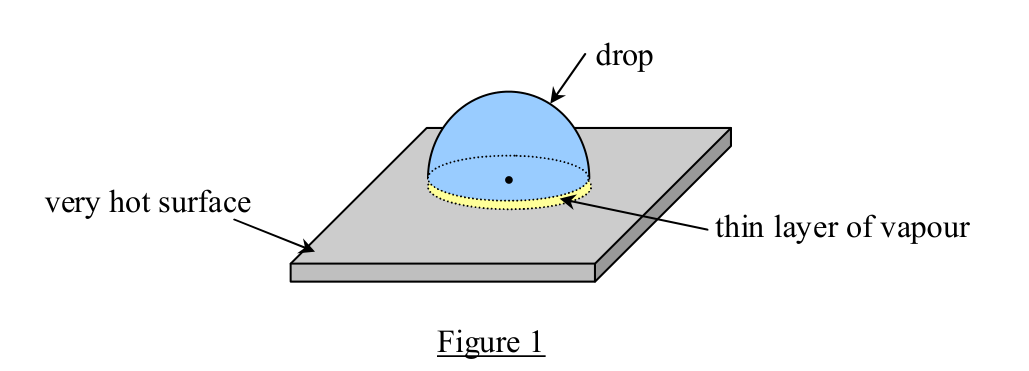
It will be assumed here that the flow of vapour underneath the drop is streamline and behaves as a Newtonian fluid of viscosity coefficient and of thermal conductivity . The specific latent heat of vaporization of the liquid is . And for a Newtonian fluid we have the shear stress the rate of shear where is the flow velocity and is the perpendicular distance to the direction of flow, and the direction of is tangential to the surface area .
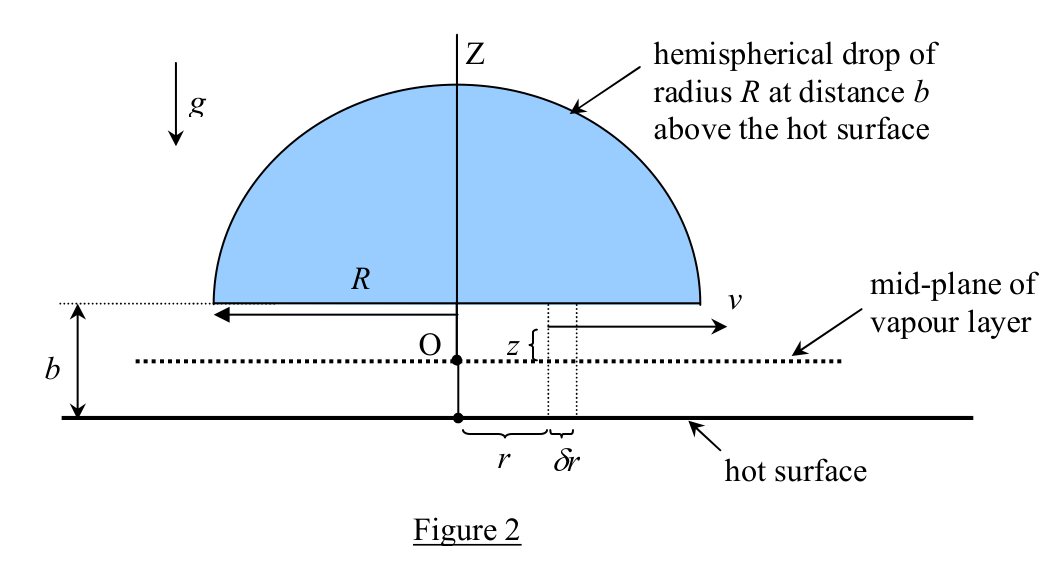
is the velocity of vapour in the radial direction at the height above the mid-plane. The pressure inside the vapour must be higher towards the centre O. This will result in the out-flowing of vapour and in force that holds the drop against the pull of gravity. The thickness of vapour layer under thermal and mechanical equilibria is .
For a Newtonian flow of vapour we can approximate that
3.1) Show that
where is an arbitrary constant of integration. (0.5 point)
3.2) Refer to figure 2, find the value of in terms of , and using the boundary condition for . (0.5 point)
3.3) Calculate the volume rate of flow of vapour through the cylindrical surface defined by . (Hint: the cylinder is of radius and of height underneath the drop). (1.0 point)
3.4) By assuming that the rate of production of vapour of density is due to heat flow from the hot surface to the drop, find the expression for the pressure . Use to represent the atmospheric pressure, and use for the temperature difference between those of the hot surface and of the drop. Assume that the system has reached the steady state. (2.0 points)
3.5) Calculate the value of by equating the weight of the drop to the net force due to pressure difference between the bottom and the top of the drop. The density of the drop is . (2.0 points)
3.6) Now, what is the total rate of vaporization? (2.0 points)
3.7) Assume that the drop maintains a hemispherical shape, what is the life-time of the drop? (2.0 points)
Fonte: Testo (PDF) — p.1
Topic: Fluid Mechanics, Thermodynamics Metodi: Calculus-Integration, Continuity Equation, Hydrostatic Equilibrium, Physical Modeling Competenze: Mathematical Modeling, Physical Reasoning Objects: Droplet, Gas
Il fenomeno del gelo di Leiden
Lo scopo è di stimare la durata di una goccia (emisferica) di liquido che si trova sopra uno strato di vapore molto sottile che isola termicamente la goccia dalla piastra molto calda sotto.
Si presume che il flusso di vapore sotto la goccia sia razionalizzato e si comporti come un fluido newtoniano con un coefficiente di viscosità e di conduttività termica . Il calore latente specifico della vaporizzazione del liquido è . E per un fluido newtoniano abbiamo la tensione di taglio il tasso di taglio dove è la velocità di flusso e è la distanza perpendicolare alla direzione del flusso, e la direzione di è tangenziale alla superficie .
è la velocità del vapore nella direzione radial all’altezza sopra il piano medio. La pressione all’interno del vapore deve essere superiore verso il centro O. Ciò causerà l’uscita di vapore e la forza che sostiene la caduta contro la forza di gravità. Lo spessore dello strato di vapore sotto equilibrio termico e meccanico è .
Per un flusso di vapore newtoniano possiamo approssimare che
**3.1) ** Mostra che
dove è una costante di integrazione arbitraria. *(0,5 punto) *
**3.2) ** Si riferisce alla figura 2, trova il valore di in termini di , e utilizzando la condizione di confine per . *(0,5 punto) *
**3.3) ** Calcolare il volume di flusso di vapore attraverso la superficie cilindrica definita da . (Signore: il cilindro ha un raggio e un’altezza sotto la goccia). *(1,0 punto) *
**3.4) ** Supponendo che il tasso di produzione di vapori di densità sia dovuto al flusso di calore dalla superficie calda alla goccia, si trova l’espressione per la pressione . Per rappresentare la pressione atmosferica utilizzare e per la differenza di temperatura tra quella della superficie calda e quella della goccia utilizzare . Supponiamo che il sistema abbia raggiunto lo stato di stabilità. *(2,0 punti) *
**3.5) ** Calcolare il valore di equiparando il peso della caduta alla forza netta dovuta alla differenza di pressione tra il fondo e la parte superiore della caduta. La densità della goccia è . *(2,0 punti) *
Ora, qual è il tasso totale di vaporizzazione? *(2,0 punti) *
Se si suppone che la goccia mantenga una forma emisfera, quale è la durata della goccia? *(2,0 punti) *
Fonte: Testo (PDF) — p.1
Topic: Fluid Mechanics, Thermodynamics Metodi: Calculus-Integration, Continuity Equation, Hydrostatic Equilibrium, Physical Modeling Competenze: Mathematical Modeling, Physical Reasoning Objects: Droplet, Gas