The schematic below shows the Hadley circulation in the Earth’s tropical atmosphere around the spring equinox. Air rises from the equator and moves poleward in both hemispheres before descending in the subtropics at latitudes (where positive and negative latitudes refer to the northern and southern hemisphere respectively). The angular momentum about the Earth’s spin axis is conserved for the upper branches of the circulation (enclosed by the dashed oval). Note that the schematic is not drawn to scale.
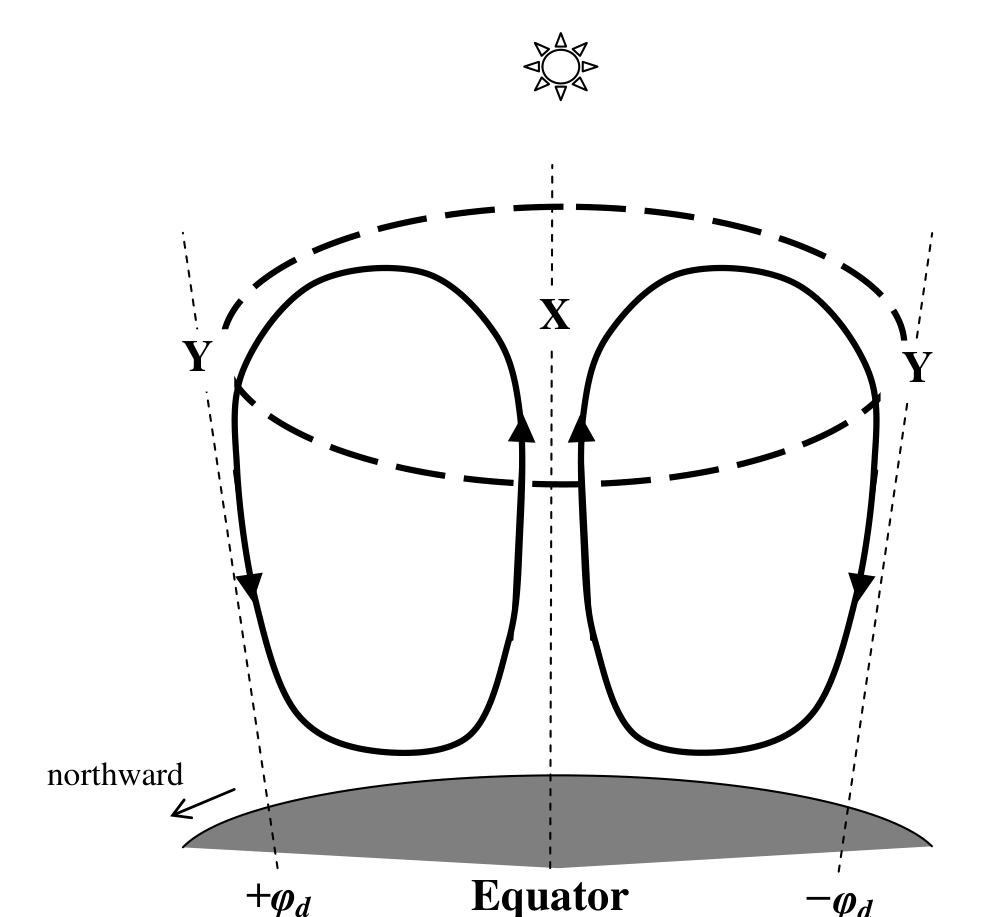 Schematic of the Hadley circulation. The sun is overhead at the equator; X marks the rising branch at the equator, Y the descending branches at latitudes . The dashed oval encloses the upper branches where angular momentum is conserved. “northward” points toward ; the surface is shaded at the bottom (Equator at centre).
(a) (2 points) Assume that there is no wind velocity in the east-west direction around the point X. What is the expression for the east-west wind velocity at the points Y? Convention: positive velocities point from west to east. (The angular velocity of the Earth about its spin axis is , the radius of the Earth is , and the thickness of the atmosphere is much smaller than .)
(b) (1 point) Which of the following explains ultimately why angular momentum is not conserved along the lower branches of the Hadley circulation? Tick the correct answer(s). There can be more than one correct answer.
- (I) There is friction from the Earth’s surface.
- (II) There is turbulence in the lower atmosphere, where different layers of air are mixed.
- (III) The air is denser lower down and so inertia slows down the motion around the spin axis of the Earth.
- (IV) The air is moist at the lower levels causing retardation to the wind velocity.
Around the northern winter solstice, the rising branch of the Hadley circulation is located at the latitude and the descending branches are located at and as shown in the schematic below. Refer to this diagram for parts (c), (d) and (e).
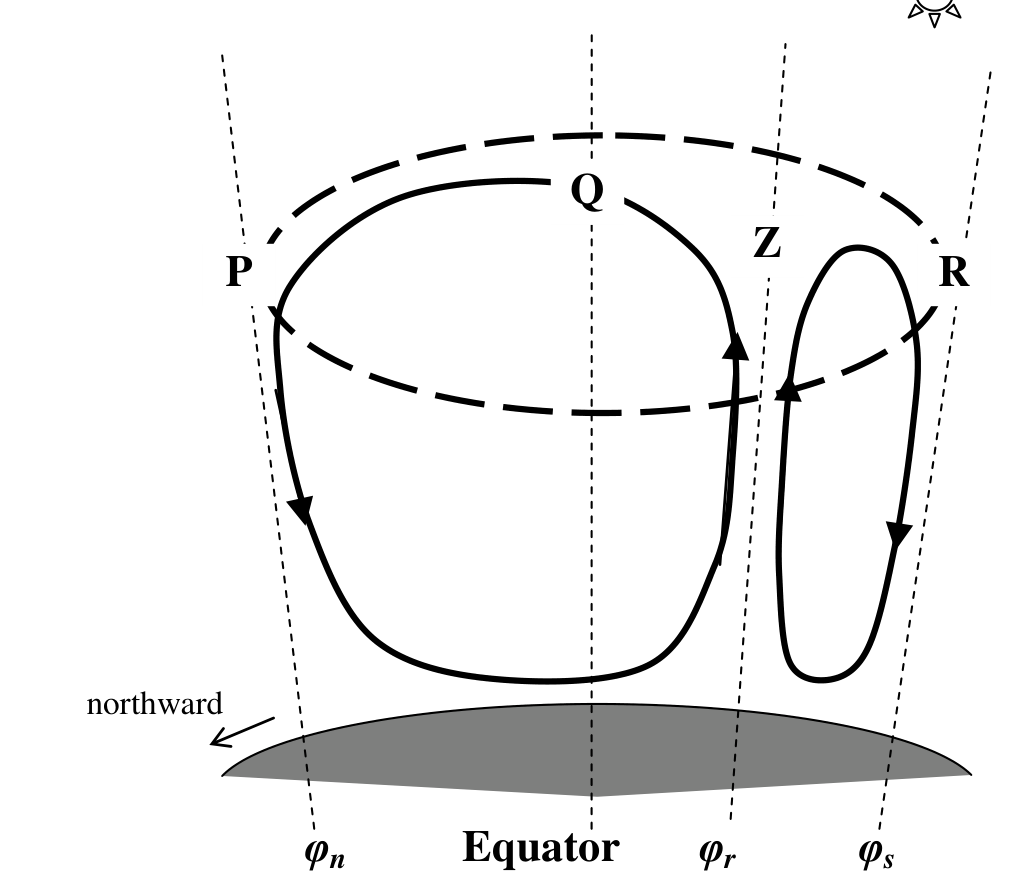 Schematic of the Hadley circulation around the northern winter solstice. The rising branch is at latitude (point Z); the descending branches are at (point P, northern hemisphere) and (point R, southern hemisphere). Points P, Q, Z, R are marked along the circulation. The dashed oval encloses the upper branches; “northward” points toward .
(c) (2 points) Assume that there is no east-west wind velocity around the point Z. Given that , and , what are the east-west wind velocities , and respectively at the points P, Q and R? (The radius of the Earth is km.) Hence, which hemisphere below has a stronger atmospheric jet stream?
- (I) Winter Hemisphere
- (II) Summer Hemisphere
- (III) Both hemispheres have equally strong jet streams.
(d) (1 point) The near-surface branch of the Hadley circulation blows southward across the equator. Mark by arrows on the figure below the direction of the east-west component of the Coriolis force acting on the tropical air mass
- A. north of the equator;
- B. south of the equator.
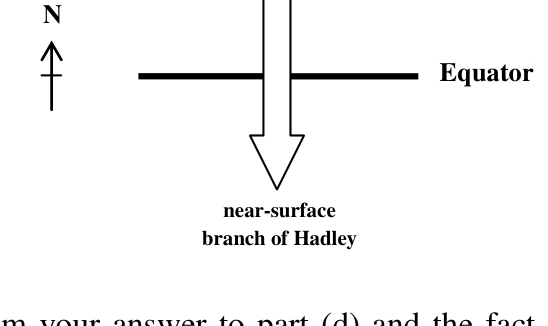 Diagram for part (d): a horizontal line marks the Equator (with N pointing up at the left), and a thick downward arrow labelled “near-surface branch of Hadley” crosses the equator from north to south.
- E. (1 point) From your answer to part
- D. and the fact that surface friction nearly balances the Coriolis forces in the east-west direction, sketch the near-surface wind pattern in the tropics near the equator during northern winter solstice.
Suppose the Hadley circulation can be simplified as a heat engine shown in the schematic below. Focusing on the Hadley circulation reaching into the winter hemisphere as shown below, the physical transformation of the air mass from A to B and from D to E are adiabatic, while that from B to C, C to D and from E to A are isothermal. Air gains heat by contact with the Earth’s surface and by condensation of water from the atmosphere, while air loses heat by radiation into space.
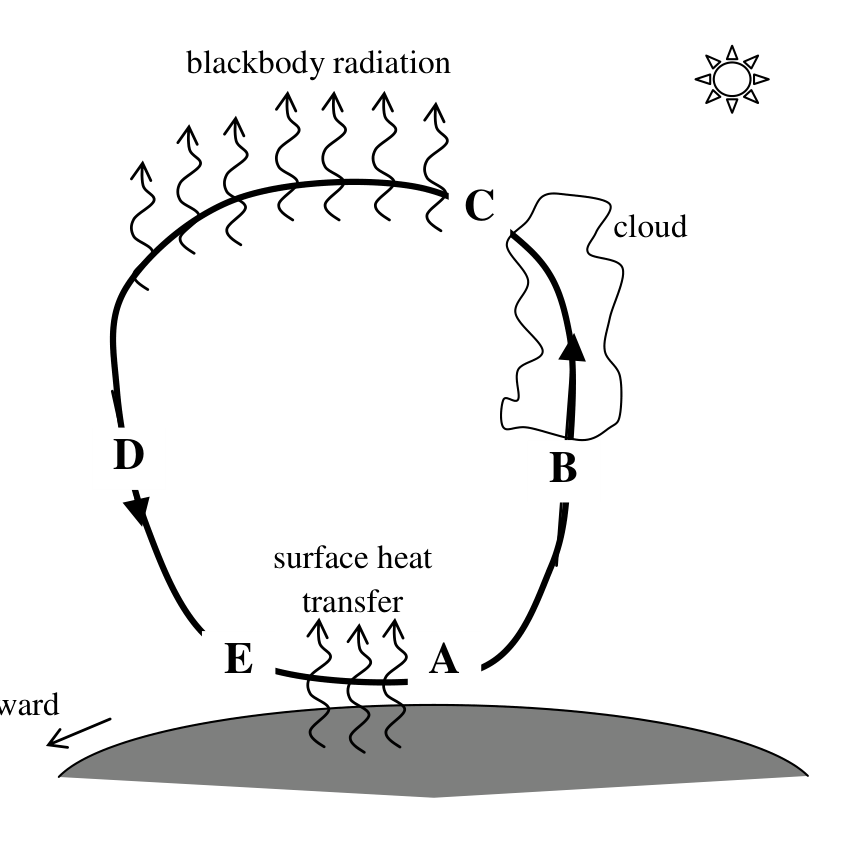 Heat-engine schematic of the Hadley circulation. Going around the loop A → B → C → D → E → A: A to B (rising, through a cloud) and D to E are adiabatic; B to C, C to D and E to A are isothermal. At the top, the air loses heat by “blackbody radiation” (wavy arrows pointing outward near C–D); near the surface (E–A) the air gains heat by “surface heat transfer” (wavy arrows from the shaded ground). “northward” points to the left.
(f) (2 points) Given that atmospheric pressure at a vertical level owes its origin to the weight of the air above that level, order the pressures , , , , , respectively at the points A, B, C, D, E by a series of inequalities. (Given that hPa and hPa. Note that 1 hPa is 100 Pa.)
(g) (2 points) Let the temperature next to the surface and at the top of the atmosphere be and respectively. Given that the pressure difference between points A and E is 20 hPa, calculate for K. Note that the ratio of molar gas constant () to molar heat capacity at constant pressure () for air, , is .
(h) (2 points) Calculate the pressure .
(i) For an air mass moving once around the winter Hadley circulation, using the molar gas constant, , and the quantities defined above, obtain expressions for
- (A) (2 points) the net work done per unit mole ignoring surface friction;
- (B) (1 point) the heat loss per unit mole at the top of the atmosphere.
(j) (1 point) What is the value of the ideal thermodynamic efficiency for the winter Hadley circulation?
(k) (2 points) Prove that the actual thermodynamic efficiency for the winter Hadley circulation is always smaller than , showing all mathematical steps.
(l) (1 point) Which of the following statements best explains why is less than the ideal value? Tick the correct answer(s). There can be more than one correct answer.
- (I) We have ignored work done against surface friction.
- (II) Condensation occurs at a temperature lower than the temperature of the heat source.
- (III) There is irreversible evaporation of water at the surface.
- (IV) The ideal efficiency is applicable only when there is no phase change of water.
Fonte: Testo (PDF) — p.1
Topic: Earth & Environmental Science, Thermodynamics Metodi: Conservation Laws, Thermodynamic Cycle Analysis, First Law of Thermodynamics, Ideal Gas Law Competenze: Physical Reasoning, Mathematical Modeling Objects: Planet, Heat Engine
Lo schema di seguito mostra la circolazione di Hadley nell’atmosfera tropicale terrestre intorno all’equinozio di primavera. L’aria sale dall’equatore e si muove verso i poli in entrambi gli emisferi prima di scendere nei subtropici alle latitudini (dove le latitudini positive e negative si riferiscono rispettivamente all’emisfero nord e meridionale). Il momento angolare intorno all’asse di rotazione della Terra è conservato per i rami superiori della circolazione (inclosso dall’ovale a strisce). Si noti che lo schema non è tracciato su scala.
Schematic of the Hadley circulation. Il sole è sopra l’equatore; X segna il ramo in salita all’equatore, Y i rami discendenti alle latitudini . L’ovalo a punti circonda i rami superiori dove viene conservato il momento angolare. “Nord” indica ; la superficie è ombrata in fondo (l’Equatore al centro).
(a) **(2 punti) ** Supponiamo che non vi sia velocità del vento nella direzione est-ovest intorno al punto X. Qual è l’espressione della velocità del vento est-ovest nei punti Y? Convenzione: le velocità positive puntano da ovest a est. (La velocità angolare della Terra intorno al suo asse di spin è , il raggio della Terra è , e lo spessore dell’atmosfera è molto inferiore a .)
b) **1 punto) ** Quale delle seguenti spiega in ultima analisi perché l’impulso angolare non viene conservato lungo i rami inferiori della circolazione di Hadley? Indicare la risposta corretta. Ci possono essere più di una risposta corretta.
- C’è attrito dalla superficie terrestre.
- (II) C’è turbolenza nell’atmosfera inferiore, dove si mescolano diversi strati di aria.
- (III) L’aria è più densa in basso e l’inerzia rallenta il movimento attorno all’asse di rotazione della Terra.
- (IV) L’aria è umida nei livelli inferiori causando ritardo della velocità del vento.
Intorno al solstizio d’inverno settentrionale, il ramo ascendente della circolazione di Hadley si trova alla latitudine e i rami discendenti si trovano a e come mostrato nello schema di seguito. Per le parti c), d) e e), si può consultare questo diagramma.
Schematic of the Hadley circulation around the northern winter solstice. Il ramo in salita è a latitudine (punto Z); i rami in discesa sono a (punto P, emisfero settentrionale) e (punto R, emisfero meridionale). I punti P, Q, Z e R sono contrassegnati lungo la circolazione. L’ovalo tracciato circonda i rami superiori; “a nord” indica verso .
c) **(2 punti) ** Supponiamo che non vi sia velocità del vento est-ovest intorno al punto Z. Dato che , e , quali sono rispettivamente le velocità del vento est-ovest , e nei punti P, Q e R? (Il raggio della Terra è km.) Quindi, quale emisfero sotto ha un flusso di getti atmosferici più forte?
- (I) Emisfero invernale
- II) Emisfero estivo
- (III) Entrambi gli emisferi hanno flussi a reazione uguali.
(d) **(1 punto) ** Il ramo vicino alla superficie della circolazione di Hadley soffia verso sud attraverso l’equatore. Marchio per frecce sulla figura sotto la direzione della componente est-ovest della forza Coriolis che agisce sulla massa dell’aria tropicale
- A. a nord dell’equatore;
- B. a sud dell’equatore.
Diagramma per la parte (d): una linea orizzontale segna l’equatore (con N che punta verso l’alto a sinistra) e una spessa freccia verso il basso etichettata “filiale di Hadley vicino alla superficie” attraversa l’equatore da nord a sud.
- E. **(1 punto) ** Da la tua risposta alla parte
- D. e il fatto che l’attrito superficiale quasi bilancia le forze di Coriolis nella direzione est-ovest, disegnare il modello di vento vicino alla superficie nei tropici vicino all’equatore durante il solstizio invernale settentrionale.
Supponiamo che la circolazione di Hadley possa essere semplificata come un motore termico mostrato nello schema di seguito. Concentrandosi sulla circolazione di Hadley che raggiunge l’emisfero invernale come mostrato di seguito, la trasformazione fisica della massa dell’aria da A a B e da D a E sono adiabatiche, mentre quelle da B a C, C a D e da E a A sono isotermico. L’aria guadagna calore dal contatto con la superficie terrestre e dalla condensazione dell’acqua dall’atmosfera, mentre l’aria perde calore dalla radiazione nello spazio.
Heat-engine schematic of the Hadley circulation. Ritornare il ciclo A → B → C → D → E → A: A a B (risalendo attraverso una nuvola) e D a E sono adiabatici; B a C, C a D ed E a A sono isotermici. In cima, l’aria perde calore per “radiamento di corpo nero” (arbole ondulate che puntano verso l’esterno vicino a CD); vicino alla superficie (EA) l’aria guadagna calore per “trasferimento di calore di superficie” (arbole ondulate dal terreno ombroso). “Nord” indica a sinistra.
(f) **(2 punti) ** Dato che la pressione atmosferica a livello verticale deve la sua origine al peso dell’aria superiore a tale livello, ordinare le pressioni , , , , rispettivamente nei punti A, B, C, D, E per una serie di disuguaglianze. (Dato che hPa e hPa. Nota che 1 hPa è 100 Pa.)
g) **(2 punti) ** La temperatura accanto alla superficie e in cima all’atmosfera deve essere rispettivamente e . Poiché la differenza di pressione tra i punti A e E è di 20 hPa, calcolare per K. Si noti che il rapporto tra la costante gas molare () e la capacità termico molare a pressione costante () per l’aria, , è .
h) **(2 punti) ** Calcolare la pressione .
(i) Per una massa d’aria che si muove una volta intorno alla circolazione invernale di Hadley, utilizzando la costante di gas molare, , e le quantità definite sopra, ottenere espressioni per
- (A) **(2 punti) ** il lavoro netto effettuato per mol unità ignorando l’attrito superficiale;
- (B) **(1 punto) ** la perdita di calore per mol unità in cima all’atmosfera.
(j) **(1 punto) ** Qual è il valore dell’efficienza termodinamica ideale per la circolazione invernale di Hadley?
k) **(2 punti) ** Dimostra che l’efficienza termodinamica effettiva per la circolazione invernale di Hadley è sempre inferiore a , mostrando tutti i passi matematici.
(l) (1 point) Which of the following statements best explains why is less than the ideal value? Indicare la risposta corretta. Ci possono essere più di una risposta corretta.
- (I) Abbiamo ignorato il lavoro svolto contro l’attrito superficiale.
- (II) La condensazione si verifica a una temperatura inferiore alla temperatura della fonte di calore.
- (III) C’è evaporazione irreversibile dell’acqua sulla superficie.
- (IV) L’efficienza ideale è applicabile solo quando non vi è alcuna modifica di fase dell’acqua.
Fonte: Testo (PDF) — p.1
Topic: Earth & Environmental Science, Thermodynamics Metodi: Conservation Laws, Thermodynamic Cycle Analysis, First Law of Thermodynamics, Ideal Gas Law Competenze: Physical Reasoning, Mathematical Modeling Objects: Planet, Heat Engine
The two-slit electron interference experiment was first performed by Möllenstedt et al., Merli-Missiroli and Pozzi in 1974 and Tonomura et al. in 1989. In the two-slit electron interference experiment, a monochromatic electron point source emits particles at that first passes through an electron “biprism” before impinging on an observational plane; and are virtual sources at distance . In the diagram, the filament is pointing into the page. Note that it is a very thin filament (not drawn to scale in the diagram).
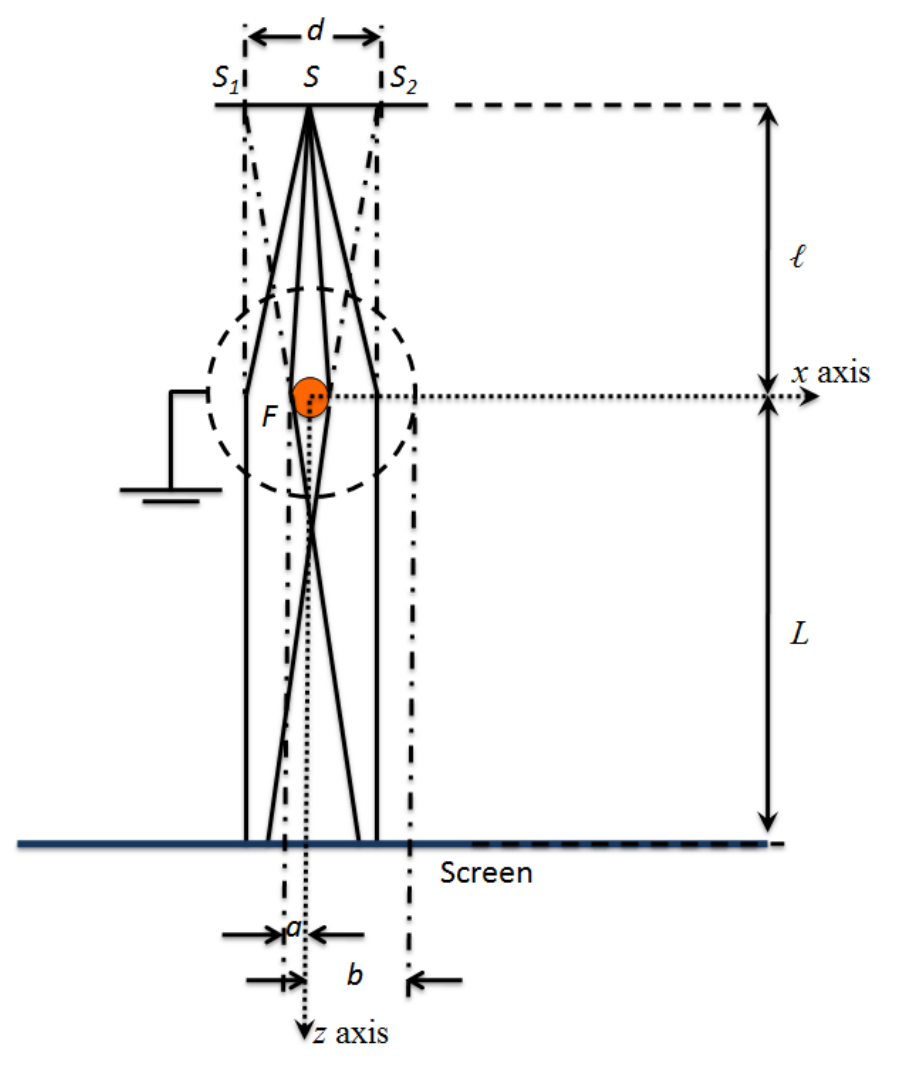 Setup of the two-slit electron biprism experiment. A point source (with virtual sources , separated by ) sits at the top; the grounded fine filament is at distance below the source (shown as an orange dot inside a dashed circle on the axis). The screen is at distance below the filament. The virtual sources are separated by at the source plane; the rays converge to a separation near the axis (with a small spacing marked at the bottom). The axis runs horizontally, the axis points downward.
The electron “biprism” consists of a grounded cylindrical wire mesh with a fine filament at the center. The distance between the source and the “biprism” is , and the distance between the distance between the “biprism” and the screen is .
(a) (2 points) Taking the center of the circular cross section of the filament as the origin , find the electric potential at any point very near the filament in terms of , and where is the electric potential of the surface of the filament, is the radius of the filament, is the radius of the grounded wire mesh ( is the distance between the centre of the filament and the cylindrical wire mesh). (Ignore edge effects.)
(b) (4 points) An electron travelling electron plane wave with wave vector is deflected by the “biprism” due to the -component of the force created by the electron. Determine , the -component of the wave vector of the wave vector due to the “biprism” before it reaches the screen. Determine , the -component of the electron deflection, in terms of the charge , the electron velocity , the deflecting region of width , and the radius , etc., and hence the charge and the -component of the velocity of the electron . Note that the -component of the velocity is , and the charge is in that Planck constant.
(Reconstruction note: part (b) reads as printed; it asks to determine , the -component of the wave vector acquired due to the “biprism”, in terms of the charge , the velocity , the half-width of the deflecting region and the radius , and hence the angle of deflection. Here , where is the Planck constant.)
(c) (2 points) Before the point , electrons are emitted from a field emission tip and accelerated through a potential . Determine the wavelength of the electron in terms of the electron mass , charge and .
- (i) (2 points) assuming relativistic effects can be ignored, and
- (ii) (3 points) taking relativistic effects into consideration.
(d) In Tonomura et al. experiment, electron charge, , mass of electron, , and the speed of light in vacuum, .
- (i) (2 points) calculate the value of .
- (ii) (2 points) determine the fringe spacing of the interference pattern on the screen.
- (iii) (1 point) If the electron wave is a spherical wave instead of a plane wave, the fringe spacing layout are smaller or larger than that fringe spacing calculated in (ii)?
- (iv) (2 points) In part (c), determine the percentage error in the wavelength of the electron using non-relativistic approximation.
- (v) (2 points) the distance between the apparent virtual points.
Fonte: Testo (PDF) — p.1
Topic: Modern-Quantum Physics, Wave Optics Metodi: de Broglie Relation, Interference & Diffraction Analysis, Relativistic Energy-Momentum, Electric Potential Method Competenze: Mathematical Modeling, Estimation & Approximation Objects: Electron, Wire, Slit, Screen
L’esperimento di interferenza elettronica a due fessure è stato eseguito per la prima volta da Möllenstedt et al., Merli-Missiroli e Pozzi nel 1974 e Tonomura et al. nel 1989. Nell’esperimento di interferenza elettronica a due fessure, una fonte monocromatica di punto elettronica emette particelle a che prima attraversano un “biprismo” elettronico prima di colpire un piano di osservazione; e sono fonti virtuali a distanza . Nel diagramma, il filamento punta verso la pagina. Si noti che si tratta di un filamento molto sottile (non disegnato a scala nel diagramma).
Inserimento dell’esperimento di biprismo elettronico a due fessure. La fonte di punto (con fonti virtuali , separate da ) si trova in alto; il filamento fine terrazzato è a distanza sotto la fonte (visto come punto arancione all’interno di un cerchio a tracciato sull’asse ). Lo schermo è a distanza sotto il filamento. Le fonti virtuali sono separate da nel piano sorgente; i raggi convergono a una separazione vicino all’asse (con un piccolo spaziamento segnato in basso). L’asse corre orizzontalmente, l’asse punta verso il basso.
Il “biprismo” elettronico è costituito da una rete di filo cilindrica a terra con un filamento al centro. La distanza tra la fonte e il “biprismo” è , e la distanza tra il “biprismo” e lo schermo è .
(a) **(2 punti) ** Prendendo come origine il centro della sezione incrociata circolare del filamento, si trova il potenziale elettrico in qualsiasi punto molto vicino al filamento in termini di , e , dove è il potenziale elettrico della superficie del filamento, è il raggio del filamento, è il raggio della rete di filo a terra ( è la distanza tra il centro del filamento e la rete di filo cilindrica). (Ignorare gli effetti di bordo.)
b) **(4 punti) ** Un’onda di piana elettronica di movimento elettronica con vettore d’onda è deviata dal “biprismo” dovuto alla componente della forza creata dall’elettrone. Determinare , la componente del vettore d’onda del vettore d’onda a causa del “biprismo” prima che raggiunga lo schermo. Determinare , il componente della deflezione degli elettroni, in termini di carica , velocità degli elettroni , regione di deflezione di larghezza , e raggio , * ecc..*, e quindi la carica e il componente della velocità degli elettroni . Si noti che la componente della velocità è , e la carica è in quella costante di Planck.
*(Nota di ricostruzione: la parte (b) si legge come stampata; chiede di determinare , la componente del vettore d’onda acquisito a causa del “biprismo”, in termini di carica , velocità , metà larghezza della regione di deviazione e raggio , e quindi angolo di deviazione. Qui , dove è la costante di Planck.) *
c) **(2 punti) ** Prima del punto , gli elettroni vengono emessi da una punta di emissione di campo e accelerati attraverso un potenziale . Determinare la lunghezza d’onda dell’elettrone in termini di massa elettronica , carica e .
- (i) **(2 punti) **, presumendo che gli effetti relativistici possano essere ignorati, e
- (ii) **(3 punti) ** tenendo conto degli effetti relativistici.
(d) Nell’esperimento Tonomura et al., carica di elettroni, , massa di elettroni, , e velocità della luce nel vuoto, .
- i) **(2 punti) ** calcola il valore di .
- (ii) **(2 punti) ** determinano l’intervallo frangiale del modello di interferenza sullo schermo.
- (iii) **(1 punto) ** Se l’onda elettronica è un’onda sferica invece di un’onda piana, il layout degli spazi di margine è più piccolo o più grande di quello calcolato in (ii)?
- (iv) **(2 punti) ** Nella parte (c) si determina l’errore percentuale nella lunghezza d’onda dell’elettrone utilizzando approssimazioni non relativistiche.
- (v) **(2 punti) ** la distanza tra i punti virtuali apparenti.
Fonte: Testo (PDF) — p.1
Topic: Modern-Quantum Physics, Wave Optics Metodi: de Broglie Relation, Interference & Diffraction Analysis, Relativistic Energy-Momentum, Electric Potential Method Competenze: Mathematical Modeling, Estimation & Approximation Objects: Electron, Wire, Slit, Screen
Gravitational lensing is a phenomenon where light from a distant source may be deflected by the curvature of space-time caused by a massive lensing object close to or in the line of sight between an observer and a distant object. This was first directly observed during the solar eclipse of 1919 where the observed positions of stars behind the sun differed from their astrometric positions following Einstein’s earlier predictions.
In the case where the observer, lensing object of mass and source are on a straight line, light from the source is deflected by an angle (in radians) given by where is the gravitational constant (), is the speed of light (), and is the Einstein radius which is the least distance between the lensing object and the apparent light path.
(a) (4 points) Draw a diagram to describe the physical layout of an ideal (observer, lens and point source in a straight line) lensing system. Draw the light path and mark the quantities and . Also mark the angular Einstein radius (the angular deflection of the source image as seen from earth), and the other quantities that an observer on earth can measure.
(b) (2 points) Sketch the image of the source (such as a star), as seen by an observer on earth, in the case where the source, lensing object and observer are on a straight line.
(c) (3 points) Sketch the image of the source (such as a star), as seen by an observer on earth, in the non-ideal case where the source, lensing object and observer are not in a straight line. Sketch the source-lens system to explain why this is so.
Gravitational lensing has been proposed as a method to detect massive compact halo objects (MACHOs) in our galaxy, which may be a candidate for dark matter. These objects are often dark stellar remnants such as neutron stars and black holes. As stars and MACHOs orbit in the galaxy, there is a chance that a lensing event may occur when a black hole or neutron star passes in front of a background star.
(d) (3 points) The Schwarzschild radius of a black hole defines the point of no return. A correct expression for the Schwarzschild radius can be obtained by taking it to be the radius where the escape speed is equal to the speed of light. This means that something inside the Schwarzschild radius cannot escape the black hole. Using Newtonian mechanics, derive the formula for the escape speed at a distance away from a point object of mass . Hence, derive the Schwarzschild radius (point object of mass in terms of the gravitational constant and the speed of light . Show your steps and reasoning clearly. (This happens to give the correct expression for the Schwarzschild radius that comes from general relativity.)
(e) (1 point) In the case where the source, lens and observer are in a straight line, given a measurement of and , how would you calculate the Schwarzschild radius of the lensing object?
(f) (2 points) Consider the case where we have a lensing object of the order of a few solar masses ( a few kg) in the nearby regions of the galaxy (distance a few m away) and a source object somewhat further out ( a few m away) of which the following apply in this case? Choose the following considering them apply to the case as described in the question:
- is large and , , must be calculated exactly — or — is large and , , must be calculated exactly;
- is small and the small angle approximations so , are permissible — or — is small and the small angle approximations so , are permissible;
- is irrelevant and need not be calculated — or — is irrelevant and need not be calculated.
(g) (3 points) Using the conditions in part (f), rewrite your expression in part (e) in terms of measurable quantities (which are , and ) for a lensing object of the order of a few solar masses ( a few kg) and in the nearby regions of the galaxy (distance a few m away) with a source object somewhat further out ( a few m away). Show your working.
(h) (2 points) Suppose we have an event where a lensing object of kg (3.0 solar masses), m away from earth passes in front of a star m away from earth. This happens such that the ideal configuration occurs during the event. What is the angular Einstein radius (as seen from earth) during this event when the source, lens and observer line up?
Fonte: Testo (PDF) — p.1
Topic: Gravitation, Astrophysics Metodi: Newton’s Law of Gravitation, Energy Conservation Method, Small-Angle Approximation, Order-of-Magnitude Estimation Competenze: Diagrammatic Reasoning, Estimation & Approximation Objects: Star, Black Hole
L’obiettivo gravitazionale è un fenomeno in cui la luce proveniente da una fonte lontana può essere deviata dalla curvatura dello spazio-tempo causata da un oggetto di lente massiccio vicino o nella linea di vista tra un osservatore e un oggetto lontano. Questo è stato osservato per la prima volta direttamente durante l’eclissi solare del 1919 dove le posizioni osservate delle stelle dietro il sole differiscono dalle loro posizioni astrometriche a seguito delle previsioni precedenti di Einstein.
Nel caso in cui l’osservatore, l’oggetto di lente di massa e la fonte si trovino su una linea retta, la luce dalla fonte viene deviata da un angolo (in radiani) dato da: dove è la costante gravitazionale (), è la velocità della luce (), e è il raggio di Einstein, che è la distanza minima tra l’oggetto di lente e il percorso della luce apparente.
(a) **(4 punti) ** Disegnare un diagramma per descrivere la disposizione fisica di un sistema di lente ideale (osservatore, obiettivo e fonte di punti in linea retta). Disegnare il percorso luminoso e segnalare le quantità e . Segna anche il raggio angolare di Einstein (la deflessione angolare dell’immagine sorgente vista dalla terra) e le altre quantità che un osservatore sulla terra può misurare.
b) **(2 punti) ** Segnare l’immagine della fonte (come una stella), come osservata da un osservatore sulla terra, nel caso in cui la fonte, l’oggetto di lente e l’osservatore si trovino in linea retta.
c) **(3 punti) ** Segnare l’immagine della fonte (come una stella), come osservata da un osservatore sulla terra, nel caso non ideale in cui la fonte, l’oggetto di lente e l’osservatore non siano in linea retta. Segna il sistema di lente sorgente per spiegare perché è così.
La lente gravitazionale è stata proposta come metodo per rilevare oggetti di halo compatto massiccio (MACHO) nella nostra galassia, che può essere un candidato per la materia oscura. Questi oggetti sono spesso resti stellari scuri come stelle di neutroni e buchi neri. Mentre le stelle e i MACHO orbitano intorno alla galassia, c’è la possibilità che si verifichi un evento di lente quando un buco nero o una stella di neutroni passa davanti a una stella di fondo.
(d) **(3 punti) ** Il raggio Schwarzschild di un buco nero definisce il punto di non ritorno. Una corretta espressione per il raggio Schwarzschild può essere ottenuta prendendolo come il raggio in cui la velocità di fuga è uguale alla velocità della luce. Questo significa che qualcosa all’interno del raggio Schwarzschild non può sfuggire al buco nero. Usando la meccanica newtonica, derivare la formula per la velocità di fuga a una distanza da un oggetto puntino di massa . Di conseguenza, derivare il raggio di Schwarzschild (oggetto punto di massa in termini di costante gravitazionale e velocità di luce . Mostra chiaramente i tuoi passi e il tuo ragionamento. (Questo accade per dare l’espressione corretta per il raggio Schwarzschild che viene dalla relatività generale.)
(e) **(1 punto) ** Nel caso in cui la fonte, l’obiettivo e l’osservatore si trovino in linea retta, data una misurazione di e , come calcolarebbe il raggio Schwarzschild dell’oggetto di lente?
(f) **(2 punti) ** Considerate il caso in cui abbiamo un oggetto di lente dell’ordine di poche masse solari ( poche kg) nelle regioni vicine della galassia (distanza poche m di distanza) e un oggetto sorgente un po’ più lontano ( poche m di distanza) di cui si applica il seguente nel caso di cui trattasi? Scegliere le seguenti se si considera che si applicano al caso descritto nella domanda:
- è grande e , , devono essere calcolati esattamente * o * è grande e , , devono essere calcolati esattamente;
- è piccolo e sono ammessi gli approssimativi a angolo piccolo, quindi , * o * è piccolo e sono ammessi gli approssimativi a angolo piccolo, quindi , ;
- non è rilevante e non deve essere calcolato * o * non è rilevante e non deve essere calcolato.
(g) **(3 punti) ** Utilizzando le condizioni di cui alla parte (f), riscrivi la tua espressione di cui alla parte (e) in termini di quantità misurabili (che sono , e ) per un oggetto di lente dell’ordine di poche masse solari ( poche kg) e nelle regioni vicine della galassia (distanza poche m) con un oggetto sorgente un po’ più lontano ( poche m). Mostrate il vostro lavoro.
h) **(2 punti) ** Supponiamo che abbiamo un evento in cui un oggetto di lente di kg (3,0 masse solari), m lontano dalla Terra passa davanti a una stella m lontano dalla Terra. Ciò avviene in modo tale che la configurazione ideale si verifichi durante l’evento. Qual è il raggio angolare di Einstein (visto dalla terra) durante questo evento quando la fonte, l’obiettivo e l’osservatore si allineano?
Fonte: Testo (PDF) — p.1
Topic: Gravitation, Astrophysics Metodi: Newton’s Law of Gravitation, Energy Conservation Method, Small-Angle Approximation, Order-of-Magnitude Estimation Competenze: Diagrammatic Reasoning, Estimation & Approximation Objects: Star, Black Hole