Mechanics of a Deformable Lattice (Total Marks: 20)
Here we study a deformable lattice hanging in gravity which acts as a deformable physical pendulum. It has only one degree of freedom, i.e. only one way to deform it and the configuration is fully described by an angle . Such structures have been studied by famous physicist James Maxwell in 19th century, and some surprising behaviors have been discovered recently.
As shown in the figure 1, identical triangular plates (red triangle) are freely hinged by identical rods and form an lattice (). The joints at the vertices are denoted by small circles. The sides of the equilateral triangles and the rods have the same length . The dashed lines in the figure represent four tubes; each tube confines vertices (grey circles) on the edge and the vertices can slide in the tube, i.e. the tube is like a sliding rail.
The four tubes are connected in a diamond shape with two angles fixed at and another two angles at as shown in Figure 1. Each plate has a uniform density with mass , and the other parts of the system are massless. The configuration of the lattice is uniquely determined by the angle , where (please see the examples of different angle in Figure 1). The system is hung vertically like a “curtain” with the top tube fixed along the horizontal direction.
The coordinate system is shown in Figure 2. The zero level of the potential energy is defined at . A triangular plate is denoted by a pair of indices , where representing the order in the and directions respectively. , and denote the positions of the 3 vertices of the triangle . The top-left vertex, (the big black circle), is fixed.
The motion of the whole system is confined in the - plane. The moment of inertia of a uniform equilateral triangular plate about its center of mass is . The free fall acceleration is . Please use and to denote kinetic energy and potential energy respectively.
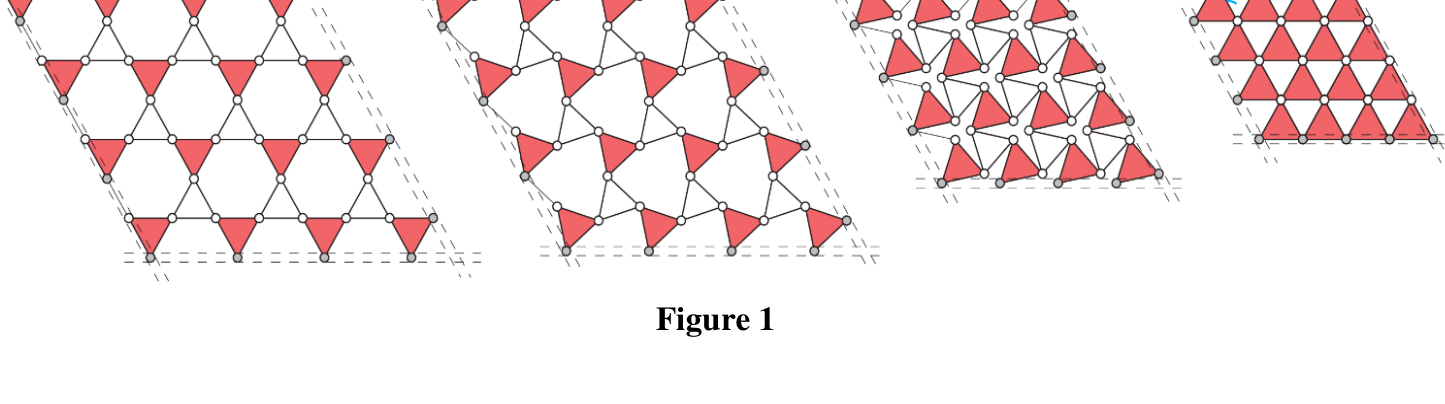 Figure 1
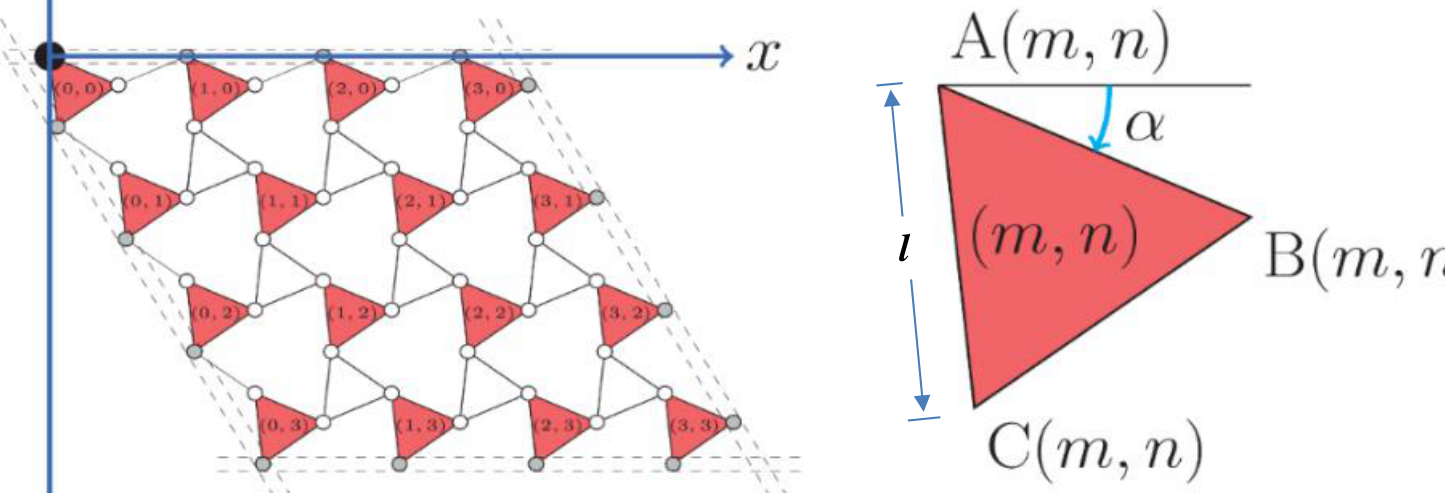 Figure 2
Section A: When (as shown in figure 3):
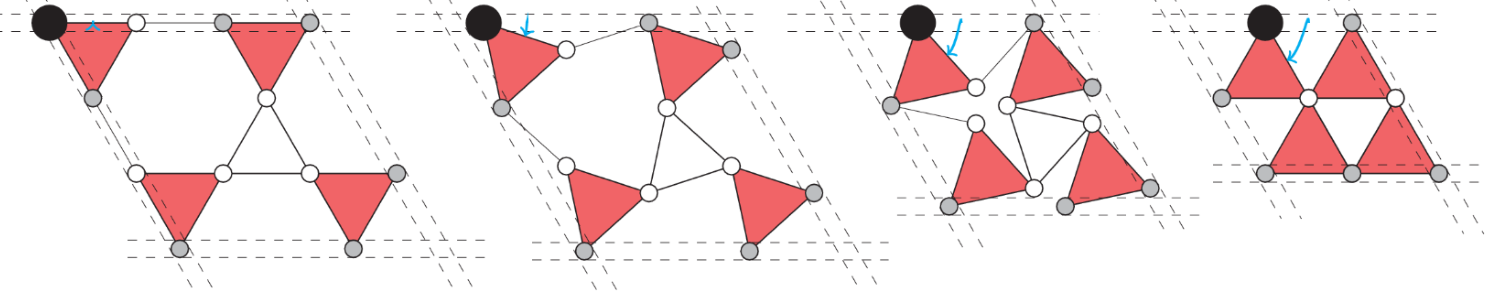 Figure 3
A1 What is the potential energy of the system for a general angle when ? (2 points)
A2 What is the equilibrium angle of the system under gravity when ? (1 point)
A3 The system follows a simple harmonic oscillation under a small perturbation from equilibrium. Calculate the kinetic energy of this system in terms of . Calculate the oscillation frequency when . (5 points)
Section B: For arbitrary :
B1 What is the equilibrium angle under gravity when is arbitrary? (3 points)
B2 Consider the case when . Under a small perturbation of angle , the change of potential energy of the system is , the kinetic energy of the system is , and the oscillation frequency is . Find the values of , and . (3 points)
Section C: A force is exerted on one of the triangle vertices so that the system maintains at .
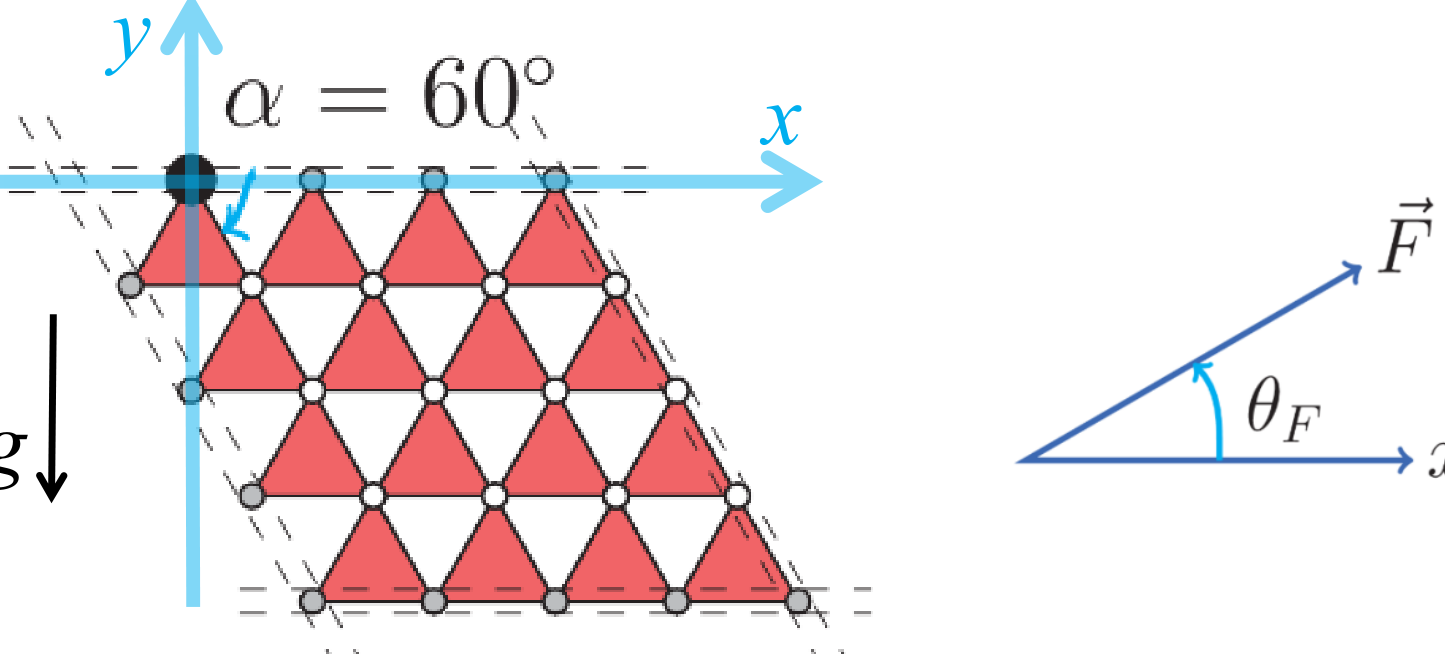 Figure 4
C1 Which vertex should we choose to minimize the magnitude of this force? (1 point)
C2 What are the direction and magnitude of this minimum force? Describe the direction in terms of the angle defined in Figure 4. (5 points)
Fonte: Testo (PDF) — p.1
Topic: Newtonian Mechanics, Oscillations & Waves Metodi: Energy Conservation Method, Simple Harmonic Motion Analysis, Torque & Angular Momentum Analysis, Approximation & Series Expansion Competenze: Physical Reasoning, Mathematical Modeling Objects: Rod
Meccanica di un Lattice Deformabile (Marchi totali: 20)
Qui studiamo una rete deformabile appesa alla gravità che agisce come un pendolo fisico deformabile. Il Parlamento europeo ha adottato una proposta di risoluzione del Parlamento europeo. solo un modo per deformarlo e la configurazione è completamente descritta con un angolo . Tali strutture sono state studiate dal famoso fisico James Maxwell nel XIX secolo, e recentemente sono stati scoperti alcuni comportamenti sorprendenti.
Come mostrato alla figura 1, le piastre triangolari identiche (triangolo rosso) sono liberamente inclinate da barre identiche e formano una rete (). Le articolazioni dei vertici sono segnate da piccoli cerchi. I lati dei triangoli equilaterali e le barre hanno la stessa lunghezza . Le linee tracciate nella figura rappresentano quattro tubi; ogni tubo limita i vertici (cerchi grigi) sul bordo e i vertici possono scivolare nel tubo, cioè Il tubo è come una rotaia scorrevole.
I quattro tubi sono collegati in forma di diamante con due angoli fissati a e altri due angoli a come mostrato alla figura 1. Ogni piastra ha una densità uniforme con massa e le altre parti del sistema sono senza massa. La configurazione della rete è determinata in modo unico dall’angolo , dove (vedere gli esempi di angolo diverso nella figura 1). Il sistema è appeso verticalmente come una “ritina” con il tubo superiore fissato lungo la direzione orizzontale.
Il sistema di coordinate è mostrato nella figura 2. Il livello zero dell’energia potenziale è definito a . Una piastra triangolare è indicata da una coppia di indici , dove rappresenta l’ordine nelle direzioni e rispettivamente. , e indicano le posizioni dei 3 vertici del triangolo . Il vertice superiore sinistro, (il grande cerchio nero), è fisso.
Il movimento di tutto il sistema è confinato nel piano -. Il momento di inerzia di una piastra triangolare equilaterale uniforme intorno al suo centro di massa è . L’accelerazione della caduta libera è . Per indicare rispettivamente l’energia cinetica e l’energia potenziale si utilizza e .
Figura 1
Figura 2
**Sezione A: ** Quando (come mostrato alla figura 3):
Figura 3
Qual è l’energia potenziale del sistema per un angolo generale quando ? *(2 punti) *
A2 Qual è l’angolo di equilibrio del sistema sotto la gravità quando ? *(1 punto) *
A3 Il sistema segue una semplice oscillazione armonica sotto una piccola perturbazione dall’equilibrio. Calcolare l’energia cinetica di questo sistema in termini di . Calcolare la frequenza di oscillazione quando . *(5 punti) *
Sezione B: Per arbitrario:
B1 Qual è l’angolo di equilibrio sotto la gravità quando è arbitrario? *(3 punti) *
B2 Considerare il caso in cui . In caso di piccola perturbazione dell’angolo , il cambiamento di energia potenziale del sistema è , l’energia cinetica del sistema è e la frequenza di oscillazione è . Trova i valori di , e . *(3 punti) *
Sezione C: Si esercita una forza su uno dei vertici del triangolo in modo che il sistema si mantenga a .
Figura 4
Quale vertice dovremmo scegliere per ridurre al minimo l’entità di questa forza? *(1 punto) *
C2 Qual è la direzione e la magnitudine di questa forza minima? Descrivere la direzione in termini di angolo definito nella figura 4. *(5 punti) *
Fonte: Testo (PDF) — p.1
Topic: Newtonian Mechanics, Oscillations & Waves Metodi: Energy Conservation Method, Simple Harmonic Motion Analysis, Torque & Angular Momentum Analysis, Approximation & Series Expansion Competenze: Physical Reasoning, Mathematical Modeling Objects: Rod
The Expanding Universe (Total Marks: 20)
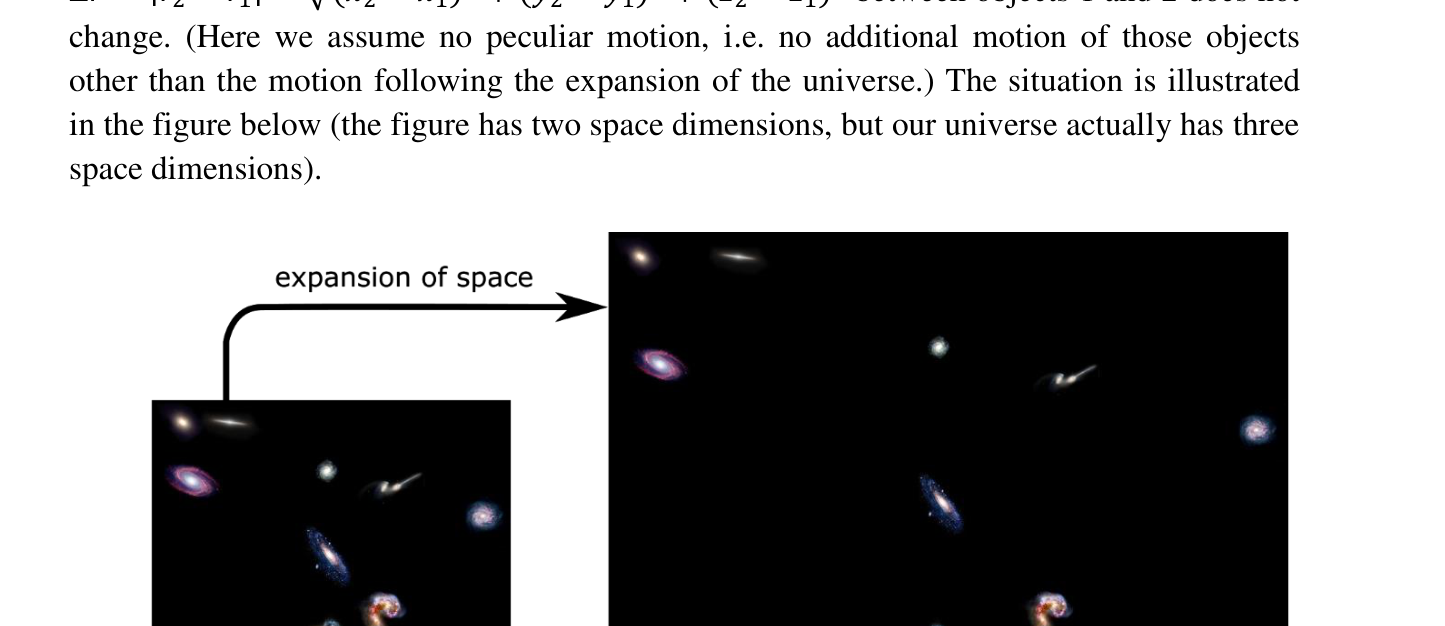
The most outstanding fact in cosmology is that our universe is expanding. Space is continuously created as time lapses. The expansion of space indicates that, when the universe expands, the distance between objects in our universe also expands. It is convenient to use “comoving” coordinate system to label points in our expanding universe, in which the coordinate distance between objects 1 and 2 does not change. (Here we assume no peculiar motion, i.e. no additional motion of those objects other than the motion following the expansion of the universe.) The situation is illustrated in the figure below (the figure has two space dimensions, but our universe actually has three space dimensions).
The modern theory of cosmology is built upon Einstein’s general relativity. However, under proper assumptions, a simplified understanding under the framework of Newton’s theory of gravity is also possible. In the following questions, we shall work in the framework of Newton’s gravity.
To measure the physical distance, a “scale factor” is introduced such that the physical distance between the comoving points and is
The expansion of the universe implies that is an increasing function of time.
On large scales — scales much larger than galaxies and their clusters — our universe is approximately homogeneous and isotropic. So let us consider a toy model of our universe, which is filled with uniformly distributed particles. There are so many particles, such that we model them as a continuous fluid. Furthermore, we assume the number of particles is conserved.
Currently, our universe is dominated by non-relativistic matter, whose kinetic energy is negligible compared to its mass energy. Let be the physical energy density (i.e. energy per unit physical volume, which is dominated by mass energy for non-relativistic matter and the gravitational potential energy is not counted as part of the “physical energy density”) of non-relativistic matter at time . We use to denote the present time.
A Derive the expression of at time in terms of , and . (2 points)
Besides non-relativistic matter, there is also a small amount of radiation in our current universe, which is made of massless particles, for example, photons. The physical wavelength of massless particles increases with the universe expansion as . Let the physical energy density of radiation be .
B Derive the physical energy density for radiation at time in terms of , and . (2 points)
Consider a gas of non-interacting photons which has thermal equilibrium distribution. In this situation, the temperature of the photon depends on time as .
C Calculate the numerical value of . (2 points)
Consider the thermodynamics of one type of non-interacting particle X. Note that the space expansion is slow enough and thermally isolated such that the entropy of X is a constant in time. Let the physical energy density of X be , which includes mass energy and internal energy. Let the physical pressure be .
D Derive in terms of , , , and . (4 points)
Consider a star . At the present time , the star is at a physical distance away from us, where is the comoving distance. Here we ignore the peculiar motion, i.e. assume that both the star and us just follow the expansion of the universe without additional motion.
The star is emitting energy in the form of light at power , which is isotropic in every direction. We use a telescope to observe its starlight. For simplicity, assume the telescope can observe all frequencies of light with 100% efficiency. Let the area of the telescope lens be .
E Derive the power received by the telescope from the star , as a function of , , , the scale factor at the starlight emission time , and the present (i.e. at the observation time) scale factor . (4 points)
If there were no gravity, the expansion speed of the universe should be a constant. In Newton’s framework, this can be understood as that, without force, matter just moves away from each other with constant speed and thus is a constant depending on the initial condition.
Let us now consider how Newton’s gravity affects the scale factor , in a universe filled with non-relativistic matter in a homogeneous and isotropic way.
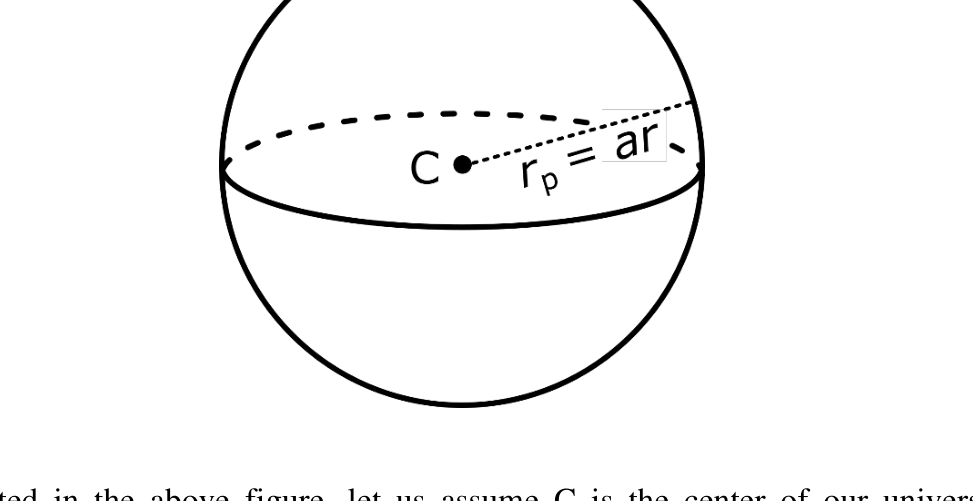
As illustrated in the above figure, let us assume C is the center of our universe (this assumption can be removed in Einstein’s general relativity, which is beyond the scope of this question). We slice matter into shells around C. Let us focus on one thin shell (the sphere in the above figure) whose comoving distance from the center is (recall that this comoving distance is a constant in time).
F Use the motion of the shell to find a relation between , and the density of mass energy . (In the final relation, if you encounter a constant depending on the initial condition, it can be kept as it is.) (5 points)
G Based on the model described in Part (F), is the expansion of the universe (a) accelerating or (b) decelerating? Choose from (a) or (b). (1 point)
For your information, in 1998, a new type of energy component of our universe is discovered. It actually changes the conclusion in Part (G).
Fonte: Testo (PDF) — p.1
Topic: Astrophysics, Thermodynamics Metodi: Newton’s Law of Gravitation, First Law of Thermodynamics, Conservation of Energy, Differential Equations Competenze: Physical Reasoning, Mathematical Modeling Objects: Photon, Star, Lens
L’Universo in espansione (Marchi totali: 20)
Il fatto più notevole della cosmologia è che il nostro universo si sta espandendo. Lo spazio si crea continuamente con il passare del tempo. L’espansione dello spazio indica che, quando l’universo si espande, la distanza tra gli oggetti nel nostro universo si espande anche. È conveniente utilizzare il sistema di coordinate “comoving” per etichettare i punti nel nostro universo in espansione, in cui la distanza di coordinate tra gli oggetti 1 e 2 non cambia. (Qui non presumiamo alcun movimento particolare, cioè: La situazione è illustrata nella figura seguente (la figura ha due dimensioni spaziali, ma il nostro universo ha in realtà tre dimensioni spaziali).
La moderna teoria della cosmologia si basa sulla relatività generale di Einstein. Tuttavia, se si propone una corretta ipotesi, è possibile anche una comprensione semplificata nel quadro della teoria della gravità di Newton. Le seguenti domande riguardano la gravità di Newton.
Per misurare la distanza fisica, viene introdotto un “fattore di scala” in modo tale che la distanza fisica tra i punti di commutazione e sia
L’espansione dell’universo implica che è una funzione crescente del tempo.
Su grandi scale scale molto più grandi delle galassie e dei loro ammassi il nostro universo è approssimativamente omogeneo e isotropo. Quindi consideriamo un modello giocattolo del nostro universo, che è pieno di particelle uniformemente distribuite. Ci sono così tante particelle, che le modelliamo come un fluido continuo. Inoltre, presumiamo che il numero di particelle sia conservato.
Attualmente, il nostro universo è dominato da materia non relativistica, la cui energia cinetica è trascurabile rispetto alla sua energia di massa. Let be the physical energy density (i.e. energia per unità di volume fisico, dominata dall’energia di massa per la materia non relativistica e l’energia potenziale gravitazionale non è contabile come parte della “densità di energia fisica”) della materia non relativistica nel tempo . Utilizziamo per indicare il tempo presente.
A Derivare l’espressione di al tempo in termini di , e . *(2 punti) *
Oltre alla materia non relativistica, c’è anche una piccola quantità di radiazioni nel nostro universo attuale, che è fatta di particelle senza massa, ad esempio, fotoni. La lunghezza d’onda fisica delle particelle senza massa aumenta con l’espansione dell’universo come . La densità di energia fisica della radiazione deve essere .
B Derivare la densità di energia fisica per la radiazione al tempo in termini di , e . *(2 punti) *
Considera un gas di fotoni non interagiscono che ha distribuzione di equilibrio termico. In questa situazione, la temperatura del fotone dipende dal tempo come .
C Calcolare il valore numerico di . *(2 punti) *
Considera la termodinamica di un tipo di particella X non interagisce. Si noti che l’espansione dello spazio è abbastanza lenta e termicamente isolata in modo tale che l’entropia di X è una costante nel tempo. La densità di energia fisica di X deve essere , che include energia di massa e energia interna. La pressione fisica deve essere .
D Derivati in termini di , , e . *(4 punti) *
Considera una stella . Al momento attuale , la stella si trova a una distanza fisica da noi, dove è la distanza di commutazione. Qui ignoriamo il peculiare movimento, cioè Supponiamo che sia la stella che noi seguiamo l’espansione dell’universo senza ulteriore movimento.
La stella emette energia sotto forma di luce a potenza , che è isotròpica in ogni direzione. Usiamo un telescopio per osservare la luce delle stelle. Per semplicità, supponiamo che il telescopio possa osservare tutte le frequenze della luce con efficienza del 100%. La superficie della lente del telescopio deve essere .
E Derivare la potenza ricevuta dal telescopio dalla stella , come funzione di , , , il fattore di scala al tempo di emissione della luce stellare , e il presente (cioè al momento dell’osservazione) fattore di scala . *(4 punti) *
Se non ci fosse la gravità, la velocità di espansione dell’universo dovrebbe essere costante. Nel quadro di Newton, questo può essere compreso come che, senza forza, la materia si allontana l’una dall’altra con velocità costante e quindi è una costante a seconda della condizione iniziale.
Consideriamo ora come la gravità di Newton influisce sul fattore di scala , in un universo pieno di materia non relativistica in modo omogeneo e isotropo.
Come illustrato nella figura precedente, supponiamo che C sia il centro del nostro universo (questa ipotesi può essere rimossa nella relatività generale di Einstein, che è al di là del campo di applicazione di questa domanda). Tagliamo la materia in conchiglie intorno a C. Concentriamoci su una scia sottile (la sfera nella figura precedente) la cui distanza di commutazione dal centro è (ricordate che questa distanza di commutazione è una costante nel tempo).
F Utilizzare il movimento della conchiglia per trovare una relazione tra , e la densità di energia di massa . (Nella relazione finale, se si incontra una costante a seconda della condizione iniziale, può essere mantenuta come è.) *(5 punti) *
G Based on the model described in Part (F), is the expansion of the universe (a) accelerating or (b) decelerating? Scegli tra le lettere a) o b). *(1 punto) *
Per la vostra informazione, nel 1998, è stato scoperto un nuovo tipo di componente energetico del nostro universo. In effetti, modifica la conclusione della parte (G).
Fonte: Testo (PDF) — p.1
Topic: Astrophysics, Thermodynamics Metodi: Newton’s Law of Gravitation, First Law of Thermodynamics, Conservation of Energy, Differential Equations Competenze: Physical Reasoning, Mathematical Modeling Objects: Photon, Star, Lens
Magnetic Field Effects on Superconductors (Total Marks: 20)
An electron is an elementary particle which carries electric charge and an intrinsic magnetic moment related to its spin angular momentum. Due to Coulomb interactions, electrons in vacuum are repulsive to each other. However, in some metals, the net force between electrons can become attractive due to the lattice vibrations. When the temperature of the metal is low enough, lower than some critical temperature , electrons with opposite momenta and opposite spins can form pairs called Cooper pairs. By forming Cooper pairs, each electron reduces its energy by compared to a freely propagating electron in the metal which has energy , where is the momentum and is the mass of an electron. The Cooper pairs can flow without resistance and the metal becomes a superconductor.
However, even at temperatures lower than , superconductivity can be destroyed if the superconductor is under the influence of an external magnetic field. In this problem, you are going to work out how Cooper pairs can be destroyed by external magnetic fields through two effects.
The first is called the paramagnetic effect, in which all the electrons can lower their energy by aligning the electron magnetic moments parallel to the magnetic field instead of forming Cooper pairs with opposite spins.
The second is called the diamagnetic effect, in which increasing the magnetic field will change the orbital motion of the Cooper pairs and increase their energy. When the applied magnetic field is stronger than a critical value , this increase in energy becomes higher than . As a result, the electrons do not prefer forming Cooper pairs.
Recently, a type of superconductor called Ising superconductors was discovered. These superconductors can survive even when the applied magnetic field is as strong as 60 Tesla, comparable to the largest magnetic fields that can be created in laboratories. You will work out why Ising superconductors can overcome both the paramagnetic and the diamagnetic effects of the magnetic fields.
A. An Electron in a Magnetic Field
Let us consider a ring with radius , charge and mass . The mass and the charge density around the ring are uniform (as shown in Figure 1).
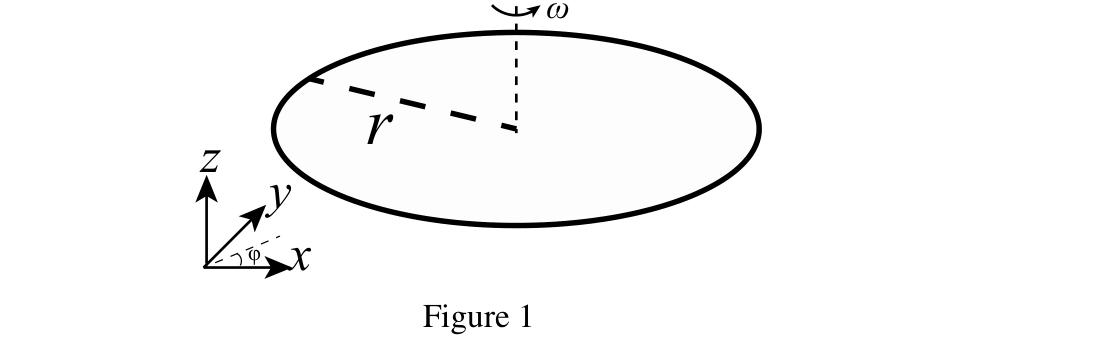 Figure 1
A1 What is the angular momentum (magnitude and direction) of this ring if the ring is rotating with angular velocity ? (2 points)
A2 The magnitude of the magnetic moment is defined as , where is the current and is the area of the ring. What is the relationship between the magnetic moment and the angular momentum of the ring? (2 points)
Suppose the normal direction of the ring is and it makes an angle with the applied magnetic field as shown in Figure 2.
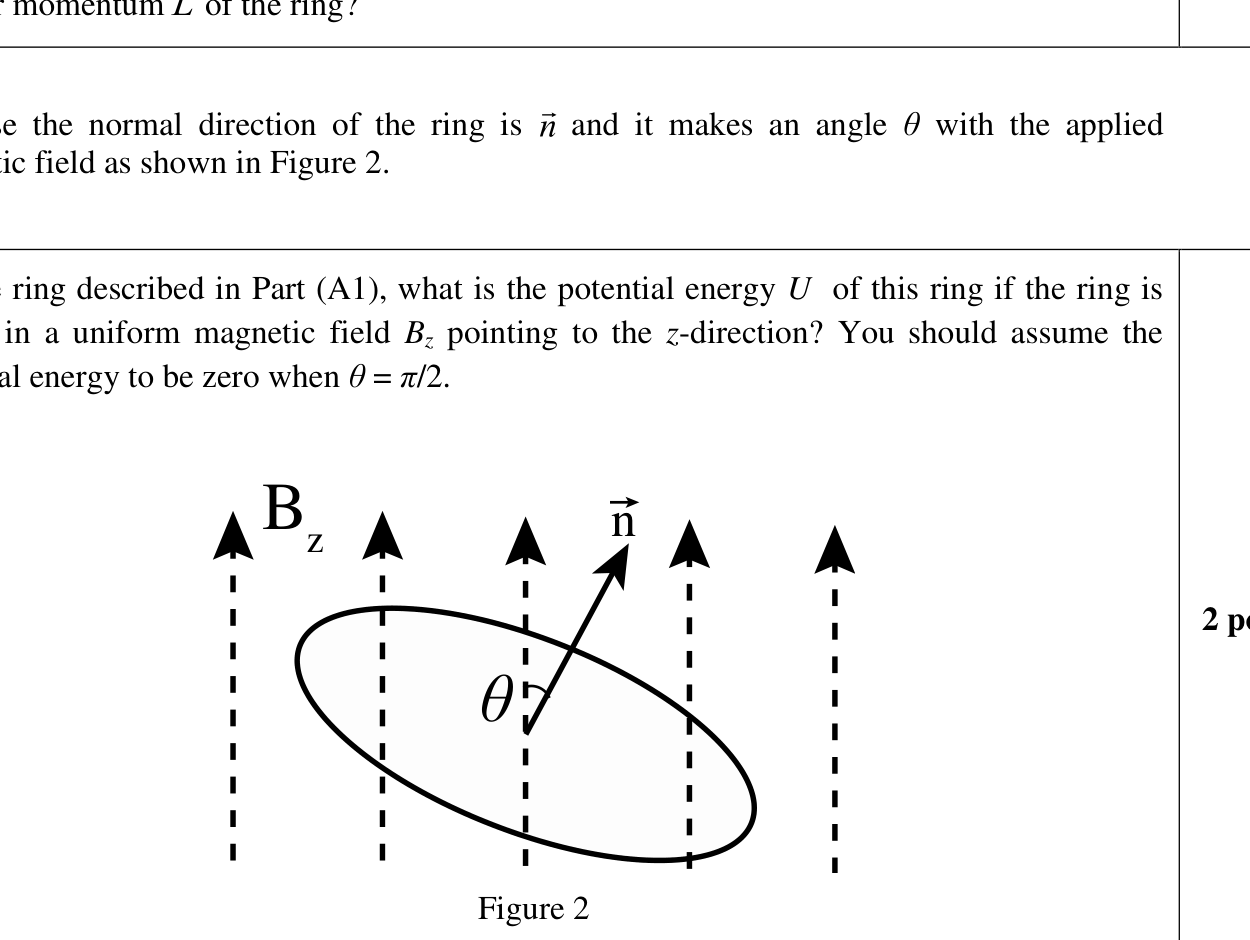 Figure 2
A3 For the ring described in Part (A1), what is the potential energy of this ring if the ring is placed in a uniform magnetic field pointing to the -direction? You should assume the potential energy to be zero when . (2 points)
An electron carries an intrinsic angular momentum, which is called spin. We know that the magnitude of spin in a particular direction is , where and is the Planck’s constant.
A4 What are the values of the potential energy and for electrons with spins parallel and anti-parallel with the applied magnetic field respectively? Please express your results in terms of the Bohr magneton and the magnetic field strength . (1 point)
A5 According to quantum mechanics, the potential energy and are twice the values and found in Part (A4). Assuming that the applied magnetic field is 1 Tesla. What is the potential energy and for an electron with spin parallel and anti-parallel to the applied magnetic field respectively? In the rest of this question, you should use the expressions for and for your calculations. (1 point)
B. Paramagnetic effect of the magnetic field on Cooper pairs
In the question below, we consider the paramagnetic effect of an external magnetic field on Cooper pairs (as shown in Figure 3).
Theoretical studies show that in superconductors, two electrons with opposite spins can form Cooper pairs so that the whole system saves energy. The energy of the Cooper pair can be expressed as , where the first two terms denote the kinetic energy of the Cooper pair and the last term is the energy saved for the electrons to form a Cooper pair. Here, is a positive constant.
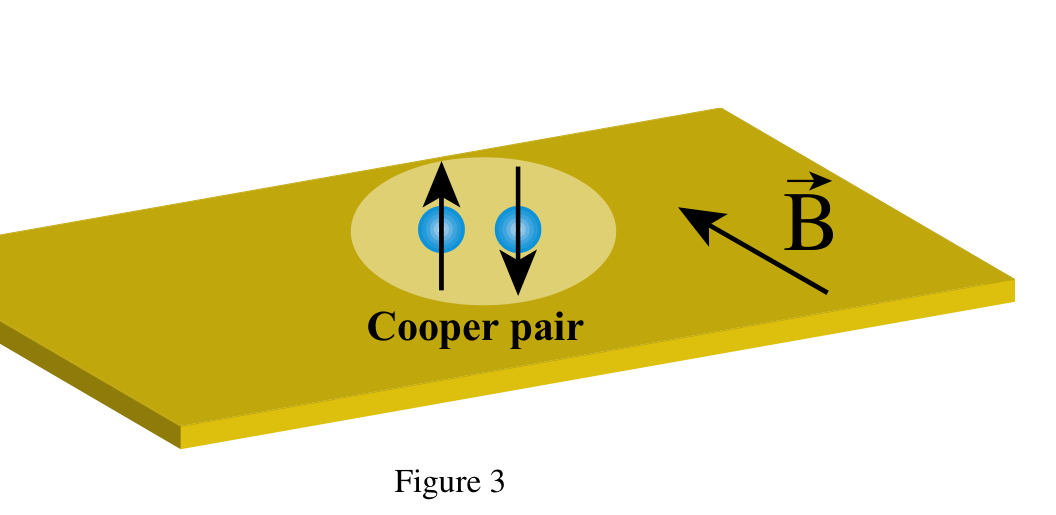 Figure 3
B1 Assuming that the effect of the external magnetic field is only on the spins of the electrons, not on the orbital motions of the electrons. What is the energy of the Cooper pair under a uniform magnetic field ? Recall that the electrons which form a Cooper pair must have opposite spins. (1 point)
B2 In the normal state (non-superconducting state), electrons do not form Cooper pairs. What is the lowest energy for the two electrons under a uniform in-plane magnetic field pointing to the -direction? Please use the and defined in Part (A5) in your calculations and ignore the effects of the magnetic field on the orbital motions of the electrons. (1 point)
B3 At zero temperature, a system will favor the state with the lowest energy. What is the critical value in terms of , such that for superconductivity will disappear? (1 point)
C. Diamagnetic effect of the magnetic field on Cooper pairs
In the question below, we are going to ignore the effects of magnetic fields on the spins of the electrons and consider the effects of external magnetic fields on the orbital motions of the Cooper pairs.
At zero temperature, the energy difference between the superconducting state and the normal state for a superconductor in a magnetic field can be written as
Here is a function of position and independent of . denotes the probability of finding a Cooper pair near . Here, is a constant and it is related to the energy saved by forming Cooper pairs. The second and the third terms in are related to the kinetic energy of the Cooper pairs taking into account the effect of the magnetic field.
At zero temperature, the system prefers to minimize its energy . In this case, takes the form , with .
C1 Find in terms of , , and . (3 points)
The following integrals may be useful:
Here is a constant.
C2 Work out the critical value of in terms of , at which the superconducting state is no longer energetically favorable. (2 points)
D. Ising Superconductors
In materials with spin-orbit coupling (spin-spin couplings can be ignored), an electron with momentum experiences an internal magnetic field . On the other hand, an electron with momentum experiences an opposite magnetic field . These internal magnetic fields act on the spins of the electrons only as shown in Figure 4. Superconductors with this kind of internal magnetic fields are called Ising superconductors.
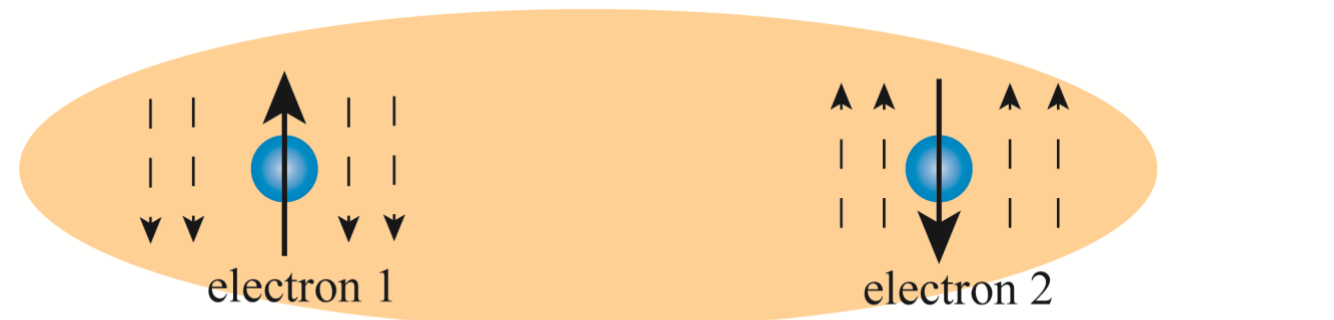
Figure 4: Two electrons form a Cooper pair. Electron 1 with momentum experiences internal magnetic field but electron 2 with momentum experiences an opposite magnetic field . The internal magnetic fields are denoted by dashed arrows.
D1 Then what is the energy for a Cooper pair in an Ising superconductor? (1 point)
D2 In the normal state of the material with spin orbit coupling, what is the energy for the two electrons under a uniform in-plane magnetic field ? (Here the internal magnetic field still exist and perpendicular to . You should also ignore the effects of the in-plane magnetic field on the orbital motions of the Cooper pairs.) (2 points)
D3 What is the critical value such that , ? (1 point)
Fonte: Testo (PDF) — p.1
Topic: Modern-Quantum Physics, Magnetism Metodi: Energy Conservation Method, Calculus-Integration, Torque & Angular Momentum Analysis, Lorentz Force Analysis Competenze: Physical Reasoning, Mathematical Modeling Objects: Electron
Effetti del campo magnetico sui superconduttori (Marchi totali: 20)
Un elettrone è una particella elementare che porta una carica elettrica e un momento magnetico intrinseco legato alla sua momentum angolare spin. A causa delle interazioni di Coulomb, gli elettroni nel vuoto sono repulsivi l’uno all’altro. Tuttavia, in alcuni metalli, la forza netta tra gli elettroni può diventare attraente a causa delle vibrazioni della rete. Quando la temperatura del metallo è sufficientemente bassa, inferiore a una certa temperatura critica , gli elettroni con i momenti opposti e le rotazioni opposte possono formare coppie chiamate coppie Cooper. Formando coppie Cooper, ogni elettrone riduce la sua energia di rispetto ad un elettrone di libera propagazione nel metallo che ha energia , dove è il momento e è la massa di un elettrone. Le coppie Cooper possono fluire senza resistenza e il metallo diventa un superconduttore.
Tuttavia, anche a temperature inferiori a , la superconduttività può essere distrutta se il superconduttore è sotto l’influenza di un campo magnetico esterno. In questo problema, si scoprirà come coppie Cooper possono essere distrutte da campi magnetici esterni attraverso due effetti.
Il primo è chiamato effetto paramagnetico, in cui tutti gli elettroni possono abbassare la loro energia allineando i momenti magnetici elettronici paralleli al campo magnetico invece di formare coppie Cooper con spin opposti.
Il secondo è chiamato effetto diamagnetico, in cui aumentare il campo magnetico cambierà il movimento orbitale delle coppie Cooper e aumenterà la loro energia. Quando il campo magnetico applicato è più forte di un valore critico , questo aumento di energia diventa superiore a . Di conseguenza, gli elettroni non preferiscono formare coppie Cooper.
Recentemente, è stato scoperto un tipo di superconduttore chiamato superconduttore Ising. Questi superconduttori possono sopravvivere anche quando il campo magnetico applicato è forte come 60 Tesla, paragonabile ai più grandi campi magnetici che possono essere creati nei laboratori. Scoprirai perché i superconduttori Ising possono superare sia gli effetti paramagnetistici che i diamagnetistici dei campi magnetici.
A. Un elettrone in un campo magnetico
Consideriamo un anello con raggio , carica e massa . La massa e la densità di carica intorno all’anello sono uniformi (come mostrato alla figura 1).
Figura 1
A1 Qual è il momento angolare (magnitude e direzione) di questo anello se l’anello ruota con velocità angolare ? *(2 punti) *
A2 La magnitudine del momento magnetico è definita come , dove è la corrente e è l’area dell’anello. Qual è la relazione tra il momento magnetico e il momento angolare dell’anello? *(2 punti) *
Supponiamo che la direzione normale dell’anello sia e che esso faccia un angolo con il campo magnetico applicato come mostrato alla figura 2.
Figura 2
A3 Per l’anello descritto nella parte (A1), qual è l’energia potenziale di questo anello se l’anello è posizionato in un campo magnetico uniforme che punta nella direzione ? Dovresti assumere che l’energia potenziale sia zero quando . *(2 punti) *
Un elettrone porta un impulso angolare intrinseco, che si chiama spin. Sappiamo che la magnitudine di spin in una particolare direzione è , dove e è la costante di Planck.
A4 Quali sono i valori dell’energia potenziale e per gli elettroni con rotazioni parallele e antiparallelle rispettivamente al campo magnetico applicato? Si prega di esprimere i risultati in termini di magnetone di Bohr e di forza del campo magnetico . *(1 punto) *
A5 Secondo la meccanica quantistica, le energie potenziali e sono il doppio dei valori e della parte (A4). Supponendo che il campo magnetico applicato sia 1 Tesla. Qual è l’energia potenziale e per un elettrone con spin parallelo e antiparallelo rispettivamente al campo magnetico applicato? Nel resto di questa domanda, per i calcoli è necessario utilizzare le espressioni e . *(1 punto) *
B. Effetto paramagnetico del campo magnetico sulle coppie Cooper
Nella domanda seguente, consideriamo l’effetto paramagnetico di un campo magnetico esterno sulle coppie Cooper (come mostrato alla figura 3).
Gli studi teorici dimostrano che nei superconduttori due elettroni con spin opposti possono formare coppie Cooper in modo che l’intero sistema risparmi energia. L’energia della coppia Cooper può essere espressa come , dove i primi due termini indicano l’energia cinetica della coppia Cooper e l’ultimo termine è l’energia risparmiata per gli elettroni per formare una coppia Cooper. Qui, è una costante positiva.
Figura 3
B1 Supponendo che l’effetto del campo magnetico esterno sia solo sulle spin degli elettroni, non sui movimenti orbiti degli elettroni. Qual è l’energia della coppia Cooper sotto un campo magnetico uniforme ? Ricordate che gli elettroni che formano una coppia di Cooper devono avere spin opposti. *(1 punto) *
B2 In stato normale (non superconduttore), gli elettroni non formano coppie Cooper. Qual è la minima energia per i due elettroni sotto un campo magnetico uniforme in piano che punta nella direzione ? Per i calcoli utilizzate le e definite nella parte (A5) e ignorate gli effetti del campo magnetico sui movimenti orbiti degli elettroni. *(1 punto) *
A temperatura zero, un sistema favorirà lo stato con la più bassa energia. Qual è il valore critico in termini di , in modo tale che per la superconduttività scompaia? *(1 punto) *
C. Effetto diamanetico del campo magnetico sulle coppie Cooper
Nella domanda seguente, ignoreremo gli effetti dei campi magnetici sulle spin degli elettroni e consideriamo gli effetti dei campi magnetici esterni sui movimenti orbiti delle coppie Cooper.
A temperatura zero, la differenza di energia tra lo stato di superconduttore e lo stato normale per un superconduttore in un campo magnetico può essere scritta come
Qui è una funzione di posizione e indipendente da . indica la probabilità di trovare una coppia Cooper vicino a . Qui, è una costante e è correlata all’energia risparmiata dalla formazione di coppie Cooper. I termini secondo e terzo di sono correlati all’energia cinetica delle coppie Cooper tenendo conto dell’effetto del campo magnetico.
A temperatura zero, il sistema preferisce ridurre al minimo la sua energia . In questo caso, assume la forma , con .
C1 Trova in termini di , e . *(3 punti) *
Le seguenti integrali possono essere utili:
Qui è una costante.
C2 Calcolare il valore critico di in termini di , quando lo stato di superconduttore non è più energeticamente favorevole. *(2 punti) *
D. Ising dei superconduttori
Nei materiali con accoppiamento spin-orbita (gli accoppiamenti spin-spin possono essere ignorati), un elettrone con impulso sperimenta un campo magnetico interno . D’altra parte, un elettrone con impulso sperimenta un campo magnetico opposto . Questi campi magnetici interni agiscono solo sulle spin degli elettroni come mostrato nella Figura 4. I superconduttori con questo tipo di campi magnetici interni sono chiamati superconduttori Ising.
Figura 4: due elettroni formano una coppia di Cooper. L’elettrone 1 con impulso sperimenta un campo magnetico interno ma l’elettrone 2 con impulso sperimenta un campo magnetico opposto . I campi magnetici interni sono indicati da frecce a punti.*
Quindi qual è l’energia per una coppia di Cooper in un superconduttore Ising? *(1 punto) *
D2 In uno stato normale del materiale con accoppiamento orbitale a spin, quale è l’energia per i due elettroni sotto un campo magnetico uniforme a piano ? (Qui esiste ancora il campo magnetico interno e perpendicolare a . Dovresti anche ignorare gli effetti del campo magnetico in piano sui movimenti orbiti delle coppie Cooper.
D3 Qual è il valore critico tale che , ? *(1 punto) *
Fonte: Testo (PDF) — p.1
Topic: Modern-Quantum Physics, Magnetism Metodi: Energy Conservation Method, Calculus-Integration, Torque & Angular Momentum Analysis, Lorentz Force Analysis Competenze: Physical Reasoning, Mathematical Modeling Objects: Electron