Problem 1. There are two conductive rods with length land resistance R are initially at rest on two parallel friction-less rails. Initially there’s a distance d between the rods. There also exists a magnetic field B perpendicular to the plane of the rods and the rails. Masses of the both the rods are equal to m. Initially, a speed v was given to the right rod. Find the distance between the rods after a long time. Figure 1: Problem 1
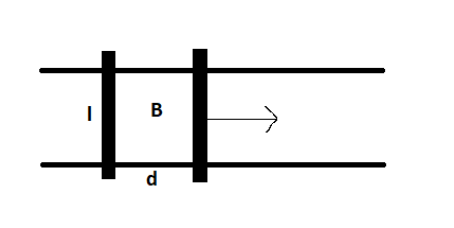 due aste conduttive su rotaie in campo B
Topic: Electromagnetic Induction, Conservation of Momentum, Magnetism Metodi: Faraday’s Law of Induction, Lorentz Force Analysis, Impulse-Momentum Theorem, Conservation of Momentum Competenze: Mathematical Modeling, Physical Reasoning Objects: Rod Fonte: Testo (PDF) — p.1
Problema 1. Ci sono due bastone conduttive con lunghezza resistenza al suolo R sono inizialmente a riposo su due trame parallele senza attrito. Inizialmente c’è una distanza d tra le barre. C’è anche un magnetico campo B perpendicolare al piano delle barre e dei binari. Le masse di entrambe le barre sono uguali a m. Inizialmente, una velocità v fu data alla barra destra. Trova la distanza tra le barre dopo un lungo periodo. Figura 1: Problema 1
In seguito alla sua rotta in campo B
Topic: Electromagnetic Induction, Conservation of Momentum, Magnetism Metodi: Faraday’s Law of Induction, Lorentz Force Analysis, Impulse-Momentum Theorem, Conservation of Momentum Competenze: Mathematical Modeling, Physical Reasoning Objects: Rod Fonte: Testo (PDF) — p.1
Problem 2. There’s an athlete at point S. He can run on the ground with v and swim on the water twice less. Find the minimal time for going from point S to F. Picture is symmetric. Give your answer in terms of , h, L, and v.
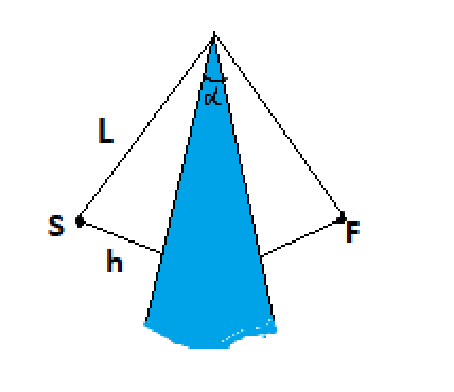 percorso atleta dal punto S a F
Topic: Newtonian Mechanics Metodi: Calculus-Integration, Physical Modeling, Small-Angle Approximation Competenze: Mathematical Modeling, Physical Reasoning Objects: — Fonte: Testo (PDF) — p.1
Il problema 2. C’è un atleta al punto S. Può correre a terra con V e nuotare sull’acqua
- Due volte meno. Trova il tempo minimo per andare dal punto S a F. L’immagine è simmetrica. Rispondi . in termini di , h, L e v.
*percorso atleta dal punto S a F *
Topic: Newtonian Mechanics Metodi: Calculus-Integration, Physical Modeling, Small-Angle Approximation Competenze: Mathematical Modeling, Physical Reasoning Objects: — Fonte: Testo (PDF) — p.1
Problem 3. A light beam with frequency falls to a mirror that possesses mass m and a velocity of v. Find the frequency of the light beam that reflected from mirror. Light beam falls normal to the mirror. The mirror’s velocity is the same direction with speed of the light (in other words, the velocity vectors are parallel).
Topic: Special Relativity, Oscillations & Waves Metodi: Lorentz Transformation, Physical Modeling Competenze: Physical Reasoning, Mathematical Modeling Objects: Mirror Fonte: Testo (PDF) — p.1
Problema 3. Un raggio luminoso di frequenza cade su uno specchio che possiede una massa m e una velocità of v. Trova la frequenza del raggio di luce riflessa dallo specchio. Il raggio di luce cade normalmente al
- Lo specchio. La velocità dello specchio è la stessa direzione della velocità della luce (in altre parole, la velocità della luce è la velocità della luce). i vettori sono paralleli).
Topic: Special Relativity, Oscillations & Waves Metodi: Lorentz Transformation, Physical Modeling Competenze: Physical Reasoning, Mathematical Modeling Objects: Mirror Fonte: Testo (PDF) — p.1
Problem 4. There’s a one mole ideal gas doing some process. The process consists of an isotherm (1, 2), an isochore (2, 3), a polytropic process (3, 4), and an isobar (4, 1). The molar capacity of gas during polytropic process is C = 0.5R. Minimal temperature of the gas during the whole cycle is Tmin = 300 K. Find the efficiency of this cycle.
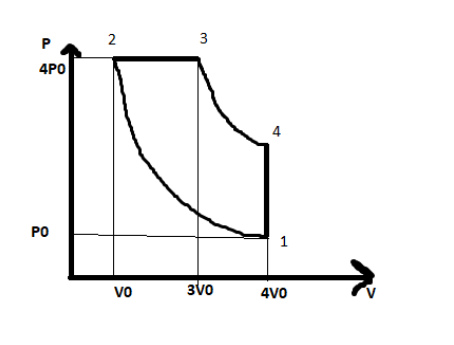 ciclo termodinamico gas ideale p-V
Topic: Thermodynamics Metodi: First Law of Thermodynamics, Thermodynamic Cycle Analysis, Ideal Gas Law Competenze: Mathematical Modeling, Diagrammatic Reasoning Objects: Gas Fonte: Testo (PDF) — p.1
Il problema 4. C’è un gas ideale di una mole che sta facendo qualche processo. Il processo consiste in un isotermo (1, 2), un isocore (2, 3), un processo politropico (3, 4), e un isobaro (4, 1). La capacità molare del gas durante il processo politrope è C = 0,5R. La temperatura minima del gas durante l’intero ciclo è Tmin = 300 K. Trova l’efficienza di questo ciclo.
ciclo termodinamico gas ideale p-V
Topic: Thermodynamics Metodi: First Law of Thermodynamics, Thermodynamic Cycle Analysis, Ideal Gas Law Competenze: Mathematical Modeling, Diagrammatic Reasoning Objects: Gas Fonte: Testo (PDF) — p.1
Problem 5. There’s a ring with radius R and a uniform charge q. Also, there’s a semi infinite rod having linear charge density and length l. The beginning point of the rod is on the center of the ring. Find the mutual interaction force between the bodies. 1 Azerbaijan Physics Olympiad 2020 Figure 2: Problem 2 Figure 3: Problem 4 Figure 4: Problem 5 2
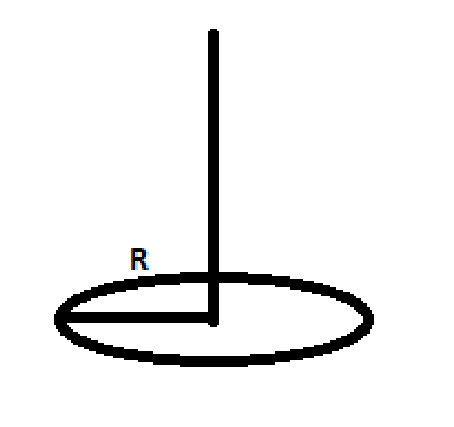 anello carico e semi-asta con densità λ
Topic: Electrostatics Metodi: Coulomb’s Law, Electric Potential Method, Calculus-Integration Competenze: Mathematical Modeling, Physical Reasoning Objects: Rod Fonte: Testo (PDF) — p.1
Problema 5. C’è un anello con raggio R e una carica uniforme q. Inoltre, c’è una barra semi infinita con densità di carica lineare e lunghezza l. Il punto di inizio della canna è al centro dell’anello. Trova la forza di interazione reciproca tra i corpi. 1 Olimpiada di fisica dell’Azerbaigian 2020 Figura 2: Problema 2 Figura 3: Problema 4 Figura 4: Problema 5 2
- anello carico e semi-asta con densità λ *
Topic: Electrostatics Metodi: Coulomb’s Law, Electric Potential Method, Calculus-Integration Competenze: Mathematical Modeling, Physical Reasoning Objects: Rod Fonte: Testo (PDF) — p.1