Domanda compulsoria, composta da brevi quesiti indipendenti:
- a) Commentare le correzioni necessarie a misure di corrente: (i) il valore di corrente in un resistore e , una sola unità decimale a (verifica di letture); (ii) le dimensioni di un parallelepipedo, misurate in mm, ; ha densità e ; (iii) corrente nel circuito di Figura 1.1 (sorgente , resistori , , ). [verificare cifre significative e ricalcolare]
- b) Calcolare il numero di fotoni prodotti in un nanosecondo () da una sorgente di ; la lunghezza d’onda della radiazione è .
- c) Un razzo, massa iniziale , è lanciato verticalmente. Dopo raggiunge una velocità di . Ha bruciato carburante a (sic) e ; calcolare (i) accelerazione iniziale, (ii) altezza massima, (iii) tempo totale di volo, (iv) il lavoro fatto dal motore.
- d) Lo ione ha massa di unità di massa atomica unificata. . Determinare per : (i) la massa in unità di massa atomica, (ii) la massa in unità di massa atomica unificata, (iii) l’energia di legame in MeV.
- e) L’energia potenziale positiva fra cariche è determinata da: (perché si forma una nube ionica unicamente positiva?); il campo elettrico e il potenziale a una distanza data.
- f) Un cilindro verticale di legno galleggia: usare la conservazione dell’energia per ricavare il centro di massa di gravità , contro l’altezza del liquido.
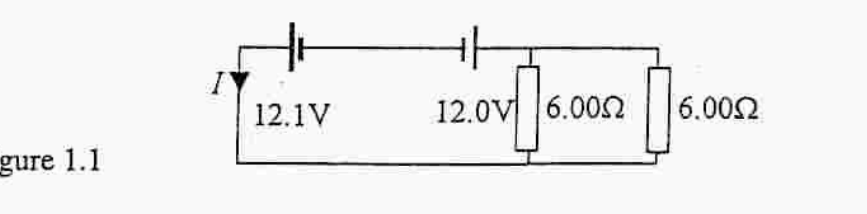 Figura 1.1 — circuito con sorgenti da e e tre resistori da percorsi dalla corrente .
Nota: alcune cifre numeriche del PDF sono di difficile lettura per la qualità della scansione; consultare il PDF sorgente per i valori esatti.
Topic: Circuits, Newtonian Mechanics, Modern-Quantum Physics Metodi: Equivalent Circuit Reduction, Kinematic Equations, Photon Energy Relation, Conservation of Energy, Dimensional Analysis Competenze: Significant Figures, Physical Reasoning, Mathematical Modeling Objects: Resistor, Battery, Photon, Nucleus, Cylinder Fonte: Testo (PDF) — p.2
Compulsory question, consisting of brief independent sub-questions:
-
a) Comment on the necessary corrections for current measurements: (i) the value of current through a resistor and , with only one decimal digit at (verification of readings); (ii) the dimensions of a rectangular parallelepiped, measured in mm, ; with density and ; (iii) current in the circuit of Figure 1.1 (source , resistors , , ). [Verify significant figures and recalculate]
-
b) Calculate the number of photons produced in one nanosecond () by a source emitting radiation with wavelength and power .
-
c) A rocket with initial mass is launched vertically. After time , it reaches a velocity of . It has burned fuel at rates (sic) and ; calculate: (i) initial acceleration, (ii) maximum height, (iii) total flight time, (iv) work done by the engine.
-
d) The ion has a mass of atomic mass units. . Determine for : (i) the mass in atomic mass units, (ii) the mass in unified atomic mass units, (iii) the binding energy in MeV.
-
e) The positive potential energy between charges is determined by: (why does a purely positively charged ion cloud form?); the electric field and potential at a given distance.
-
f) A vertical wooden cylinder floats: use conservation of energy to derive the center of mass of gravity , as a function of the liquid height .
Figure 1.1 — circuit with sources and and three resistors through which current flows.
Note: some numerical values in the PDF are difficult to read due to scan quality; refer to the original PDF for exact values.
Due sbarre orizzontali identiche e , ciascuna di massa , sono poste una sopra l’altra; l’inferiore è appoggiata su molle ideali e l’altra è tenuta a un’altezza sopra. Il sistema è rilasciato da fermo (Figura 2.1).
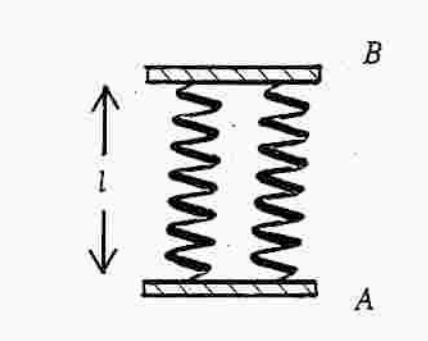 Figura 2.1 — sbarra in alto e sbarra in basso, collegate da molle ideali; indica la separazione.
- a)
- (i) Come varia la separazione delle sbarre durante la caduta libera, prima che colpisca il suolo?
- (ii) colpisce il suolo e il sistema dissipa completamente l’energia; trasferito alle molle, l’urto è completamente anelastico; il suono. Ottenere un’espressione per la separazione massima delle molle.
- (iii) Esprimere l’energia, , del sistema in termini delle compressioni successive prima del suono.
- (iv) Dedurre un’espressione per .
- b)
- (i) Immediatamente dopo che le molle toccano , che cosa avviene appena raggiunge il suolo?
- (ii) Usando considerazioni di energia, dedurre un’espressione per la compressione in cui l’istante lascia il suolo.
- (iii) Una compressione per cui inizia a sollevarsi dal suolo. (Si trascuri lo spessore delle sbarre.)
Topic: Newtonian Mechanics, Conservation of Energy, Oscillations & Waves Metodi: Energy Conservation Method, Simple Harmonic Motion Analysis, Free-Body Diagram Competenze: Mathematical Modeling, Physical Reasoning, Diagrammatic Reasoning Objects: Rod, Spring Fonte: Testo (PDF) — p.4
Two identical horizontal bars and , each of mass , are stacked one above the other; the lower bar is supported by ideal springs, and the upper bar is held at a height above it. The system is released from rest (Figure 2.1).
Figure 2.1 — upper bar and lower bar , connected by ideal springs; indicates the separation.
-
a)
- (i) How does the separation between the bars change during free fall, before hits the ground?
- (ii) When hits the ground, the system completely dissipates its energy; transferred to the springs, the collision is perfectly inelastic; sound is produced. Derive an expression for the maximum separation of the springs.
- (iii) Express the energy, , of the system in terms of successive spring compressions before sound is produced.
- (iv) Deduce an expression for .
-
b)
- (i) Immediately after the springs touch , what happens just as reaches the ground?
- (ii) Using energy considerations, deduce an expression for the compression at which the instant leaves the ground.
- (iii) A compression for which begins to lift off the ground. (Neglect the thickness of the bars.)
a) Fotoni di lunghezza d’onda entrano nell’apparato di fotoemissione (Figura 3.1). I fotoni colpiscono il catodo ed estraggono fotoelettroni. Una tensione esiste fra catodo e anodo.
- (i) Spiegare la natura del catodo.
- (ii) Perché la teoria ondulatoria non riesce a spiegare l’effetto fotoelettrico?
- (iii) Ricavare un’espressione, in funzione di , , e , per l’energia cinetica massima dei fotoelettroni; per la massima lunghezza d’onda che permette ancora l’emissione di fotoelettroni.
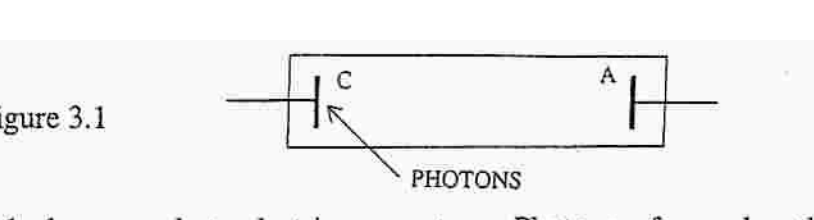 Figura 3.1 — apparato per l’effetto fotoelettrico: catodo , anodo e fascio di fotoni incidente.
b) I fotoelettroni emergono da con griglie e , che hanno aperture, e gli elettroni accelerati per (Figura 3.2). Le due griglie elettrodate sono a apart e tutti gli elettroni sono accelerati su un potenziale di base . La forma dell’onda osservata sul CRO è mostrata in Figura 3.3.
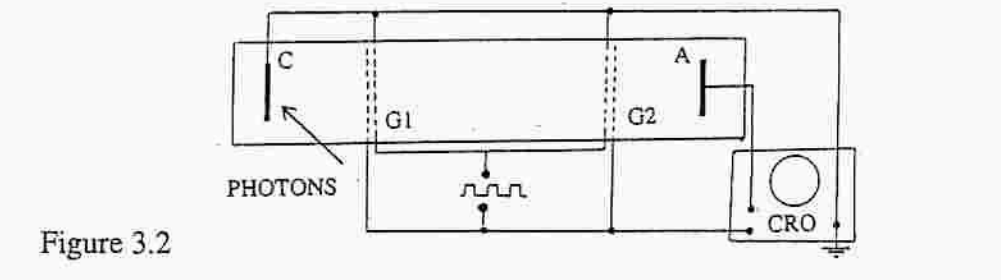 Figura 3.2 — apparato fotoelettrico modificato con griglie e e oscilloscopio (CRO).
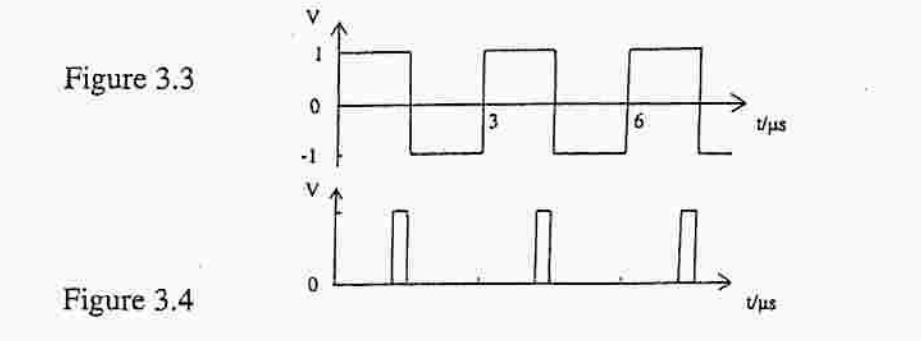 Figure 3.3 e 3.4 — tracce di tensione in funzione del tempo osservate sul CRO.
c) Il monitor della fotoemissione fra e il display finale della griglia è determinato solamente dal potenziale sulla griglia. Quando e sono a :
- (i) Disegnare un grafico del campo elettrico , contro la distanza , lungo il tubo da fino all’estremità di .
- (ii) Disegnare l’energia cinetica di un fotoelettrone fra e .
- (iii) Determinare la velocità di un fotoelettrone fra e .
- (iv) Spiegare la forma della traccia contro .
- (v) Stimare la larghezza in tempo () dell’impulso di elettroni che emergono da .
Topic: Modern-Quantum Physics, Electrostatics Metodi: Photon Energy Relation, Energy Conservation Method, Kinematic Equations Competenze: Physical Reasoning, Mathematical Modeling, Diagrammatic Reasoning Objects: Photon, Electron Fonte: Testo (PDF) — p.5
a) Photons of wavelength enter the photoemission apparatus (Figure 3.1). The photons strike the cathode and eject photoelectrons. A voltage exists between the cathode and the anode.
- (i) Explain the nature of the cathode.
- (ii) Why does the wave theory fail to explain the photoelectric effect?
- (iii) Derive an expression, in terms of , , and , for the maximum kinetic energy of the photoelectrons; and for the maximum wavelength that still allows electron emission.
Figure 3.1 — photoelectric effect apparatus: cathode , anode and incident photon beam.
b) The photoelectrons emerge from through grids and , which have apertures, and are accelerated by (Figure 3.2). The two electrostatic grids are separated by and all electrons are accelerated to a base potential of . The shape of the waveform observed on the CRO is shown in Figure 3.3.
Figure 3.2 — modified photoelectric apparatus with grids and and oscilloscope (CRO).
Figures 3.3 and 3.4 — voltage traces versus time observed on the CRO.
c) The emission monitor between and the final grid display is determined solely by the potential on the grid. When and are at :
- (i) Draw a graph of the electric field versus distance along the tube from to the end of .
- (ii) Draw the kinetic energy of a photoelectron between and .
- (iii) Determine the velocity of a photoelectron between and .
- (iv) Explain the shape of the trace versus .
- (v) Estimate the temporal width () of the electron pulse emerging from .
a) Determinare le correnti e nel circuito di Figura 4.1. Le celle hanno emf , con resistenza interna trascurabile, e resistori di resistenza .
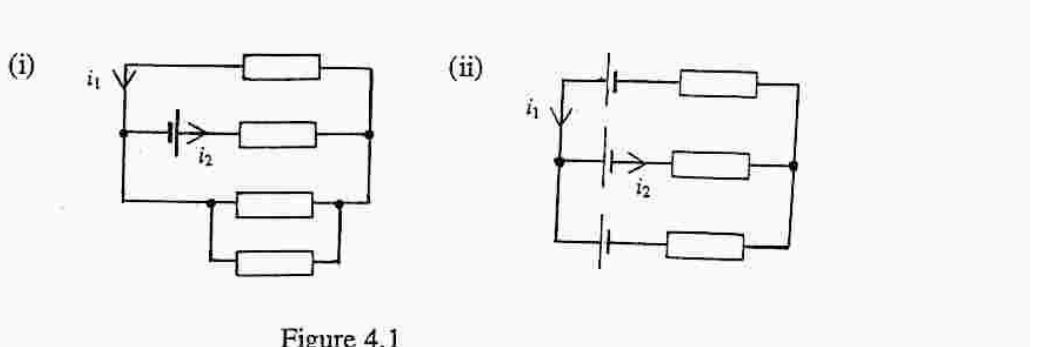 Figura 4.1 — i due circuiti (i) e (ii) con celle di emf e resistori , percorsi dalle correnti e .
b) La Figura 4.2 contiene due circuiti, ciascuno con punti etichettati , e , contenenti questi resistori:
- (i) la rete a stella con resistenze , e ;
- (ii) la rete a triangolo con resistenze , e (le frecce indicano le resistenze fra i punti etichettati , , ). Le due reti hanno correnti identiche , e e potenziali identici. Per ricavare le relazioni usate per valutare per (i) stella e (ii) triangolo, e dedurre le equazioni
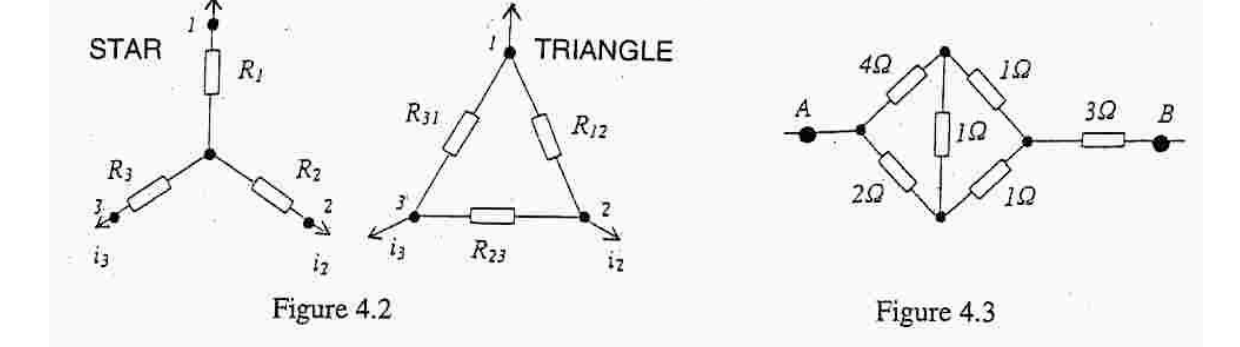 Figura 4.2 — rete a STELLA (resistori ) e rete a TRIANGOLO (resistori ); Figura 4.3 — disposizione triangolare di resistori fra e .
c) Dedurre le relazioni che legano una rete a stella a una a triangolo.
d) La Figura 4.3 contiene una disposizione triangolare di , , , , , resistori. Verificare che la disposizione equivalente dia un circuito con tutti i resistori. Dunque determinare la resistenza fra e .
Topic: Circuits Metodi: Kirchhoff’s Laws, Equivalent Circuit Reduction, Symmetry Argument Competenze: Mathematical Modeling, Diagrammatic Reasoning, Physical Reasoning Objects: Battery, Resistor Fonte: Testo (PDF) — p.6
a) Determine the currents and in the circuit of Figure 4.1. The cells have electromotive force (emf) , negligible internal resistance, and resistors of resistance .
Figure 4.1 — the two circuits (i) and (ii), each with cells of emf and resistors , through which currents and flow.
b) Figure 4.2 contains two circuits, each with points labeled , and , containing these resistors:
- (i) a star network with resistances , and ;
- (ii) a delta network with resistances , and (the arrows indicate the resistances between points labeled , and ). The two networks carry identical currents , and and have identical potentials. For , derive the relations used to evaluate for (i) star and (ii) delta, and deduce the equations
Figure 4.2 — star network (resistors ) and delta network (resistors ); Figure 4.3 — triangular arrangement of resistors between and .
c) Derive the relations that connect a star network to a delta network.
d) Figure 4.3 contains a triangular arrangement of , , , , and resistors. Verify that the equivalent arrangement yields a circuit with all resistors. Hence determine the resistance between points and .
a) Il modulo della densità di flusso magnetico a una distanza da un filo rettilineo infinito che porta corrente è dato da dove è la permeabilità dello spazio libero. Mostrare che la forza per unità di lunghezza fra due fili paralleli infiniti che portano correnti e a distanza è Indicare la direzione di con un diagramma.
b) Disegnare il campo (con linee per due fili paralleli, ciascuno con corrente ): (i) nella stessa direzione e (ii) in direzione opposta. Disegnare un grafico della densità di flusso magnetico , contro la distanza, , lungo la linea infinita che attraversa i due fili, in un piano perpendicolare ai fili, per casi (i) e (ii).
c) Fili paralleli che portano corrente sono posti su un set di rotaie a nella stessa direzione, separati e a (Figura 5.1). Determinare la forza per unità di lunghezza su ciascun filo. Disegnare un diagramma di forze.
d) La Figura 5.2 mostra un tappo di sughero, con massa che galleggia su un palo orizzontale, sospeso da un filo nel campo magnetico. Una piccola perturbazione fa oscillare il tappo a frequenza angolare data da dove e sono costanti. Quando il tappo è sospeso da un filo nel campo magnetico:
- su quali proprietà fisiche dipende ? Descrivere come si potrebbe disporre il filo affinché galleggi liberamente con frequenza angolare data, e infine come variare () per determinare .
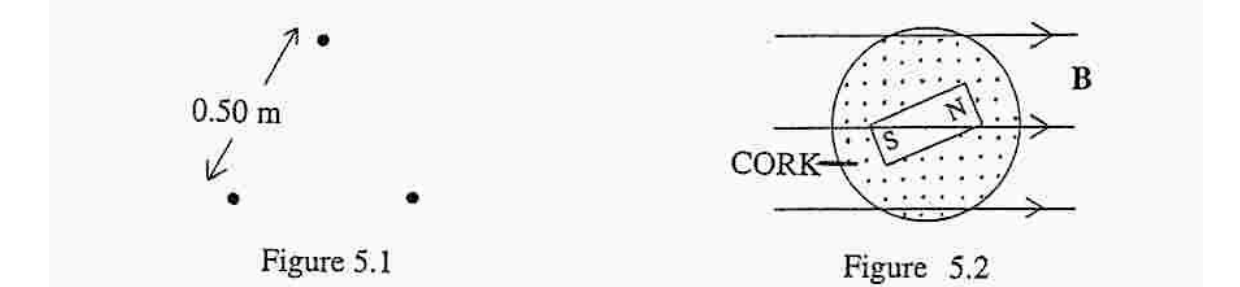 Figura 5.1 — i due fili paralleli separati da ; Figura 5.2 — tappo di sughero magnetico (poli , ) immerso nel campo magnetico .
Topic: Magnetism, Oscillations & Waves, Fluid Mechanics Metodi: Biot-Savart Law, Dimensional Analysis, Simple Harmonic Motion Analysis Competenze: Mathematical Modeling, Diagrammatic Reasoning, Physical Reasoning Objects: Wire, Magnet Fonte: Testo (PDF) — p.7
a) The magnitude of the magnetic flux density at a distance from an infinite straight wire carrying current is given by , where is the permeability of free space. Show that the force per unit length between two infinite parallel wires carrying currents and separated by distance is . Indicate the direction of with a diagram.
b) Draw the magnetic field (using lines for two parallel wires, each carrying current ): (i) when currents are in the same direction and (ii) when currents are in opposite directions. Draw a graph of magnetic flux density versus distance along the infinite line passing through both wires, in a plane perpendicular to the wires, for cases (i) and (ii).
c) Parallel wires carrying current are placed on a set of rails at in the same direction, separated by distance (Figure 5.1). Determine the force per unit length on each wire. Draw a force diagram.
d) Figure 5.2 shows a cork stopper, of mass floating on a horizontal rod, suspended by a wire in a magnetic field. A small perturbation causes the stopper to oscillate with angular frequency given by , where and are constants. When the stopper is suspended by a wire in the magnetic field:
- on which physical properties does depend? Describe how the wire could be arranged so that the stopper floats freely with given angular frequency , and finally how to vary () in order to determine .
Figure 5.1 — the two parallel wires separated by ; Figure 5.2 — magnetic cork stopper (poles , ) immersed in the magnetic field .
a) Spiegare, con diagrammi di raggi appropriati, le eclissi di Sole e Luna. Perché tali eclissi non si verificano una volta al mese?
b) Assumendo un’orbita circolare, mostrare che il periodo orbitale della Luna è legato al raggio da dove è la massa della Terra e è la distanza fra i centri di Terra e Luna.
c) Questa relazione è valida per ogni possibile orbita ellittica interpretata come asse maggiore dell’ellisse (la metà dell’asse maggiore); il caso di un’ellisse di cui i due fuochi coincidono col centro è un caso speciale. Nel caso limite di un’ellisse “molto stretta” il fuoco coincide con le estremità dell’ellisse. Ciò corrisponde all’orbita della Luna che cade verso la Terra da una distanza iniziale fra i centri di Terra e Luna; trascurando l’effetto di Terra e Luna, calcolare:
- (i) il tempo che impiega la Luna a colpire la Terra;
- (ii) la velocità media della Luna nella caduta verso la Terra;
- (iii) la velocità massima della Luna a distanza dal centro della Terra;
- (iv) il tempo che impiega un asteroide stazionario a cadere verso il Sole, da dal Sole, in modo che l’asteroide stazionario cada in una collisione con un altro asteroide.
Topic: Gravitation, Astrophysics, Geometric Optics Metodi: Kepler’s Laws, Newton’s Law of Gravitation, Energy Conservation Method Competenze: Mathematical Modeling, Diagrammatic Reasoning, Estimation & Approximation Objects: Planet, Star, Satellite Fonte: Testo (PDF) — p.8
a) Explain, using appropriate ray diagrams, solar and lunar eclipses. Why do such eclipses not occur once per month?
b) Assuming a circular orbit, show that the orbital period of the Moon is related to the radius by , where is the mass of Earth and is the distance between the centers of Earth and Moon.
c) This relation holds for any possible elliptical orbit interpreted as the semi-major axis of the ellipse (half of the major axis); the case of an ellipse for which both foci coincide with the center is a special case. In the limiting case of a “very narrow” ellipse, one focus coincides with the ends of the ellipse. This corresponds to the Moon’s orbit falling toward Earth from an initial distance between centers of Earth and Moon; neglecting the effects of Earth and Moon, calculate:
- (i) the time it takes for the Moon to collide with Earth;
- (ii) the average velocity of the Moon during its fall toward Earth;
- (iii) the maximum velocity of the Moon at a distance from Earth’s center;
- (iv) the time it takes for a stationary asteroid to fall toward the Sun from away from the Sun, such that the stationary asteroid collides with another asteroid.
a) Spiegare, con diagrammi, le differenze fra onde longitudinali e trasversali. Dare un esempio di onda trasversale.
b) Spiegare i seguenti fenomeni acustici:
- (i) battimenti fra due onde sonore;
- (ii) effetto Doppler.
c) Se una sorgente sonora, emettendo una nota di frequenza , si muove verso un osservatore con velocità , mostrare che, ammesso che il vento sia nullo, la frequenza rilevata dall’osservatore è dove è la velocità del suono in aria.
d) Come si modifica il risultato in (c) se la sorgente si muove allontanandosi dall’osservatore? Cosa accade alla velocità del suono rispetto a ? Perché le onde acustiche trasversali non si propagano in aria?
e) Un aereo bimotore vola a bassa quota verso un osservatore stazionario. La frequenza di battimento fra i due motori, osservata, cambia da a quando passa sopra l’osservatore. Se è udibile, dedurre la velocità dell’aereo. (Velocità del suono in aria .)
Topic: Oscillations & Waves Metodi: Wave Equation, Superposition Principle, Physical Modeling Competenze: Mathematical Modeling, Physical Reasoning, Diagrammatic Reasoning Objects: — Fonte: Testo (PDF) — p.9
a) Explain, with diagrams, the differences between longitudinal and transverse waves. Give an example of a transverse wave.
b) Explain the following acoustic phenomena:
- (i) beats between two sound waves;
- (ii) Doppler effect.
c) If a sound source emitting a note of frequency moves toward an observer with speed , show that, assuming no wind, the frequency detected by the observer is where is the speed of sound in air.
d) How does the result in (c) change if the source moves away from the observer? What happens to the speed of sound compared to ? Why do transverse acoustic waves not propagate in air?
e) A twin-engine airplane flies at low altitude toward a stationary observer. The beat frequency between the two engines, as observed, changes from to when it passes directly overhead. If audible, deduce the airplane’s speed. (Speed of sound in air .)
a) Una banda di frequenza di radiazione elettromagnetica, come presente nella luce bianca, è trasmessa attraverso un reticolo. Osservando il fascio di luce diffratto, lo spettro trasmesso permette di concludere che l’indice di rifrazione del mezzo con luce visibile è data dalla lunghezza d’onda?
b) Un fascio laser, lunghezza d’onda , incide normalmente su due fenditure a distanza apart su uno schermo a distanza dalle fenditure (Figura 8.1).
- (i) Quali sono le condizioni per interferenza costruttiva e distruttiva?
- (ii) Mostrare che per il primo ordine di frangia, quando è minore di radiante, l’indice di rifrazione . [verificare]
- (iii) Come si modifica la condizione in (ii) se il sistema è immerso in un mezzo di indice di rifrazione ?
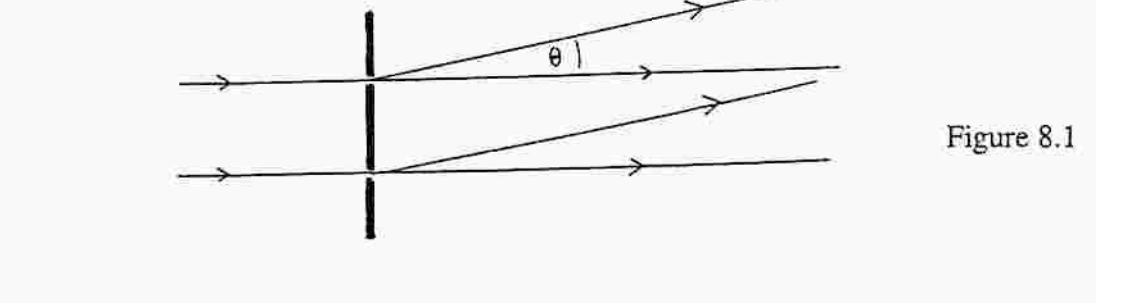 Figura 8.1 — geometria della doppia fenditura: fasci incidenti e diffratti con angolo .
c) Un radiotelescopio ha due antenne a apart su una linea est-ovest. Una sorgente è direttamente in verticale, a una lunghezza d’onda di . Le ampiezze del fascio diffratto in funzione del cavo, Figura 8.2, mostrano l’intervallo angolare fra massimi adiacenti, in funzione del tempo, , trascorso dopo noon.
- (i) Determinare l’intervallo di tempo fra massimi adiacenti di intensità.
- (ii) Come si modifica il risultato registrato se è effettuato a Cambridge, Inghilterra, alla latitudine ?
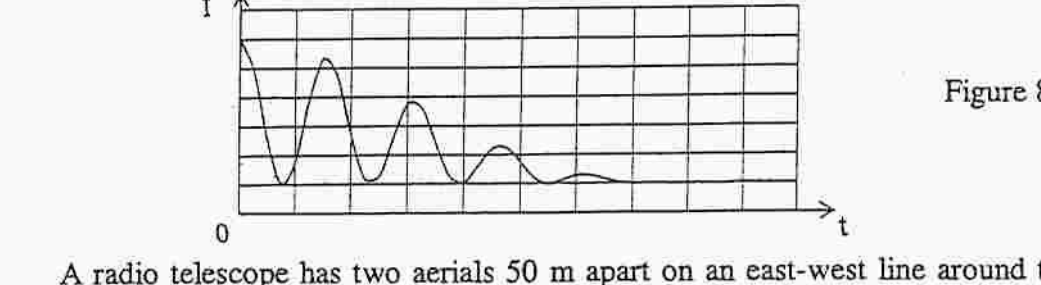 Figura 8.2 — ampiezza/intensità del segnale ricevuto in funzione del tempo .
d) Un impulso è un evento di neutroni stellari adiacenti che cambiano l’indice di rifrazione fra punti adiacenti. Come si può rilevare otticamente tale nube? Quando una nube di neutroni adiacenti passa di fronte alla stella, l’indice di rifrazione cambia. Come può un osservatore rilevare tale nube?
Topic: Wave Optics, Astrophysics Metodi: Interference & Diffraction Analysis, Snell’s Law, Superposition Principle Competenze: Mathematical Modeling, Estimation & Approximation, Diagrammatic Reasoning Objects: Diffraction Grating, Slit, Screen, Star Fonte: Testo (PDF) — p.10
a) A band of electromagnetic radiation frequency, such as present in white light, is transmitted through a diffraction grating. Observing the diffracted light beam, the transmitted spectrum allows one to conclude that the refractive index of the medium for visible light is given by the wavelength?
b) A laser beam, wavelength , normally incident on two slits separated by distance , located on a screen at distance from the slits (Figure 8.1).
- (i) What are the conditions for constructive and destructive interference?
- (ii) Show that, for the first-order fringe, when is less than radians, the refractive index is given by . [Verify]
- (iii) How does the condition in (ii) change if the system is immersed in a medium of refractive index ?
Figure 8.1 — geometry of the double-slit setup: incident and diffracted beams at angle .
c) A radio telescope has two antennas separated by along an east-west line. A source is directly overhead, at a wavelength of . The amplitudes of the diffracted beam as a function of time, Figure 8.2, show the angular interval between adjacent maxima, as a function of time elapsed after noon .
- (i) Determine the time interval between adjacent intensity maxima.
- (ii) How does the recorded result change if performed in Cambridge, England, at latitude ?
Figure 8.2 — amplitude/intensity of the received signal as a function of time .
d) An impulse is an event involving adjacent neutron stars that alters the refractive index between neighboring points. How can such a cloud be optically detected? When a cloud of adjacent neutron stars passes in front of the star, the refractive index changes. How can an observer detect such a cloud?
a) Un elettrone in un atomo di idrogeno fa una transizione dallo stato fondamentale, con energia , al primo stato eccitato, energia .
- (i) Dedurre se un fotone è stato emesso o assorbito.
- (ii) Determinare la lunghezza d’onda del fotone.
- (iii) Qual è l’energia di ionizzazione dell’atomo?
b) Come differiscono i livelli energetici di un elettrone legato nell’atomo di idrogeno per una lunghezza d’onda ?
c) Un positronio stazionario, energia a riposo , decade in due fotoni di uguale lunghezza d’onda .
- (i) Perché le lunghezze d’onda sono uguali?
- (ii) Quali differenze ci sono se il positrone è in moto?
- (iii) Calcolare .
d) Un raggio X di lunghezza d’onda è diffuso da un elettrone stazionario producendo un raggio X diffuso di lunghezza d’onda . L’elettrone acquisisce energia, non-relativistica, . Determinare la lunghezza d’onda . (Il momento di un fotone, frequenza , è legato alla sua energia da .)
Topic: Modern-Quantum Physics, Special Relativity Metodi: Photon Energy Relation, Conservation of Momentum, Mass-Energy Equivalence Competenze: Mathematical Modeling, Physical Reasoning, Estimation & Approximation Objects: Electron, Photon, Atom Fonte: Testo (PDF) — p.11
a) An electron in a hydrogen atom transitions from the ground state, with energy , to the first excited state, energy .
- (i) Deduce whether a photon was emitted or absorbed.
- (ii) Determine the wavelength of the photon.
- (iii) What is the ionization energy of the atom?
b) How do the energy levels of an electron bound in a hydrogen atom differ for a wavelength ?
c) A stationary positronium, rest energy , decays into two photons of equal wavelength .
- (i) Why are the wavelengths equal?
- (ii) What differences arise if the positron is in motion?
- (iii) Calculate .
d) An X-ray with wavelength is scattered by a stationary electron, producing a scattered X-ray of wavelength . The electron gains non-relativistic energy . Determine the wavelength . (The momentum of a photon, with frequency , is related to its energy by .)
a) Un recipiente isolato contiene un blocco di ghiaccio a . Una resistenza di riscaldamento costante e una sonda di temperatura sono inserite nel ghiaccio; il riscaldatore è acceso e la temperatura sale lentamente in modo da rendere il riscaldamento sempre a un tasso uniforme. La temperatura sale da a , con il seguente schizzo di temperatura, , contro il tempo, . Spiegare la disposizione delle molecole nelle diverse regioni di temperatura.
b) Un recipiente di Dewar contiene un liquido in ebollizione e una resistenza. Il riscaldatore ha resistenza di e prende una corrente di . La temperatura del bilancio è registrata a un tasso uniforme di per minuto. Il riscaldatore è acceso e si dà il risultato registrato. Determinare il calore latente specifico di vaporizzazione del liquido.
| Temperatura/min | 0,00 | 2,00 | 4,00 | 6,00 | 8,00 | 10,00 | 12,00 | 14,00 | 16,00 |
|---|---|---|---|---|---|---|---|---|---|
| Massa/grammi | 73,0 | 72,5 | 72,0 | 71,5 | 70,5 | 68,5 | 66,5 | 64,5 | 62,5 |
c) Caffè nero a , con una massa di e calore specifico del caffè è seguito dall’aggiunta di di panna a , con calore specifico . Determinare la temperatura finale di equilibrio della miscela caffè-panna. Spiegare, senza calcolo, se per portare il caffè nero alla temperatura di equilibrio rispetto alla temperatura , è maggiore di .
Topic: Thermodynamics Metodi: First Law of Thermodynamics, Energy Conservation Method, Experimental Data Analysis Competenze: Graph Linearization, Experimental Data Analysis, Mathematical Modeling Objects: Block, Resistor, Calorimeter Fonte: Testo (PDF) — p.12
a) An isolated container holds an ice block at . A constant heating resistor and a temperature probe are inserted into the ice; the heater is turned on, and the temperature rises slowly so as to maintain heating at a constant rate. The temperature increases from to , as shown in the following temperature graph, , versus time, . Explain the molecular arrangement in the different temperature regions.
b) A Dewar flask contains a boiling liquid and a heating resistor. The heater has resistance and draws a current of . The equilibrium temperature is recorded at a uniform rate of per minute. The heater is turned on, and the recorded result is provided below. Determine the specific latent heat of vaporization of the liquid.
| Temperature/min | 0.00 | 2.00 | 4.00 | 6.00 | 8.00 | 10.00 | 12.00 | 14.00 | 16.00 |
|---|---|---|---|---|---|---|---|---|---|
| Mass/grams | 73.0 | 72.5 | 72.0 | 71.5 | 70.5 | 68.5 | 66.5 | 64.5 | 62.5 |
c) Black coffee at , with a mass of and specific heat capacity of coffee , is followed by the addition of of cream at , with specific heat capacity . Determine the final equilibrium temperature of the coffee-cream mixture. Explain, without calculation, whether the heat required to bring the black coffee from its initial temperature to the equilibrium temperature is greater than or less than the heat released by the cream cooling from its initial temperature to the equilibrium temperature .