Domanda compulsoria, con brevi quesiti indipendenti:
- a)
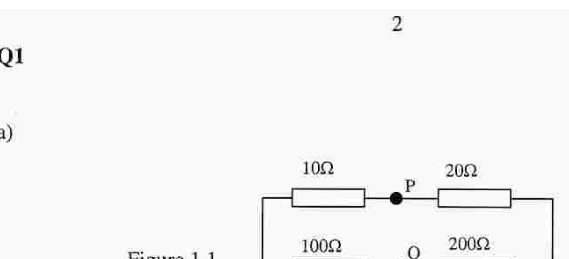 circuito con resistori P e Q
(i) Determinare la differenza di potenziale fra e . (ii) Se il resistore è sostituito da un resistore tale che la d.d.p. resti immutata, calcolare ; con resistori addizionali, modificare per determinare .
- b)
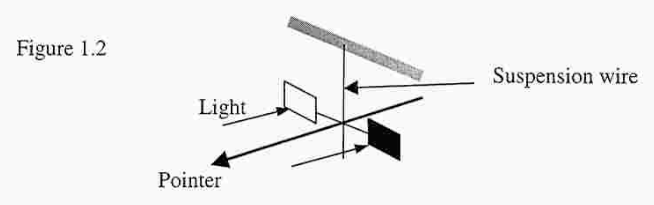 palette sospese su filo con puntatore
(i) Un fascio laser di , lunghezza d’onda , incide normalmente su uno specchio nero perfetto. Calcolare la forza sullo specchio. (ii) Se lo specchio è sostituito da uno che riflette il della luce incidente, dedurre la forza esercitata sullo specchio. (iii) Due piccole alette metalliche sono sospese da un filo (Figura 1.2): una molto riflettente, l’altra molto annerita. Entrambe sono illuminate da luce identica. In buon vuoto le alette mostrano rotazione antioraria; in vuoto molto piccolo mostrano rotazione oraria molto piccola. Come è influenzata la velocità delle molecole nella camera dall’urto con le alette? Spiegare le osservazioni.
- c) Un blocco di massa , velocità , coordinate , scivola senza attrito su un tratto rettilineo (Figura 1.1). Determinare, o ricavare: (i) l’accelerazione del blocco; (ii) la velocità totale del blocco se localizzato a ; (iii) commento sull’accelerazione risultante; (iv) se rilasciato da fermo a , determinare la velocità a .
- d)
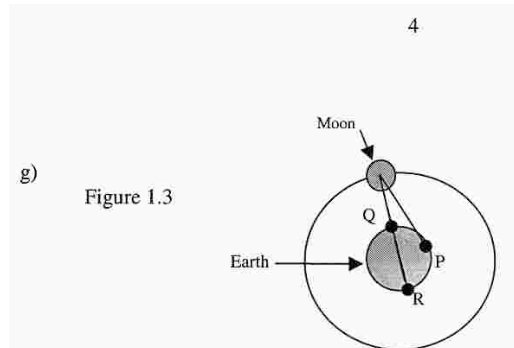 Luna in orbita attorno alla Terra
La Figura 1.3 mostra la Luna che orbita attorno alla Terra. Perché molti percorsi delle particelle dell’orbita ellittica della Luna fanno due cambi ore? Spiegare quali parti della Luna esperiscono , e a dalla superficie della Terra.
- e) Secondo la teoria della relatività ristretta una massa , con velocità , relativa a un osservatore, è data da , dove è la massa misurata quando , è la velocità della luce. (i) Una lady che pattina su ghiaccio, in moto, pattina a . Trascurando l’attrito, calcolare: (i) la decelerazione tenendo conto della resistenza; (ii) la perdita di energia cinetica; (iii) la massa massima di ghiaccio fuso a . Il calore latente specifico di fusione del ghiaccio è .
- f)
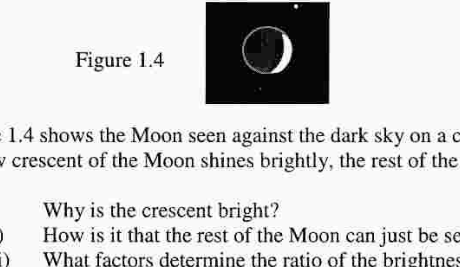 fotografia di luna crescente
La Figura 1.4 mostra la Luna contro il cielo notturno scuro in una notte d’inverno chiara. Una sezione stretta della Luna brilla luminosa; il resto della Luna può essere visto. (i) Perché si vede la falce di Luna? (ii) Come è che la parte più luminosa della Luna è la falce? (iii) Quali fattori determinano il rapporto delle luminosità della falce e del resto della Luna?
- g) Secondo l’equazione di stato di Van der Waals per un gas reale: dove e sono costanti. (i) Quali sono le dimensioni, o unità, di e ? (ii) Calcolare la pressione di kmol di gas a contenuta in , con SI e SI. (iii) Cosa accade se il gas è ideale?
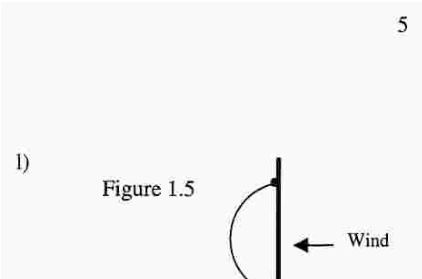
- l) Una vela quadrata di una barca solare, di lato , è regolata in modo da fare un angolo con la direzione del vento: (i) Mostrare che la forza sulla vela è , dove è una costante. (ii) Quali sono le dimensioni di ? (iii) Come dipende la forza dalla densità dell’aria? (iv) Spiegare perché raddoppiando la velocità del vento non si raddoppia la velocità della barca.
- n) Durante un temporale uno studente cronometra il ritardo fra il lampo e il tuono. I risultati sono dati nella tabella (intervallo ): a e . (i) Perché l’intervallo fra lampo e tuono si riduce mentre il temporale si avvicina? (ii) Determinare la velocità con cui si avvicina il temporale (velocità del suono ).
Nota: alcune cifre/passaggi del PDF sono di difficile lettura per la qualità della scansione; consultare il PDF sorgente per i valori esatti.
 barca a vela vista laterale
 barca a vela vista posteriore
Topic: Circuits, Special Relativity, Thermodynamics Metodi: Equivalent Circuit Reduction, Kirchhoff’s Laws, Lorentz Transformation, Ideal Gas Law, Dimensional Analysis, Kinematic Equations Competenze: Physical Reasoning, Mathematical Modeling, Estimation & Approximation Objects: Resistor, Mirror, Block, Gas, Planet Fonte: Testo (PDF) — p.2
Compulsory question, with brief independent sub-questions:
- a)
electric circuit with resistors P and Q
(i) Determine the potential difference between points and . (ii) If resistor is replaced by resistor such that the potential difference remains unchanged, calculate ; with additional resistors, modify to determine .
- b)
pendulum-like plate suspended by a wire with pointer
(i) A laser beam of power , wavelength , is incident normally on a perfect black mirror. Calculate the force exerted on the mirror. (ii) If the mirror is replaced by one that reflects of the incident light, deduce the force exerted on the mirror. (iii) Two small metal vanes are suspended by a wire (Figure 1.2): one highly reflective, the other strongly absorbing (blackened). Both are illuminated by identical light. In good vacuum, the vanes rotate counterclockwise; in very low vacuum, they show a small clockwise rotation. How is the molecular speed inside the chamber affected by collisions with the vanes? Explain the observations.
- c) A block of mass , initial velocity , located at coordinates , slides without friction along a straight track (Figure 1.1). Determine or derive: (i) the acceleration of the block; (ii) the total velocity of the block if located at ; (iii) comment on the resulting acceleration; (iv) if released from rest at , determine the velocity at .
- d)
Luna in orbita attorno alla Terra
Figure 1.3 shows the Moon orbiting Earth. Why do many particle paths of the Moon’s elliptical orbit make two changes hours? Explain which parts of the Moon experience , and at what distance from Earth’s surface.
- e) According to special relativity, the relativistic mass of a body moving with velocity relative to an observer is given by , where is the mass measured when , and is the speed of light. (i) A lady ice-skating, in motion, skates at . Neglecting friction, calculate: (i) the deceleration considering air resistance; (ii) the loss of kinetic energy; (iii) the maximum mass of ice melted at . The specific latent heat of fusion of ice is .
- f)
photo of a waxing moon
Figure 1.4 shows the Moon against a dark night sky on a clear winter night. A narrow section of the Moon shines brightly; the rest of the Moon is visible as well. (i) Why is the crescent of the Moon visible? (ii) How is it that the brightest part of the Moon is the crescent? (iii) What factors determine the ratio of brightness between the crescent and the rest of the Moon?
-
g) According to the Van der Waals equation of state for a real gas: where and are constants. (i) What are the dimensions, or units, of and ? (ii) Calculate the pressure of kmol of gas at contained in , with SI and SI. (iii) What happens if the gas is ideal?
-
l) A square sail of a solar boat, with side length , is oriented so as to make an angle with the wind direction: (i) Show that the force on the sail is , where is a constant. (ii) What are the dimensions of ? (iii) How does the force depend on the air density ? (iv) Explain why doubling the wind speed does not double the boat’s speed.
-
n) During a thunderstorm, a student measures the delay between lightning and thunder. The results are given in the table (time interval ): at and . (i) Why does the interval between lightning and thunder decrease as the storm approaches? (ii) Determine how fast the storm is approaching (speed of sound ).
Note: some digits/steps in the PDF are difficult to read due to scan quality; refer to the original PDF for exact values.
sailboat viewed from the side
sailboat viewed from the back
a) Una pietra è lasciata cadere in un canyon profondo. Dopo si sente il rumore del fondo. Stimare approssimativamente:
- (i) la profondità del canyon, trascurando il tempo che impiega l’onda di ritorno a raggiungere la cima del canyon;
- (ii) il tempo che impiega l’onda di ritorno a raggiungere la cima del canyon, assumendo che la velocità del suono sia .
b) Se è il tempo che impiega la pietra a raggiungere il fondo del canyon e il tempo che impiega l’onda di ritorno a raggiungere la cima del canyon:
- (i) scrivere le equazioni che determinano e , trascurando la resistenza dell’aria;
- (ii) calcolare il valore esatto di ;
- (iii) calcolare il valore esatto di ;
- (iv) dedurre la profondità del canyon.
c) Se la pietra è inizialmente lanciata verso il basso nel canyon con velocità , come cambiano le risposte alla domanda (b)(ii)?
d) Se la pietra è invece lanciata verticalmente verso l’alto con velocità , come cambierà la risposta?
Topic: Newtonian Mechanics, Oscillations & Waves Metodi: Kinematic Equations, Approximation & Series Expansion Competenze: Mathematical Modeling, Physical Reasoning, Estimation & Approximation Objects: — Fonte: Testo (PDF) — p.6
a) A stone is dropped into a deep canyon. After , the sound of it hitting the bottom is heard. Estimate approximately:
- (i) the depth of the canyon, neglecting the time it takes for the returning sound wave to reach the top of the canyon;
- (ii) the time it takes for the returning sound wave to reach the top of the canyon, assuming the speed of sound is .
b) If is the time it takes for the stone to reach the bottom of the canyon and is the time it takes for the returning sound wave to reach the top:
- (i) write the equations that determine and , neglecting air resistance;
- (ii) calculate the exact value of ;
- (iii) calculate the exact value of ;
- (iv) deduce the depth of the canyon.
c) If the stone is initially thrown downward into the canyon with speed , how do the answers to question (b)(ii) change?
d) If instead the stone is thrown vertically upward with speed , how will the answer change?
Un’asta rigida leggera lunga è sospesa dal soffitto mediante due fili verticali e , ciascuno di lunghezza naturale , attaccati alle estremità dell’asta. è un filo di rame con modulo di Young , diametro ; è un filo di ottone con modulo di Young , diametro .
a) Una massa di è attaccata al punto medio dell’asta. Calcolare:
- (i) la tensione in ciascun filo, assumendo l’asta orizzontale;
- (ii) il conseguente allungamento di ;
- (iii) il conseguente allungamento di ;
- (iv) l’angolo che l’asta forma con l’orizzontale.
b) L’attacco della massa di è spostato in un punto , a distanza da lungo l’asta. Calcolare:
- (i) l’allungamento di ;
- (ii) l’allungamento di ;
- (iii) la distanza affinché l’asta sia orizzontale.
Topic: Elasticity & Materials, Rigid Body Statics Metodi: Stress-Strain Analysis, Free-Body Diagram, Torque & Angular Momentum Analysis Competenze: Mathematical Modeling, Diagrammatic Reasoning, Physical Reasoning Objects: Rod, Wire, Block Fonte: Testo (PDF) — p.7
A light rigid rod of length is suspended from the ceiling by two vertical wires and , each with natural length , attached to the ends of the rod. is a copper wire with Young’s modulus and diameter ; is a brass wire with Young’s modulus and diameter .
a) A mass of is attached to the midpoint of the rod. Calculate:
- (i) the tension in each wire, assuming the rod remains horizontal;
- (ii) the resulting elongation of ;
- (iii) the resulting elongation of ;
- (iv) the angle that the rod makes with the horizontal.
b) The attachment point of the mass is moved to a point , located at distance from along the rod. Calculate:
- (i) the elongation of ;
- (ii) the elongation of ;
- (iii) the distance such that the rod remains horizontal.
a)
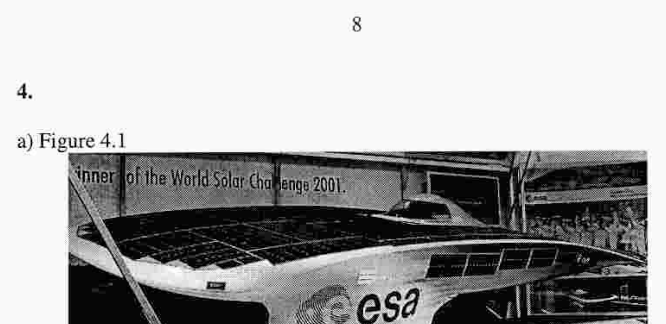 foto auto solare World Solar Challenge
La Figura 4.1 mostra l’auto solare che ha vinto la World Solar Challenge 2001. La potenza solare massima, da pannelli solari, era . La potenza elettrica prodotta dai pannelli solari, con efficienza , era . L’efficienza del motore era . Non c’era vento.
- (i) Calcolare la forza di trazione totale , nel caso di velocità massima.
- (ii) Perché l’auto richiede una potenza molto minore di un’auto convenzionale?
- (iii) Calcolare la potenza del motore incidente , della forza sull’auto.
- (iv) L’auto ha quattro ruote. Quale vantaggio dà questo design?
b) Un motore solare consiste di una cella elettrica, di p.d. e resistenza interna trascurabile, e una semplice bobina o motore costituiti da una bobina rotante, resistenza , e un magnete permanente. Il motore ruota a una velocità del flusso sull’auto.
- (i) Spiegare perché la velocità decresce mentre il motore accelera.
- (ii) Ricavare l’equazione che lega e , introducendo una costante appropriata.
c)
 schema motore DC brushless con bobine
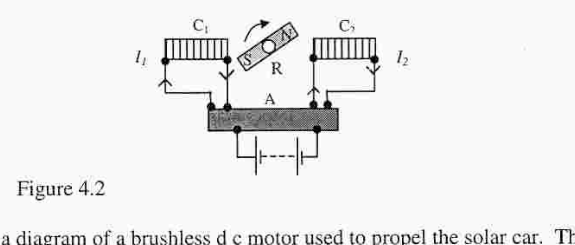
La Figura 4.2 è uno schema di un motore brushless DC, usato per pilotare l’auto solare. La corrente elettrica è collegata a una bobina “nera” , che fornisce le correnti e alle estremità delle bobine. La forza che ruota la bobina.
- (i) Qual è lo scopo di ?
- (ii) Disegnare il grafico, le correnti nelle bobine e in funzione del tempo .
d) Perché le celle solari surriscaldano l’auto quando essa è stazionaria e le batterie non si stanno caricando?
Topic: Circuits, Electromagnetic Induction, Newtonian Mechanics Metodi: Energy Conservation Method, Faraday’s Law of Induction, Kirchhoff’s Laws Competenze: Mathematical Modeling, Diagrammatic Reasoning, Physical Reasoning Objects: Battery, Coil, Magnet Fonte: Testo (PDF) — p.8
a)
photo of solar car from World Solar Challenge
Figure 4.1 shows the solar car that won the World Solar Challenge 2001. The maximum solar power, from solar panels, was . The electrical power produced by the solar panels, with efficiency , was . The motor efficiency was . There was no wind.
- (i) Calculate the total traction force , in the case of maximum speed.
- (ii) Why does the car require much less power than a conventional car?
- (iii) Calculate the motor input power , due to the force on the car.
- (iv) The car has four wheels. What advantage does this design provide?
b) A solar motor consists of a single electrical cell, with electromotive force and negligible internal resistance, and a simple coil or motor made of a rotating coil, with resistance , and a permanent magnet. The motor rotates at an angular velocity proportional to the flux through the car.
- (i) Explain why the angular velocity decreases as the motor accelerates.
- (ii) Derive the equation relating and , introducing an appropriate constant.
c)
diagram of brushless DC motor with coils
Figure 4.2 is a schematic of a brushless DC motor, used to drive the solar car. Electric current is connected to a “black” coil , which supplies currents and to the ends of the coils. The force that rotates the coil.
(i) What is the purpose of ? (ii) Draw the graph of the currents in the coils and as a function of time .
d) Why do the solar cells overheat the car when it is stationary and the batteries are not charging?
Misure storiche della velocità della luce: Galileo, Roemer (lune di Giove), Fizeau (ruota dentata)
a) Nel 1600, Galileo tentò di misurare la velocità della luce, , mandando un fascio di luce a un altro osservatore, a distanza di . Era in grado di stimare gli intervalli di tempo con un’accuratezza di . Commentare la probabile riuscita di questo esperimento. Quale ordine di accuratezza nella misura del tempo era richiesto per determinare una stima della velocità della luce in questo esperimento?
b)
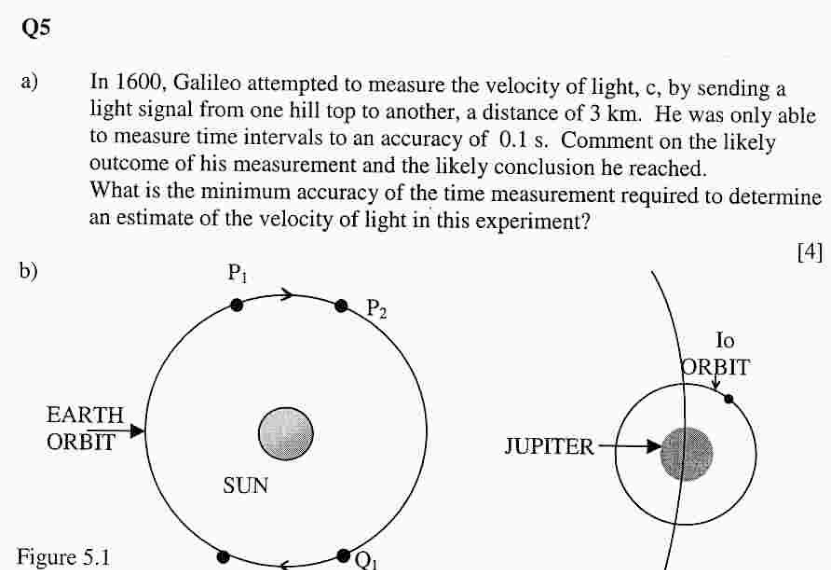 orbite Terra e Giove attorno al Sole
Roemer, nel 1676, misurò il periodo di rotazione della luna Io di Giove attorno al pianeta, Figura 5.1. Questo periodo è minore del periodo di rotazione della Terra attorno al Sole. Spiegare come il periodo appare variare mentre la Terra si muove da:
- (i) a , verso Giove;
- (ii) a , allontanandosi da Giove. Notò una serie di osservazioni, assumendo il periodo di Io costante, che il tempo di apparizione di Io variava di minuti durante il corso di un anno. Spiegare in modo dettagliato come dedurre .
c) Fizeau, nel 1849, ideò un metodo più accurato per misurare usando uno specchio rotante (ruota dentata). La luce attraversava i denti di una ruota a di distanza, ed era riflessa indietro. La ruota gira con periodo variabile fino a una velocità di giri al secondo. Determinare il valore di ottenuto e la possibile accuratezza del risultato. Se il tasso di rotazione era accurato al , dedurre l’accuratezza del risultato.
Topic: Geometric Optics, Astrophysics, Order-of-Magnitude Estimation Metodi: Order-of-Magnitude Estimation, Kepler’s Laws, Error Propagation Competenze: Estimation & Approximation, Mathematical Modeling, Physical Reasoning Objects: Planet, Star, Satellite, Wheel Fonte: Testo (PDF) — p.9
Historical measurements of the speed of light: Galileo, Roemer (Jupiter’s moons), Fizeau (toothed wheel)
a) In 1600, Galileo attempted to measure the speed of light, , by sending a beam of light to another observer at a distance of . He could estimate time intervals with an accuracy of . Comment on the likely success of this experiment. What order of magnitude in time measurement accuracy was required to obtain an estimate of the speed of light in this experiment?
b)
orbits of Earth and Jupiter around the Sun
Roemer, in 1676, measured the orbital period of Jupiter’s moon Io around the planet, Figure 5.1. This period is shorter than Earth’s orbital period around the Sun. Explain how the observed period appears to vary as Earth moves from:
- (i) to , toward Jupiter;
- (ii) to , away from Jupiter. He noted a series of observations, assuming Io’s period to be constant, that the time of appearance of Io varied by minutes over the course of a year. Explain in detail how he deduced .
c) Fizeau, in 1849, devised a more accurate method to measure using a rotating mirror (toothed wheel). Light passed through the gaps between the teeth of a wheel located at a distance , and was reflected back. The wheel rotated with a variable period until it reached a speed of revolutions per second. Determine the value of obtained and the possible accuracy of the result. If the rotation rate was accurate to , deduce the accuracy of the result.
a)
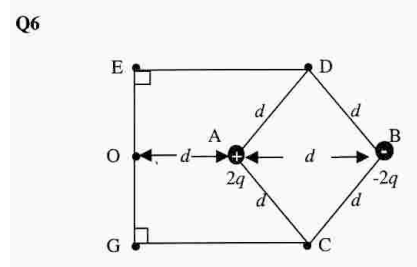 geometria cariche 2q e -2q a rombo
Le cariche e sono separate da una distanza e localizzate ai vertici e . La Figura 6.1 mostra , dove è il punto medio di . Determinare:
- (i) il campo vettoriale e a con segno positivo;
- (ii) il potenziale e a ;
- (iii) il lavoro fatto nel portare la carica lungo il percorso verso .
b)
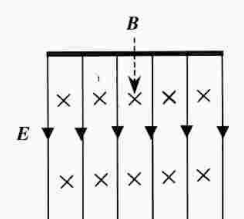 piastre CRO con campo E e B
La Figura 6.2 mostra un campo magnetico a con campo elettrico orizzontale , e una particella carica positiva deflessa verticalmente di una distanza data da
- (i) Se , mostrare che la carica positiva viene deflessa verticalmente di una distanza data da quanto sopra.
- (ii) Se e è la stessa, ma la carica positiva si muove con una velocità verticale, mostrare che dove .
- (iii) Mostrare che, durante il moto in cui i piani, i campi sono regolati in modo che la forza sia equilibrata, allora .
Topic: Electrostatics, Magnetism Metodi: Coulomb’s Law, Electric Potential Method, Lorentz Force Analysis, Vector Decomposition Competenze: Mathematical Modeling, Diagrammatic Reasoning, Physical Reasoning Objects: Point Charge Fonte: Testo (PDF) — p.10
a)
geometry of charges 2q and -2q arranged in a rhombus
The charges and are separated by a distance and located at vertices and . Figure 6.1 shows , where is the midpoint of . Determine:
- (i) the vector field and at point with positive sign;
- (ii) the potential and at point ;
- (iii) the work done in moving charge along path toward .
b)
parallel plates CRO with electric field E and magnetic field B
Figure 6.2 shows a magnetic field at with horizontal electric field , and a positively charged particle deflected vertically by a distance given by
- (i) If , show that the positive charge is deflected vertically by a distance as given above.
- (ii) If and remains the same, but the positive charge moves with vertical velocity, show that where .
- (iii) Show that, during motion in which the plates are adjusted so that forces are balanced, then .
a) Un oggetto puntiforme è posto di fronte a uno specchio piano, in un piano perpendicolare a quello dello specchio. Disegnare due raggi di luce dall’oggetto che sono riflessi nello specchio. Indicare la posizione dell’immagine.
b)
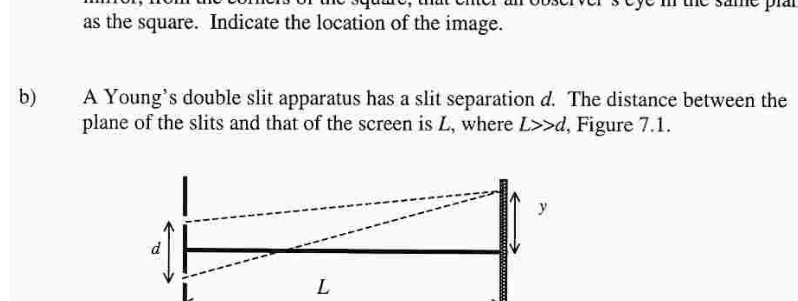 doppia fenditura di Young
Una lastra di vetro a doppia inclinazione ha una separazione all’estremità . La distanza fra i piani di simmetria delle lastre , dove , Figura 7.1. Mostrare che l’interferenza costruttiva in un punto a distanza lungo lo schermo, dal piano di simmetria delle lastre, è dove è un intero e è la lunghezza d’onda della luce.
c)
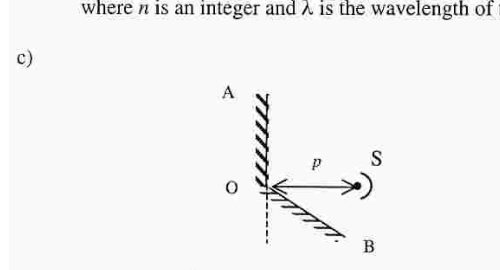 due specchi ad angolo AOB con sorgente
L’angolo fra specchi adiacenti e è , Figura 7.2. è verticale. Un raggio orizzontale colpisce .
- (i) Dove si trovano le immagini di localizzate?
- (ii) Perché è possibile produrre un pattern di interferenza su uno schermo?
- (iii) In quale direzione la separazione delle frange dipende ?
- (iv) Cosa significa “effettivo ” per questo sistema?
- (v) Cosa significa “effettivo ” per questo sistema?
- (vi) Se cresce gradualmente da a , come cambia la separazione delle frange?
Topic: Wave Optics, Geometric Optics Metodi: Interference & Diffraction Analysis, Ray Tracing, Superposition Principle Competenze: Diagrammatic Reasoning, Mathematical Modeling, Physical Reasoning Objects: Mirror, Slit, Screen Fonte: Testo (PDF) — p.11
a) A point-like object is placed in front of a plane mirror, in a plane perpendicular to the mirror’s surface. Draw two light rays from the object that are reflected by the mirror. Indicate the position of the image.
b)
double-slit experiment of Young
A glass plate with double inclination has a separation at the edge . The distance between the symmetry planes of the plates is , where , Figure 7.1. Show that constructive interference at a point located a distance along the screen from the symmetry plane of the plates is given by , where is an integer and is the wavelength of light.
c)
two mirrors at angle AOB with source
The angle between adjacent mirrors and is , Figure 7.2. is vertical. A horizontal ray strikes .
- (i) Where are the images of located?
- (ii) Why is it possible to produce an interference pattern on a screen?
- (iii) In which direction does the fringe separation depend ?
- (iv) What does “real ” mean for this system?
- (v) What does “real ” mean for this system?
- (vi) If gradually increases from to , how does the fringe separation change?
a) Neutroni veloci, massa , con velocità sono rallentati da un nucleo bersaglio fermo. Mentre il neutrone rallenta, è elasticamente diffuso da un nucleo. Entrambi sono inizialmente in quiete. Il neutrone rimbalza e si muove a velocità . Dopo l’urto, l’altro nucleo riacquista velocità. [Determinare le velocità dopo un urto elastico frontale fra un neutrone e un nucleo bersaglio inizialmente in quiete.]
b) Il nucleo bersaglio è ora idealmente fermo. La velocità del neutrone è ridotta in seguito a un urto frontale, dove riacquista velocità. Se l’urto del neutrone è ripetuto, calcolare la velocità del neutrone dopo urti successivi.
Nota: alcuni dettagli numerici del PDF sono di difficile lettura per la qualità della scansione; consultare il PDF sorgente per i valori esatti.
Topic: Nuclear & Particle Physics, Conservation of Momentum, Conservation of Energy Metodi: Conservation of Momentum, Conservation of Energy, Conservation Laws Competenze: Mathematical Modeling, Physical Reasoning Objects: Nucleus, Particle Beam Fonte: Testo (PDF) — p.12
a) Fast neutrons, mass , with velocity are slowed down by a stationary target nucleus. As the neutron slows, it is elastically scattered by a nucleus. Both are initially at rest. The neutron rebounds and moves with velocity . After the collision, the other nucleus regains velocity. [Determine the velocities after a head-on elastic collision between a neutron and a target nucleus initially at rest.]
b) The target nucleus is now ideally stationary. The neutron’s velocity is reduced after a head-on collision, where regains velocity. If the neutron’s collision is repeated, calculate the neutron’s velocity after subsequent collisions.
Note: Some numerical details from the PDF are difficult to read due to poor scan quality; refer to the original PDF for exact values.
⚠️ Questa domanda è solo parzialmente visibile in fondo a pagina 12 del PDF sorgente.
Un nuclide radioattivo , con costante di decadimento , decade nel nuclide , che a sua volta decade con costante nel nuclide stabile . Studiare l’evoluzione temporale dei numeri di atomi , , e le condizioni di stato stazionario/equilibrio secolare. Per il testo completo consultare il PDF sorgente.
Topic: Nuclear & Particle Physics Metodi: Radioactive Decay Law, Differential Equations, Approximation & Series Expansion Competenze: Mathematical Modeling, Physical Reasoning, Graph Linearization Objects: Nucleus Fonte: Testo (PDF) — p.12
⚠️ This question is only partially visible at the bottom of page 12 in the source PDF.
A radioactive nuclide , with decay constant , decays into the nuclide , which in turn decays with decay constant into the stable nuclide . Study the time evolution of the numbers of atoms , , and the conditions for stationary state/secular equilibrium. For the complete text, consult the source PDF.