Domanda compulsoria, con brevi quesiti indipendenti:
- a) Un termometro accurato, di capacità termica , segna . È posto in d’acqua e raggiungono la stessa temperatura finale di . Calcolare la temperatura dell’acqua prima dell’inserimento del termometro. Il calore specifico dell’acqua è .
- b) Il potenziale in volt attraverso un nuovo materiale varia con la corrente in ampere secondo , da a . Determinare la resistenza per (i) , (ii) . Per una lampadina e un LED: (iii) disegnare i grafici di contro ; (iv) spiegare la variazione in ciascun caso.
- c) (i) Perché c’è una forza di attrazione netta fra una particella carica e una sfera di rame neutra isolata a distanza? Perché tale forza aumenta se la sfera è messa a terra? (ii) Perché una scala può essere appoggiata inclinata su un pavimento ruvido contro una parete liscia, ma non su un pavimento liscio contro una parete ruvida? (iii) Perché un foro in una camera oscura non deve essere né troppo piccolo né troppo grande? (iv) Perché un panno blu appare scuro se osservato in luce al sodio?
- d) (i) Spiegare perché la luce può essere polarizzata ma il suono no. Come si distingue sperimentalmente fra luce parzialmente e completamente polarizzata? (ii) L’equazione di un’onda con spostamento , in moto lungo l’asse al tempo , è , dove , , e sono costanti. Quali sono le dimensioni o unità di , , , ? Perché questa equazione rappresenta un’onda in moto a velocità costante?
- e) Vestiti bagnati a sono stesi ad asciugare. L’aria è a e c’è un vento secco. Dopo un certo tempo si trova che parte dell’acqua è evaporata e l’acqua rimasta sui vestiti è congelata. Il calore latente specifico di fusione del ghiaccio è e il calore latente specifico di evaporazione dell’acqua è . (i) Qual è la sorgente di energia richiesta per evaporare l’acqua? Spiegare il meccanismo dell’evaporazione. (ii) Stimare la frazione, in massa, dell’acqua originariamente nei vestiti che congela.
- f) Un proiettile lascia la canna di di un fucile a velocità orizzontale di : (i) calcolare l’accelerazione nella canna assumendola costante; (ii) se il proiettile emerge dalla canna dopo due rotazioni complete, stimare la sua velocità angolare in radianti al secondo; (iii) quale vantaggio ha una canna che fa ruotare il proiettile? (iv) in pratica l’accelerazione non è costante. Disegnare un grafico della variazione attesa, con la distanza, e spiegarla.
- g) (i) Un palloncino di elio ha volume di . Qual è la massa massima che può essere sollevata dal palloncino a STP se il palloncino ha massa trascurabile? (ii) Un bambino, trattenuto da una cintura di sicurezza, viaggia a velocità costante in un autobus e tiene una corda verticale con un palloncino di elio in cima. Spiegare cosa accade al palloncino quando l’autobus decelera e infine si ferma.
- h) L’accelerazione di una particella, velocità , lungo una linea retta può avere le forme: (i) ; (ii) ; (iii) . è l’accelerazione costante di caduta libera, la velocità, , , costanti. Disegnare i grafici, in ciascun caso, assumendo a , di (1) contro ; (2) contro il tempo .
- j) Per il circuito determinare:
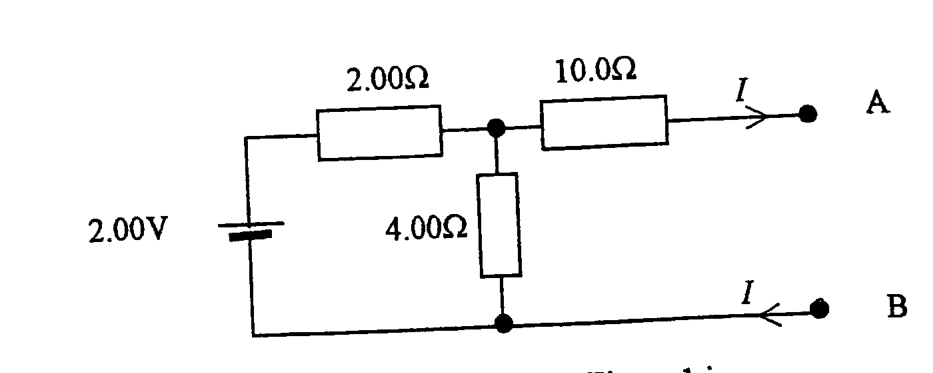 Figura 1.j: circuito con resistori , e , sorgente e terminali ,
(i) la corrente fra e quando e sono cortocircuitati; (ii) la d.d.p. ai capi di a circuito aperto. Se un resistore è collegato a , la corrente è identica a quella di un circuito con sorgente in serie con e una resistenza (teorema di Thévenin). (iii) Una lampada di resistenza è collegata a ; determinare la corrente nella lampada.
- k) La massa e il raggio di Marte sono e , dove è la massa della Terra e il suo raggio. Determinare la velocità di fuga dalla superficie di Marte in funzione del suo valore sulla Terra, .
- l) Due sfere elastiche identiche, ciascuna di massa , sono in quiete su un tavolo liscio e si toccano. Sono colpite simmetricamente da una sfera identica, ma di massa , con velocità , perpendicolare alla linea dei centri delle due sfere stazionarie. La massa si ferma immediatamente dopo l’urto. Determinare il rapporto .
- m) La Figura 1.m mostra un circuito percorso da corrente in cui la corrente si divide per passare attraverso due resistori paralleli e . I resistori formano i bracci verticali della parte rettangolare del circuito di lunghezza e larghezza . La disposizione rettangolare è nel piano di un campo magnetico orizzontale uniforme di densità di flusso prodotto da due espansioni polari. Qual è la coppia sul circuito rettangolare?
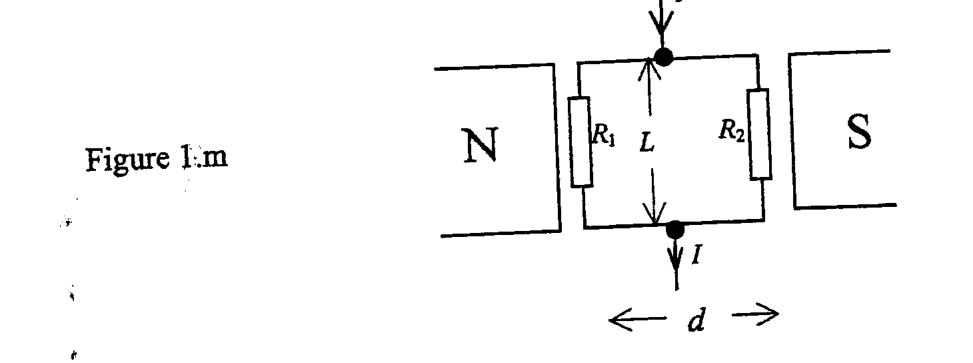 Figura 1.m: circuito rettangolare percorso da corrente, con resistori paralleli e , immerso nel campo magnetico orizzontale tra le espansioni polari N e S
Topic: Newtonian Mechanics, Circuits, Thermodynamics Metodi: Energy Conservation Method, Kirchhoff’s Laws, Dimensional Analysis, Free-Body Diagram, Lorentz Force Analysis Competenze: Diagrammatic Reasoning, Physical Reasoning, Mathematical Modeling Objects: Resistor, Conducting Sphere, Projectile, Sphere, Planet Fonte: Testo (PDF) — p.2
Mandatory question, with brief independent sub-questions:
-
a) An accurate thermometer of heat capacity reads . It is placed in of water, and both reach the same final temperature of . Calculate the initial temperature of the water before inserting the thermometer. The specific heat capacity of water is .
-
b) The voltage in volts across a new material varies with current in amperes according to , from to . Determine the resistance for (i) , (ii) . For a light bulb and an LED: (iii) draw graphs of versus ; (iv) explain the variation in each case.
-
c) (i) Why is there a net attractive force between a charged particle and an isolated neutral copper sphere at a distance? Why does such a force increase if the sphere is grounded? (ii) Why can a ladder be leaned against a rough floor and a smooth wall, but not against a smooth floor and a rough wall? (iii) Why must a hole in a camera obscura not be too small nor too large? (iv) Why does a blue cloth appear dark when observed under sodium light?
-
d) (i) Explain why light can be polarized but sound cannot. How can one experimentally distinguish between partially and completely polarized light? (ii) The equation of a wave with displacement , moving along the axis at time , is given by , where , , and are constants. What are the dimensions or units of , , , and ? Why does this equation represent a wave moving at constant velocity?
-
e) Wet clothes at are hung to dry. The air is at and there is a dry wind. After some time, part of the water has evaporated and the remaining water on the clothes is frozen. The specific latent heat of fusion of ice is and the specific latent heat of vaporization of water is . (i) What is the source of energy required to evaporate the water? Explain the mechanism of evaporation. (ii) Estimate, by mass fraction, the portion of water originally present in the clothes that freezes.
-
f) A bullet leaves a rifle barrel of length with horizontal velocity : (i) calculate the acceleration inside the barrel, assuming it is constant; (ii) if the bullet emerges from the barrel after two complete rotations, estimate its angular velocity in radians per second; (iii) what advantage does a barrel that spins the bullet have? (iv) in practice, acceleration is not constant. Draw a graph of the expected variation of acceleration with distance traveled and explain it.
-
g) (i) A helium balloon has a volume of . What is the maximum mass that can be lifted by the balloon at STP, assuming the balloon’s mass is negligible? (ii) A child, restrained by a seatbelt, travels at constant speed in a bus and holds a vertical string with a helium balloon attached to its end. Explain what happens to the balloon when the bus decelerates and finally comes to a stop.
-
h) The acceleration of a particle, velocity , along a straight line may have the following forms: (i) ; (ii) ; (iii) . Here, is the constant acceleration due to free fall, is velocity, and , , are constants. Draw the graphs in each case, assuming to , for (1) versus ; and (2) versus time .
-
j) For the circuit, determine:
Figure 1.j: circuit with resistors , , and , source , and terminals ,
(i) the current between and when and are short-circuited; (ii) the potential difference across with open circuit. If a resistor is connected across , the current equals that in a circuit with source in series with and resistance (Thévenin’s theorem). (iii) A lamp with resistance is connected across ; determine the current through the lamp.
-
k) The mass and radius of Mars are and , where is the mass of Earth and its radius. Determine the escape velocity from the surface of Mars as a function of its value on Earth, .
-
l) Two identical elastic spheres, each of mass , are at rest on a smooth table and touching each other. They are symmetrically struck by another identical sphere, but of mass , with velocity , perpendicular to the line joining the centers of the two stationary spheres. The mass comes to an immediate stop after the collision. Determine the ratio .
-
m) Figure 1.m shows a current-carrying circuit in which the current splits to pass through two parallel resistors and . The resistors form the vertical arms of the rectangular portion of the circuit, which has length and width . The rectangular arrangement lies in the plane of a horizontal uniform magnetic field with flux density , produced by two polar expansions. What is the torque on the rectangular circuit?
Figure 1.m: rectangular current-carrying circuit with parallel resistors and , immersed in a horizontal magnetic field between the N and S polar expansions
a)
- (i) Ricavare un’espressione per l’accelerazione di gravità a un’altezza sopra la superficie terrestre, , in funzione di (accelerazione di gravità alla superficie) e (raggio della Terra). Assumere che la Terra sia una sfera di densità uniforme.
- (ii) Ripetere il calcolo precedente per un punto sotto la superficie terrestre, a distanza dal centro della Terra.
- (iii) Disegnare un grafico della variazione dell’accelerazione di gravità con la distanza dal centro della Terra.
- (iv) Commentare l’assunzione che la Terra abbia densità uniforme.
b) Un satellite terrestre, in orbita circolare, ha periodo di rotazione di ore. È nel piano dell’equatore terrestre, in moto nello stesso verso di rotazione della Terra.
- (i) Quanto è alto il satellite sopra la superficie terrestre?
- (ii) Calcolare la velocità angolare del satellite relativa a quella della Terra.
- (iii) Determinare l’angolo, misurato attorno al centro della Terra, attraverso cui il satellite sarà visibile a un osservatore all’equatore.
c) Cosa limita il periodo massimo e minimo possibili di un satellite terrestre?
Topic: Gravitation, Newtonian Mechanics Metodi: Newton’s Law of Gravitation, Gauss’s Law, Kinematic Equations Competenze: Mathematical Modeling, Diagrammatic Reasoning Objects: Planet, Satellite Fonte: Testo (PDF) — p.5
a) (i) Derive an expression for the gravitational acceleration at a height above Earth’s surface, , in terms of (gravitational acceleration at the surface) and (Earth’s radius). Assume Earth is a sphere of uniform density. (ii) Repeat the calculation for a point below Earth’s surface, at a distance from Earth’s center. (iii) Draw a graph showing the variation of gravitational acceleration with distance from Earth’s center. (iv) Comment on the assumption that Earth has uniform density.
b) A terrestrial satellite in circular orbit has a rotational period of hours. It lies in the equatorial plane and moves in the same direction as Earth’s rotation. (i) How high is the satellite above Earth’s surface? (ii) Calculate the angular velocity of the satellite relative to that of Earth. (iii) Determine the angle, measured around Earth’s center, through which the satellite is visible to an observer on the equator.
c) What limits the maximum and minimum possible periods of a terrestrial satellite?
Un elemento è radioattivo, con costante di decadimento , e decade nell’elemento . decade, con costante di decadimento , dove , nell’elemento stabile . Al tempo il numero di atomi di è e il numero di atomi di è . è il numero totale di atomi. Il rapporto si può mostrare essere dato da
a) Disegnare un grafico di in funzione di .
b) Ottenere la variazione approssimata di con per: (i) piccolo; (ii) grande.
c) Usando dati sperimentali estesi, da valori misurati di e , come si determinerebbe graficamente: (i) ? (ii) , noto ?
d) Dall’equazione per dedurre la relazione approssimata . Indicare le condizioni in cui è valida.
e) Disegnare l’andamento di , numero di atomi di , in funzione di .
Relazione utile per piccolo:
Topic: Nuclear & Particle Physics Metodi: Radioactive Decay Law, Differential Equations, Approximation & Series Expansion, Graph Linearization Competenze: Graph Linearization, Mathematical Modeling Objects: Nucleus Fonte: Testo (PDF) — p.6
An element is radioactive, with decay constant , and decays into element . Element decays with decay constant into element , which then decays into the stable element . At time , the number of atoms of is and the number of atoms of is . is the total number of atoms. The ratio can be shown to be given by
a) Draw a graph of as a function of .
b) Obtain the approximate variation of with for: (i) small; (ii) large.
c) Using extended experimental data, from measured values of and , how would one determine graphically: (i) ? (ii) , given that is known?
d) From the equation for , deduce the approximate relation . State the conditions under which it is valid.
e) Draw the behavior of , the number of atoms of , as a function of .
Useful relation for small :
a) Una particella, massa , ruota in un cerchio di raggio con velocità costante .
- (i) Determinare il lavoro fatto dalla particella in una rivoluzione.
- (ii) Indicare la forza che agisce sulla particella. Come varia durante il moto?
b) Una particella, massa e carica , entra in un campo magnetico costante diretto lungo . Inizialmente ha componenti di velocità lungo gli assi cartesiani , , pari a , , rispettivamente, ed è all’origine.
- (i) Qual è il modulo della componente iniziale di velocità nel piano -? Scrivere:
- (ii) la sua posizione lungo l’asse al tempo ;
- (iii) il raggio di curvatura in un qualunque piano -.
c)
- (i) Qual è il periodo del moto?
- (ii) Spiegare come si altera il moto se aumenta in modulo.
d) Disegnare i grafici che danno la variazione nel tempo di: (i) spostamenti e ; (ii) componenti di velocità cartesiane e ; (iii) componenti di accelerazione cartesiane e .
e) Come influisce sul moto invertire la direzione di ?
Topic: Magnetism, Newtonian Mechanics Metodi: Lorentz Force Analysis, Vector Decomposition, Simple Harmonic Motion Analysis Competenze: Mathematical Modeling, Diagrammatic Reasoning Objects: Point Charge Fonte: Testo (PDF) — p.7
a) A particle of mass moves in a circle of radius with constant speed .
- (i) Determine the work done by the particle in one revolution.
- (ii) Identify the force acting on the particle. How does it change during motion?
b) A particle of mass and charge enters a constant magnetic field directed along . Initially, its velocity components along the Cartesian axes , , and are equal to , , and respectively, and it is at the origin.
- (i) What is the magnitude of the initial velocity component in the plane –? Write:
- (ii) its position along the axis at time ;
- (iii) the radius of curvature in any plane –.
c)
- (i) What is the period of the motion?
- (ii) Explain how the motion changes if increases in magnitude.
d) Draw graphs showing the time variation of: (i) displacements and ; (ii) Cartesian velocity components and ; (iii) Cartesian acceleration components and .
e) How does reversing the direction of affect the motion?
a) Due sfere isolanti identiche e di raggio hanno densità di carica uniforme, ciascuna con carica negativa totale . I loro centri sono a distanza . L’origine delle coordinate è a metà strada fra i centri. L’asse è lungo la linea dei centri.
- (i) Qual è il potenziale elettrostatico in ?
- (ii) In quali punti lungo l’asse il potenziale è uguale a quello in ?
- (iii) Disegnare la curva equipotenziale elettrostatica di modulo nel piano - e mostrare le sfere sul diagramma.
b)
- (i) Indicare, in un diagramma, il/i punto/i sulla superficie di con il potenziale più alto , e calcolarne il valore.
- (ii) Qual è la “barriera” di potenziale più bassa che deve essere superata da una particella carica positivamente lanciata da per raggiungere ?
- (iii) Qual è la velocità minima con cui uno ione di gas positivo, massa e carica positiva , emesso dalla superficie di , può essere catturato da ?
c) Calcolare la forza che agisce su una particella di carica , massa , sull’asse .
Topic: Electrostatics Metodi: Electric Potential Method, Energy Conservation Method, Symmetry Argument, Coulomb’s Law Competenze: Mathematical Modeling, Diagrammatic Reasoning Objects: Sphere, Point Charge Fonte: Testo (PDF) — p.8
a) Two identical insulating spheres and of radius have uniform charge density, each carrying total negative charge . Their centers are separated by distance . The origin of coordinates lies midway between the centers. The axis is aligned along the line connecting the centers.
- (i) What is the electrostatic potential at point ?
- (ii) At which points along axis is the potential equal to that at point ?
- (iii) Draw the electrostatic equipotential curve of magnitude in the plane – and indicate the spheres on the diagram.
b)
- (i) On a diagram, identify the point(s) on the surface of with the highest potential , and compute its value.
- (ii) What is the lowest potential barrier that a positively charged particle launched from must overcome to reach ?
- (iii) What is the minimum speed with which a positive gas ion, of mass and positive charge , emitted from the surface of , can be captured by ?
c) Calculate the force acting on a particle of charge and mass , located on axis .
Ci sono tre forme di cristallo con struttura reticolare cubica: (i) cubico semplice (SC); (ii) cubico a corpo centrato (BCC); (iii) cubico a facce centrate (FCC). L’SC ha atomi ai vertici del cubo di ogni cella. Il BCC, in più, ha un atomo al centro di ogni cella cubica. L’FCC è un SC con atomi addizionali al centro di ogni faccia di ogni cella cubica. Un atomo condiviso fra più celle cubiche dà solo un contributo frazionario a una singola cella.
a) Determinare il numero di atomi per cella cubica nei casi (i), (ii) e (iii).
b) La lunghezza dei lati della cella cubica è . Determinare per ciascuno dei tre cristalli la distanza fra i centri di due atomi primi vicini e il numero di primi vicini attorno a un qualunque atomo.
c) Le macchie di diffrazione X sono prodotte dai reticoli cristallini, dovute all’interferenza prodotta da strati paralleli di atomi che riflettono i raggi. Il diagramma (Figura 6.1) mostra due strati separati da una distanza . I due raggi paralleli con angolo rispetto al piano degli atomi sono riflessi e interferiscono. (i) Determinare la differenza di cammino fra i due raggi. (ii) Dedurre la condizione di interferenza costruttiva per raggi X di lunghezza d’onda .
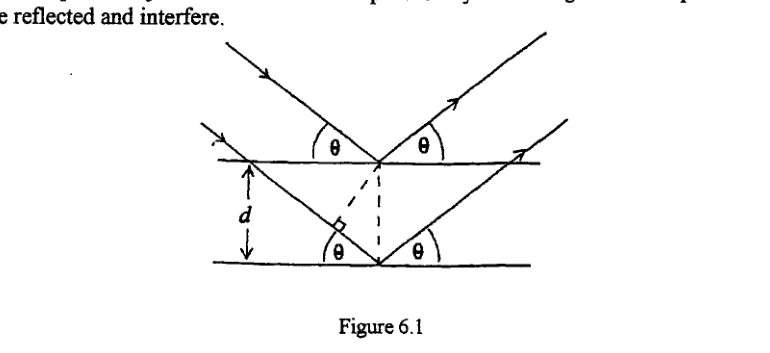 Figura 6.1: due strati di atomi separati da una distanza ; due raggi paralleli incidenti con angolo rispetto ai piani sono riflessi e interferiscono
d) Raggi X di lunghezza d’onda incidono sui piani di atomi paralleli a una faccia delle celle cubiche di un reticolo SC con . Mentre aumenta da , la prima macchia di diffrazione appare a e la macchia di ordine più alto a . Determinare e .
Topic: Wave Optics, Elasticity & Materials Metodi: Interference & Diffraction Analysis, Symmetry Argument Competenze: Mathematical Modeling, Physical Reasoning Objects: Atom Fonte: Testo (PDF) — p.9
There are three crystal forms with cubic lattice structure: (i) simple cubic (SC); (ii) body-centered cubic (BCC); (iii) face-centered cubic (FCC). The SC has atoms at the vertices of each cube cell. The BCC, in addition, has one atom at the center of each cubic cell. The FCC is an SC with additional atoms located at the centers of each face of every cubic cell. An atom shared among multiple cubic cells contributes only a fractional part to any single cell.
a) Determine the number of atoms per cubic cell in cases (i), (ii), and (iii).
b) The side length of the cubic cell is . Determine for each of the three crystals: (i) the distance between centers of two nearest neighboring atoms, and (ii) the number of nearest neighbors surrounding any given atom.
c) X-ray diffraction spots are produced by crystal lattices due to interference caused by parallel atomic layers reflecting the X-rays. The diagram (Figure 6.1) shows two such layers separated by a distance . Two parallel incident rays at angle relative to the atomic plane are reflected and interfere. (i) Determine the path difference between the two rays. (ii) Derive the condition for constructive interference of X-rays with wavelength .
Figure 6.1: two atomic layers separated by distance ; two parallel incident rays at angle relative to the planes are reflected and interfere
d) X-rays with wavelength are incident on parallel atomic planes perpendicular to a face of the cubic unit cells of a simple cubic (SC) lattice with . As increases from , the first diffraction spot appears at and the highest-order spot appears at . Determine and .
a) L’energia relativistica di un elettrone con quantità di moto è data da
- (i) Cosa si intende per energia a riposo dell’elettrone?
- (ii) Dedurre un’espressione per l’energia cinetica dell’elettrone.
b) Un fotone di frequenza è diffuso di un angolo di da un elettrone inizialmente stazionario. Dopo l’urto il fotone ha frequenza . L’elettrone acquista quantità di moto relativistica diretta a un angolo rispetto al fotone incidente.
- (i) Scrivere le equazioni di conservazione per questo urto.
- (ii) Dimostrare che (La quantità di moto di un fotone, frequenza , è .)
c) Cosa si può dedurre su , e quando ?
Relazione utile: .
Topic: Special Relativity, Modern-Quantum Physics Metodi: Relativistic Energy-Momentum, Conservation of Momentum, Photon Energy Relation, Approximation & Series Expansion Competenze: Mathematical Modeling, Physical Reasoning Objects: Photon, Electron Fonte: Testo (PDF) — p.10
a) The relativistic energy of an electron with momentum is given by
- (i) What is meant by the rest energy of the electron?
- (ii) Derive an expression for the kinetic energy of the electron.
b) A photon of frequency is scattered at an angle of by an electron initially at rest. After the collision, the photon has frequency . The electron acquires relativistic momentum directed at an angle relative to the incident photon.
- (i) Write down the conservation equations for this collision.
- (ii) Prove that (The momentum of a photon, frequency , is .)
c) What can be deduced about , and when ?
Useful relation: .
a)
- (i) La Figura 8.1 è una fotografia del recente transito di Venere. Il pianeta Venere è mostrato mentre attraversa la faccia del Sole. Determinare, per misurazione, il rapporto dell’area fotografica della faccia piena del Sole a quella prodotta da Venere. Indicare l’accuratezza del risultato.
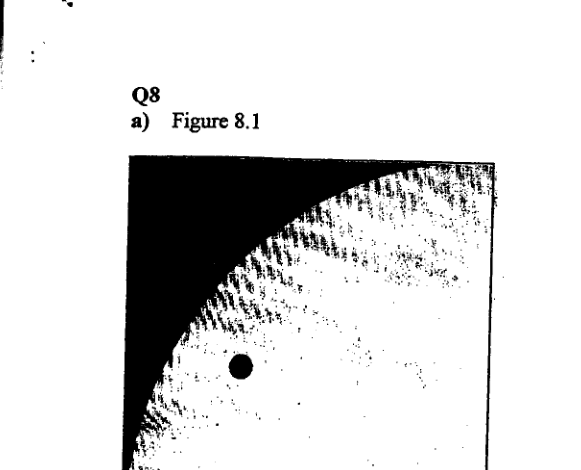 Figura 8.1: fotografia del transito di Venere, mostrato come piccolo disco scuro mentre attraversa la faccia del Sole
- (ii) Calcolare , con l’accuratezza associata, usando i dati della Tabella 8.1.
| Corpo | Raggio/m | Periodo orbitale (attorno al Sole)/s | Distanza dal Sole/m |
|---|---|---|---|
| Sole | |||
| Venere | |||
| Terra |
b) Assumere che le orbite di Terra e Venere siano complanari.
- (i) Determinare l’intervallo, in anni, fra transiti successivi usando i dati della Tabella 8.1. Commentare il risultato alla luce delle osservazioni astronomiche.
- (ii) Calcolare il tempo di transito affinché Venere completi un diametro del Sole.
c) Nel XVIII secolo il transito di Venere fu osservato usando due telescopi separati all’incirca dal diametro della Terra. Ciò permise di determinare la distanza fra Venere e la Terra. La Figura 8.2 illustra la disposizione più semplice dei telescopi.
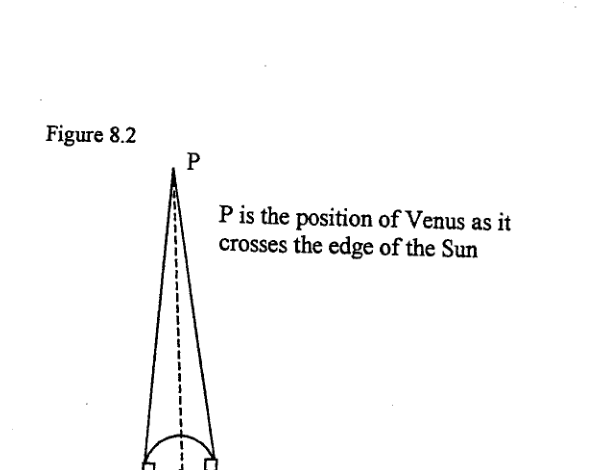 Figura 8.2: punto P, posizione di Venere al bordo del Sole, osservato da due telescopi posti su punti diversi della Terra
- (i) Qual è l’angolo fra i telescopi?
- (ii) Perché era essenziale che entrambi i telescopi osservassero il punto in cui l’immagine di Venere toccava quella del bordo del Sole?
- (iii) Quali erano le difficoltà associate al cronometrare le misure?
d) Calcolare la più piccola componente di velocità , perpendicolare alla sua orbita, richiesta a Venere affinché il transito successivo atteso non avvenga.
Topic: Astrophysics, Gravitation Metodi: Kepler’s Laws, Order-of-Magnitude Estimation, Experimental Data Analysis Competenze: Experimental Data Analysis, Estimation & Approximation, Measurement & Instrumentation Objects: Planet, Star Fonte: Testo (PDF) — p.11
a)
- (i) Figure 8.1 is a photograph of the recent transit of Venus. The planet Venus is shown crossing the face of the Sun. Determine, by measurement, the ratio of the photographic area of the full face of the Sun to that covered by Venus. State the accuracy of your result.
Figure 8.1: photograph of the transit of Venus, shown as a small dark disk crossing the face of the Sun
- (ii) Calculate , with the associated accuracy, using the data from Table 8.1.
| Body | Radius/m | Orbital period (around the Sun)/s | Distance from the Sun/m |
|---|---|---|---|
| Sun | |||
| Venus | |||
| Earth |
b) Assume that the orbits of Earth and Venus are coplanar.
- (i) Determine, in years, the interval between successive transits using data from Table 8.1. Comment on your result in light of astronomical observations.
- (ii) Calculate the duration of transit, i.e., the time required for Venus to cross a diameter of the Sun.
c) In the 18th century, the transit of Venus was observed using two telescopes separated by approximately the diameter of Earth. This allowed determination of the distance between Venus and Earth. Figure 8.2 illustrates the simplest arrangement of the telescopes.
Figure 8.2: point P, position of Venus at the edge of the Sun, observed from two telescopes located at different points on Earth
- (i) What is the angle between the telescopes?
- (ii) Why was it essential that both telescopes observed the point where Venus’s image touched that of the Sun’s edge?
- (iii) What were the difficulties associated with timing the measurements?
d) Calculate the smallest component of velocity , perpendicular to its orbit, required for Venus such that the expected next transit does not occur.
a) Il circuito di Figura 9.1 consiste di cinque resistori, con resistenze e . La corrente entra in . Scegliendo valori appropriati di e nell’intervallo da zero a infinito, ridurre il circuito ai seguenti, indicando i valori di e e dando un diagramma circuitale:
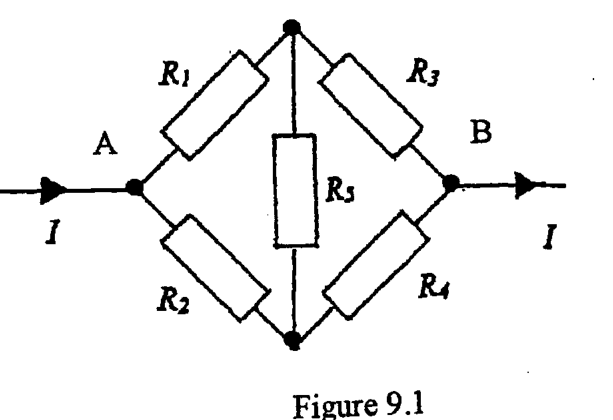 Figura 9.1: rete a ponte di cinque resistori , con corrente che entra in ed esce da
- (i) tre resistori in serie;
- (ii) tre resistori in parallelo fra loro;
- (iii) due resistori uguali in parallelo.
b) Per ciascuna rete in (a) calcolare: (1) la resistenza totale fra e ; (2) la potenza dissipata in .
c) La rete di Figura 9.2 consiste di otto resistori ciascuno di resistenza .
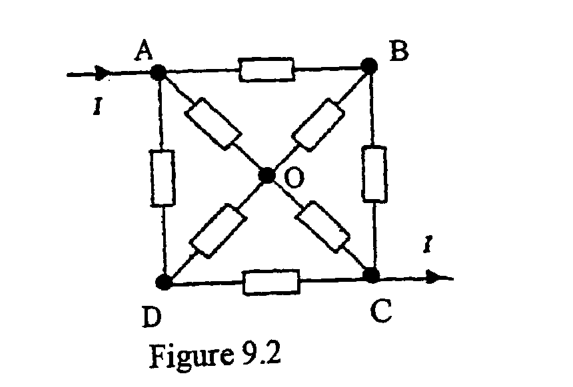 Figura 9.2: rete di otto resistori uguali di resistenza , con vertici e centro ; la corrente entra in ed esce da
- (i) Spiegare perché e sono allo stesso potenziale.
- (ii) Determinare la resistenza totale fra e .
Topic: Circuits Metodi: Kirchhoff’s Laws, Equivalent Circuit Reduction, Symmetry Argument Competenze: Diagrammatic Reasoning, Mathematical Modeling Objects: Resistor Fonte: Testo (PDF) — p.12
a) The circuit in Figure 9.1 consists of five resistors with resistances and . Current enters at . By choosing appropriate values of and in the range from zero to infinity, reduce the circuit to the following cases, indicating the values of and and providing a circuit diagram:
Figure 9.1: bridge network of five resistors , with current entering at and exiting at
- (i) three resistors in series;
- (ii) three resistors in parallel with each other;
- (iii) two equal resistors in parallel.
b) For each network in (a), calculate: (1) the total resistance between and ; (2) the power dissipated in .
c) The circuit in Figure 9.2 consists of eight resistors, each with resistance .
Figure 9.2: network of eight identical resistors with resistance , vertices and center ; current enters at and exits at
- (i) Explain why and are at the same potential.
- (ii) Determine the total resistance between and .