Domanda compulsoria, con brevi quesiti indipendenti:
- a) Una palla da cricket di massa è lanciata verticalmente verso l’alto con velocità iniziale . Se raggiunge un’altezza massima di , determinare la percentuale di perdita di energia causata dalla resistenza dell’aria.
- b) Un terremoto al largo di Sumatra, Indonesia, in produce onde meccaniche P e S che viaggiano nel mantello terrestre a velocità rispettive e . Se l’onda S arriva alla stazione costiera , attraverso l’Oceano Indiano vicino a Mombasa, Kenya, dopo l’onda P, determinare: (i) la distanza di da ; (ii) il tempo impiegato da uno tsunami, prodotto dal terremoto, ad arrivare a se viaggia a ; (iii) su quale principio si potrebbe basare un sistema di allerta tsunami?
- c) Una classe di studenti ha determinato ciascuno un valore di con un pendolo semplice: . (i) Qual è la stima migliore di ? (ii) Stimare l’accuratezza, basandosi sulla deviazione dal valore migliore di in (i).
- d) Un uomo in una barca, che galleggia su uno stagno di area , ha con sé un masso di pietra di massa e densità , e un blocco di legname di massa e densità . L’acqua ha densità . Di quanto cambia il livello dell’acqua nello stagno se getta nello stagno: (i) il masso? (ii) il blocco di legname? Dare una spiegazione completa in ciascun caso.
- e) Un recipiente cilindrico aperto, raggio , contiene acqua di densità . Ha un foro alla base collegato a un tubo orizzontale di uscita. Il recipiente è sospeso da una molla, costante elastica , a una distanza verticale dalla superficie dell’acqua. Mentre l’acqua defluisce dal recipiente, quale valore di è richiesto per mantenere la superficie dell’acqua alla distanza iniziale sotto il supporto?
recipiente cilindrico con molla e uscita
- f) Un veicolo viaggia a lungo una strada rettilinea, senza slittamento. Quali sono le velocità ai “punti cardinali” , , , del bordo della ruota?
- g) Una sorgente pulsata di microonde produce raffiche di radiazione a . Ogni raffica ha durata di . Un riflettore parabolico, raggio , è usato per produrre un fascio parallelo. La potenza media in uscita di ogni impulso è . Determinare: (i) la lunghezza d’onda ; (ii) l’energia totale di ogni impulso; (iii) la densità di energia propagata dal riflettore; (iv) la densità di quantità di moto propagata dal riflettore.
- h) Un’accelerazione orizzontale costante è applicata a una scatola, inizialmente in quiete, di massa per . La sua velocità finale è . Quale forza è richiesta? La scatola è mantenuta a questa velocità costante su una pista priva di attrito mentre un flusso verticale continuo di sabbia è depositato su di essa a un tasso di , impattando a . Determinare la forza verticale sulla scatola dovuta alla sabbia che cade e la forza orizzontale richiesta per mantenere la velocità costante della scatola.
- j) Nel circuito di Figura 1.j tutti i resistori hanno resistenza e le celle hanno emf . Calcolare la corrente che scorre attraverso ciascuna cella.
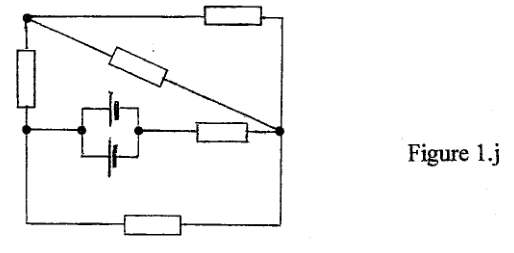 circuito con celle e resistori
- k) [Tabella 1.k] Determinare l’energia liberata quando un nucleo di deuterio e uno di tritio sono fusi a dare un neutrone e un nucleo di elio . Masse: , , , ; .
- l) Una sbarra metallica a forma di U rovesciata, di resistenza elettrica trascurabile, è eretta in un piano verticale su un banco. Una sbarra orizzontale , lunghezza pari alla distanza fra i bracci della U, massa e resistenza elettrica , può scorrere liberamente lungo i bracci della U. Un campo magnetico omogeneo di densità di flusso è perpendicolare al piano della U. (i) Se la sbarra orizzontale cade da ferma, sotto gravità, raggiungerà una velocità limite. Spiegare perché. (ii) Calcolare il modulo e la direzione della corrente prodotta dopo che è raggiunta la velocità limite della sbarra. (iii) Considerando il moto terminale durante un piccolo intervallo di tempo , mostrare che la perdita di energia potenziale gravitazionale è uguale al calore dissipato.
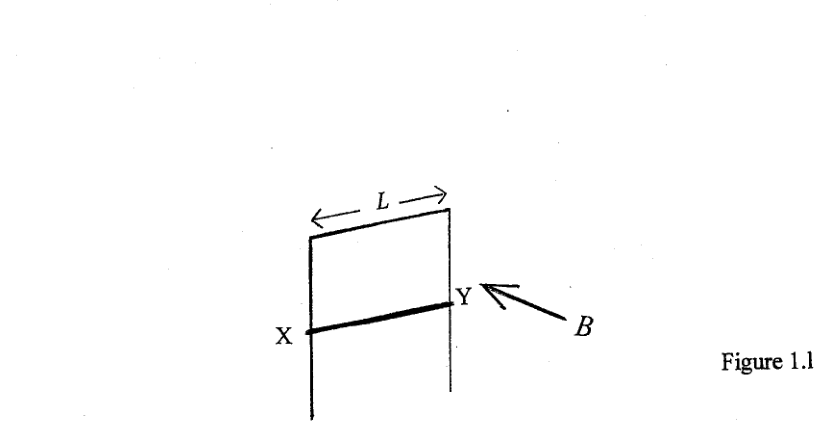 sbarra XY su guida a U in campo B
- m) Una sorgente di suono, che emette una nota di frequenza , parte da un osservatore stazionario e viaggia direttamente verso una parete a velocità . La velocità del suono è ; è molto minore di . Ricavare un’espressione per la frequenza ricevuta dall’osservatore stazionario: (i) direttamente dalla sorgente; (ii) dopo riflessione dalla parete; (iii) determinare il valore di , piccolo rispetto a , se l’osservatore rileva una frequenza di battimento di .
- n) Le abbondanze attuali degli isotopi e sono nel rapporto . Hanno emivite rispettive di e anni. Stimare l’età della Terra assumendo che quantità uguali di ciascun isotopo esistessero alla formazione della Terra.
Topic: Newtonian Mechanics, Electromagnetic Induction, Nuclear & Particle Physics Metodi: Energy Conservation Method, Impulse-Momentum Theorem, Faraday’s Law of Induction, Radioactive Decay Law Competenze: Experimental Data Analysis, Physical Reasoning, Estimation & Approximation Objects: Ball, Pendulum, Spring, Wheel, Resistor Fonte: Testo (PDF) — p.2
Compulsory question, with short independent sub-questions:
- a) A cricket ball of mass is thrown vertically upward with initial speed . If it reaches a maximum height of , determine the percentage of energy loss caused by air resistance.
- b) An earthquake off the coast of Sumatra, Indonesia, in produces P and S mechanical waves that travel in the Earth’s mantle at respective speeds and . If the S wave arrives at the coastal station , across the Indian Ocean near Mombasa, Kenya, after the P wave, determine: (i) the distance from to ; (ii) the time taken by a tsunami, produced by the earthquake, to arrive at if it travels at ; (iii) on what principle a tsunami warning system could be based?
- c) A class of students each determined a value of with a simple pendulum: . (i) What is the best estimate of ? (ii) Estimate the accuracy, based on the deviation from the best value of in (i).
- d) A man in a boat, floating on a pond of area , has with him a stone boulder of mass and density , and a block of wood of mass and density . The water has density . By how much does the water level in the pond change if he throws into the pond: (i) the boulder? (ii) the block of wood? Give a complete explanation in each case. e) An open cylindrical container, radius , contains water of density . It has a hole at the base connected to a horizontal outlet tube. The container is suspended by a spring, spring constant , at a vertical distance from the water surface. As water flows out of the container, what value of is required to keep the water surface at the initial distance below the support?
vertical cylindrical container with spring and outlet tube
- f) A vehicle travels at along a straight road without slipping. What are the velocities at the “cardinal points” , , , on the rim of the wheel?
- g) A pulsed microwave source produces bursts of radiation at . Each burst lasts for . A parabolic reflector of radius is used to produce a parallel beam. The average output power of each pulse is . Determine: (i) the wavelength ; (ii) the total energy of each pulse; (iii) the energy density propagated by the reflector; (iv) the momentum density propagated by the reflector.
- h) A constant horizontal acceleration is applied to a box initially at rest, of mass for . Its final velocity is . What force is required? The box is maintained at this constant velocity on a frictionless track while a continuous vertical flow of sand is deposited onto it at a rate of , impacting at . Determine the vertical force on the box due to the falling sand and the horizontal force required to maintain constant velocity of the box.
- j) In the circuit shown in Figure 1.j, all resistors have resistance and the cells have electromotive force (emf) . Calculate the current flowing through each cell.
circuit with cells and resistors
-
k) [Table 1.k] Determine the energy released when a deuterium nucleus and a tritium nucleus are fused to produce a neutron and a helium nucleus . Masses: , , , ; .
-
l) A metal U-shaped bar, inverted, with negligible electrical resistance, is mounted vertically on a bench. A horizontal bar , of length equal to the distance between the arms of the U, mass , and electrical resistance , can slide freely along the arms of the U. A uniform magnetic field with flux density is perpendicular to the plane of the U. (i) If the horizontal bar falls from rest under gravity, it will reach a terminal velocity. Explain why. (ii) Calculate the magnitude and direction of the current induced after the terminal velocity of the bar has been reached. (iii) Considering the motion during a small time interval , show that the loss of gravitational potential energy is equal to the heat dissipated.
horizontal bar XY on U-shaped guide in magnetic field B
-
m) A sound source emitting a note of frequency starts from a stationary observer and moves directly toward a wall at speed . The speed of sound is ; is much smaller than . Derive an expression for the frequency received by the stationary observer: (i) directly from the source; (ii) after reflection from the wall; (iii) determine the value of , small compared to , if the observer detects a beat frequency of .
-
n) The current abundances of the isotopes and are in the ratio . Their half-lives are respectively and years. Estimate the age of the Earth assuming equal amounts of each isotope were present at the time of Earth’s formation.
Sei resistori con resistenze, in ohm, di sono collegati come indicato in Figura 2.1.
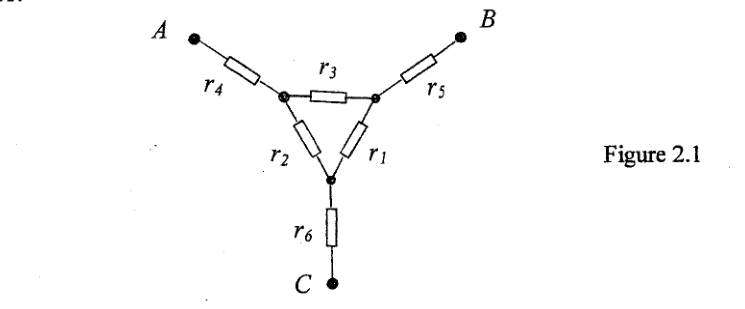 rete a stella sei resistori A B C
a) Se tutte le resistenze hanno valore , determinare la resistenza: (i) ai capi di ; (ii) ai capi di quando è cortocircuitato; (iii) ai capi di quando è cortocircuitato.
b) I resistori in Figura 2.1 hanno resistenze di e ohm, con nessun resistore avente lo stesso valore. Inizialmente tutti i resistori sono non specificati.
- (i) Ottenere un’espressione algebrica per la resistenza ai capi di , come frazione razionale (numeratore e denominatore algebrici).
- (ii) Se , dedurre il valore di .
- (iii) Mostrare che si può esprimere come , dove e sono interi.
- (iv) Valutare per tutti e sei i possibili valori di e dedurre il valore di . Analogamente dedurre i valori di e se e .
- (v) Determinare i possibili valori di e , e quindi e , per .
- (vi) Analogamente ottenere i possibili valori di e per e , e dedurre i valori di , e .
Topic: Circuits Metodi: Kirchhoff’s Laws, Equivalent Circuit Reduction, Symmetry Argument Competenze: Diagrammatic Reasoning, Mathematical Modeling Objects: Resistor Fonte: Testo (PDF) — p.5
Six resistors with resistances in ohms of are connected as indicated in Figure 2.1.
star-shaped six-resistor network A B C
a) If all resistances have value , determine the resistance: (i) across terminals ; (ii) across terminals when is short-circuited; (iii) across terminals when is short-circuited.
b) The resistors in Figure 2.1 have resistances of and ohms, with no resistor having the same value. Initially all resistors are unspecified.
- (i) Obtain an algebraic expression for the resistance across terminals , as a rational fraction (numerator and denominator algebraic).
- (ii) If , deduce the value of .
- (iii) Show that can be expressed as , where and are integers.
- (iv) Evaluate for all six possible values of and deduce the value of . Similarly deduce the values of and if and .
- (v) Determine the possible values of and , and thus and , for .
- (vi) Similarly obtain the possible values of and for and , and deduce the values of , and .
a) Una stella doppia consiste di due stelle, ciascuna con la stessa massa del nostro Sole, , separate da una distanza . Si osserva che compiono una rotazione completa attorno al loro centro di massa in una settimana. Determinare, a due cifre significative, il rapporto , dove è la distanza Sole-Terra, senza assumere il valore numerico di .
b) In questo calcolo la luce può essere considerata come un flusso di particelle, fotoni, ciascuna con massa ed energia , dove è la lunghezza d’onda della luce. Luce con è emessa dalla superficie del Sole, raggio , e ricevuta sulla Terra, raggio , leggermente spostata in lunghezza d’onda di dopo aver percorso una distanza .
- (i) Dare un’espressione algebrica per la variazione di energia potenziale gravitazionale del fotone, .
- (ii) Stimare l’ordine di grandezza relativo di ciascun termine nell’espressione per in (i). Indicare quale/i termine/i può essere trascurato affinché il risultato sia corretto a 2 cifre significative.
- (iii) Calcolare a 2 cifre significative.
(Questi calcoli danno risultati identici a quelli di un calcolo più rigoroso.)
c) Spiegare perché il valore di all’equatore terrestre differisce dal suo valore ai poli. Quale ha il valore maggiore?
Topic: Gravitation, Astrophysics, Newtonian Mechanics Metodi: Kepler’s Laws, Newton’s Law of Gravitation, Energy Conservation Method, Order-of-Magnitude Estimation Competenze: Mathematical Modeling, Estimation & Approximation, Physical Reasoning Objects: Star, Photon, Planet Fonte: Testo (PDF) — p.6
a) A binary star system consists of two stars, each with the same mass as our Sun, , separated by a distance . It is observed that they complete one full revolution around their center of mass in one week. Determine, to two significant figures, the ratio , where is the Earth-Sun distance, without assuming the numerical value of .
b) In this calculation, light may be considered as a stream of particles, photons, each with mass and energy , where is the wavelength of light. Light with wavelength is emitted from the surface of the Sun, radius , and received on Earth, radius , slightly shifted in wavelength by after traveling a distance .
- (i) Give an algebraic expression for the change in gravitational potential energy of the photon, .
- (ii) Estimate the order of magnitude of each term in the expression for given in (i). Indicate which, if any, terms may be neglected so that the result is correct to two significant figures.
- (iii) Calculate to two significant figures.
(These calculations yield results identical to those from a more rigorous calculation.)
c) Explain why the value of at the Earth’s equator differs from its value at the poles. Which has the greater value?
a) Una massa pende da un’estremità di una trave uniforme di lunghezza e massa . L’altra estremità è incernierata a una parete verticale in . Un cavo orizzontale, di massa trascurabile, è attaccato alla trave in un punto a da per tenere la trave in equilibrio a un angolo di con l’orizzontale. Determinare: (i) la tensione nel cavo; (ii) le componenti orizzontale e verticale delle forze della cerniera sulla trave, e rispettivamente.
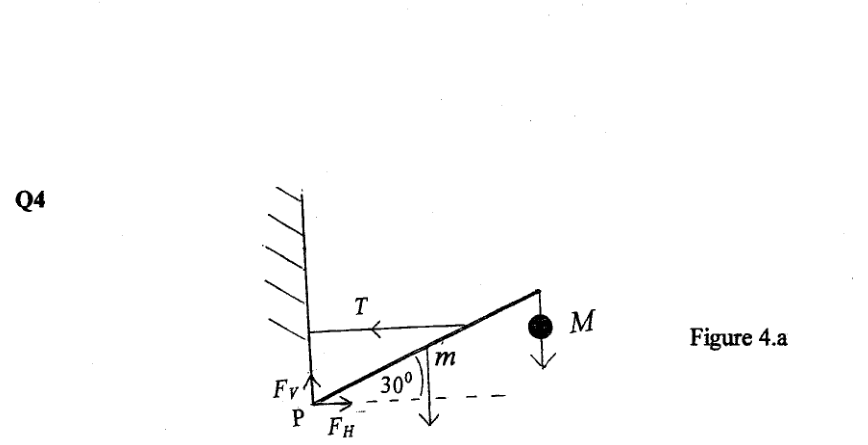 trave incernierata con cavo e massa M
b) Un tiratore a terra in spara il fucile in direzione di un piccione d’argilla stazionario posto su una torre in , ad altezza , a distanza orizzontale da . In quello stesso istante il piccione è rilasciato e cade verticalmente sotto gravità. Verificare che il proiettile colpisce il piccione durante la sua caduta.
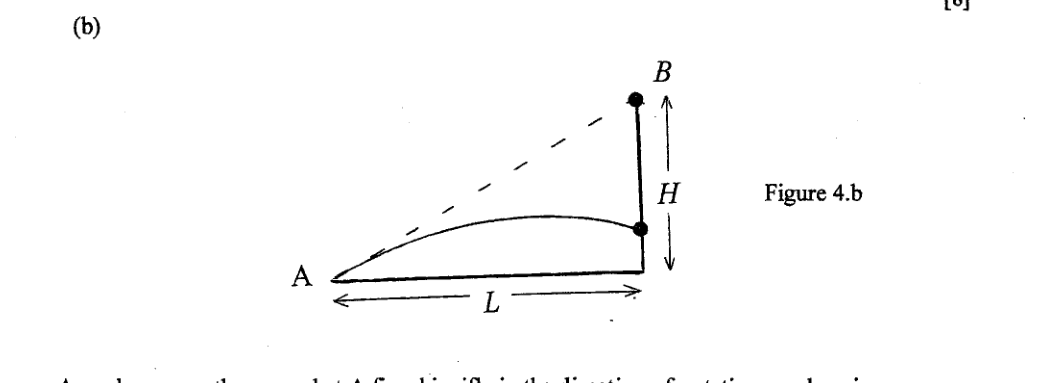 tiratore A piccione torre B geometria
Topic: Newtonian Mechanics, Rigid Body Statics Metodi: Free-Body Diagram, Torque & Angular Momentum Analysis, Kinematic Equations Competenze: Diagrammatic Reasoning, Mathematical Modeling, Physical Reasoning Objects: Beam, String, Projectile Fonte: Testo (PDF) — p.7
a) A mass hangs from one end of a uniform beam of length and mass . The other end is hinged to a vertical wall at . A horizontal, massless cable is attached to the beam at a point from , holding the beam in equilibrium at an angle of with the horizontal.
Determine: (i) the tension in the cable; (ii) the horizontal and vertical components of the hinge force on the beam, and respectively.
Hinged beam with cable and mass M
b) A marksman at ground level located at fires a rifle toward a stationary clay pigeon positioned on a tower at , at height , and horizontal distance from . At the same instant, the clay pigeon is released and falls vertically under gravity. Verify that the bullet strikes the pigeon during its fall.
Marksman A, clay pigeon, tower B geometry
a) Una sfera che viaggia orizzontalmente su un tavolo liscio, con velocità , collide simmetricamente, ed elasticamente, con due sfere stazionarie e che si toccano. Tutte le sfere sono identiche e di massa . Determinare le velocità di tutte le sfere dopo l’urto. ha un’ulteriore collisione con una sfera identica , inizialmente in quiete e a contatto con essa. I centri di , e giacciono su una linea retta. Determinare l’esito di questa collisione.
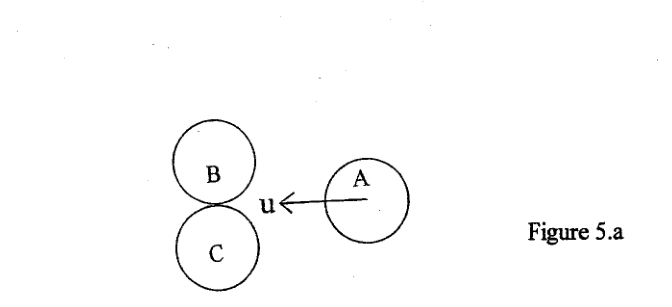 tre sfere A B C collisione
b) Due contenitori cilindrici identici, e , entrambi di volume e capacità termica trascurabile, sono collegati da una valvola , inizialmente chiusa. Il cilindro contiene moli di un gas monoatomico, a temperatura e con calore specifico per mole pari a . È dotato di un pistone inizialmente completamente ritratto. è un cilindro chiuso evacuato. La valvola è aperta e il gas è spinto in premendo il pistone a un tasso tale che la pressione in resta costante. Si ferma dopo essere stato spostato di un volume . La temperatura finale del gas è .
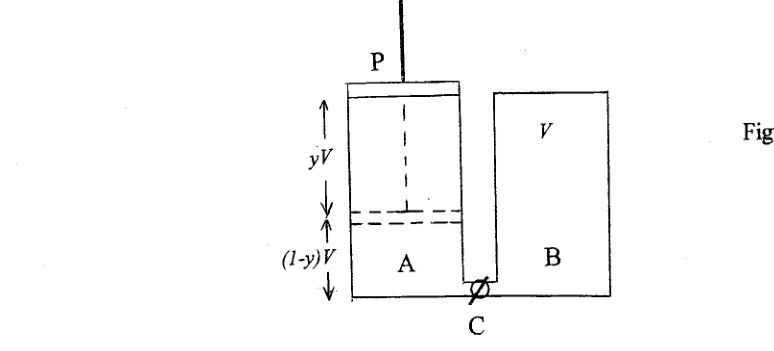 due cilindri A B con pistone P
- (i) Scrivere le equazioni del gas iniziale e finale per il sistema.
- (ii) Determinare il lavoro fatto dal pistone, , e l’energia interna acquisita dal gas, .
- (iii) Dedurre il valore numerico del rapporto .
Topic: Conservation of Momentum, Conservation of Energy, Thermodynamics Metodi: Conservation of Momentum, Conservation of Energy, First Law of Thermodynamics, Ideal Gas Law Competenze: Physical Reasoning, Mathematical Modeling Objects: Sphere, Cylinder, Piston, Gas Fonte: Testo (PDF) — p.8
a) A sphere moving horizontally on a smooth table with velocity undergoes a symmetric, elastic collision with two stationary spheres and that are touching each other. All spheres are identical and have mass . Determine the velocities of all spheres after the collision. Sphere subsequently collides with another identical sphere initially at rest and in contact with it. The centers of spheres , , and lie along a straight line. Determine the outcome of this collision.
three spheres A B C collision
b) Two identical cylindrical containers, and , each with volume and negligible heat capacity, are connected by a valve initially closed. Cylinder contains moles of a monatomic gas at temperature and with molar specific heat equal to . It is equipped with a piston initially fully retracted. Cylinder is a closed, evacuated cylinder. The valve is opened and the gas is pushed into by pushing the piston at a rate such that pressure in remains constant. The process stops after the piston has been displaced by volume . The final temperature of the gas is .
two cylinders A B with piston P
- (i) Write the initial and final gas equations for the system.
- (ii) Determine the work done by the piston, , and the internal energy acquired by the gas, .
- (iii) Deduce the numerical value of the ratio .
In un esperimento per studiare l’effetto fotoelettrico, luce di lunghezza d’onda incide su una superficie metallica e si produce una corrente. La corrente è soppressa fornendo una differenza di potenziale fra la superficie metallica e la piastra collettrice.
a) (i) Ricavare, con spiegazione completa, un’equazione che lega , e il lavoro di estrazione del metallo. (ii) Perché la spiegazione classica dell’effetto fotoelettrico non riesce a spiegare i risultati sperimentali?
b) [Tabella 6.b] I risultati ottenuti nell’esperimento sono nella Tabella 6.b.
| /V | / m |
|---|---|
| 1,0 | 200 |
| 2,0 | 196 |
| 3,0 | 158 |
| 4,0 | 144 |
- (i) Verificare graficamente che i risultati seguono la relazione ricavata in (a)(i).
- (ii) Determinare e dal grafico, specificandone l’accuratezza.
- (iii) Ottenere la frequenza di soglia per l’emissione fotoelettrica.
- (iv) Qual è l’effetto di raddoppiare l’intensità della luce incidente?
Topic: Modern-Quantum Physics Metodi: Photon Energy Relation, Energy Conservation Method, Graph Linearization Competenze: Graph Linearization, Experimental Data Analysis, Error Propagation Objects: Photon Fonte: Testo (PDF) — p.9
In an experiment to study the photoelectric effect, light of wavelength is incident on a metallic surface and produces a current. The current is suppressed by applying a potential difference between the metallic surface and the collecting plate.
a) (i) Derive, with complete explanation, an equation relating , and the work function of the metal. (ii) Why does the classical explanation of the photoelectric effect fail to explain the experimental results?
b) [Table 6.b] The results obtained in the experiment are given in Table 6.b.
| /V | / m |
|---|---|
| 1,0 | 200 |
| 2,0 | 196 |
| 3,0 | 158 |
| 4,0 | 144 |
- (i) Verify graphically that the results follow the relationship derived in (a)(i).
- (ii) Determine and from the graph, specifying their accuracy.
- (iii) Obtain the threshold frequency for photoemission.
- (iv) What is the effect of doubling the intensity of the incident light?
Una sorgente radioattiva contiene una miscela di due sostanze radioattive non correlate, e , con costanti di decadimento e ; ha la costante di decadimento maggiore. Un contatore è efficiente al nel rilevare tutti i decadimenti dei nuclei , ma solo all’ per quelli della sostanza . Al tempo , e producono e conteggi al minuto rispettivamente. I risultati delle misure sperimentali dei conteggi totali sono nella Tabella 7.1.
| Tempo/giorni | Conteggi/min |
|---|---|
| 0,5 | 7000 |
| 2,0 | 620 |
| 5,0 | 142 |
| 9,0 | 76 |
| 15,0 | 28 |
a)
- (i) Scrivere l’equazione per , il numero di conteggi al minuto rilevati dal contatore.
- (ii) Dedurre il comportamento di per grande.
- (iii) Usando (ii) tracciare un grafico opportuno per determinare e .
- (iv) Qual è il numero iniziale di atomi di presenti?
b)
- (i) Estrapolare il grafico per ottenere un valore di al tempo e quindi determinare .
- (ii) Usando il primo risultato sperimentale della Tabella 7.1, determinare .
Topic: Nuclear & Particle Physics Metodi: Radioactive Decay Law, Graph Linearization, Experimental Data Analysis Competenze: Graph Linearization, Experimental Data Analysis, Mathematical Modeling Objects: Nucleus Fonte: Testo (PDF) — p.10
A radioactive source contains a mixture of two unrelated radioactive substances, and , with decay constants and ; has the larger decay constant. A detector is efficient at in detecting all decays of nuclei , but only at for those from substance . At time , and produce and counts per minute, respectively. The results of the experimental measurements of total counts are given in Table 7.1.
| Time/days | Counts/min |
|---|---|
| 0.5 | 7000 |
| 2.0 | 620 |
| 5.0 | 142 |
| 9.0 | 76 |
| 15.0 | 28 |
a) (i) Write the equation for , the number of counts per minute detected by the counter. (ii) Deduce the behavior of for large . (iii) Using (ii), draw an appropriate graph to determine and . (iv) What is the initial number of atoms of present?
b) (i) Extrapolate the graph to obtain a value of at time and thus determine . (ii) Using the first experimental result from Table 7.1, determine .
Due armature conduttrici circolari parallele, distanti , sono in un recipiente sotto vuoto. Le armature sono a una differenza di potenziale di e poste in un campo magnetico costante di densità di flusso parallelo alla superficie delle armature. Una sorgente radioattiva di particelle beta, con energia massima di , è posta, simmetricamente, al centro del gap fra le armature.
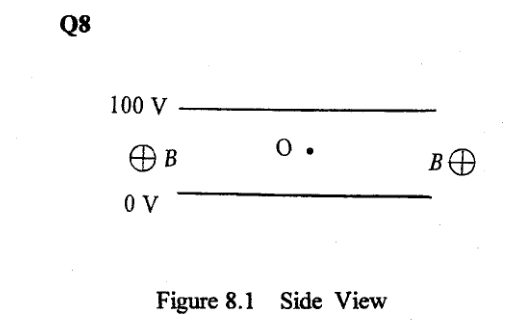 armature parallele vista laterale campo B (Figura 8.1)
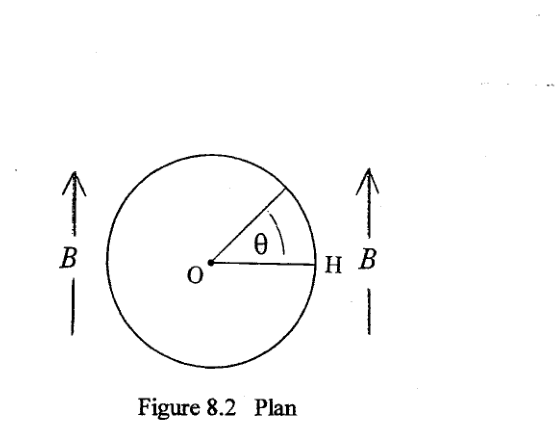 vista in pianta circolare angolo theta (Figura 8.2)
a) Determinare usando la fisica classica: (i) la forza elettrica su una particella beta; (ii) l’ordine di grandezza del rapporto della forza gravitazionale a quella elettrica su una particella beta; (iii) la velocità massima della particella beta in ; (iv) la condizione affinché le particelle beta, che viaggiano nel piano orizzontale attraverso , emergano dalle armature; (v) l’intervallo di velocità delle particelle beta emergenti dalle armature; (vi) l’intervallo angolare di (Figura 8.2) delle particelle beta in (v).
b)
- (i) I calcoli in (a) assumono che le particelle beta non viaggino a velocità relativistiche. Questa assunzione è giustificata? Dare una risposta quantitativa. La massa relativistica degli elettroni è data da , dove è la massa a riposo dell’elettrone e è la velocità dell’elettrone.
- (ii) In che modo l’energia cinetica di un elettrone relativistico differisce da quella di una particella non relativistica?
Topic: Electrostatics, Magnetism, Special Relativity Metodi: Lorentz Force Analysis, Electric Potential Method, Relativistic Energy-Momentum, Order-of-Magnitude Estimation Competenze: Mathematical Modeling, Diagrammatic Reasoning, Physical Reasoning Objects: Capacitor, Electron Fonte: Testo (PDF) — p.11
Two parallel conducting circular plates, separated by a distance , are located inside an evacuated container. The plates are maintained at a potential difference of and placed in a constant magnetic field with flux density , parallel to the surface of the plates. A radioactive source emitting beta particles, with a maximum energy of , is positioned symmetrically at the center of the gap between the plates.
Parallel plates, side view with magnetic field B (Figure 8.1)
Top view, circular geometry with angle theta (Figure 8.2)
a) Determine using classical physics: (i) the electric force on a beta particle; (ii) the order of magnitude of the ratio between the gravitational force and the electric force on a beta particle; (iii) the maximum speed of the beta particle in ; (iv) the condition for beta particles traveling in the horizontal plane through to emerge from the plates; (v) the range of speeds of beta particles emerging from the plates; (vi) the angular interval of (Figure 8.2) for beta particles in (v).
b) (i) The calculations in (a) assume that beta particles do not travel at relativistic speeds. Is this assumption justified? Provide a quantitative answer. The relativistic mass of electrons is given by , where is the rest mass of the electron and is the velocity of the electron. (ii) How does the kinetic energy of a relativistic electron differ from that of a non-relativistic particle?