(a) A glass block measures 5.0 cm × 5.0 cm × 8.0 cm. When the block stands on one of its smaller faces, and viewed directly from above, it appears to be a cube. Determine the refractive index of the block. [2]
(b) A plane, inclined, mirror lies at the bottom of a long flat bottomed tank containing water. The mirror makes an angle of 10° with the horizontal (Figure 2.b). A narrow beam of monochromatic light falls on the surface of the water at an angle of incidence . If the refractive index of water is , determine the maximum value of for which light, after reflection from the mirror, would emerge from the upper surface of the water. The angle SCO is indicated by . OX is normal to the mirror. [6]
(c) Figure 2.c shows the cross-section of a glass prism, refractive index , with the angles indicated showing a light ray passing through it. OS is perpendicular to EF.
(i) Express angle BOC in terms of .
(ii) Determine the angle in terms of .
(iii) For what value of is ? What condition does this impose on if total internal reflection occurs at O?
(iv) What is the angle between the incident and emergent rays when ? [10]
(d) Why, at night, are the images of lights reflected from a river elongated? [2]
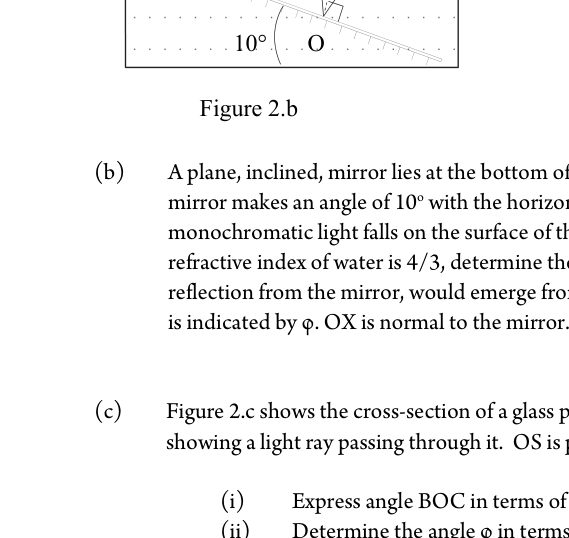 Inclined mirror in water tank
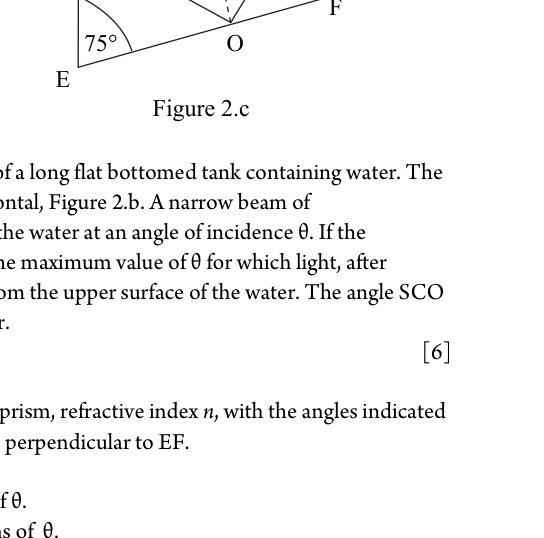 Glass prism cross-section ray path
Topic: Geometric Optics Metodi: Snell’s Law, Ray Tracing, Thin Lens & Mirror Equation Competenze: Diagrammatic Reasoning, Physical Reasoning Objects: Mirror, Prism Fonte: Testo (PDF) — p.2
**(a) ** Un blocco di vetro misura 5,0 cm × 5,0 cm × 8,0 cm. Quando il blocco si trova su una delle sue facce più piccole, e visto direttamente dall’alto, sembra essere un cubo. Determinare l’indice di rifrazione del blocco. [2]
**(b) ** Un piano, inclinato, specchio si trova al fondo di un lungo serbatoio a fondo piatto contenente acqua. Lo specchio fa un angolo di 10° con l’orizzontale (Figura 2.b). Un raggio stretto di luce monocromatica cade sulla superficie dell’acqua ad un angolo di incidenza . Se l’indice di rifrazione dell’acqua è , determinare il valore massimo di per il quale la luce, dopo il riflesso dallo specchio, emergerà dalla superficie superiore dell’acqua. L’angolo SCO è indicato da . L’OX è normale per lo specchio. [6]
**(c) ** La figura 2.c mostra la sezione trasversale di un prisma di vetro, indice di rifrazione , con gli angoli indicati che mostrano un raggio di luce che lo attraversa. OS è perpendicolare a EF.
(i) Angolo espresso BOC in termini di .
(ii) Determinare l’angolo in termini di .
(iii) Per quale valore di è ? Qual è la condizione che questo impone a se la riflessione interna totale si verifica a O?
(iv) Qual è l’angolo tra il raggi incidentale e quelli emergenti quando ? [10]
Perché, di notte, le immagini di luci riflesse da un fiume sono allungate? [2]
L’ospetto inclinato nel serbatoio d’acqua
Cosco di raggi di sezione trasversale del prisma di vetro
Topic: Geometric Optics Metodi: Snell’s Law, Ray Tracing, Thin Lens & Mirror Equation Competenze: Diagrammatic Reasoning, Physical Reasoning Objects: Mirror, Prism Fonte: Testo (PDF) — p.2
(a) The ends of a uniform wire of cross-sectional area m² and negligible mass are attached to fixed points A and B which are 1.00 m apart, in the same horizontal line. The wire is initially straight and unstretched. A mass of 0.50 kg is attached to the mid-point of the wire and hangs in equilibrium with the mid-point at a distance of 10 mm below AB. Calculate the Young’s modulus for the wire. [10]
(b) A man, mass 90 kg, begins to climb a 4.0 m ladder of mass 10 kg. The ladder rests against a wall at A. The foot of the ladder, B, is 2.0 m from the wall.
(i) Draw a diagram indicating all the forces present in terms of their vertical and horizontal components using the notation , , and for components at A and B; the vertical components have subscripts V and the horizontal components have subscripts H.
(ii) What conditions must be satisfied by the forces, and the moment of the forces about A, if the man is to climb a distance up the ladder when it is against a smooth wall?
(iii) If the man is to climb to the top of the ladder, what is the minimum value of the coefficient of friction, , required on the ground? [10]
Topic: Elasticity & Materials, Rigid Body Statics Metodi: Stress-Strain Analysis, Free-Body Diagram, Torque & Angular Momentum Analysis Competenze: Diagrammatic Reasoning, Mathematical Modeling Objects: Wire, Rod Fonte: Testo (PDF) — p.3
**(a) ** Le estremità di un filo uniforme di superficie trasversale m2 e di massa trascurabile sono fissate ai punti fissi A e B, separati di 1,00 m, nella stessa linea orizzontale. Il filo è inizialmente retto e non esteso. Una massa di 0,50 kg è attaccata al punto medio del filo e si trova in equilibrio con il punto medio a una distanza di 10 mm sotto AB. Calcola il modulo del Young per il filo. [10]
Un uomo di massa 90 kg inizia a salire una scala di 4,0 m di massa 10 kg. La scala si appoggia a un muro a A. Il piede della scala, B, è a 2,0 m dal muro.
(i) Disegnare un diagramma che indichi tutte le forze presenti in termini di componenti verticali e orizzontali utilizzando la notazione , , e per i componenti di A e B; i componenti verticali hanno sottoscrizioni V e i componenti orizzontali hanno sottoscrizioni H.
(ii) Quali condizioni devono essere soddisfatte dalle forze e dal momento delle forze intorno a A, se l’uomo deve salire una distanza su la scala quando si trova contro un muro liscio?
(iii) Se l’uomo deve salire in cima alla scala, qual è il valore minimo del coefficiente di attrito, , richiesto sul terreno? [10]
Topic: Elasticity & Materials, Rigid Body Statics Metodi: Stress-Strain Analysis, Free-Body Diagram, Torque & Angular Momentum Analysis Competenze: Diagrammatic Reasoning, Mathematical Modeling Objects: Wire, Rod Fonte: Testo (PDF) — p.3
A weight of mass hangs from the end of a light vertical spring that is attached, at its upper end, to a rigid support. When in equilibrium the spring has an extension . The natural angular frequency of the system is .
(i) Determine in terms of . [2]
(ii) The mass vibrates about its equilibrium position, the spring having an extension at time . Obtain an expression for the total potential energy, , of the system. The zero of the gravitational potential energy of the mass is to be taken at the equilibrium extension, . [3]
(iii) If the amplitude of the motion is , determine the maximum kinetic energy, , of the mass and the total energy, , of the system. [2]
(iv) The mass collides elastically with a stationary body of mass at . Determine the new velocity, , after the collision and amplitude, , of the motion of the mass . [5]
(v) If in (iv) the masses coalesce, determine the new equilibrium position, , and the new amplitude, , in terms of . [8]
Topic: Oscillations & Waves, Conservation of Momentum, Conservation of Energy Metodi: Simple Harmonic Motion Analysis, Conservation of Momentum, Conservation of Energy, Energy Conservation Method Competenze: Mathematical Modeling, Physical Reasoning Objects: Spring, Block Fonte: Testo (PDF) — p.4
Un peso di massa è appeso all’estremità di una leggera molla verticale che è collegata, nella sua parte superiore, a un supporto rigido. Quando è in equilibrio, la molla ha un’estensione . La frequenza angolare naturale del sistema è .
(i) Determina in termini di . [2]
(ii) La massa vibra circa la sua posizione di equilibrio, la molla con un’estensione al tempo . Ottenere un’espressione per l’energia potenziale totale, , del sistema. La forza di gravità della massa deve essere calcolata al punto zero dell’estensione di equilibrio, . [3]
(iii) Se l’ampiezza del movimento è , determinare l’energia cinetica massima, , della massa e l’energia totale, , del sistema. [2]
(iv) La massa colpisce elasticamente con un corpo stazionario di massa a . Determinare la nuova velocità, , dopo la collisione e l’ampiezza, , del movimento della massa . [5]
(v) Se nelle lettere (iv) le masse si fondono, determinare la nuova posizione di equilibrio, , e la nuova amplitudine, , in termini di . [8]
Topic: Oscillations & Waves, Conservation of Momentum, Conservation of Energy Metodi: Simple Harmonic Motion Analysis, Conservation of Momentum, Conservation of Energy, Energy Conservation Method Competenze: Mathematical Modeling, Physical Reasoning Objects: Spring, Block Fonte: Testo (PDF) — p.4
(a) Two capacitors, of capacitance F and F, are each given a charge of C. The positive plates are now connected together, as are the negative plates. Calculate:
(i) the new potential difference between the plates of the capacitors
(ii) the change in energy. Explain this energy change. [6]
(b) All the resistors in the circuit in Figure 5.b have resistance . The potential difference across AB is and the currents in the arms are , as indicated.
(i) How are the currents altered if is reversed? Give the relations between the currents by comparing the circuits in the two situations; and .
(ii) Deduce the currents in terms of and .
(iii) Determine the resistance across AB. [7]
(c) The circuit in Figure 5.c has a capacitor C, with capacitance F, a diode and a resistor . It is used to rectify an a.c. supply of frequency 50 Hz and peak to peak voltage of 20 V. can have the values of or . In each case:
(i) determine the time constant for the circuit
(ii) sketch the voltage waveforms across
If the a.c. supply is replaced by a square wave supply of the same frequency and amplitude, determine the greatest fractional change in the voltage across for the circuit with the resistor. [7]
 Six-resistor bridge circuit AB
 Half-wave rectifier RC circuit
Topic: Circuits, Electrostatics Metodi: Kirchhoff’s Laws, Equivalent Circuit Reduction, Conservation of Energy Competenze: Mathematical Modeling, Physical Reasoning Objects: Capacitor, Resistor Fonte: Testo (PDF) — p.5
**(a) ** Due condensatori, di capacità F e F, hanno ciascuna una carica di C. Le placche positive sono ora collegate tra loro, così come le placche negative. Calcola:
-
la nuova differenza di potenziale tra le piastre dei condensatori
-
la variazione dell’energia. Spiega questo cambiamento di energia. [6]
**(b) ** Tutte le resistenze del circuito di cui alla figura 5.b hanno resistenza . La differenza potenziale tra AB è e le correnti nei bracci sono , come indicato.
(i) Come si alterano le correnti se viene invertito? Date le relazioni tra le correnti confrontando i circuiti nelle due situazioni; e .
- Riduzione delle correnti in termini di e .
(iii) Determinare la resistenza in AB. [7]
**(c) ** Il circuito di cui alla figura 5.c ha un condensatore C, con capacità F, un diodo e una resistenza . È usato per rettificare un a.c. una corrente di frequenza 50 Hz e una tensione di picco a picco di 20 V. può avere i valori di o . In ogni caso:
-
determinare la costante temporale del circuito
-
disegnare le forme d’onda di tensione su
Se l’ aria condizionata la fornitura è sostituita da una fornitura a onde quadrate della stessa frequenza e amplitudine, determinare la maggiore variazione frazionaria della tensione attraverso per il circuito con resistore . [7]
Circuito di ponte a sei resistori AB
*circuito RC del retticatore a mezza onda *
Topic: Circuits, Electrostatics Metodi: Kirchhoff’s Laws, Equivalent Circuit Reduction, Conservation of Energy Competenze: Mathematical Modeling, Physical Reasoning Objects: Capacitor, Resistor Fonte: Testo (PDF) — p.5
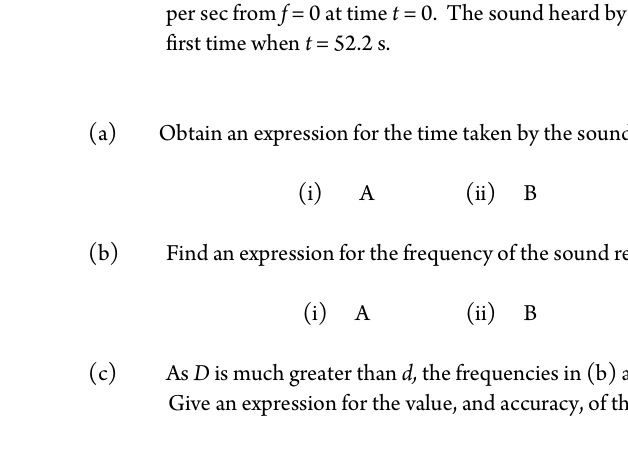
Two loud speakers, A and B, are mounted at ground level, a distance cm apart, and are connected in parallel to the output of an amplifier, which is fed from a variable frequency oscillator. An observer, also at ground level, stands at a point R that is 1.20 km from the line joining the loud speakers and 1.20 km from the perpendicular bisector of AB at O. , Figure 6.1. The oscillator is adjusted so that its frequency, , rises linearly with time, at 10 Hz per sec from at time . The sound heard by the observer drops to a minimum for the first time when s.
(a) Obtain an expression for the time taken by the sound, velocity , to reach R from:
(i) A (ii) B [4]
(b) Find an expression for the frequency of the sound reaching R at time from:
(i) A (ii) B [4]
(c) As is much greater than , the frequencies in (b) are approximately equal. Give an expression for the value, and accuracy, of the ‘common’ frequency. [4]
(d) Deduce an expression for the wavelength of the sound reaching R. [1]
(e) Calculate the speed of sound, . [7]
 Loudspeaker geometry R at 45 degrees
Topic: Oscillations & Waves Metodi: Superposition Principle, Approximation & Series Expansion, Wave Equation Competenze: Mathematical Modeling, Physical Reasoning Objects: — Fonte: Testo (PDF) — p.6
Due altoparlanti a forte voce, A e B, sono montati a livello del suolo, a distanza di cm, e sono collegati in parallelo alla uscita di un amplificatore, alimentato da un oscillatore a frequenza variabile. Un osservatore, anche a livello del suolo, si trova al punto R a 1,20 km dalla linea che collega gli altoparlanti e a 1,20 km dal bisettore perpendicolare di AB a O. , figura 6.1. L’oscillato è regolato in modo che la sua frequenza, , salire linealmente con il tempo, a 10 Hz al secondo rispetto a al tempo . Il suono udito dall’osservatore scende al minimo per la prima volta quando s.
**(a) ** Ottieni un’espressione per il tempo impiegato dal suono, velocità , per raggiungere R da:
(i) A (ii) B [4]
**(b) ** Trova un’espressione per la frequenza del suono che raggiunge R al tempo da:
(i) A (ii) B [4]
**(c) ** Poiché è molto maggiore di , le frequenze di (b) sono approssimativamente uguali. Indicare il valore e l’accuratezza della frequenza “comune”. [4]
**(d) ** Riduce un’espressione per la lunghezza d’onda del suono che raggiunge R. [1]
**(e) ** Calcolare la velocità del suono, . [7]
Geometria del altoparlante R a 45 gradi
Topic: Oscillations & Waves Metodi: Superposition Principle, Approximation & Series Expansion, Wave Equation Competenze: Mathematical Modeling, Physical Reasoning Objects: — Fonte: Testo (PDF) — p.6
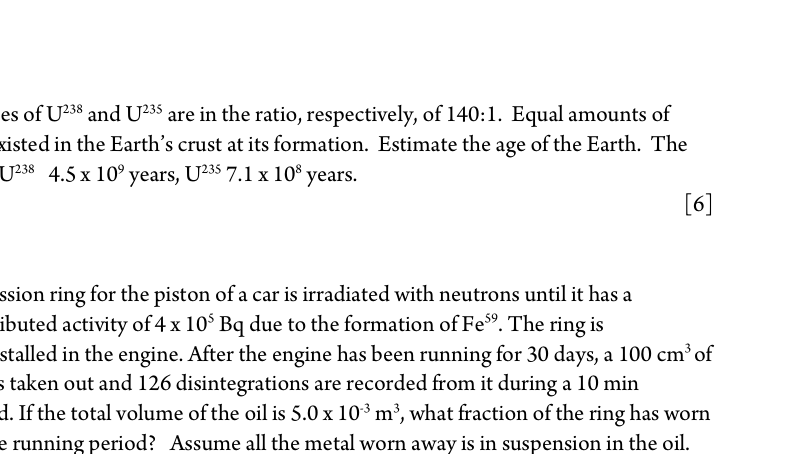
(a) The abundances of U and U are in the ratio, respectively, of 140:1. Equal amounts of each isotope existed in the Earth’s crust at its formation. Estimate the age of the Earth. The half-lives are: U years, U years. [6]
(b) A steel compression ring for the piston of a car is irradiated with neutrons until it has a uniformly distributed activity of Bq due to the formation of Fe. The ring is immediately installed in the engine. After the engine has been running for 30 days, a sample of the engine oil is taken out and 126 disintegrations are recorded from it during a 10 min counting period. If the total volume of the oil is , what fraction of the ring has worn away during the running period? Assume all the metal worn away is in suspension in the oil. (1 Bq is one disintegration per sec., half-life Fe days) [6]
(c) A radioactive detector is used to measure the count rate of a single radioactive source. It initially registered 82 counts s, which dropped after 210 s to 19 counts s. Find the half-life of the source. [6]
Topic: Nuclear & Particle Physics Metodi: Radioactive Decay Law, Approximation & Series Expansion Competenze: Mathematical Modeling, Physical Reasoning Objects: Nucleus, Piston Fonte: Testo (PDF) — p.7
**(a) ** Le abbondanza di U e U sono rispettivamente in rapporto di 140:1. Le quantità uguali di ogni isotopo esistevano nella crosta terrestre alla sua formazione. Calcola l’età della Terra. Le emivita sono: U anni, U anni. [6]
**(b) ** Un anello di compressione in acciaio per il pistone di un’auto viene irradiato con i neutroni fino a raggiungere un’attività uniformemente distribuita di Bq a causa della formazione di Fe. L’anello viene installato immediatamente nel motore. Dopo che il motore è stato in funzione per 30 giorni, viene prelevato un campione dell’olio del motore e vengono registrate 126 disintegrazioni durante un periodo di conteggio di 10 minuti. Se il volume totale dell’olio è , quale frazione dell’anello si è spossata durante il periodo di funzionamento? Supponiamo che tutto il metallo usurpato sia sospeso nell’olio. (1 Bq è una disintegrazione al secondo, emivita Fe giorni) [6]
**(c) ** Per misurare il tasso di conteggio di una singola fonte radioattiva si utilizza un rilevatore radioattivo. Inizialmente, è stato registrato 82 conteggi s, che sono scesi dopo 210 s a 19 conteggi s. Trova la meta’ vita della fonte. [6]
Topic: Nuclear & Particle Physics Metodi: Radioactive Decay Law, Approximation & Series Expansion Competenze: Mathematical Modeling, Physical Reasoning Objects: Nucleus, Piston Fonte: Testo (PDF) — p.7