Q1 a) Gas is contained in a tank at a pressure of 10 atm and a temperature of 15°C. If one half of the gas is withdrawn and the temperature is raised to 65°C, what is the new pressure in the tank?
[3]
Topic: Thermodynamics, Kinetic Theory Metodi: Ideal Gas Law Competenze: Mathematical Modeling, Physical Reasoning Objects: Gas, Container Fonte: Testo (PDF) — p.4
**Q1 a) ** Il gas è contenuto in un serbatoio a una pressione di 10 atm e a una temperatura di 15°C. Se la metà del gas viene ritirata e la temperatura è aumentata a 65°C, quale è la nuova pressione nel serbatoio?
[3]
Topic: Thermodynamics, Kinetic Theory Metodi: Ideal Gas Law Competenze: Mathematical Modeling, Physical Reasoning Objects: Gas, Container Fonte: Testo (PDF) — p.4
Q1 b) In Figure 1.b, what is the value of the resistor , in terms of the resistances and , expressed in its simplest form, if the total resistance across AB is equal to ?
[2]
(Figure 1.b shows a circuit with , , and in a network between terminals A and B.)
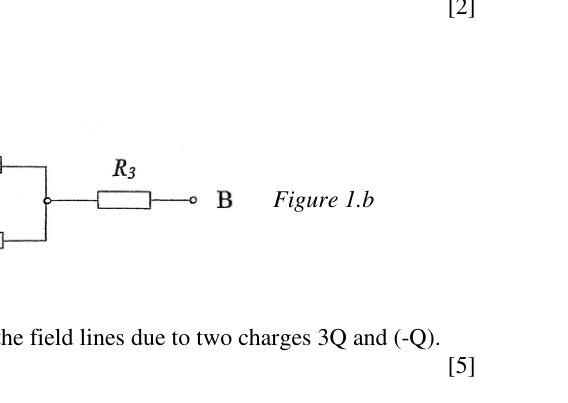 Circuit with R1, R2, R3 between A and B
Topic: Circuits Metodi: Equivalent Circuit Reduction, Kirchhoff’s Laws Competenze: Mathematical Modeling, Physical Reasoning Objects: Resistor Fonte: Testo (PDF) — p.4
**Q1 b) ** Nella figura 1.b, qual è il valore della resistenza , in termini di resistenze e , espresse nella sua forma più semplice, se la resistenza totale su AB è uguale a ?
[2]
*(La figura 1.b mostra un circuito con , e in una rete tra i terminali A e B.) *
Circuito con R1, R2, R3 tra A e B
Topic: Circuits Metodi: Equivalent Circuit Reduction, Kirchhoff’s Laws Competenze: Mathematical Modeling, Physical Reasoning Objects: Resistor Fonte: Testo (PDF) — p.4
Q1 c) What is an electric field line? Sketch the field lines due to two charges and .
[5]
Topic: Electrostatics Metodi: Coulomb’s Law, Superposition Principle Competenze: Diagrammatic Reasoning, Physical Reasoning Objects: Point Charge Fonte: Testo (PDF) — p.4
**Q1 c) ** Che cos’è una linea di campo elettrico? Segnare le linee di campo a causa di due cariche e .
[5]
Topic: Electrostatics Metodi: Coulomb’s Law, Superposition Principle Competenze: Diagrammatic Reasoning, Physical Reasoning Objects: Point Charge Fonte: Testo (PDF) — p.4
Q1 d) A uniform cable has a mass of 100 kg and is suspended between two fixed points A and B, at the same horizontal level (Figure 1.d). At the support points the cable makes angles of 30°.
What is:
(i) The force exerted on each support? (ii) The tension in the cable at its lowest point?
[5]
 Cable suspended between supports A and B
Topic: Newtonian Mechanics, Rigid Body Statics Metodi: Free-Body Diagram, Vector Decomposition Competenze: Mathematical Modeling, Diagrammatic Reasoning Objects: String Fonte: Testo (PDF) — p.4
**Q1 d) ** Un cavo uniforme ha una massa di 100 kg e è sospeso tra due punti fissi A e B, allo stesso livello orizzontale (figura 1.d). Ai punti di supporto il cavo fa angoli di 30°.
Che cos’è:
(i) La forza esercitata su ciascun supporto? (ii) La tensione del cavo al suo punto più basso?
[5]
Cabello sospeso tra i supporti A e B
Topic: Newtonian Mechanics, Rigid Body Statics Metodi: Free-Body Diagram, Vector Decomposition Competenze: Mathematical Modeling, Diagrammatic Reasoning Objects: String Fonte: Testo (PDF) — p.4
Q1 e) When the Sun is directly overhead a narrow shaft of light enters an ancient temple through a small hole in the ceiling and produces a light spot, 10 m below, on the floor.
(i) At what speed does the spot move across the floor? (ii) If a mirror is placed on the floor to reflect the beam, at what speed will the reflected spot move across the ceiling?
[4]
Topic: Newtonian Mechanics, Geometric Optics Metodi: Kinematic Equations, Physical Modeling Competenze: Physical Reasoning, Mathematical Modeling Objects: Mirror Fonte: Testo (PDF) — p.5
Quando il Sole è direttamente sopra di sé, un angolo di luce che entra in un antico tempio attraverso un piccolo buco nel soffitto produce una macchia luminosa, 10 m sotto, sul pavimento.
(i) A che velocità si muove il punto sul pavimento? (ii) Se si pone uno specchio sul pavimento per riflettere il fascio, a che velocità si muoverà il punto riflesso attraverso il soffitto?
[4]
Topic: Newtonian Mechanics, Geometric Optics Metodi: Kinematic Equations, Physical Modeling Competenze: Physical Reasoning, Mathematical Modeling Objects: Mirror Fonte: Testo (PDF) — p.5
Q1 f) The potassium isotope disintegrates into .
(i) What are the likely source/s of radiation produced? (ii) How many protons, neutrons and electrons are present in an atom of the daughter nucleus ?
[3]
Topic: Nuclear & Particle Physics, Modern-Quantum Physics Metodi: Radioactive Decay Law Competenze: Physical Reasoning, Mathematical Modeling Objects: Nucleus, Atom Fonte: Testo (PDF) — p.5
**Q1 f) ** L’ isotopo di potassio si disintegra in .
I) Quali sono le probabili fonti di radiazioni prodotte? (ii) Quanti protoni, neutroni ed elettroni sono presenti in un atomo del nucleo della figlia ?
[3]
Topic: Nuclear & Particle Physics, Modern-Quantum Physics Metodi: Radioactive Decay Law Competenze: Physical Reasoning, Mathematical Modeling Objects: Nucleus, Atom Fonte: Testo (PDF) — p.5
Q1 g) A thin film of glass, refractive index 1.52, and thickness is viewed by reflection with white light at normal incidence. What visible wavelength is most strongly reflected?
[6]
Topic: Wave Optics Metodi: Interference & Diffraction Analysis, Superposition Principle Competenze: Mathematical Modeling, Physical Reasoning Objects: — Fonte: Testo (PDF) — p.5
**Q1 g) ** Un sottile film di vetro, con un indice di rifrazione di 1,52, e spessore è visto attraverso riflessione con luce bianca ad incidenza normale. Quale lunghezza d’onda visibile si riflette più fortemente?
[6]
Topic: Wave Optics Metodi: Interference & Diffraction Analysis, Superposition Principle Competenze: Mathematical Modeling, Physical Reasoning Objects: — Fonte: Testo (PDF) — p.5
Q1 h) A 50 kg ball is attached to one end of a 1.2 m chord that has a mass of 0.13 kg and initially hangs vertically in equilibrium. The other end of the chord is attached to a ring that can slide on a smooth horizontal rod (Figure 1.h). A horizontal blow is delivered to the chord which excites its fundamental mode. Assume the ball remains stationary as the chord vibrates.
(i) What is the frequency, , and period, , of the fundamental mode? (ii) What is the amplitude, , of the ring if its maximum velocity is ? (iii) If, initially, the ball is not stationary, determine its natural period, . (iv) Determine the ratio . Is the original assumption justified?
[11]
 Ball on cord attached to sliding ring on rod
Topic: Oscillations & Waves, Newtonian Mechanics Metodi: Wave Equation, Simple Harmonic Motion Analysis Competenze: Mathematical Modeling, Physical Reasoning Objects: Ball, String, Rod Fonte: Testo (PDF) — p.5
**Q1 h) ** Una palla da 50 kg è attaccata ad una estremità di un’accordazione da 1,2 m, che ha una massa di 0,13 kg e che inizia a pendere verticalmente in equilibrio. L’altra estremità dell’accordo è attaccata ad un anello che può scivolare su una barra orizzontale liscia (Figura 1.h). Un colpo orizzontale viene dato all’accordo che eccita il suo modo fondamentale. Supponiamo che la palla rimanga fermata mentre l’accordo vibra.
(i) Qual è la frequenza, , e il periodo, , della modalità fondamentale? (ii) Qual è l’ampiezza, , dell’anello se la sua velocità massima è ? (iii) Se, inizialmente, la palla non è stazionaria, determinare il suo periodo naturale, . (iv) Determinare il rapporto . È giustificata l’ipotesi originale?
[11]
*Palla su cavo attaccata all’anello scorrevole su bastone *
Topic: Oscillations & Waves, Newtonian Mechanics Metodi: Wave Equation, Simple Harmonic Motion Analysis Competenze: Mathematical Modeling, Physical Reasoning Objects: Ball, String, Rod Fonte: Testo (PDF) — p.5
Q1 i) A sphere, mass and speed , collides elastically head-on with an identical sphere of mass which is initially at rest. After the collision the masses and have respectively speeds, in the direction of , of and .
(i) Prove or verify that . (ii) If , prove . (iii) Express in terms of and only.
[8]
Topic: Newtonian Mechanics, Conservation of Momentum Metodi: Conservation of Momentum, Conservation of Energy, Conservation Laws Competenze: Mathematical Modeling, Physical Reasoning Objects: Sphere Fonte: Testo (PDF) — p.6
**Q1 i) ** Una sfera, di massa e velocità , si schianta elasticamente di fronte ad una sfera identica di massa che è inizialmente in riposo. Dopo la collisione le masse e hanno rispettivamente velocità, nella direzione , di e .
(i) dimostrare o verificare che . (ii) Se , provare . (iii) Esprimere solo in termini di e .
[8]
Topic: Newtonian Mechanics, Conservation of Momentum Metodi: Conservation of Momentum, Conservation of Energy, Conservation Laws Competenze: Mathematical Modeling, Physical Reasoning Objects: Sphere Fonte: Testo (PDF) — p.6
Q1 j) Two identical plastic balls of mass 5.00 g are charged to and suspended from a fixed point by massless non-conducting threads, each of length 1.00 m. Verify that the angle between the threads is .
[7]
Topic: Electrostatics, Newtonian Mechanics Metodi: Coulomb’s Law, Free-Body Diagram, Vector Decomposition Competenze: Mathematical Modeling, Physical Reasoning Objects: Ball, String, Point Charge Fonte: Testo (PDF) — p.6
**Q1 j) ** Due palle di plastica identiche di massa 5,00 g sono caricate a e sospese da un punto fisso da fili non conduttori senza massa, di lunghezza di 1,00 m ciascuno. Verificare che l’angolo tra i fili sia .
[7]
Topic: Electrostatics, Newtonian Mechanics Metodi: Coulomb’s Law, Free-Body Diagram, Vector Decomposition Competenze: Mathematical Modeling, Physical Reasoning Objects: Ball, String, Point Charge Fonte: Testo (PDF) — p.6
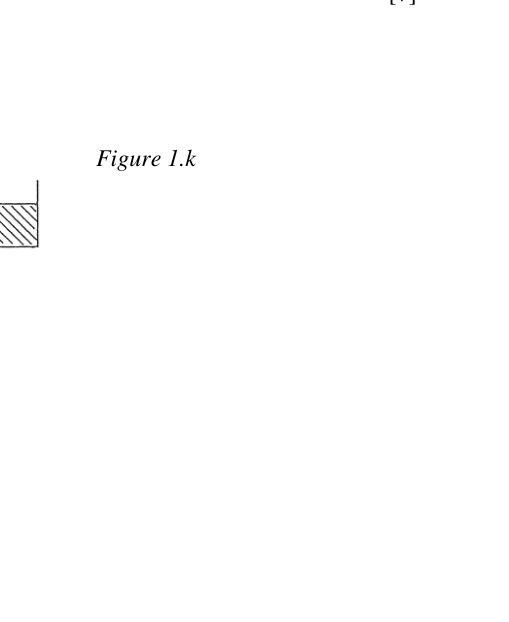
Q1 k) The height of mercury, density , in a barometer (Figure 1.k), is 75.9 cm at 15°C. The height of the evacuated space in the barometer is 8.0 cm. The internal diameter of the barometer is 6.5 mm. A small amount of nitrogen is introduced into this space and the mercury level drops to 62.2 cm. Determine the mass, , of nitrogen present.
[7]
 Barometer with mercury and evacuated space
Topic: Fluid Mechanics, Thermodynamics Metodi: Ideal Gas Law, Hydrostatic Equilibrium Competenze: Mathematical Modeling, Physical Reasoning Objects: Manometer, Gas Fonte: Testo (PDF) — p.6
**Q1 k) ** L’altezza del mercurio, densità , in un barometro (Figura 1.k), è di 75,9 cm a 15°C. L’altezza dello spazio evacuato nel barometro è di 8,0 cm. Il diametro interno del barometro è di 6,5 mm. Una piccola quantità di azoto viene introdotta in questo spazio e il livello di mercurio scende a 62,2 cm. Determinare la massa, , dell’azoto presente.
[7]
Barometro con mercurio e spazio evacuato
Topic: Fluid Mechanics, Thermodynamics Metodi: Ideal Gas Law, Hydrostatic Equilibrium Competenze: Mathematical Modeling, Physical Reasoning Objects: Manometer, Gas Fonte: Testo (PDF) — p.6
Q1 l) A battery consisting of two cells, in series, each of emf , is used to charge a capacitor, capacitance .
(i) What is the energy of the charged capacitor? (ii) How much energy has been lost? (iii) If the capacitor is charged in two stages, first with one cell and then with two cells, determine the energy lost. Comment on the result.
[8]
Topic: Circuits, Electrostatics Metodi: Conservation of Energy, Kirchhoff’s Laws, Energy Conservation Method Competenze: Mathematical Modeling, Physical Reasoning Objects: Battery, Capacitor Fonte: Testo (PDF) — p.7
**Q1 l) ** Per caricare un condensatore, la capacità , si utilizza una batteria composta da due celle, in serie, ciascuna di emf .
(i) Qual è l’energia del condensatore carico? (ii) Quanta energia è stata persa? (iii) Se il condensatore viene caricato in due fasi, prima con una cella e poi con due celle, determinare l’energia persa. Commenta il risultato.
[8]
Topic: Circuits, Electrostatics Metodi: Conservation of Energy, Kirchhoff’s Laws, Energy Conservation Method Competenze: Mathematical Modeling, Physical Reasoning Objects: Battery, Capacitor Fonte: Testo (PDF) — p.7
Q1 m) Two masses of 0.90 kg and 1.10 kg are hung vertically from identical springs on a common support, each with force constant . Both are released simultaneously from a position of maximum extension to describe simple harmonic motion. Calculate:
(i) The frequencies of the two masses. (ii) The beat period and frequency.
[4]
Topic: Oscillations & Waves Metodi: Simple Harmonic Motion Analysis, Hooke’s Law Competenze: Mathematical Modeling, Physical Reasoning Objects: Spring, Block Fonte: Testo (PDF) — p.7
**Q1 m) ** Due masse di 0,90 kg e 1,10 kg sono appese verticalmente da sorgenti identiche su un supporto comune, ciascuna con costante forza . Entrambi vengono rilasciati contemporaneamente da una posizione di massima estensione per descrivere un semplice movimento armonico. Calcola:
(i) Le frequenze delle due masse.
- Il periodo e la frequenza dei battiti.
[4]
Topic: Oscillations & Waves Metodi: Simple Harmonic Motion Analysis, Hooke’s Law Competenze: Mathematical Modeling, Physical Reasoning Objects: Spring, Block Fonte: Testo (PDF) — p.7
Q1 n) The tangential frictional force produced by a band brake on a rotating metal drum of circumference 0.25 m is 20 N. The mass of the drum is 0.40 kg and its specific heat capacity is . Calculate the number of complete revolutions required to increase its temperature by 5.0 K.
[3]
Topic: Thermodynamics, Newtonian Mechanics Metodi: Conservation of Energy, Energy Conservation Method Competenze: Mathematical Modeling, Physical Reasoning Objects: Cylinder Fonte: Testo (PDF) — p.7
**Q1 n) ** La forza di attrito tangenziale prodotta da un freno a banda su un tamburo metallico rotante di circonferenza 0,25 m è di 20 N. La massa del tamburo è di 0,40 kg e la sua capacità termico specifica è . Calcolare il numero di rotazioni complete necessarie per aumentare la sua temperatura di 5,0 K.
[3]
Topic: Thermodynamics, Newtonian Mechanics Metodi: Conservation of Energy, Energy Conservation Method Competenze: Mathematical Modeling, Physical Reasoning Objects: Cylinder Fonte: Testo (PDF) — p.7
Q1 o) If the atmosphere is assumed to be composed of a layer of air of uniform density, , calculate its height if it produces a pressure of at the Earth’s surface.
[2]
Topic: Fluid Mechanics, Newtonian Mechanics Metodi: Hydrostatic Equilibrium, Physical Modeling Competenze: Mathematical Modeling, Estimation & Approximation Objects: — Fonte: Testo (PDF) — p.7
Se si presume che l’atmosfera sia composta da uno strato di aria di densità uniforme, , calcolare la sua altezza se produce una pressione di sulla superficie terrestre.
[2]
Topic: Fluid Mechanics, Newtonian Mechanics Metodi: Hydrostatic Equilibrium, Physical Modeling Competenze: Mathematical Modeling, Estimation & Approximation Objects: — Fonte: Testo (PDF) — p.7