Q2
(a) In the circuit below, determine the potential difference between A and B in Figure 2.a.
[6]
(b) The network in Figure 2.b consists of eight 3.00 Ω resistors. The currents , in the arms of the circuit are indicated. A and B are connected to a voltage source.
Determine:
(i) Using symmetry, the relations between currents.
(ii) By reversing the pd across AB, further relations between the currents.
(iii) Which points in the circuit are at the same potential.
(iv) The resistance, , between AB.
(v) What can be deduced about the potential at O?
[14]
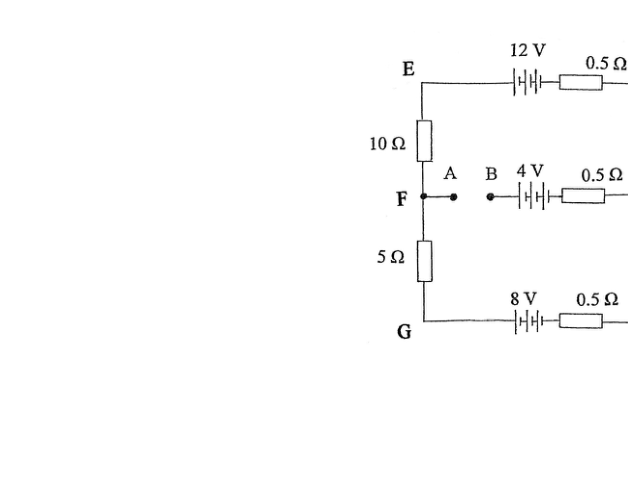 Figure 2.a: circuit for VAB
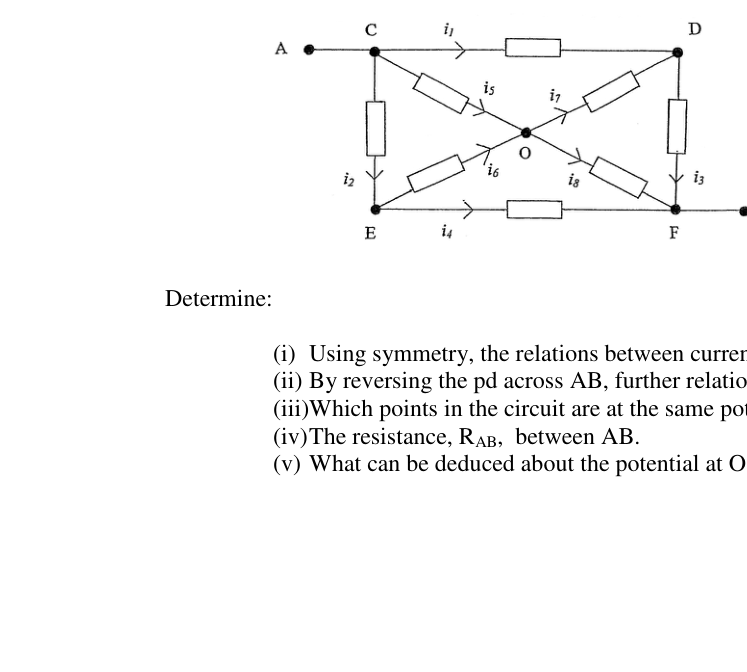 Figure 2.b: eight-resistor network
Topic: Circuits Metodi: Kirchhoff’s Laws, Equivalent Circuit Reduction, Symmetry Argument Competenze: Mathematical Modeling, Physical Reasoning Objects: Resistor Fonte: Testo (PDF) — p.4
Q2
a) Nel circuito seguente, determinare la differenza di potenziale tra A e B nella figura 2.a.
[6]
b) La rete di cui alla figura 2.b è composta da otto resistori di 3,00 Ω. Le correnti , nei bracci del circuito sono indicate. A e B sono collegate ad una fonte di tensione.
Determinazione:
- la simmetria, le relazioni tra correnti.
(ii) Invertendo il pd attraverso AB, ulteriori relazioni tra le correnti.
(iii) Quali punti del circuito hanno lo stesso potenziale.
(iv) La resistenza, , tra AB.
(v) Cosa si può dedurre sul potenziale di O?
[14]
Figura 2.a: circuito per VAB
Figura 2.b: rete a otto resistori
Topic: Circuits Metodi: Kirchhoff’s Laws, Equivalent Circuit Reduction, Symmetry Argument Competenze: Mathematical Modeling, Physical Reasoning Objects: Resistor Fonte: Testo (PDF) — p.4
Q3
(a) A calorimeter, heat capacity , contains 0.80 kg of water at 15°C. 0.40 kg of molten lead, specific heat capacity and latent heat of fusion , is poured into the calorimeter. The final temperature of the system is 25.0°C. What was the initial temperature of the lead?
The specific heat capacity of water is .
The melting temperature of lead is 327°C.
The specific heat capacity of solid lead is .
[6]
(b) A stream of particles, each of mass and kinetic energy , is collimated into a parallel beam of cross-sectional area . The particles are incident, at a rate of per second, on a smooth plane surface and rebound elastically.
(i) Derive an expression for the pressure on the surface.
(ii) Why would the pressure differ if the surface were rough?
[6]
(c) A photon of wavelength has momentum and energy .
(i) Determine the relation between and .
An electric light bulb emits 20 W of radiation uniformly in all directions.
(ii) What is the maximum radiation pressure on a surface placed 2.0 m away from the bulb?
(iii) State the conditions under which this occurs.
[8]
Topic: Thermodynamics, Newtonian Mechanics, Modern-Quantum Physics Metodi: Conservation of Energy, Photon Energy Relation, Kinematic Equations, Physical Modeling Competenze: Physical Reasoning, Mathematical Modeling Objects: Calorimeter, Particle Beam, Photon Fonte: Testo (PDF) — p.5
Q3
a) Un caloriometro, con capacità termico , contiene 0,80 kg di acqua a 15° C. 0,40 kg di piombo fuso, capacità termico specifica e calore latente di fusione , viene versato nel caloriometro. La temperatura finale del sistema è 25.0°C. Qual era la temperatura iniziale del piombo?
La capacità termico specifica dell’acqua è .
La temperatura di fusione del piombo è 327°C.
La capacità termico specifica del piombo solido è .
[6]
b) Un flusso di particelle, ciascuna di massa ed energia cinetica , è collimato in un fascio parallelo di superficie trasversale . Le particelle incidono, a velocità al secondo, su una superficie piano liscia e rimbalzano elasticamente.
(i) Derivare un’espressione per la pressione sulla superficie.
(ii) Perché la pressione differirebbe se la superficie fosse rugosa?
[6]
c) Un fotone di lunghezza d’onda ha un impulso ed un’energia .
- Determinare il rapporto tra e .
Una lampadina elettrica emette 20 W di radiazioni uniformemente in tutte le direzioni.
(ii) Qual è la pressione radiologica massima su una superficie posta a 2,0 m dalla lampadina?
- indicare le condizioni in cui ciò avviene.
[8]
Topic: Thermodynamics, Newtonian Mechanics, Modern-Quantum Physics Metodi: Conservation of Energy, Photon Energy Relation, Kinematic Equations, Physical Modeling Competenze: Physical Reasoning, Mathematical Modeling Objects: Calorimeter, Particle Beam, Photon Fonte: Testo (PDF) — p.5
Q4
(a) A stone is projected with a speed at a small angle to the horizontal ground. It impacts on the ground at a distance , having reached a maximum height . At time its velocity makes an angle with the horizontal.
Determine in terms of and :
(i) The time taken, , to reach the ground and the distance .
(ii) The maximum height, , reached.
(iii) An expression for the radius of curvature of the trajectory, , at height .
(iv) Express in terms of and .
(v) Sketch a graph of against , indicating the key points on the graph.
(vi) Deduce, from (v), that there are no pair of points on the stone’s trajectory with velocities that are perpendicular if .
[16]
(b) A car, mass , travels across a parabolic bridge of horizontal length and maximum height , the same values as in (a), at a constant speed . Determine the reaction force, , exerted by the bridge on the car at height for any value of . What advantage could be obtained by adding a spoiler to the car?
[4]
Topic: Newtonian Mechanics Metodi: Kinematic Equations, Free-Body Diagram, Calculus-Integration Competenze: Mathematical Modeling, Physical Reasoning, Diagrammatic Reasoning Objects: Projectile Fonte: Testo (PDF) — p.6
Q4
a) Una pietra viene proiettata con velocità ad un angolo piccolo verso il terreno orizzontale. Colpisce il terreno a una distanza , dopo aver raggiunto un’altezza massima . Al tempo la sua velocità fa un angolo con l’orizzontale.
Determinare in termini di e :
(i) Il tempo necessario, , per raggiungere il suolo e la distanza .
-
L’altezza massima, , raggiunta.
-
espressione del raggio di curvatura della traiettoria, , ad altezza .
(iv) Esprimere in termini di e .
(v) Segnare un grafico di contro , indicando i punti chiave del grafico.
(vi) Deduci, da (v), che non ci sono coppie di punti sulla traiettoria della pietra con velocità perpendicolari se .
[16]
b) Un’auto, di massa , attraversa un ponte parabolico di lunghezza orizzontale e altezza massima , i valori di cui alla lettera a), a velocità costante . Determinare la forza di reazione, , esercitata dal ponte sulla vettura ad altitudine per qualsiasi valore di . Che vantaggio si potrebbe ottenere aggiungendo uno spoiler alla macchina?
[4]
Topic: Newtonian Mechanics Metodi: Kinematic Equations, Free-Body Diagram, Calculus-Integration Competenze: Mathematical Modeling, Physical Reasoning, Diagrammatic Reasoning Objects: Projectile Fonte: Testo (PDF) — p.6
Q5
(a) A taut horizontal wire, with zero tension, has length and elastic constant . A mass is attached to its mid point O and the system is allowed to come to equilibrium. The wire is stretched by an amount , much less than ; O is displaced vertically by an amount , and the wire is at an angle (Figure 5.a).
(i) Derive, using Pythagoras’s theorem, the approximate relation
(ii) Determine the equilibrium displacement , in terms of , and .
[10]
(b) If mass is released from its initial rest position, with the wire horizontal:
(i) Give its equation of motion in terms of the vertical coordinate, .
(ii) Write down an expression for the kinetic energy of the mass in terms of .
(iii) Deduce the maximum value of , .
[10]
For much smaller than unity the approximation can be applied.
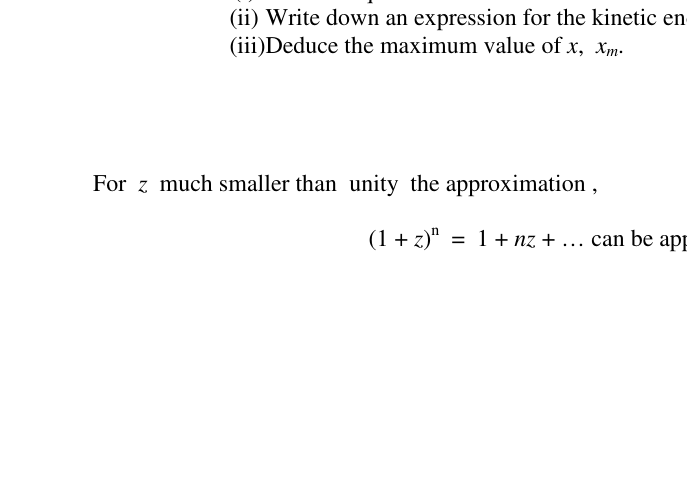 Figure 5.a: mass on stretched horizontal wire
Topic: Oscillations & Waves, Newtonian Mechanics, Elasticity & Materials Metodi: Hooke’s Law, Differential Equations, Approximation & Series Expansion, Free-Body Diagram Competenze: Mathematical Modeling, Physical Reasoning Objects: Wire, Block Fonte: Testo (PDF) — p.7
Q5
a) Un filo orizzontale tenso, a tensione zero, ha una lunghezza e una costante elastica . Una massa è attaccata al suo punto medio O e il sistema è permesso di raggiungere l’equilibrio. Il filo è esteso di un importo , molto inferiore a ; O è spostato verticalmente di un importo , e il filo è ad un angolo (Figura 5.a).
(i) Derivare, utilizzando il teorema di Pitagora, la relazione approssimativa
ii) Determinare il spostamento di equilibrio , in termini di , e .
[10]
b) Se la massa viene rilasciata dalla sua posizione di riposo iniziale, con il filo orizzontale:
(i) Indicare la sua equazione di movimento in termini di coordinate verticali, .
(ii) Scrivere un’espressione per l’energia cinetica della massa in termini di .
- Riduzione del valore massimo di , .
[10]
Per molto più piccolo dell’unità si può applicare l’approssimazione .
Figura 5.a: massa su filo orizzontale allungato
Topic: Oscillations & Waves, Newtonian Mechanics, Elasticity & Materials Metodi: Hooke’s Law, Differential Equations, Approximation & Series Expansion, Free-Body Diagram Competenze: Mathematical Modeling, Physical Reasoning Objects: Wire, Block Fonte: Testo (PDF) — p.7
Q6
Two mirrors, OA and OB (Figure 6.1), are rigidly set at a constant fixed angle , but can rotate about O. A fixed point P is situated between the mirrors. OP makes an angle with the fixed axis OX.
(a) Draw, using graph paper, an accurate diagram showing two light rays from P that are first reflected from mirror OA and then reflected from mirror OB, indicating any real or virtual images, in mirror OA, and in mirror OB.
[6]
(b) OB makes an angle with the fixed axis OX. If the mirrors are rotated, by changing , show:
(i) That P and the images of P remain at a fixed distance from O.
(ii) How the angle varies with .
(iii) How the angle varies with , providing P remains within AOB.
[9]
(c) Explain qualitatively how a rainbow is produced by spherical water droplets.
[5]
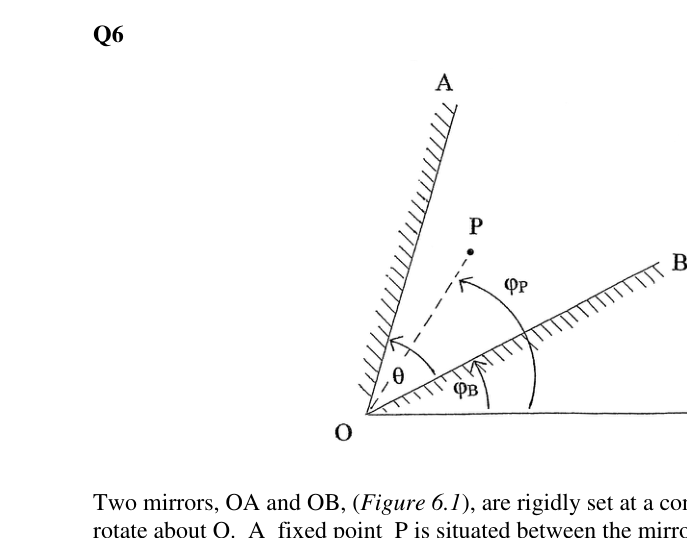 Figure 6.1: two mirrors at fixed angle theta
Topic: Geometric Optics, Wave Optics Metodi: Ray Tracing, Superposition Principle, Snell’s Law Competenze: Diagrammatic Reasoning, Physical Reasoning Objects: Mirror, Droplet Fonte: Testo (PDF) — p.8
Q6
Due specchi, OA e OB (Figura 6.1), sono rigidamente fissati ad un angolo fisso costante , ma possono ruotare circa O. Tra gli specchi si trova un punto fisso P. OP fa un angolo con l’asse fisso OX.
a) Disegnare, utilizzando carta grafica, un diagramma preciso che mostri due raggi luminosi di P che vengono riflessi prima dallo specchio OA e poi dallo specchio OB, indicando qualsiasi immagine reale o virtuale, nello specchio OA e nello specchio OB.
[6]
b) L’OB fa un angolo con l’asse fisso OX. Se gli specchi sono rotati, modificando , mostrare:
(i) Che P e le immagini di P restino a una distanza fissa da O.
(ii) Come l’angolo varia con .
(iii) Come l’angolo varia con , purché P rimanga all’interno di AOB.
[9]
c) Spiegare qualitativamente come un arcobaleno viene prodotto da gocce d’acqua sferiche.
[5]
Figura 6.1: due specchi a angolo fisso theta
Topic: Geometric Optics, Wave Optics Metodi: Ray Tracing, Superposition Principle, Snell’s Law Competenze: Diagrammatic Reasoning, Physical Reasoning Objects: Mirror, Droplet Fonte: Testo (PDF) — p.8
Q7
(a)
(i) Explain the photoelectric effect.
(ii) Derive a relation between the incident photon frequency, , and the electron kinetic energy for a photocathode with work function .
(iii) How does the classical explanation of this phenomenon differ from the quantum explanation?
(iv) Sketch a graph of current, , against voltage, , from anode to cathode, for positive and negative , in the presence of a constant beam of photons in a photoelectric experiment.
(v) How could one graphically determine from measurements of photon wavelength and electron velocity?
[12]
(b) In a photoelectric experiment the measurements of stopping potential, , against frequency, , were obtained:
| / V | 0.60 | 1.0 | 1.4 | 1.8 | 2.2 |
|---|---|---|---|---|---|
| / Hz | 6.0 | 7.0 | 8.0 | 9.0 | 10 |
Plot a graph and deduce:
(i) The threshold frequency .
(ii) The value of .
[8]
Topic: Modern-Quantum Physics Metodi: Photon Energy Relation, Graph Linearization, Bohr Model & Quantization Competenze: Graph Linearization, Physical Reasoning, Experimental Data Analysis Objects: Photon, Electron Fonte: Testo (PDF) — p.9
Q7
(a)
(i) Spiega l’effetto fotoelettrico.
(ii) Derivare una relazione tra la frequenza fotonica incidente, , e l’energia cinetica degli elettroni per un fotocatodo con funzione di lavoro .
(iii) In che modo l’esposizione classica di questo fenomeno differisce dall’esposizione quantistica?
(iv) Segnare un grafico di corrente, , contro tensione, , da anodo a catodo, per positivo e negativo, in presenza di un fascio costante di fotoni in un esperimento fotoelettrico.
(v) Come si può determinare graficamente dalle misurazioni della lunghezza d’onda del fotone e della velocità degli elettroni?
[12]
b) In un esperimento fotoelettrico sono state ottenute le misure del potenziale di arresto, , contro la frequenza, :
| / V | 0.60 | 1.0 | 1.4 | 1.8 | 2.2 |
|---|---|---|---|---|---|
| / Hz | 6.0 | 7.0 | 8.0 | 9.0 | 10 |
Tracciare un grafico e dedurre:
(i) La frequenza soglia .
(ii) Il valore di .
[8]
Topic: Modern-Quantum Physics Metodi: Photon Energy Relation, Graph Linearization, Bohr Model & Quantization Competenze: Graph Linearization, Physical Reasoning, Experimental Data Analysis Objects: Photon, Electron Fonte: Testo (PDF) — p.9
Q8
(a) A satellite of mass is in a circular orbit at an altitude of above the Earth’s surface. The satellite returns to Earth as a result of the frictional forces and impacts with a speed of . How much energy was absorbed by the atmosphere?
[6]
(b) A rocket, mass , is launched from the Earth. Its motors are used only near the Earth’s surface in order to give the rocket just sufficient energy to reach the Moon. Once the fuel is exhausted the rocket has initial velocity . Assume no relative motion of the Earth–Moon system.
Determine:
(i) The speed required for the rocket to just reach the Moon, in terms of the given constants.
(ii) The point between the Earth and Moon where the net gravitational force on the rocket is zero.
(iii) The minimum speed needed at that neutral point for the rocket to continue to the Moon.
[14]
Topic: Gravitation, Newtonian Mechanics Metodi: Newton’s Law of Gravitation, Conservation of Energy, Kepler’s Laws Competenze: Mathematical Modeling, Physical Reasoning Objects: Satellite, Planet Fonte: Testo (PDF) — p.10
Q8
a) Un satellite di massa si trova in orbita circolare ad un’altitudine di sopra la superficie terrestre. Il satellite ritorna sulla Terra a seguito delle forze di attrito e degli impatti con una velocità . Quanta energia è stata assorbita dall’atmosfera?
[6]
b) Da terra viene lanciato un razzo di massa . I suoi motori vengono utilizzati solo vicino alla superficie terrestre per dare al razzo solo abbastanza energia per raggiungere la Luna. Una volta esaurito il carburante, il razzo ha una velocità iniziale . Non si presume alcun movimento relativo del sistema Terra-Luna.
Determinazione:
(i) La velocità necessaria per raggiungere la Luna, in termini di costanti.
(ii) Il punto tra la Terra e la Luna dove la forza gravitazionale netta del razzo è zero.
(iii) La velocità minima necessaria in quel punto neutro per il razzo per proseguire verso la Luna.
[14]
Topic: Gravitation, Newtonian Mechanics Metodi: Newton’s Law of Gravitation, Conservation of Energy, Kepler’s Laws Competenze: Mathematical Modeling, Physical Reasoning Objects: Satellite, Planet Fonte: Testo (PDF) — p.10