Q1 In this question you are asked to make reasoned estimates and assumptions. These must be clearly stated. a) (i) Foolishly I turn on the shower tap when the showerhead is resting on the floor - the flexible pipe thrashes around like a berserk snake. Explain this behaviour. [2] (ii) The garden hose is 50 m long and connected to a tap. It is then turned on. I partially close the hole emitting the water. The water spurts out faster. Why? [2] (iii) How could I measure the increased speed of the water – I only have a metre rule? [2]
b)
Proton from the Sun N Earth North Geographic Pole. Magnetic field line, B. Figure 1.1
(i) Figure 1.1 shows a cross-section of the Earth and a typical magnetic field line. A proton from the Sun is shown approaching the Earth. Sketch the path of the proton. What effects may be observed when these protons reach the atmosphere of the Earth. [2.2]
(ii) A charged particle, mass m, charge q, travelling in a circle radius r in a magnetic field B at right angles to the plane of the circle emits electromagnetic radiation of frequency f, where f is given by m Bq f 2
. Show that this is equal to the rotational frequency of the charged particle rotating in a plane at right angles to the direction of motion.
[2]
(iii) The speed of the proton is 2 m s 5 10
- -1 and the magnetic field density, B, is 1.0 T. Calculate the frequency of electromagnetic waves given off. [1]
c) Figure 1.2
Figure 1.2 shows the circuit diagram needed to test a three terminal device, D. It is found that within the working limits of the device that: b c kI I = , where k is a constant. The formula holds only if Ib >0. D Ic +5V Ib 0 Ie 3
(i) Write down a relationship between the three currents.
[2] (ii) How would you modify the circuit so that a small changing p d in v , (where V vin 5 << ) gave a much larger changing p d, out v , out?
[7]
d) According to the kinetic theory of gases for a perfect gas: 2 3 1 c p
, where p is the pressure of the gas, is the density of the gas and c is the root mean square velocity of the gas molecules.
Find an expression of the rate of leakage of a gas from a small hole, cross-sectional area a, in a cubic container, side l, a
l .
[5]
A cylinder that contains helium has a diameter of 300 mm and a length of 1.5 m. The pressure of the gas in the cylinder is 10 atmospheres above the ambient air pressure. There is a small hole in the piston, diameter 2 mm. Calculate the rate of fall of pressure in the cylinder assuming that the expansion is isothermal. [3]
e)
Figure 1.3, Small hemisphere Surface of the damp ground. Vstrike r a
Figure 1.3 shows a diagram of a theoretical model of lightening striking damp ground. The constant potential of the small central hemisphere, radius a, is Vstrike. At a very long distance away, from the region where the lightening strikes the Earth, the potential of a point in and on the Earth is zero. The radius of the hemisphere in Figure 1.3 is r and a thin hemispherical shell, radius r, is of thickness . You can assume that the specific resistivity of the damp earth is much less than that of the air and that the current flows radially through the hemisphere. Spherical symmetry is to be assumed on and below the ground. Sketch graphs (i) the current density , (ii) the potential gradient E, against r the radial distance from the centre. Show that for a small change in r, , there is a small change in potential , given by: r r K V 2 2
, where is the specific resistivity of the earth (Ω m) and K is a constant. What is the physical significance of K?
[3] Hence or otherwise find an expression for the potential with distance from the centre of the strike and sketch V(r) against r.
[4] In one newspaper report it was stated that lightening struck a field in which there were a herd of cows, and most cows were killed. However in another incident lightening struck a rugby pitch whilst a game was in progress. All, but one, of the players were uninjured, though shocked. The injured man recovered. Suggest a physical reason for the different medical effects in the two incidents.
[3] Total 40 4
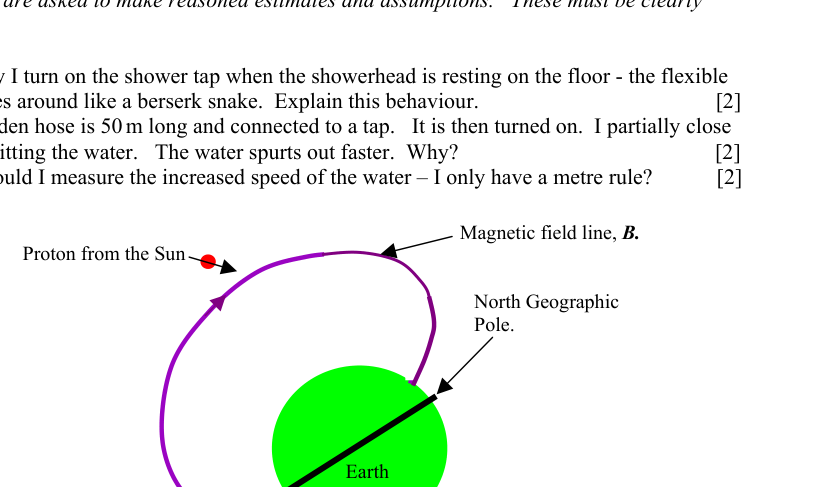 sezione Terra con linea di campo e protone
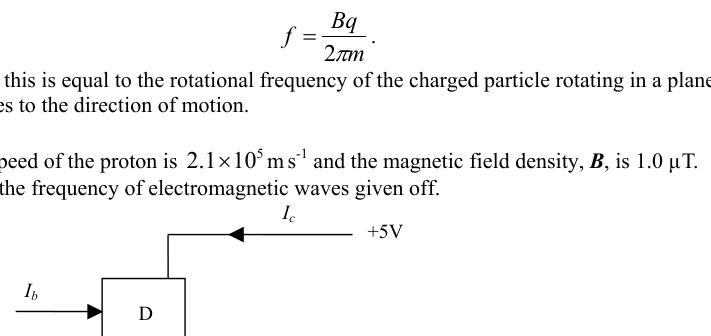 circuito dispositivo a tre terminali D
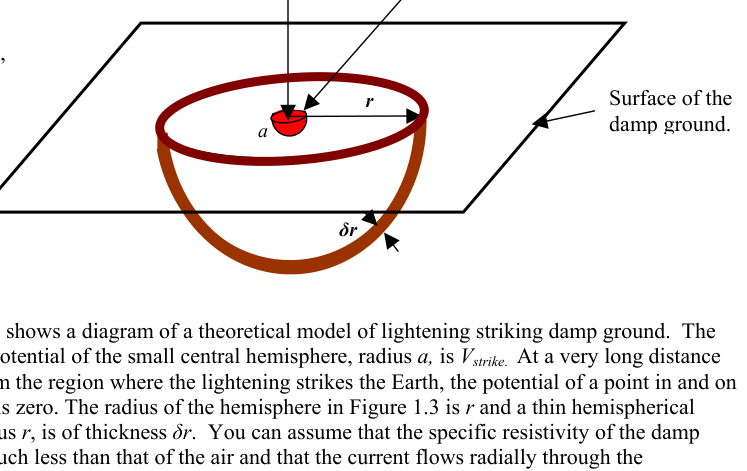 modello emisferico fulmine su terreno bagnato
Topic: Fluid Mechanics, Magnetism, Kinetic Theory Metodi: Physical Modeling, Lorentz Force Analysis, Kinetic Theory of Gases Competenze: Physical Reasoning, Estimation & Approximation, Mathematical Modeling Objects: Tube, Point Charge, Gas, Cylinder, Piston Fonte: Testo (PDF) — p.2
Q1 In questa domanda vi viene chiesto di fare stime e ipotesi motivate. Questi devono essere chiaramente
- E’ stato detto. a) (i) Insensatamente accendo il rubinetto quando la testa della doccia sta appoggiata sul pavimento - la flessibilità La pipa si batte come un serpente di Berserk. Spiega questo comportamento. [2]
- il tubo di giardino è lungo 50 m e collegato a un rubinetto. E’ poi accesa. Chiudo parzialmente . il buco che emette l’acqua. L’acqua scorre più velocemente. - Perché? - Perché? [2] (iii) Come posso misurare l’aumento della velocità dell’acqua? [2]
b)
Protone del Sole N Terra North Geographic
- Polio. Linea di campo magnetico, B. Figura 1.1
(i) La figura 1.1 mostra una sezione trasversale della Terra e una linea tipica del campo magnetico. Un protone dal Sole è mostrato avvicinarsi alla Terra. Segna il percorso del protone. Quali effetti possono essere osservati quando questi protoni raggiungono l’atmosfera terrestre. [2.2]
(ii) Particella carica, massa m, carica q, che viaggia in un cerchio di raggio r in un campo magnetico B a gli angoli rettissimi verso il piano del cerchio emettono radiazioni elettromagnetiche di frequenza f, dove f è data da m Bq f 2
. Mostrare che questo è uguale alla frequenza di rotazione della particella carica che ruota in un piano a angoli rettissimi verso la direzione del movimento.
[2]
(iii) La velocità del protone è di 2 m s 5 10
- -1 e la densità del campo magnetico, B, è di 1,0 T. Calcolare la frequenza delle onde elettromagnetiche emesse. [1]
c) Figura 1.2
La figura 1.2 mostra il diagramma di circuito necessario per testare un dispositivo a tre terminali, D. Si è rilevato che entro i limiti di funzionamento del dispositivo che: b c kI I = , dove k è una costante. La formula è valida solo se Ib > 0. D Ic +5V Ib 0 Ie 3
(i) Scrivi una relazione tra le tre correnti.
[2] (ii) Come si modifica il circuito in modo che un piccolo cambiamento p d in v , (dove V vin 5 << ) ha dato un tasso di variazione molto maggiore, fuori v
- E’ fuori?
[7]
d) Secondo la teoria cinetica dei gas per un gas perfetto: 2 3 1 c p
, dove p è la pressione del gas, è la densità del gas e c è la media quadrata radicale velocità delle molecole di gas.
Trova un’espressione del tasso di perdita di un gas da un piccolo buco, area di sezione trasversale a, in un contenitore cubo, lato I, a
l .
[5]
Un cilindro contenente elio ha un diametro di 300 mm e una lunghezza di 1,5 m. La pressione di gas contenuto nel cilindro è di 10 atmosfere sopra la pressione atmosferica ambientale. C’è una piccola buco nel pistone, di diametro 2 mm. Calcolare il tasso di calo della pressione nel cilindro se si presume che l’espansione sia isotermica. [3]
e)
Figura 1.3, Piccolo emisfero Superficie del terreno umido. Vstrike r a
La figura 1.3 mostra un diagramma di un modello teorico di luce che colpisce il terreno umido. Il Il potenziale costante del piccolo emisfero centrale, raggio a, è Vstrike. A una distanza molto lunga lontano, dalla regione in cui il fulmine colpisce la Terra, il potenziale di un punto in e su la Terra è zero. Il raggio dell’emisfero nella figura 1.3 è r e un’emisfera sottile con un di spessore , di raggio r. Si può presumere che la specificità di resistenza dell’umidità La superficie della terra è molto inferiore a quella dell’aria e che la corrente fluisce radialmente attraverso il
- L’emisfero. Si presume una simmetria sferica su e sotto il suolo. Sketch grafici (i) la densità di corrente , (ii) il gradiente potenziale E, rispetto a r il radial Distanza dal centro. Mostra che per una piccola variazione di r, , vi è una piccola variazione del potenziale , data da: r r K V 2 2 = , dove è la resistenza specifica della terra (Ω m) e K è una costante. Cos’è la fisica significato di K?
[3] In questo modo o in altro modo trovare un’espressione del potenziale con la distanza dal centro della Strike e schizzo V(r) contro r.
[4] In un rapporto di giornale si diceva che un fulmine colpì un campo dove c’era un gregge La maggior parte delle mucche sono state uccise. Tuttavia in un altro incidente fulmine ha colpito un rugby lanciare mentre la partita era in corso. Tutti, tranne uno, erano feriti.
- Sono scioccato. L’uomo ferito si è ripreso. Suggerire una ragione fisica per le diverse cure mediche Gli effetti dei due incidenti.
[3] Complessivamente 40 4
sezione Terra con linea di campo e protone
*circuito dispositivo a tre terminali D *
- modello emisferico fulmine su terreno bagnato *
Topic: Fluid Mechanics, Magnetism, Kinetic Theory Metodi: Physical Modeling, Lorentz Force Analysis, Kinetic Theory of Gases Competenze: Physical Reasoning, Estimation & Approximation, Mathematical Modeling Objects: Tube, Point Charge, Gas, Cylinder, Piston Fonte: Testo (PDF) — p.2
Q2 a) How do the electrical currents in the arms of a network, containing resistors and batteries, alter if the connections to all the batteries are reversed?
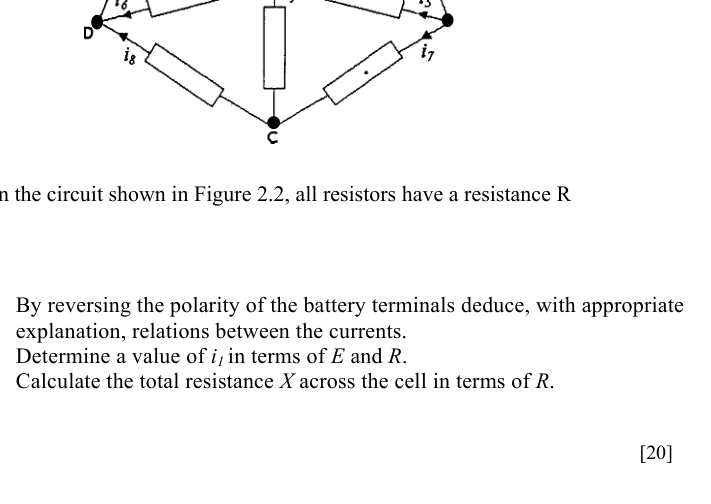
b) In Figure 2.1 all the resistors have resistance R and the cell has an emf of E. The currents indicated in the arms are i1, i2, i3, i4, i5, and i6. (i) By reversing the polarity of the battery terminals deduce, using a symmetry argument, two relationships between the currents. (ii) Show that i1, = 0. (iii) Determine i1, i2 and i6.
E
(i) By reversing the polarity of the battery terminals deduce, with appropriate explanation, relations between the currents. (ii) Determine a value of i1 in terms of E and R. (iii) Calculate the total resistance X across the cell in terms of R. Figure 2.1 i2 c) In the circuit shown in Figure 2.2, all resistors have a resistance R Figure 2.2 i4 i1 i3 i5 i1 [20] 5
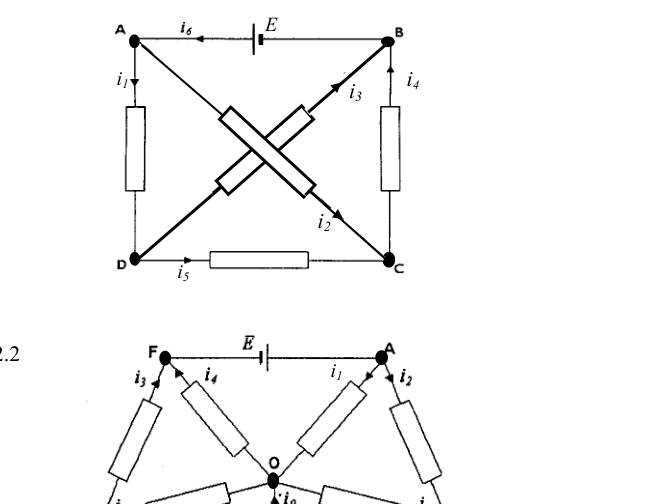 rete resistori con batteria Figure 2.1
 rete pentagonale resistori Figure 2.2
Topic: Circuits Metodi: Kirchhoff’s Laws, Symmetry Argument, Equivalent Circuit Reduction Competenze: Physical Reasoning, Diagrammatic Reasoning, Mathematical Modeling Objects: Resistor, Battery Fonte: Testo (PDF) — p.4
Q2 a) Come alterano le correnti elettriche nei bracci di una rete, contenente resistenti e batterie, se le connessioni a tutte le batterie sono invertite?
b) Nella figura 2.1 tutte le resistenze hanno resistenza R e la cella ha un emf di E. Le correnti indicati nei bracci sono i1, i2, i3, i4, i5 e i6. (i) Invertendo la polarità dei terminali della batteria, dedurre, utilizzando un argomento di simmetria, due Le relazioni tra le correnti. (ii) Mostra che i1, = 0. (iii) Determina i1, i2 e i6.
E
(i) Invertendo la polarità dei terminali della batteria, dedurre, con le opportune La relazione è stata approvata dal Consiglio. (ii) Determinare un valore di i1 in termini di E e R. (iii) Calcolare la resistenza totale X attraverso la cellula in termini di R. Figura 2.1 i2 c) Nel circuito mostrato alla figura 2.2, tutte le resistenze hanno una resistenza R Figura 2.2 i4 i1 i3 i5 i1 [20] 5
*resistori con batteri
rete pentagonale resistori Figura 2.2
Topic: Circuits Metodi: Kirchhoff’s Laws, Symmetry Argument, Equivalent Circuit Reduction Competenze: Physical Reasoning, Diagrammatic Reasoning, Mathematical Modeling Objects: Resistor, Battery Fonte: Testo (PDF) — p.4
Q3 This question concerns a proposed satellite navigation system.
(a) A satellite orbits the Earth, radius RE, in a circular polar orbit with a period, T, and a height, h, above the Earth’s surface. Find h in terms of T. (b) Sketch an orbit of the satellite on a rough Mercator projection map of the Earth, and a subsequent orbit at a time later. T <24 hrs and .
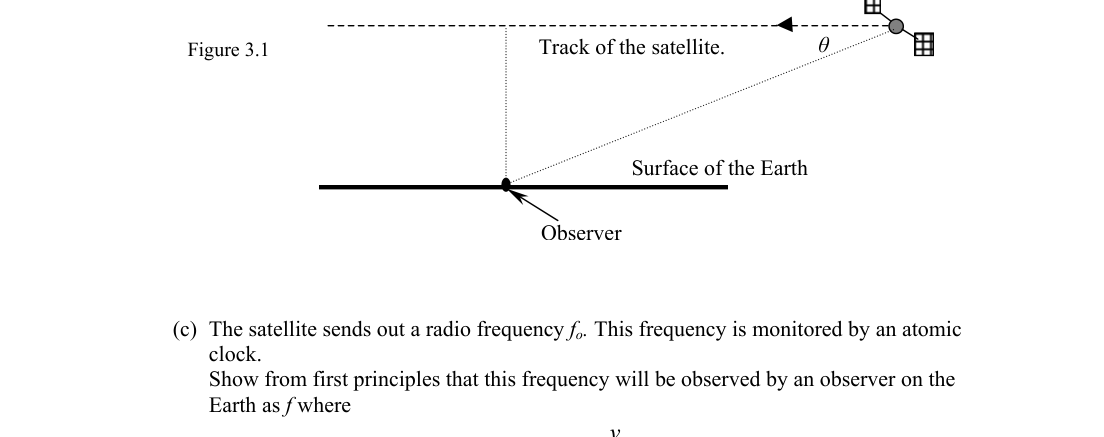
(c) The satellite sends out a radio frequency fo. This frequency is monitored by an atomic clock. Show from first principles that this frequency will be observed by an observer on the Earth as f where cos c v f f f o o
, v is the velocity of the satellite and is the angle between the satellite’s instantaneous direction and the observer, Figure 3.1. Assume v<<c where c is the speed of light. (d) A satellite in low orbit is monitored by an observer at latitude of 0o and longitude of 0o. Sketch a graph of , cos
where , c v f f f o
against time, t, as the satellite (i) approaches (ii) passes overhead and (iii) disappears from the observer. (e) Find expressions for asymptotes and turning points on your graph. (f) The observer moves 1o East. The height of the satellite is 200 km. What is the effect on the frequency of the observed signals as the satellite approaches and recedes next time the satellite passes over the position latitude 0o and longitude 0o? (g) The special theory of relativity predicts that in addition to any of the above effects moving clocks appear to run slow i.e. “ 2 / 1 2 2 1
c v observed ” where is the time variable, is a time interval in the inertial frame of the clock and v is the relative velocity of the clock with respect to the observer. What error will have occurred if non relativistic equations are assumed?
[20]
Track of the satellite. Figure 3.1 Surface of the Earth Observer 6
 traccia satellite angolo theta osservatore
Topic: Gravitation, Oscillations & Waves, Special Relativity Metodi: Kepler’s Laws, Newton’s Law of Gravitation, Approximation & Series Expansion Competenze: Mathematical Modeling, Physical Reasoning, Diagrammatic Reasoning Objects: Satellite, Planet Fonte: Testo (PDF) — p.5
Q3 La questione riguarda un sistema di navigazione satellitare proposto.
(a) Un satellite orbita intorno alla Terra, a raggio RE, in un’orbita polare circolare con un periodo, T, e un altezza, h, sopra la superficie terrestre. Trova h in termini di T. b) Segnare un’orbita del satellite su una mappa di proiezione Mercator della Terra e orbite successive in un momento successivo. T < 24 ore e .
c) Il satellite trasmette una frequenza radio. Questa frequenza è monitorata da un atomo
- L’orologio. Sosteniamo che questa frequenza sarà osservata da un osservatore sulla Terra come f dove cos c v f f f o o = , v è la velocità del satellite e è l’angolo tra il satellites istantaneo direzione e l’osservatore, figura 3.1. Supponiamo che v<<c dove c è la velocità della luce. d) Un satellite in bassa orbita è monitorato da un osservatore a latitudine 0o e longitudine di 0o. Segna un grafico di , cos
dove , c v f f f o
contro il tempo, t, come il satellite
- i) avvicinamenti ii) passano oltre e iii) scompaiono dall’osservatore. (e) Trova espressioni per asintot e punti di svolta sul grafico. f) L’osservatore si muove verso est. L’altezza del satellite è di 200 km. Qual è l’ effetto sulla frequenza dei segnali osservati quando il satellite si avvicina e si allontana tempo in cui il satellite passa sopra la posizione latitudine 0o e longitudine 0o? (g) La teoria speciale della relatività prevede che, oltre a uno qualsiasi degli effetti sopra indicati, gli orologi in movimento sembrano funzionare lentamente, cioè “ 2 / 1 2 2 1
c v osservato dove è il tempo variabile, è un intervallo temporale nel quadro inerziale dell’orologio e v è il relativo velocità dell’orologio rispetto all’osservatore. Qual è l’errore che si è verificato se le equazioni non relativistiche sono state presunte?
[20]
Traccia del satellite. Figura 3.1 Superficie della Terra Osservatore 6
traccia satellite angolo theta osservatore
Topic: Gravitation, Oscillations & Waves, Special Relativity Metodi: Kepler’s Laws, Newton’s Law of Gravitation, Approximation & Series Expansion Competenze: Mathematical Modeling, Physical Reasoning, Diagrammatic Reasoning Objects: Satellite, Planet Fonte: Testo (PDF) — p.5
Q4
This question is about the motion of objects down a slope.
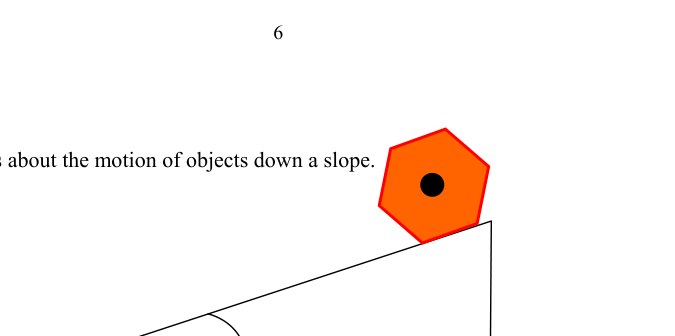
Figure 4.1.
(a) Figure 4.1 shows the cross-section of a slope on which a pencil rests. The pencil is hexagonal in cross-section. Find the angle, , of the slope, at which the pencil will tend to roll down the slope. (b) The pencil could slip. Find the value of at which the pencil will slide if the coefficient of friction between the surfaces is . (c) Consider a cylindrical object that has a cross-section in the form of a polygon with N equal sides. Find the algebraic condition such that if is greater than a certain value the object will roll rather than slip. (d)
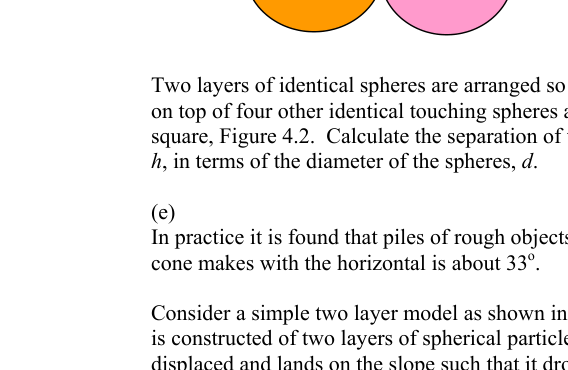
Figure 4.2 Figure 4.3
Two layers of identical spheres are arranged so that each sphere forming the upper layer sits on top of four other identical touching spheres arranged with their centres at the corners of a square, Figure 4.2. Calculate the separation of the planes through the centres of the spheres, h, in terms of the diameter of the spheres, d.
(e)
In practice it is found that piles of rough objects are conical and the angle that the face of the cone makes with the horizontal is about 33o.
Consider a simple two layer model as shown in (d). A slope, (angle with the horizontal), is constructed of two layers of spherical particles, Figure 4.3. A spherical particle is displaced and lands on the slope such that it drops symmetrically between four other particles, as in Figure 4.3, at a speed v. On impact it loses 50% of its KE. Calculate the smallest value of v so that it continues to bounce down the slope. What criticism can be made of this model and its ability to predict the behaviour of non-attracting particles?
(f) Clay slopes are never stable. Suggest a reason for this.
[20]
h
 matita esagonale su piano inclinato angolo theta
 due strati sfere impilate separazione h
 sfera su piano inclinato due strati sfere
Topic: Newtonian Mechanics, Rotational Dynamics Metodi: Free-Body Diagram, Vector Decomposition, Energy Conservation Method Competenze: Diagrammatic Reasoning, Mathematical Modeling, Physical Reasoning Objects: Inclined Plane, Sphere Fonte: Testo (PDF) — p.6
Q4
Questa domanda riguarda il movimento degli oggetti lungo una pendenza.
Figura 4.1.
(a) La figura 4.1 mostra la sezione trasversale di una pendenza su cui si posa una matita. La matita è esagonale in sezione trasversale. Trova l’angolo, , della pendenza, alla quale la matita tenderà per arrotondare la pendice. b) La matita potrebbe scivolare. Trova il valore di al quale la matita scivolerà se il coefficiente di attrito tra le superfici è . (c) Considerate un oggetto cilindrico che ha una sezione trasversale in forma di poligono con N parti uguali. Trova la condizione algebrica tale che se è maggiore di un certo valore il l’oggetto si rotola piuttosto che scivolare. (d)
Figura 4.2 Figura 4.3
Due strati di sfere identiche sono disposte in modo che ciascuna sfera che forma lo strato superiore si siede sopra altre quattro sfere di tocco identiche disposte con i loro centri alle estremità di un quadrato, figura 4.2. Calcolare la separazione dei piani attraverso i centri delle sfere, h, in termini di diametro delle sfere, d.
(e)
In pratica si constata che le pile di oggetti grossi sono conico e che l’angolo che la faccia del Il cono con l’orizzontale è di circa 33°.
Considerate un modello di due strati semplice come mostrato nella lettera d). Una pendenza, (angolo con orizzontale), è costituito da due strati di particelle sferiche, figura 4.3. Una particella sferica è di un’altra parte del terreno, che si trova in una zona di terra di cui la superficie è di circa un milione di metri, particelle, come nella figura 4.3, a velocità v. L’impatto ne fa perdere il 50%. Calcolare il il valore più piccolo di v in modo che continui a rimbalzare verso il basso. Che critica può essere La Commissione ha adottato una decisione del Consiglio che prevede che il sistema di controllo delle particelle non attraenti sia stato adottato.
f) Le piste di argilla non sono mai stabili. Suggerisci un motivo.
[20]
h
- matita esagonale su piano inclinato angolo theta *
- due strati sfere impilate separazione h *
- sfera su piano inclinato due strati sfera *
Topic: Newtonian Mechanics, Rotational Dynamics Metodi: Free-Body Diagram, Vector Decomposition, Energy Conservation Method Competenze: Diagrammatic Reasoning, Mathematical Modeling, Physical Reasoning Objects: Inclined Plane, Sphere Fonte: Testo (PDF) — p.6